Building Donor Center Processes: Registration and Pre-Donation Parameters

The potential donor enters the collection area.  He takes a number and waits to be called.  When called, he shows a picture identification card with a unique alphanumeric sequence.  This is entered into the donor module software and the system checks the donor deferral database for temporary and/or permanent contraindications.  If none are found, a consent form with an ISBT specimen number is generated.

In this post, we will consider:

  1. Registration process in multiple languages
  2. Donor deferral database
  3. Donor consent with generated unique ISBT specimen number
  4. Registration Parameters

Registration:

In the Middle Eastern region, multiple languages are used.  Although Arabic may be the main language, not all the registration staff may speak it.  English is commonly used as the main work language.  The date may be entered as Common Era (Gregorian) and/or Hijri.

An issue is that for native Arabs, the only precise, unambiguous name spelling is in Arabic.  English transliterations vary.  Example, Muhammad in Arabic is very simple to write, in English it may be rendered as Mohamed, Mohammed, Muhammad, etc.  The donor’s name should be recorded exactly.  How do you register when the staff do not speak or type Arabic?

Fortunately, I have worked with software that is in UNICODE, meaning that the data does not have to be restricted to English (I wonder why the hospital information system we had at one institution could be sold in the Middle East and not have this capability!).  That means we could perform registration and donor questionnaire tasks in multiple languages, and preferable the native language of the donor.  We could even prepare database reports in Arabic.

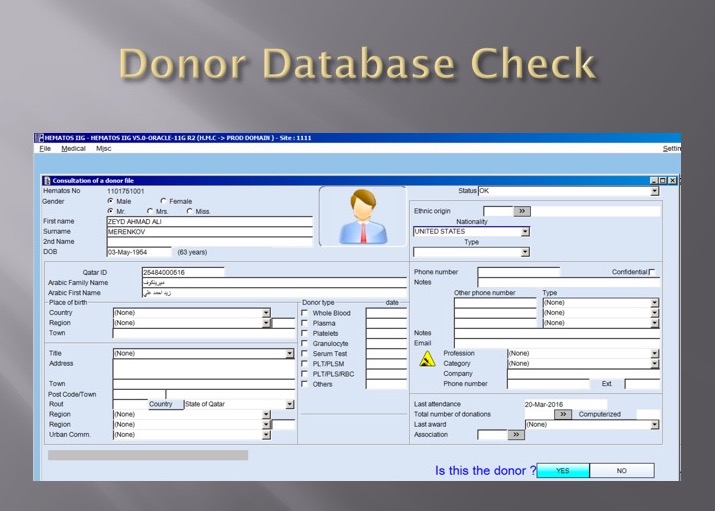
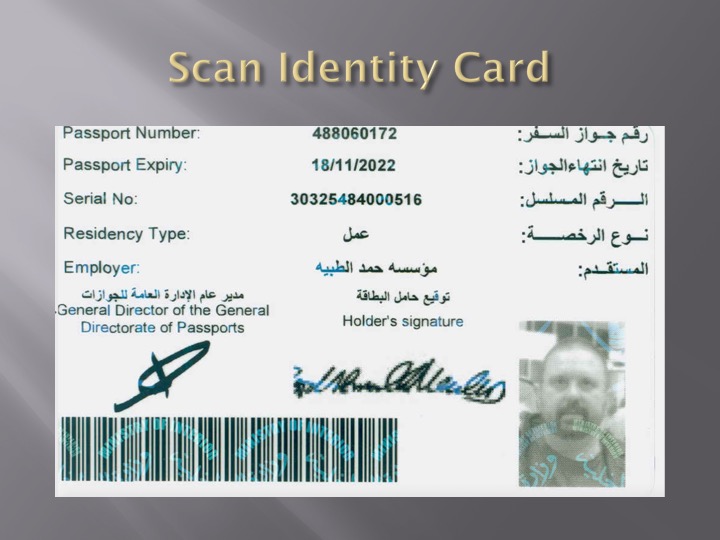
Medinfo had an elegant solution to the registration process.  It read the local identity card issued by the Ministry of Interior and accessed (read-only) the demographic data on that donor.  Just by reading the bar code one received both English and Arabic name fields:

This would generate the demographic fields in the registration:
The blood bank software would check the national donor deferral database and list any deferrals/contraindications to donation and the next eligibility date.  It would also list what type of donations were permitted (e.g. for females, only RBCs could be collected and processed:  if a whole blood unit was collected, then the platelets and plasma would NOT be permitted to be processed and were discarded.)

Medinfo used a unique key field, the Medinfo Hematos Donor ID for the database.  This was not the same as the national ID card.  All records were indexed against this number.

Donor Deferral Database:

Medinfo imported donor data from a previous system and added this to its own database.  Thus, there was only one database to check.  The database listed all previous donations:  dates, type, status (complete, aborted).  Any contraindications would be prominently shown in RED.

Donor Consent and Assignment of Donor Unit (ISBT Specimen) Number:

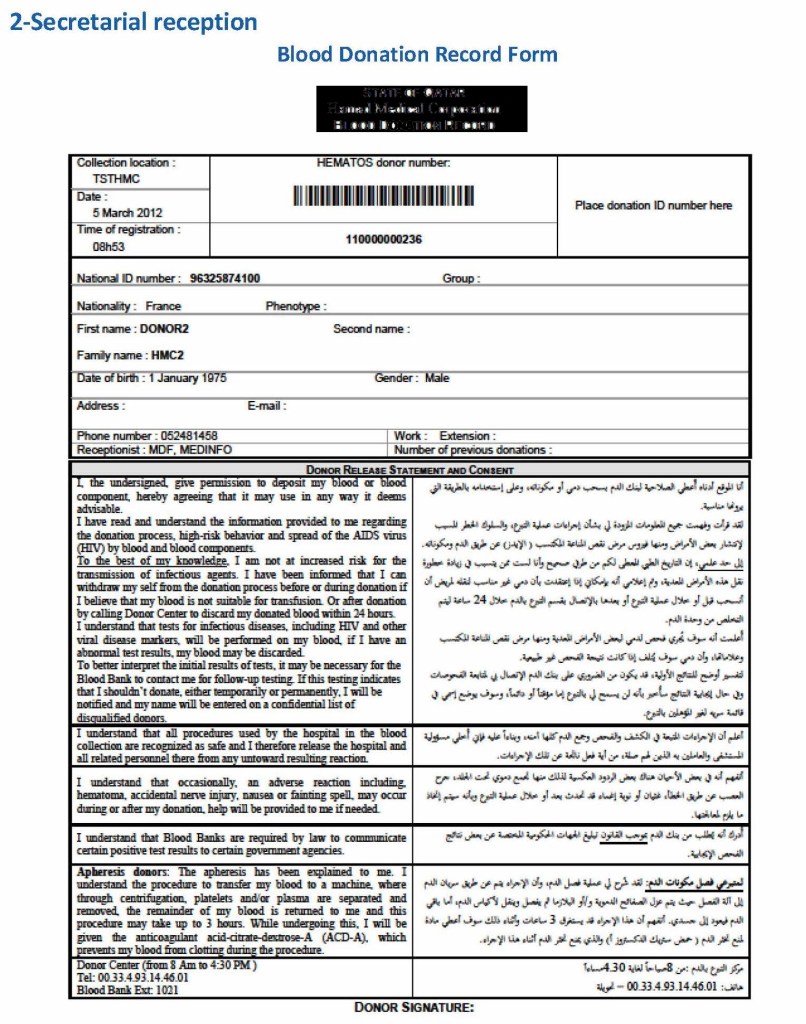
If there were no contraindications, Medinfo generated a donor consent in English and Arabic and the unique donor unit number for the current encounter:

Registration Parameters:

Medinfo enforced registration according to the format of the identity card.  The donor ID format was built into Medinfo.  If the entry deviated from this, it was rejected and registration could not continue:
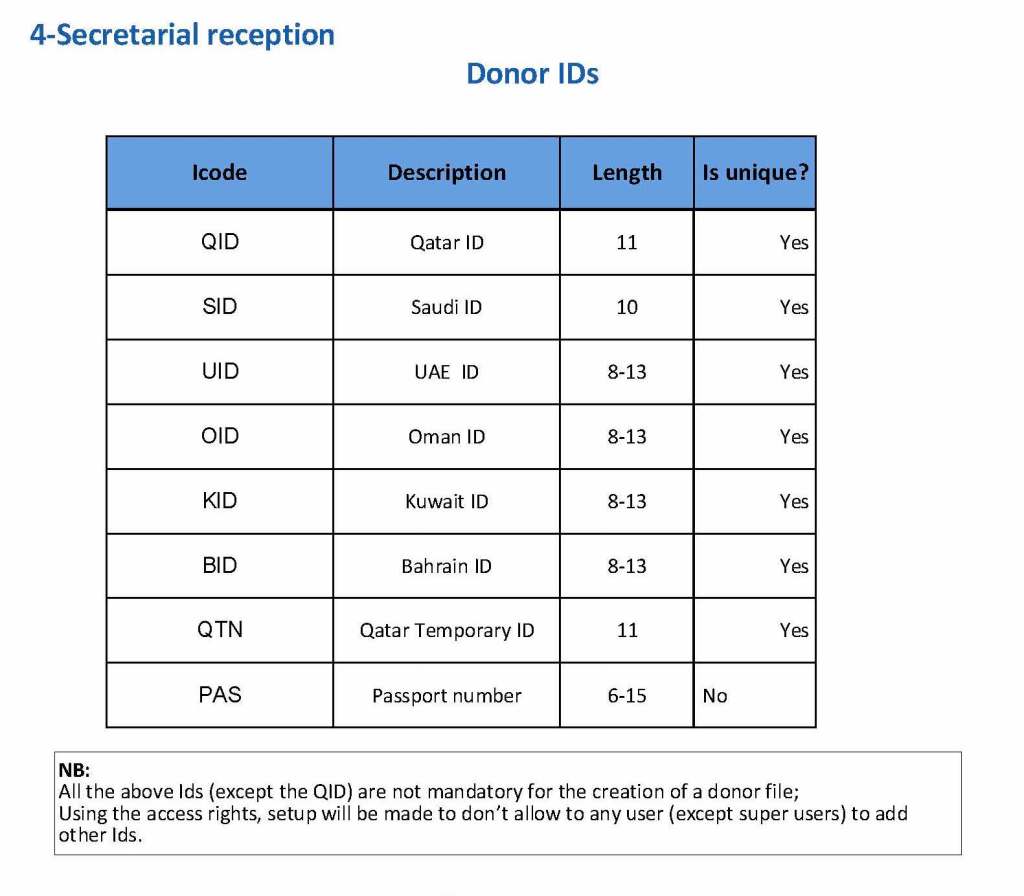
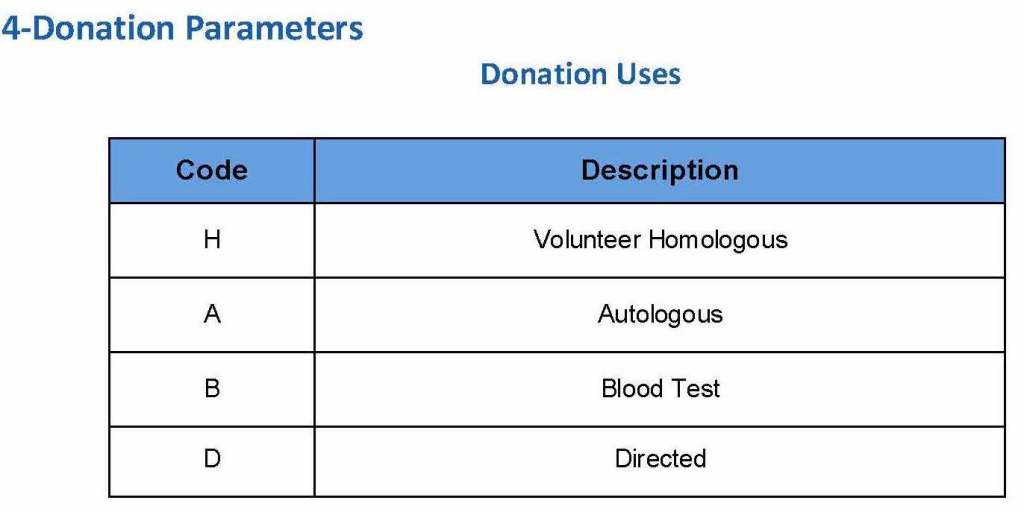
The registration type would be selected (volunteer, autologous, directed, or paid).  In Qatar, paid donations were not permitted:
Next, the donation type had to be selected:
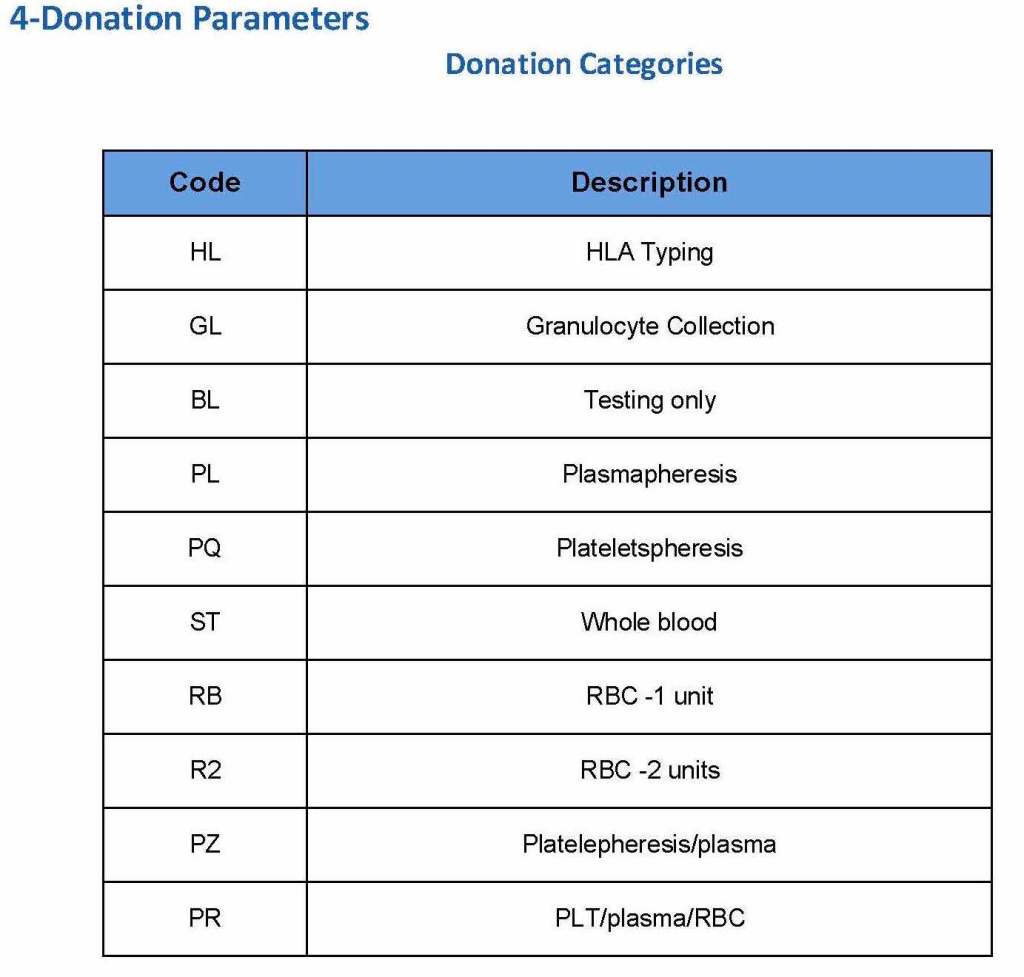
At the time of registration, the type of collection bag (or kit if using Reveos) was automatically set in Medinfo.  I will consider this further in the next post of this series to determine eligibility based on the previous donation interval.

At each donation site, the allowable types of donations and kits could be set.  Based on the donation parameters above, staff could not select the wrong type of bag/kit (e.g. an apheresis kit for a mobile donation).

To Be Continued:
Building Processes for the Blood Donor Center: Donor Collection and Screening Current and Future States

This is a first is a series of detailed posts of how I collaborated with Medinfo (Nice, France) to build customized donor software for both Saudi National Guard Health Services and Hamad Medical Corporation Doha.

In particular, we were using a non-turnkey software which could be built to order.  If we didn’t know what we were currently doing, how could we build something better?

At both sites, we had good manual systems in effect and prepared detailed mapping of the current state.  We reviewed our variance reports to see where we needed to bolster the system and improve the critical control points (page 2).

We studied the software options and prepared a draft Medinfo future state (page 3), from which we started to build the system.  We did this in small stages so we could test it and adjust our settings as needed—without being charged extra (unlike a general laboratory software I had been working with at the same time).

To do this, I engaged early a team of my most computer-literate staff to work as Super Users.  In the Donor Center, this consisted of nurses and technologists.

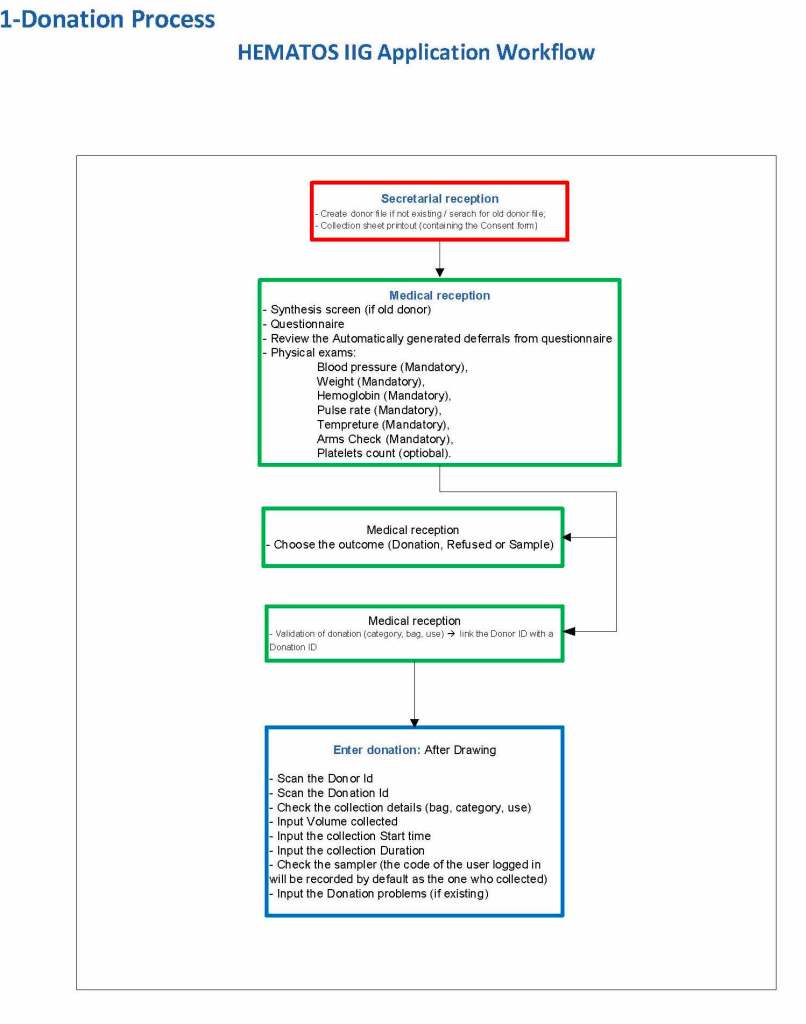
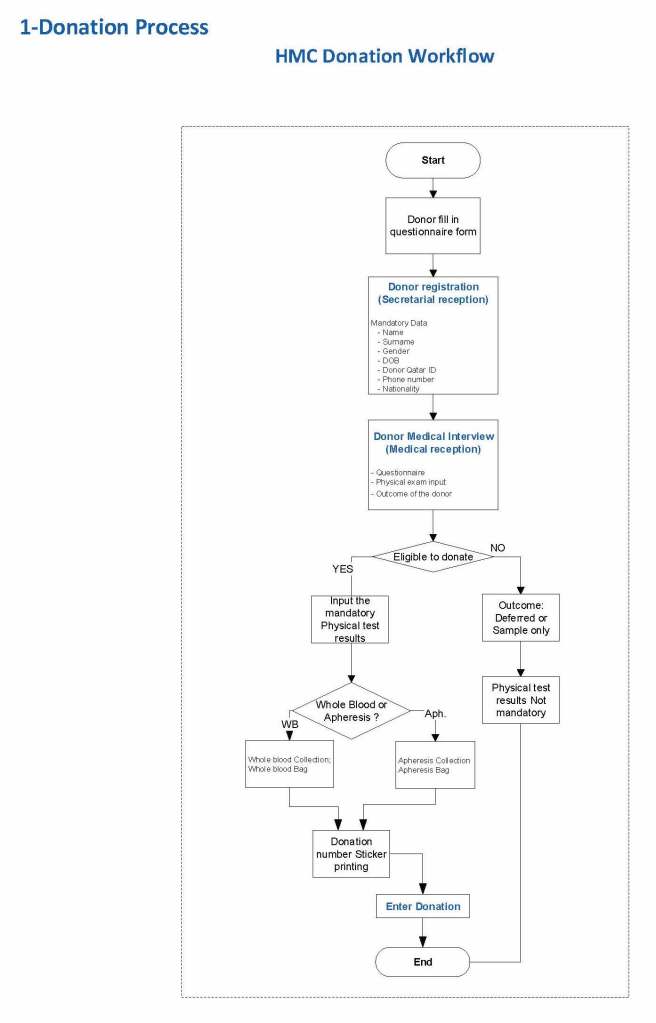
We then prepared a Medinfo flow chart overview from this:

To Be Continued:

Process: Donor Reactions

5.6.1 PROCESS:  Donor Reactions

Process:

  1. Donor is continuously observed in the collection and post-donation areas by collection staff.
  2. Staff respond promptly to any adverse effect.
  3. Staff contact transfusion physician immediately if they cannot treat the reaction.
  4. Donor is referred promptly to emergency service if the transfusion physician cannot handle the situation or is not on premises.
  5. All reactions are documented in the adverse effects log and Hematos IIG.

References:

  1. HMC 1001 Setting Specification, Version 1.5, Hematos IIG, Medinfo
  2. Standards for Blood Banks and Transfusion Services, Current Edition, AABB, Bethesda, Maryland, USA

Policy: Donor Reactions

Document Enumeration:  5.6

Policy:

  1. All donors must be continuously observed throughout and after the collection process.
  2. Donors showing any signs of an adverse reaction must be treated promptly.
  3. All collection staff should be trained and deemed competent to handle donor reactions.
  4. All adverse effects should be recorded in the appropriate log AND the Hematos IIG system.
  5. All policies, processes, and procedures must comply with Qatari, HMC, and applicable accreditation standards (i.e. AABB, CAP, and JCI).

References:

  1. HMC 1001 Setting Specification, Version 1.5, Hematos IIG, Medinfo
  2. Standards for Blood Banks and Transfusion Services, Current Edition, AABB, Bethesda, Maryland, USA

Process: Donor Collection

Process:  Donor Collection

Zeyd Merenkov, MD, FCAP, FASCP

Independent Consultant in Transfusion Medicine

5.4.1 PROCESS DONOR COLLECTION:

Process:

  1. Donors must pass and complete all previous processes in the donor workflow (registration, questionnaire, and physical examination) before the collection process begins.
  2. The donor is positively identified by a designated picture ID and Hematos donor consent form with specimen/encounter number and barcode.
  3. Donor staff checks and prepares a suitable vein
  4. Donor staff collects/labels specimens and the whole blood or apheresis components AT THE DONOR’S BEDSIDE.
  5. Donor reactions are assessed and treated as they occur.
  6. Donors are observed in a post-donation area and given post-donation instructions before discharge.
  7. All processes are documented in Hematos IIG.
  8. Donor units and specimens are sent to component processing and donor marker testing.
  9. The collection workstation and equipment are cleaned before starting a new donor collection.

References:

  1. HMC 1001 Setting Specification, Version 1.5, Hematos IIG, Medinfo
  2. Standards for Blood Banks and Transfusion Services, Current Edition, AABB, Bethesda, Maryland, USA

Policy: Donor Collection

5.4 POLICY: DONOR COLLECTION

Policy:

  1. All donors will be positively identified with a picture ID and by their Hematos identifiers (donor ID and session registration/specimen number).
  2. All previous processes (registration, donor deferral database check, questionnaire, and physical examination) must pass.
  3. The donor’s arm veins will be inspected for a suitable donation site and prepared by a suitable aseptic technique.
  4. Whole Blood:
    1. Only whole blood units collected within the specified time interval may be used for component processing.
  5. Apheresis:
    1. Apheresis units will be collected at frequencies to keep the total RBC loss below 200 in any 8-week period.
    2. Only apheresis units collected within the specified time interval may be used for component processing.
  6. Donors will be treated for adverse reactions as needed.
  7. All specimens and donor units will be labeled at the donor’s bedside before starting a new donor collection.
  8. Donors will be monitored post-donation for a reasonable interval before discharge.
  9. All processes will be documented in the Hematos blood bank computer system.
  10. All equipment and supplies will be used according to manufacturer’s instructions.
  11. The collection workstation and equipment will be cleaned before starting the next donor.
  12. All policies, processes, and procedures must comply with Qatari, HMC, and applicable accreditation standards (i.e. AABB, CAP, and JCI).

References:

  1. HMC 1001 Setting Specification, Version 1.5, Hematos IIG, Medinfo
  2. Standards for Blood Banks and Transfusion Services, Current Edition, AABB, Bethesda, Maryland, USA, October 2013

Process: Donor Physical Examination

This is a sample process document for donor physical examination. Compare it to the previous post Policy: Donor Physical Examination.

5.3.1 PROCESS DONOR PHYSICAL EXAMINATION:

Process:

  1. The donor is positively identified by a designated picture ID and Hematos donor consent form with specimen/encounter number and barcode.
  2. Donor staff measures vital signs of donor and enters results into Hematos IIG.
  3. Donor staff inspects donor arms for suitable veins and checks for concurrent skin diseases and/or scarring.
  4. Medinfo Hematos IIG determines donor eligibility to collect components.

References:

  1. HMC 1001 Setting Specification, Version 1.5, Hematos IIG, Medinfo
  2. Standards for Blood Banks and Transfusion Services, Current Edition, AABB, Bethesda, Maryland, USA

Policy: Donor Physical Examination

This is another example of a short concise policy statement. The process example will follow:

5.3 POLICY: DONOR PHYSICAL EXAM

Policy:

  1. All donors will be positively identified with a picture ID and by their Hematos identifiers (donor ID and session registration/specimen number).
  2. The donor’s vital signs (BP, pulse, temperature, respiratory rate) will be measured by designated Donor Center staff.
  3. The donor’s arm veins will be inspected for a suitable donation site and evidence of scarring.
  4. Donor eligibility for actual collection will be determined by the Hematos IIG algorithms based on this data.
  5. All policies, processes, and procedures must comply with Qatari, HMC, and applicable accreditation standards (i.e. AABB, CAP, and JCI).

References:

  1. HMC 1001 Setting Specification, Version 1.5, Hematos IIG, Medinfo
  2. Standards for Blood Banks and Transfusion Services, Current Edition, AABB, Bethesda, Maryland, USA

Process: Donor Medical Questionnaire

This is one of a series of posts comparing policies and processes in the blood bank.

PROCESS:  5.2.1 DONOR QUESTIONNAIRE

Process:

  1. The donor is positively identified by a designated picture ID and Medinfo Hematos donor consent form with specimen/encounter number and barcode.
  2. Donor is taken to a private area for the interview.
  3. Donor is asked ALL questions by Donor Center staff using the Hematos IIG questionnaire.
  4. Hematos IIG determines if any contraindications apply.
  5. Questionnaire will be referred to transfusion medicine physician for any questions requiring physician review.
  6. Donors without contraindication are sent for donor physical examination.

References:

  1. HMC 1001 Setting Specification, Version 1.5, Hematos IIG, Medinfo
  2. Standards for Blood Banks and Transfusion Services, Current Edition, AABB, Bethesda, Maryland, USA

Policy: Donor Medical Questionnaire

This is one of a series of posts on blood bank operations, comparing the process and policy documents.

5.2 POLICY:  DONOR MEDICAL QUESTIONNAIRE

Policy:

  1. All policies, processes, and procedures must comply with Qatari, HMC, and applicable accreditation standards (i.e. AABB, CAP, and JCI).
  2. All donors will be positively identified with a picture ID and by their Medinfo Hematos identifiers (donor ID and session registration/specimen number).
  3. Donors will be assessed confidentially in a private area.
  4. Donors will be asked questions based on the latest Uniform Donor Questionnaire with additional localization questions for Qatar using Medinfo Hematos IIG software.
  5. Donor must understand either English or Arabic.
    1. Otherwise, they cannot be accepted for donation.
  6. Donors passing the donor questionnaire will be processed for the donor physical examination.

References:

  1. HMC 1001 Setting Specification, Version 1.5, Hematos IIG, Medinfo
  2. Standards for Blood Banks and Transfusion Services, Latest Edition, AABB, Bethesda, Maryland, USA