Process: Donor Medical Questionnaire

This is one of a series of posts comparing policies and processes in the blood bank.

PROCESS:  5.2.1 DONOR QUESTIONNAIRE

Process:

  1. The donor is positively identified by a designated picture ID and Medinfo Hematos donor consent form with specimen/encounter number and barcode.
  2. Donor is taken to a private area for the interview.
  3. Donor is asked ALL questions by Donor Center staff using the Hematos IIG questionnaire.
  4. Hematos IIG determines if any contraindications apply.
  5. Questionnaire will be referred to transfusion medicine physician for any questions requiring physician review.
  6. Donors without contraindication are sent for donor physical examination.

References:

  1. HMC 1001 Setting Specification, Version 1.5, Hematos IIG, Medinfo
  2. Standards for Blood Banks and Transfusion Services, Current Edition, AABB, Bethesda, Maryland, USA

Policy: Donor Medical Questionnaire

This is one of a series of posts on blood bank operations, comparing the process and policy documents.

5.2 POLICY:  DONOR MEDICAL QUESTIONNAIRE

Policy:

  1. All policies, processes, and procedures must comply with Qatari, HMC, and applicable accreditation standards (i.e. AABB, CAP, and JCI).
  2. All donors will be positively identified with a picture ID and by their Medinfo Hematos identifiers (donor ID and session registration/specimen number).
  3. Donors will be assessed confidentially in a private area.
  4. Donors will be asked questions based on the latest Uniform Donor Questionnaire with additional localization questions for Qatar using Medinfo Hematos IIG software.
  5. Donor must understand either English or Arabic.
    1. Otherwise, they cannot be accepted for donation.
  6. Donors passing the donor questionnaire will be processed for the donor physical examination.

References:

  1. HMC 1001 Setting Specification, Version 1.5, Hematos IIG, Medinfo
  2. Standards for Blood Banks and Transfusion Services, Latest Edition, AABB, Bethesda, Maryland, USA

Processes and Software Building 5: Processes

This is revision of a previous post.

Building Processes:

This post is mainly on building processes for a non-turnkey system such as the Medinfo Hematos IIG software that I have worked with in several countries, but there will be a few words about turnkey systems for general laboratories.

This has been a collaborative effort between the software vendor’s engineers, my Super Users, and myself.  This pluralistic approach has been most productive.

A turnkey system has pretty much already defined most of the basic processes—those have been specifically approved by a regulatory agency such as US FDA.  There is little customization except formatting screen and reports.  Instrument interfaces are also mainly predefined.  This requires much less thought and planning than a custom-built system designed on the sites actual workflows, but it can be an exercise of putting a round peg in a square hole.  You don’t always get what you want.

In the locations where I collaborated in setting up the Medinfo Hematos IIG program, we did not follow US FDA but mainly the Council of Europe CE standards since this was much more customizable.  Additionally, we could modify and add additional criteria specific to our country and region (e.g. rules for donor qualification for local pathogens).  This has always been my preferred approach.

Start with a frame of reference (CE) and then try to optimize it for our local needs. 

I recommend the Council of Europe CE since it is more flexible and extensible.  Those subject to the US FDA has many fewer approved options in the preparation of blood components (e.g. prohibiting the use of pooled buffy coat platelets, automated blood component production such as Reveos, and use of world-class pathogen-inactivation technologies such as Mirasol.)

If you invested the time to make a detailed workflow across all current processes and tests, much of this can be readily translated into the software processes, but first you must study the flows and determine where you can optimize them.  This requires that you study the options in the new software to see what you can use best.

I always liked Occam’s Razor, i.e. “ntia non sunt multiplicanda praeter necessitatem,”—the simpler the better as long as it meets your needs.  If the manual processes are working well and can be translated into the new system, do so.  If they need changes for optimization, then do so only if necessary.

Most of my career has been spent overseas with staff from many different countries and backgrounds, most of whom were not native in English.  The wording of the processes is very important.  Think of the additional obstacle of working with a complicated software in your non-mother tongue!  Also consider the differences between American English, British English, and international English.  I always made the Super Users read my proposed specifications and then asked them to repeat what I wrote/said.

There were many surprises discovered.  I think of the Aesop’s fable about the mother who gave birth to an ugly baby looking like a monkey.  Still, to the mother her baby was the most beautiful baby and she entered him into a beauty contest.  In other words, to the mother her child is perfect!

It is most important to use the manufacturer’s recommendations to build tests and for the special automated processing and pathogen-inactivation processes.  For example, we had multiple ABO and D typing tests—they did not necessarily agree on what were acceptable results for automated release of results.  The same is true for many other tests.

Example:  One method for Rh(D) typing stated that only results in {0, 2+, 3+, 4+} were acceptable—all other results required manual review and/or additional testing.  Another only accepted results in {0,3,4}.  Thus we had to build separate D typing processes for each methodology.

Another consideration is whether to offer all the processes globally or restricted to one site.  I favor allowing access to all methodologies at all sites—in case of a disaster where tests had to performed at another site.   This means that if you send an order over an interface from the hospital system to the blood bank system, that at the receiving (blood bank) end, you can choose which methodology to use, i.e. it is not a one-to-one mapping but rather a one to many mapping.

If we changed equipment at one site to that used at another site, we didn’t have to modify our software to accommodate this.  Even if you didn’t have the equipment or reagents at one site, you could always build it into the system and not activate the settings until needed.

Finally, the issue of middleware.  Many instruments offer this, but one faces the problem about support and regression errors when you either update the middleware software or the blood bank computer software.  Medinfo itself can serve as the middleware so there is less chance of errors when updating the software.  In fact, I never have used any middleware when using Medinfo.

Instrument interfaces will be a future topic.

Process Donor Medical Questionnaire

5.2.1 PROCESS:  DONOR QUESTIONNAIRE

Process:

  1. Donor passes donor deferral database screening.
  2. Donor is taken to a private area for the interview.
  3. The donor is positively identified by a designated picture ID and Hematos donor consent form with specimen/encounter number and barcode.
  4. Donor is asked ALL questions by trained Donor Center staff using the Medinfo Hematos IIG questionnaire.
  5. Hematos IIG determines if any contraindications apply.
  6. Donor responses are reviewed by the transfusion medicine physician as indicated in the questionnaire.
  7. Donors without contraindication are sent for donor physical examination.
  8. Donors passing transfusion medicine physician review are sent for donor physicial examination.

References:

  1. HMC 1001 Setting Specification, Version 1.5, Hematos IIG, Medinfo, Nice, France
  2. Standards for Blood Banks and Transfusion Services, Current Edition, AABB, Bethesda, Maryland, USA

Policy Donor Medical Questionnaire

Policy Donor Medical Questionnaire

5.2 POLICY:  DONOR MEDICAL QUESTIONNAIRE

Policy:

  1. All policies, processes, and procedures must comply with local, national, and applicable accreditation standards (i.e. AABB, CAP, and JCI).
  2. All donors will be positively identified with a picture ID and by their Medinfo Hematos software identifiers (donor ID and session registration/specimen number).
  3. Donors will be assessed confidentially in a private area.
  4. Donors will be asked questions based on the latest Uniform Donor Questionnaire with additional localization questions for Qatar.
  5. Donor must understand either English or Arabic.
    1. Otherwise, they cannot be accepted for donation.
  6. Donors passing the donor questionnaire will be processed for the donor physical examination.

References:

  1. HMC 1001 Setting Specifications, Version 1.5, Hematos IIG, Medinfo, Nice France
  2. Standards for Blood Banks and Transfusion Services, Current Edition, AABB, Bethesda, Maryland, USA

Processes and Software Building 4: Super Users

Super-Users:  Engaging Laboratory Staff in Computer Operations

This is an update of a previous post.

It is critical to engage the technical, medical , and (blood bank) nursing staff in this process,  That is why it is so important to identify a core of computer-literate users to help with the building and testing/validation.

I don’t mean finding staff who can already program or code.  Rather, I mean staff that are astute with knowing their work processes and who had good skills with Microsoft Office and Windows or equivalent.  I did not expect them to understand database structure or use structured query language.  They were chosen for their ability to learn quickly and their meticulousness.

For our blood bank system, I chose computer-literate technical staff to be involved in the build from the very beginning.  They learned how to test each module and to some degree support it.  These became my Super-Users and to this day support the system for many tasks.  These staff served as the system administrators and worked directly with me as the Division Head for Laboratory Information Systems.  They were not full-time and still had their other clinical/technical duties.  They liaised with the software vendors engineers.

Our blood bank system was NOT a turnkey system.  It was custom designed according to our workflows.  There were NO default settings!!  We had to be remember, ‘Be careful what you ask for, you might get it!’  In some countries, approved systems are turnkey and may allow only few changes to the core structure and thus may not be this optimized for the needed workflow;  often only cosmetic changes are permitted.

When we built our first dedicated blood bank computer system, the company would take a module and completely map out the current processes collaboratively with me.  After this, I analyzed the critical control points and started to map out the improved computer processes that would take over.  After that we would build that those processes in the software and test it.  If it failed, we would correct it and test again…and again if necessary.  Fortunately, the blood bank vendor did not charge us when we made mistakes.

Sadly, another vendor (non-blood bank), only gave limited opportunities to make settings.  If wrong, there might be additional charges to make corrections.  This other vendor really pushed the client to accept the default settings regardless whether or not they actually fit.  End-users were selected to make and approve the settings, but they were only minimally trained on how to make the settings.  It was a journey of the end-users being led to the slaughter—and being blamed for their settings when they accepted the vendor’s recommendations—they usually selected the defaults.  There wasn’t enough time for trial and error and correction.

The blood bank system Super Users were an important part of our process.  They were an integral part of the implement team and could propose workflows, changes, etc.—subject to my approval.  They learned the system from the start and developed invaluable skills that allowed them to support the system after the build.  Also, they could serve to validate the system according to the protocols I prepared.  Moreover, I took responsibilities for their activities and they were not left out to hang.

Every hospital blood bank location and the blood donor center had Super-Users.  These included:

  1. Blood Donor Center:
    1. Administrative Clerk for donor registration, consent, ISBT specimen labels, creation of new donors and patients for validation purposes
    1. Apheresis/Donor Nurse for donor questionnaire, donor physical examination, and donor collection
    1. Medical technologist for donor marker testing
    1. Medical technologists for blood component production including Reveos, Mirasol, platelet additive solution, pooling, and leukodepletion
    1. Medical technologist for donor immunohematology testing
    1. Medical technologist for inter-depot transfer of blood components
  2. Hospital Blood Banks and Transfusion Centers:
    1. At least one technologist at each site for inter-depot transfer, component medication (washing, irradiating, aliquoting, reconstituted whole blood), immunohematology testing, component allocation and release

The cost of using these staff?  They were paid overtime and were relieved of other duties when working on Super User duties.  This was much cheaper than hiring outside consultants who may or may not know our system well enough to perform these tasks.

By having a Super User at each site, I in effect had an immediate local contact person for troubleshooting problems who could work with the technical/nursing staff.  We did not rely on the corporate IT department for support and worked directly with the software vendor.  Response time was excellent this way.

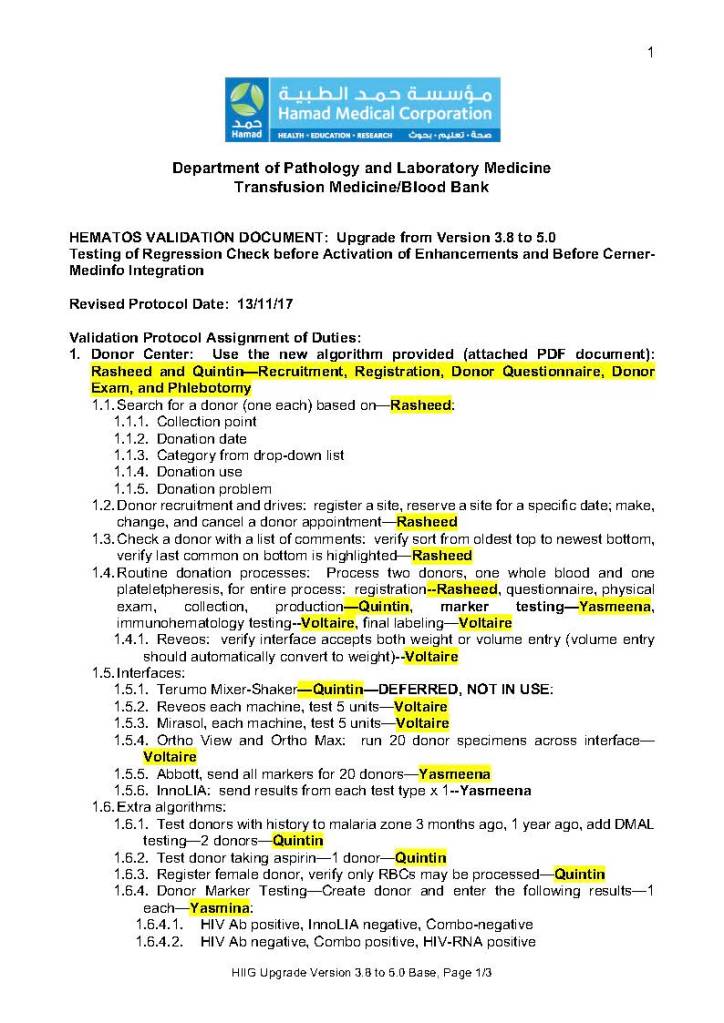
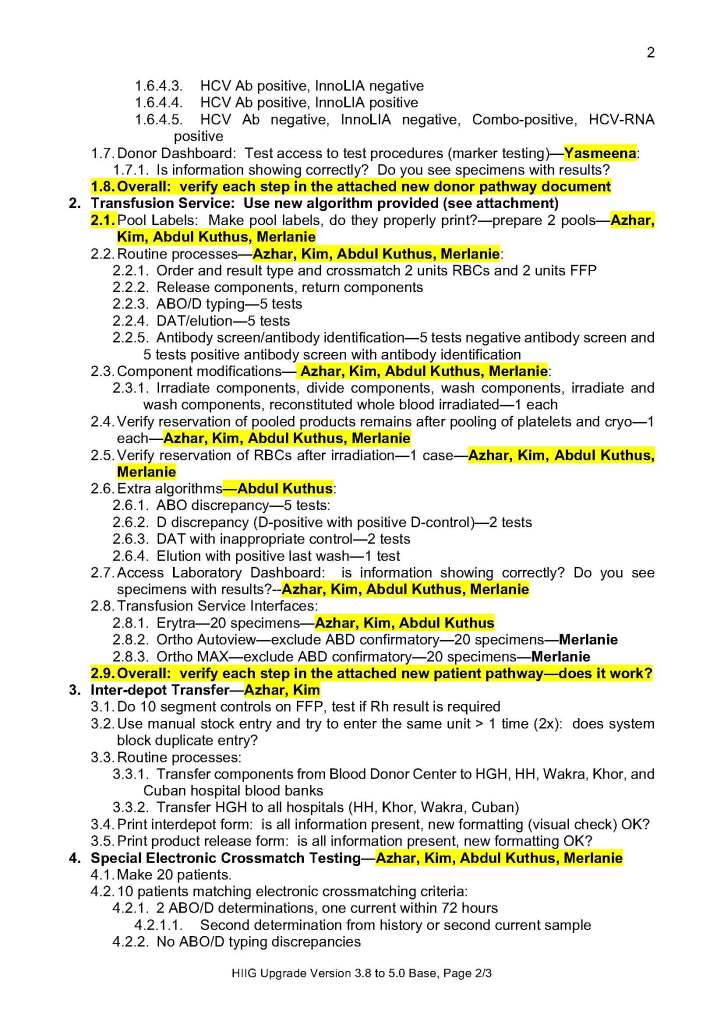
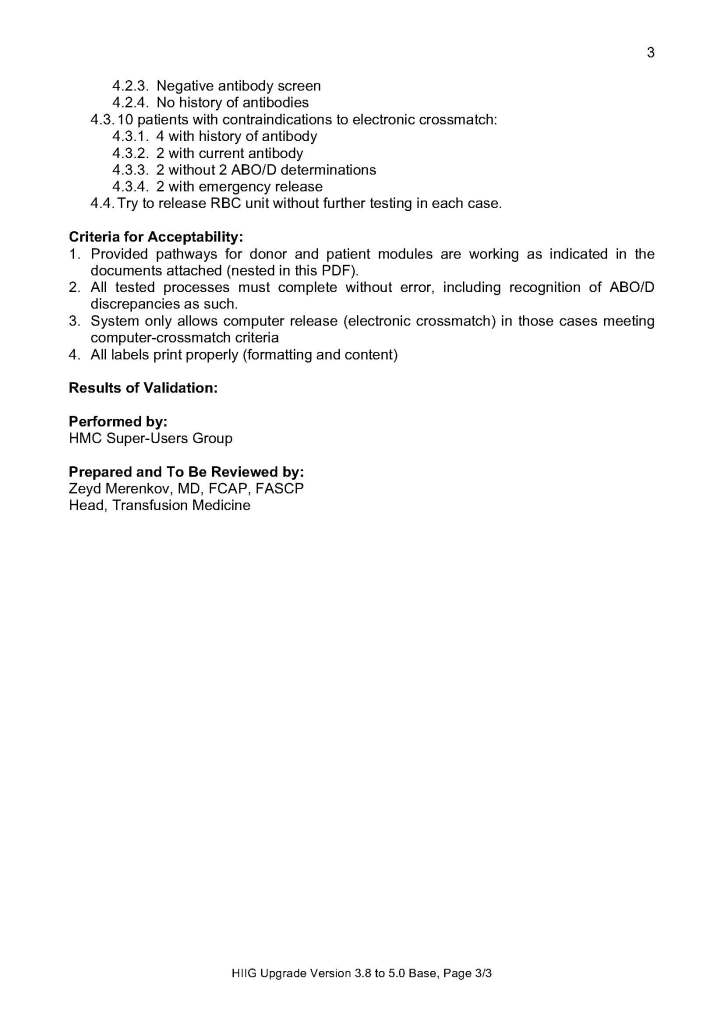
The following document is a sample document of the assigned Super User duties during a validation.

Donor Registration Process

5.1.1 PROCESS:  Donor Registration

Process:

  1. Donor presents acceptable picture ID with a unique alphanumeric identifier.
  2. Donors without Qatari ID must be approved by the Coordinator, Donor Recruitment, a donor center physician, or Head, Transfusion Medicine.
  3. Donor ID is scanned into Hematos IIG.
  4. Donor is assigned Hematos IIG Donor ID if not already in the system.
    1. Donors with previous ID will be given a Hematos ID
    1. All donors are registered only using the Hematos ID
  5. Medinfo Hematos IIG software checks donor deferral database
  6. Donor is accepted for medical questionnaire only if he has no contraindications.

References:

  1. HMC 1001 Setting Specification, Version 1.5, Hematos IIG, Medinfo
  2. Standards for Blood Banks and Transfusion Services, Current Edition, AABB, Bethesda, Maryland, USA

Donor Recruitment and Campaigns Process

5.0.1 PROCESS:  Donor Recruitment and Campaigns

Process:

  1. Company or organization contacts Coordinator, Donor Recruitment to schedule donation OR:
  2. Coordinator, Donor Recruitment contacts companies or organizations to schedule donations.
  3. The Coordinator, Donor Affairs, is responsible for all recruitment activities:
    1. Serves as initial contact point for organizations and companies desiring to have a donor campaign.
    2. Schedules donor campaigns in advance, arranges for emergency collections as needed.
    3. Assigns donor recruitment staff to visit and inspect prospective donation sites.
    4. Arranges logistics of resources for donor campaigns (personnel, equipment, vehicles, supplies)
    5. Coordinates with HMC Public Relations and the media
    6. Prepares news media to encourage donation
  4. All contacts and schedules are entered into Hematos IIG.
  5. Donor recruitment materials are left at donation site to encourage donation and provide means for donors to schedule their donations during the campaign.
  6. Donor recruitment staff prepare the donation site at time of donation.
  7. Donation processes are conducted in accordance to policies, processes, and procedures for registration, donor questionnaire, physical examination, and collection.
  8. Hematos IIG is accessed by either wireless connection (VPN) or off-line data dump to check donor against donor deferral database.
  9. Blood is stored at suitable temperatures at collection site and in transit back to Donor Center.
  10. Campaign blood components and specimens are received in Donor Center and transferred for further processing and testing.

References:

  1. HMC 1001 Setting Specification, Version 1.5, Hematos IIG, Medinfo
  2. Standards for Blood Banks and Transfusion Services, Current Edition, AABB, Bethesda, Maryland, USA

Donor Recruitment and Campaigns Policy

5.0 Donor Recruitment and Campaigns Policy

Policy:

  1. All policies, processes, and procedures must comply with local, national, and applicable international accreditation standards (i.e. AABB, CAP, ISO, and JCI).
  2. All recruitment information must be entered into Hematos IIG.
  3. The Coordinator, Donor Affairs, is responsible for all recruitment activities.
  4. Donor recruitment staff will visit scheduled donation sites in advance and assess their suitability and prepare them for use before the start of each campaign.
  5. Donor recruitment materials and announcements will be left at each location during the inspection visit.
  6. Collected blood will be stored at room temperature during the collection on-site and transported back to the Donor Center in suitable validated containers to maintain storage at desirable temperature.
  7. The processes and procedures for normal donation, e.g. registration, donor questionnaire, physical examination, and collection apply.

References:

  1. HMC 1001 Setting Specification, Version 1.5, Hematos IIG, Medinfo
  2. Standards for Blood Banks and Transfusion Services, Current Edition, AABB, Bethesda, Maryland, USA

Summary of Accomplishments at Hamad Medical Corporation 2011-2020

2011

Established automated component production using Atreus technology, plasma and platelet pathogen inactivation (Mirasol)—made HMC component production Good Manufacturing System GMP compliant

2011

Qatar is the first to adopt non-PCR-based NAT technology (Grifols/Novartis Tigress) and becomes world reference site for this

2011

Based on the above, Qatar can now completely process all whole blood into blood components (red cells, platelets, and plasma) in as little as 5 hours from collection!

2011-2020:

I established policies and procedures for the hospital blood banks/transfusion services, blood donor center, therapeutic apheresis, and laboratory information systems to bring HMC in compliance with the Council of Europe, international AABB, and other standards.  I customized our own standards for our local needs based on them.

2012-2013

Implemented custom build of the multilingual blood bank computer system (Medinfo) for both patient and donor services, including development of interfaces to all production equipment including Atreus and Mirasol (world’s first) and a direct link to Ministry of the Interior to obtain patient demographics in English and Arabic—Qatar became the world’s first site to combine fully-interfaced, automated component production with pathogen inactivation:  Qatar becomes world reference site for this.

2013-2014

Built, validated, and implemented laboratory build of hospital information system, Cerner Millennium

2015

Replaced and updated Atreus with Reveos automated component production to allow faster throughput and capacity with a full bidirectional interface (world’s first), introduced platelet

additive solution PAS with pathogen inactivation (Mirasol)—Medinfo interfaces updated to Reveos for all equipment:  this doubles the capacity to process whole blood into components using the same physical space

2015-2019

Updated dedicated blood bank software Medinfo Hematos IIG by several versions using Division Head, LIS, and internally trained Super Users—at great cost savings to HMC by not using outside consultants (e.g. Dell Consulting)

2019

Established column absorption technology using Terumo Optia therapeutic apheresis machine for treatment of ABO-incompatible renal transplants:  I validated using the Ortho Vision MAX to perform ABO antibody titers for this system and correlated it with the reference method at Karolinska Institutet in Stockholm (manual gel) to bring rapid throughput and labor savings—Qatar being the first-site in the world to do this.  We saved money by using the same apheresis machine to use this column absorption technology (no need for second machine to use the columns)

2020

Expedited setup (two weeks total) of COVID-19 convalescent plasma production, initially manual and then fully integrated into the Medinfo computer system as a customized module with separate quarantine collection, production, and transfusion service functions

Other:

I was awarded two HMC Star of Excellence Awards:

2013—Liver Transplantation Transfusion Support

2019—ABO-Incompatible Renal Transplantation Support