
Processes and Software Building 35: Donor Malaria Test Screening

Processes and Software Building—Part 35:

Malaria Testing Donor Screening Process

Zeyd Merenkov, MD, FCAP, FASCP

Independent Consultant in Transfusion Medicine and Information Technology

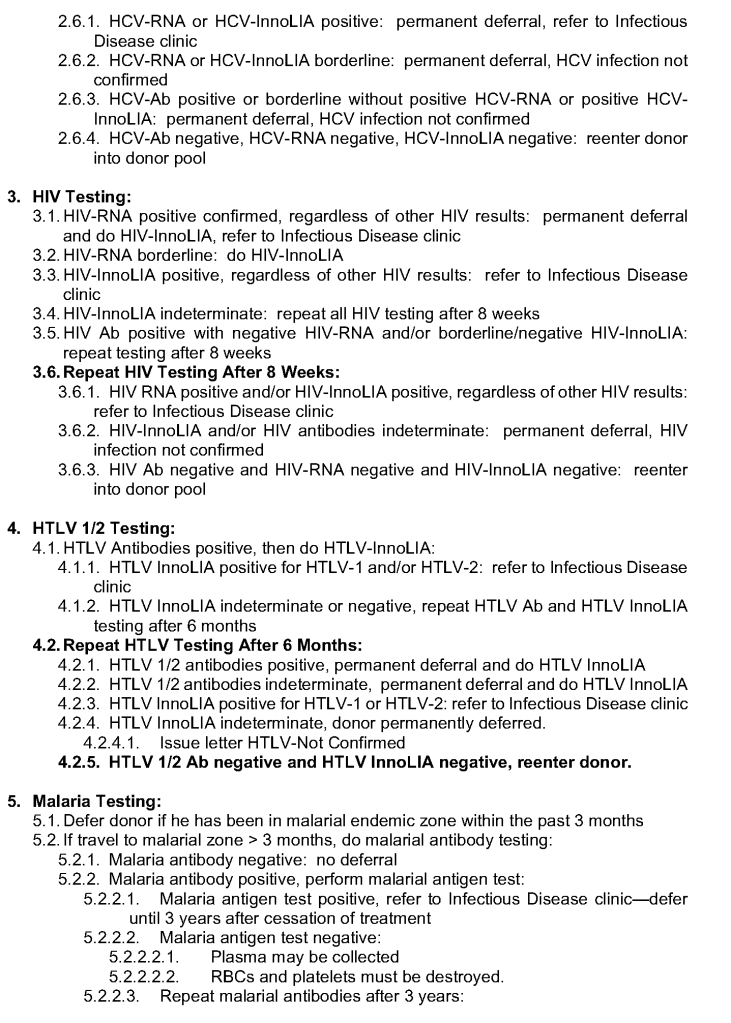
The malaria screening varies considerably by country.  I chose for Qatar to follow a combination of WHO and Australian guidelines as per the attached criteria.  We used a malaria antibody screen and malaria antigen test.  There are many alternate approaches, including using a malaria NAT.  The actual specification was:

  1. Malaria Testing:
    1. Defer donor if he has been in malarial endemic zone within the past 3 months
    2. If travel to malarial zone > 3 months, do malarial antibody testing:
      1. Malaria antibody negative:  no deferral
      2. Malaria antibody positive, perform malarial antigen test:
        1. Malaria antigen test positive, refer to Infectious Disease clinic—defer until 3 years after cessation of treatment
        2. Malaria antigen test negative:
          1. Plasma may be collected
          2. RBCs and platelets must be destroyed.
        3. Repeat malarial antibodies after 3 years:
          1. If malarial antibody test positive, donor must not be used for RBC components but may be used for plasma production
          2. If malarial antibody test negative, reenter donor for all components
    3. Defer donor if he has received malarial treatment (not prophylaxis) for 3 years
      1. After 3 years, perform both malarial antibody and antigen testing:
        1. Defer based on section 5.2

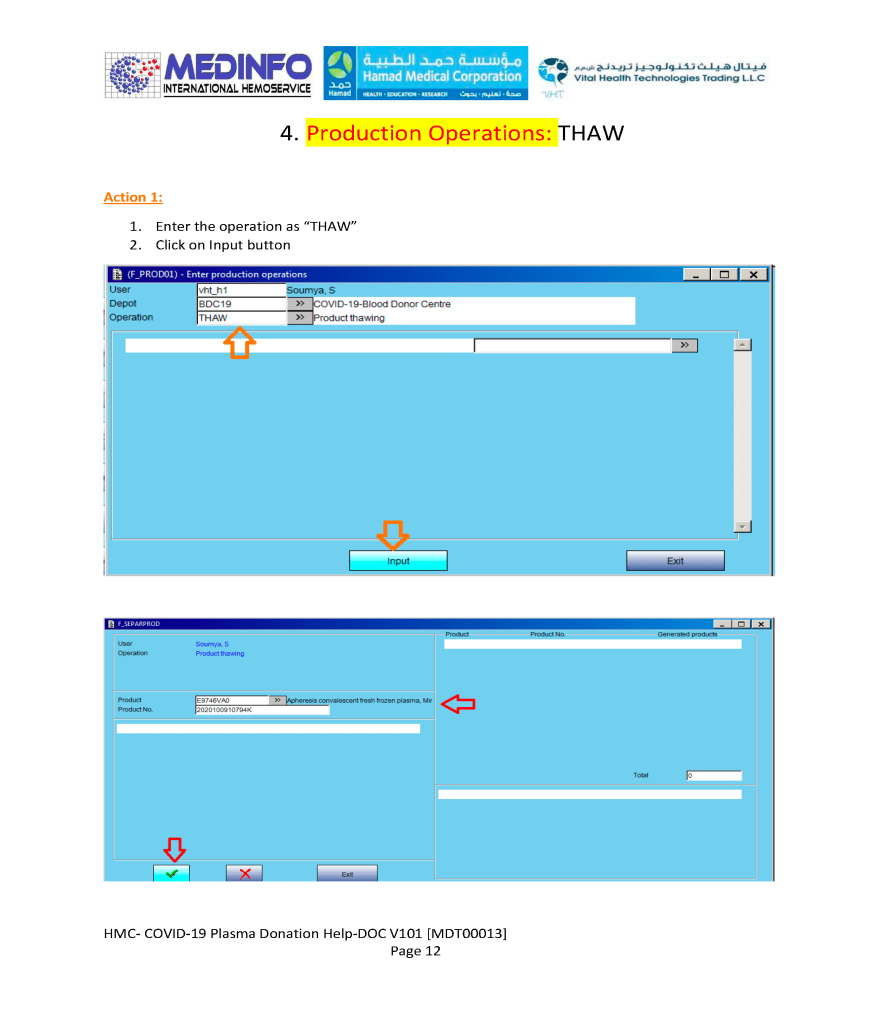
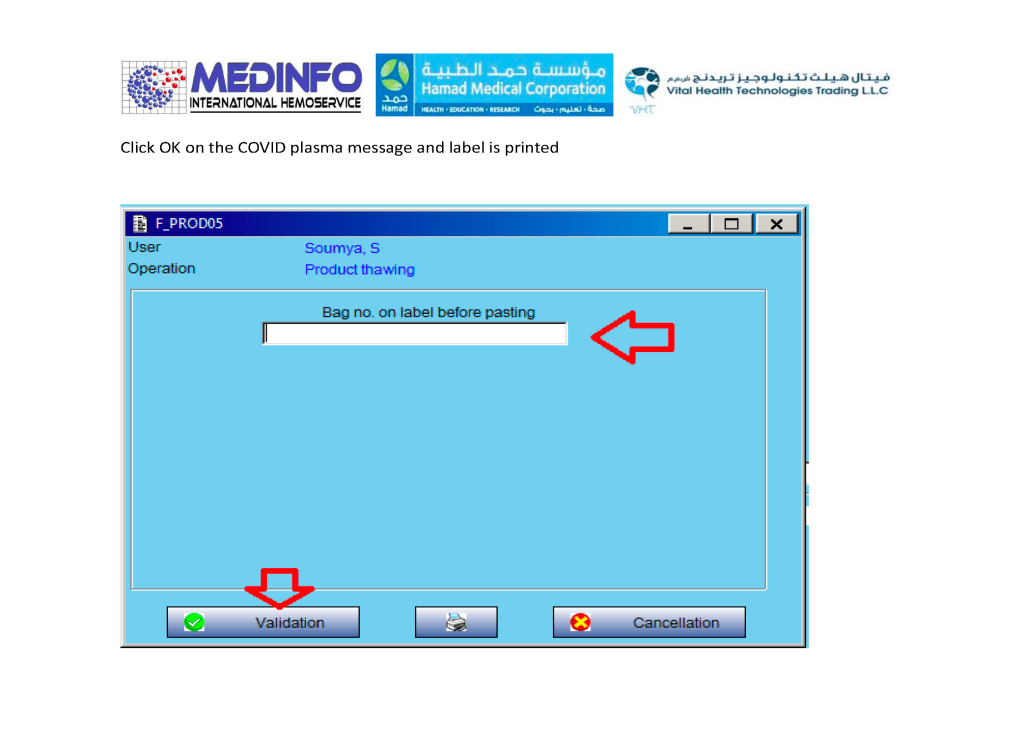
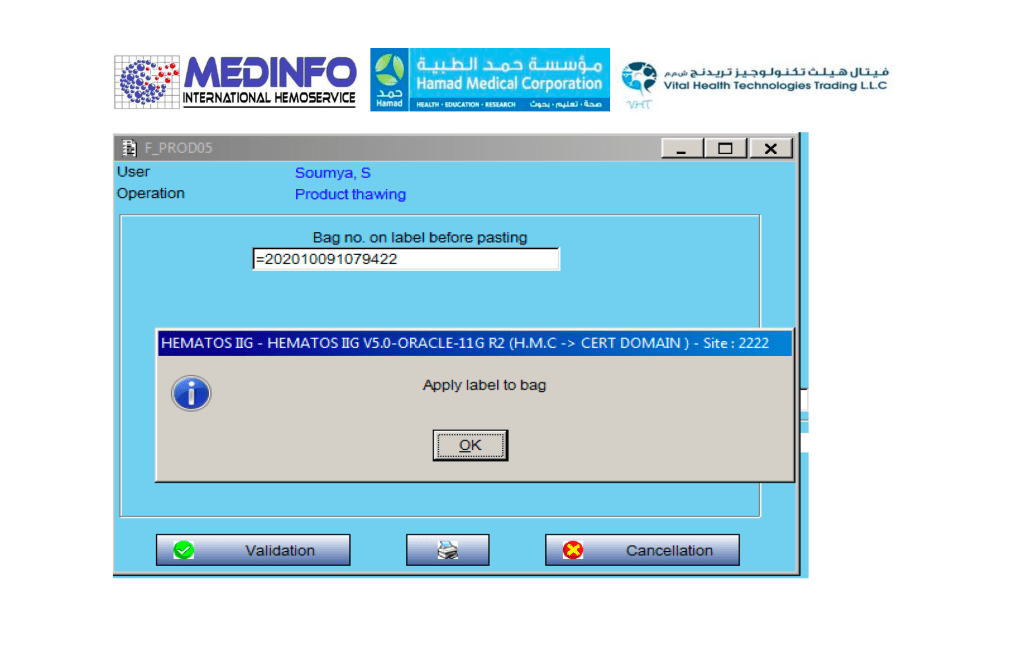
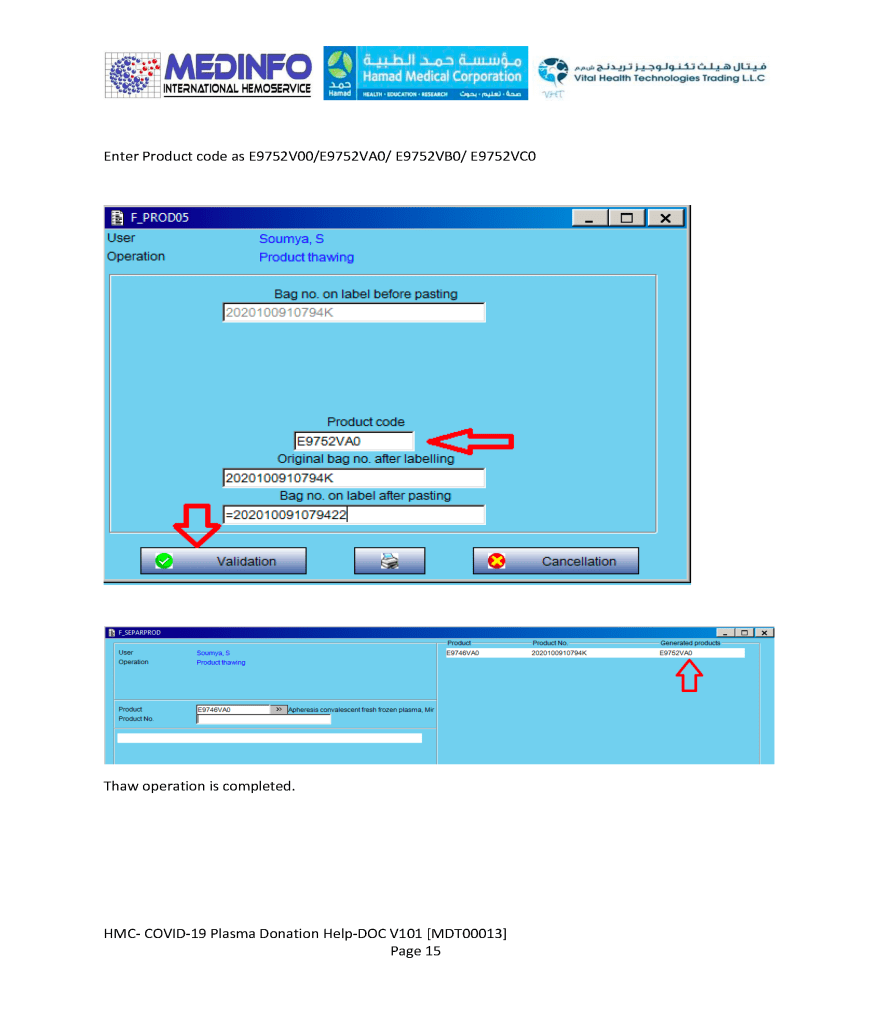
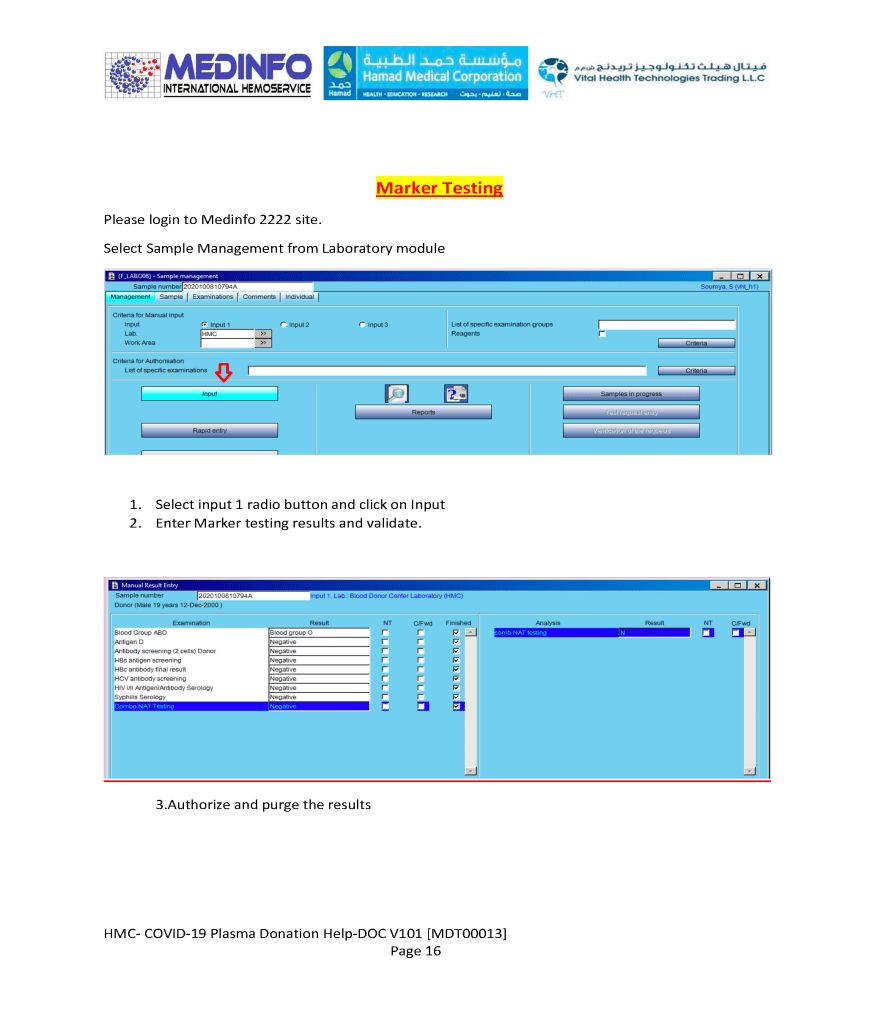
The Medinfo testing algorithm follows:

To Be Continued:

22/8/20

Processes and Software Building 34: Donor Syphilis Testing

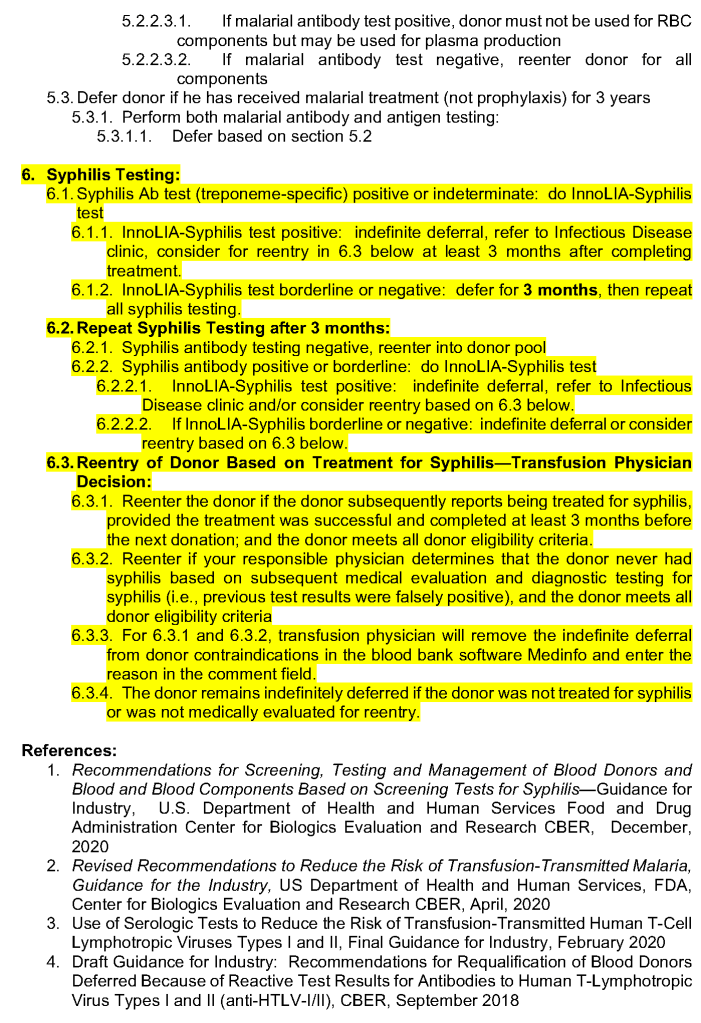
Syphilis testing uses a screening test (we used an EIA methodology to detect cardiolipin) and a confirmatory test a syphilis linear immunoblot assay LIA.

I emphasize that any test methodologies and testing algorithms can be designed in Medinfo.  This is what I selected during the time I was HMC Doha.

My algorithm specification was:

  1. Syphilis Testing:
    1. Syphilis Ab test positive or indeterminate:  do InnoLIA-Syphilis test
      1. InnoLIA-Syphilis test positive:  permanent deferral, refer to Infectious Disease clinic
    2. InnoLIA-Syphilis test borderline or negative:  defer for 1 year, then repeat all syphilis testing.
    3. Repeat Syphilis Testing after 1 Year:
      1. Syphilis antibody testing negative, reenter into donor pool
      2. Syphilis antibody positive or borderline:  do InnoLIA-Syphilis test
        1. InnoLIA-Syphilis test positive:  permanent deferral, refer to Infectious Disease clinic
        2. If InnoLIA-Syphilis borderline or negative:  permanent deferral, syphilis not confirmed

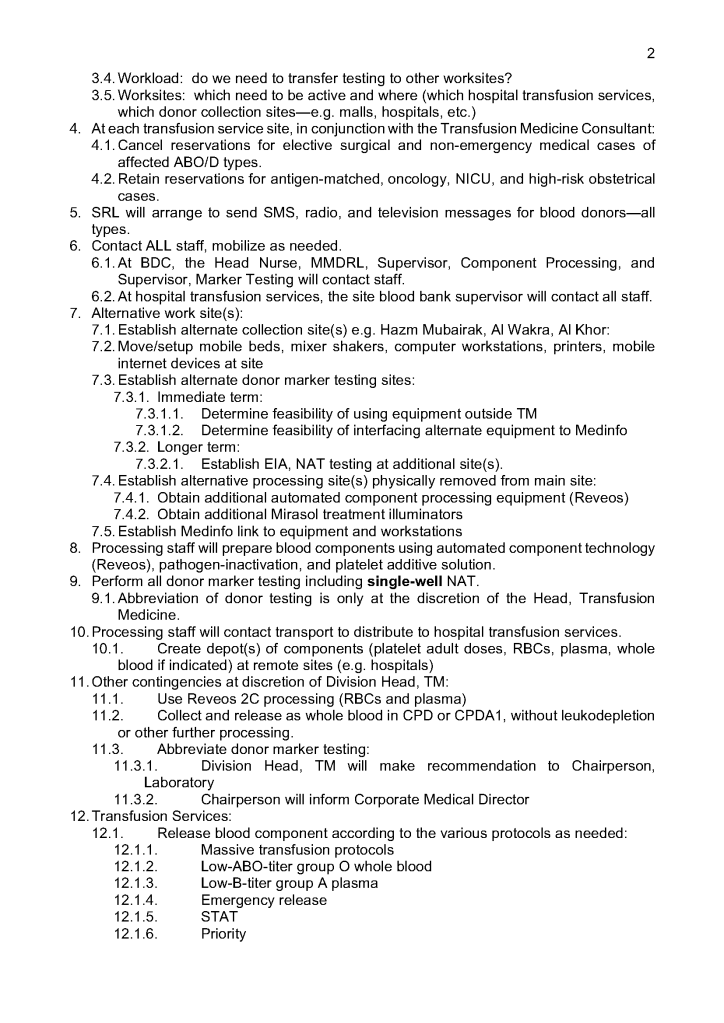
This was translated into Medinfo processes as follows:

To Be Continued:

21/8/20

Processes and Software Building 33: HBV Donor Testing

Hepatitis B donor screening consists of HBsAg and HBcAb for all donors, the latter to detect the window period.  In the USA, a non-negative HBcAb result will trigger a deferral.  In the Gulf area/KSA, there HBV was positive higher than in the West so there was a high rate of HBcAb positivity often from recovered HBV infection.

Here was my last algorithm before I left HMC Doha, which allowed use of donors with protective titers of HBsAb.  Note that the WHO cut-off for this is 10 IU/L whereas we used 100 IU/L as our threshold:

  1. Hepatitis B:
    1. HBsAg non-negative, then:
      1. HBsAg positive with HBsAg confirmatory positive, regardless of other results:  permanent deferral, refer to Infectious Disease clinic
      2. HBsAg positive with HBsAg confirmatory borderline or negative, repeat all HBV testing after 8 weeks
      3. HBsAg borderline:  repeat all HBV testing after 8 weeks
      4. HBV-DNA positive confirmed, regardless of other results:  permanent deferral, refer to Infectious Disease clinic
    2. If HBcAb positive, repeat after 8 weeks
    3. Repeat Hepatitis B Testing After 8 weeks:
      1. HBsAg positive with HBsAg confirmatory positive:  permanent deferral, refer to Infectious Disease clinic
      2. HBsAg positive with HBsAg confirmatory borderline or negative:  permanent deferral, refer to Infectious Disease clinic
      3. HBsAg borderline, permanent deferral, refer to Infectious Disease clinic
      4. HBV-DNA positive confirmed:  permanent deferral, refer to Infectious Disease clinic
      5. HBcAb positive or borderline with negative HBsAg and negative HBV-DNA:  review HBsAb level:
        1. If HBsAb level >= 100 mIU/mL (100 IU/L), donor may be reentered
        2. If HBsAb level < 100, then recommend to donor to receive booster HBV vaccine
          1. After HBV vaccine administration, retest after 30 days:
            1. If HBsAb level >= 100, donor may be reentered
            2. If HBsAb level < 100, donor is indefinitely deferred
      6. HBsAg, HBcAb, HBsAb all negative:  reenter into donor pool

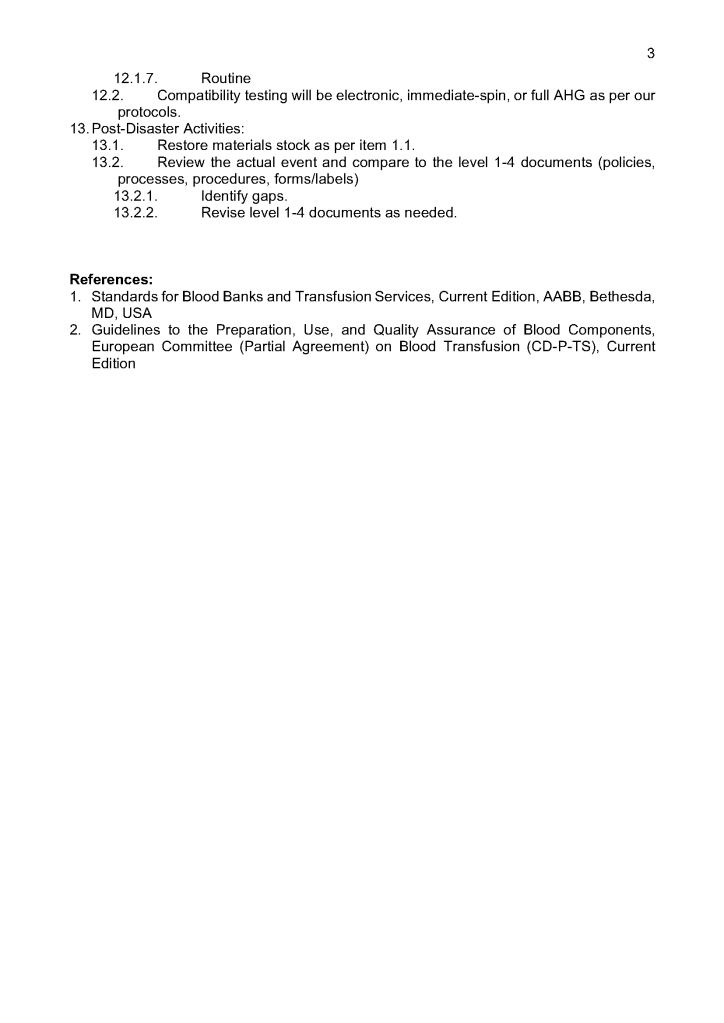
Here is the HBcAb and HBsAb part of the algorithm:

Previously, we had we had disqualified any donor with a nonnegative HBcAb:

To Be Continued: 

18/8/20

Processes and Software Building 32: HIV-1/HIV-2 Donor Screening

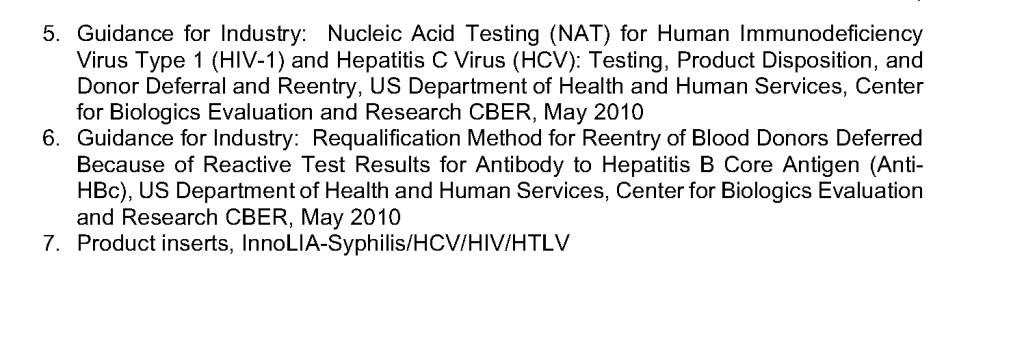
As I designed this in Medinfo, this is algorithm uses an HIV- /HIV-2 antibody EIA screening test, HIV p24 antigen test, and a confirmatory linear immunoblot assay LIA that can discriminate between type HIV-1 and type HIV-2.  If there is an indeterminate result, a repeat test is ordered after 8 weeks.  A reentry protocol is also included (1.6.3 below).

  1. HIV Testing:
    1. HIV-RNA positive confirmed, regardless of other HIV results:  permanent deferral and do HIV-InnoLIA, refer to Infectious Disease clinic
    2. HIV-RNA borderline:  do HIV-InnoLIA
    3. HIV-InnoLIA positive, regardless of other HIV results:  permanent deferral and refer to Infectious Disease clinic
    4. HIV-InnoLIA indeterminate:  repeat all HIV testing after 8 weeks
    5. HIV Ab positive with negative HIV-RNA and/or borderline/negative HIV-InnoLIA:  repeat testing after 8 weeks
    6. Repeat HIV Testing After 8 Weeks:
      1. HIV RNA positive and/or HIV-InnoLIA positive, regardless of other HIV results:  refer to Infectious Disease clinic
      2. HIV-InnoLIA and/or HIV antibodies indeterminate:  permanent deferral, HIV infection not confirmed
      3. HIV Ab negative and HIV-RNA negative and HIV-InnoLIA negative:  reenter into donor pool

This algorithm is represented in Medinfo as follows:

To Be Continued:

17/8/20

Processes and Software Building 31: HTLV Donor Testing

As I designed in Medinfo, this is a much simpler algorithm than HCV and uses an HTLV-1/HTLV-2 screening test and a confirmatory linear immunoblot assay LIA that can discriminate between type 1 and type 2.  If there is an indeterminate result, a repeat test is ordered after 6 months:

  1. HTLV 1/2 Testing:
    1. HTLV Antibodies positive, then do HTLV-InnoLIA:
      1. HTLV InnoLIA positive for HTLV-1 and/or HTLV-2:  refer to Infectious Disease clinic
      2. HTLV InnoLIA indeterminate or negative, repeat HTLV Ab and HTLV InnoLIA testing after 6 months
    2. Repeat HTLV Testing After 6 Months:
      1. HTLV 1/2 antibodies positive, permanent deferral and do HTLV InnoLIA
      2. HTLV 1/2 antibodies indeterminate,  permanent deferral and do HTLV InnoLIA
      3. HTLV InnoLIA positive for HTLV-1 or HTLV-2: refer to Infectious Disease clinic
      4. HTLV InnoLIA indeterminate, donor permanently deferred.
        1. Issue letter HTLV-Not Confirmed
      5. HTLV 1/2 Ab negative and HTLV InnoLIA negative, reenter donor.

This is translated into the following Medinfo processes:

To Be Continued:

15/8/20

Processes and Software Building 30: Donor HCV Screening Tests

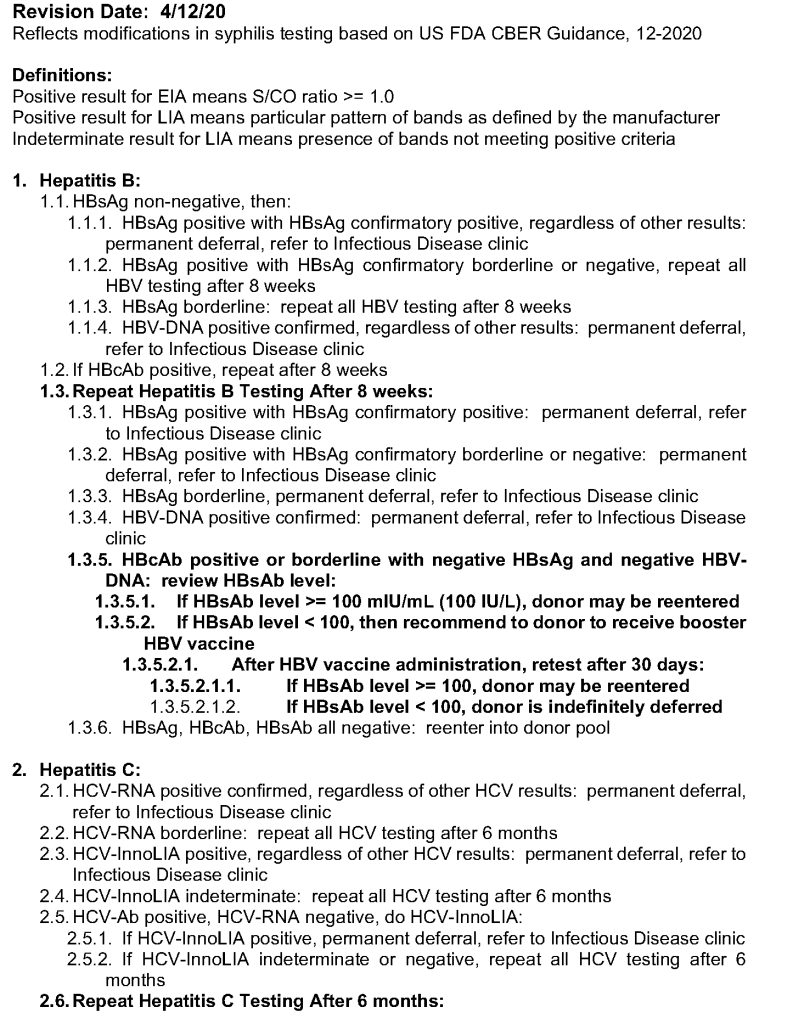
The testing algorithms may trigger additional testing, repeat of current testing at some future date, or permanent deferral.  One of the most complex processes is for HCV testing.  The following criteria are based on US FDA CBER guidelines, but are modified for the availability of test methodologies not licensed in the USA.

For HCV, we use the following testing in all donors:

  1. HCV antibody EIA
  2. HCV NAT
  3. If any of the tests are non-negative, then we do the HCV LIA immunoblot assay. 

HCV LIA is more sensitive than RIBA-3 (now no longer performed in the USA) but is not available in the USA.  This test has been incorporated into the testing algorithm from CBER:

  1. Hepatitis C:
    1. HCV-RNA positive confirmed, regardless of other HCV results:  permanent deferral, refer to Infectious Disease clinic
    2. HCV-RNA borderline:  repeat all HCV testing after 6 months
    3. HCV-InnoLIA positive, regardless of other HCV results:  permanent deferral, refer to Infectious Disease clinic
    4. HCV-InnoLIA indeterminate:  repeat all HCV testing after 6 months
    5. HCV-Ab positive, HCV-RNA negative, do HCV-InnoLIA:
      1. If HCV-InnoLIA positive, permanent deferral, refer to Infectious Disease clinic
      2. If HCV-InnoLIA indeterminate or negative, repeat all HCV testing after 6 months
    6. Repeat Hepatitis C Testing After 6 months:
      1. HCV-RNA or HCV-InnoLIA positive:  permanent deferral, refer to Infectious Disease clinic
      2. HCV-RNA or HCV-InnoLIA borderline:  permanent deferral, HCV infection not confirmed
      3. HCV-Ab positive or borderline without positive HCV-RNA or positive HCV-InnoLIA:  permanent deferral, HCV infection not confirmed
      4. HCV-Ab negative, HCV-RNA negative, HCV-InnoLIA negative:  reenter donor into donor pool

Note that indeterminate HCV results may be carried forward repeatedly by CBER rules but I decided to permanently defer the donor after 2 cycles of indeterminate results.  The donor must wait SIX MONTHS before the next round of testing.  Should he/she return before that time, those results may not be used for determining donor eligibility (unless the results have become clearly positive).

To Be Continued:

10/8/20

Processes and Software Building 29: Donor Marker Testing Overview

Donor marker testing algorithms are very complex and serve multiple objectives:

  1. Is the blood safe for the recipient, i.e. minimize likelihood of disease transmission?
  2. How do we to counsel the affected donor?  Does he need referral for treatment or follow-up?

Often the donor disposition is unclear based on a single encounter and a temporary deferral must be triggered so the current results may be compared to future ones, usually after 8 weeks, 6 months, or one year—depending on the pathogen in question.

Regretfully, the significance of reactions that do not meet the criteria for positivity may be unclear.  It is very difficult to explain to the donor that he has abnormal results and cannot donate but we as physicians do not know what their significance is.

Thus, the testing algorithms may trigger current additional testing, temporary deferral with repeat of testing at some future date, or permanent deferral.

At my previous positions, I started with the AABB/FDA CBER Uniform Donor Questionnaire UDQ and then modified it to include some advanced methodologies not available in the USA.

In the next series of posts I will elaborate on the processes developed for this for each marker.

To Be Continued

9/8/20

My Opinion: Separate Transfusion Medicine from the Laboratory

Transfusion Medicine includes laboratory and non-laboratory functions.  The non-laboratory and purely clinical functions are unique and have no analogy within the general laboratory.

The transfusion service/hospital blood bank laboratory is the closest to a laboratory operation, but there is component modification and complex manual testing, especially for reference immunohematology testing.  The staff must make detailed manual decisions, the errors for which could be life-threatening for the patient.

The blood donor center manufactures a pharmaceutical, i.e. blood components with collection, donor qualification, donor abnormal results review, infectious disease marker testing, component production, and donor immunohematology testing—all subject to Good Manufacturing Practices.  Never forget:  Blood is a drug!!

No other laboratory section is directly responsible for treatment of critically ill patients.  Therapeutic apheresis is essential for organ and stem-cell transplants, nephrology, neurology, etc.  No other laboratory section is directly responsible for treatment of critically ill patients.  Transfusion Medicine physicians are functioning as intensivists.  There is no hiding in the laboratory from clinical medicine.

There may also be an industrial manufacturing plant to extract various blood derivatives (e.g. factor concentrates, albumin, Rh immune globulin, etc.)  This is pharmaceutical manufacturing on a large-scale basis.  There is medical, technical, and special administrative expertise.

Many functions may operate 24/7.  The transfusion medicine physician may be on-call for donor issues and review of complex immunohematology problems to acutely decide which blood component (and phenotype) should be given as well as review all adverse reactions to transfusion.

The unique blend of clinical skills is unlike anything else in the laboratory.  Also, those outside the blood bank rarely have the skills or judgments for the best course of action for transfusion medicine or for its operations.

The clinical transfusion medicine physician must make acute, life-threatening decisions unlike anyone else in the laboratory.  The blood bank technologist is at the cutting edge of the battle with his testing and interpretations.  No other area of the laboratory is at such risk for injuring or even killing the patient.  There is high stress and burn-out.

I have talked with many blood bankers and many seem to share the exasperation that the laboratory does not understand us.  The latter looks at blood bank testing like that coming off a hematology or chemistry analyzer—although patients rarely would have severe morbidity or mortality like the blood bank from errors in those analyzers.

No laboratory pathologist has the pressure of the blood bank physician on-call.  It really is 24/7 and requires a broad, clinical background to make the right decisions.  It is very stressful and does not permit a good night’s sleep.

Thus, I make my case to separate us from the laboratory.  We can form our own more effective administrative organization and optimize our own planning.  Regretfully, I have never worked in such an administrative structure.  I also am a realist that cost-containment nowadays makes it much less likely high administration would permit this change for a mere cost center.  This will probably never happen during my career.

Finally, Transfusion Medicine is an essential service.  Blood components are essential drugs.  The operations and staff must be free of political influences.  This is a service for the entire region or country like the fire department, civil defense, etc.

8/8/20

Processes and Software Building 9: Enforcing GMP

Enforcing Good Manufacturing Process Through A Dedicated Blood Bank Software

Blood components are a drug and like medications must be consistently produced and follow Good Manufacturing Practices GMP.  The following system that I set up for HMC Doha Qatar blood collection and processing is an example of the impact of Medinfo donor software on enhancing our safety and GMP compliance.  In earlier posts, I provided the Medinfo flowcharts for these processes.

This is an outline of the processes I built in conjunction with the Medinfo software engineers:

  1. Registration:
    1. Read the barcode on the specified picture ID (usually a Qatar Residency/Citizen card).
      1. Retrieve the prospective donor’s demographics in English and Arabic from the Ministry of Interior.
      2. Check the donor deferral database (Qatar has only one), defer if contraindicated according to the rules built into Medinfo.
    2. Choose the type of donation (apheresis or whole blood;  volunteer, directed, or autologous).
    3. Print a consent form and ISBT specimen labels for the donation.
  2. Pre-Collection Screening:
    1. Perform the donor questionnaire on-line in English or Arabic:  this has contingent fields and could exceed 60 questions depending on the answers provided.
    2. Proceed to donor physical exam (vital signs and arm check).
  3. Collection:
    1. Collect the whole blood or apheresis component and specimen tubes:  determine if the collection meets the volume requirement and time limit.
    2. Send the specimens for donor marker and donor immunohematology testing.
    3. Send the raw components for processing.
  4. Donor Marker Testing:
    1. Perform NAT, EIA, and LIA marker testing according to algorithms defined in Medinfo.
    2. Perform follow-up reflex marker testing according to Medinfo criteria.
  5. Component Processing:
    1. Process the raw whole blood in the Reveos machine into PRBCs, leukodepleted plasma, and buffy coat platelets.
    2. Filter/leukodeplete the RBCs.
    3. If marker test results pass:
      1. Pool the buffy coat platelets according to the platelet yield index for a yield of 2.4E11/dose.
      2. Add platelet additive solution PAS and pathogen inactivate (Mirasol).
      3. Pathogen inactivate the whole-blood-derived plasma.
      4. Divide the apheresis plasma into 200-250 ml aliquots and pathogen inactivate.
    4. Divide the apheresis platelets to provide a yield of 2.4E11 in each dose, then pathogen-inactivate (PAS had been added at the time of the apheresis collection).
  6. Donor Immunohematology Testing:
    1. Perform ABO/D testing and antibody screen (identification if positive):
    2. If antibody screening positive, discard the component.
      1. If ABO discrepancy, send for manual review and approval, otherwise discard.
  7. Labelling, Storage, and Transfer:
    1. If all criteria were met, attach the final ISBT label (this can only be printed based on the acceptance of each component).
    2. Place the components into storage (37C, 1-6C, or <= minus 18C).
    3. Distribute to the hospital blood banks using Inter-Depot Transfer function.

I emphasize that only if all criteria across all areas pass is the final ISBT label printed.  Medinfo is not a label printing program.  It enforces the rules ruthlessly.  My technical staff tell me that it is merciless—as it should be for patient safety.

Attachments:  None—please refer to earlier posts regarding collection, processing, donor testing, and inter-depot transfer.

28/6/20

Processes and Software Building 6: Interfaces–General Considerations

When buying equipment while planning/implementing new laboratory software, I originally had a rule not to purchase anything that the vendor did not have a ready interface.  Even that was not so clear since some vendors had interfaces listed as alpha, beta, and completed.

Could you use an alpha or beta interface?  Was it safe for patient care?  What was the development cycle for new interfaces with your vendor—months, years?

Even if the vendor had a completed interface?  How “complete” was it?  Did it accept all data from the machine?  Did the data stream require reformatting?  Who would write the transformational script?

Even if the vendor could support it, could your local IT organization and the local agent’s IT staff do it?  I had plenty of headaches over this.  The best equipment with the best interface that the local agent could not support was worthless to me.

Some finished interfaces took months to install because of connectivity issues?  What version of the operating system was used?  Was it secure?  Did our IT department accept that version (e.g. Windows 7) and the provided malware protection?  I have seen malware spread across a network from the interface software installed by the vendor, threatening the entire corporate system. 

Did the solution require middleware?  What were the implications of having middleware and its affect on the main software program, especially at the time of its upgrade or the main software?

I have seen vendors using Windows 2000 for their interface software as late as 2017.  It was difficult for some of them to update to current, more secure versions.  Anyway, our corporate IT department gave them all a deadline to update to the current operating system—they all complied or risked losing all connectivity to the network.

Almost every instrument vendor has told me that they can communicate with my laboratory system.  I guess that is true:  one talks in Russian and the other Sanskrit—they do communicate but is it effective?  Talking is not necessarily communication!

I remember one open EIA machine that had a TCP/IP port but it was not functional by the standard protocols.  One had to emulate a serial port to get some rudimentary communication.  The port’s light blinked, however.  I never imagined that someone would put a nonfunctional port as a mere decoration.

On the other hand, I have had excellent experience with another software vendor Medinfo.  Even if the vendor did not have the interface developed, they could build it from scratch in a few weeks.  Paradoxically, it was faster for these new interfaces than some so-called already interfaces.

I must emphasize:  This is a collaborative team effort between the blood bank information system, software vendor, instrument vendor, and your institution’s IT staff.  There must be excellent cooperation between them for a successful result.

When installing the Medinfo Hematos IIG software, many of our most important interfaces (the Terumo mixed shaker, Trima, Reveos and its predecessor Atreus, Mirasol illuminator) had no developed interfaces when we started,  This was a risk;  but actually those interfaces were developed in a few weeks and fully functional.  In fact, we were the first site in the world to have those interfaces working—and without any Middleware.

In general, the blood bank software vendor installed the completed interface and did some low-level testing.  Then, my blood bank computer team did the testing.  The final responsibility for testing and acceptance was with the end-user blood bank team.

I am attaching a copy of our Abbott Architect interface as updated a few years ago.  Again, here I wrote the validation protocol and assigned the tasks to the Medinfo Super Users.  To perform this EIA testing, we still had to register donors and collect and then export the specimens to the donor marker testing laboratory before the actual interface testing could begin.  This was all done in a special test domain separate from the production domain.

I made the validation criteria and reviewed all data as Division Head of Laboratory Information Systems.  Representative screen shots were made.  All data was sent to me.  My final acceptance was required before the interface could be activated.

Automated component processing (Reveos) and component modification are more complicated and will be covered in a future post.

Attachment:

Abbott Architect Interface

To Be Continued:

24/6/20