Donor Center Materials and Equipment Strategy

This is the policy I developed for HMC Doha Blood Donor Center:

Policy:

  1. This policy applies to all blood donor processing (including reagents, materials, equipment) in the Blood Donor Center.
    1. Immunohematology testing and donor infectious disease marker testing are not included.
  2. Equipment and reagents must be selected to meet/exceed productions standards set by the Council of Europe, International AABB, HMC policies and procedures, and Qatari law.
  3. Each equipment must have a fully functioning, reliable, bidirectional interface to Medinfo Hematos IIG and be fully interfaced
    1. Vendor is responsible to pay for the interface licensing for each piece of equipment.
  4. Materials/reagents/equipment must cover the following functionalities:
    1. Automated separation of whole blood and apheresis components into:
      1. Packed RBCs in additive solution
      2. Buffy coat derived platelet pools
      3. Apheresis-derived platelets, plasma, and/or RBCs
      4. Fresh frozen and FP24 plasma
    2. Pathogen inactivation of whole blood, platelets, plasma, RBCs
    3. Cryoprecipitate
    4. Cryo-poor plasma
    5. Frozen RBCs (high-glycerol method)
    6. Washed RBCs
    7. Thawed plasma
    8. Irradiated RBCs
    9. Reconstituted whole blood (PRBCs and thawed plasma)
    10. Leukodepletion of ALL components to current and future CE standards
  5. Equipment must have/meet:
    1. CE mark or equivalent (FDA, CSA, etc.)
    2. Sufficient throughput for the workload in the area assigned
    3. Scalability:  A path of upgrading to larger capacity/throughput equipment using the same reagent line of the vendor
    4. A minimum of two of each equipment type must be obtained to minimize disruption of blood supply.
  6. Vendors:
    1. Vendors must offer 24/7 service on critical equipment for donor blood component and patient compatibility testing
    2. Vendors who do not meet qualification standards must not be used.

References:

  1. Standards for Blood Banks and Transfusion Services, Current Edition, AABB, Bethesda, MD, USA
  2. Guide to the Preparation, Use, and Quality Assurance of Blood Components, European Committee (Partial Agreement) on Blood Transfusion (CD-P-TS), European Directorate for the Quality of Medicines and Healthcare, Current Edition, Strasbourg, France

Re-Entry of Donors with History of Hepatitis On/After Age 11

Principle:

Until this guidance, everyone with hepatitis at age ≥ 11 has been permanently deferred, regardless of the type of hepatitis.  Except for confirmed cases of HCV at any age, donors with other causes may be reassessed to determine if they may be re-entered into the donor pool.  I have also included assessing levels of anti-HBs as per my previous policy at HMC Doha.

Policy:

  1. All donors with a history of HBV (confirmed HBsAg and/or HBV-NAT positive) or HCV, regardless of the age it occurred, continue to be permanently/indefinitely deferred.
  2. Donors with anti-HBc with negative HBsAg and/or HBV-NAT may be further assessed by performing anti-HBs titering.
    1. If the level of anti-HBs >= 100 IU/L (mIU/ml), then the donor may be reentered.
    1. If the donor’s antibody titer < 100 IU/L, he may be offered HBV vaccination:
      1. If the post-vaccination HBV titer >= 100 IU/L, then he may be reentered.
      1. If the donor does not receive HBV vaccination, he remains deferred.
  3. Donors with a history of HAV, CMV, or Epstein-Barr hepatitis may be reentered into the donor pool without further testing.
  4. If the donor is uncertain what type of hepatitis he had, then perform:
    1. HBV testing (HBsAg, HBcAb, HBsAb, HBV DNA NAT)
    1. HCV testing (HCV Ab, HCV LIA, HCV RNA NAT
    1. Liver enzyme testing (ALT, AST)
  5. If there is evidence of current or past HBV and/or HCV, then the donor is still permanently deferred
  6. If there is evidence of ALT or AST elevation, the donor remains indefinitely deferred.

References:

Requalification of Donors Previously Deferred for a History of Viral Hepatitis after the 11th Birthday, FDA-2017-D-5152–Requalification for History of Hepatitis Guidance-Final, US FDA/CBER, September 2017

CMV Prophylaxis Policy

I developed this policy for HMC Doha where most of the local population are CMV-seropositive. Note that I used the CE definition of <1E6 instead of the American <5E6.

Principle:

Since most of the local population (>90%) are CMV-seropositive, it is impractical to rely on CMV-negative donors as our basis for CMV prophylaxis.  Instead, we perform universal leukodepletion and pathogen-inactivation to greatly reduce this risk:

  1. CMV transmission risk can be lowered to a level comparable to using CMV-seronegative components by universal leukodepletion to levels <1E6.
  2. Pathogen inactivation greatly reduces (at least 2 log10) the number of organisms with nucleic acid (DNA or RNA) and is used for all platelet (pools and apheresis) and plasma components.
  3. Platelet additive solution reduces the amount of original plasma to about 35 ml and further reduces donor exposure to foreign material.

Policy:

  1. All blood components (platelets, plasma, RBCs) are universally leukodepleted to residual levels below 1E6.
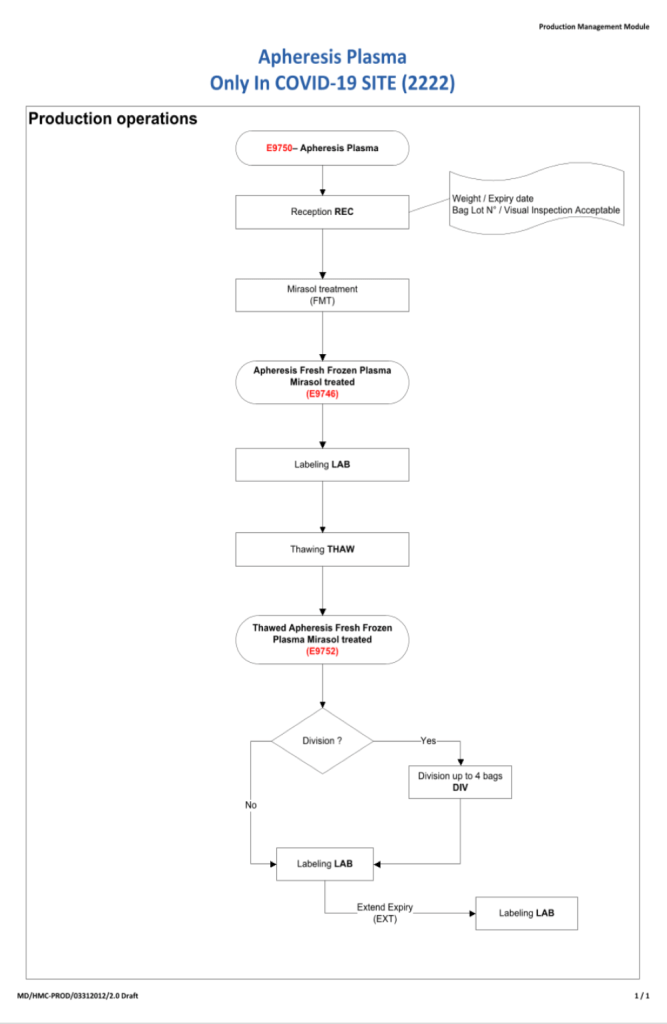
  2. All platelet and plasma components are pathogen-inactivated using the Mirasol system (riboflavin added and then exposed to ultraviolet light).
  3. All platelet components (pooled buffy coat and apheresis) are prepared in platelet additive solution PAS.

References:

  1. Technical Manual, AABB, Current Edition, Bethesda, Maryland, USA
  2. Standards for Blood Banks and Transfusion Services, Current Edition, AABB, Bethesda, Maryland, USA
  3. Guidelines to the Preparation, Use, and Quality Assurance of Blood Components, European Committee (Partial Agreement) on Blood Transfusion (CD-P-TS), Current Edition

External Disaster Plan

Principle:

Maintaining an adequate blood supply and expedited compatibility testing are critical in disaster planning.  This plan is assuming that the Blood Donor Center is functional and can process donors and make components.

Medinfo Hematos IIG System is critical to monitoring inventory, preparing blood components expeditiously using Good Manufacturing Processes, and distributing blood components in a timely controlled manner.

Policy:

  1. Determinate total available blood supply across all locations by using the Cumulative Stock Display program in Medinfo Hematos IIG.
    1. Recheck stock at least every hour during the disaster.
  2. At each transfusion service site, in conjunction with the Transfusion Medicine Consultant:
    1. Cancel reservations for elective surgical and non-emergency medical cases of affected ABO/D types.
    2. Retain reservations for antigen-matched, oncology, NICU, and high-risk obstetrical cases.
  3. Inform Manager for Donor Recruitment/Logistics to send SMS, radio, and television messages for blood donors—all types.
  4. Contact ALL staff and have them report to duty.
    1. At Blood Donor Center, the Head Nurse, Recruitment Manager, Supervisor, Component Processing, and Supervisor, Marker Testing will contact their respective staff.
    2. At various hospital blood bank transfusion services, the site supervisor will contact all staff.
  5. Process blood components using automated component technology (Reveos).
  6. Perform all donor marker testing including single-well NAT.
    1. Abbreviation of donor testing is only at the discretion of the Head, Transfusion Medicine.
  7. Send blood components using Inter-Depot Transfer function of Medinfo.
  8. Transfusion Services:
    1. Release blood component according to the various protocols as needed:
      1. Massive transfusion protocol
      2. Emergency release
      3. STAT
      4. Priority
      5. Routine
  9. Compatibility testing will be electronic, immediate-spin, or full AHG as per our protocols.

References:

  1. Standards for Blood Banks and Transfusion Services, Current Edition, AABB, Bethesda, MD, USA
  2. Guidelines to the Preparation, Use, and Quality Assurance of Blood Components, European Committee (Partial Agreement) on Blood Transfusion (CD-P-TS), Current Edition

Revised 10/9/20

Review of Product Inserts

This is a policy I made for NGHA Jeddah many years ago but is still useful today.

Principle:

All technical staff are required to read and understand the manufacturer package inserts that apply to the procedures that they perform.  This policy establishes a means of documenting compliance with this requirement.

Policy Details:

  1. Technical staff are defined as anyone who uses the reagent in the performance of a procedure or process or anyone reviews or supervises that process or procedure.  This includes the supervisor, medical technologists, medical technicians, nurses, phlebotomists, and assistants.
  2. All technical staff are required to read and understand ALL product inserts for each procedure applicable to the section(s) that they work in—apheresis, donor room, component preparation, and/or transfusion service.
  3. If they have any questions about a particular insert, they should refer it to the supervisor, senior technologist (Med Tech 1), or in the latter’s absence, the blood bank medical director/section head.
  4. Each staff member must sign the Manufacturer’s Package Insert Review Form for that particular policy/procedure, including his signature, employee identification number, and date.
  5. Each Manufacturer’s Package Insert Review Form will be retained with a copy of the package insert by the Blood Bank Supervisor in a special file while the material is being used and for at least five (5) years after a new or revised manufacturer package insert is applicable.
  6. A new Manufacturer’s Package Insert Review Form should be used for each revision of the insert.

Insert Review Form

Type of Insert:  New  Revised
Product Name:
Date of Insert:

I have read this insert and understand its contents and accept responsibility for following its instructions and directions.

Staff Name & Badge #–PRINT!SignatureDate


Sample Resident Examination for Donor Center

Reading Assignments:

  • Chapters 5-9:  Blood Donation and Collection in Technical Manual, 16th Edition
  • Standards for Blood Banks and Transfusion Services, AABB, 25th Edition

Study Questions:

  1. Which of the following candidates is acceptable for donation?
    1. Saudi, visited Sudan 11 months ago as part of National Guard exchange
    2. Saudi former student lived in UK for 2 years from 1993-95
    3. Normotensive taking amlodipine and valsartan
    4. Psoriatic using Tegison
    5. Male adult using ibuprofen for lower back pain
    6. Female 4 weeks post-partum
    7. Husband of patient with recent onset of hepatitis B infection
    8. Male stopped taking ampicillin one week ago for acute pharyngitis
    9. Donor with WBC count 12000/cmm but otherwise normal
  2. Which of the following donors is suitable for autologous donation?
    1. Cataract surgery patient
    2. Well, but had gastroenteritis 3 days ago
    3. Pregnant with Hgb 11 g/dl
    4. CGL patient with Hgb 13 g/dl
    5. Hodgkin’s disease patient Hgb 12 for exploratory laparotomy
    6. Patient with rare antibody anti-Tja, Hgb 13 for cholecystecomy
  3. How do you handle the following events?
    1. Donor draw fills bag with bright red blood in 30 seconds
    2. Donor faints when needle is shown
    3. Lipemic serum during donor plateletpheresis session
    4. Donor with numbness and tingling of extremities during donor apheresis session
  4. How would you handle the following therapeutic phlebotomy requests?
    1. Hgb 22 g/dl, suspected polycythemia rubra vera
    2. Hgb 13, suspected hemochromatosis patient
    3. Hgb 16, renal failure patient post-erythropoietin treatment
    4. Unstable angina, Hgb 9
  5. What is the final volume of each of the following blood components?
    1. Whole blood
    2. Packed RBCs—state hematocrit as well
    3. Washed RBCs
    4. Irradiated packed cells
    5. Platelet pool—state number of platelets
    6. FFP
    7. Cryo-poor plasma
    8. Cryoprecipitate
  6. What are the outdates of each of the following components?
    1. Packed RBCs
    2. Platelet pool
    3. FFP frozen at -35C
    4. Granulocyte concentrate
  7. Which donor units are acceptable for transfusion?
    1. HBsAg negative, HBcAb positive, HBsAb > 20 IU/liter
    2. HCV Ab positive, RIBA-3 negative, HCV-RNA negative
    3. Syphilis positive, FTA-ABS negative

Revised:

29/8/20

Advanced Hematology Resident Training in Donor Center and Apheresis

Objectives:

  1. Donor criteria based on AABB standards
    1. Is it safe for the donor to donate?
    2. Medical history
      1. Current medical conditions
      2. Past medical conditions
  2. Medications
  3. Vaccinations
  4. Travel history
  5. High-risk behaviors
  6. SARS/MERS
  7. COVID-19 convalescent plasma CCP
  8. Prion diseases
  9. Donor medical examination
  10. Is it safe for the recipient to receive the donor’s blood?
  11. Donor registration issues
    1. Positive identification
    2. Donor deferral database
  12. Donor phlebotomy
    1. Safe volume to donate
    2. Anticoagulant-preservative solutions
    3. Time limit for phlebotomy
    4. Post-donation care
  13. Donor reactions—Dx and Rx of the following:
    1. Vasovagal
    2. Seizures
    3. Air embolism
    4. Arterial stick
    5. Hematoma
  14. Donor Apheresis
    1. Plateletpheresis
    2. Plasmapheresis
    3. Plateletpheresis with concurrent plasma collection
    4. RBC collection
    5. Combined platelet, plasma, and RBC collection
  15. Autologous donation
    1. Predeposit
    2. Perioperative
    3. Intraoperative
    4. Postoperative
  16. Donor self-deferral
  17. Therapeutic Phlebotomy
  18. Therapeutic Apheresis
    1. Therapeutic plasma exchange/plasmapheresis
    2. Leukapheresis
    3. Thrombapheresis
    4. Red cell exchange
    5. Stem cell collection
    6. Column absorption technologies
    7. Clinical indications
    8. Writing orders for above procedures
  19. Component Processing:
    1. Manual
    2. Automated—Reveos
    3. Pathogen Inactivation Mirasol
    4. Buffy coat vs classic platelet-rich plasma platelets and pools
    5. Platelet Additive Solution PAS
    6. FFP, FP24, thawed plasma
    7. Cryoprecipitate
    8. Cryo-poor plasma (plasma, cryoprecipitate-removed)
    9. COVID-19 convalescent plasma CCP

Clinical Responsibilities (after proven competence):

  1. Triage of donor requests
  2. Handling of donor reactions
  3. Approval of therapeutic phlebotomies
  4. Assistance with therapeutic apheresis

Assessments:

  1. Pre-training/baseline
  2. Competency documentation for clinical responsibilities (#11 above)
  3. Post-training

Working Hours:

  1. 0900-1700, Saturday through Wednesday
  2. Must carry pager for clinical responsibilities

Reviewed 17/8/20

Basic Hematology Fellowship Rotation in Transfusion Medicine

Objectives:

  1. Donor Center
    1. Donor eligibility criteria
    2. Whole blood collection
    3. Donor apheresis (platelets, plasma, dual-RBC)
    4. Donor reactions
  2. Therapeutic Apheresis
    1. Plasma exchange
    2. Leukocyte reduction—stem cell collection
    3. Reductive thrombapheresis
    4. RBC exchange
    5. Column-absorption procedures including phototherapy
  3. Component Preparation
    1. Preparation and release issues
  4. Transfusion Service:
    1. Blood component therapy
    2. RBC blood groups
    3. Compatibility Testing
    4. Antibody Identification and clinical significance
    5. Transfusion reactions
    6. Direct antiglobulin test clinical significance
    7. Drug-related hemolysis

Venue:

TMS Donor and Transfusion Services

Conducted by:  Head, TMS, and senior TMS technical staff

Evaluation:

Discussion of topics with TMS Head and written final examination

Source Materials:

  1. Technical Manual, AABB
  2. Standards for Blood Banks and Transfusion Services, AABB
  3. Apheresis, Principles and Practice, AABB

This is a full-time, one-month rotation—attendance in mandatory.  Vacations should NOT be taken during this rotation.

Originally Prepared for NGHA Riyadh 31/3/09

Reviewed 26/8/20

Processes and Software Building 37: Donor Marker Testing–Final Comments

This series of the processes for donor marker testing has demonstrated the complexity and flexibility of designing processes.  In Medinfo, you can custom-design the criteria based on your local, national, and international requirements.  The end-user client must specify what he wants, and I reiterate:  Be careful what you ask for, you may get it.  Seek assistance if you are uncertain of what to use.

My criteria were based on several international standards, e.g. AABB, US FDA, CE, and Australian.  I strongly recommend you start with a set of standards and localize it for your needs.

For example, US FDA/AABB do not have a screening criteria for brucellosis since it is rare in their jurisdiction.  However, it is relatively common in the Middle East so I added a donor screening question for it.  International AABB does allow for variance with US FDA criteria so if you are outside the USA, embrace this.  The advantage of customizable software allows you do localize it to your needs.  A turnkey system, e.g. from the USA, may not allow such changes.

Finally, there are emerging pathogens that are constantly changing the donor criteria (e.g. SARS-CoV-2, MERS, SARS, Zika).  The software must be robust and allow rapid alteration to meet new donor screening criteria.  This is a constant uphill battle and requires a lot of time to keep up and validate any changes.

Complete Interim Policy on Marker Testing

For your reference, the following is the complete set of marker testing algorithms I used just before I left HMC Doha:

Definitions:

Positive result for EIA means S/CO ratio >= 1.0

Positive result for LIA means particular pattern of bands as defined by the manufacturer

Indeterminate result for LIA means presence of bands not meeting positive criteria

  1. Hepatitis B:
    1. HBsAg non-negative, then:
      1. HBsAg positive with HBsAg confirmatory positive, regardless of other results:  permanent deferral, refer to Infectious Disease clinic
      2. HBsAg positive with HBsAg confirmatory borderline or negative, repeat all HBV testing after 8 weeks
      3. HBsAg borderline:  repeat all HBV testing after 8 weeks
      4. HBV-DNA positive confirmed, regardless of other results:  permanent deferral, refer to Infectious Disease clinic
    2. If HBcAb positive, repeat after 8 weeks
    3. Repeat Hepatitis B Testing After 8 weeks:
      1. HBsAg positive with HBsAg confirmatory positive:  permanent deferral, refer to Infectious Disease clinic
      2. HBsAg positive with HBsAg confirmatory borderline or negative:  permanent deferral, refer to Infectious Disease clinic
      3. HBsAg borderline, permanent deferral, refer to Infectious Disease clinic
      4. HBV-DNA positive confirmed:  permanent deferral, refer to Infectious Disease clinic
      5. HBcAb positive or borderline with negative HBsAg and negative HBV-DNA:  review HBsAb level:
        1. If HBsAb level >= 100 mIU/mL (100 IU/L), donor may be reentered
        2. If HBsAb level < 100, then recommend to donor to receive booster HBV vaccine
          1. After HBV vaccine administration, retest after 30 days:
            1. If HBsAb level >= 100, donor may be reentered
            2. If HBsAb level < 100, donor is indefinitely deferred
      6. HBsAg, HBcAb, HBsAb all negative:  reenter into donor pool
  • Hepatitis C:
    • HCV-RNA positive confirmed, regardless of other HCV results:  permanent deferral, refer to Infectious Disease clinic
    • HCV-RNA borderline:  repeat all HCV testing after 6 months
    • HCV-InnoLIA positive, regardless of other HCV results:  permanent deferral, refer to Infectious Disease clinic
    • HCV-InnoLIA indeterminate:  repeat all HCV testing after 6 months
    • HCV-Ab positive, HCV-RNA negative, do HCV-InnoLIA:
      • If HCV-InnoLIA positive, permanent deferral, refer to Infectious Disease clinic
      • If HCV-InnoLIA indeterminate or negative, repeat all HCV testing after 6 months
    • Repeat Hepatitis C Testing After 6 months:
      • HCV-RNA or HCV-InnoLIA positive:  permanent deferral, refer to Infectious Disease clinic
      • HCV-RNA or HCV-InnoLIA borderline:  permanent deferral, HCV infection not confirmed
      • HCV-Ab positive or borderline without positive HCV-RNA or positive HCV-InnoLIA:  permanent deferral, HCV infection not confirmed
      • HCV-Ab negative, HCV-RNA negative, HCV-InnoLIA negative:  reenter donor into donor pool
  • HIV Testing:
    • HIV-RNA positive confirmed, regardless of other HIV results:  permanent deferral and do HIV-InnoLIA, refer to Infectious Disease clinic
    • HIV-RNA borderline:  do HIV-InnoLIA
    • HIV-InnoLIA positive, regardless of other HIV results:  refer to Infectious Disease clinic
    • HIV-InnoLIA indeterminate:  repeat all HIV testing after 8 weeks
    • HIV Ab positive with negative HIV-RNA and/or borderline/negative HIV-InnoLIA:  repeat testing after 8 weeks
    • Repeat HIV Testing After 8 Weeks:
      • HIV RNA positive and/or HIV-InnoLIA positive, regardless of other HIV results:  refer to Infectious Disease clinic
      • HIV-InnoLIA and/or HIV antibodies indeterminate:  permanent deferral, HIV infection not confirmed
      • HIV Ab negative and HIV-RNA negative and HIV-InnoLIA negative:  reenter into donor pool
  • HTLV 1/2 Testing:
    • HTLV Antibodies positive, then do HTLV-InnoLIA:
      • HTLV InnoLIA positive for HTLV-1 and/or HTLV-2:  refer to Infectious Disease clinic
      • HTLV InnoLIA indeterminate or negative, repeat HTLV Ab and HTLV InnoLIA testing after 6 months
    • Repeat HTLV Testing After 6 Months:
      • HTLV 1/2 antibodies positive, permanent deferral and do HTLV InnoLIA
      • HTLV 1/2 antibodies indeterminate,  permanent deferral and do HTLV InnoLIA
      • HTLV InnoLIA positive for HTLV-1 or HTLV-2: refer to Infectious Disease clinic
      • HTLV InnoLIA indeterminate, donor permanently deferred.
        • Issue letter HTLV-Not Confirmed
      • HTLV 1/2 Ab negative and HTLV InnoLIA negative, reenter donor.
  • Malaria Testing:
    • Defer donor if he has been in malarial endemic zone within the past 3 months
    • If travel to malarial zone > 3 months, do malarial antibody testing:
      • Malaria antibody negative:  no deferral
      • Malaria antibody positive, perform malarial antigen test:
        • Malaria antigen test positive, refer to Infectious Disease clinic—defer until 3 years after cessation of treatment
        • Malaria antigen test negative:
          • Plasma may be collected
          • RBCs and platelets must be destroyed.
        • Repeat malarial antibodies after 3 years:
          • If malarial antibody test positive, donor must not be used for RBC components but may be used for plasma production
          • If malarial antibody test negative, reenter donor for all components
    • Defer donor if he has received malarial treatment (not prophylaxis) for 3 years
      • Perform both malarial antibody and antigen testing:
        • Defer based on section 5.2
  • Syphilis Testing:
    • Syphilis Ab test positive or indeterminate:  do InnoLIA-Syphilis test
      • InnoLIA-Syphilis test positive:  permanent deferral, refer to Infectious Disease clinic
      • InnoLIA-Syphilis test borderline or negative:  defer for 1 year, then repeat all syphilis testing.
    • Repeat Syphilis Testing after 1 Year:
      • Syphilis antibody testing negative, reenter into donor pool
      • Syphilis antibody positive or borderline:  do InnoLIA-Syphilis test
        • InnoLIA-Syphilis test positive:  permanent deferral, refer to Infectious Disease clinic
        • If InnoLIA-Syphilis borderline or negative:  permanent deferral, syphilis not confirmed

References:

  1. Revised Recommendations to Reduce the Risk of Transfusion-Transmitted Malaria, Guidance for the Industry, US Department of Health and Human Services, FDA, Center for Biologics Evaluation and Research CBER, April, 2020
  2. Use of Serologic Tests to Reduce the Risk of Transfusion-Transmitted Human T-Cell Lymphotropic Viruses Types I and II, Final Guidance for Industry, February 2020
  3. Draft Guidance for Industry:  Recommendations for Requalification of Blood Donors Deferred Because of Reactive Test Results for Antibodies to Human T-Lymphotropic Virus Types I and II (anti-HTLV-I/II), CBER, September 2018
  4. Guidance for Industry:  Nucleic Acid Testing (NAT) for Human Immunodeficiency Virus Type 1 (HIV-1) and Hepatitis C Virus (HCV): Testing, Product Disposition, and Donor Deferral and Reentry, US Department of Health and Human Services, Center for Biologics Evaluation and Research CBER, May 2010
  5. Guidance for Industry:  Requalification Method for Reentry of Blood Donors Deferred Because of Reactive Test Results for Antibody to Hepatitis B Core Antigen (Anti-HBc), US Department of Health and Human Services, Center for Biologics Evaluation and Research CBER, May 2010
  6. Product inserts, InnoLIA-Syphilis/HCV/HIV/HTLV, Immunogenetics, Singapore
  7. Malaria Section, Australian Red Cross brochure, 2007

25/8/20

Processes and Software Building 36: Donor Nucleic Acid Testing

In Medinfo, criteria for donor screening may be based on one test (e.g. Hgb), a group of tests taken together (HBsAg, HBcAb, HBsAb), or separate sets of donor testing criteria.  Nucleic Acid Testing NAT is considered separate from the EIA, LIA, and Ag tests.  In any case, when there is a combination of both acceptable and deferrable results, the longest deferral is applied as the deferral or contraindication, e.g. a temporary deferral is replaced by a permanent deferral.

Our NAT testing at HMC Doha consisted of a combination combo test.  If this was non-negative, then individual HIV 1-2, HCV, and HBV NAT testing were performed.  For speed, we used single-well testing for each donor.  However, it is very easy to build pooling into the algorithm if that is preferred by the client:

To Be Continued:

24/8/20