Selection of Components for ABO-Incompatible Renal Transplants

Principle:

Kidneys have strong expression of ABO type and must be matched the same way as RBC components.  In the case of ABO-incompatible renal transplants, we must not give significant amounts of plasma incompatible to the ABO type of the donor kidney.  Plasma must also be compatible with the patient’s ABO type for RBC transfusions.  The amount of residual plasma in PRBCs is limited since we use an additive solution SAGM.  Likewise, platelet components are suspended in platelet additive solution with only minimal residual plasma.  Cryoprecipitate has only minimal plasma and is given without regard to the patient’s ABO type.

Policy:

  1. RBC components:  Use ABO-compatible RBCs in SAGM.  DO NOT USE WHOLE BLOOD!!
  2. Platelet components in platelet additive solution PAS (normally available component):  Any ABO type may be given
  3. Platelet components in plasma:  Only group AB platelets may be used.
  4. Plasma (any type FFP, FP24, solvent-detergent treated, or thawed):  Only group AB plasma may be used
  5. Cryoprecipitate:  Any ABO type including mixed types may be used, mixed types are preferable to neutralize the minimal ABO-incompatible plasma.

References:

  1. Standards for Blood Banks and Transfusion Services, AABB, Current Edition, Bethesda, MD USA
  2. Technical Manual, AABB, Current Edition, Bethesda, MD, USA
Policy: ABO-Incompatible Plasma for Infants

Principle:

HMC Blood Donor Center used platelets (buffy coat pools) and/or apheresis-derived suspended in PAS (platelet additive solution).  In each platelet pool or apheresis platelet, less than 35 ml (average < 20%) of the original plasma. This was much less than would remain if volume-reduced platelets had been prepared by centrifugation. Furthermore, the platelets would NOT be traumatized by the centrifugation.

Policy:

  1. For neonates (< 4 months old) and infants (<20 kg), we will give preference to use plasma-compatible platelet and plasma type.
  2. In any case, PAS-suspended platelets will be used with little residual plasma (far less than if we had centrifuged them).
  3. In the rare event that plasma-compatible platelet types are not available, the transfusion medicine physician must approve the release.

References:

  1. Standards for Blood Banks and Transfusion Services, Current Edition, AABB, Bethesda, MD, USA
  2. Guide to the Preparation, Use, and Quality Assurance of Blood Components, European Committee (Partial Agreement) on Blood Transfusion, Council of Europe, Strasbourg, France

External Disaster Plan

Principle:

Maintaining an adequate blood supply and expedited compatibility testing are critical in disaster planning.  This plan is assuming that the Blood Donor Center is functional and can process donors and make components.

Medinfo Hematos IIG System is critical to monitoring inventory, preparing blood components expeditiously using Good Manufacturing Processes, and distributing blood components in a timely controlled manner.

Policy:

  1. Determinate total available blood supply across all locations by using the Cumulative Stock Display program in Medinfo Hematos IIG.
    1. Recheck stock at least every hour during the disaster.
  2. At each transfusion service site, in conjunction with the Transfusion Medicine Consultant:
    1. Cancel reservations for elective surgical and non-emergency medical cases of affected ABO/D types.
    2. Retain reservations for antigen-matched, oncology, NICU, and high-risk obstetrical cases.
  3. Inform Manager for Donor Recruitment/Logistics to send SMS, radio, and television messages for blood donors—all types.
  4. Contact ALL staff and have them report to duty.
    1. At Blood Donor Center, the Head Nurse, Recruitment Manager, Supervisor, Component Processing, and Supervisor, Marker Testing will contact their respective staff.
    2. At various hospital blood bank transfusion services, the site supervisor will contact all staff.
  5. Process blood components using automated component technology (Reveos).
  6. Perform all donor marker testing including single-well NAT.
    1. Abbreviation of donor testing is only at the discretion of the Head, Transfusion Medicine.
  7. Send blood components using Inter-Depot Transfer function of Medinfo.
  8. Transfusion Services:
    1. Release blood component according to the various protocols as needed:
      1. Massive transfusion protocol
      2. Emergency release
      3. STAT
      4. Priority
      5. Routine
  9. Compatibility testing will be electronic, immediate-spin, or full AHG as per our protocols.

References:

  1. Standards for Blood Banks and Transfusion Services, Current Edition, AABB, Bethesda, MD, USA
  2. Guidelines to the Preparation, Use, and Quality Assurance of Blood Components, European Committee (Partial Agreement) on Blood Transfusion (CD-P-TS), Current Edition

Revised 10/9/20

Projective Exercise 6: ABO Discrepancies

As a transfusion medicine physician, I must know if I can trust my staff’s interpretation of immunohematology testing.  I may be called at night and they will provide me with results and I must use these to make a medical judgment.  If their interpretation is flawed, I might make a decision that harms the patient.

I really don’t like multiple-choice questions, but nowadays this is often the norm.  For my staff, especially senior staff and those who want to be promoted to senior staff, I have developed a series of projective exercises to help me understand their thought processes.

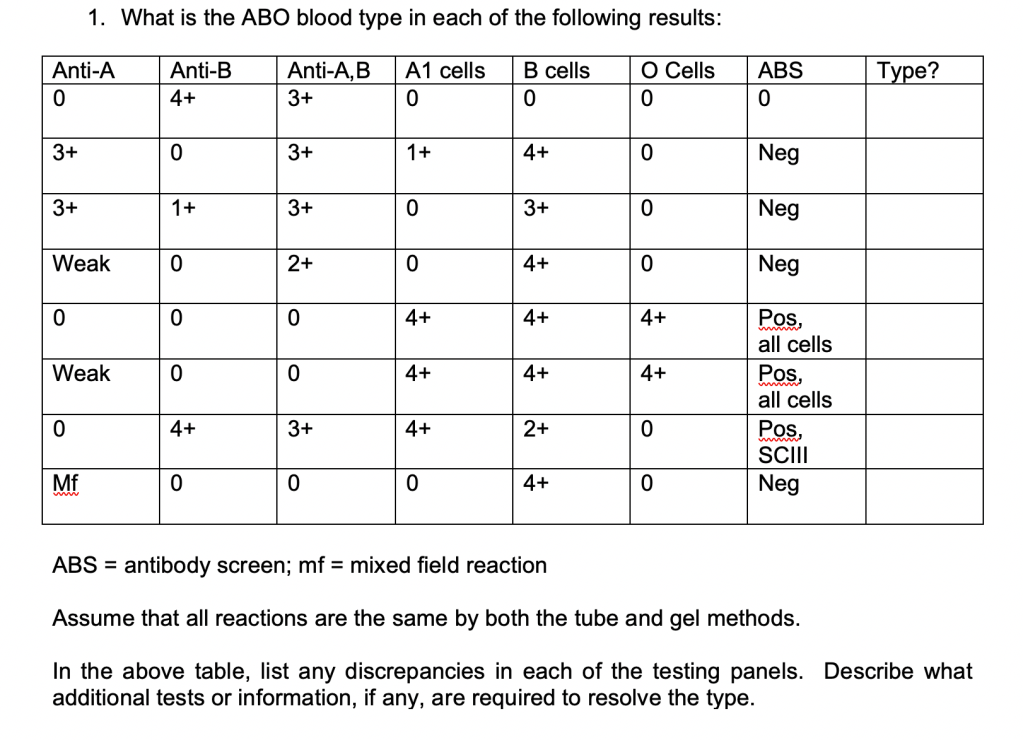
Here is another series of exercises, usually given to advanced technologists and supervisor candidates.  I want them to tell me what they need to assess each scenario.  Can they definitively diagnose solely on the information provided?

These are open-ended and may have more than one possible interpretation:

9/9/20

Review of Product Inserts

This is a policy I made for NGHA Jeddah many years ago but is still useful today.

Principle:

All technical staff are required to read and understand the manufacturer package inserts that apply to the procedures that they perform.  This policy establishes a means of documenting compliance with this requirement.

Policy Details:

  1. Technical staff are defined as anyone who uses the reagent in the performance of a procedure or process or anyone reviews or supervises that process or procedure.  This includes the supervisor, medical technologists, medical technicians, nurses, phlebotomists, and assistants.
  2. All technical staff are required to read and understand ALL product inserts for each procedure applicable to the section(s) that they work in—apheresis, donor room, component preparation, and/or transfusion service.
  3. If they have any questions about a particular insert, they should refer it to the supervisor, senior technologist (Med Tech 1), or in the latter’s absence, the blood bank medical director/section head.
  4. Each staff member must sign the Manufacturer’s Package Insert Review Form for that particular policy/procedure, including his signature, employee identification number, and date.
  5. Each Manufacturer’s Package Insert Review Form will be retained with a copy of the package insert by the Blood Bank Supervisor in a special file while the material is being used and for at least five (5) years after a new or revised manufacturer package insert is applicable.
  6. A new Manufacturer’s Package Insert Review Form should be used for each revision of the insert.

Insert Review Form

Type of Insert:  New  Revised
Product Name:
Date of Insert:

I have read this insert and understand its contents and accept responsibility for following its instructions and directions.

Staff Name & Badge #–PRINT!SignatureDate


Projective Exercise 5: Antibody to a Public Antigen

As a transfusion medicine physician, I must know if I can trust my staff’s interpretation of immunohematology testing.  I may be called at night and they will provide me with results and I must use these to make a medical judgment.  If their interpretation is flawed, I might make a decision that harms the patient.

I really don’t like multiple-choice questions, but nowadays this is often the norm.  For my staff, especially senior staff and those who want to be promoted to senior staff, I have developed a series of projective exercises to help me understand their thought processes.

Here is another exercise, usually given to physicians.  I give them the following scenario:

There is a major trauma on an unidentified young adult male patient.  We do not know the transfusion, medical, or medication history.  They need six units RBCs STAT.

What blood type do you select?  How do you release the blood?

You give the 6 units and receive a specimen back.  The patient’s typing reactions are:

Forward type:  Anti-A, anti-B both negative

Reverse type:  4+ reaction with A1 and B cells

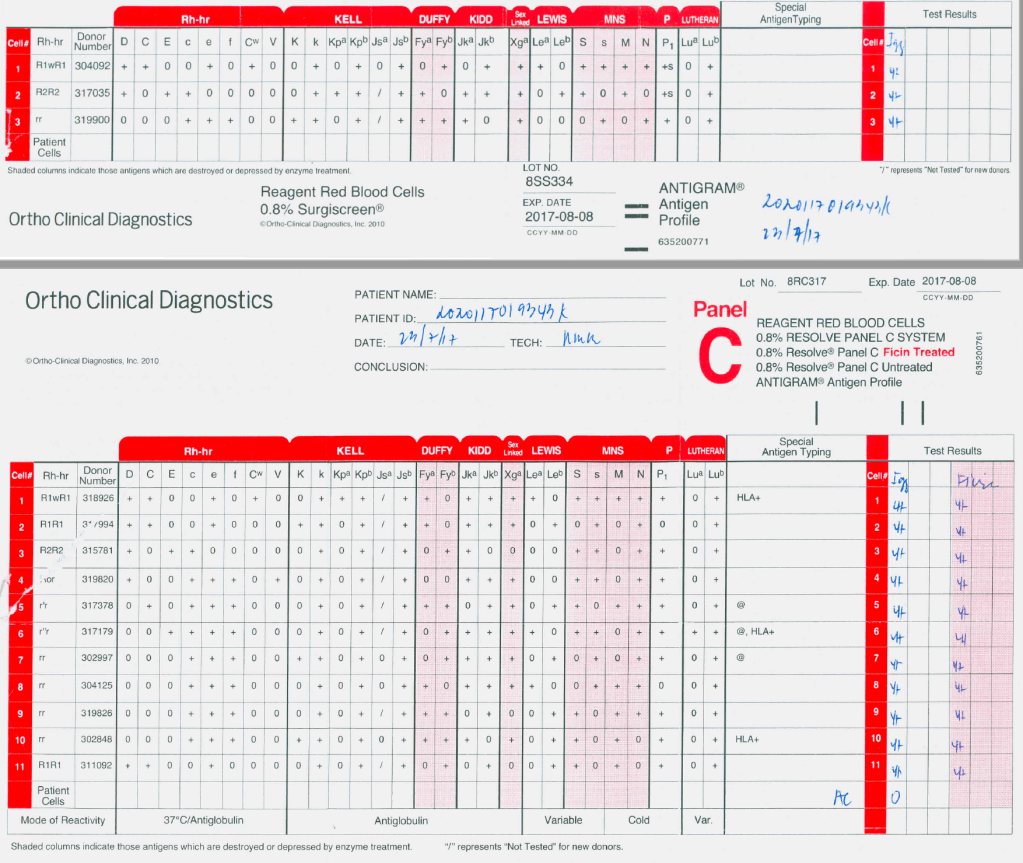
About 15 minutes later, your technologist tells you that the antibody screen is 4+ in all cells and all panel cells react 4+ both at AHG and enzyme phases.  What do you tell the treating clinician?  What do you do?

The technologist in panic has been performing AHG crossmatches but all 4+ incompatible.

Here is the panel:

I have them review this panel and tell me to interpret it

  1. What further testing would you do, if any?
  2. What blood type do you release now?
  3. What is the significance of the negative autocontrol when there is panreactivity?
  4. What if the enzyme panel results are all negative?
  5. What if the autocontrol is 4+?

The smart ones will ask for a full extended phenotype (e.g. Diamed/Biorad’s three profile cards) and for anti-H.

I tell them the clinician is very angry and demands you release more group O blood immediately?  How do you respond?

5/9/20

Advanced Hematology Resident Training in Immunohematology

Objectives:

  1. Theoretical:
    1. ABO system and discrepancies
    2. Rh system and discrepancies
    3. Other blood groups (Kell, Kidd, Duffy, MNSs, Gerbich)
    4. Direct antiglobulin test
    5. Comparison of gel and tube methodologies
    6. Transfusion reactions
    7. Drug-related hemolysis
    8. Inventory management
    9. Emergency blood release
    10. Massive transfusion
    11. Hemolytic disease of the newborn
    12. Transfusion-transmitted diseases and look-back
    13. Filtration
    14. Irradiation
  2. Practical:
    1. ABO/D typing
    2. Antibody screen
    3. Crossmatch
      1. Immediate-spin
      2. AHG-phase
  1. DAT
  2. Elution
  3. Antibody identification
  4. ZZAP

Clinical Responsibilities (after proven competence):

  1. Evaluation of DAT results
  2. Evaluation of antibody workups
  3. Transfusion reaction workups
  4. Component substitutions for inventory management (excluding Rh-incompatible)

Assessments:

  1. ABO typing and discrepancies
  2. Rh(D) typing and discrepancies
  3. Antibody identification
  4. DAT and drug-related hemolysis evaluations
  5. Transfusion reaction assessments
  6. Post-training

Working Hours:

  1. 0900-1700, Saturday through Wednesday
  2. Must carry pager for clinical responsibilities

Original Date:  26/6/06 for NGHA Riyadh, Reviewed 27/8/20

Basic Hematology Fellowship Rotation in Transfusion Medicine

Objectives:

  1. Donor Center
    1. Donor eligibility criteria
    2. Whole blood collection
    3. Donor apheresis (platelets, plasma, dual-RBC)
    4. Donor reactions
  2. Therapeutic Apheresis
    1. Plasma exchange
    2. Leukocyte reduction—stem cell collection
    3. Reductive thrombapheresis
    4. RBC exchange
    5. Column-absorption procedures including phototherapy
  3. Component Preparation
    1. Preparation and release issues
  4. Transfusion Service:
    1. Blood component therapy
    2. RBC blood groups
    3. Compatibility Testing
    4. Antibody Identification and clinical significance
    5. Transfusion reactions
    6. Direct antiglobulin test clinical significance
    7. Drug-related hemolysis

Venue:

TMS Donor and Transfusion Services

Conducted by:  Head, TMS, and senior TMS technical staff

Evaluation:

Discussion of topics with TMS Head and written final examination

Source Materials:

  1. Technical Manual, AABB
  2. Standards for Blood Banks and Transfusion Services, AABB
  3. Apheresis, Principles and Practice, AABB

This is a full-time, one-month rotation—attendance in mandatory.  Vacations should NOT be taken during this rotation.

Originally Prepared for NGHA Riyadh 31/3/09

Reviewed 26/8/20

Projective Assessment 4

As a transfusion medicine physician, I must know if I can trust my staff’s interpretation of immunohematology testing.  I may be called at night and they will provide me with results and I must use these to make a medical judgment.  If their interpretation is flawed, I might make a decision that harms the patient.

I really don’t like multiple-choice questions, but nowadays this is often the norm.  For my staff, especially senior staff and those who want to be promoted to senior staff, I have developed a series of projective exercises to help me understand their thought processes.

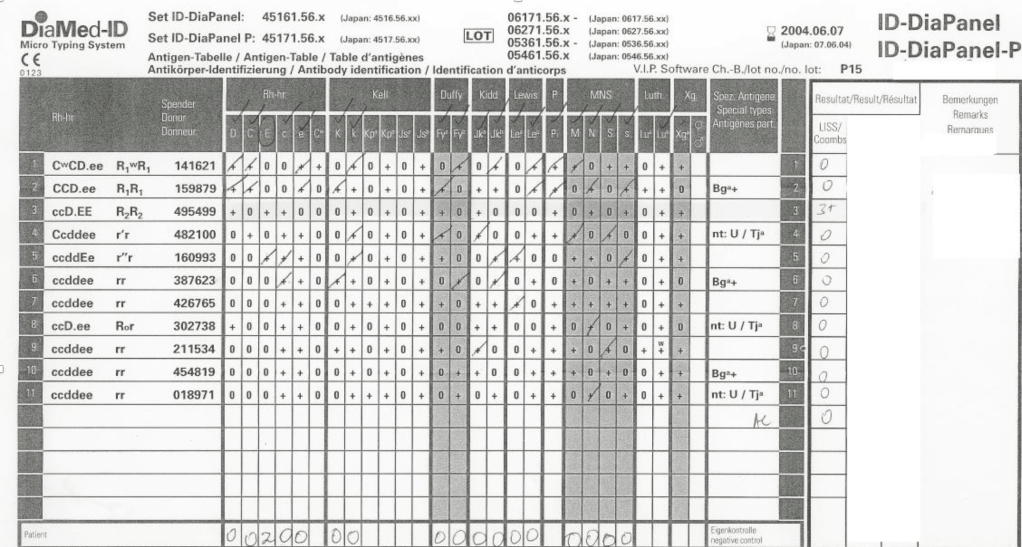
Here is another exercise, usually given to base medical technologists.  I have the staff review this panel and tell me to interpret it:

You just can’t solve this without the enzyme panel.  Will the staff member ask for this?  Will he note that the one cell reacting is homozygous for E?  Will he ask for extended antigen typing (the patient is R1R1)?

Projective Assessment 3

As a transfusion medicine physician, I must know if I can trust my staff’s interpretation of immunohematology testing.  I may be called at night and they will provide me with results and I must use these to make a medical judgment.  If their interpretation is flawed, I might make a decision that harms the patient.

I really don’t like multiple-choice questions, but nowadays this is often the norm.  For my staff, especially senior staff and those who want to be promoted to senior staff, I have developed a series of projective exercises to help me understand their thought processes.

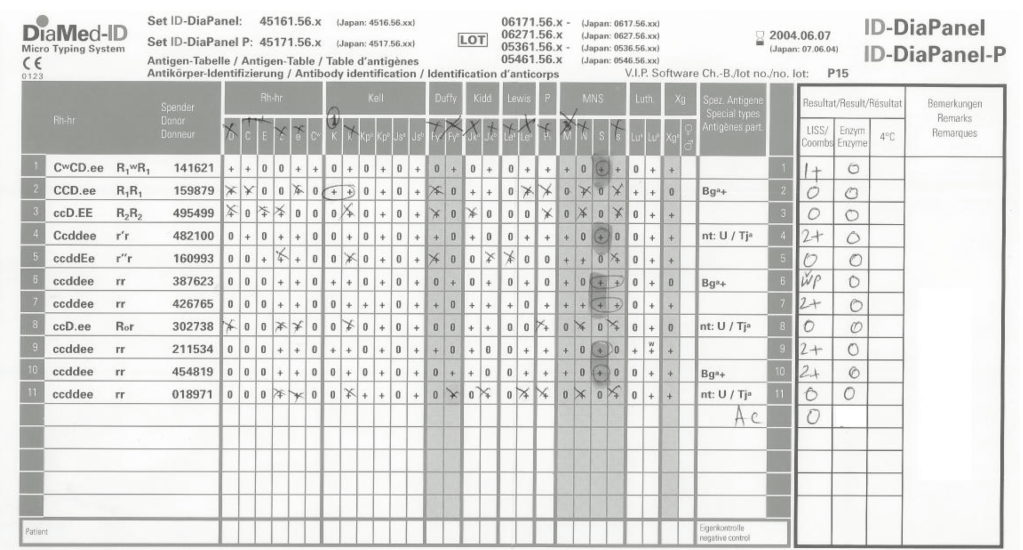
Here is another exercise, usually given to base medical technologists.  I have the staff review this panel and tell me to interpret it:

Everyone reports this is anti-S, enzyme-labile, but relatively few bother to ask for the S phenotype.  All were trained to check the phenotype as part of the workup.  I also had a version of this examination in which I only showed the AHG results.  Many did not ask to perform enzyme.

The proper answer was probable anti-S, enzyme-labile, but request S phenotype. If the enzyme had not been performed, then the enzyme panel results should be requested.