Processes and Software Building 43: Manual Whole Blood Processing

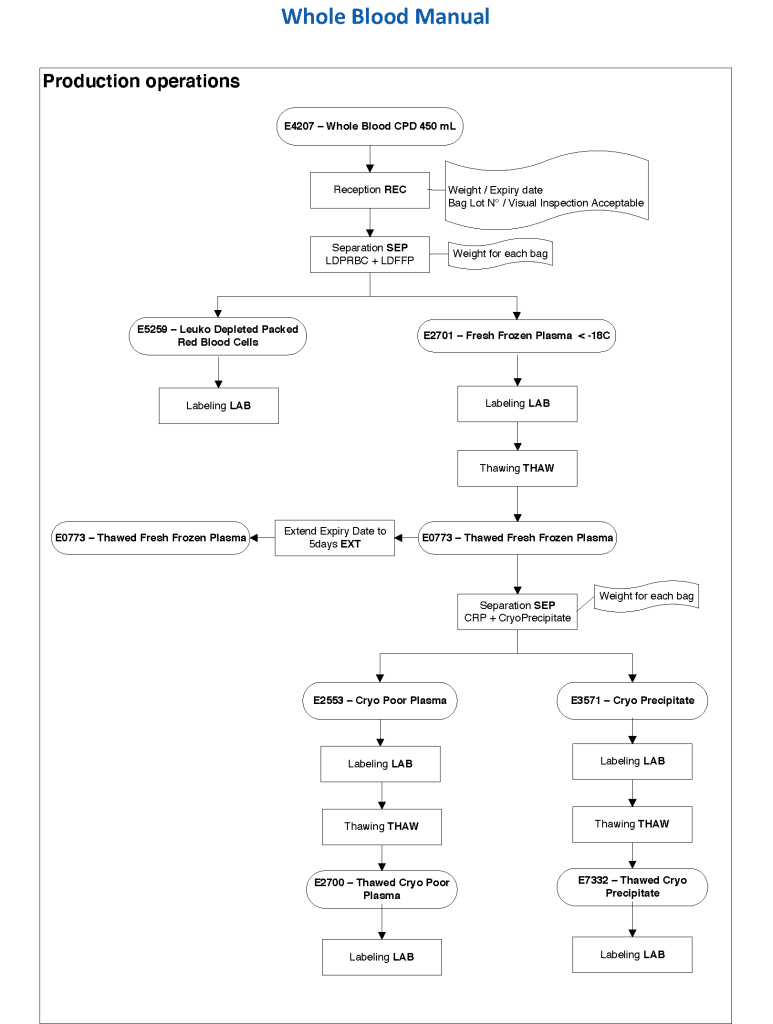
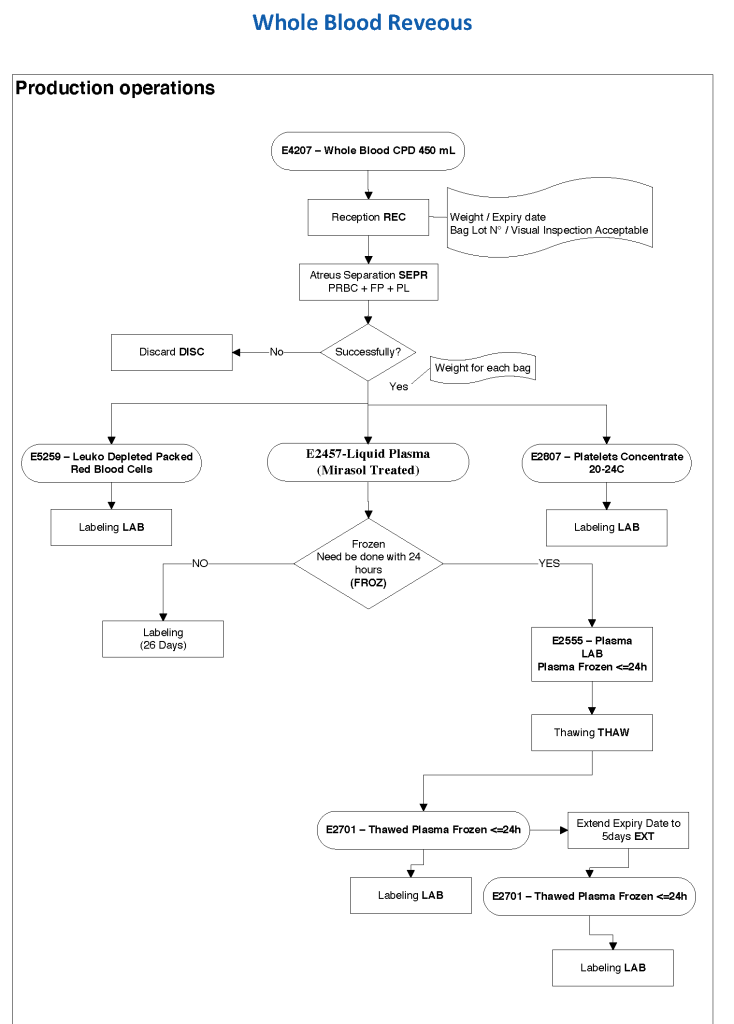
This was the HMC methodology for manual whole blood processing to prepare packed RBCs, plasma, cryoprecipitate, and cryo-poor plasma using blood bank centrifuges (not Reveos).  It did not include preparing platelets since we did not have manual buffy coat processing equipment.  In this algorithm we did not specifically release whole blood as a final product (although we did have the capability of activating this in emergency situations).

10/9/20

External Disaster Plan

Principle:

Maintaining an adequate blood supply and expedited compatibility testing are critical in disaster planning.  This plan is assuming that the Blood Donor Center is functional and can process donors and make components.

Medinfo Hematos IIG System is critical to monitoring inventory, preparing blood components expeditiously using Good Manufacturing Processes, and distributing blood components in a timely controlled manner.

Policy:

  1. Determinate total available blood supply across all locations by using the Cumulative Stock Display program in Medinfo Hematos IIG.
    1. Recheck stock at least every hour during the disaster.
  2. At each transfusion service site, in conjunction with the Transfusion Medicine Consultant:
    1. Cancel reservations for elective surgical and non-emergency medical cases of affected ABO/D types.
    2. Retain reservations for antigen-matched, oncology, NICU, and high-risk obstetrical cases.
  3. Inform Manager for Donor Recruitment/Logistics to send SMS, radio, and television messages for blood donors—all types.
  4. Contact ALL staff and have them report to duty.
    1. At Blood Donor Center, the Head Nurse, Recruitment Manager, Supervisor, Component Processing, and Supervisor, Marker Testing will contact their respective staff.
    2. At various hospital blood bank transfusion services, the site supervisor will contact all staff.
  5. Process blood components using automated component technology (Reveos).
  6. Perform all donor marker testing including single-well NAT.
    1. Abbreviation of donor testing is only at the discretion of the Head, Transfusion Medicine.
  7. Send blood components using Inter-Depot Transfer function of Medinfo.
  8. Transfusion Services:
    1. Release blood component according to the various protocols as needed:
      1. Massive transfusion protocol
      2. Emergency release
      3. STAT
      4. Priority
      5. Routine
  9. Compatibility testing will be electronic, immediate-spin, or full AHG as per our protocols.

References:

  1. Standards for Blood Banks and Transfusion Services, Current Edition, AABB, Bethesda, MD, USA
  2. Guidelines to the Preparation, Use, and Quality Assurance of Blood Components, European Committee (Partial Agreement) on Blood Transfusion (CD-P-TS), Current Edition

Revised 10/9/20

Processes and Software Building 42: Platelet Pooling

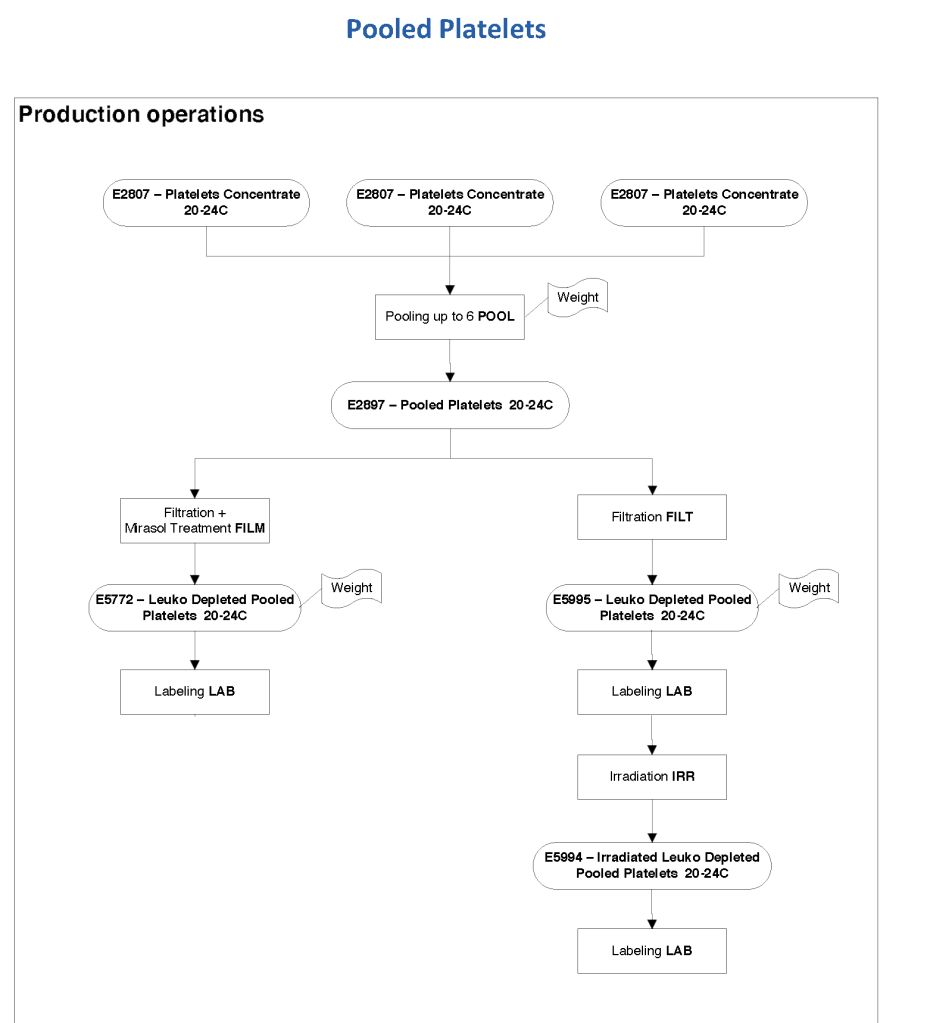
Outside the USA, platelet pools stored at room temperature may be valid for up to 7 days, especially if pathogen-inactivation is used.  The following workflow shows both Mirasol pathogen-inactivated and standard platelets.  The standard platelets are then irradiated.  Both types can be aliquoted.

A major advantage in using a specific blood bank computer software is to enforce the Good Manufacturing Process.  Medinfo is merciless:  there are no exceptions without authorization and that is restricted by the security policies.

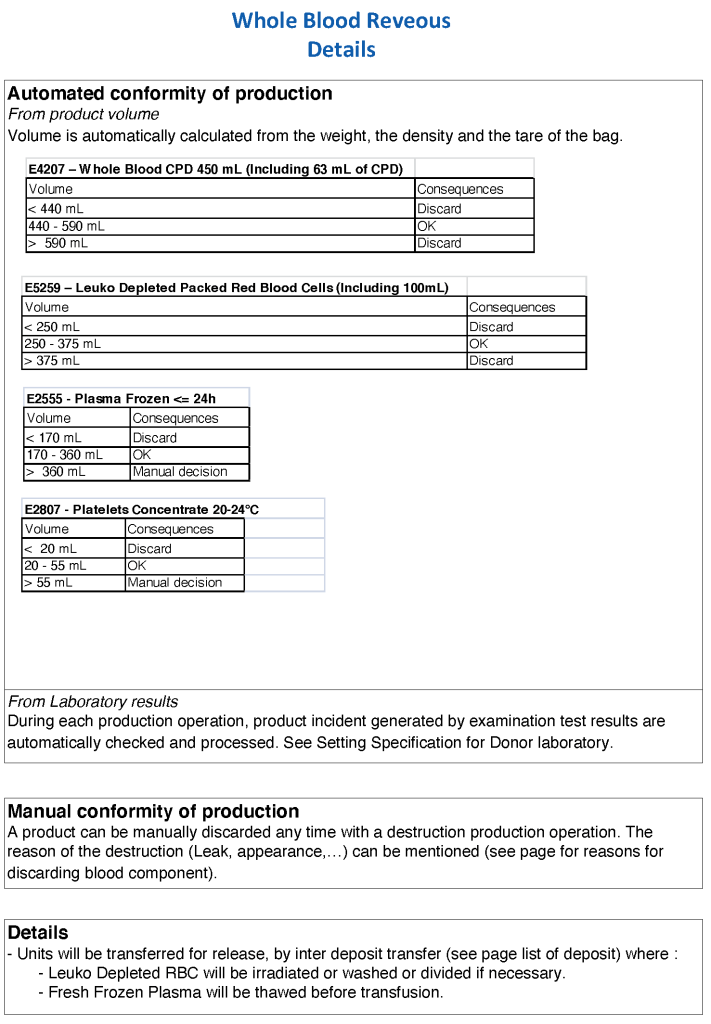
In the recent Reveos post, the upper and lower platelet volume specifications were discussed.  The platelets are weighed and the volume is calculated.  If a manual or another method for preparing platelets is used, then the according values can be specified.

To Be Continued:  8/9/20

Processes and Software Building 41: Off-Line Medinfo Donor Transactions

Principle:

Normally, outside donor campaigns still connect to the main server via wireless 4G/5G with a VPN.  However, if there is a “dead” spot, Medinfo can provide a local area network using one of the PCs/laptops to serve as a server.  The local server receives an uploaded image of the donor database.  Upon return to the donor center, the local server’s data is uploaded and synchronized.

When you cannot establish a direct link to the live Medinfo program, you must arrange for Medinfo/VHT to create a local server that will have the current Medinfo donor database for use at outside campaigns where the internet connection cannot be used.  This can also be used if for some reason the Blood Donor Center link is down in order to register donors and check the donor deferral database.

Policy:

  1. For each outside campaign, there should be a pre-campaign visit to verify the availability of internet to connect to Medinfo.
    1. If the internet connection is working, use Medinfo using the 4G/5G access points.  Otherwise:
    2. If none, inform Medinfo/VHT to prepare a local server—at least ONE DAY in advance of the campaign.
      1. Provide Medinfo/VHT one of the portable computers to download the database and software.  This will be the offline server for the campaign.
      2. Link the offline server to the other portable computers for the campaign (see the corresponding Medinfo job aid).
      3. Use the local network (offline server and other portable computers) for registering donors.
      4. Upon return to the Blood Donor Center, upload the data as indicated in the Medinfo job aid.
      5. Continue the regular processes after uploading.

7/9/20

Processes and Software Building 40: Reveos Detailed Settings

A major advantage in using a specific blood bank computer software is to enforce the Good Manufacturing Processes.  Medinfo is merciless:  there are no exceptions without authorization and that is restricted by the security policies.

The following tables show the values established at HMC Doha during my tenure.  These values were recommended by the Terumo BCT Reveos engineer after his direct, hands-on set-up of the equipment.

The minimum and maximum volumes for platelets are specifically designed to work for pooling the buffy coats before Mirasol pathogen inactivation.  There are different settings for platelets suspended in plasma versus those suspended in platelet additive solution PAS.

Similarly, there are specific volume ranges for plasma so that pathogen inactivation can be performed according to Terumo BCT recommendations.

To Be Continued:  4/9/20

Processing and Software Building 39: Atreus and Reveos

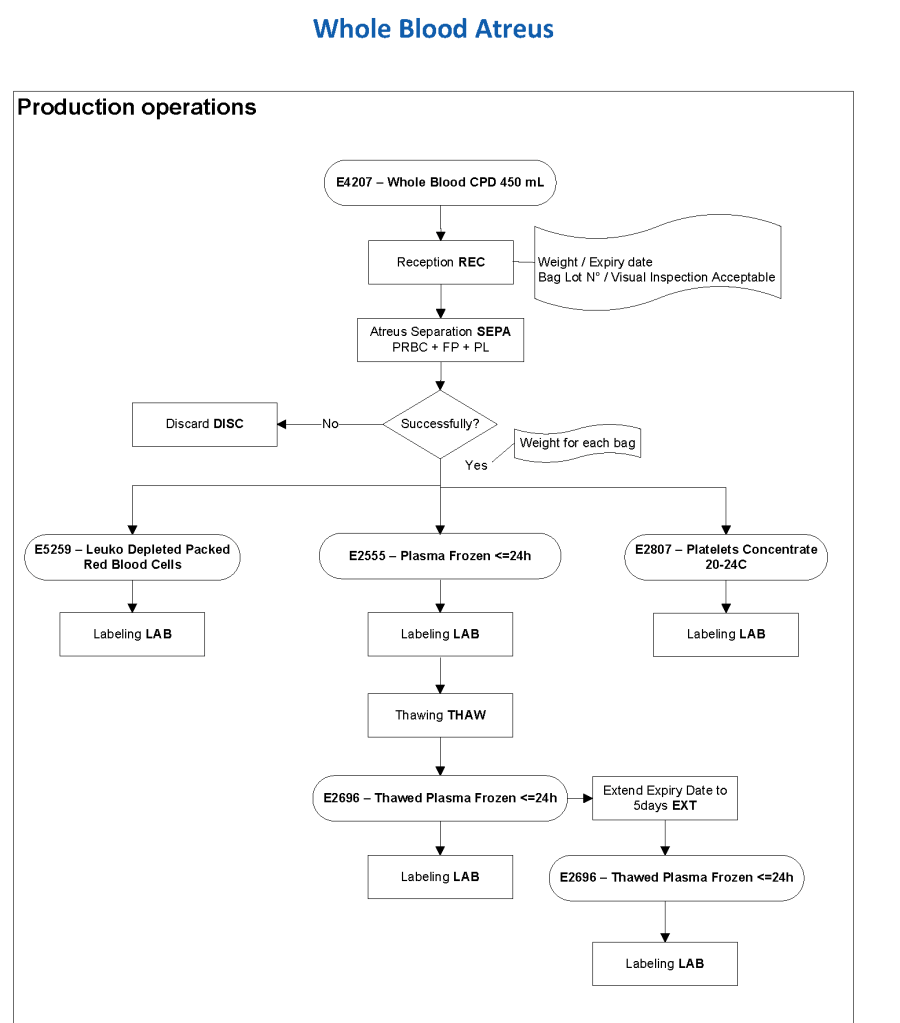
Automated component processing is an almost hands-free separation of into packed RBCs (ready for leukodepletion), buffy coat platelets (ready for pooling), leukodepleted plasma, and a residual buffy coat.  The older Atreus device takes about 10 minutes for one whole blood unit whereas the newer Reveos device needs slightly more than 20 minutes to process four whole blood units.  At the end of processing:

  1. RBCs are ready for leukodepletion using the integral filter provided with the kit.
  2. Plasma is ready for pathogen-inactivation and freezing.
  3. Buffy coat platelets are ready for pooling using the Platelet Yield Index PYI.
    1. Further processing (filtration and Mirasol treatment) occurs if the donor marker testing results pass
  4. Residual buffy coat is not a clinical product but may be used for quality control for stem cell processing and/or cell line expansion

The process in Medinfo is as follows:

  1. Receive the whole blood units for processing by reading the ISBT specimen barcode.
  2. Collection data (volume, time to complete collection, time of collection, etc.) is transferred to the component processor.
  3. Select the processing machine:  Atreus vs. Reveos
  4. Select the protocol:  2C (RBCs and plasma) versus 3C (RBCs, platelets, and plasma)
  5. Further processing as per the flow diagrams.

At HMC Doha, Medinfo developed the first bidirectional interfaces to both Reveos and Atreus.

To Be Continued

2/9/20

Processes and Software Building 38: Component Processing Overview

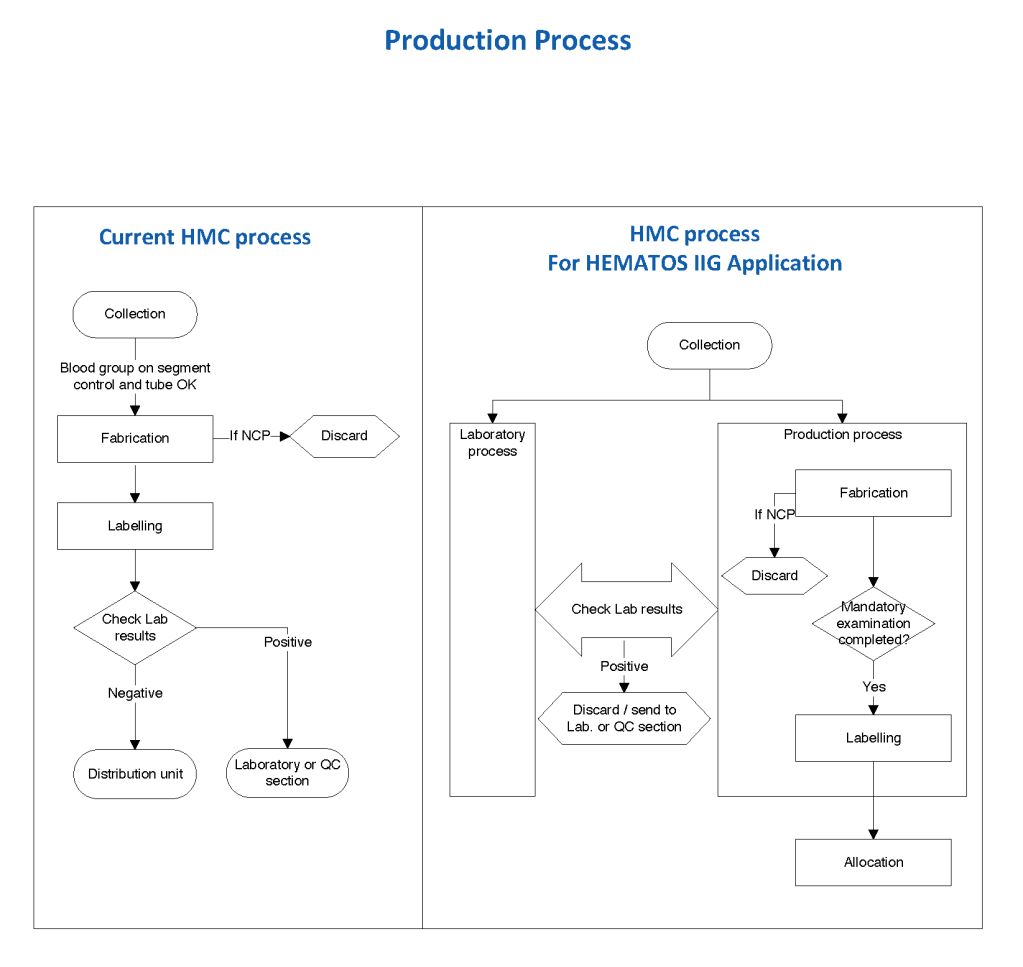
As with each major area of Transfusion Medicine, a current state is captured.  From this, a future state overview is then developed.

At this time, the client should study his current state and the future state and see how he can bolster the critical control points and build them into the processes.

In this series of posts, we will consider:

  1. Component production by Reveos automated component processing
  2. Component production by Atreus automated component processing—replaced by Reveos
  3. Manual component processing
  4. RBC leukodepletion
  5. Platelet pooling
  6. Mirasol pathogen inactivation for platelets and plasma
  7. Platelet production with platelet additive solution PAS
  8. Cryoprecipitate and cryo-poor plasma production
  9. Labelling

The example of current and future state shown is what Medinfo and I built for HMC Doha:

To Be Continued

1/9/20

Processes and Software Building 37: Donor Marker Testing–Final Comments

This series of the processes for donor marker testing has demonstrated the complexity and flexibility of designing processes.  In Medinfo, you can custom-design the criteria based on your local, national, and international requirements.  The end-user client must specify what he wants, and I reiterate:  Be careful what you ask for, you may get it.  Seek assistance if you are uncertain of what to use.

My criteria were based on several international standards, e.g. AABB, US FDA, CE, and Australian.  I strongly recommend you start with a set of standards and localize it for your needs.

For example, US FDA/AABB do not have a screening criteria for brucellosis since it is rare in their jurisdiction.  However, it is relatively common in the Middle East so I added a donor screening question for it.  International AABB does allow for variance with US FDA criteria so if you are outside the USA, embrace this.  The advantage of customizable software allows you do localize it to your needs.  A turnkey system, e.g. from the USA, may not allow such changes.

Finally, there are emerging pathogens that are constantly changing the donor criteria (e.g. SARS-CoV-2, MERS, SARS, Zika).  The software must be robust and allow rapid alteration to meet new donor screening criteria.  This is a constant uphill battle and requires a lot of time to keep up and validate any changes.

Complete Interim Policy on Marker Testing

For your reference, the following is the complete set of marker testing algorithms I used just before I left HMC Doha:

Definitions:

Positive result for EIA means S/CO ratio >= 1.0

Positive result for LIA means particular pattern of bands as defined by the manufacturer

Indeterminate result for LIA means presence of bands not meeting positive criteria

  1. Hepatitis B:
    1. HBsAg non-negative, then:
      1. HBsAg positive with HBsAg confirmatory positive, regardless of other results:  permanent deferral, refer to Infectious Disease clinic
      2. HBsAg positive with HBsAg confirmatory borderline or negative, repeat all HBV testing after 8 weeks
      3. HBsAg borderline:  repeat all HBV testing after 8 weeks
      4. HBV-DNA positive confirmed, regardless of other results:  permanent deferral, refer to Infectious Disease clinic
    2. If HBcAb positive, repeat after 8 weeks
    3. Repeat Hepatitis B Testing After 8 weeks:
      1. HBsAg positive with HBsAg confirmatory positive:  permanent deferral, refer to Infectious Disease clinic
      2. HBsAg positive with HBsAg confirmatory borderline or negative:  permanent deferral, refer to Infectious Disease clinic
      3. HBsAg borderline, permanent deferral, refer to Infectious Disease clinic
      4. HBV-DNA positive confirmed:  permanent deferral, refer to Infectious Disease clinic
      5. HBcAb positive or borderline with negative HBsAg and negative HBV-DNA:  review HBsAb level:
        1. If HBsAb level >= 100 mIU/mL (100 IU/L), donor may be reentered
        2. If HBsAb level < 100, then recommend to donor to receive booster HBV vaccine
          1. After HBV vaccine administration, retest after 30 days:
            1. If HBsAb level >= 100, donor may be reentered
            2. If HBsAb level < 100, donor is indefinitely deferred
      6. HBsAg, HBcAb, HBsAb all negative:  reenter into donor pool
  • Hepatitis C:
    • HCV-RNA positive confirmed, regardless of other HCV results:  permanent deferral, refer to Infectious Disease clinic
    • HCV-RNA borderline:  repeat all HCV testing after 6 months
    • HCV-InnoLIA positive, regardless of other HCV results:  permanent deferral, refer to Infectious Disease clinic
    • HCV-InnoLIA indeterminate:  repeat all HCV testing after 6 months
    • HCV-Ab positive, HCV-RNA negative, do HCV-InnoLIA:
      • If HCV-InnoLIA positive, permanent deferral, refer to Infectious Disease clinic
      • If HCV-InnoLIA indeterminate or negative, repeat all HCV testing after 6 months
    • Repeat Hepatitis C Testing After 6 months:
      • HCV-RNA or HCV-InnoLIA positive:  permanent deferral, refer to Infectious Disease clinic
      • HCV-RNA or HCV-InnoLIA borderline:  permanent deferral, HCV infection not confirmed
      • HCV-Ab positive or borderline without positive HCV-RNA or positive HCV-InnoLIA:  permanent deferral, HCV infection not confirmed
      • HCV-Ab negative, HCV-RNA negative, HCV-InnoLIA negative:  reenter donor into donor pool
  • HIV Testing:
    • HIV-RNA positive confirmed, regardless of other HIV results:  permanent deferral and do HIV-InnoLIA, refer to Infectious Disease clinic
    • HIV-RNA borderline:  do HIV-InnoLIA
    • HIV-InnoLIA positive, regardless of other HIV results:  refer to Infectious Disease clinic
    • HIV-InnoLIA indeterminate:  repeat all HIV testing after 8 weeks
    • HIV Ab positive with negative HIV-RNA and/or borderline/negative HIV-InnoLIA:  repeat testing after 8 weeks
    • Repeat HIV Testing After 8 Weeks:
      • HIV RNA positive and/or HIV-InnoLIA positive, regardless of other HIV results:  refer to Infectious Disease clinic
      • HIV-InnoLIA and/or HIV antibodies indeterminate:  permanent deferral, HIV infection not confirmed
      • HIV Ab negative and HIV-RNA negative and HIV-InnoLIA negative:  reenter into donor pool
  • HTLV 1/2 Testing:
    • HTLV Antibodies positive, then do HTLV-InnoLIA:
      • HTLV InnoLIA positive for HTLV-1 and/or HTLV-2:  refer to Infectious Disease clinic
      • HTLV InnoLIA indeterminate or negative, repeat HTLV Ab and HTLV InnoLIA testing after 6 months
    • Repeat HTLV Testing After 6 Months:
      • HTLV 1/2 antibodies positive, permanent deferral and do HTLV InnoLIA
      • HTLV 1/2 antibodies indeterminate,  permanent deferral and do HTLV InnoLIA
      • HTLV InnoLIA positive for HTLV-1 or HTLV-2: refer to Infectious Disease clinic
      • HTLV InnoLIA indeterminate, donor permanently deferred.
        • Issue letter HTLV-Not Confirmed
      • HTLV 1/2 Ab negative and HTLV InnoLIA negative, reenter donor.
  • Malaria Testing:
    • Defer donor if he has been in malarial endemic zone within the past 3 months
    • If travel to malarial zone > 3 months, do malarial antibody testing:
      • Malaria antibody negative:  no deferral
      • Malaria antibody positive, perform malarial antigen test:
        • Malaria antigen test positive, refer to Infectious Disease clinic—defer until 3 years after cessation of treatment
        • Malaria antigen test negative:
          • Plasma may be collected
          • RBCs and platelets must be destroyed.
        • Repeat malarial antibodies after 3 years:
          • If malarial antibody test positive, donor must not be used for RBC components but may be used for plasma production
          • If malarial antibody test negative, reenter donor for all components
    • Defer donor if he has received malarial treatment (not prophylaxis) for 3 years
      • Perform both malarial antibody and antigen testing:
        • Defer based on section 5.2
  • Syphilis Testing:
    • Syphilis Ab test positive or indeterminate:  do InnoLIA-Syphilis test
      • InnoLIA-Syphilis test positive:  permanent deferral, refer to Infectious Disease clinic
      • InnoLIA-Syphilis test borderline or negative:  defer for 1 year, then repeat all syphilis testing.
    • Repeat Syphilis Testing after 1 Year:
      • Syphilis antibody testing negative, reenter into donor pool
      • Syphilis antibody positive or borderline:  do InnoLIA-Syphilis test
        • InnoLIA-Syphilis test positive:  permanent deferral, refer to Infectious Disease clinic
        • If InnoLIA-Syphilis borderline or negative:  permanent deferral, syphilis not confirmed

References:

  1. Revised Recommendations to Reduce the Risk of Transfusion-Transmitted Malaria, Guidance for the Industry, US Department of Health and Human Services, FDA, Center for Biologics Evaluation and Research CBER, April, 2020
  2. Use of Serologic Tests to Reduce the Risk of Transfusion-Transmitted Human T-Cell Lymphotropic Viruses Types I and II, Final Guidance for Industry, February 2020
  3. Draft Guidance for Industry:  Recommendations for Requalification of Blood Donors Deferred Because of Reactive Test Results for Antibodies to Human T-Lymphotropic Virus Types I and II (anti-HTLV-I/II), CBER, September 2018
  4. Guidance for Industry:  Nucleic Acid Testing (NAT) for Human Immunodeficiency Virus Type 1 (HIV-1) and Hepatitis C Virus (HCV): Testing, Product Disposition, and Donor Deferral and Reentry, US Department of Health and Human Services, Center for Biologics Evaluation and Research CBER, May 2010
  5. Guidance for Industry:  Requalification Method for Reentry of Blood Donors Deferred Because of Reactive Test Results for Antibody to Hepatitis B Core Antigen (Anti-HBc), US Department of Health and Human Services, Center for Biologics Evaluation and Research CBER, May 2010
  6. Product inserts, InnoLIA-Syphilis/HCV/HIV/HTLV, Immunogenetics, Singapore
  7. Malaria Section, Australian Red Cross brochure, 2007

25/8/20

Processes and Software Building 36: Donor Nucleic Acid Testing

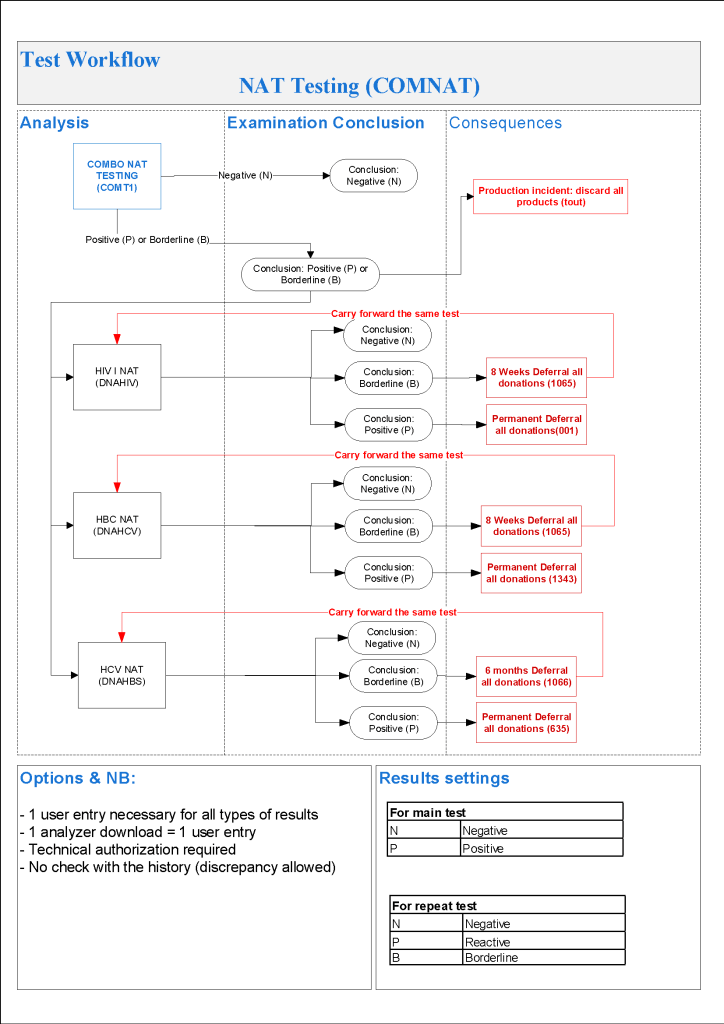
In Medinfo, criteria for donor screening may be based on one test (e.g. Hgb), a group of tests taken together (HBsAg, HBcAb, HBsAb), or separate sets of donor testing criteria.  Nucleic Acid Testing NAT is considered separate from the EIA, LIA, and Ag tests.  In any case, when there is a combination of both acceptable and deferrable results, the longest deferral is applied as the deferral or contraindication, e.g. a temporary deferral is replaced by a permanent deferral.

Our NAT testing at HMC Doha consisted of a combination combo test.  If this was non-negative, then individual HIV 1-2, HCV, and HBV NAT testing were performed.  For speed, we used single-well testing for each donor.  However, it is very easy to build pooling into the algorithm if that is preferred by the client:

To Be Continued:

24/8/20

Processes and Software Building 35: Donor Malaria Test Screening

Processes and Software Building—Part 35:

Malaria Testing Donor Screening Process

Zeyd Merenkov, MD, FCAP, FASCP

Independent Consultant in Transfusion Medicine and Information Technology

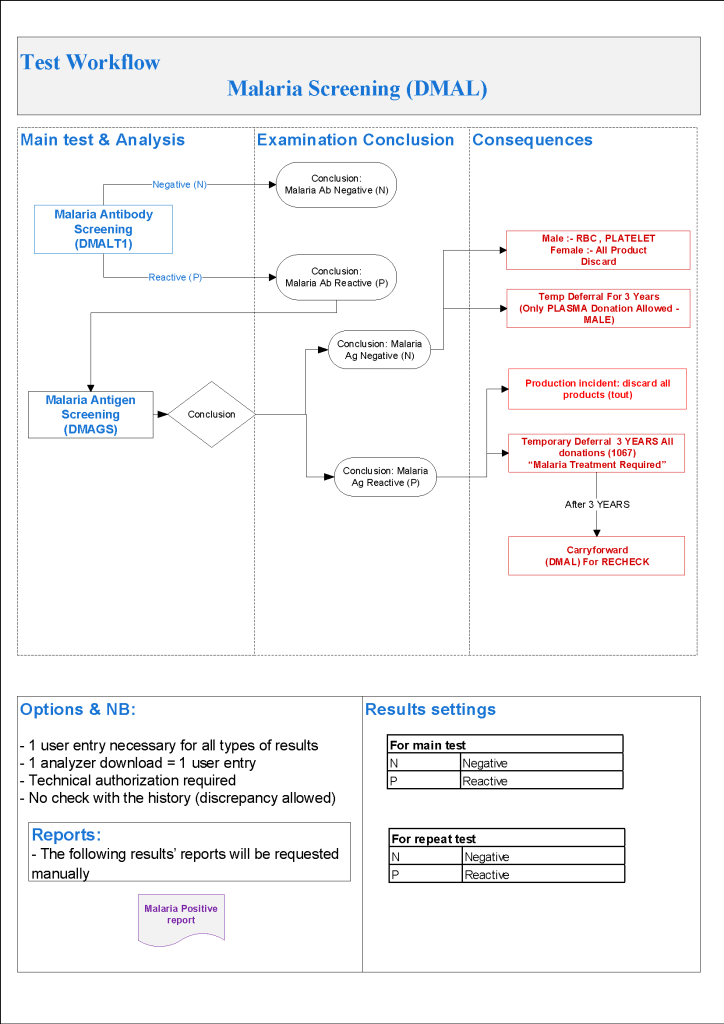
The malaria screening varies considerably by country.  I chose for Qatar to follow a combination of WHO and Australian guidelines as per the attached criteria.  We used a malaria antibody screen and malaria antigen test.  There are many alternate approaches, including using a malaria NAT.  The actual specification was:

  1. Malaria Testing:
    1. Defer donor if he has been in malarial endemic zone within the past 3 months
    2. If travel to malarial zone > 3 months, do malarial antibody testing:
      1. Malaria antibody negative:  no deferral
      2. Malaria antibody positive, perform malarial antigen test:
        1. Malaria antigen test positive, refer to Infectious Disease clinic—defer until 3 years after cessation of treatment
        2. Malaria antigen test negative:
          1. Plasma may be collected
          2. RBCs and platelets must be destroyed.
        3. Repeat malarial antibodies after 3 years:
          1. If malarial antibody test positive, donor must not be used for RBC components but may be used for plasma production
          2. If malarial antibody test negative, reenter donor for all components
    3. Defer donor if he has received malarial treatment (not prophylaxis) for 3 years
      1. After 3 years, perform both malarial antibody and antigen testing:
        1. Defer based on section 5.2

The Medinfo testing algorithm follows:

To Be Continued:

22/8/20