Anecdotes: Outside Software Consultants

Sometimes, you may not have adequate resources for a project so you will consider hiring an outside consultant.  During my career, I have used several outside consultants for projects ranging from installing a new general laboratory computer system to assisting in getting international accreditations.

Regrettably, my experience with software consultants has been mixed.  I have used them for general laboratory software installation and settings.  Very few have any experience with dedicated blood bank software or setting up hospital blood bank modules.  They are often former employees of the software vendor you are using.  There is always a potential for conflict of interest.

The software consultant must work for you, NOT for the vendor you are using.  He/she must maintain his independence from the vendor and only represent your interests.  I have had many problems with this.  Here are some of my unpleasant experiences:

Current and Future States:

One set of consultants gave essentially the following current state mapping for almost every test in our menu:

  • Order this.
  • Collect this.
  • Receive this.
  • Perform this.
  • Release this.

They did not know our current state so they were unable to help us build a proper future state.

Mapping Errors:

The consultants were in charge of exporting results from a previous system into the new one, this included mapping the results into the appropriate test fields.  They assumed it would map properly, I insisted on testing a two-week sample of laboratory results and discovered major errors that could adversely affect patient care—it was a major disaster and almost held up implementing a hospital go-live on-time.

Benefits of New Software:

The consultants were obsessed with calculating benefits of the conversion to the new software vendor and making fancy PowerPoint presentations to assure officials that they were gaining benefits.  There were many issues to resolve that were critical to the functionality that I felt the time would have been better spent in fixing the software issues than calculating alleged benefits.

The Need for Speed:

There were some consultants without any experience in blood bank who insisted that this had no bearing in making software settings.  One bragged to me that he could install a blood bank system in a few days.

Default Settings:

Some outside consultants kept pushing using the default settings.  There is no “one size fits all” solution for a large healthcare organization.  There is need for customization.  I wondered why we needed the consultants to set up default settings which is what the vendor wanted us to do anyway.
Opinion: Outside Accreditation and Quality Consultants

Sometimes, you may not have adequate resources for a project so you will consider hiring an outside consultant.  During my career, I have used several outside consultants for projects ranging from installing a new general laboratory computer system to assisting in getting international accreditations.

For a complex accreditation process such as AABB, I have used such consultants to audit operations in the donor center including processing and testing, hospital blood banks, and stem cell laboratory.  They are high-level technical specialists with highest blood bank qualifications (e.g. SBB(ASCP) or equivalent) and have considerable experience in practice of blood banking and quality systems.  They have been AABB Assessors so they can give you a dry-run accreditation assessment.
Depending on the project, you may need one or a group of consultants.  I have worked with both individual consultants and groups.  A group can complete the tasks quicker but this is not always necessary.  Organizations such as AABB have many different consultants with different types of expertise so you can select the most appropriate individuals to form a team for your needs.

These specialists can audit your operations and propose a model and if you want, actually help you to implement the processes.  They can help you with the accreditation formalities, especially if you do not have any staff with experience in the process.  It all depends how much you can spend.

In the Middle East, to bring in such consultants may mean expensive air fares, hotels, meals, plus the actual costs of doing the consulting.  This is a major investment for your organization but it is well worth it to expedite the process.  There are local consultants available as well and using them may greatly help with the expenses.

Although it is expensive upfront, it can be cheaper in the long run by establishing the appropriate framework in the first place.  You can engage the consultants to actually do much of the work themselves, but it is better for them to offer a train the trainer experience, i.e. engage your own technical staff to learn new skills and then have them cross-train the rest of the staff. 

Based on the findings, your local staff can implement the changes.  You can then consider rehiring the consultants to verify that the work has been done properly.

I have used both individual consultants and groups through AABB Consulting.  My staff and I have learned much from such interactions, and I highly recommend their use when local expertise is not available.

Process: Donor Medical Questionnaire

This is one of a series of posts comparing policies and processes in the blood bank.

PROCESS:  5.2.1 DONOR QUESTIONNAIRE

Process:

  1. The donor is positively identified by a designated picture ID and Medinfo Hematos donor consent form with specimen/encounter number and barcode.
  2. Donor is taken to a private area for the interview.
  3. Donor is asked ALL questions by Donor Center staff using the Hematos IIG questionnaire.
  4. Hematos IIG determines if any contraindications apply.
  5. Questionnaire will be referred to transfusion medicine physician for any questions requiring physician review.
  6. Donors without contraindication are sent for donor physical examination.

References:

  1. HMC 1001 Setting Specification, Version 1.5, Hematos IIG, Medinfo
  2. Standards for Blood Banks and Transfusion Services, Current Edition, AABB, Bethesda, Maryland, USA

Policy: Donor Medical Questionnaire

This is one of a series of posts on blood bank operations, comparing the process and policy documents.

5.2 POLICY:  DONOR MEDICAL QUESTIONNAIRE

Policy:

  1. All policies, processes, and procedures must comply with Qatari, HMC, and applicable accreditation standards (i.e. AABB, CAP, and JCI).
  2. All donors will be positively identified with a picture ID and by their Medinfo Hematos identifiers (donor ID and session registration/specimen number).
  3. Donors will be assessed confidentially in a private area.
  4. Donors will be asked questions based on the latest Uniform Donor Questionnaire with additional localization questions for Qatar using Medinfo Hematos IIG software.
  5. Donor must understand either English or Arabic.
    1. Otherwise, they cannot be accepted for donation.
  6. Donors passing the donor questionnaire will be processed for the donor physical examination.

References:

  1. HMC 1001 Setting Specification, Version 1.5, Hematos IIG, Medinfo
  2. Standards for Blood Banks and Transfusion Services, Latest Edition, AABB, Bethesda, Maryland, USA

Processes and Software Building 5: Processes

This is revision of a previous post.

Building Processes:

This post is mainly on building processes for a non-turnkey system such as the Medinfo Hematos IIG software that I have worked with in several countries, but there will be a few words about turnkey systems for general laboratories.

This has been a collaborative effort between the software vendor’s engineers, my Super Users, and myself.  This pluralistic approach has been most productive.

A turnkey system has pretty much already defined most of the basic processes—those have been specifically approved by a regulatory agency such as US FDA.  There is little customization except formatting screen and reports.  Instrument interfaces are also mainly predefined.  This requires much less thought and planning than a custom-built system designed on the sites actual workflows, but it can be an exercise of putting a round peg in a square hole.  You don’t always get what you want.

In the locations where I collaborated in setting up the Medinfo Hematos IIG program, we did not follow US FDA but mainly the Council of Europe CE standards since this was much more customizable.  Additionally, we could modify and add additional criteria specific to our country and region (e.g. rules for donor qualification for local pathogens).  This has always been my preferred approach.

Start with a frame of reference (CE) and then try to optimize it for our local needs. 

I recommend the Council of Europe CE since it is more flexible and extensible.  Those subject to the US FDA has many fewer approved options in the preparation of blood components (e.g. prohibiting the use of pooled buffy coat platelets, automated blood component production such as Reveos, and use of world-class pathogen-inactivation technologies such as Mirasol.)

If you invested the time to make a detailed workflow across all current processes and tests, much of this can be readily translated into the software processes, but first you must study the flows and determine where you can optimize them.  This requires that you study the options in the new software to see what you can use best.

I always liked Occam’s Razor, i.e. “ntia non sunt multiplicanda praeter necessitatem,”—the simpler the better as long as it meets your needs.  If the manual processes are working well and can be translated into the new system, do so.  If they need changes for optimization, then do so only if necessary.

Most of my career has been spent overseas with staff from many different countries and backgrounds, most of whom were not native in English.  The wording of the processes is very important.  Think of the additional obstacle of working with a complicated software in your non-mother tongue!  Also consider the differences between American English, British English, and international English.  I always made the Super Users read my proposed specifications and then asked them to repeat what I wrote/said.

There were many surprises discovered.  I think of the Aesop’s fable about the mother who gave birth to an ugly baby looking like a monkey.  Still, to the mother her baby was the most beautiful baby and she entered him into a beauty contest.  In other words, to the mother her child is perfect!

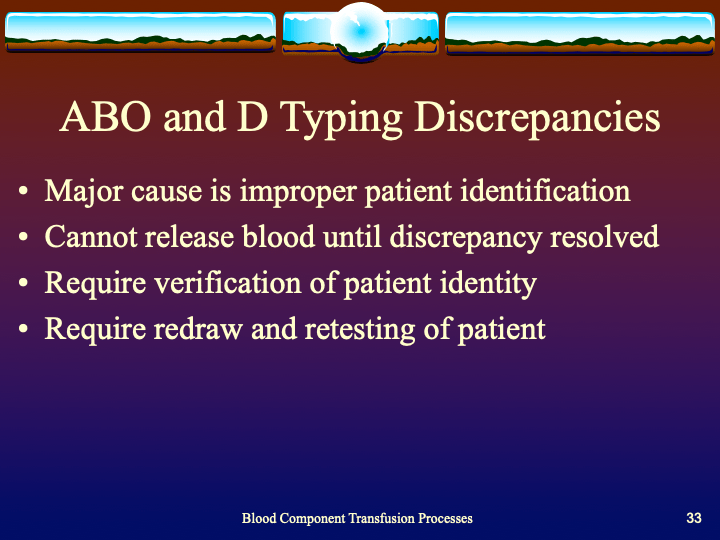
It is most important to use the manufacturer’s recommendations to build tests and for the special automated processing and pathogen-inactivation processes.  For example, we had multiple ABO and D typing tests—they did not necessarily agree on what were acceptable results for automated release of results.  The same is true for many other tests.

Example:  One method for Rh(D) typing stated that only results in {0, 2+, 3+, 4+} were acceptable—all other results required manual review and/or additional testing.  Another only accepted results in {0,3,4}.  Thus we had to build separate D typing processes for each methodology.

Another consideration is whether to offer all the processes globally or restricted to one site.  I favor allowing access to all methodologies at all sites—in case of a disaster where tests had to performed at another site.   This means that if you send an order over an interface from the hospital system to the blood bank system, that at the receiving (blood bank) end, you can choose which methodology to use, i.e. it is not a one-to-one mapping but rather a one to many mapping.

If we changed equipment at one site to that used at another site, we didn’t have to modify our software to accommodate this.  Even if you didn’t have the equipment or reagents at one site, you could always build it into the system and not activate the settings until needed.

Finally, the issue of middleware.  Many instruments offer this, but one faces the problem about support and regression errors when you either update the middleware software or the blood bank computer software.  Medinfo itself can serve as the middleware so there is less chance of errors when updating the software.  In fact, I never have used any middleware when using Medinfo.

Instrument interfaces will be a future topic.

Case Study: Importance of Enzyme Panels in RBC Antibody Workups

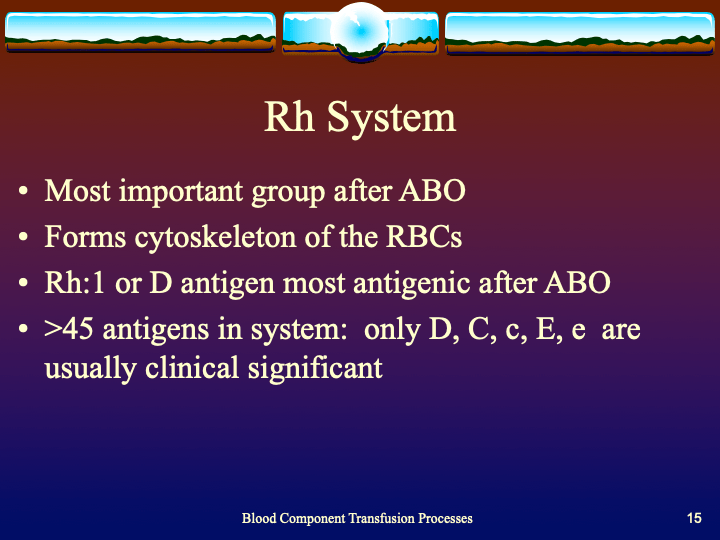
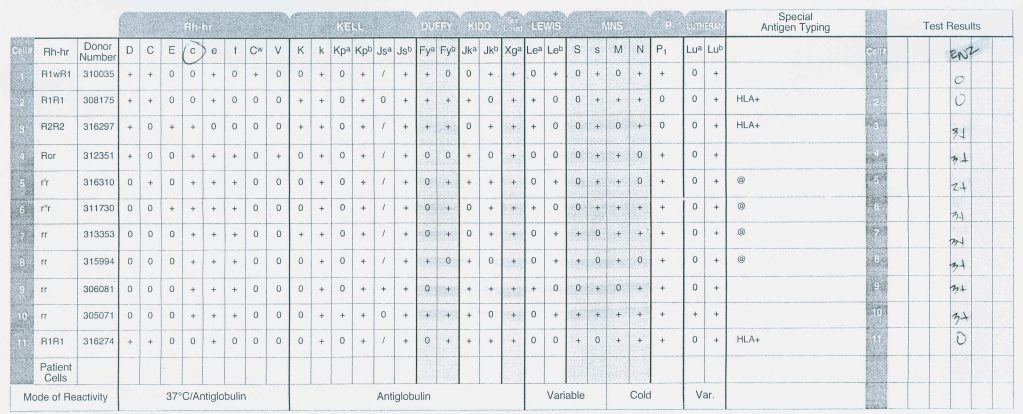
I am a strong believer in performing both AHG and enzyme panels together in routine antibody workups.  I especially feel this is important when the patient is R1R1 since I always want to rule out anti-c.  Sometimes, anti-c is only identified in the enzyme phase.

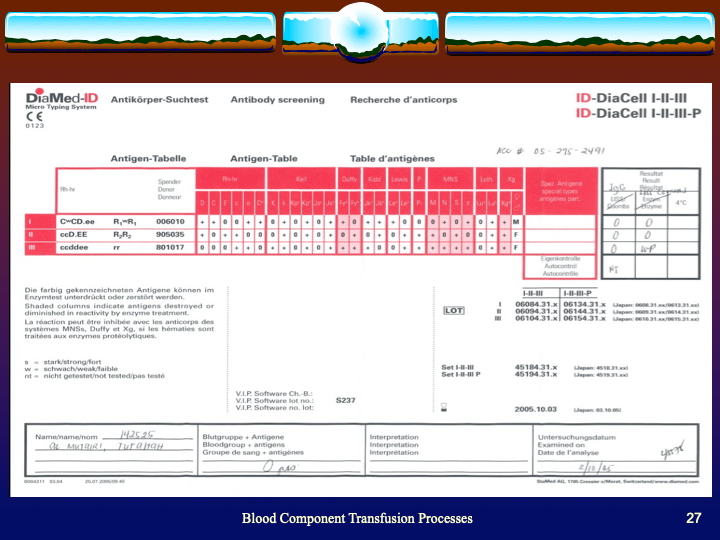
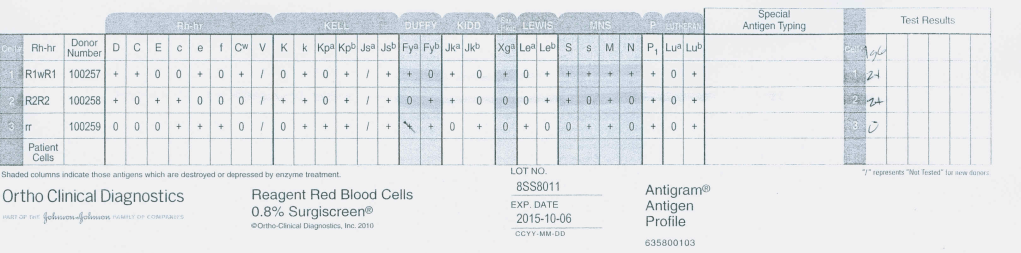
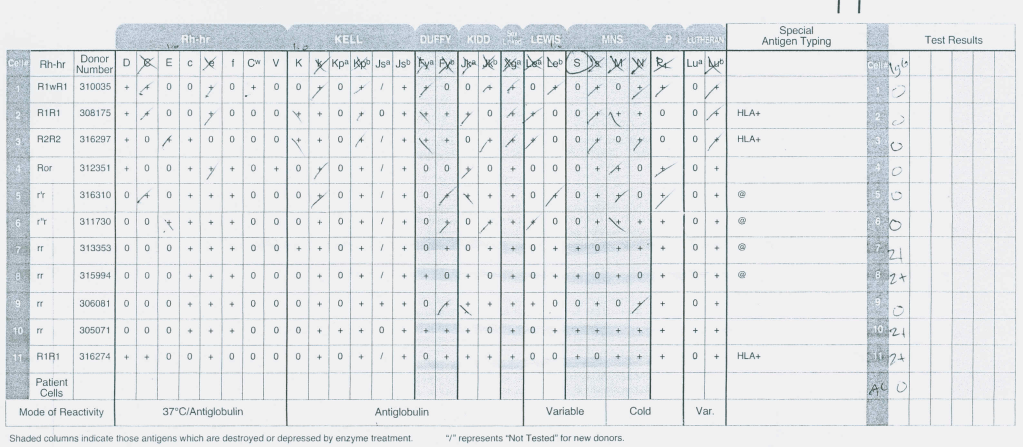
This is a case from my files of an R1R1 patient with the following results:

Antibody Screen:

AHG Panel:

Enzyme Panel (Ficin):

This anti-S is enzyme-labile but anti-c is revealed, only reacting at enzyme phase.  The patient was Kell-negative so I selected S-negative, R1R1 K-negative RBCs for transfusion.  Anti-c can be a dangerous antibody causing severe hemolytic disease of the fetus/newborn and sever hemolytic transfusion reaction.  If only the AHG panel had been performed, the anti-c would have been missed.

Hypotonic Saline to Phenotype Multiply Transfused Sickle Cell Patient

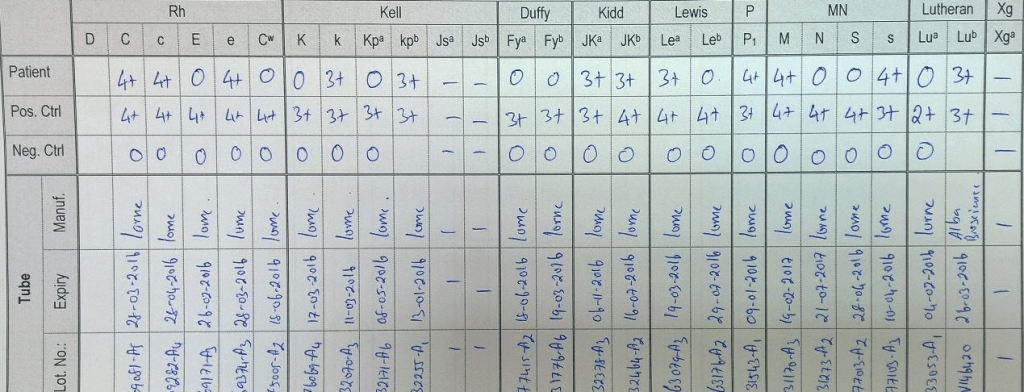
Nowadays, if we have a multiply transfused patient with a complex antibody pattern, we might resort to RBC genotyping to help us resolve the antibody issues.  Fortunately, there is one situation where we can quickly phenotype the patient by using hypotonic saline to lyse the transfused RBCs since the sickle cells are resistant.

The results can be quite clean and easy to interpret as in the following example using 0.4% saline:

It is a lot cheaper to make dilute saline than an RBC genotype—and much quicker!