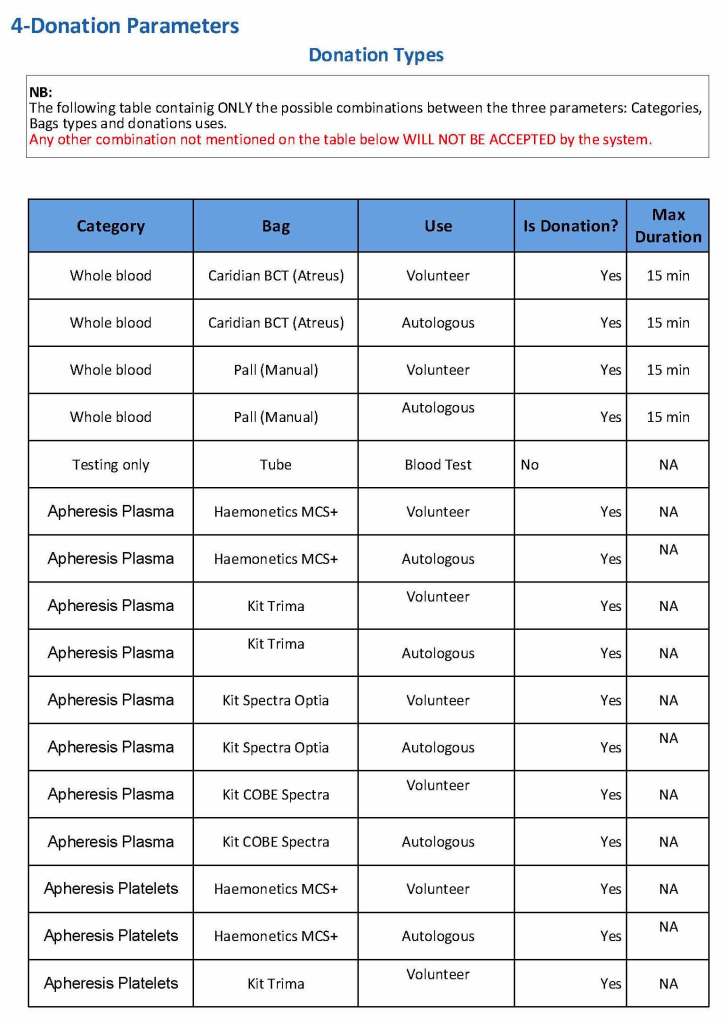
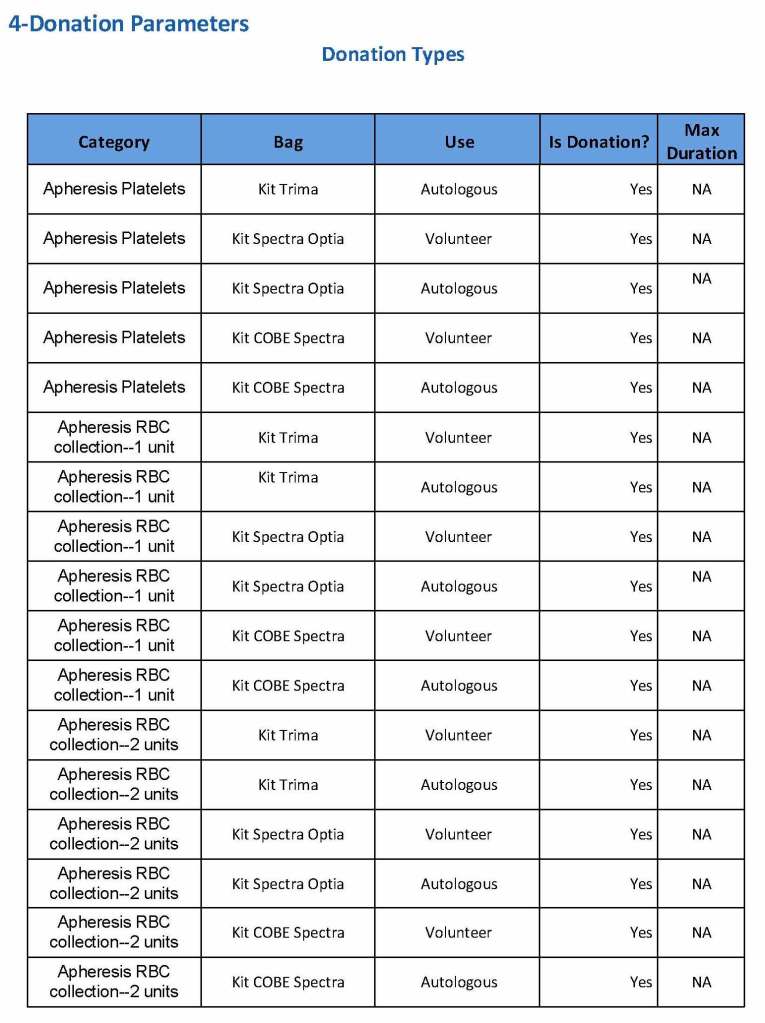
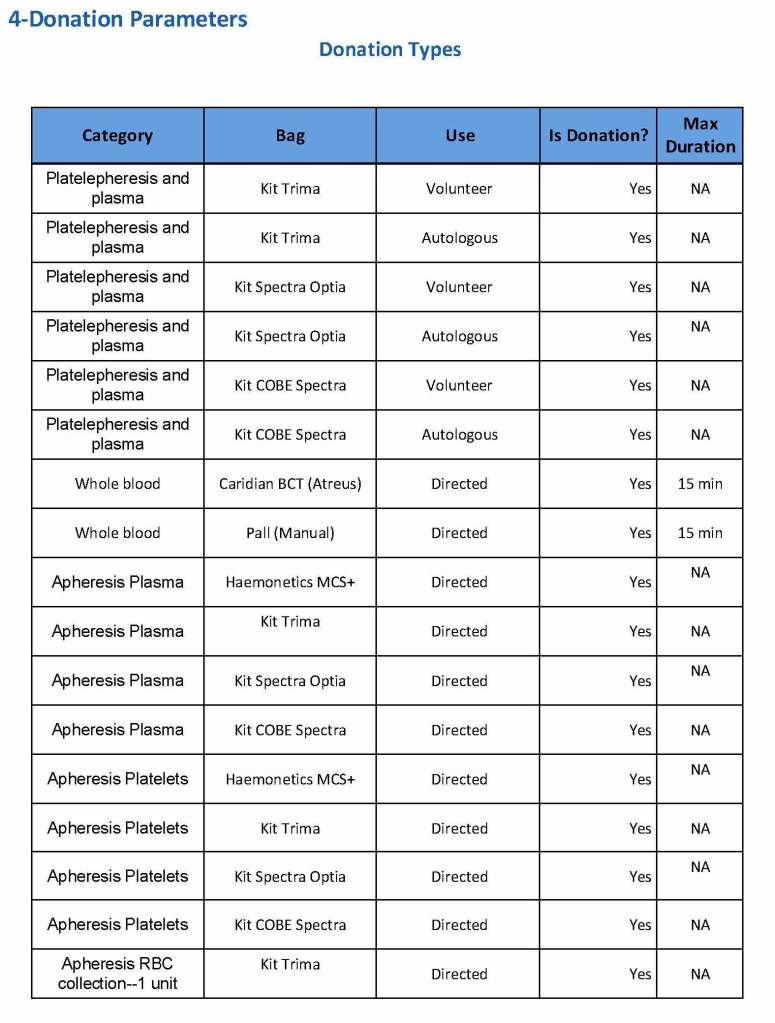
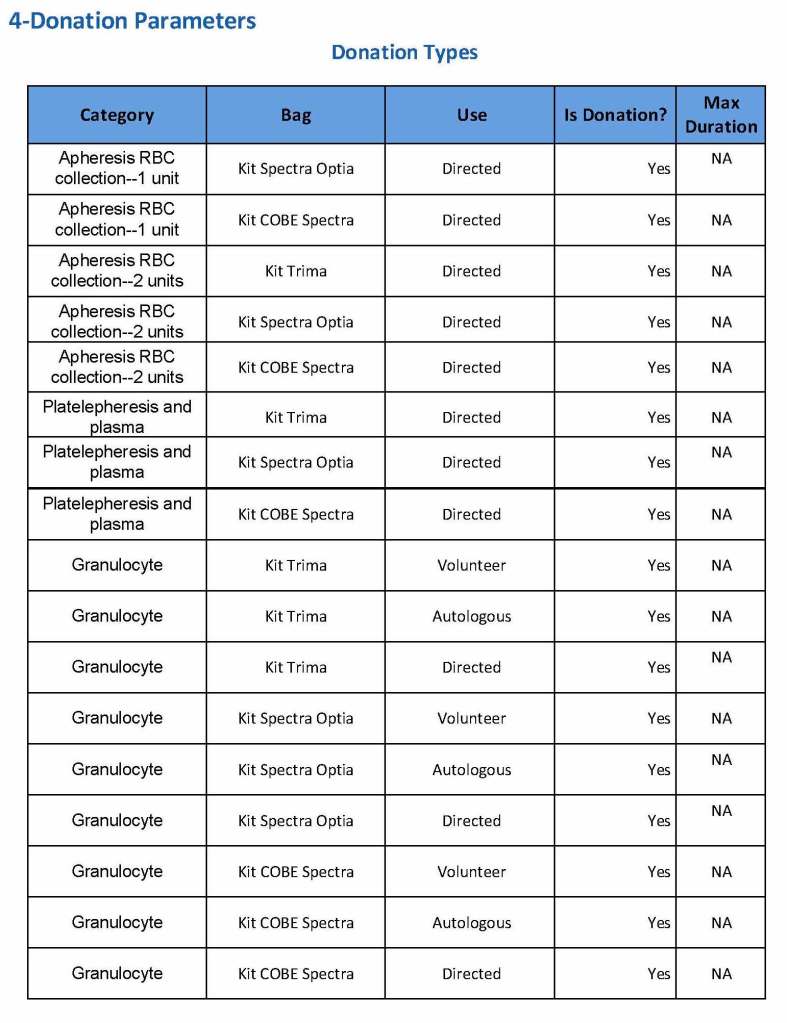
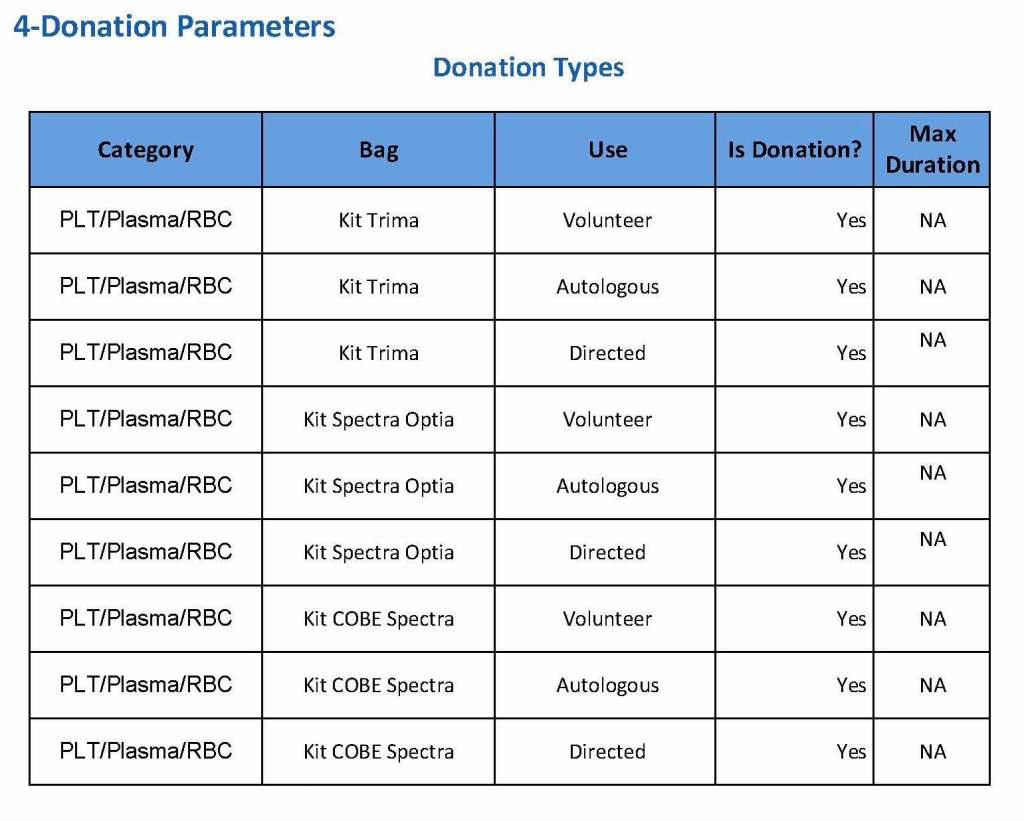
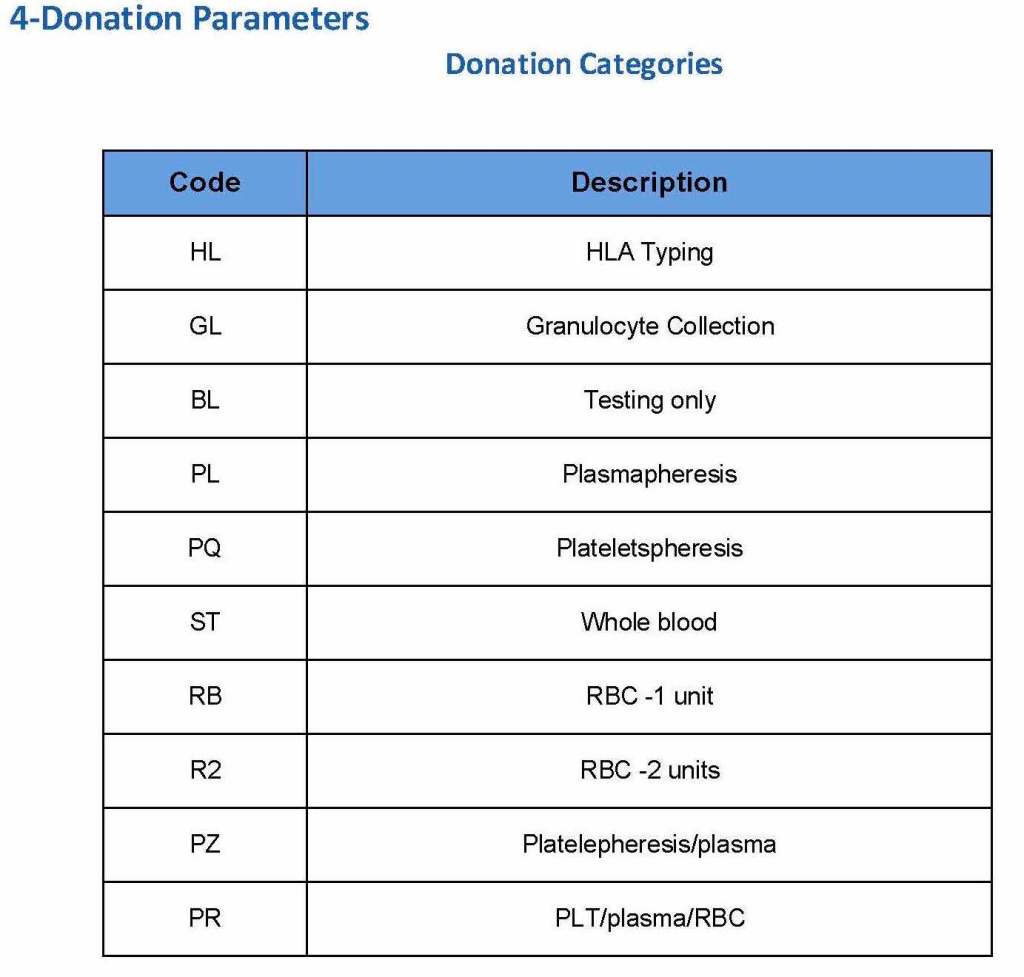
At the time of registration, the type of donation must be specified. In my last position, this could include whole blood for automated Reveos, whole blood for cryoprecipitate, plasmapheresis, COVID 19 convalescent plasmapheresis, plateletpheresis, concurrent platelet and plasmapheresis, concurrent platelet, plasma, and RBC apheresis, RBC apheresis-one unit, and RBC apheresis-2 units.
There is also a specimen-only donation without actual collection that includes database check, assignment of an ISBT specimen number, donor questionnaire, physical examination, and specimen collection only..
We specified which bag or kit could be used for each type of donation so when it was selected, only that bag type would be accepted by Medinfo
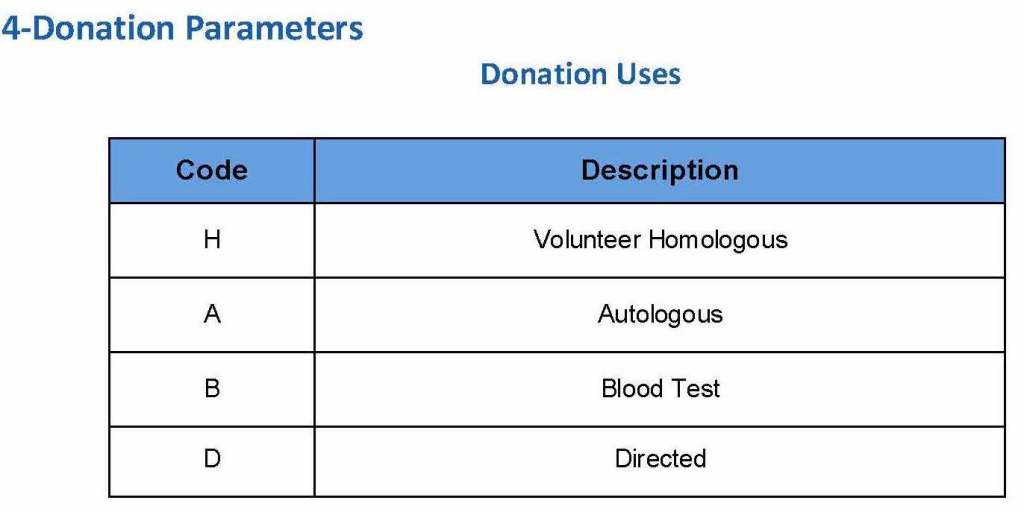
For each of these types we must specify what type of donation is permitted: volunteer, autologous, or directed.
Finally, we must indicate the maximum length of the procedure permitted. This applied to whole blood only and we set this at 15 minutes—this is user definable.
The following are a sample set of parameter settings for the above:
Note how we included contingencies for old bag sets and equipment (that we later discontinued) and for granulocyte collection (which we did not actually perform).
The potential donor enters the collection area. He takes a number and waits to be called. When called, he shows a picture identification card with a unique alphanumeric sequence. This is entered into the donor module software and the system checks the donor deferral database for temporary and/or permanent contraindications. If none are found, a consent form with an ISBT specimen number is generated.
In this post, we will consider:
Registration process in multiple languages
Donor deferral database
Donor consent with generated unique ISBT specimen number
Registration Parameters
Registration:
In the Middle Eastern region, multiple languages are used. Although Arabic may be the main language, not all the registration staff may speak it. English is commonly used as the main work language. The date may be entered as Common Era (Gregorian) and/or Hijri.
An issue is that for native Arabs, the only precise, unambiguous name spelling is in Arabic. English transliterations vary. Example, Muhammad in Arabic is very simple to write, in English it may be rendered as Mohamed, Mohammed, Muhammad, etc. The donor’s name should be recorded exactly. How do you register when the staff do not speak or type Arabic?
Fortunately, I have worked with software that is in UNICODE, meaning that the data does not have to be restricted to English (I wonder why the hospital information system we had at one institution could be sold in the Middle East and not have this capability!). That means we could perform registration and donor questionnaire tasks in multiple languages, and preferable the native language of the donor. We could even prepare database reports in Arabic.
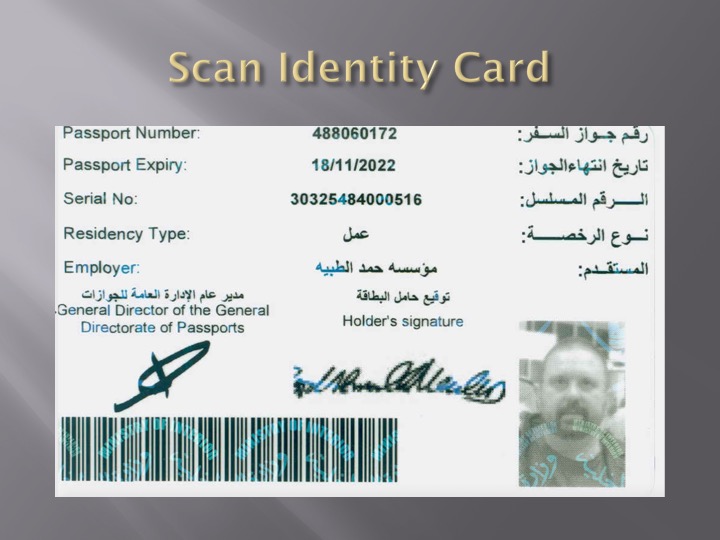
Medinfo had an elegant solution to the registration process. It read the local identity card issued by the Ministry of Interior and accessed (read-only) the demographic data on that donor. Just by reading the bar code one received both English and Arabic name fields:
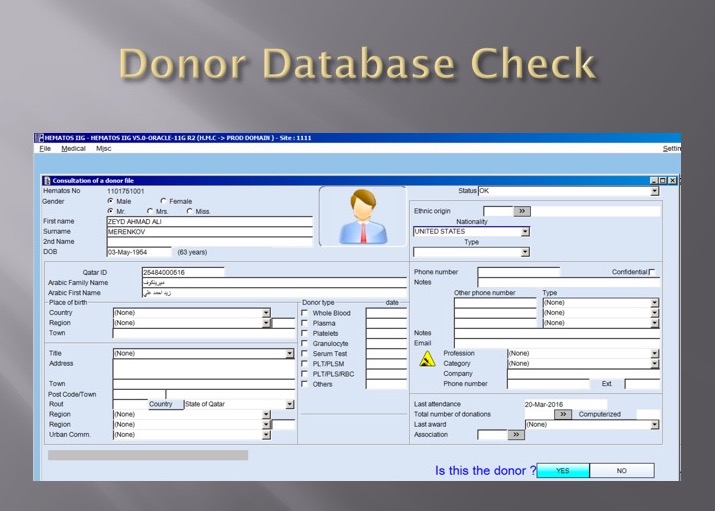
This would generate the demographic fields in the registration:
The blood bank software would check the national donor deferral database and list any deferrals/contraindications to donation and the next eligibility date. It would also list what type of donations were permitted (e.g. for females, only RBCs could be collected and processed: if a whole blood unit was collected, then the platelets and plasma would NOT be permitted to be processed and were discarded.)
Medinfo used a unique key field, the Medinfo Hematos Donor ID for the database. This was not the same as the national ID card. All records were indexed against this number.
Donor Deferral Database:
Medinfo imported donor data from a previous system and added this to its own database. Thus, there was only one database to check. The database listed all previous donations: dates, type, status (complete, aborted). Any contraindications would be prominently shown in RED.
Donor Consent and Assignment of Donor Unit (ISBT Specimen) Number:
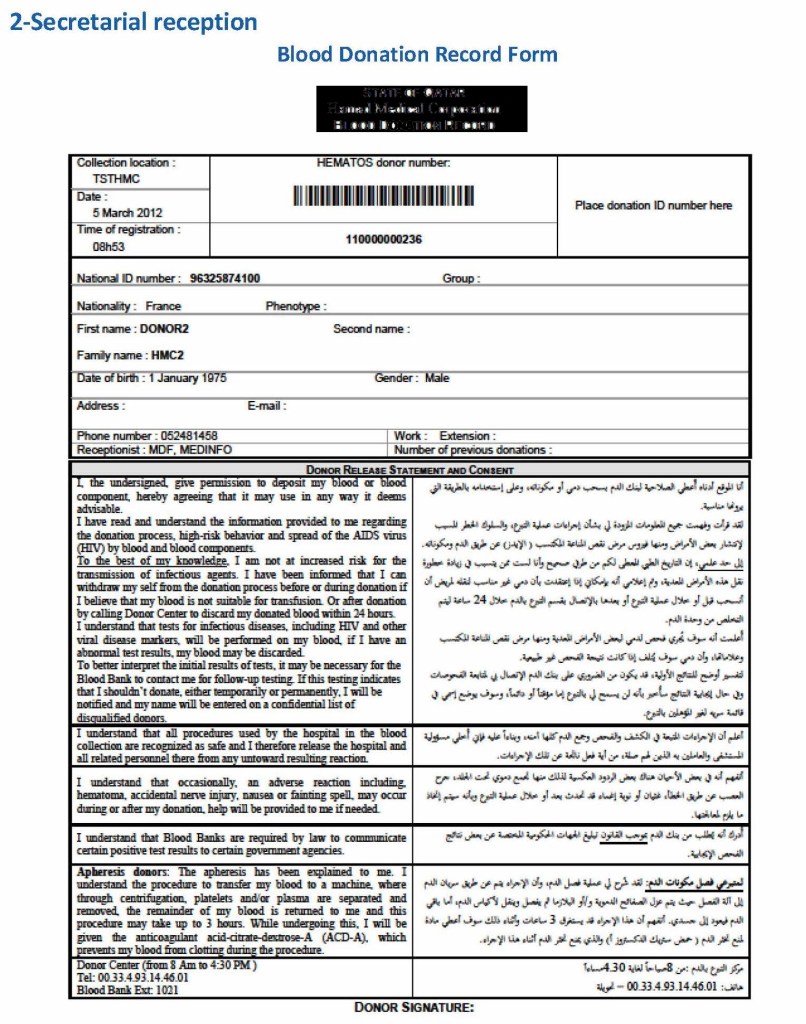
If there were no contraindications, Medinfo generated a donor consent in English and Arabic and the unique donor unit number for the current encounter:
Registration Parameters:
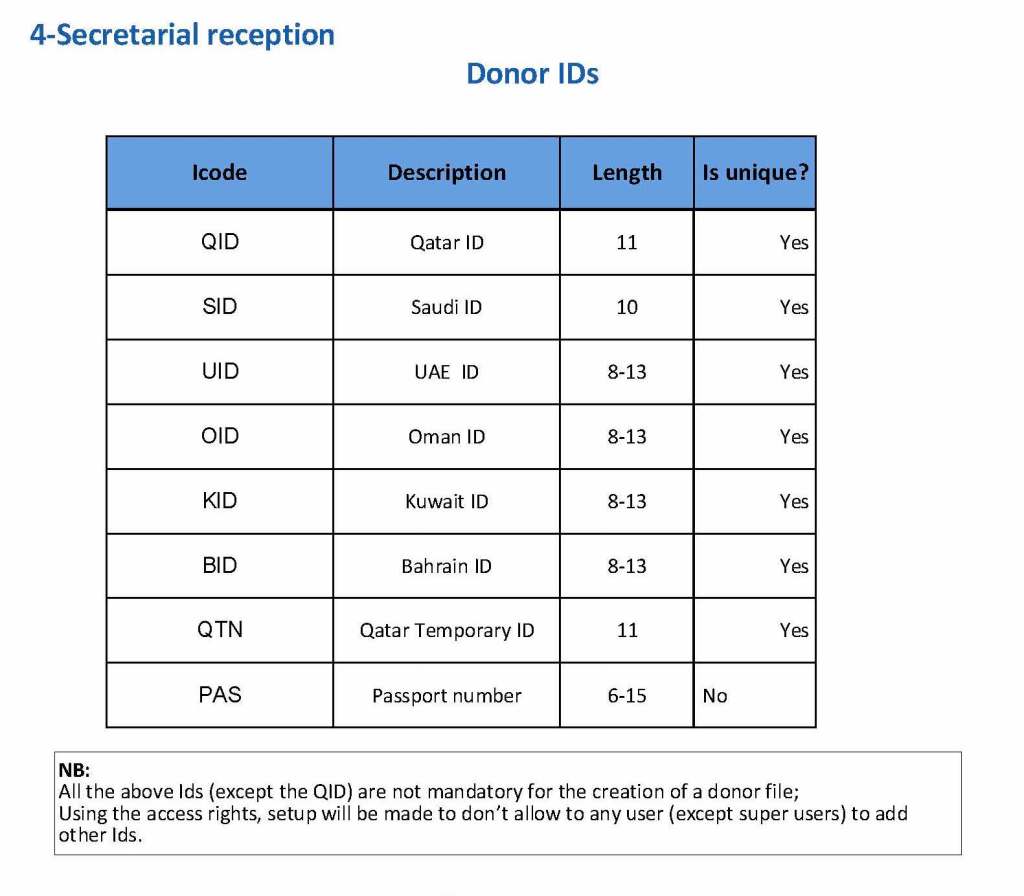
Medinfo enforced registration according to the format of the identity card. The donor ID format was built into Medinfo. If the entry deviated from this, it was rejected and registration could not continue:
The registration type would be selected (volunteer, autologous, directed, or paid). In Qatar, paid donations were not permitted:
Next, the donation type had to be selected:
At the time of registration, the type of collection bag (or kit if using Reveos) was automatically set in Medinfo. I will consider this further in the next post of this series to determine eligibility based on the previous donation interval.
At each donation site, the allowable types of donations and kits could be set. Based on the donation parameters above, staff could not select the wrong type of bag/kit (e.g. an apheresis kit for a mobile donation).
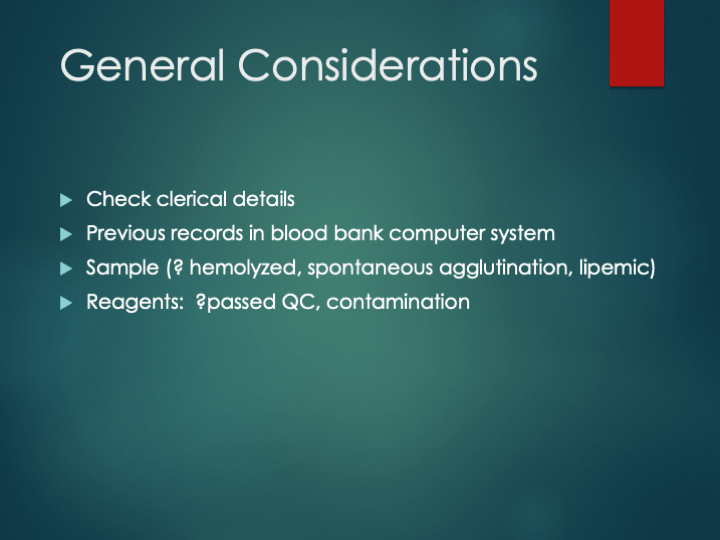
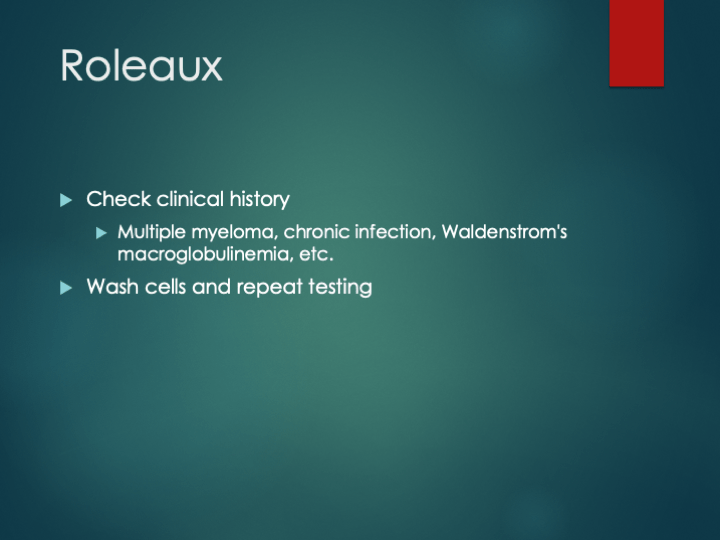
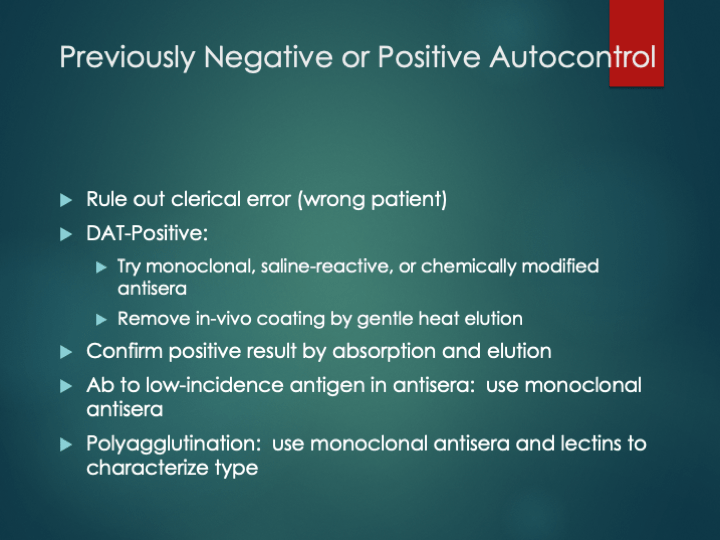
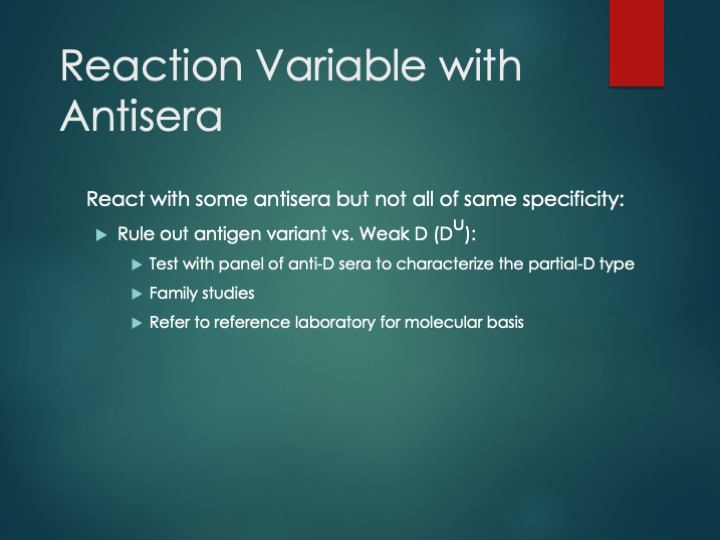
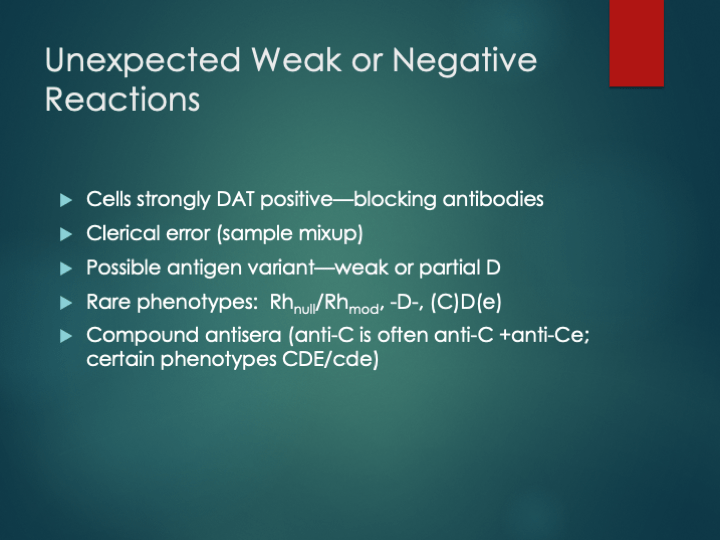
This is an old lecture I gave to medical technologists at National Guard Health Affairs in Jeddah. This was prepared in the pre-molecular blood bank era, but there is good common sense in it to deal with many interferences.
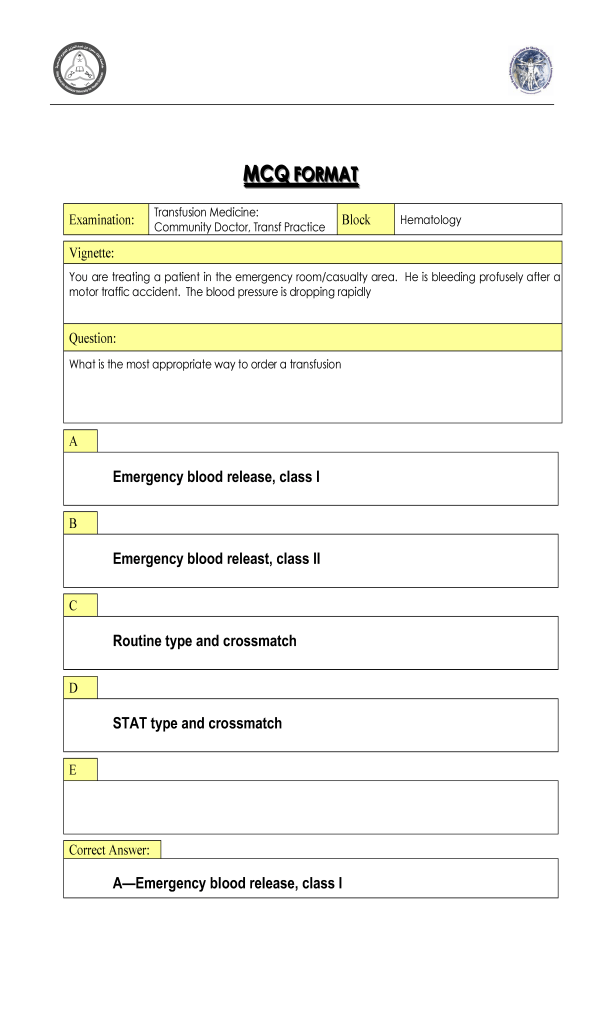
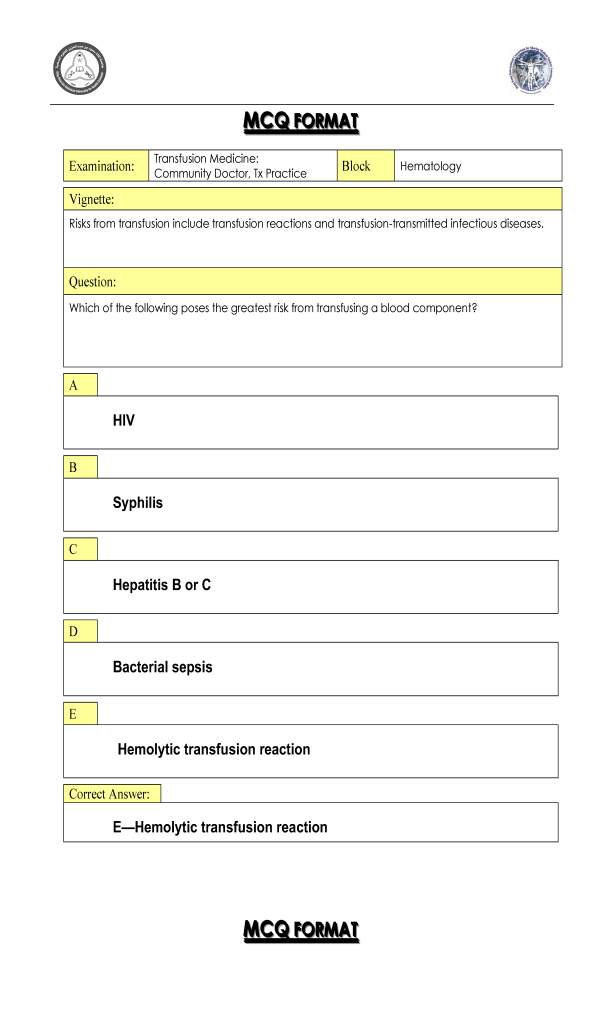
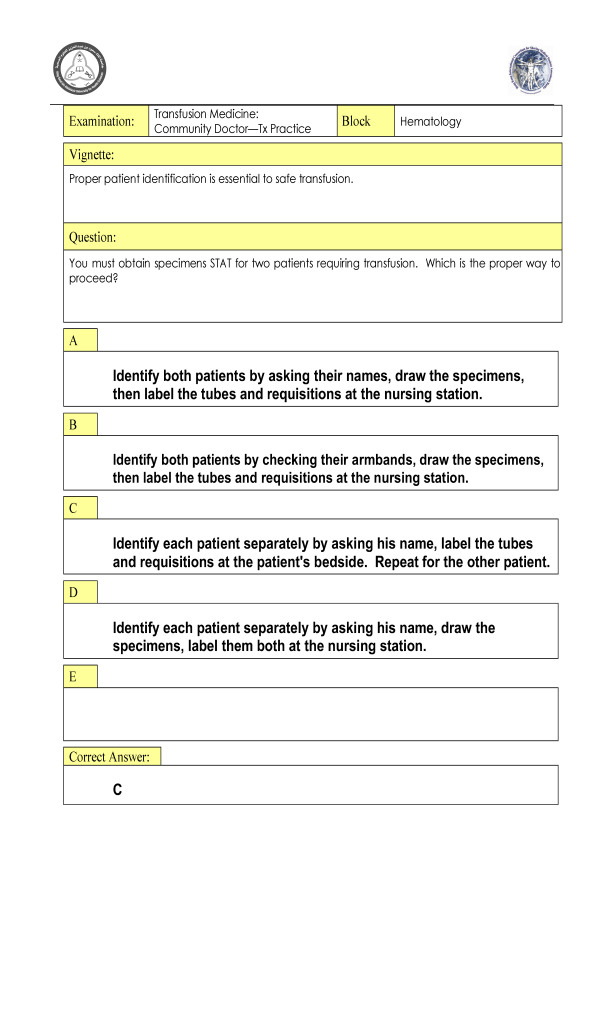
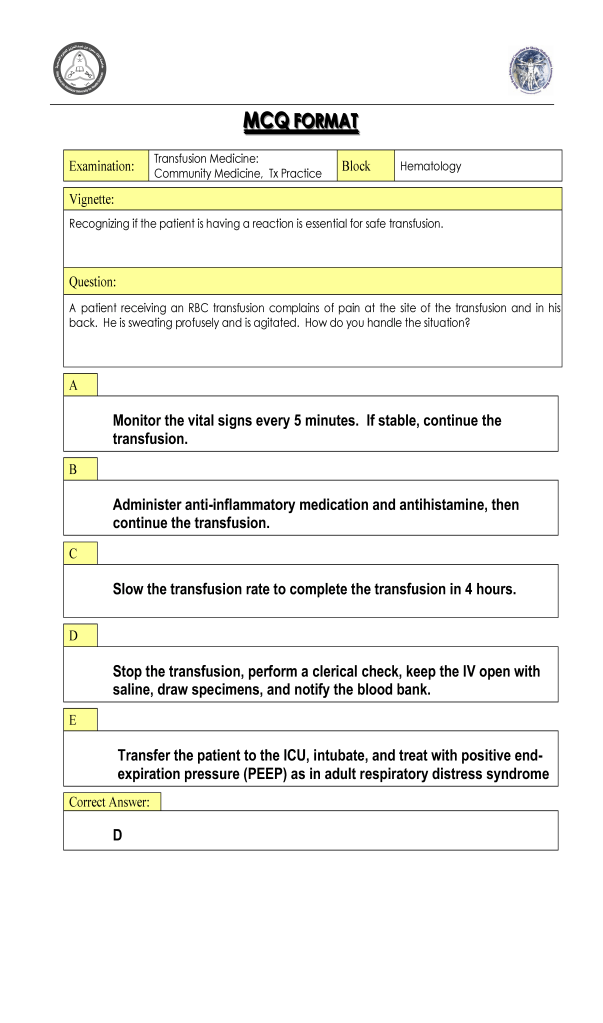
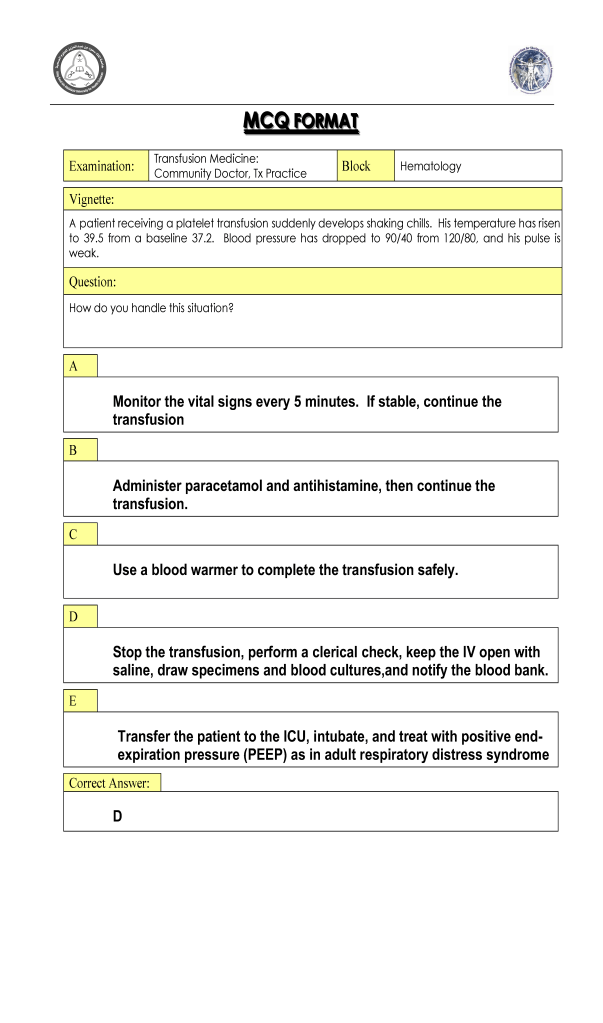
These are questions based on my medical student lecture on Community Practice of Transfusion originally given at National Guard Health Affairs in Riyadh:
Transfusion-transmitted infectious disease are a continuing threat. Despite donor infectious marker testing and new donor questioning, there are many threats which are not addressed by these measures. Also new pathogens are being identified for which there are no tests or specific donor questions available. How can we handle these new threats?
Pathogen inactivation can significantly reduce infectious agents in blood components, although the degree varies depends on the agent. Theoretically any agent with nucleic acid—RNA or DNA is affected. The only class of agents not affected at all are prions, which have NO nucleic acid at all.
In general, a photoactive agent is added to the blood component which binds to the nucleic acid. Photoactive agents include riboflavin, psoralen dyes, and methylene blue. Then the component is irradiated, the time proportional to the volume of the unit.
The component is then exposed to ultraviolet light to photoactivate it, which disrupts the DNA and RNA present, including in the white cells. Thus, NO irradiation or bacterial culture is required.
Here are my questions to consider when selecting a pathogen inactivation system:
Targets? Platelets vs plasma vs whole blood?
Methylene may be used for plasma, but riboflavin or psoralens may be used for platelets or plasma. Whole blood inactivation with riboflavin is CE-approved.
Photoactive dye: Is it riboflavin vs psoralen vs methylene based?
Riboflavin is vitamin B2—the amount used is small and does not need to be removed whereas the psoralen must be removed for clinical use.
Does the photoactive material need to be removed before transfusion?
You can immediately use the riboflavin-treated component but the psoralen must be removed before transfusion—this may take 6 or 20 hours depending on the licensing of the product.
What is the loss of platelets or coagulation factors after treatment?
With treatment by all methods, there is some loss of platelets and coagulation factors. The platelet loss may be greater in psoralen-based methods and require additional components be added to the pool to reach the desired dose. Likewise, plateletpheresis components treated with psoralen may require a recalibration of the donor apheresis equipment to collect more platelets per dose to compensate. There may be some RBC loss additionally in whole blood pathogen inactivation.
What is the efficacy of pathogen reduction for the infectious agents, particularly the ones in your region?
Example: How well does the treatment handle local agents like Hepatitis E? Psoralen agents may be less effective than riboflavin for this agent.
Does it work with platelet additive solution PAS?
There are minimum and maximum volumes for pathogen inactivation set by the manufacturer. Can you get sufficient yields within these volumes?
How good is the data management system? Can it be integrated with your blood bank computer system?
Can the equipment be integrated with your system? This is important to set rules and enforce good manufacturing processes GMP.
Does it work well with an automated blood component production system?
Such automated systems like the Reveos can free up personnel for pathogen inactivation. Can the volumes produced be handled effectively by the pathogen-inactivation method? Do the timings for separation of components work synergistically with the pathogen inactivation method?
Vendor issues: how well will the local agent provide support? Is someone else in your country or region using the system?
You need an experienced vendor to provide optimal support.