Bedside Monitoring of Transfusion

Once the blood component has left the hospital blood bank, it should be directed transported to the patient’s bedside for immediate transfusion.

At the bedside, the transfusionist (usually a nurse or doctor) must verify the information on the blood component labels (both the ISBT and specific reservation one for the patient).  With a bedside device, this includes:

  1. Scan the patient armband for hospital number
  2. Scan ISBT label:
    1. ABO/D type and any other antigen typings
    2. Blood component type (RBCs, platelets, plasma, etc.)
    3. Expiration date/time of the component
  3. Verify Reservation Label (on back of unit)— centrally performed in blood bank computer system based on #1 and #2 above:
    1. Intended recipient name and hospital number
    2. Compatibility status (compatible, least-incompatible, etc.)
    3. Expiration date/time of the compatibility testing/crossmatch
  4. Record Documentation During Transfusion:
    1. Physical inspection of the unit
    2. Time stamp of transfusion start
    3. Vital signs before starting transfusion
    4. Periodic vital signs during transfusion
    5. Time stamp of stopping transfusion
    6. Any adverse effects during the transfusion
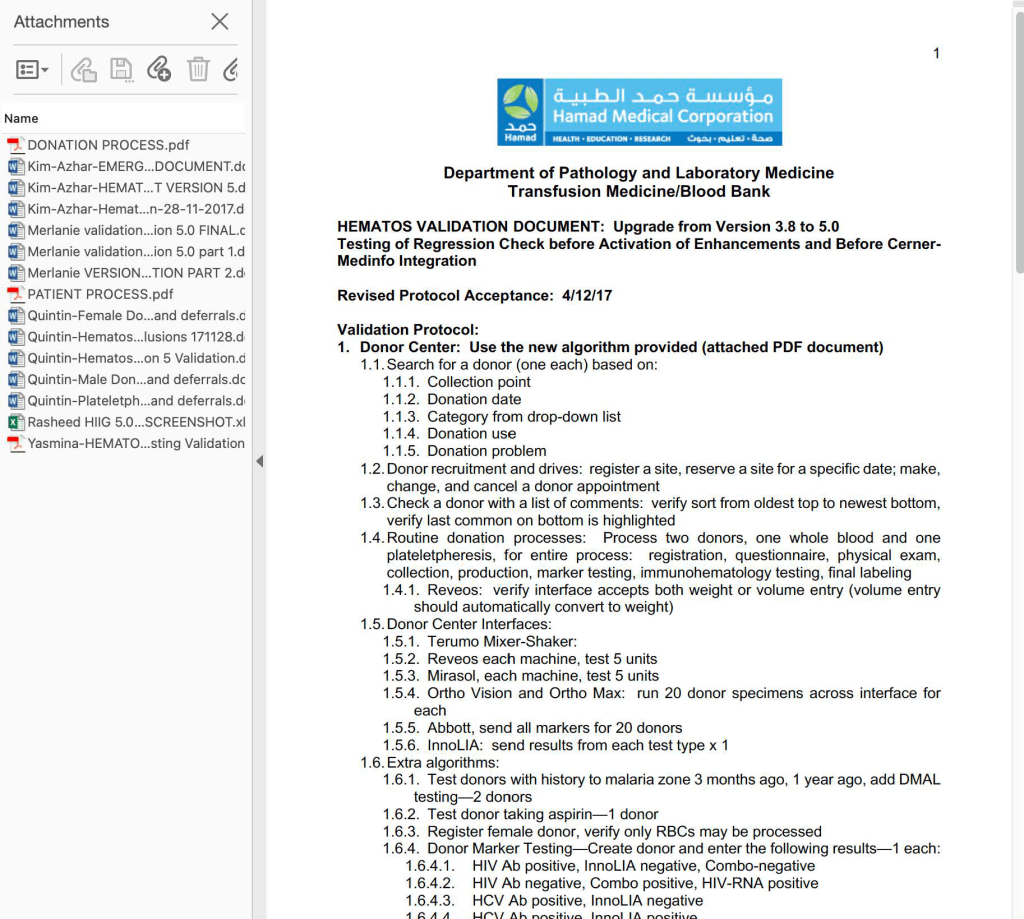
    7. Any adverse effects after the transfusion (remote vital signs, oxygen saturation, EKG lead—if appropriate monitoring device attached to patient (e.g. Umana T1 device).

All of these parameters can be entered into a hand-held device that transmits them to the blood bank computer system (e.g. Medinfo Hemotrace.)

The Blood bank computer system (patient module) should verify that this is the proper unit for the intended recipient and that the transfusion is starting within the reservation limit of the unit and serves to verify the information on the reservation label attached on the back of the blood unit.

With a device such as  the new Umana T1 device from the GPI group, the vital signs together with an EKG lead and oxygen saturation can be automatically uploaded into the handheld device that feeds into the blood bank computer system such as Medinfo Hematos IIG and/or directly transmitted to the blood bank software.  This device can continuously record this information for several days and detect post-transfusion adverse effects such as TRALI/TACO and delayed hemolytic transfusion reactions.
Note:

Some other nursing hand-held devices are available for recording patient data but many cannot read the ISBT unit number or descriptor information.  They also do not check with the blood bank computer system to check if the right unit of blood is being offered to the patient during the validity of the transfusion period (four hours after leaving the blood bank).
Opinion: Ready after Fellowship?

I was recently interviewing a candidate for consultant in Transfusion Medicine.  Several months previously he had completed a fellowship in Transfusion Medicine in the United States.  He was applying for a position in my hospital in Qatar, which included seven hospitals and a blood donor center.  He had no training in donor management or therapeutic apheresis.

The successful candidate was to rotate on-call to cover all hospitals and the blood donor center.  He had never worked outside the United States.  Routinely, he did not review antibody panels since those workups were usually sent to the local blood provider there.  In his training, he had strictly followed US FDA and American version of AABB Standards.  His training center did not routinely do extended phenotypes (C, c, E, e, and Kell).  Extra testing and phenotyping had to be explicitly ordered by the clinician to get reimbursement.  Thus, there was no prophylactic antigen matching done on patients.  He did not feel comfortable reviewing antibody panels.

He had no experience with universal leukodepletion, pathogen-inactivation, platelet additive solutions, or automated component production such as the Terumo BCT Reveos.  He did not interpret donor marker testing results.

On the contrary in our organization, the transfusion medicine physician had to review all antibody panels (usually he was the most knowledgeable person for this).  We followed the Council of Europe CE and other practices that did prophylactic antigen matching.  We were also in charge of donor qualification and therapeutic apheresis and reviewed any product deviations from the Reveos and donor marker testing.

Clearly, this candidate did not practice transfusion medicine in the way that was necessary for our operations.  We could not cut him loose and make him responsible for a hospital transfusion service or the blood donor center.

Let us contrast this candidate for one being recruited for anatomic pathology/histopathology.  Grossing specimens, performing frozen sections, reading slides, diagnosing cases are the same everywhere in the world.  After completing his American certification, he could perform his profession almost anywhere in the world.

Transfusion medicine practices need to be localized and the selection of blood components and donor qualification are different.  Most of the world does not follow US FDA and has access to blood components, tests, and other technology that is different and maybe more advanced than his training in the USA.

I gave him a clinical scenario to interpret.  An AB patient with anti-K needs to be transfused with plasma.  Are there any special requirements for the plasma?  What if the only AB donor had anti-K would you use it?  What if the only RBCs available had not been phenotyped for Kell?  What would you do?

He did not know that we discard plasma with clinically significant alloantibodies routinely.  He did not want to phenotype the RBC unit for this patient since this had not been explicitly ordered by the clinician.

My recommendation was not to hire this candidate if there were others who had worked in European or similar systems to our own practices.  In effect, to use this physician, he would have to undergo a mini-fellowship to learn our practices since they were contrary to ours.  Unfortunately, we were very short-staffed and did not have resources to offer this training.

In summary, blood bank practices are very localized.  If you are considering to hire staff from other countries not following your standards, you must assess if the candidate is flexible to change his practices and/or whether you have the resources to train the physician.

Opinion: Laboratory Software Issues from Hell

In my career, I have dealt with many different laboratory software vendors.  Regretfully, not all encounters have been straight-forward.  Since ultimately these products are used for patient care, I had hoped that there would be a sacred trust to do what is best.

Things that bother me:

  1. Current state:  whoever prepared it for the client, didn’t care or understand the local processes and came up with a generic:  Order it, collect it, receive it, do it, report it for each and every test.
  2. No training for super users:  more like lambs being led to the slaughter.  They will obey the vendor out of fear of making a mistake.
  3. No discussion of options:  pushing us to take the default setting—not even offering the available options.  The only way you find out there are available options is because other staff have used the same software at other institutions which used these options.
  4. Corrections to build:  only giving one shot to do it right, further corrections cost $$
  5. Scenarios:  vendor shows specially crafted scenarios that “work” but when you ask the vendor to do a random, non-scripted scenario, it crashes.
  6. Scalability:  limited scalability on client’s chosen platform.  That may force a rebuilding of the software when the limit is reached.
  7. Reference site does not match the test volume or activities of the client, uses different platform, and thus you cannot make a valid assessment.
  8. Performance issues:  if you don’t know why the system is slow, you can add more hardware (RAM, disk space, etc.) and try again—it can’t be due to the software design!
  9. Handling of requests:  does not permit your local IT staff to make changes, must send it back to the vendor for $$
  10. Waiting until hell freezes over:  will we get the corrected/updated package during this reincarnation?
  11. Interfaces:  an acceptable communication link is when one side speaks Sanskrit and the other Algonquin and they both hear each other, but who cares if they understand?
  12. Waiting for Godot:  God forbid if your equipment needs an interface not currently available:  how many cycles of the big bang can you wait?
  13. Champions or Heroes:  make a class of users who are to be evangelists for the new system and have them undergo sensitivity training including actions that are culturally irrelevant.  Don’t tailor it to local sensitivities or customs.  Will this convince the staff how useful the software is?
  14. Relevance of vendor experts:  Assume everyone understands what maple syrup is or comes from Kansas.  The expert assumes everyone has the same background as his/hers.  Who in the Middle East has seen maple syrup being made?  How can that analogy be useful for building software?
  15. Describe all reference units in feet/pounds/inches/furlongs/fortnights—no metric.  Do not use SI.
  16. Mix 24-hour clock with 12-hour clock:  what does 12:00 mean?  How do you measure time intervals?
  17. Consulting companies:  They are supposed to assist the client with the settings, but do they have the client’s best interests at heart?  Some are good spin-doctors and transfer blame to the client’s software staff when it is really their responsibility for the build.
  18. Rush, rush, rush:  Administrative powers who just want everything done quickly whether or not it is correct or validated properly, who cares if the processes built are right?

International Perspective

When I first moved overseas from the United States, I brought the perspective of my American training and experience.  I saw everything in my new blood bank through those eyes.

Yet, most of my staff were not American or even North American.  Few were even native in English, and most of those  were not American.  They had different qualifications, many of which would not have been accepted by the American schemes.  Still, they functioned well.

I also worked with the US military technologist staff during Gulf War One.  Some did not even have a Bachelor’s degree;  yet, they performed the work well.

I used many technologies that were not yet (or never) US FDA approved such as gel or glass bead typings and pooled buffy coat platelet production.  There were rare reagents I could buy off the shelf (e.g. anti-Tja/PP1Pk).

Later, I adopted pathogen-reduction technology (Mirasol), automated component production (Atreus then Reveos), and platelet additive solution.  I achieve a level of good manufacturing practice that would have been difficult to achieve by the FDA-approved methods.

My perspective had changed.  In the Middle East, I studied many frameworks and came to the conclusion that the best approach was to customize them to our local needs.  My particular experience was to start with one framework, i.e. Council of Europe CE, and then localize it.

To do this, I could not use an American turnkey blood bank software for either the donor or patient operations.  I needed a flexible system that could be customized to my needs.  Again, I chose a CE-marked system, Medinfo Hematos IIG that had already been adapted to many frameworks.

It is much easier to work solely within one system such as FDA.  However, if I had done that, I would have lost so much flexibility and not had a system optimized for local conditions.  I would not have used Mirasol, Reveos, Diamed, and many other reagents.

One big disappointment at such international meetings is the perspective by one country’s regulatory agency that they feel its regulations and framework will work well overseas.  I would wager that those people were not well acquainted with international conditions.

Another frustration was attending another international meeting in which the presenters apologized for the source of information since it came from a foreign country (France) and not their own (United States).

No country has a monopoly on what is best for everyone.  To share our experiences and compare is so valuable.  No one assume his way is the best.  In my career, I have had the richest experiences studying other perspectives and my organizations have benefited greatly from the exchange.  We can all learn from each other.  We are citizens of the world.

Information to Collect Before Contacting the Transfusion Medicine Physician

The Transfusion Medicine Physician needs certain minimal information to make a medical/clinical assessment and decide what action needs to be taken.

Policy:

  1. Before contacting the transfusion medicine physician, please obtain the following:
    1. Clinical diagnosis
    2. Transfusion history
    3. Medication history
  2. In the case of transfusion reactions, follow Interim Policy Transfusion Reaction Workup and be certain to include the following information before contacting:
    1. Vital signs (BP, pulse, temperature, respiratory rate) both pre- and post-transfusion
    2. Clinical symptoms (e.g. rash, urticaria, fever, respiratory distress, etc.)
    3. Pre-transfusion DAT if post-transfusion DAT is positive.
    4. Donor Unit DAT and eluate on the post-transfusion specimen if the post-transfusion DAT is positive and pre-transfusion negative.
    5. Eluate on the post-transfusion specimen if both the pre- and post-transfusion DAT are positive.

6/11/20

Opinion: Handling Incorrect Physician Orders

Most of the non-transfusion-medicine physicians with whom I have worked have had only limited training in placing component or hospital blood bank orders.  In previous posts I have discussed this and suggested that all physicians who may possibly order blood bank tests or blood components should have a training and documented competence on a periodic basis.  Only a very few physicians, mainly hematologists and some organ transplant physicians, have placed reliable orders.

Before we had a blood bank computer system, we received orders on a manual paper requisition.  If there were errors, my technical staff and I corrected the order.  Any changes were made by me in my capacity as the blood bank medical director.  The ordering physicians and I had good relations and they had no problem with this—in fact, many were afraid of the blood bank and felt happy to be relieved of the responsibility.

In the current software era, what happens depends on how the order is placed.  Can the technical staff and I correct the order directly or must we each and every time contact the physician to revise his/her order?  Do my staff have to cancel each erroneous order and wait for the corrected order?  This could slow down the work process and prevent release of blood components in a timely manner.

Should the non-blood bank physician be allowed to order our complicated esoteric transfusion tests directly—e.g. ordering extended antigen typings or antibody identifications or elutions?   What if they order something unnecessary or inappropriate?

At a recent hospital position as Division Head of Transfusion Medicine, I discovered that the Hospital Information System HIS was very slow for all blood bank orders.  The physicians complained, I would allow them to bypass the HIS and use the manual backup system in critical situations.  If we had been forced to cancel the order and have the physician reorder, this would have greatly disrupted the work process.

We did not use the HIS at all in Transfusion Medicine.  We had patient and donor modules in the dedicated blood bank system Medinfo.  We had a limited ordering interface from the HIS to Medinfo for blood components and some basic testing (e.g. ABO/D typing, DAT, type and screen/group and save, cord blood testing, and transfusion reaction workups).  All work was done in the dedicated blood bank system.

All components were leukodepleted to < 1E6, all platelet and plasma were Mirasol pathogen-inactivated, all platelets were in platelet additive solution PAS.

The doctors did not order the specific blood component, rather they indicated a preference, e.g.

  • Packed RBCs
  • Platelets (adult dose of 2.4 E11)
  • Plasma
  • Cryoprecipitate

The following appeared as an order comment in the blood bank system:

  • The specific number or amount of the each component type
  • Preferences for pooled vs. apheresis platelets, washed RBCs, irradiated RBCs.

The blood bank staff could review the doctor’s request and order in Medinfo as per our internal protocols under my responsibility.  In effect, I was modifying the orders when needed just as I had done under our manual system.  This included type, modification, and quantity.  Yet now, I did not have to change any orders since the doctors had only indicated preferences.

For blood bank testing orders, we had our own internal algorithms for the workups.  The doctors could not order antibody identifications, elutions, or any antigen typings other than ABO/D.  They latter were triggered by the screening test results.

This system allowed us to avoid cancellations due to physician errors.  I was very comfortable taking the responsibility to alter the orders for best patient care.  If a physician did not agree with our algorithms, they could discuss the issue with one of the transfusion physicians, or ultimately appeal to me.  I was fortunate that there were no legal issues with this approach where I practiced.

In summary, my recommendations are:

  1. Have the doctors order a preference for the type of blood component.  They still order the quantity and can request modifications such as washing or irradiating or apheresis-derived or buffy coat pool platelets.  The actual allocation is made by blood bank staff under my direction.
  2. Offer algorithmic based testing.  Doctors only order basic testing which triggers reflex algorithms.  Most of the test menu is not orderable directly by the physicians (example:  an antibody identification is triggered by a non-negative antibody screen.

9/12/20

Release of COVID-19 Convalescent Plasma CCP

Principle:

Testing, allocation, release, and transfusion of this special plasma will be similar to normal blood components except that the storage, modification, and release will handled at special quarantine location(s).  Release and modification of components is to be handled separately from the regular hospital blood bank/transfusion service.

Abbreviations:

CCP:  COVID-19 convalescent plasma

ID:  Infectious Disease Department (clinical COVID19 treatment unit)

QHBBB:  Quarantine hospital blood bank (which stores, thaws, and releases CCP)

Policy:

  1. Any potential recipient for CCP must have a CURRENT type and screen test (< 72 hours old.)
    1. A repeat type and screen should be ordered every 3 days during the time that CCP may be used.
  2. All CCP orders must be submitted to the ID senior consultant for triage.
  3. If the order is accepted by that authority, then an order and a doctor’s prescription for CCP must be both prepared and submitted to the QHBB.
  4. QHBB will allocate ABO-compatible CCP units and attached blood bank computer-generated release labels and forms to it.
  5. Designated ward staff will pick-up the CCP at the QHBB.
  6. Allow 1 hour for the plasma to be thawed.
  7. Only order when the transfusion is scheduled—1 hour before the intended transfusion date/time.
    1. Sign-out will follow normal procedures, same as other blood components.
    2. Ward staff must provide a doctor’s prescription for CCP and a fully completed request.
    3. Ward staff will directly transport the CCP to the intended transfusion site.  They should immediately transport it to the patient transfusion site.
  8. Transfusion will be performed according to standard procedures:
    1. Positively identify the patient.
    2. Use a standard 180 micron blood filter.
    3. Transfusion should be done as quickly as possible to avoid potency loss
    4. Fill out the transfusion record and return a copy to the QHBB.

Example of Dealing with HIS Interface Issues to Dedicated Blood Bank Software

The following is an actual working document for interactions between the Medinfo HIIG system and a monolithic hospital information system covering nursing, laboratory, ADT, etc.  For the purpose of this post, I shall name it B*.

In a previous position, I was in charge of the Laboratory Information Systems and worked both with Medinfo for donor and patient hospital blood bank processes AND B* for the general laboratory.  It was my decision NOT to use B* for the hospital blood bank because there would be no integration between the donor module in Medinfo and patient blood bank module in B*.  Also, B* had limited handling of complex immunology algorithms and fewer safeguards than Medinfo.

B* could not directly read ISBT product labels from the ISBT dictionary and required hard-coding the links for each and every type of blood component and modification.  It was also slow to order blood components so in emergency situations, I allowed physicians to bypass B* and order directly if they felt in their clinical judgment that the delay in using B* might harm the patient.

The non-transfusion physicians had to directly order blood components in B* except for emergencies as stated above.  They were only allowed to order a limited number of basic tests such as ABO/D type, direct antiglobulin test DAT, or antibody screen.  Based on those tests, we would use algorithms in Medinfo’s patient module.  Example:  an outside doctor could not order a Jka typing—that could only be done according to our internal Medinfo algorithms.  Doctors could only order antibody screens, not antibody identifications, elutions, or titrations.

Sadly, most physicians had no specific training in blood component or blood component therapy so they made many mistakes in ordering manually before the computer system.  I had requested offering training sessions for the doctors but this had never been approved by the medical administration.

Thus, my decision was to place the responsibility for the correct ordering of blood components and testing directly by Transfusion Medicine.  The non-transfusion doctors were only ordering preferences for components—the actual selection was made in Medinfo by my blood bank staff under my order.  We decided whether to irradiate.  All platelet and plasma components were pathogen-inactivated.  All components were leukodepleted to < 1E6 according to CE Standards.

In Medinfo we could thus modify or even cancel requests without having to deal with the B* system.  B* would accept Medinfo cancellations directly.

During the frequent B* downtimes, all processes would be limited to using Medinfo.  There was no way to initiate orders in Medinfo and send them back to B*.  Thus during downtimes, the only way to retrieve results was to use Medinfo.

The following is the process for the interface as was used during my tenure at that institution:

Medinfo-B* Interface Process

Principle:

Limited ordering of components and basic transfusion testing may be initiated on the B* side.  All component orders and all test results will pass into B*, including those which can only be ordered by blood bank staff.  All blood bank processes will continue to be performed within Medinfo.  Transfusion Medicine is not responsible for training physicians and nurses on how to use the B* interface.

Abbreviations:

NTMP:  Non-Transfusion Medicine physicians

TM:  Transfusion Medicine

B*:  A hospital information system including laboratory module (not used by Transfusion Medicine for either patient blood bank or donor issues)—NOT MEDINFO!!

THE FOLLOWING POLICY SUPERCEDES ANY AND ALL PROCESSES CURRENTLY DOCUMENTED IN TRANSFUSION MEDICINE.  The processes are currently being updated to reflect the Medinfo-B* interface issues.

Policy:

  1. For our hospitals, B* ordering must be used unless B* is non-functional or there is a life-threatening clinical emergency that cannot be met expeditiously by ordering in B* e.g. MTP)
  2. NTMP must place all component orders (RBC, plasma, and platelet) and the limited test menu (type and screen, transfusion reaction, ABO/D type, direct antiglobulin test, cord blood) in B*.
    1. The ordering physician must DIRECTLY enter the order, not list the transfusion as a nursing task in the B* system.
  3. NTMP may indicate a preference to the type of component and number/amount requested, but the actual selection and release will be based on internal TM algorithms under the order of the Division Head, Transfusion Medicine.
  4. Tests not listed in the B* menu cannot be directly ordered by the NTMP.
  5. It is the responsibility of TM staff to periodically check the interface from Medinfo to import requests.
  6. Transfusion service/hospital blood bank staff will integrate those order requests which are currently needed for patient care.
    1. Other requests will be kept in the B*-Medinfo queue until they are needed and will be automatically cancelled after 3 days.
  7. Internal Hospital Transfusion Service/Blood Bank Processes:
    1. All Transfusion Medicine work processes will be performed within Medinfo, nothing within B*.
    2. B* Functioning (non-MTP):
    3. Transfusion Medicine staff will accept signed specimens without requisition.
      1. The specimen bar code will provide the two unique identifiers for patient identification.
        1. We will accept even if name is truncated on the B*-generated label, relying on the full name and HC number visible on the screen
      2. Internal processes and algorithms in Medinfo are to be used for selection and reservation of components, component modification, and all testing.
    4. Documentation of work:
      1. Routine specimens (type and screen, ABO/D typings, DAT, negative cord bloods) will be paperless.
      2. Non-routine specimens require paper documentation.  These include:
        1. Abnormal Results that needs supervisor /TRM physician review
        2. If the analyzer is not interfaced to Medinfo
        3. If a manual tube technique is performed
        4. Requests received from any site not ordering through the Medinfo-B* interface
    5. Massive transfusion protocols:
      1. The ordering physician will decide whether to order in B*:  if he decides that ordering in B* will adversely affect the patient outcome, he may revert to the old system (e.g. call the blood bank hotline and request blood and then send paper requisitions and samples to blood bank as conditions permit)
      2. Physicians who use the B* interface must order each wave of the MTP separately (e.g. MTP1, MTP2, MTP3) and adjust the quantities accordingly.
        1. The B*-Medinfo interface does not include ordering for non-blood-bank items (e.g. medications) in the massive transfusion protocol.
  8. B* Results and Statuses:
    1. All results and statuses of tests and components will be available in B* for those sites using the Medinfo-B* interface.
      1. This includes non-B* orderables for components and tests.
    2. Formatting of tests and other requests are limited to the B* build’s capabilities:
      1. NTMP may see test results in the Medinfo Viewer if they prefer.
    3. During B* downtime, TM will revert to Medinfo-only processes including ordering, test-requesting, resulting, and release of components.
      1. There will be NO recovery post-down-time in B*:   test results will be viewable in the Medinfo Viewer only.  There will be no component information in the Medinfo Viewer.
  9. Downtimes and recovery:
    1. B* Downtimes:
      1. Revert to 100% Medinfo processes.
      2. Manual requisitions and specimens will be sent:  complete concordance between specimen tube and requisition is required for the specimen to be used for the purpose of selecting components.
      3. Medinfo accession numbers will be used.
      4. There will be no B* ordering recovery.
      5. Test results will be viewable in Medinfo Viewer only.
      6. No statuses will be available.
    2. Medinfo Downtimes (B* available):
      1. Paper downtime procedures will be in effect.
      2. After restoration:
        1. Retrieve orders from B* interface and proceed OR:
        2. Others use paper requisitions and order/process in Medinfo only.
  10. Training of Clinical Staff:
    1. Training of physicians and nurses to use the B* interface is the responsibility of the Hospital Information System HIS staff, NOT TRANSFUSION MEDICINE!!
    2. All questions for clinical usage should be referred to the hospital’s HIS Help Desk.
    3. Transfusion Medicine will NOT provide B* support!!!

References:

  1. Medinfo interface documentation for B* Integration, January, 2019
  2. Standards for Blood Banks and Transfusion Services, Current Edition, AABB, Bethesda, MD, USA

Assessment of External Technical Qualifications

Principle:

The development of Transfusion Medicine will include recruitment of technical staff with external qualifications, often higher or more advanced than current on-site staff who normally would make their competency assessment.  This policy addresses an interim approach to making a fair, unbiased assessment of these highly qualified staff and avoid conflicts.

Definitions:

External Qualifications:  BB(ASCP), SBB(ASCP), MT(ASCP), MLS(ASCP), RT, ART, AIMLS, FIBLS, or equivalent

Designated Assessor:  Supervisor, SBB, Specialist Physician, or other staff designated by the Head, Transfusion Medicine to perform the assessment

Scope:

This policy applies to all initial (probationary), annual, and all other competency assessments across ALL HMC transfusion services and the Donor Center.

Policy:

  1. Technical Issues:
    1. All staff with external competencies as defined above will have a special assessment for technical skills if there is not a senior staff member with at least the same or higher technical external qualification (e.g. SBB(ASCP), FIBLS, ART for BB(ASCP), RT, or AIMLS).
    2. Senior staff (e.g. SBBs, specialist physicians at outlying hospitals) other than the direct supervisor may perform this technical evaluation if so designated by the Head, Transfusion Medicine.
    3. The supervisor or other designated assessor will liaise with the Head, Transfusion Medicine to develop this assessment for technical skills.
    4. The final arbiter for the content of the assessment will be the Head, Transfusion Medicine.
    5. All such evaluations will be sent by the designated assessor to the Head, Transfusion Medicine for his review and approval.
    6. NO evaluations will be submitted to Laboratory Administration until they have been reviewed, accepted, and signed (with stamp) by the Head, Transfusion Medicine.
  2. Non-Technical Issues:
    1. Non-technical and administrative skills assessment will continue to be conducted by the Supervisor or Specialist Physician of the corresponding transfusion service.  New staff must become proficient in both technical and non-technical issues as described in the job description.
  3. Utilization for Special Procedures:
    1. The Head, Transfusion Medicine reserves the right to utilize such staff for performing special investigations, (e.g. antibodies and other complex immunohematologic testing) even before their full competency assessments and reviews are complete.
      1. In such situations, the Head, Transfusion Medicine assumes full responsibility for such actions.

References:

Standard 1.1.1. and Section 2, Standards for Blood Banks and Transfusion Services, 30th Edition, AABB.