Donor Deferrals for Transfusion of Blood Components, Body Fluid Exposure, Tattoos, Body Piercing, and Hijama

Principle: 

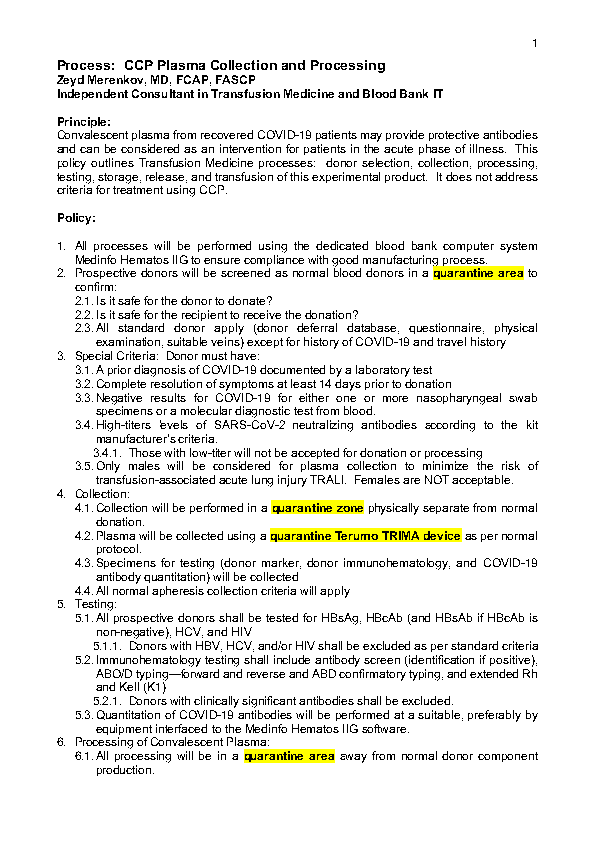
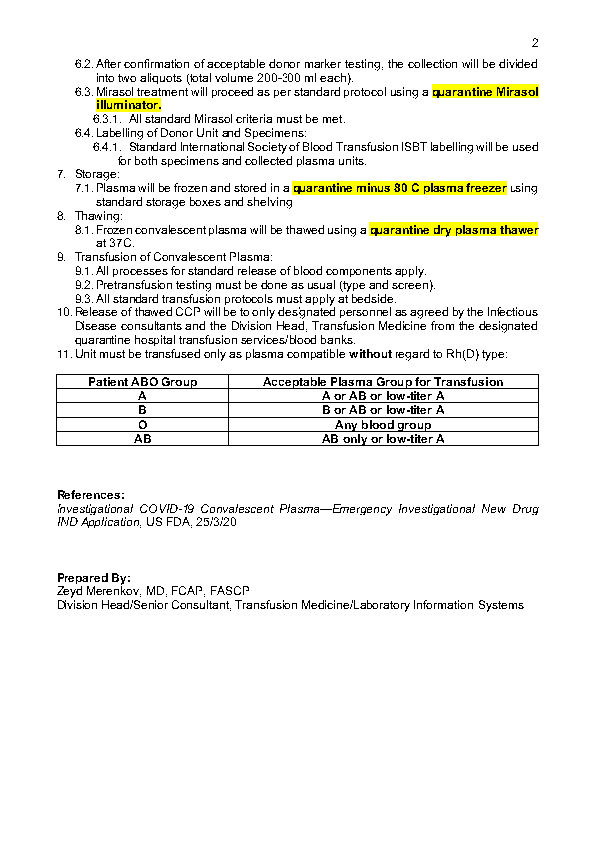
This is an updated set of donor deferral rules based on US FDA CBER guidances for body fluid exposures, blood components, and exposure to COVID-19 convalescent plasma CCP.

Policy:

  1. We will accept donors AFTER THREE MONTHS from the following activities:
    1. HIJAMA (ritual blood-letting)
    2. Tattooing
    3. Body piercing (e.g. piercing for ear-rings)
    4. Contact with blood of another individual through percutaneous inoculation such as a needle stick or through contact with a donor’s open wound or mucous membranes
    5. Transfusion of a blood component, including COVID-19 convalescent plasma
  2. Transfusion of clotting factors cases should be reviewed by the Transfusion Medicine Physician.

References:

  1. Revised Recommendations for Reducing the Risk of Human Immunodeficiency Virus Transmission by Blood and Blood Products, Guidance for Industry,  U.S. Department of Health and Human Services, Food and Drug Administration, Center for Biologics Evaluation and Research, April 2020
  2. Updated Information for Blood Establishments Regarding the COVID-19 Pandemic and Blood Transfusion, CBER, US FDA, 19/1/21
  3. AABB Summary:  Donation of CCP and Blood Components Following COVID-19 Vaccines or CCP Transfusion, 14/12/20

Operational Effects of the COVID Pandemic–My Experience in Qatar

The COVID-19 pandemic imposed new challenges to our system.  In general, these could be divided into:

  1. Decreased donors
  2. COVID vaccine effects
  3. Decreased available staff
  4. Shortages of supplies
  5. More demands on donor apheresis staff—CCP
  6. More demands on donor processing staff—CCP
  7. More demands on hospital transfusion service/blood bank staff—CCP

There were fewer donors in the early phase and the nurses also had to add a large number of donor plasmapheresis collections for COVID convalescent plasma CCP.  Still they had to maintain all donor and therapeutic apheresis services with no increase in staff.  Although elective procedures had been cancelled, there were still obstetrical, oncologic, and trauma services in full action.

Many of our staff were on leave when the borders were closed.  Some had to wait months before they could return to work.  Others had COVID-19 infection and were quarantined for several weeks.  This further reduced staffing.  We could not just hire outside staff since considerable training is involved in these processes.

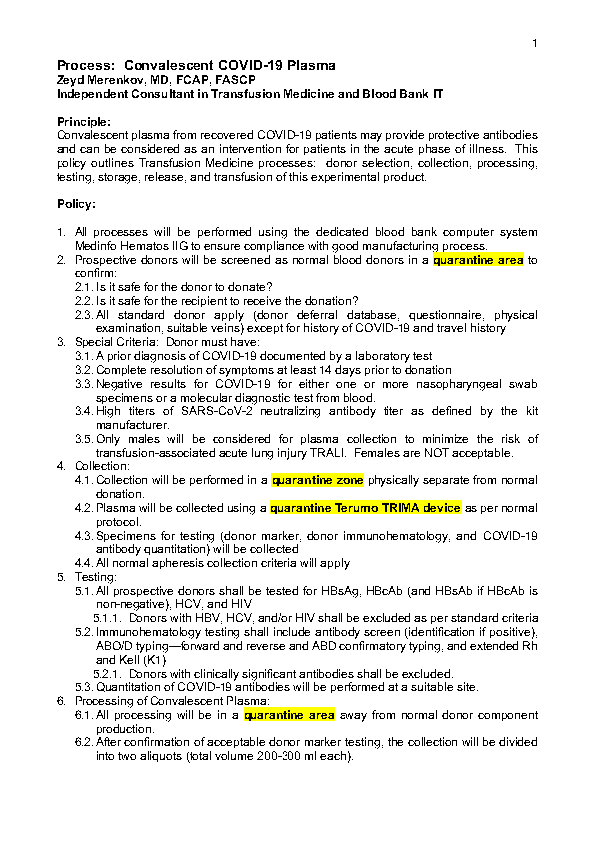
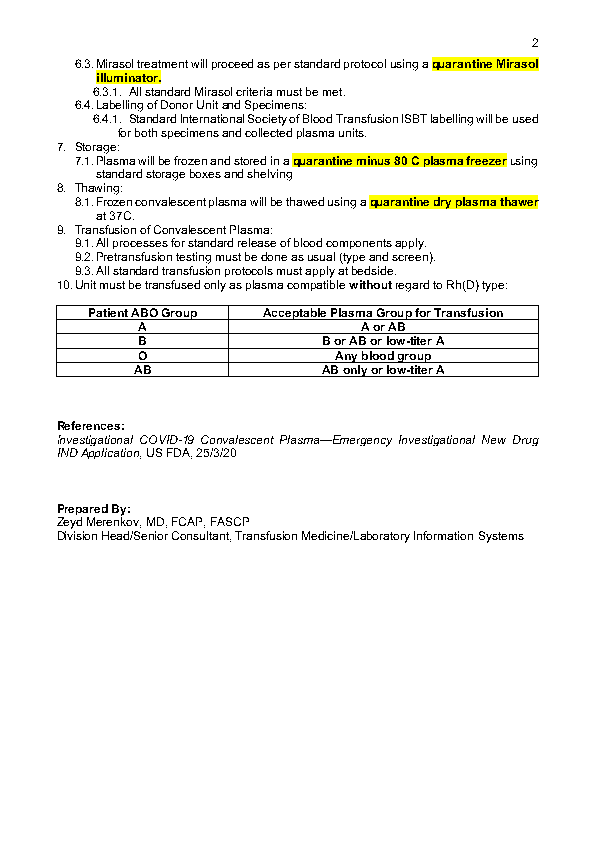
I dedicated a separate donor collection space for the CCP program away from the regular donors as well as a quarantine processing area.  Similarly, the CCP plasma was kept segregated from the regular plasma supply and a specially designed location was identified for release of this product.  Working for this program diverted resources from blood collection to this special project, again without increasing resources.

With disruptions to shipments of supplies, including the Reveos whole blood kits and Trima donor apheresis sets, we had to rely on our large in-home inventory until the situation stabilized.  We prescreened the CCP donor candidates before we would collect them to avoid wastage of kits.

Fortunately, our throughput was minimally affected because our equipment and processes had always stressed speed.  We used single-well NAT testing to minimize the need of additional runs.  Also, we used Reveos automated component processing to greatly speed production (one Reveos can process four whole blood units in about 23 minutes or about 12 units in 75 minutes.)  One technologist could operate all 4 of our machines simultaneously and perform other tasks while the machines were working.

In the system I developed in Qatar, we could complete processing into components (RBCs, buffy coat platelet pools, leukodepleted plasma), all marker and immunohematology testing, leukoreduction of the pools and RBCs, Mirasol pathogen inactivation, and platelet additive solution in as little as five hours.

In rapid turn-around events, it is most helpful to have a robust blood bank computer system that can scale to the challenge.  Also, it must mercilessly enforce all the rules starting with donor qualification, screening, collection through testing and production.  At times of emergency, it is difficult to meet Good Manufacturing Processes manually.

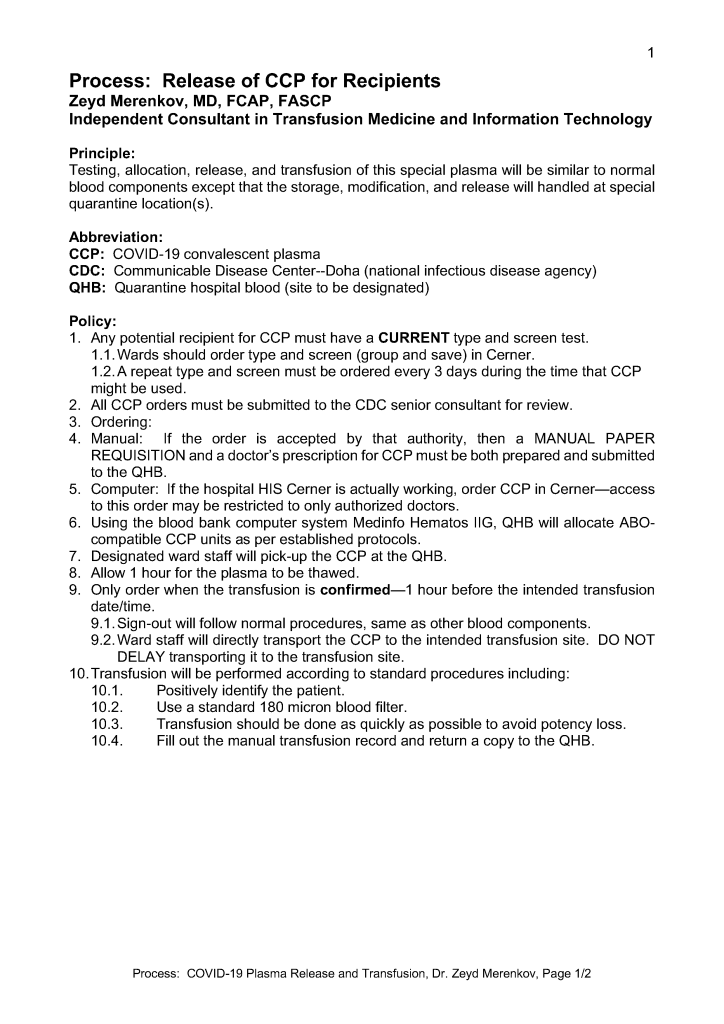
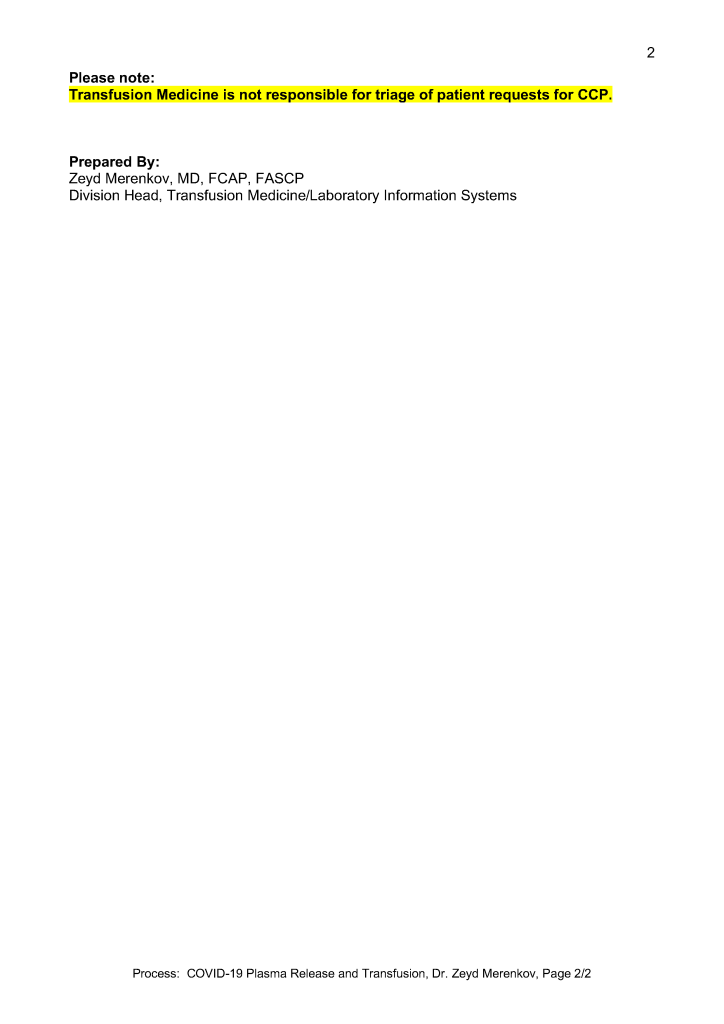
I had built parallel separate donor collection, donor processing, and transfusion service/hospital blood bank processes specifically for CCP and had to staff them with available personnel, limited our capability to process regular donors.  The blood bank computer software restricted CCP use to designated physicians and transfusing locations.  For those interested, there is a separate series of posts about the CCP project and its implementation in the dedicated blood bank Medinfo HIIG.

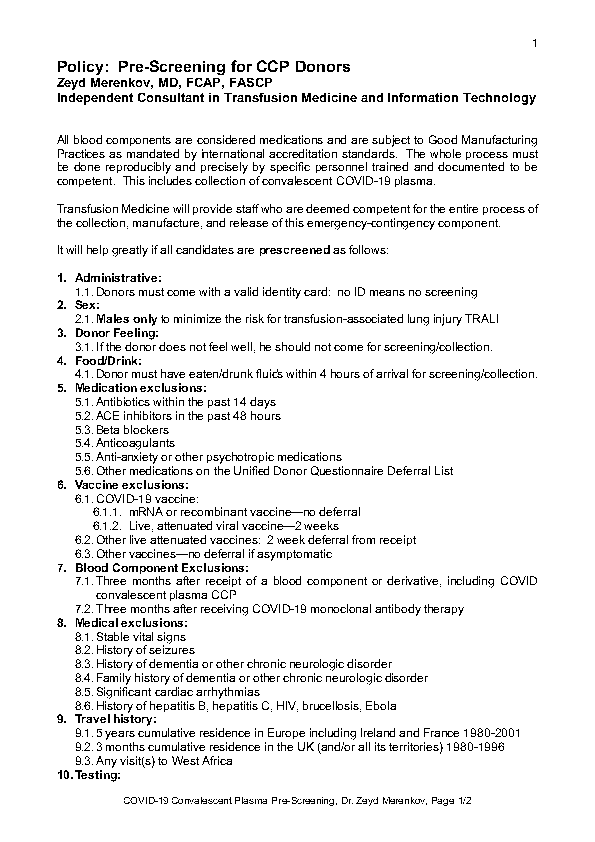
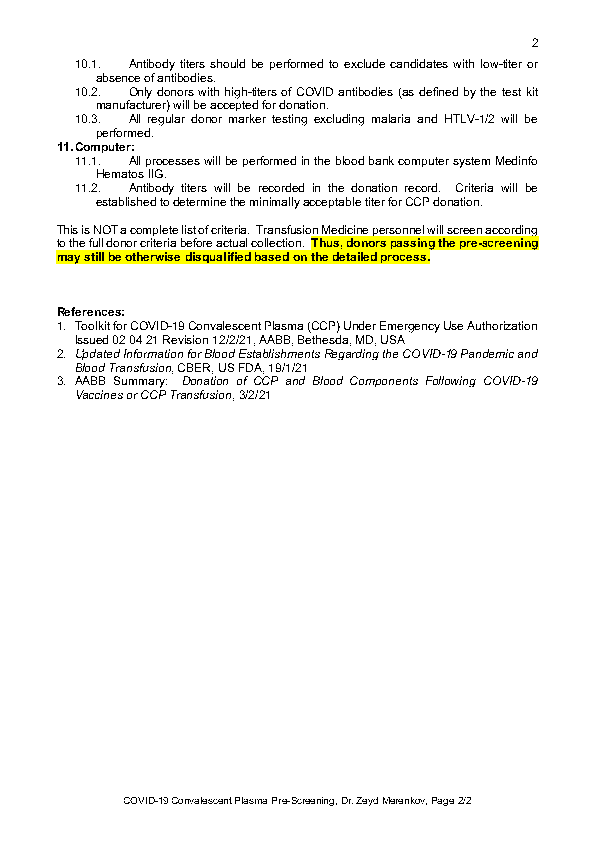
COVID-19 vaccinations should have minimal effect in donor qualification since mRNA or antigen-based ones do not cause donor deferral.  Live attenuated COVID vaccines will defer donors for 2 weeks by current rules—the same as other live vaccines.  Donors who had previously received CCP will be deferred for three (3) months after last receiving this product.

In summary, the COVID pandemic reduced staffing and affected donor recruitment.  We had production mitigations to maximize throughput.  The system was stressed by the reduced staffing and special demands to produce CCP.  However, the extent of our automation allowed us to maintain throughput throughout the crisis.

Updated COVID-19 Donor Eligibility Requirements

Principle:

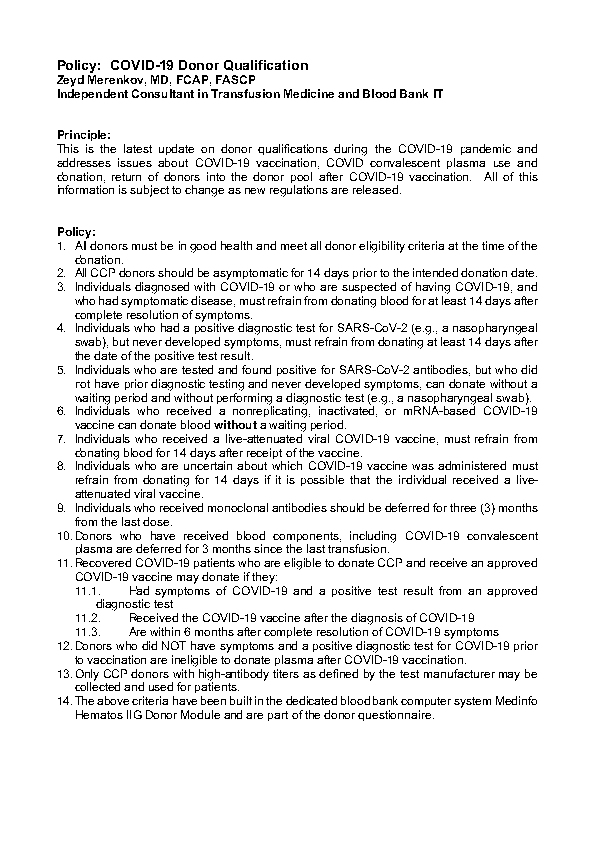
This policy is based on the 19/1/21 CBER document Updated Information for Blood Establishments Regarding COVID-19 Pandemic and Blood Donation.

Policy:

  1. There is no COVID-19 laboratory testing requirement for routine blood donor screening.
  2. Donors must be in good health and meet all blood donor eligibility criteria on the day of donation.
  3. The blood establishment’s responsible physician must evaluate prospective donors and determine eligibility according to the blood donor criteria.
  4. Donors with a diagnosis of COVID-19 or who are suspected of having COVID-19 and who had symptomatic disease should refrain from blood donation for at least 14 days after COMPLETE resolution of symptoms.
  5. Donors who had a positive diagnostic test (RT-PCR SARS-CoV-2 or equivalent) but never developed symptoms, should refrain from blood donation for at least 14 days after the date of the positive test result.
  6. Donors who are positive for SARS-CoV-2 antibodies but did not have prior diagnostic testing and never developed symptoms can donate WITHOUT a waiting period and WITHOUT a diagnostic test (RT-PCR).
  7. Vaccination deferrals are as follows:
    1. Recipients of nonreplicating, inactivated, or mRNA-based COVID-19 vaccines can donate blood WITHOUT a waiting period if #2 above applies.
    2. Recipients of live attenuated viral COVID-19 vaccines should be deferred for 14 days after receipt of the vaccine.
    3. Recipients who are uncertain which COVID-19 vaccine was administered, should wait 14 days.

Note that these rules do not address the special case of COVID-19 convalescent plasma donors.

References:

Updated Information for Blood Establishments Regarding the COVID-19 Pandemic and Blood Transfusion, CBER, US FDA, 19/1/21

Physician Comments in Medinfo

Principle:

There are several different types of comments in HIIG:

  • Donor Global
  • Patient Global
  • Analytical Comments
  • Result Comments

Physicians may enter any of these comment types.  Comments may be entered before or after a test is authorized/verified.  If entered after authorization, the test must be modified to accept the comment.  Only result comments are visible in the patient’s medical record.

Policy:

  1. Physicians should use comments in the following situations:
    1. Interpretations of DAT, antibody identification, ABO discrepancies
    2. Instructions for the selection of specific and/or modified blood components
    3. Donor eligibility issues (e.g. donor marker testing abnormalities and disposition)
    4. Donor reactions
    5. Telephone call documentation
    6. Donor counseling documentation
    7. Any special instructions to staff
    8. Any other situation where the transfusion physician determines it is desirable to enter a comment
  2. Copy all result-comments and also enter then as global comments against the patient or donor record as applicable.

Procedure—Patient Result Comments After Results are Authorized/Verified:

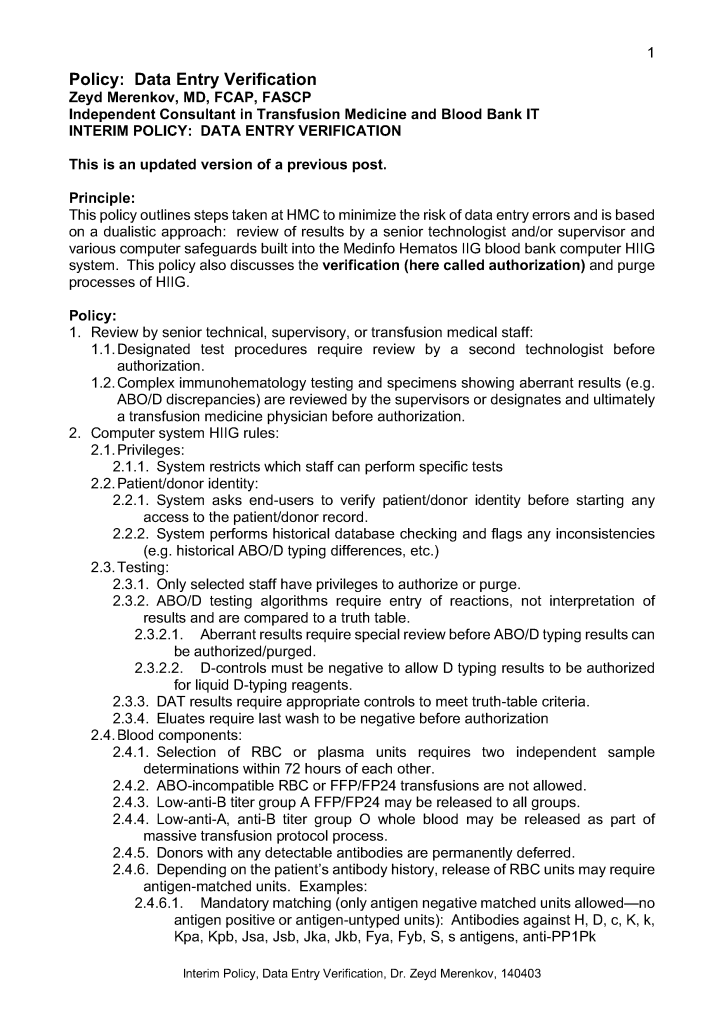
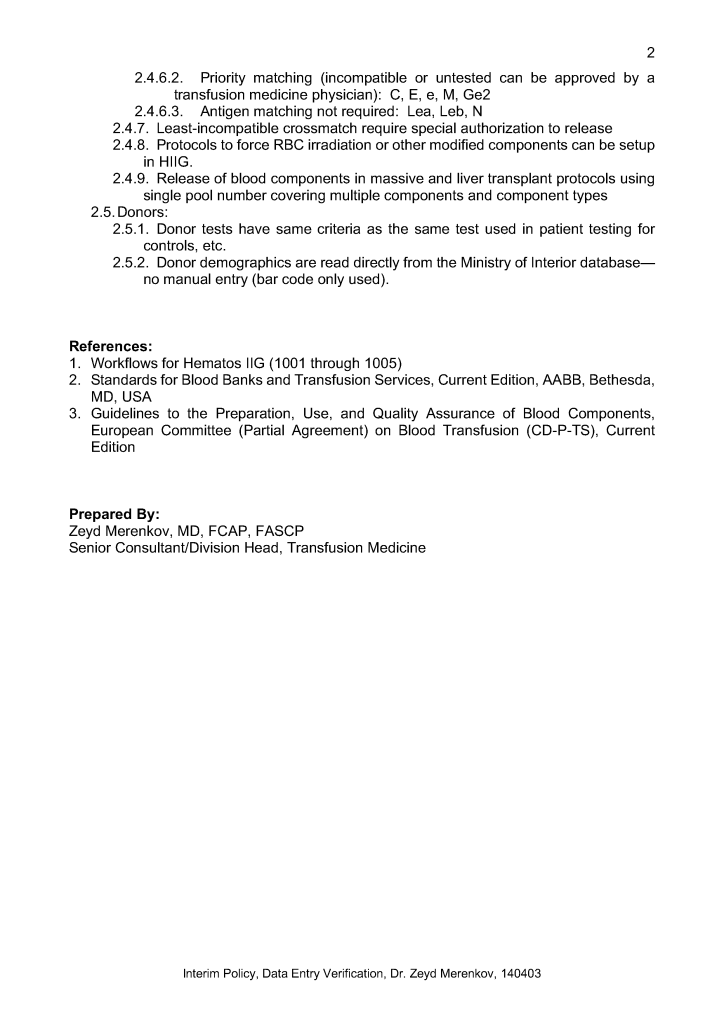
Sign into HIIG and select Patient module, Patient Consultation, and enter the patient hospital HC number.

Comments in Medinfo Hematos IIG

This post is the policy for using comments in Medinfo software.  A subsequent post will show the process of entering comments.

Principle:

There are several different types of comments in HIIG:

  • Donor Global
  • Patient Global
  • Analytical Comments
  • Result Comments
  • Contraindication Comments

Global Comments appear on the first main screen of either the donor or patient record.  The presence of comments is indicated by a bar at the bottom of the screen (in yellow or blue saying Presence of Comments.  Double-clicking opens the list of entered comments.

Examination/Results Comments appear only when you open the result to which it is attached.  You must know in advance to which result they are linked to find them.

Contraindication Comments appear when entering a donor deferral code

At HMC, we will enter examination/results comments again as global comments (donor or patient) so it is easy for staff to retrieve them and see them with all other comments.  You can do this by cut and paste.

Physicians may enter any of these comment types.  Comments may be entered before or after a test is authorized/verified.  If entered after authorization, the test must be modified to accept the comment and require a special password (not the user sign-into HIIG).  Only results/examination comments are visible in the patient’s medical record.  Global, analysis, and contraindication comments are visible only in HIIG!  Donor comments are only visible in HIIG.

The presence of comments documents physician review of abnormal results as required by the various accreditation standards.

Policy:

  1. Only designated staff may enter comments.
  2. Comments entered after authorization/verification of results will modify the donor/patient record and require a special, high-level password distinctly different from the normal user password.
  3. Enter comments in the following situations:
    1. Telephone call documentation (e.g. critical values).
    2. Interpretations of donor or patient test results, transfusion reactions, etc.
    3. Instructions for the selection of specific and/or modified blood components
    4. Donor eligibility issues (e.g. donor marker testing abnormalities and disposition)
    5. Donor reactions
    6. Donor counseling documentation (e.g. donor counseled at 0930 on 24/3/14 about his abnormal result).
    7. Any special instructions to staff
    8. Any other situation where the transfusion physician/supervisor or designate determines it is desirable to enter a comment
  4. Copy all results/examination-comments and also enter then as global comments against the patient or donor record as applicable.

References:

  1. Standards for Blood Banks and Transfusion Services, Current Edition, AABB, Bethesda, MD, USA
  2. Workflows 1001-1005, Medinfo Hematos IIG, 2013-2014.

Documenting Physician Review of Abnormal Results

International accreditation standards require physician review of certain abnormal results such as transfusion reaction and antibody workups.  This post describes how such review is documented in Medinfo Hematos IIG dedicated blood bank software.

In general there are three main ways to do this:

  1. User ID associated with each transaction
  2. Comments against results, analysis, or globally
  3. Physician direct entry of results (e.g. transfusion reactions)

This applies to all modules of Medinfo, including donor and patient.

User ID:

The system records the User ID of the staff member who performed an action—this includes the authorized transfusion physicians  This covers everything in the system, donor or patient.  However, it may require a specific query by user ID to list all of that person’s transactions.  This is not easy to show an external assessor/inspector unless the query is performed in advance.

Comments:

For those cases requiring review, comments can be placed with the results, which will be visible to anyone viewing that record.  Additionally, internal comments can be added to the analysis and globally within the record.

Direct Physician Entry of Results and Interpretations:

For transfusion reaction workups, physicians may directly enter their interpretations and results in the system.

Subsequent posts will show how comments and direct physician entry of results are performed in the system.

Transfusion Medicine Lectures for Pediatric Fellows

In my time at the Saudi National Guard Health Affairs and at HMC Qatar, I offered the pediatric fellows a series of lectures of 1-2 hours duration.  The following list has been updated to cover current topics of interest, including COVID-19 convalescent plasma.

  1. Transfusing blood components for physicians—what do you need to know
  2. Recognizing and treating adverse effects of transfusion
  3. Blood components and derivatives—what you need to know
  4. Blood filters, irradiation, aliquoting, and washing blood components
  5. Pathogen inactivation and platelet additive solutions
  6. COVID-19 and the blood supply, COVID-19 convalescent plasma
  7. Indications for blood components and monitoring efficacy
  8. Patient blood management:  minimizing transfusions
  9. Blood group serology and compatibility—what you need to know
  10. Adult vs. pediatric transfusion medicine:  special considerations for the pediatrics
  11. Hemolytic disease of the fetus and newborn
  12. Rh immunoprophylaxis:  RhIG, fetomaternal hemorrhage
  13. Platelet refractoriness:  prevention and treatment
  14. Hemoglobinopathy:  component selection for pediatric patients
  15. Therapeutic apheresis, focused on pediatric age group
  16. Stem cell transplantation
  17. Transfusion-transmitted diseases
  18. Emerging pathogens:  ZIKA, Chikungunya, Dengue

25/2/21