Logistics and Processes for a COVID-19 Convalescent Plasma Program

I prepared the following plan for a CCP program for HMC Qatar in March, 2020.  The workflow is divided into four (4) modules:

  1. Registration/Interview/Physical Examination/Apheresis Collection
  2. Donor Marker Testing and Immunohematology Testing
  3. Production/Aliquoting/Pathogen-Inactivation/Storage
  4. Product Thawing/Product Release

Module 1:

  1. Collection/registration/screening must be in a separate area from regular blood and apheresis donations.
  2. Donors must provide consent.
  3. ISBT specimen labels must be used on each tube collected.
  4. We need a minimum of two apheresis nurses, one for the registration/screening/post-donation observation and one for the actual apheresis procedure.
  5. If there will be multiple serial donors, then we need a waiting area (each donor at least 2 meters apart).
  6. Donor screening must be in sound-proof area so that other waiting donors cannot hear the interview/questionnaire process.
  7. Amount that can be collected depends on body weight:  500 ml for <80 kg and 600 ml for >= 80 kg, collection may occur twice per week
  8. Collection time includes 15 minutes for registration/interview/physical examination, 60-75 minutes and 15 minutes for cleanup/disinfection before the next case, approximately 2 hours per donation.
  9. A post-donation observation area (minimum 15 minutes after collection) with apheresis nurse nearby in case of reactions is needed if there will be multiple donors.
  10. Specimens will

Module 2:

  1. Donor testing and donor immunohematology will be done with other donor specimens in our regular location

Module 3:

  1. Apheresis collection must be processed and stored separately from regular blood/apheresis donations.
  2. Processing will occur only after the results are shown to meet all criteria.
  3. Pre-collection testing (test-only donation) would permit processing without waiting for results.
  4. Storage at minus 80C may be for a minimum of six (6) years but this may be extended if needed.
  5. All acceptable components will have a final ISBT label—no products without the ISBT label will be transfused.  The ISBT label indicates that the unit meets all donor criteria for convalescent plasma.

Module 4:

  1. Product modification (thawing) and release (sign out from blood bank) must be in a separate area(s) from the regular hospital blood bank.
  2. Release of convalescent plasma follows the same process as regular component release
  3. Transfusion of convalescent plasma at the patient’s bedside follows same process as regular component transfusion
  4. Nursing and other staff performing the transfusion must pass competency assessment.
  5. Plasma will be transfused as ABO-identical or compatible unless low ABO-titer group A is used.
  6. Plasma must be free of clinically significant antibodies

Workflow Considerations:

  1. Donors must be restricted to the waiting, collection, or post-donation observation areas.
  2. Donors must NOT pass through production, testing, or component release areas (just as they are currently restricted in the Blood Donor Center and HMC hospital blood banks/transfusion services).

Logistics:

  1. Throughput is a maximum of 4 donors (2000 to 2400 ml plasma) per eight-hour shift with one apheresis nurse and one donor apheresis (Trima) machine.
  2. The processes are scalable with additional staff and machines (e.g. with 3 machines and nurses, then 12 donors and 6000 to 7200 ml of plasma collected).
  3. Thawing of 1-2 units of plasma takes up to one hour.  Contact the quarantine blood bank at least one hour before the desired pick-up time.
  4. The four modules above can be in separate areas not adjacent to one another.  Modules 1, 3, and 4 must be quarantine areas where access is limited.  Module 2 can be performed with regular donor specimens using standard precautions.
  5. We can provide training for transfusion of blood components and competency assessment to any location transfusing this product.

Information Technology:

  1. All modules will be connected to the Medinfo Hematos IIG dedicated blood bank computer system.
  2. All records of collection/production/testing/storage/modification/release will be stored therein.
  3. All ordering of convalescent plasma components will be through Medinfo.
  4. External test results (e.g. future antibody titering) can be added to the component information.
  5. Links to the Hospital Information System (Cerner) may be considered after the Medinfo processes are fully functional.
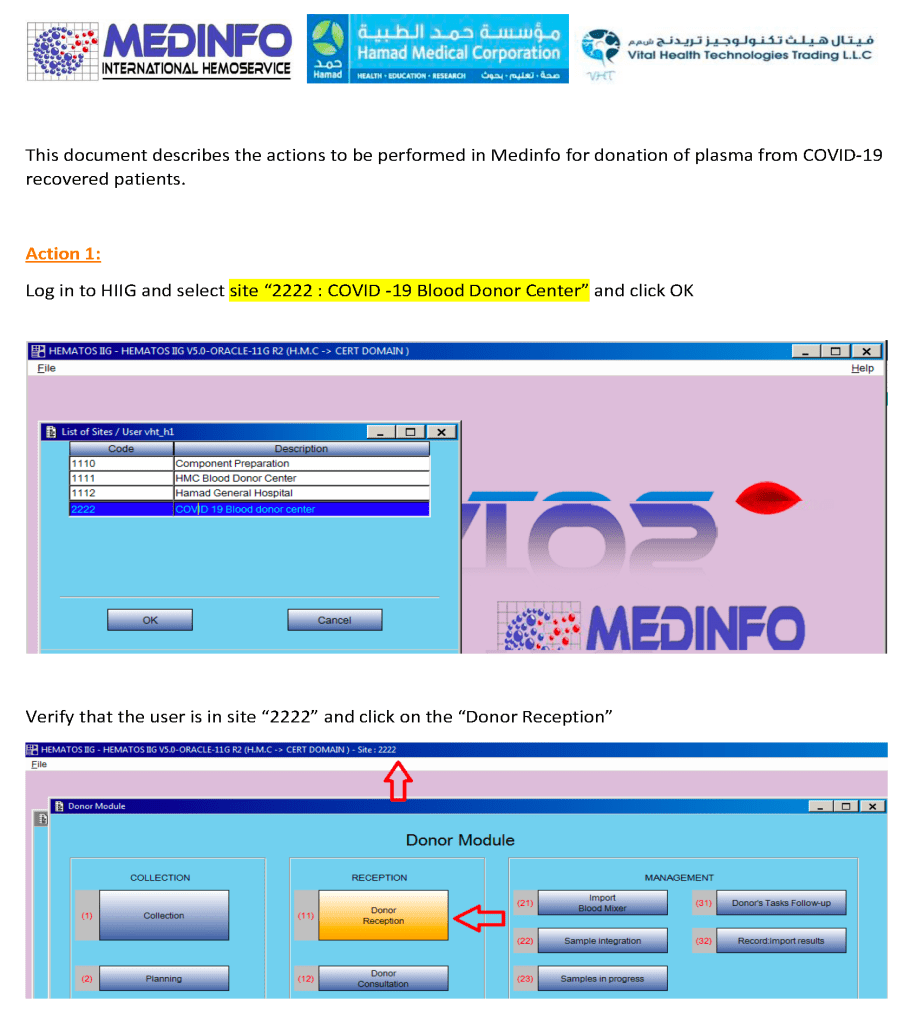
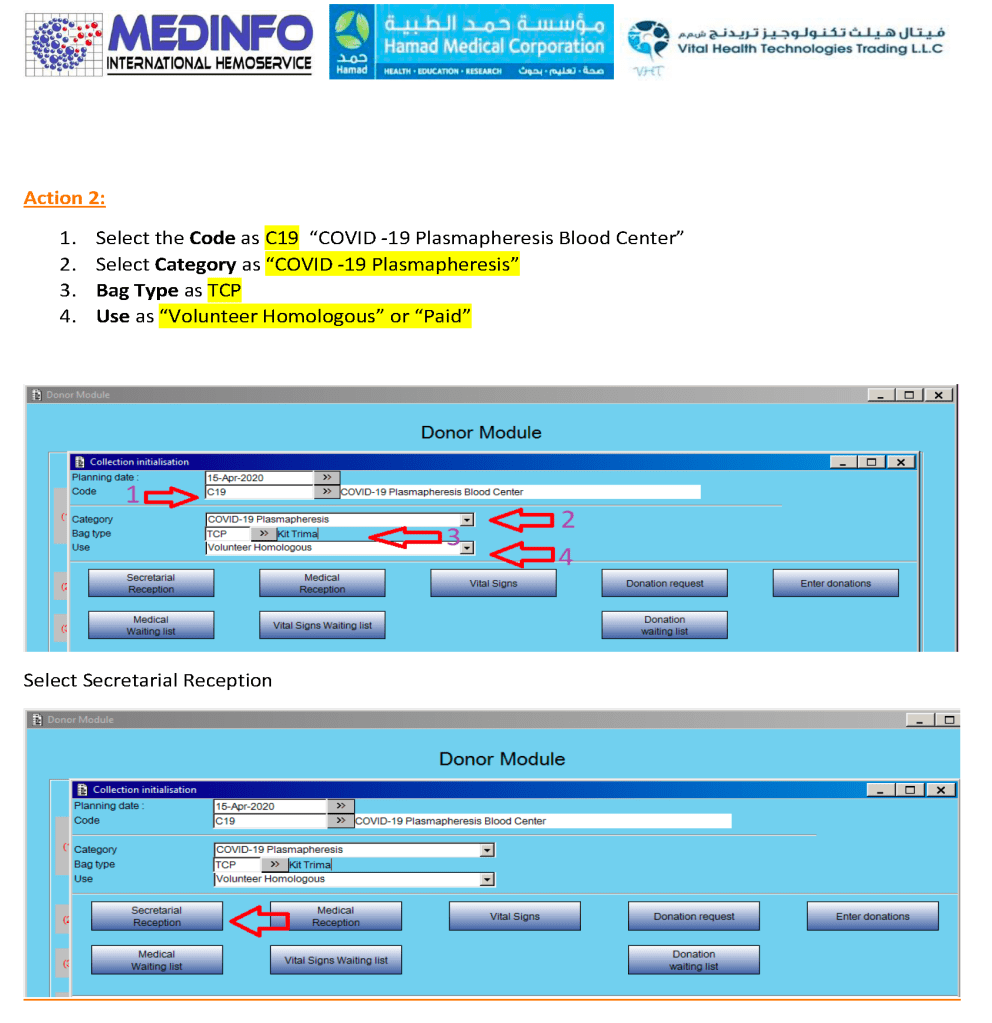
COVID-19 Convalescent Plasma CCP Site Registration

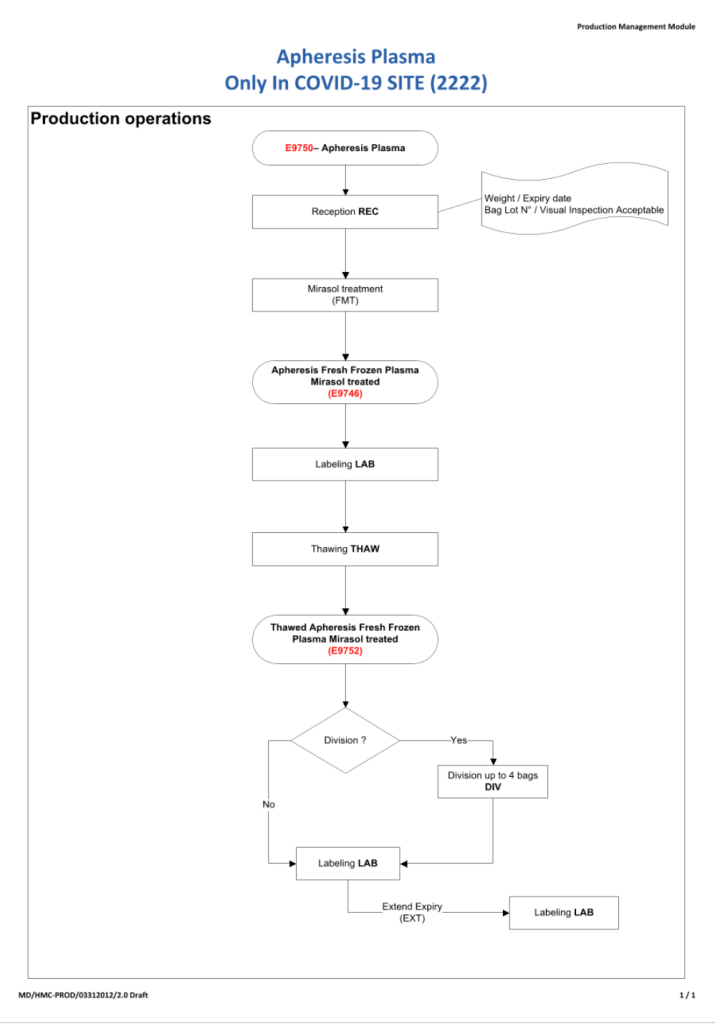
I designed a completely quarantined process for collection, processing, and release of CCP at HMC Doha.  This document shows the Medinfo process for site registration as a separate donor center code.

CCP could only be collected at this special site and only the apheresis bag could be used for collection.  Regular donation options were not available at this CCP site nor was CCP collection an option at the regular donation sites.

4/1/21

Medinfo COVID Convalescent Plasma Workflow Revisited

It now has been over eight 8 months since I prepared the CCP workflow in Medinfo.  It was built on the framework of the manual CCP process including donor prescreening with an abbreviated donor questionnaire.  It was really quite simple and used the donor and patient modules to create quarantine areas for donor screening, collection, processing, and hospital patient blood bank release.

Here are my current comments on the process:

Donor Qualification:

I would still exclude malaria and HTLV from the donor questionnaire and would update to UDQ 2.1.  Since these donors have recovered from a potentially life-threatening illness, I would keep the Hgb threshold at 11 g/dl.

Donor Collection:

In the future, I would consider using one of the soon-to-be-released portable devices that continuously monitor vital signs with pO2 and EKG lead to rule out asymptomatic pulmonary or cardiac problems.

I would also consider using low-ABO-titer, group A, universally to meet the demand for group B and AB patients.

Donor Testing:

There is still no need to segregate and separately test CCP donor specimens from regular blood donor specimens.  I would perform SARS-CoV-2 antibody testing and set a threshold for qualifying donors—that threshold will be based on the manufacturer’s recommendations.  However, if the treating physician wanted to use a low-titer unit, I would permit this.

Donor Processing:

There is no need to change this from the current processes.  Keep the CCP processing separate from the regular operations.

CCP Plasma Release:

I would keep the quarantine release and restrict it to the locations used for treating COVID-19 patients

Medinfo Software Modifications:

I would record the IgG and IgM titers for SARS-CoV-2 antibodies in each donation record.  This would include testing and entering the results on donations prior to this testing.  ISBT labels should include this antibody titer.

Hospital Information Software Modifications:

Set up restricted CCP ordering for the actual treating physicians only.  Also provide the ISBT code and shortened descriptors to it if necessary (certain HIS vendors still cannot read ISBT codes natively).

The original CCP workflow is attached for reference.

Manual Collection of COVID-19 Convalescent Plasma

This process was originally done in the first phase of CCP collection.  I have updated it to include SARS-CoV-2 antibody testing.

Principle:

Due to the pandemic, we will initially MANUALLY collect an experimental, investigational-use-only plasma product from apheresis donors and treat it with Mirasol.  THIS IS A EMERGENCY INTERIM PROCESS UNTIL THE MEDINFO HEMATOS IIG PROCESSES ARE PREPARED AND VALIDATED.

Policy:

  1. Good Manufacturing Practice applies:
    1. Manufacturers’ recommended processes for equipment and materials usage applies.
    1. All staff engaged in these processes must be competency assessed successfully.
  2. Pre-Screening:
    1. Clinical staff will use the prescreening document to select donors for pre-donation screening.
  3. Quarantine:
    1. All processes (day 0, day 1, day 2, and product modification and release) will be done in quarantine areas SEPARATE and DISTINCT from regular Transfusion Medicine activities.  This includes:
      1. Separate space and equipment must be provided.
        1. Equipment for this project may NOT be used for regular, non-quarantine processes
    2. Non-Transfusion Medicine staff will not be permitted in operational areas.
    3. Prospective donors will not be permitted in the processing, testing, storage, or blood bank work areas.
  4. Donation Process:
    1. Day 0:  Registration, check donor deferral database, questionnaire, physical exam including arm check, and specimen collection using ISBT specimen labels
    2. Use latest manual donor questionnaire.
    3. Day 1:  Donor marker and immunohematology testing, review of results, accept or reject donor for actual plasmapheresis
    4. Day 2:  Collect manufacturer’s recommended volume of plasma (500 ml if < 80 kg, 600 ml if >= 80 kg), aliquot, pathogen-inactivate (Mirasol), freeze at minus 80C
  5. Testing:
    1. Testing will be performed with regular blood donor specimens using ISBT specimen labels
    2. Testing must be done by donor-specific processes (not those for clinical patients)
      1. Exclude malaria and HTLV testing.
    3. Testing must be directly interfaced to Medinfo Hematos IIG donor module
    4. CCP COVID antibody testing:
      1. SARS-CoV-2 antibody testing to be performed to determine cut-off for donor eligibility for CCP collection.
      2. Use of donors with antibody levels below threshold is at the discretion of the treating clinician.
  6. Processing:
    1. Aliquoting, pathogen-inactivation, and labelling may proceed if the pre-donation screening results are acceptable.
  7. Storage:
    1. Long-term in minus 80C quarantine freezer
    2. Short-term at 1-6 C just after thawing in quarantine refrigerator
    3. Standard temperature monitoring and alarms apply
  8. Labelling:
    1. The backup manual labelling process applies
    2. The ISBT specimen label will the donor unit number
      1. Outdate will be 6 years if the product is stored at -65C, 1 year if stored at -18C
  9. Product Release:
    1. Orders must be on the PAPER requisition (old Blood Bank Order Form) with a patient prescription and signed by a physician designated to treat COVID patients.
      1. No orders in Cerner
    2. Thawing plasma at 37C upon receipt of order by Transfusion Medicine staff
    3. Signing out component to clinical unit by Transfusion Medicine Staff to locations treating COVID-19 patients.
  10. Information Technology:  Medinfo Hematos IIG customized software to be implemented as soon as possible for all processes
  11. Not covered:  Transfusion Medicine is NOT responsible for:
    1. Triage of request for convalescent plasma
    2. Pickup and transport of components

References:

  1. Level 1-4 documents for donation, testing, processing, and release of blood components
  2. COVID-19 Plasma Donor Prescreening Document, 8/4/20

COVID-19 Convalescent Plasma Donor Pre-Screening

All blood components are considered medications and are subject to Good Manufacturing Practices as mandated by international accreditation standards.  The whole process must be done reproducibly and precisely by specific personnel trained and documented to be competent.  This includes collection of convalescent COVID-19 plasma.

Transfusion Medicine will provide staff who are deemed competent for the entire process of the collection, manufacture, and release of this unlicensed, emergency-contingency component.

It will help greatly if all candidates are prescreened to exclude the following candidates:

  1. Administrative:
    1. Donors must come with a valid Qatari identity card:  no ID means no screening
  2. Sex:
    1. Males only to minimize the risk for transfusion-associated lung injury TRALI
  3. Donor Feeling:
    1. If the donor does not feel well, he should not come for screening/collection.
  4. Food/Drink:
    1. Donor must have eaten/drunk fluids within 4 hours of arrival for screening/collection.
  5. Medication exclusions:
    1. Antibiotics within the past 14 days
    2. ACE inhibitors in the past 48 hours
    3. Beta blockers
    4. Anticoagulants
    5. Anti-anxiety or other psychotropic medications
    6. Other medications on the attached list
  6. Medical exclusions:
    1. Stable vital signs
    2. History of seizures
    3. History of dementia or other chronic neurologic disorder
    4. Family history of dementia or other chronic neurologic disorder
    5. Significant cardiac arrhythmias
    6. History of hepatitis B, hepatitis C, HIV, brucellosis, Ebola
  7. Travel history:
    1. 5 years cumulative residence in Europe including Ireland and France 1980-2001
    2. 3 months cumulative residence in the UK (and/or all its territories) 1980-1996
    3. Any visit(s) to West Africa

This is NOT a complete list of criteria.  Transfusion Medicine personnel will screen according to the full donor criteria.  Thus, donors passing the pre-screening may still be otherwise disqualified based on the detailed process.

COVID-19 Convalescent Plasma CCP Series Introduction

I will be posting a detailed series about the manual and software-enhanced COVID-19 processes that I set up in Qatar at HMC Doha in March-April 2020.

In this series I will provide you with screen shots of my Medinfo Hematos IIG software design for each step in the process:  collection, processing, testing, inter-depot transfer, and hospital transfusion service/blood bank release.

This GMP-compliant software-enhanced system is based on the manual system I set up in early March 2020 at HMC.

I want to thank Medinfo Hematos IIG for their rapid response to building this parallel system based on my standard processes in so short a time (two weeks) and my special thanks to the software engineering team at Vital Health Technologies, the agent for Medinfo in Qatar.

To start the series, I am providing the basic workflow for the system.  As is normal in Medinfo software design, a full mapping of the processes are made.  This workflow shows the new CCP ISBT codes and the quarantine collection and processing steps.  The donor testing (marker and immunohematology) processes are similar to those for regular donor units.

This is basically the same process both manually and in the software.  I always say:

A good software process is based on a good manual process!!

Please note the following workflow for our initial discussion.

Release of COVID-19 Convalescent Plasma CCP

Principle:

Testing, allocation, release, and transfusion of this special plasma will be similar to normal blood components except that the storage, modification, and release will handled at special quarantine location(s).  Release and modification of components is to be handled separately from the regular hospital blood bank/transfusion service.

Abbreviations:

CCP:  COVID-19 convalescent plasma

ID:  Infectious Disease Department (clinical COVID19 treatment unit)

QHBBB:  Quarantine hospital blood bank (which stores, thaws, and releases CCP)

Policy:

  1. Any potential recipient for CCP must have a CURRENT type and screen test (< 72 hours old.)
    1. A repeat type and screen should be ordered every 3 days during the time that CCP may be used.
  2. All CCP orders must be submitted to the ID senior consultant for triage.
  3. If the order is accepted by that authority, then an order and a doctor’s prescription for CCP must be both prepared and submitted to the QHBB.
  4. QHBB will allocate ABO-compatible CCP units and attached blood bank computer-generated release labels and forms to it.
  5. Designated ward staff will pick-up the CCP at the QHBB.
  6. Allow 1 hour for the plasma to be thawed.
  7. Only order when the transfusion is scheduled—1 hour before the intended transfusion date/time.
    1. Sign-out will follow normal procedures, same as other blood components.
    2. Ward staff must provide a doctor’s prescription for CCP and a fully completed request.
    3. Ward staff will directly transport the CCP to the intended transfusion site.  They should immediately transport it to the patient transfusion site.
  8. Transfusion will be performed according to standard procedures:
    1. Positively identify the patient.
    2. Use a standard 180 micron blood filter.
    3. Transfusion should be done as quickly as possible to avoid potency loss
    4. Fill out the transfusion record and return a copy to the QHBB.

Pre-Screening for CCP Patients

This is a review/update of this document prepared early in the course of our COVID-19 Convalescent Plasma CCP collections.  It now includes testing of specimens not only for donor marker testing but also COVID-19 antibody titers.

All blood components are considered medications and are subject to Good Manufacturing Practices as mandated by international accreditation standards.  The whole process must be done reproducibly and precisely by specific personnel trained and documented to be competent.  This includes collection of convalescent COVID-19 plasma.

Transfusion Medicine will provide staff who are deemed competent for the entire process of the collection, manufacture, and release of this unlicensed, emergency-contingency component.

It will help greatly if all candidates are prescreened to exclude the following candidates:

  1. Administrative:
    • Donors must come with a valid Qatari identity card:  no ID means no screening
  2. Sex:
    • Males only to minimize the risk for transfusion-associated lung injury TRALI
  3. Donor Feeling:
    • If the donor does not feel well, he should not come for screening/collection.
  4. Food/Drink:
    • Donor must have eaten/drunk fluids within 4 hours of arrival for screening/collection.
  5. Medication exclusions:
    • Antibiotics within the past 14 days
    • ACE inhibitors in the past 48 hours
    • Beta blockers
    • Anticoagulants
    • Anti-anxiety or other psychotropic medications
    • Other medications on the Unified Donor Questionnaire Deferral List
  6. Medical exclusions:
    • Stable vital signs
    • History of seizures
    • History of dementia or other chronic neurologic disorder
    • Family history of dementia or other chronic neurologic disorder
    • Significant cardiac arrhythmias
    • History of hepatitis B, hepatitis C, HIV, brucellosis, Ebola
  7. Travel history:
    • 5 years cumulative residence in Europe including Ireland and France 1980-2001
    • 3 months cumulative residence in the UK (and/or all its territories) 1980-1996
    • Any visit(s) to West Africa
  8. Testing:
    • Antibody titers should be performed to exclude candidates with low-titer or absence of antibodies.
    • Regular donor marker testing (excluding malaria and HTLV 1/2)

All processes will continue to be performed in the dedicated blood bank computer system. The COVID-19 antibody titers will be part of the donation record.

This is NOT a complete list of criteria.  Transfusion Medicine personnel will screen according to the full donor criteria.  Thus, donors passing the pre-screening may still be otherwise disqualified based on the detailed process.

8/11/20

COVID-19 Convalescent Plasma Revisited:

In February, 2020, I developed a program for convalescent COVID-19 plasma at Hamad Medical Corporation in Doha.  In early March, 2020, our program started collecting CCP by apheresis.  We started before the software modifications were completed since there were urgent requests by the clinicians for the product.

I proposed the software specifications and our vendor Medinfo Hematos IIG implemented them within 2-3 weeks, after which they were implemented/validated

Thus, now we have 8 month experience has been 8 months since starting manually and more than 7 months using a specific modification of our blood bank software Medinfo.

A complete manual system was implemented with quarantined registration, screening, collection, processing, and release.  Only the donor marker testing was shared with the regular donors.  This was built into the computer system.

Upon review, these are my current thoughts on our processes:

  1. Actively monitor supply requests:  Keep good communication between ordering/treating physicians and apheresis unit to optimize the stock according to patient needs.
  2. Collect/process/release separately from regular donations.
  3. Use dedicated quarantine equipment (apheresis, processing, storage refrigerators)
  4. Collect manufacturer’s recommended maximum of plasma based on body weight.
  5. Use pre-donation screening to allow quick release of components and avoid wasting apheresis kits.
  6. Repeat testing on the new specimen collected at the time of apheresis donation.
  7. Process units by same processes used for normal donations, including pathogen-inactivation.
  8. Use standard processes for release of blood components to end-users.
  9. Restrict ordering to designated treating COVID-19 physicians (enforce in computer system)
  10. Restrict release of CCP to designated non-blood bank staff from the quarantine storage location (enforce in computer system)

Notes:

  1. Include COVID-19 antibody testing and establish a threshold level (e.g. 1:128 titer) for donor qualification.  Do not collect if low-titer or absence of COVID-19 antibodies.   Store titer information with donation record.  Add antibody results to donation records that occurred before the assay was available.
  2. Review of donor criteria:  are there increased risks using these recovered donors:  cardiac or respiratory risk?  Is there a way to continuously monitor CCP donors’s vital signs during the donation?
  3. Collect apheresis components only in pre-screened donors:  Apheresis kits are expensive, use them only if the donor is prequalified, continue to retest when actual apheresis donation occurs
  4. Allow use of units directly after collection/processing as long as the other donor processing steps have been completed (allow blood bank computer system to use pre-donation specimen for marker testing criteria).