Patients Post-Stem-Cell Transplant

Principle:

The patient’s blood type may change after receiving an ABO-incompatible stem cell (HPC-A stem cell or HPC-M marrow) transplant.  We must verify that the change detected is due to the transplant and NOT due to a mistake in identifying the correct patient at the time of the specimen collection.  Thus, the first time there is a specimen after transplant, we should treat the patient as if there is an ABO/Rh discrepancy, i.e. positively identify the patient again and redraw a new specimen and verify the type.

After transplant, both the original and new clones of RBCs may survive.  It is important to check for ABO discrepancies between the forward and reverse type.

Also note that the other RBC antigen phenotypes may have changed.  Particularly, note if the D type has changed.  The previous extended phenotype may no longer apply.

Policy:

  1. On the first encounter with a patient post-stem cell transplant, if the ABO/D type has changed, request a second (NEW) specimen:
    1. Repeat the ABO/D type, verify that both specimens from this admission agree.
    2. Perform the ABO/D type using a gel or glass bead methodology, check for mixed field reactions.
    3. Verify that that forward and reverse types agree (i.e. are there any discrepant reactions?)
  2. Contact the Division Head, Transfusion Medicine, and give the history (i.e. date of the transplant) and describe all the reactions (historical type, new type, ABO discrepancies).  He will tell you what blood groups of RBCs and plasma to use for transfusion.

Note:  In an emergency situation, use group O RBCs and AB plasma.  If the patient was previously D-positive and now post-transplant is D-negative, use D-negative RBCs if it is a female < 55 years old.

Platelet ABO/D Type Substitutions/Mitigations

Principle:

Platelets have only weak ABO antigen expression but contain the naturally occurring antibodies of the original donor.

Policy:

  1. 20 kg or more:
    1. Platelets of any ABO/D type may be given to any patient
  2. Below 20 kg:
    1. First choice:  ABO identical
    2. Second choice:  Plasma compatible
    3. Third choice:  Platelet components in platelet additive solution PAS
    4. Fourth choice:  Contact transfusion medicine for use of plasma-incompatible type
  3. Do NOT volume reduce platelets:  this adversely affects platelet function and requires a prolonged recuperation period of several hours before the platelets can be transfused.  Platelets in additive solution have only minimal residual plasma (35 ml out of 200 ml volume).
  4. There is no need to chose platelet types from a D-compatible donor because we use methods that minimize RBC contamination (automated component processing to prepare buffy coats for pooling or apheresis).
    1. It is at the discretion of the ordering physician if he wants to consider Rh immunoprophylaxis if D-incompatible type is chosen.

References:

  1. Standards for Blood Banks and Transfusion Services, Current Edition, AABB, Bethesda, MD, USA
  2. Guidelines to the Preparation, Use, and Quality Assurance of Blood Components, European Committee (Partial Agreement) on Blood Transfusion (CD-P-TS), Current Edition

Opinion: Handling Incorrect Physician Orders

Most of the non-transfusion-medicine physicians with whom I have worked have had only limited training in placing component or hospital blood bank orders.  In previous posts I have discussed this and suggested that all physicians who may possibly order blood bank tests or blood components should have a training and documented competence on a periodic basis.  Only a very few physicians, mainly hematologists and some organ transplant physicians, have placed reliable orders.

Before we had a blood bank computer system, we received orders on a manual paper requisition.  If there were errors, my technical staff and I corrected the order.  Any changes were made by me in my capacity as the blood bank medical director.  The ordering physicians and I had good relations and they had no problem with this—in fact, many were afraid of the blood bank and felt happy to be relieved of the responsibility.

In the current software era, what happens depends on how the order is placed.  Can the technical staff and I correct the order directly or must we each and every time contact the physician to revise his/her order?  Do my staff have to cancel each erroneous order and wait for the corrected order?  This could slow down the work process and prevent release of blood components in a timely manner.

Should the non-blood bank physician be allowed to order our complicated esoteric transfusion tests directly—e.g. ordering extended antigen typings or antibody identifications or elutions?   What if they order something unnecessary or inappropriate?

At a recent hospital position as Division Head of Transfusion Medicine, I discovered that the Hospital Information System HIS was very slow for all blood bank orders.  The physicians complained, I would allow them to bypass the HIS and use the manual backup system in critical situations.  If we had been forced to cancel the order and have the physician reorder, this would have greatly disrupted the work process.

We did not use the HIS at all in Transfusion Medicine.  We had patient and donor modules in the dedicated blood bank system Medinfo.  We had a limited ordering interface from the HIS to Medinfo for blood components and some basic testing (e.g. ABO/D typing, DAT, type and screen/group and save, cord blood testing, and transfusion reaction workups).  All work was done in the dedicated blood bank system.

All components were leukodepleted to < 1E6, all platelet and plasma were Mirasol pathogen-inactivated, all platelets were in platelet additive solution PAS.

The doctors did not order the specific blood component, rather they indicated a preference, e.g.

  • Packed RBCs
  • Platelets (adult dose of 2.4 E11)
  • Plasma
  • Cryoprecipitate

The following appeared as an order comment in the blood bank system:

  • The specific number or amount of the each component type
  • Preferences for pooled vs. apheresis platelets, washed RBCs, irradiated RBCs.

The blood bank staff could review the doctor’s request and order in Medinfo as per our internal protocols under my responsibility.  In effect, I was modifying the orders when needed just as I had done under our manual system.  This included type, modification, and quantity.  Yet now, I did not have to change any orders since the doctors had only indicated preferences.

For blood bank testing orders, we had our own internal algorithms for the workups.  The doctors could not order antibody identifications, elutions, or any antigen typings other than ABO/D.  They latter were triggered by the screening test results.

This system allowed us to avoid cancellations due to physician errors.  I was very comfortable taking the responsibility to alter the orders for best patient care.  If a physician did not agree with our algorithms, they could discuss the issue with one of the transfusion physicians, or ultimately appeal to me.  I was fortunate that there were no legal issues with this approach where I practiced.

In summary, my recommendations are:

  1. Have the doctors order a preference for the type of blood component.  They still order the quantity and can request modifications such as washing or irradiating or apheresis-derived or buffy coat pool platelets.  The actual allocation is made by blood bank staff under my direction.
  2. Offer algorithmic based testing.  Doctors only order basic testing which triggers reflex algorithms.  Most of the test menu is not orderable directly by the physicians (example:  an antibody identification is triggered by a non-negative antibody screen.

9/12/20

Anti-CD47 Interference

Background:

Anti-CD47 (Hu5F9-G4)interferes with all phases of pretransfusion testing, including ABO reverse typing.

Anti-CD47 (Hu5F9-G4) is a human monoclonal IgG4 antibody used to treat hematologic or solid malignancies.  CD47 is a glycoprotein expressed on all cells. 

All plasma samples reacted 3-4+ in all phases with RBCs, including immediate spin.  Stronger reactivity may occur in D-negative RBCs.  Plasma reacted with DTT, trypsin, papain, alpha-chymotrypsin or WARM (warm autoantibody removal medium—Immucor). 

DAT and autocontrol are negative or weak whereas eluates are 3+ reactive.  Reactivity is removed by multiple alloadsorptions with papain-treated cells or pooled platelets.  PEG absorption is invalid due to precipitation of the antibody.  Gamma heavy-chain specific AHG reagent (Gamma-clone IgG—Immucor) does not detect IgG4 antibodies.

Process:

  1. Always check medication history for anti-CD47 treatment.
  2. If positive, use gamma heavy-chain specific AHG reagent (Gamma-clone IgG) for IAT.

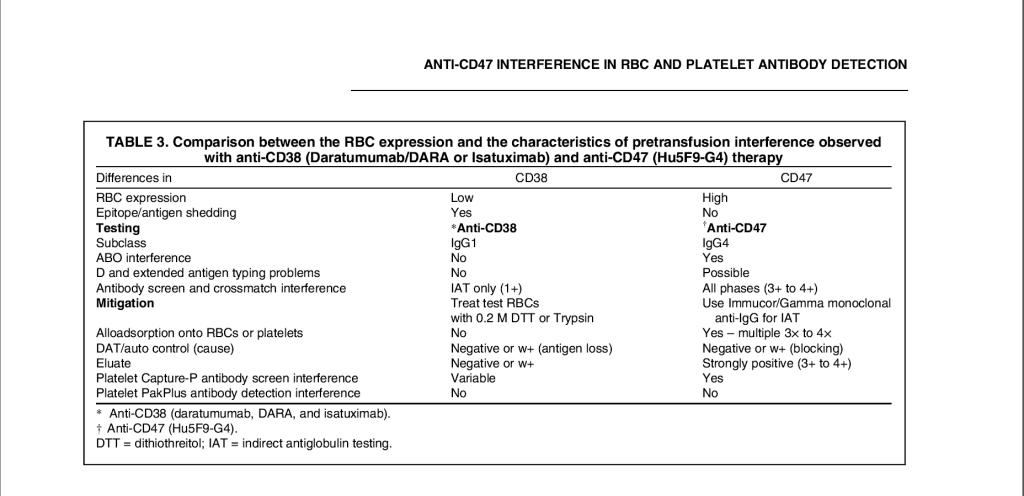
The following table summarizes anti-CD47 reactivity and compares it to anti-CD38—see reference below.

Reference:

Randall Velliquette et al, Anti-CD47 Interference in Red Cell and Platelet Testing, Transfusion 2019; 59, 730-737

Off-Line Donor Medinfo Transactions

Principle:

When you cannot establish a direct link to the live Medinfo program, you must arrange for the local Medinfo engineers to create a local server that will have the current Medinfo donor database for use at outside campaigns where the internet connection cannot be used.  This can also be used if for some reason the Blood Donor Center link is down in order to register donors and check the donor deferral database.

Policy:

  1. For each outside campaign, there should be a pre-campaign visit to verify the availability of internet to connect to Medinfo.
    1. If the internet connection is working, use Medinfo using the 4G access points.  Otherwise:
    2. If none, inform the Medinfo engineers to prepare a local server on one of the laptops at least ONE DAY in advance of the campaign.
      1. Give Medinfo engineers the laptop to download the database and software.  This will be the offline server for the campaign.
      2. Link the offline server to the other portable computers for the campaign (see the corresponding Medinfo job aid).
      3. Use the local network (offline server and other portable computers) for registering donors.
      4. Upon return to the Blood Donor Center, upload the data.
      5. Continue the regular processes after uploading.

Note:  When the offline data is uploaded into Medinfo main database, it will be checked against the latest donor deferral database.  The latter will be applied for the donation.

Liver Transplant Processes for the Transfusion Service

Principle:

Liver transplantation requires coordination of the Transfusion Service TS, Liver Transplant LTS , and the Blood Donor Center BDC to prepare blood components for this massive transfusion setting.

Policy:

  1. Whoever receives notification of a possible liver transplant should ensure that ALL of the following senior staff are also informed:
    1. Head, Transfusion Medicine
    2. Coordinator, Donor Recruitment
    3. Supervisor, Transfusion Service
  2. Transfusion Service Supervisor will arrange transfusion service staffing as needed to cover the surgery period and immediate post-operative period.
  3. The current, up-to-date inventory must be calculated.  The following minimum stock must be reserved:
    1. Twenty (20) packed RBCs
    2. Twenty (20) FFPs—-leukodepleted and pathogen-inactivated
    3. Three (3) platelet pools or apheresis doses (each ≥ 2E11 absolute number of platelets)—leukodepleted and pathogen-inactivated.
    4. The Medinfo Liver Transplant Protocol automatically orders all the above.
  4. Complex needs:
    1. If the patient has clinically significant antibodies, confirm the availability of the requested number of antigen-negative/compatible units.
    2. The Head, Transfusion Medicine, or the covering transfusion medicine consultant on-call will contact the liver transplant team to discuss the feasibility of proceeding after assessing the inventory of antigen-negative units.
    3. Only the transfusion medicine consultant can approve the use of antigen-incompatible RBCs in conjunction with the liver transplant team.
  5. Donor Center should increase recruitment/production to meet the anticipated usage as needed.
  6. When the procedure is confirmed:
    1. Crossmatch the RBCs by the appropriate technique according to our algorithms (i.e. computer/electronic, immediate-spin, or full AHG).
    2. Thaw the FFP:  the FFP is valid for FIVE days after thawing for use for the transplant patient or other patients with coagulopathy.
    3. If more than the above number of units is needed, HGH Transfusion Service must inform the Donor Center senior staff (Head, Donor Center; Administrative/Technical Director, and Coordinator, Donor Recruitment) to arrange for additional donations.

Enzyme Panel Details

Principle:

Performing antibody panels using both enzyme (ficin, bromelin, and/or papain)-treated  and routine panel cells may be necessary to detect most clinically significant antibodies

Policy:

  1. Regular (LISS) panels are to be performed using AHG reagents whereas enzyme panels done by the gel technology must use the saline (NaCl)-enzyme card.
  2. Perform BOTH enzyme and routine panels in the following situations
    1. All patients with sickle cell anemia and thalassemia
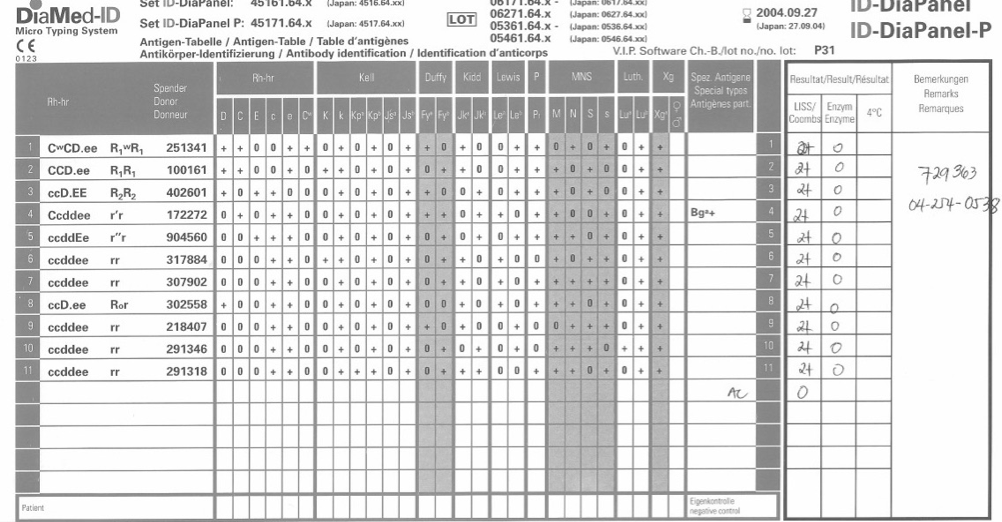
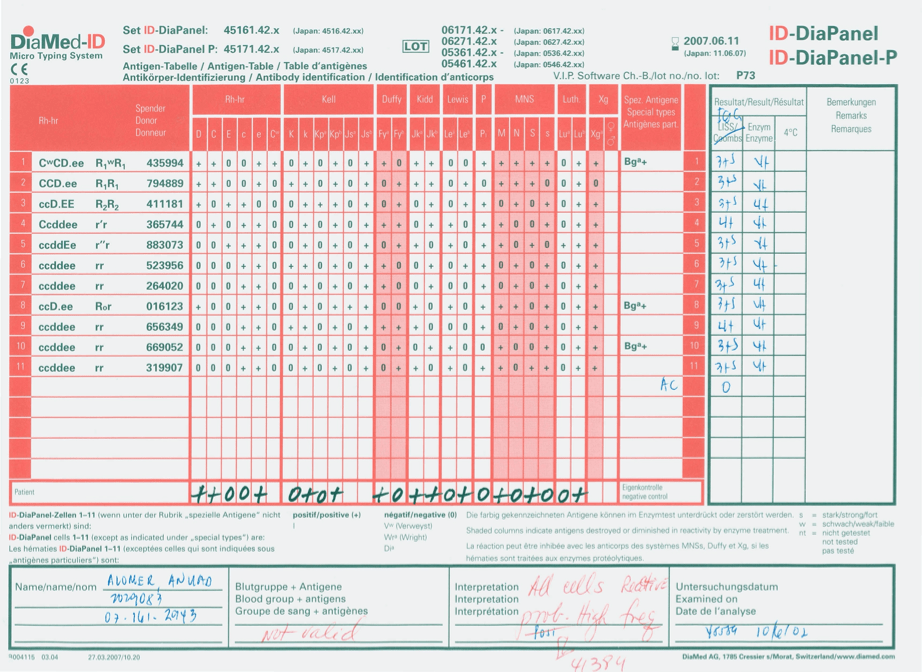
    2. Antibody pattern of panreactivity with a negative autocontrol (see attached examples)
    3. Antibody workup that does not show a specific pattern with the regular panel alone
    4. Any case with a previous history of antibodies with a current negative antibody screen
    5. Any other case that you are directed to do so by the transfusion medicine consultant, supervisor, or senior technologist.
  3. Remember the reactivities of the following antibody specificities with enzyme-treated cells:
    1. Reactions may not be the same with papain vs ficin-treated cells!
    2. Enzyme-labile with both papain- and ficin-treated cells:  Fya, Fyb, M, N, Ge2, Yta, Rg, Ch, Pr, Tn, Mg, Mia, Cla, Jea, Nya, JMH, Inb
    3. Variable, enzyme-labile or weakened, some unchanged with both papain and ficin-treated cells:  S, s, U
    4. Variable reactions with papain (labile, weakened, unchanged, or increased) but usually increased or unchanged with ficin-treated cells:  Kell system (K, k, Kpa, Kpb)
    5. Reactions are increased or unchanged with both papain and ficin-treated cells:  Rh (D, C, c, E, e), Jka, Jkb, Lea, Leb, Lua, Lub, P1, H, most cold antibodies, autoantibodies, Tja (PP1Pk)

Example 1:

Antibody to High-Incidence/Prevalence or Public Antigen:

Reactions destroyed by enzyme (typical of anti-Ge2):

Example 2:

Antibody to high-incidence antigen, reactions unchanged or enhanced by enzyme—VERY DANGEROUS PATTERN:  Examples:  Anti-H, Anti-Tja (PP1Pk), anti-k (cellano), anti-U

Enzyme Reagent Effects

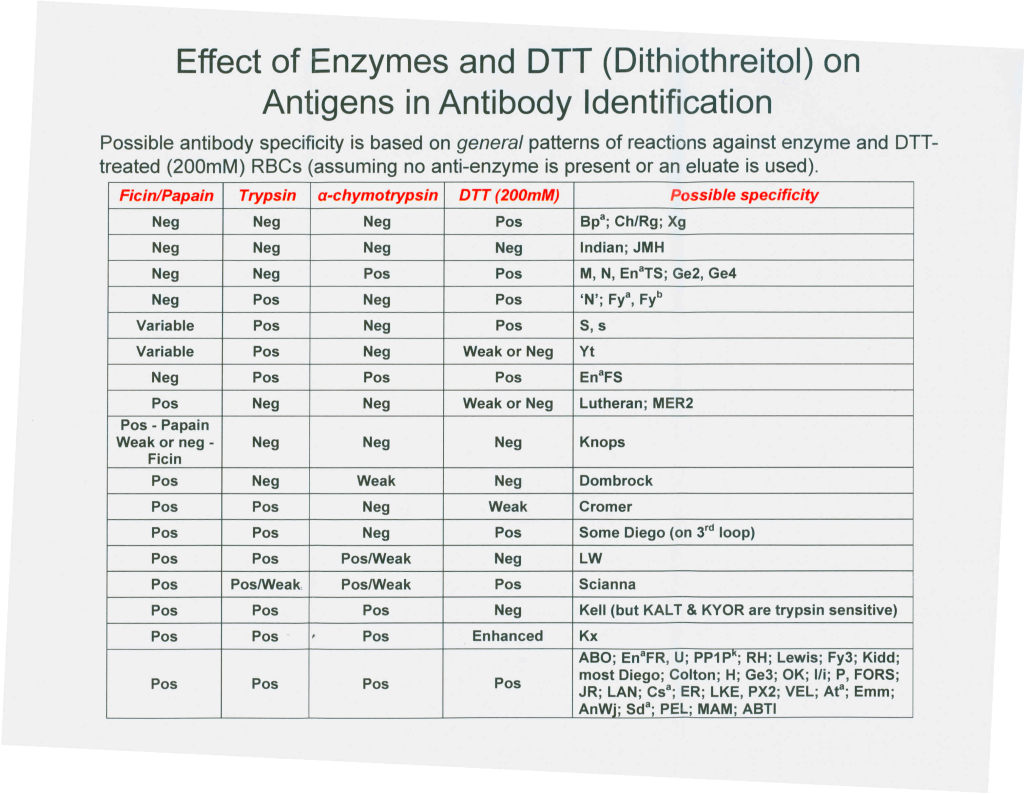
The following table was distributed at an AABB technical seminar at its 2015 Annual Convention and comes from the Blood Center of Wisconsin.  It is especially noteworthy for discussing enzymes that are mainly used in a reference laboratory setting.

Opinion: Transfusion Education for Physicians

Although there are resources allocated for nursing transfusion proficiencies, the training for physicians and medical students may not be as developed.

In medical school in the United States, I had one hour dedicated to transfusion medicine and it did not discuss the actual proficiencies necessary to select and physically transfuse patients.  In my clinical rotations, especially surgery, I was given “cookbook formulae” on what to order for different procedures—without any explanation.

I had considerable training in transfusion medicine during my pathology residency, and I took it seriously.  Many/most pathology residents are not interested in the topic and use the rotation for vacations and other business.  They learn what is necessary to pass the pathology board examinations and do not intend to practice this at all.  Actually, I sense that many practicing pathologists are afraid of blood bank and minimize their activities there.

What about the non-pathology residency training?  In the Middle East, some centers rotate the hematology, surgical, and obstetrics-gynecology residents through the blood bank.  In other posts, I have discussed some training plans I have used for each group.

Sadly, however, most practicing physicians do not well understand how to select and order blood components or administer components.  I try to tell them that they should at least know if the blood components being used for their family members are correct.

In a previous position, there were mandatory training programs for physicians including infection control, fire,  and disaster training.  There was even a program on handwashing!  Yet, there was no required training for transfusion practices.  I had offered to make such a training program but there was little interest.

Minimally, such a proficiency program should be offered to all physicians who might order a transfusion.  It should include:

  • Indications for transfusion of each component type including the institution’s transfusion triggers
  • Indications for modified components, e.g. irradiated, aliquoted, etc.
  • How to order blood components—manually and in the institution’s computer system
  • How to administer blood components, including the maximum transfusion times (e.g. four hours for RBC components), use of filters, etc.
  • Recognition and treatment of transfusion reactions and other adverse effects

In my career, I received blood component orders with many errors.  In the pre-computer, paper era, the blood bank staff automatically corrected these under the direction of the blood bank medical director.  Nowadays, with computer systems, it may not be possible for the blood bank staff to “autocorrect” the orders.

In my Middle Eastern practice, we could still correct the orders—even after adopting a blood bank computer system.  That will be the subject of a future post.

Release of COVID-19 Convalescent Plasma CCP

Principle:

Testing, allocation, release, and transfusion of this special plasma will be similar to normal blood components except that the storage, modification, and release will handled at special quarantine location(s).  Release and modification of components is to be handled separately from the regular hospital blood bank/transfusion service.

Abbreviations:

CCP:  COVID-19 convalescent plasma

ID:  Infectious Disease Department (clinical COVID19 treatment unit)

QHBBB:  Quarantine hospital blood bank (which stores, thaws, and releases CCP)

Policy:

  1. Any potential recipient for CCP must have a CURRENT type and screen test (< 72 hours old.)
    1. A repeat type and screen should be ordered every 3 days during the time that CCP may be used.
  2. All CCP orders must be submitted to the ID senior consultant for triage.
  3. If the order is accepted by that authority, then an order and a doctor’s prescription for CCP must be both prepared and submitted to the QHBB.
  4. QHBB will allocate ABO-compatible CCP units and attached blood bank computer-generated release labels and forms to it.
  5. Designated ward staff will pick-up the CCP at the QHBB.
  6. Allow 1 hour for the plasma to be thawed.
  7. Only order when the transfusion is scheduled—1 hour before the intended transfusion date/time.
    1. Sign-out will follow normal procedures, same as other blood components.
    2. Ward staff must provide a doctor’s prescription for CCP and a fully completed request.
    3. Ward staff will directly transport the CCP to the intended transfusion site.  They should immediately transport it to the patient transfusion site.
  8. Transfusion will be performed according to standard procedures:
    1. Positively identify the patient.
    2. Use a standard 180 micron blood filter.
    3. Transfusion should be done as quickly as possible to avoid potency loss
    4. Fill out the transfusion record and return a copy to the QHBB.