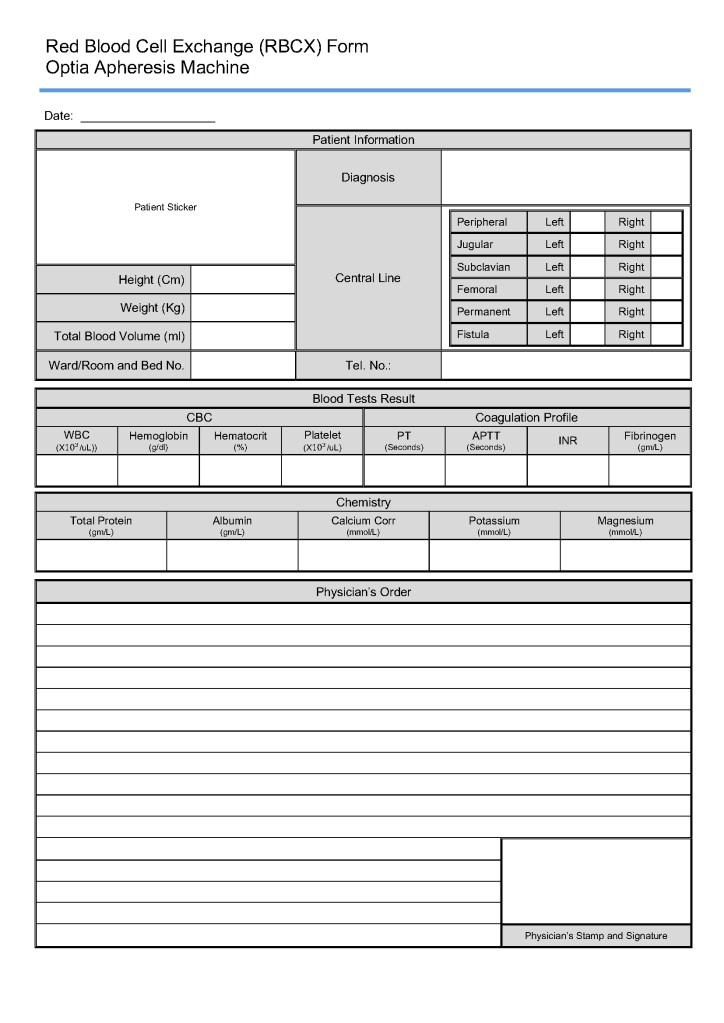
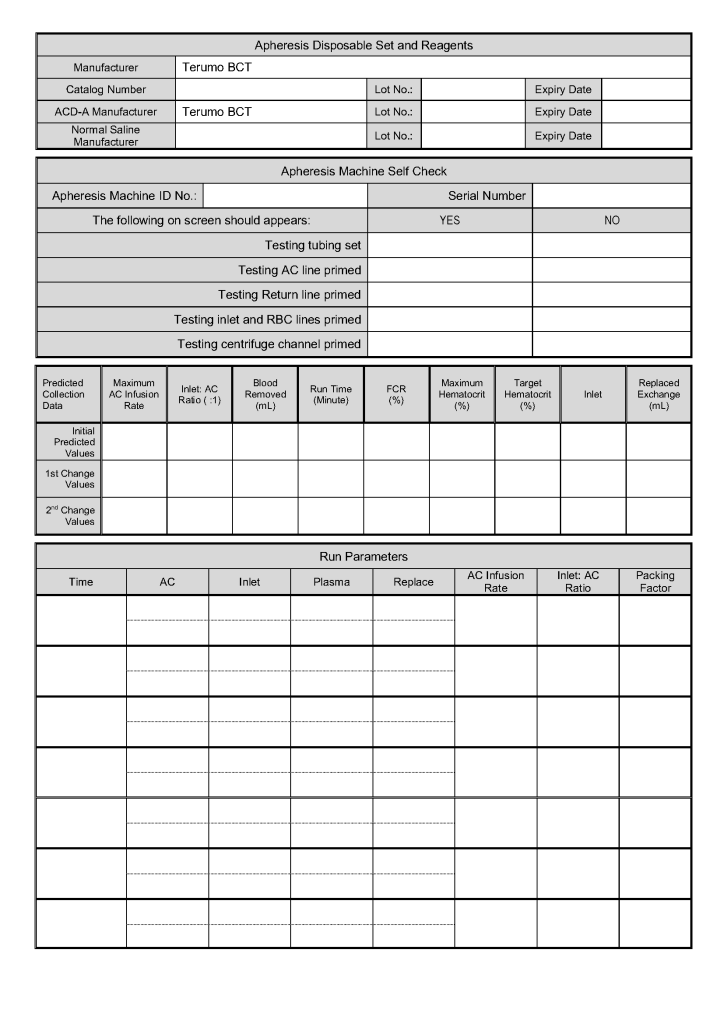
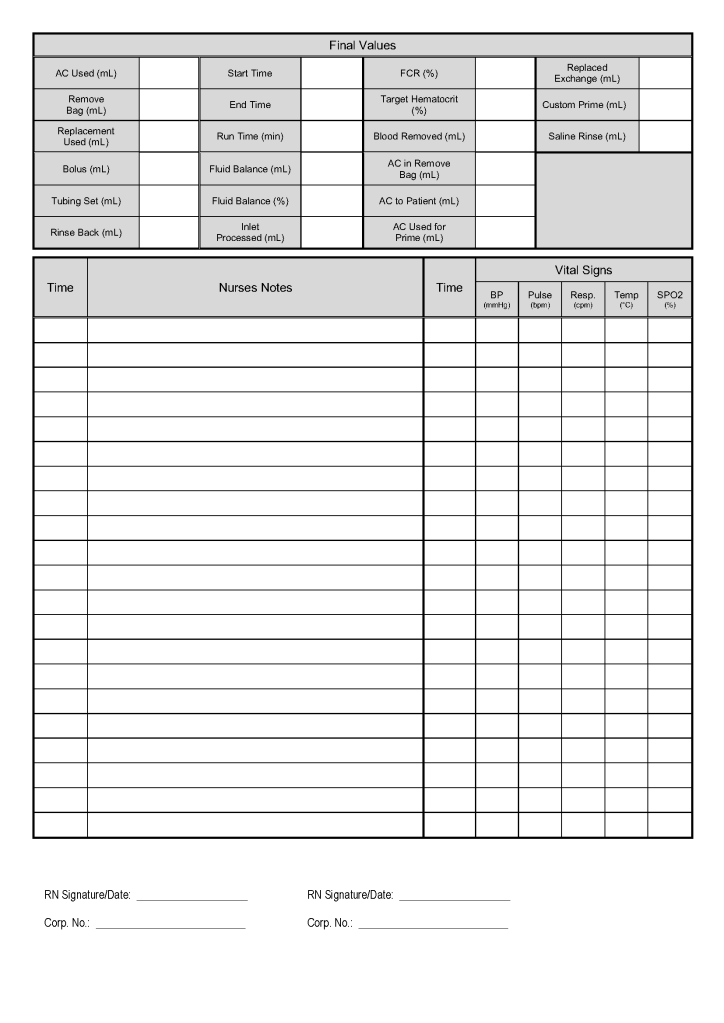
Opinion: Continue Manual Data Collection During Therapeutic Apheresis Procedures

While I was  Division Head, Laboratory Information Systems LIS at my previous position, I was asked to use the hospital information system HIS to collect information during the procedure analogous to what was done for dialysis.

I thought of the logistics:  one apheresis nurse, one Spectra Optia machine, and one metal cage containing a theft-proof computer on a stand.  There was no room for the patient’s bed with all this equipment—the nurse could not move around comfortably.

Second, what I was presented was a hodge-podge of screens on the HIS that the apheresis had to maneuver back and forth between for each measurement—none of the data entry was on one screen!  Honestly, there wasn’t enough time to enter all the data between the screens AND look at the patient.

I remind everyone that therapeutic apheresis is not a benign procedure.  The patient may be critically ill.  The apheresis nurse must concentrate on the patient.  The HIS team was more interested in the data collection, even at the expense of the patient.

LIS had not been engaged in building the pathway and the HIS wanted us to follow the dialysis template.  They did not know that there are many types of therapeutic procedures, often with different data collection.  There is no one-size-fits-all screen!

I refused.  The nurse must concentrate on the patient, not the LCD screen.  To use the HIS would have been harmful to patient care in this situation.  We retained the manual, cellulose interface.  We scanned the manual data form and uploaded it into HIS.

Lessons to be learned:

  1. HIS must engage LIS, and in particular Transfusion Medicine, when building anything for the blood bank.  This is in accordance with international  accreditation standards.
  2. We must never lose sight that we are treating the patient, not the computer screen.  Especially in therapeutic apheresis, we must use the apheresis specialist nurse to monitor the clinical status of the patient, first and foremost!
  3. If the proposed computer process is worse than the manual process, keep the latter.

8/10/20

Basic Hematology Fellowship Rotation in Transfusion Medicine

Objectives:

  1. Donor Center
    1. Donor eligibility criteria
    2. Whole blood collection
    3. Donor apheresis (platelets, plasma, dual-RBC)
    4. Donor reactions
  2. Therapeutic Apheresis
    1. Plasma exchange
    2. Leukocyte reduction—stem cell collection
    3. Reductive thrombapheresis
    4. RBC exchange
    5. Column-absorption procedures including phototherapy
  3. Component Preparation
    1. Preparation and release issues
  4. Transfusion Service:
    1. Blood component therapy
    2. RBC blood groups
    3. Compatibility Testing
    4. Antibody Identification and clinical significance
    5. Transfusion reactions
    6. Direct antiglobulin test clinical significance
    7. Drug-related hemolysis

Venue:

TMS Donor and Transfusion Services

Conducted by:  Head, TMS, and senior TMS technical staff

Evaluation:

Discussion of topics with TMS Head and written final examination

Source Materials:

  1. Technical Manual, AABB
  2. Standards for Blood Banks and Transfusion Services, AABB
  3. Apheresis, Principles and Practice, AABB

This is a full-time, one-month rotation—attendance in mandatory.  Vacations should NOT be taken during this rotation.

Originally Prepared for NGHA Riyadh 31/3/09

Reviewed 26/8/20

My Opinion: Separate Transfusion Medicine from the Laboratory

Transfusion Medicine includes laboratory and non-laboratory functions.  The non-laboratory and purely clinical functions are unique and have no analogy within the general laboratory.

The transfusion service/hospital blood bank laboratory is the closest to a laboratory operation, but there is component modification and complex manual testing, especially for reference immunohematology testing.  The staff must make detailed manual decisions, the errors for which could be life-threatening for the patient.

The blood donor center manufactures a pharmaceutical, i.e. blood components with collection, donor qualification, donor abnormal results review, infectious disease marker testing, component production, and donor immunohematology testing—all subject to Good Manufacturing Practices.  Never forget:  Blood is a drug!!

No other laboratory section is directly responsible for treatment of critically ill patients.  Therapeutic apheresis is essential for organ and stem-cell transplants, nephrology, neurology, etc.  No other laboratory section is directly responsible for treatment of critically ill patients.  Transfusion Medicine physicians are functioning as intensivists.  There is no hiding in the laboratory from clinical medicine.

There may also be an industrial manufacturing plant to extract various blood derivatives (e.g. factor concentrates, albumin, Rh immune globulin, etc.)  This is pharmaceutical manufacturing on a large-scale basis.  There is medical, technical, and special administrative expertise.

Many functions may operate 24/7.  The transfusion medicine physician may be on-call for donor issues and review of complex immunohematology problems to acutely decide which blood component (and phenotype) should be given as well as review all adverse reactions to transfusion.

The unique blend of clinical skills is unlike anything else in the laboratory.  Also, those outside the blood bank rarely have the skills or judgments for the best course of action for transfusion medicine or for its operations.

The clinical transfusion medicine physician must make acute, life-threatening decisions unlike anyone else in the laboratory.  The blood bank technologist is at the cutting edge of the battle with his testing and interpretations.  No other area of the laboratory is at such risk for injuring or even killing the patient.  There is high stress and burn-out.

I have talked with many blood bankers and many seem to share the exasperation that the laboratory does not understand us.  The latter looks at blood bank testing like that coming off a hematology or chemistry analyzer—although patients rarely would have severe morbidity or mortality like the blood bank from errors in those analyzers.

No laboratory pathologist has the pressure of the blood bank physician on-call.  It really is 24/7 and requires a broad, clinical background to make the right decisions.  It is very stressful and does not permit a good night’s sleep.

Thus, I make my case to separate us from the laboratory.  We can form our own more effective administrative organization and optimize our own planning.  Regretfully, I have never worked in such an administrative structure.  I also am a realist that cost-containment nowadays makes it much less likely high administration would permit this change for a mere cost center.  This will probably never happen during my career.

Finally, Transfusion Medicine is an essential service.  Blood components are essential drugs.  The operations and staff must be free of political influences.  This is a service for the entire region or country like the fire department, civil defense, etc.

8/8/20

Therapeutic Apheresis Responsibilities

Transfusion Medicine TM:

  1. Head, TMS, or the covering TM physician discusses case with the most responsible physician MRP; the plan of action mutually is agreed upon.
  2. Head, TM, or the covering TM physician gives verbal or written orders to apheresis nurse, including:
    • Type of procedure (RBC exchange, plasmapheresis, plasmapheresis with column absorption, leukapheresis, thrombopheresis, stem cell collection)
    • Machine parameters if indicated (e.g. fraction of cells remaining FCR, target hematocrit, unit hematocrit for RBC exchanges)
    • Amount of exchange in liters (e.g. one-volume, two volume, etc.)
    • Fluid balance (e.g. isovolemic, volume-reduced, volume enhanced)
    • Replacement fluids and volume (e.g. normal saline, 5% albumin, ACD-A, blood components, solvent-detergent treated plasma SDP)
    • Calcium replacement (calcium gluconate IV)
    • Orders for laboratory testing prior to and after the apheresis (usually CBC, PT, APTT,  fibrinogen, total protein, albumin, calcium, LDH for TTP/HUS)
  3. Apheresis nurse convey the order to the ward/clinic.
  4. The requesting clinical service will place the order in the hospital information system.
  5. If a verbal order is made, TMS physician will sign his verbal orders, a copy of which will kept in the Apheresis Unit.
  6. If the hospital computer system is used, the TM physician will enter his orders and the apheresis nurses will take off the orders electronically.
  7. If a stem cell product is collected:
    • TM will label it with a unique alphanumeric identifier barcode, i.e. an ISBT specimen label with check-digit that is generated by the Medinfo Hematos IIG system .
    • Cellular Therapy Laboratory staff in conjunction with the apheresis nurse will sign-out the collection from TM to CTL using two donor identifiers:  patient name and the unique alphanumeric sequence barcode (same as process of sign-out of blood component).
  8. Note:  Use of Medinfo HIIG for stem cell collection is out of scope of TM.

Cellular Therapy Laboratory:

  1. Directly receive collected product from apheresis nurses will use the procedure outlined in 7.2 above.

Most Responsible Physician:

  1. Initiates request for apheresis with Division Head. Transfusion Medicine or covering Transfusion Medicine physician.
  2. Obtains informed consent from patient
  3. Arranges for proper venous access (rigid-bore central line or AV shunt)
  4. Is responsible for clinical support during the procedure
  5. Provides medication changes (e.g., substitution of non-ACE-inhibitors for hypertension therapy) as requested by the Head, TMS or Transfusion Medicine Physician

Ward/Clinic Nursing Responsibilities:

  1.  Ward/clinic nursing staff effect written orders to obtain replacement fluids (albumin, blood components, crystalloid), calcium, and order tests in hospital computer.
  2.  Ward nurses provide support (e.g., obtain medications, blood components, and miscellaneous items such as gauze, etc. and bring them to patient’s room) DURING THE PROCEDURE.
  3.  As per Apheresis Policy (TRM-PM-410-000-000-01), the assigned staff nurse from the unit shall contact the Blood Donation Center.
  4. The assigned clinical staff nurse from the unit should call the local Blood Bank to request preparation of the requested components, e.g. RBCs, FFP, or cryoprecipitate and follow up.
  5. To avoid unnecessary delays before calling the Blood Donor Center Apheresis Staff Nurse the assigned unit staff nurse shall inform the Blood Donation Center Charge Nurse when the following have been completed and are available on the ward:
    • Signed, informed consent
    • A central line with a large bore double lumen.
    • Completed blood laboratory results
      • Only results within 24 hours of the intended procedure may be used to write the order.
      • In some cases, more recent results may be required (e.g. TTP) at the discretion of the Transfusion Medicine physician.
    • The ordered replacement fluids such as normal saline, thawed or liquid plasma, cryo-poor plasma, albumin and red cell units available in the ward
    • Calcium gluconate (ordered amount in 100 ml normal saline) available
  6. The assigned apheresis nurse shall then perform the required therapeutic apheresis procedure strictly following the related TRM standard operating procedure.

Note:

  1. Apheresis is a SCHEDULED, high-priority procedure like other invasive procedures. The ward must make certain that the patient is available for the procedure at the scheduled time and place.
  2. Normally, apheresis procedures are performed 0600 to 1500 hours daily.
  3. The service is ONLY available 24/7 for emergency procedures outside this time frame. Emergencies must be approved by the TM physician.
  4. Transfusion Medicine does not guarantee that non-emergency procedures will be performed outside the 0600-1500 time frame.
  5. The most-responsible physician MRP is responsible for the patient’s concern form, establishing the proper venous access (rigid-bore central line), and providing coverage ON-SITE during the procedure. The apheresis nurse may not leave the patient’s bedside during the procedure.
  6. The apheresis nurse reports directly to the Division Head, Transfusion Medicine or the covering TM physician, not to the ward or MRP.   Any issues about changing the apheresis orders must be approved by the Head, TM or the covering TM physician.
  7. All other procedures must be cancelled during apheresis.
  8. If the patient is not available at the specified, scheduled time, the procedure will be cancelled.
  9. If ward or MRP support is not available, the procedure will be cancelled.

Therapeutic Apheresis

Principle:

All therapeutic apheresis procedures are potentially life-threatening and must only occur by an order from a transfusion medicine physician with experience/competence in such procedures.

Definitions:

  • Referring Physician is the clinical physician requesting a therapeutic apheresis procedure.
  • Transfusion Medicine Physician is a physician in the Transfusion Medicine Section with medical privileges for therapeutic apheresis procedures.  This includes the Head, Transfusion Medicine, consultants in Transfusion Medicine, and designated specialist physicians in Transfusion Medicine.  The final decision to accept/reject the patient is made by the transfusion medicine physician.
  • Covering Physician is the clinical physician designated by the referring physician to be physically present and covering the patient in case of any adverse reactions during a therapeutic apheresis procedure.
  • Apheresis Nurses are nurses in Transfusion Medicine who are designated by this section for performing therapeutic apheresis procedures.
  • Medical Privileges are determined by the Department of Pathology and Laboratory Medicine in conjunction with the HMC medical privileging by the Medical Director.

Policy:

  1. The referral physician will discuss the request for a therapeutic apheresis with the designated transfusion medicine physician.  The referral physician must certify that the patient can tolerate the procedure based on his medical condition.
  2. The transfusion medicine physician will review the patient’s clinical and laboratory data, with special note of the history of allergies, medications, previous transfusion reactions, and current vital signs.
  3. Vascular access will be initially assessed by the apheresis nurse.  Any questionable situations will be reviewed by the transfusion medicine physician.
  4. The following laboratory values (less than 24 hours old) must be available before the procedure may begin:
    1. CBC including platelet count
    2. PT and APTT
    3. Fibrinogen
    4. Serum calcium
    5. Serum protein and albumin
    6. LDH for TTP cases
  5. A valid type and screen must have been done within the previous three days of the procedure.
  6. Upon review of # 2 through 5, the transfusion medicine physician will determine if the procedure is indicated and will communicate this to the referral physician, who will sign written order in the patient chart.  Appropriate replacement fluids will also be mutually agreed upon in advance of the procedure and ordered by the transfusion medicine physician.  The order specification must include:
    1. Name of procedure and specification (e.g. therapeutic plasma exchange, isovolemic)
    2. Replacement fluid type and volume (e.g. 3 liters 5% albumin, 2 liters, FFP, cryoprecipitate, normal saline)
    3. Blood component orders if indicated (e.g. RBC exchange) and timing (before, during, and/or after the procedure)
    4. Calcium replacement (e.g. 2 grams calcium gluconate IV in 100 ml normal saline to run during the procedure)
    5. Any special laboratory testing post-procedure
  7. The apheresis nurse will follow the orders of the necessary prescribed replacement fluids (FFP, albumin, PPF) in the quantities necessary for the exchange.
  8. The referring physician will obtain the signed, informed consent from the patient.
  9. If vascular access is unsatisfactory, the referring physician will obtain the proper access (central line, AV shunt, etc.).
  10. The referring physician will arrange for a physician member of his team to be present at the actual therapeutic procedure.  This physician designate will be responsible to treat any complications arising from the procedure.
  11. Vital signs and weight will be obtained before starting the procedure.
  12. When approved by the Blood Bank Director or designate with proper venous access and informed consent, the apheresis may start the procedure in the presence of the patient’s covering physician.  The procedure will be performed in a designated hospital area.
  13. The procedure must be documented on the appropriate therapeutic apheresis order and procedure worksheets.

References:

  1. Standards for Blood Banks and Transfusion Services Current Edition, AABB, Bethesda, MD, USA
  2. CAP Standard TRM.42245 regarding therapeutic apheresis procedures

Now An Independent Consultant

I am an independent consultant in Transfusion Medicine. Effective 16 April 2020, I am no longer associated with Hamad Medical Corporation or the State of Qatar.

I am willing to consider other opportunities in Transfusion Medicine (donor, patient, apheresis) and blood bank informatics.

Just before leaving HMC, I established the COVID19 convalescent plasma program with full good manufacturing practices using Medinfo Hematos IIG blood bank software.

I have 10 year’s experience in pathogen inactivation and blood component automated production. I established the first site using Terumo Atreus (later Reveos) with Mirasol pathogen inactivation AND platelet additive solution. I established Medinfo interfaces with all production equipment to achieve GMP.

I have worked with laboratory information systems, especially but not limited to blood bank systems (donor, component processing, donor marker testing, pathogen inactivation, platelet additive solutions) and serve as the Head of the Medinfo IIG (Nice, France) Software Users Group.

I was involved with planning for the national plasma fractionation project in Saudi Arabia. I have worked with this industry while I was practicing in the United States.

It is my philosophy to start with an international framework (e.g.FDA, CE) and localize it for the country’s particular needs. My operation sites have served as international reference sites for combined IT and medical/technical processes.