Processes and Software Building 37: Donor Marker Testing–Final Comments

This series of the processes for donor marker testing has demonstrated the complexity and flexibility of designing processes.  In Medinfo, you can custom-design the criteria based on your local, national, and international requirements.  The end-user client must specify what he wants, and I reiterate:  Be careful what you ask for, you may get it.  Seek assistance if you are uncertain of what to use.

My criteria were based on several international standards, e.g. AABB, US FDA, CE, and Australian.  I strongly recommend you start with a set of standards and localize it for your needs.

For example, US FDA/AABB do not have a screening criteria for brucellosis since it is rare in their jurisdiction.  However, it is relatively common in the Middle East so I added a donor screening question for it.  International AABB does allow for variance with US FDA criteria so if you are outside the USA, embrace this.  The advantage of customizable software allows you do localize it to your needs.  A turnkey system, e.g. from the USA, may not allow such changes.

Finally, there are emerging pathogens that are constantly changing the donor criteria (e.g. SARS-CoV-2, MERS, SARS, Zika).  The software must be robust and allow rapid alteration to meet new donor screening criteria.  This is a constant uphill battle and requires a lot of time to keep up and validate any changes.

Complete Interim Policy on Marker Testing

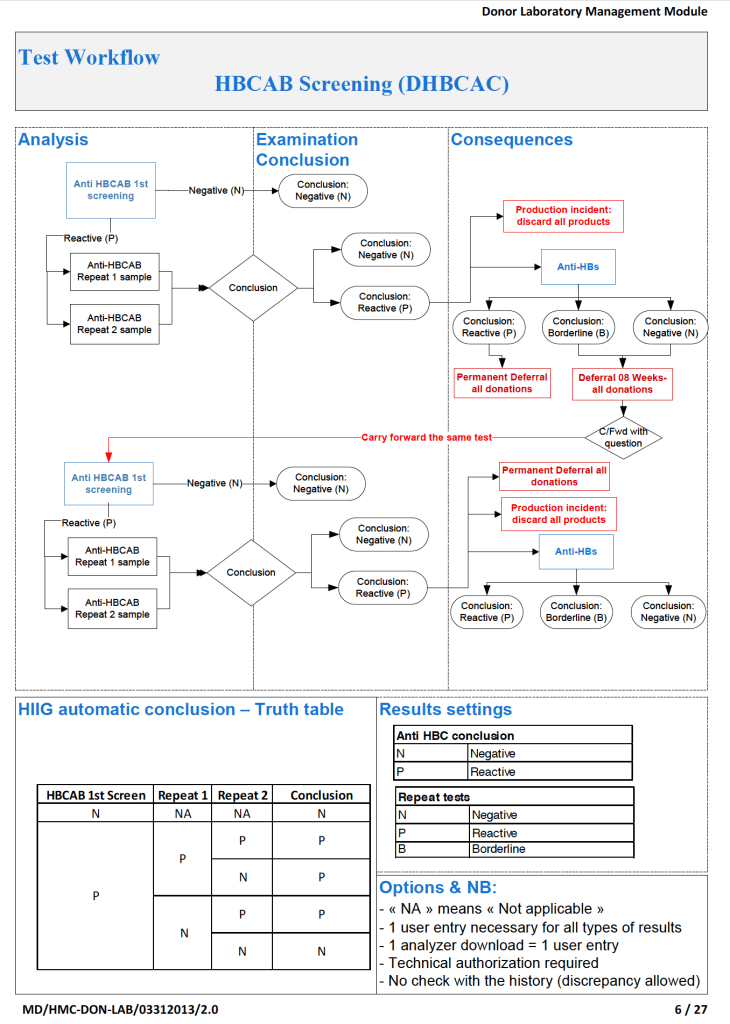
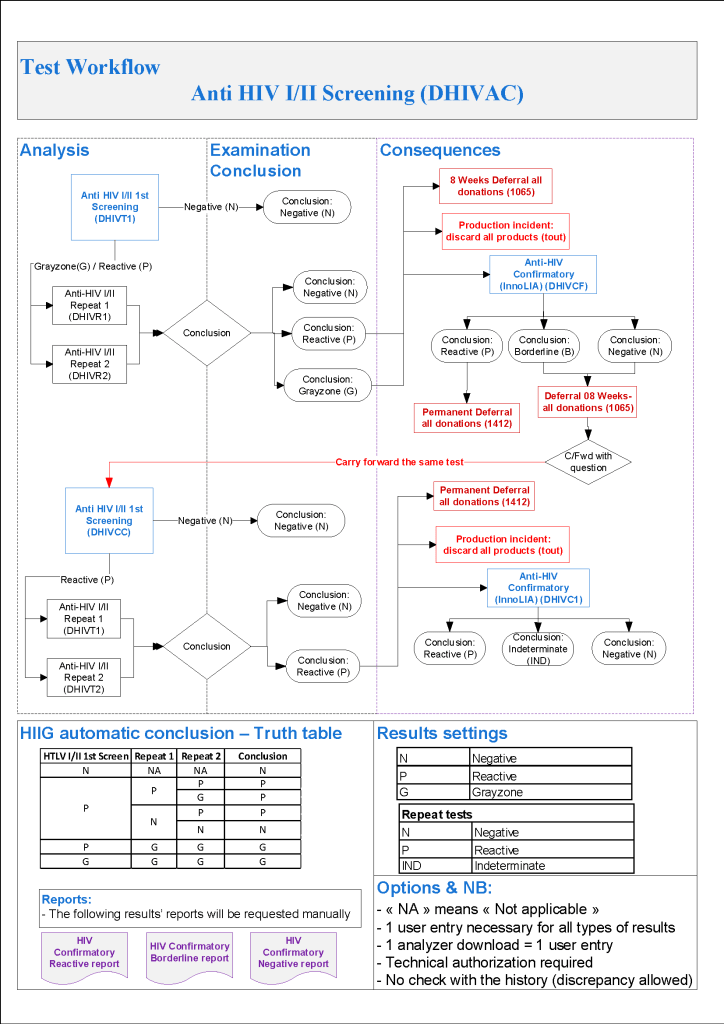
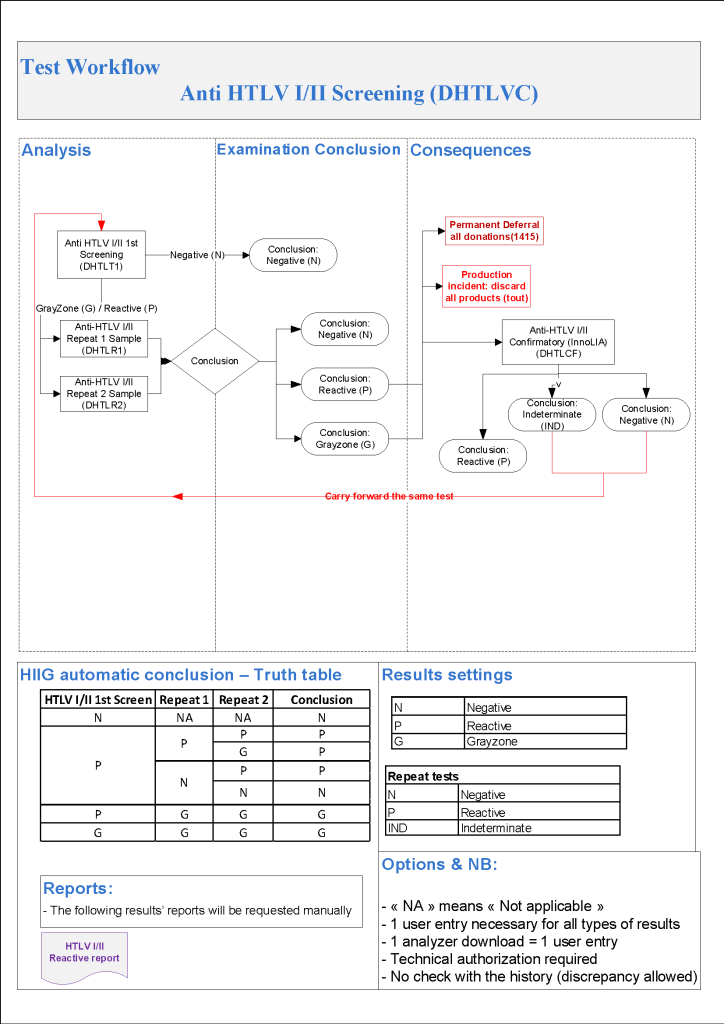
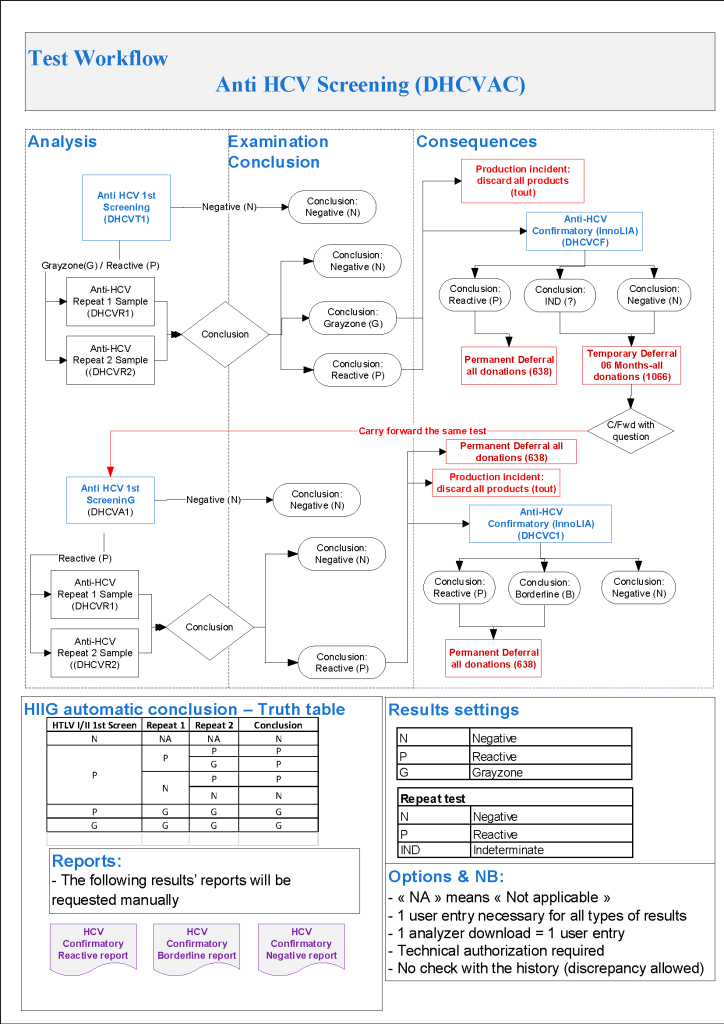
For your reference, the following is the complete set of marker testing algorithms I used just before I left HMC Doha:

Definitions:

Positive result for EIA means S/CO ratio >= 1.0

Positive result for LIA means particular pattern of bands as defined by the manufacturer

Indeterminate result for LIA means presence of bands not meeting positive criteria

  1. Hepatitis B:
    1. HBsAg non-negative, then:
      1. HBsAg positive with HBsAg confirmatory positive, regardless of other results:  permanent deferral, refer to Infectious Disease clinic
      2. HBsAg positive with HBsAg confirmatory borderline or negative, repeat all HBV testing after 8 weeks
      3. HBsAg borderline:  repeat all HBV testing after 8 weeks
      4. HBV-DNA positive confirmed, regardless of other results:  permanent deferral, refer to Infectious Disease clinic
    2. If HBcAb positive, repeat after 8 weeks
    3. Repeat Hepatitis B Testing After 8 weeks:
      1. HBsAg positive with HBsAg confirmatory positive:  permanent deferral, refer to Infectious Disease clinic
      2. HBsAg positive with HBsAg confirmatory borderline or negative:  permanent deferral, refer to Infectious Disease clinic
      3. HBsAg borderline, permanent deferral, refer to Infectious Disease clinic
      4. HBV-DNA positive confirmed:  permanent deferral, refer to Infectious Disease clinic
      5. HBcAb positive or borderline with negative HBsAg and negative HBV-DNA:  review HBsAb level:
        1. If HBsAb level >= 100 mIU/mL (100 IU/L), donor may be reentered
        2. If HBsAb level < 100, then recommend to donor to receive booster HBV vaccine
          1. After HBV vaccine administration, retest after 30 days:
            1. If HBsAb level >= 100, donor may be reentered
            2. If HBsAb level < 100, donor is indefinitely deferred
      6. HBsAg, HBcAb, HBsAb all negative:  reenter into donor pool
  • Hepatitis C:
    • HCV-RNA positive confirmed, regardless of other HCV results:  permanent deferral, refer to Infectious Disease clinic
    • HCV-RNA borderline:  repeat all HCV testing after 6 months
    • HCV-InnoLIA positive, regardless of other HCV results:  permanent deferral, refer to Infectious Disease clinic
    • HCV-InnoLIA indeterminate:  repeat all HCV testing after 6 months
    • HCV-Ab positive, HCV-RNA negative, do HCV-InnoLIA:
      • If HCV-InnoLIA positive, permanent deferral, refer to Infectious Disease clinic
      • If HCV-InnoLIA indeterminate or negative, repeat all HCV testing after 6 months
    • Repeat Hepatitis C Testing After 6 months:
      • HCV-RNA or HCV-InnoLIA positive:  permanent deferral, refer to Infectious Disease clinic
      • HCV-RNA or HCV-InnoLIA borderline:  permanent deferral, HCV infection not confirmed
      • HCV-Ab positive or borderline without positive HCV-RNA or positive HCV-InnoLIA:  permanent deferral, HCV infection not confirmed
      • HCV-Ab negative, HCV-RNA negative, HCV-InnoLIA negative:  reenter donor into donor pool
  • HIV Testing:
    • HIV-RNA positive confirmed, regardless of other HIV results:  permanent deferral and do HIV-InnoLIA, refer to Infectious Disease clinic
    • HIV-RNA borderline:  do HIV-InnoLIA
    • HIV-InnoLIA positive, regardless of other HIV results:  refer to Infectious Disease clinic
    • HIV-InnoLIA indeterminate:  repeat all HIV testing after 8 weeks
    • HIV Ab positive with negative HIV-RNA and/or borderline/negative HIV-InnoLIA:  repeat testing after 8 weeks
    • Repeat HIV Testing After 8 Weeks:
      • HIV RNA positive and/or HIV-InnoLIA positive, regardless of other HIV results:  refer to Infectious Disease clinic
      • HIV-InnoLIA and/or HIV antibodies indeterminate:  permanent deferral, HIV infection not confirmed
      • HIV Ab negative and HIV-RNA negative and HIV-InnoLIA negative:  reenter into donor pool
  • HTLV 1/2 Testing:
    • HTLV Antibodies positive, then do HTLV-InnoLIA:
      • HTLV InnoLIA positive for HTLV-1 and/or HTLV-2:  refer to Infectious Disease clinic
      • HTLV InnoLIA indeterminate or negative, repeat HTLV Ab and HTLV InnoLIA testing after 6 months
    • Repeat HTLV Testing After 6 Months:
      • HTLV 1/2 antibodies positive, permanent deferral and do HTLV InnoLIA
      • HTLV 1/2 antibodies indeterminate,  permanent deferral and do HTLV InnoLIA
      • HTLV InnoLIA positive for HTLV-1 or HTLV-2: refer to Infectious Disease clinic
      • HTLV InnoLIA indeterminate, donor permanently deferred.
        • Issue letter HTLV-Not Confirmed
      • HTLV 1/2 Ab negative and HTLV InnoLIA negative, reenter donor.
  • Malaria Testing:
    • Defer donor if he has been in malarial endemic zone within the past 3 months
    • If travel to malarial zone > 3 months, do malarial antibody testing:
      • Malaria antibody negative:  no deferral
      • Malaria antibody positive, perform malarial antigen test:
        • Malaria antigen test positive, refer to Infectious Disease clinic—defer until 3 years after cessation of treatment
        • Malaria antigen test negative:
          • Plasma may be collected
          • RBCs and platelets must be destroyed.
        • Repeat malarial antibodies after 3 years:
          • If malarial antibody test positive, donor must not be used for RBC components but may be used for plasma production
          • If malarial antibody test negative, reenter donor for all components
    • Defer donor if he has received malarial treatment (not prophylaxis) for 3 years
      • Perform both malarial antibody and antigen testing:
        • Defer based on section 5.2
  • Syphilis Testing:
    • Syphilis Ab test positive or indeterminate:  do InnoLIA-Syphilis test
      • InnoLIA-Syphilis test positive:  permanent deferral, refer to Infectious Disease clinic
      • InnoLIA-Syphilis test borderline or negative:  defer for 1 year, then repeat all syphilis testing.
    • Repeat Syphilis Testing after 1 Year:
      • Syphilis antibody testing negative, reenter into donor pool
      • Syphilis antibody positive or borderline:  do InnoLIA-Syphilis test
        • InnoLIA-Syphilis test positive:  permanent deferral, refer to Infectious Disease clinic
        • If InnoLIA-Syphilis borderline or negative:  permanent deferral, syphilis not confirmed

References:

  1. Revised Recommendations to Reduce the Risk of Transfusion-Transmitted Malaria, Guidance for the Industry, US Department of Health and Human Services, FDA, Center for Biologics Evaluation and Research CBER, April, 2020
  2. Use of Serologic Tests to Reduce the Risk of Transfusion-Transmitted Human T-Cell Lymphotropic Viruses Types I and II, Final Guidance for Industry, February 2020
  3. Draft Guidance for Industry:  Recommendations for Requalification of Blood Donors Deferred Because of Reactive Test Results for Antibodies to Human T-Lymphotropic Virus Types I and II (anti-HTLV-I/II), CBER, September 2018
  4. Guidance for Industry:  Nucleic Acid Testing (NAT) for Human Immunodeficiency Virus Type 1 (HIV-1) and Hepatitis C Virus (HCV): Testing, Product Disposition, and Donor Deferral and Reentry, US Department of Health and Human Services, Center for Biologics Evaluation and Research CBER, May 2010
  5. Guidance for Industry:  Requalification Method for Reentry of Blood Donors Deferred Because of Reactive Test Results for Antibody to Hepatitis B Core Antigen (Anti-HBc), US Department of Health and Human Services, Center for Biologics Evaluation and Research CBER, May 2010
  6. Product inserts, InnoLIA-Syphilis/HCV/HIV/HTLV, Immunogenetics, Singapore
  7. Malaria Section, Australian Red Cross brochure, 2007

25/8/20
Processes and Software Building 36: Donor Nucleic Acid Testing

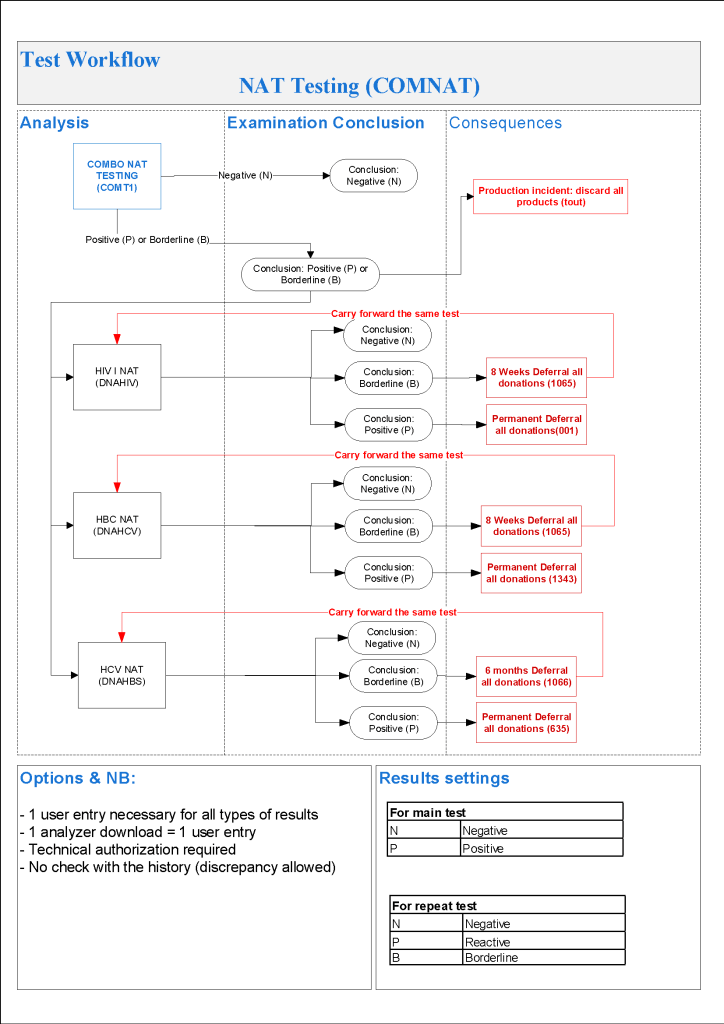
In Medinfo, criteria for donor screening may be based on one test (e.g. Hgb), a group of tests taken together (HBsAg, HBcAb, HBsAb), or separate sets of donor testing criteria.  Nucleic Acid Testing NAT is considered separate from the EIA, LIA, and Ag tests.  In any case, when there is a combination of both acceptable and deferrable results, the longest deferral is applied as the deferral or contraindication, e.g. a temporary deferral is replaced by a permanent deferral.

Our NAT testing at HMC Doha consisted of a combination combo test.  If this was non-negative, then individual HIV 1-2, HCV, and HBV NAT testing were performed.  For speed, we used single-well testing for each donor.  However, it is very easy to build pooling into the algorithm if that is preferred by the client:

To Be Continued:

24/8/20

Processes and Software Building 35: Donor Malaria Test Screening

Processes and Software Building—Part 35:

Malaria Testing Donor Screening Process

Zeyd Merenkov, MD, FCAP, FASCP

Independent Consultant in Transfusion Medicine and Information Technology

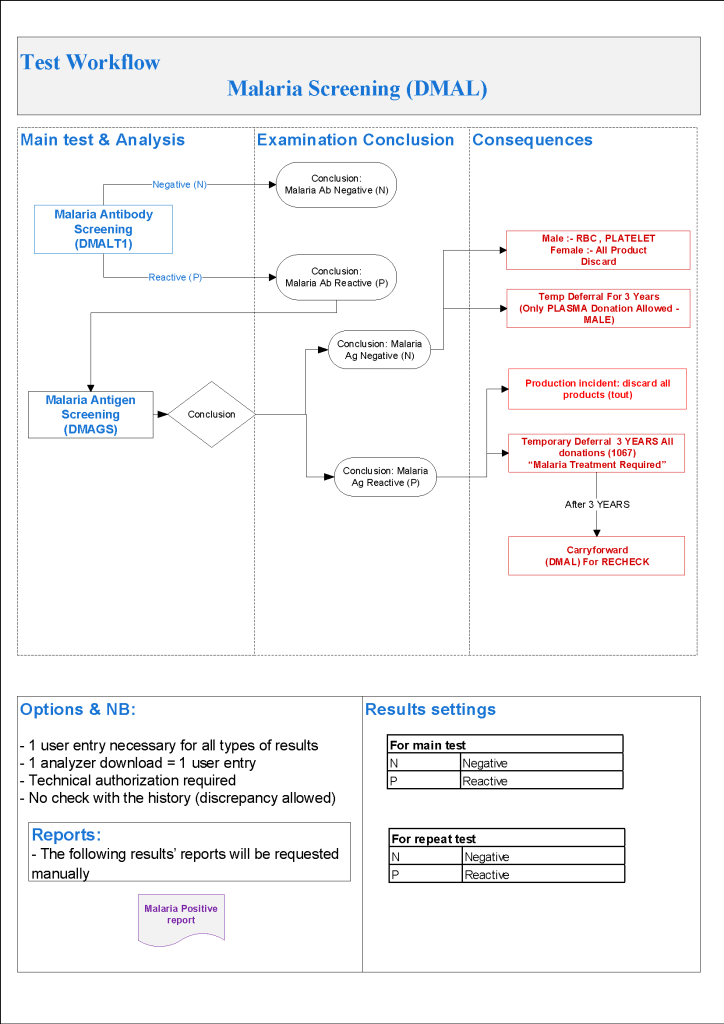
The malaria screening varies considerably by country.  I chose for Qatar to follow a combination of WHO and Australian guidelines as per the attached criteria.  We used a malaria antibody screen and malaria antigen test.  There are many alternate approaches, including using a malaria NAT.  The actual specification was:

  1. Malaria Testing:
    1. Defer donor if he has been in malarial endemic zone within the past 3 months
    2. If travel to malarial zone > 3 months, do malarial antibody testing:
      1. Malaria antibody negative:  no deferral
      2. Malaria antibody positive, perform malarial antigen test:
        1. Malaria antigen test positive, refer to Infectious Disease clinic—defer until 3 years after cessation of treatment
        2. Malaria antigen test negative:
          1. Plasma may be collected
          2. RBCs and platelets must be destroyed.
        3. Repeat malarial antibodies after 3 years:
          1. If malarial antibody test positive, donor must not be used for RBC components but may be used for plasma production
          2. If malarial antibody test negative, reenter donor for all components
    3. Defer donor if he has received malarial treatment (not prophylaxis) for 3 years
      1. After 3 years, perform both malarial antibody and antigen testing:
        1. Defer based on section 5.2

The Medinfo testing algorithm follows:

To Be Continued:

22/8/20

Processes and Software Building 34: Donor Syphilis Testing

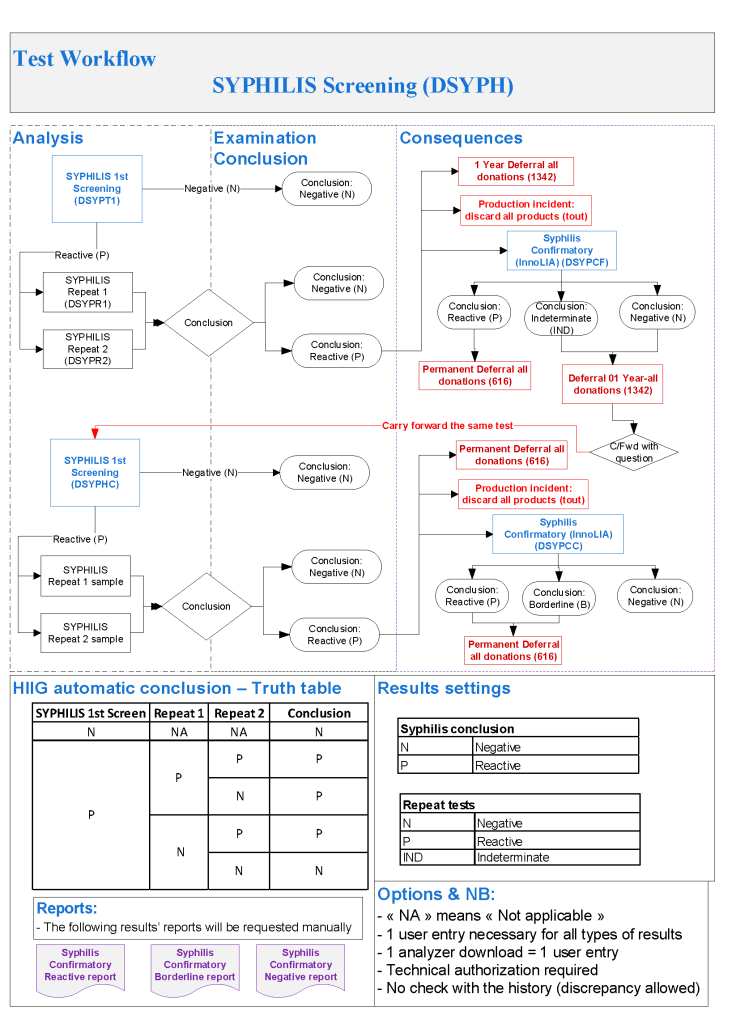
Syphilis testing uses a screening test (we used an EIA methodology to detect cardiolipin) and a confirmatory test a syphilis linear immunoblot assay LIA.

I emphasize that any test methodologies and testing algorithms can be designed in Medinfo.  This is what I selected during the time I was HMC Doha.

My algorithm specification was:

  1. Syphilis Testing:
    1. Syphilis Ab test positive or indeterminate:  do InnoLIA-Syphilis test
      1. InnoLIA-Syphilis test positive:  permanent deferral, refer to Infectious Disease clinic
    2. InnoLIA-Syphilis test borderline or negative:  defer for 1 year, then repeat all syphilis testing.
    3. Repeat Syphilis Testing after 1 Year:
      1. Syphilis antibody testing negative, reenter into donor pool
      2. Syphilis antibody positive or borderline:  do InnoLIA-Syphilis test
        1. InnoLIA-Syphilis test positive:  permanent deferral, refer to Infectious Disease clinic
        2. If InnoLIA-Syphilis borderline or negative:  permanent deferral, syphilis not confirmed

This was translated into Medinfo processes as follows:

To Be Continued:

21/8/20

Processes and Software Building 33: HBV Donor Testing

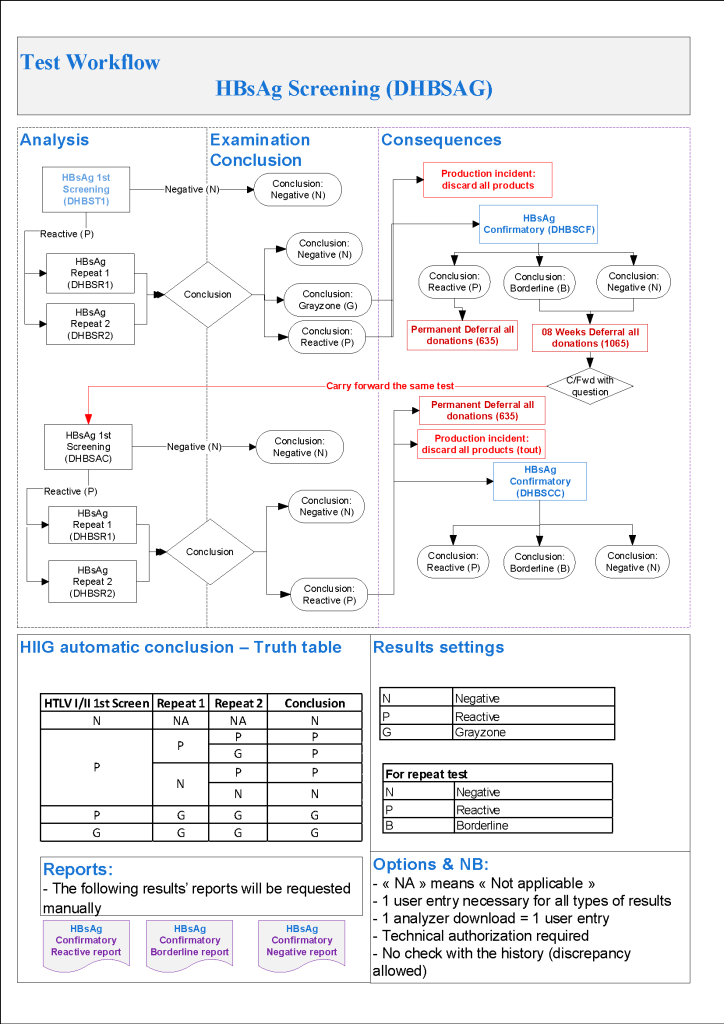
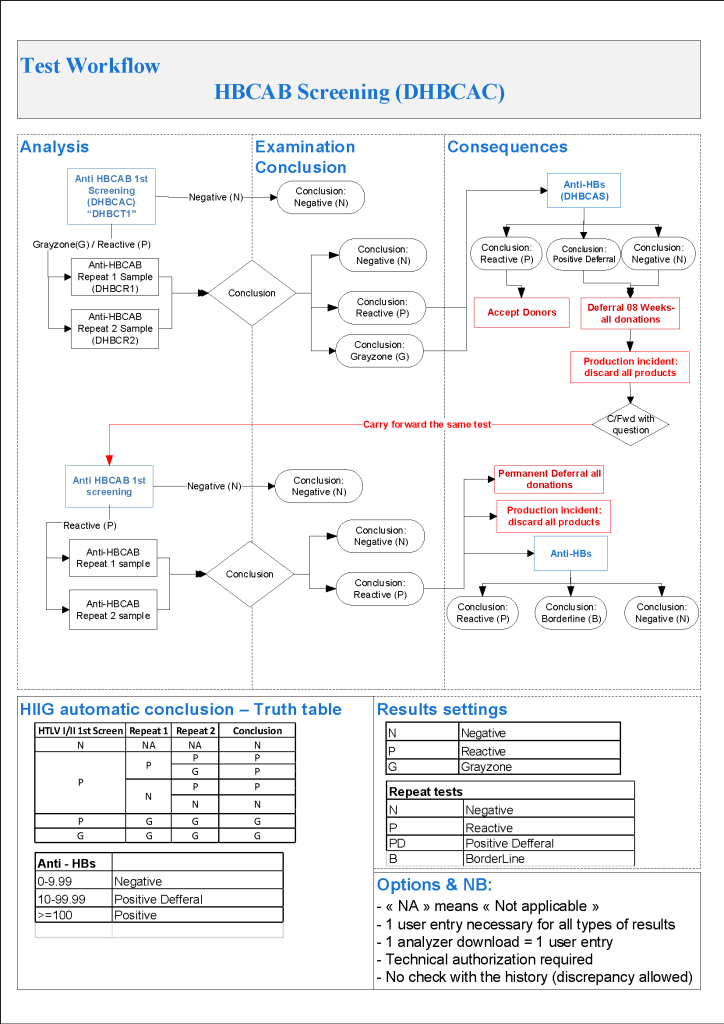
Hepatitis B donor screening consists of HBsAg and HBcAb for all donors, the latter to detect the window period.  In the USA, a non-negative HBcAb result will trigger a deferral.  In the Gulf area/KSA, there HBV was positive higher than in the West so there was a high rate of HBcAb positivity often from recovered HBV infection.

Here was my last algorithm before I left HMC Doha, which allowed use of donors with protective titers of HBsAb.  Note that the WHO cut-off for this is 10 IU/L whereas we used 100 IU/L as our threshold:

  1. Hepatitis B:
    1. HBsAg non-negative, then:
      1. HBsAg positive with HBsAg confirmatory positive, regardless of other results:  permanent deferral, refer to Infectious Disease clinic
      2. HBsAg positive with HBsAg confirmatory borderline or negative, repeat all HBV testing after 8 weeks
      3. HBsAg borderline:  repeat all HBV testing after 8 weeks
      4. HBV-DNA positive confirmed, regardless of other results:  permanent deferral, refer to Infectious Disease clinic
    2. If HBcAb positive, repeat after 8 weeks
    3. Repeat Hepatitis B Testing After 8 weeks:
      1. HBsAg positive with HBsAg confirmatory positive:  permanent deferral, refer to Infectious Disease clinic
      2. HBsAg positive with HBsAg confirmatory borderline or negative:  permanent deferral, refer to Infectious Disease clinic
      3. HBsAg borderline, permanent deferral, refer to Infectious Disease clinic
      4. HBV-DNA positive confirmed:  permanent deferral, refer to Infectious Disease clinic
      5. HBcAb positive or borderline with negative HBsAg and negative HBV-DNA:  review HBsAb level:
        1. If HBsAb level >= 100 mIU/mL (100 IU/L), donor may be reentered
        2. If HBsAb level < 100, then recommend to donor to receive booster HBV vaccine
          1. After HBV vaccine administration, retest after 30 days:
            1. If HBsAb level >= 100, donor may be reentered
            2. If HBsAb level < 100, donor is indefinitely deferred
      6. HBsAg, HBcAb, HBsAb all negative:  reenter into donor pool

Here is the HBcAb and HBsAb part of the algorithm:

Previously, we had we had disqualified any donor with a nonnegative HBcAb:

To Be Continued: 

18/8/20

Processes and Software Building 32: HIV-1/HIV-2 Donor Screening

As I designed this in Medinfo, this is algorithm uses an HIV- /HIV-2 antibody EIA screening test, HIV p24 antigen test, and a confirmatory linear immunoblot assay LIA that can discriminate between type HIV-1 and type HIV-2.  If there is an indeterminate result, a repeat test is ordered after 8 weeks.  A reentry protocol is also included (1.6.3 below).

  1. HIV Testing:
    1. HIV-RNA positive confirmed, regardless of other HIV results:  permanent deferral and do HIV-InnoLIA, refer to Infectious Disease clinic
    2. HIV-RNA borderline:  do HIV-InnoLIA
    3. HIV-InnoLIA positive, regardless of other HIV results:  permanent deferral and refer to Infectious Disease clinic
    4. HIV-InnoLIA indeterminate:  repeat all HIV testing after 8 weeks
    5. HIV Ab positive with negative HIV-RNA and/or borderline/negative HIV-InnoLIA:  repeat testing after 8 weeks
    6. Repeat HIV Testing After 8 Weeks:
      1. HIV RNA positive and/or HIV-InnoLIA positive, regardless of other HIV results:  refer to Infectious Disease clinic
      2. HIV-InnoLIA and/or HIV antibodies indeterminate:  permanent deferral, HIV infection not confirmed
      3. HIV Ab negative and HIV-RNA negative and HIV-InnoLIA negative:  reenter into donor pool

This algorithm is represented in Medinfo as follows:

To Be Continued:

17/8/20

Processes and Software Building 31: HTLV Donor Testing

As I designed in Medinfo, this is a much simpler algorithm than HCV and uses an HTLV-1/HTLV-2 screening test and a confirmatory linear immunoblot assay LIA that can discriminate between type 1 and type 2.  If there is an indeterminate result, a repeat test is ordered after 6 months:

  1. HTLV 1/2 Testing:
    1. HTLV Antibodies positive, then do HTLV-InnoLIA:
      1. HTLV InnoLIA positive for HTLV-1 and/or HTLV-2:  refer to Infectious Disease clinic
      2. HTLV InnoLIA indeterminate or negative, repeat HTLV Ab and HTLV InnoLIA testing after 6 months
    2. Repeat HTLV Testing After 6 Months:
      1. HTLV 1/2 antibodies positive, permanent deferral and do HTLV InnoLIA
      2. HTLV 1/2 antibodies indeterminate,  permanent deferral and do HTLV InnoLIA
      3. HTLV InnoLIA positive for HTLV-1 or HTLV-2: refer to Infectious Disease clinic
      4. HTLV InnoLIA indeterminate, donor permanently deferred.
        1. Issue letter HTLV-Not Confirmed
      5. HTLV 1/2 Ab negative and HTLV InnoLIA negative, reenter donor.

This is translated into the following Medinfo processes:

To Be Continued:

15/8/20

Processes and Software Building 30: Donor HCV Screening Tests

The testing algorithms may trigger additional testing, repeat of current testing at some future date, or permanent deferral.  One of the most complex processes is for HCV testing.  The following criteria are based on US FDA CBER guidelines, but are modified for the availability of test methodologies not licensed in the USA.

For HCV, we use the following testing in all donors:

  1. HCV antibody EIA
  2. HCV NAT
  3. If any of the tests are non-negative, then we do the HCV LIA immunoblot assay. 

HCV LIA is more sensitive than RIBA-3 (now no longer performed in the USA) but is not available in the USA.  This test has been incorporated into the testing algorithm from CBER:

  1. Hepatitis C:
    1. HCV-RNA positive confirmed, regardless of other HCV results:  permanent deferral, refer to Infectious Disease clinic
    2. HCV-RNA borderline:  repeat all HCV testing after 6 months
    3. HCV-InnoLIA positive, regardless of other HCV results:  permanent deferral, refer to Infectious Disease clinic
    4. HCV-InnoLIA indeterminate:  repeat all HCV testing after 6 months
    5. HCV-Ab positive, HCV-RNA negative, do HCV-InnoLIA:
      1. If HCV-InnoLIA positive, permanent deferral, refer to Infectious Disease clinic
      2. If HCV-InnoLIA indeterminate or negative, repeat all HCV testing after 6 months
    6. Repeat Hepatitis C Testing After 6 months:
      1. HCV-RNA or HCV-InnoLIA positive:  permanent deferral, refer to Infectious Disease clinic
      2. HCV-RNA or HCV-InnoLIA borderline:  permanent deferral, HCV infection not confirmed
      3. HCV-Ab positive or borderline without positive HCV-RNA or positive HCV-InnoLIA:  permanent deferral, HCV infection not confirmed
      4. HCV-Ab negative, HCV-RNA negative, HCV-InnoLIA negative:  reenter donor into donor pool

Note that indeterminate HCV results may be carried forward repeatedly by CBER rules but I decided to permanently defer the donor after 2 cycles of indeterminate results.  The donor must wait SIX MONTHS before the next round of testing.  Should he/she return before that time, those results may not be used for determining donor eligibility (unless the results have become clearly positive).

To Be Continued:

10/8/20

Processes and Software Building 29: Donor Marker Testing Overview

Donor marker testing algorithms are very complex and serve multiple objectives:

  1. Is the blood safe for the recipient, i.e. minimize likelihood of disease transmission?
  2. How do we to counsel the affected donor?  Does he need referral for treatment or follow-up?

Often the donor disposition is unclear based on a single encounter and a temporary deferral must be triggered so the current results may be compared to future ones, usually after 8 weeks, 6 months, or one year—depending on the pathogen in question.

Regretfully, the significance of reactions that do not meet the criteria for positivity may be unclear.  It is very difficult to explain to the donor that he has abnormal results and cannot donate but we as physicians do not know what their significance is.

Thus, the testing algorithms may trigger current additional testing, temporary deferral with repeat of testing at some future date, or permanent deferral.

At my previous positions, I started with the AABB/FDA CBER Uniform Donor Questionnaire UDQ and then modified it to include some advanced methodologies not available in the USA.

In the next series of posts I will elaborate on the processes developed for this for each marker.

To Be Continued

9/8/20

Processes and Software Building 28: Donor Questionnaire

Donor Collection 6

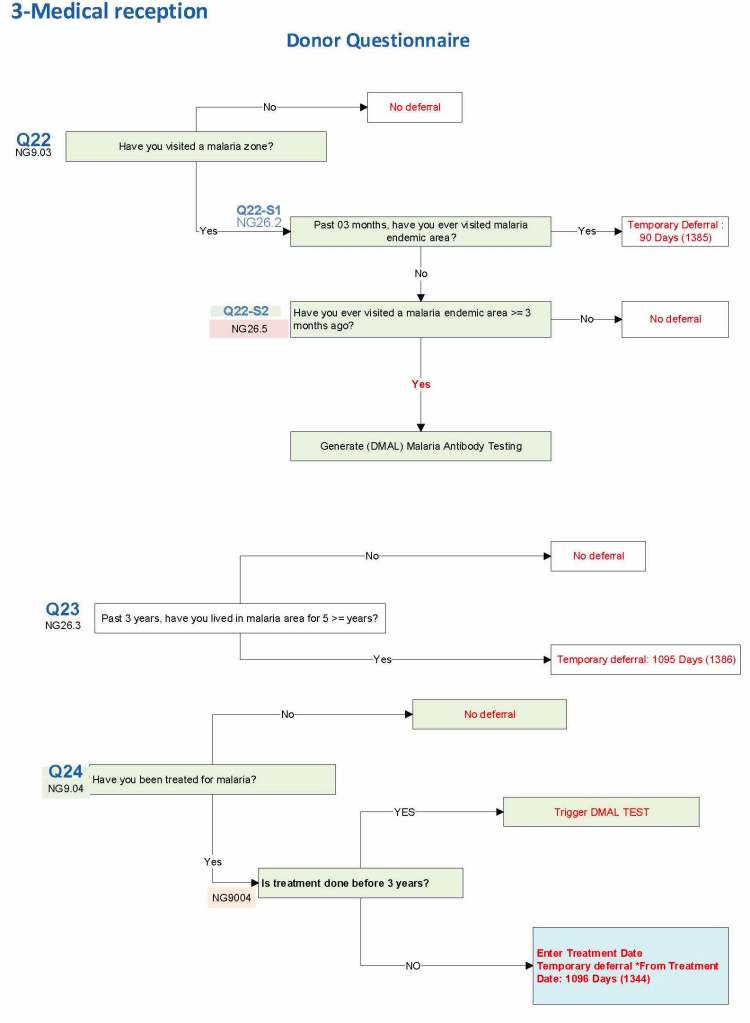
I started building this using the Uniform Donor Questionnaire UDQ from the AABB;  however, I modified it to include coverage for Chikungunya, Zika, etc. and to include enhanced processes for malaria based on the Australian Red Cross.

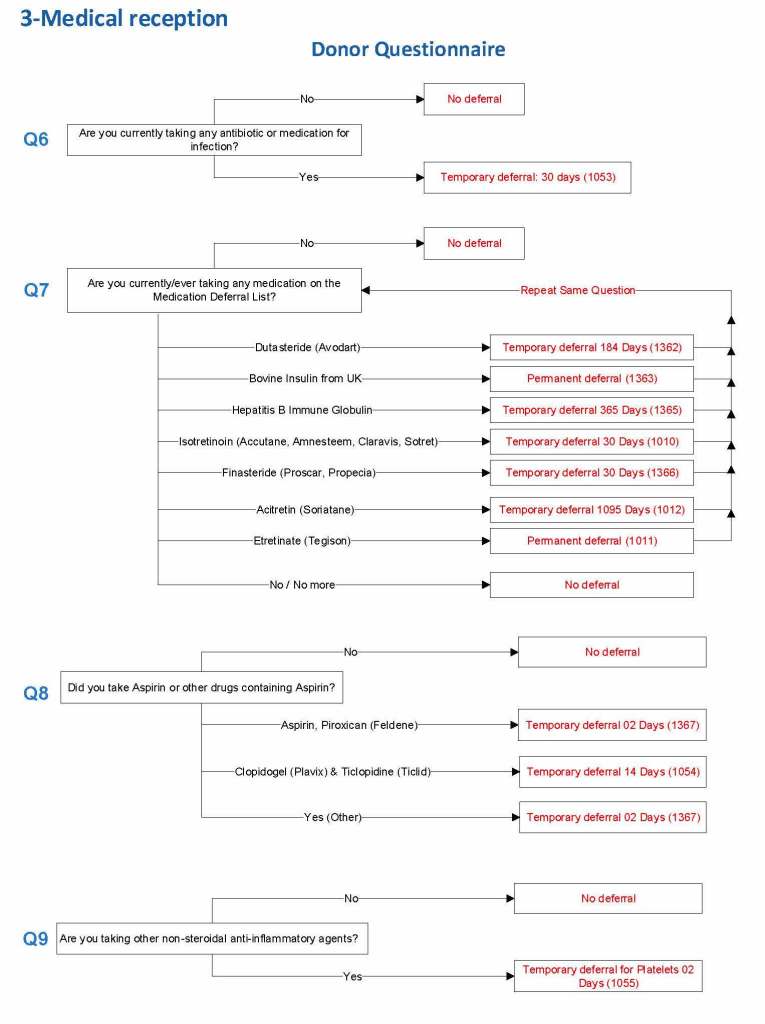
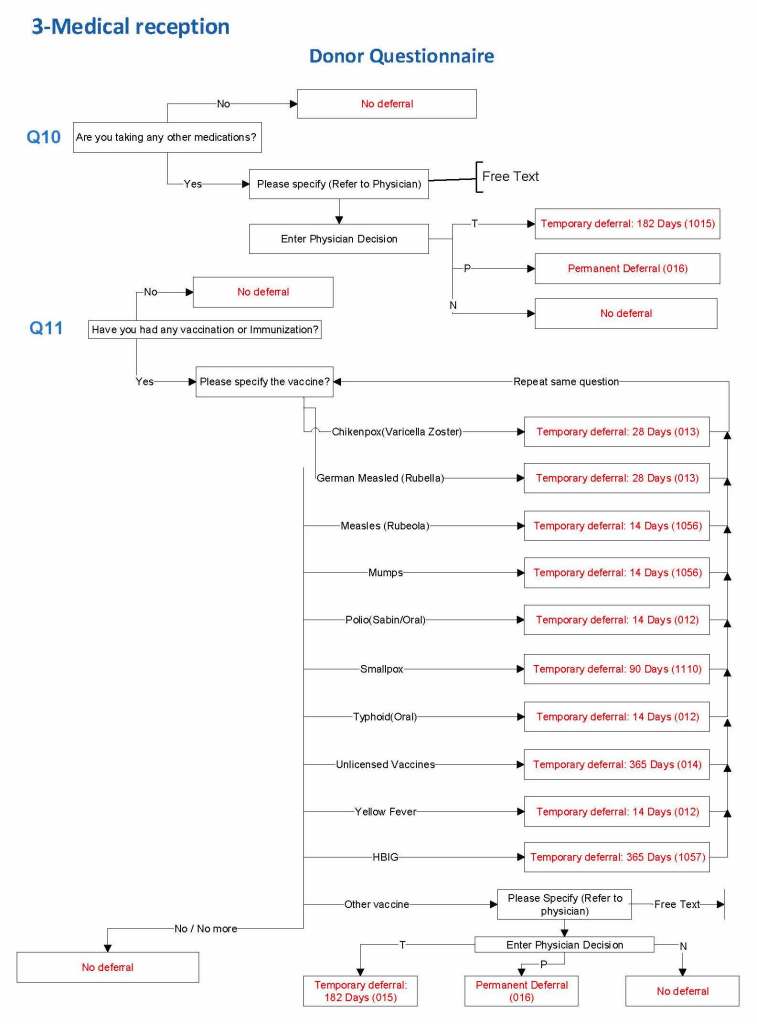
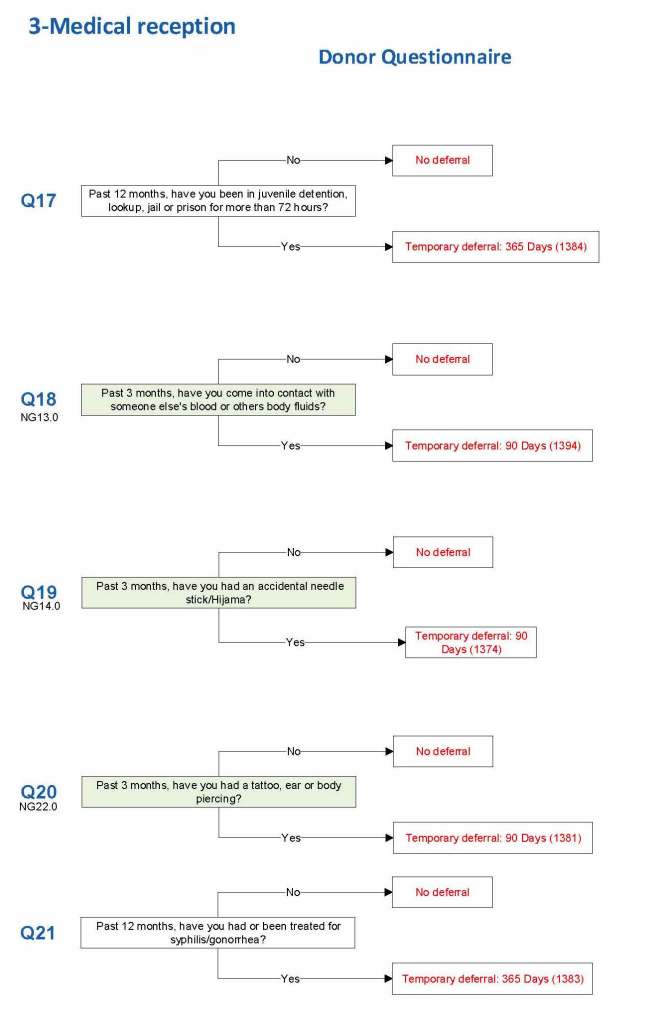
For each screening question, I prepared the exact wording (usually the UDQ’s) and set the deferral to temporary (how many days) or permanent.

Some questions were more open-ended, and the interviewer manually entered a medication, surgical procedure, etc.  The transfusion physician would review this and assign a temporary (specifying the interval) or permanent deferral.

The questionnaire was constantly being updated by changes.  My role was to review different accreditation systems (AABB, CE, etc.) and the World Health Organization’s websites.  I would then prepare an interim policy and pass the specifications for the changes to the Medinfo software engineer and when ready, finally to the Super Users for testing.  If there was an urgent change, the whole process could be completed in less than one day including validation testing.

The following shows examples of the software processes:

  1. Medications
  2. Body fluid exposures
  3. Vaccinations
  4. Malaria
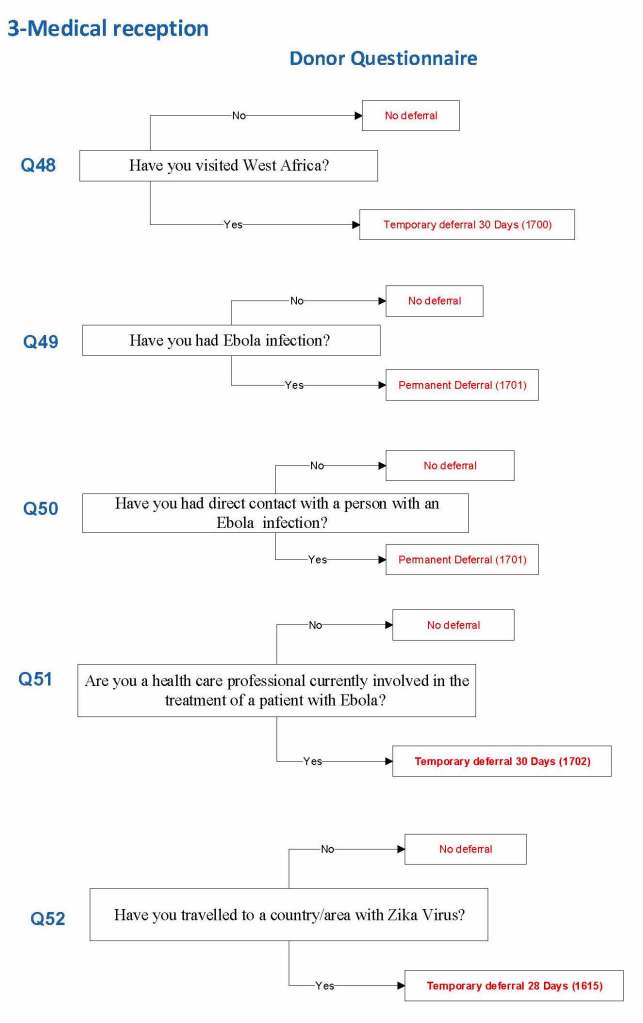
  5. Ebola/Zika

I emphasize that all of these settings are user-definable (at least in jurisdictions that permit all open, non-turnkey software).

Medication Questions:

Vaccinations:


Blood and Body Fluid Exposures:

Malaria Example:  DMAL refers to the malaria antibody test.


Ebola and Zika Examples:

7/8/20