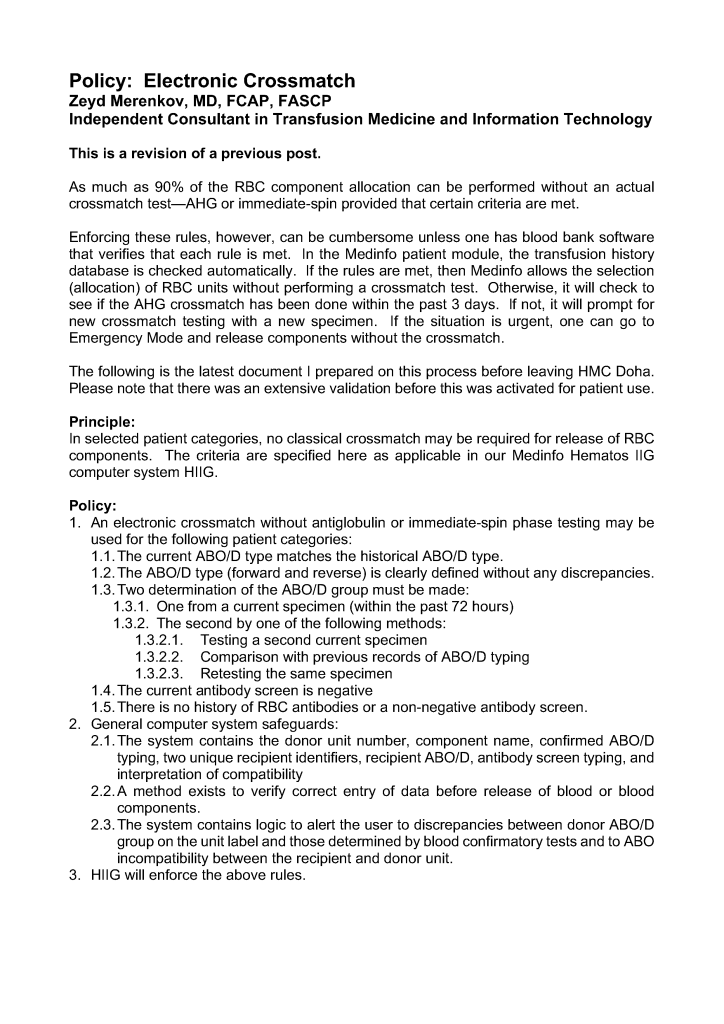
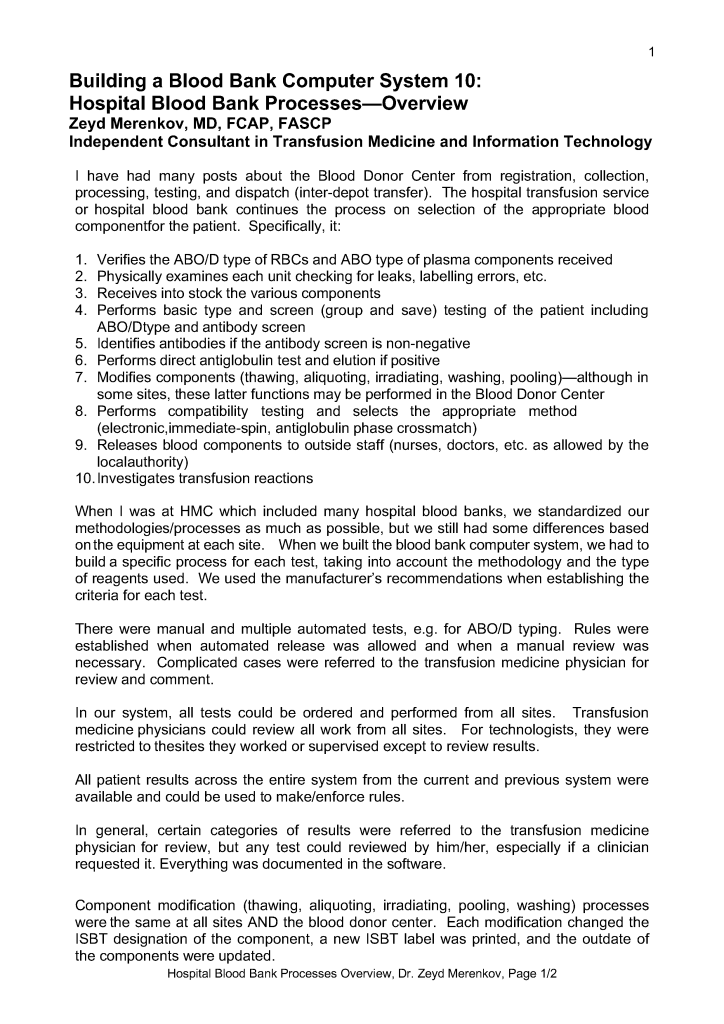
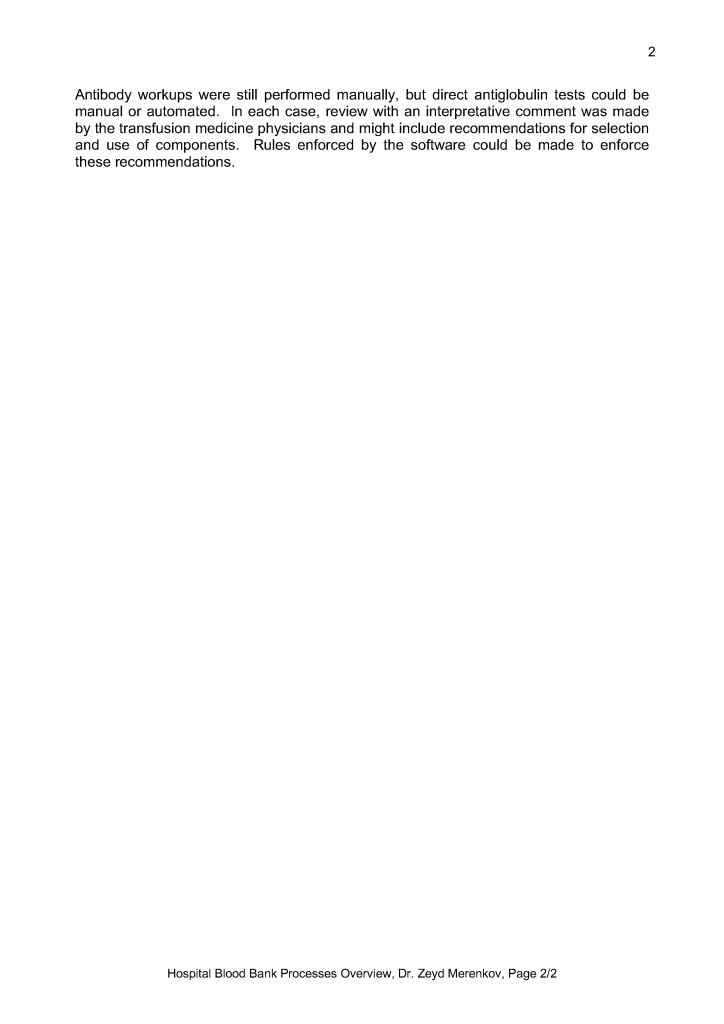
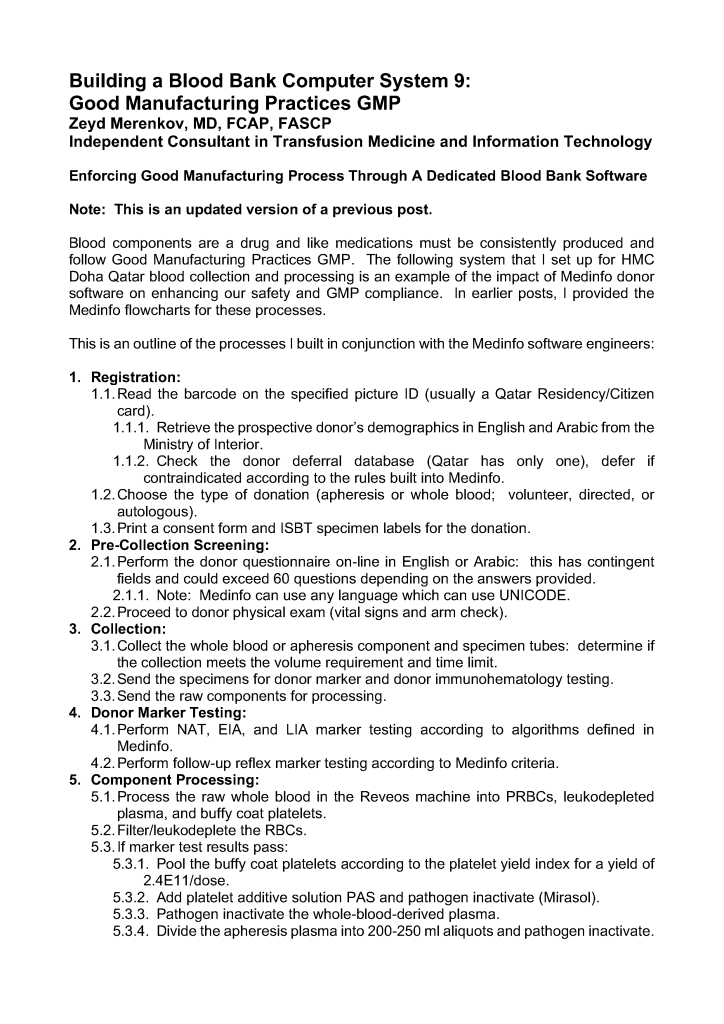
Allocation Antigen Matching in Medinfo

In the previous post, the Medinfo document for Inter-Depot transfer had many pages of rules for matching RBC antigens.  Multiple actions were available:

  1. Forced Match, no release of untested or antigen-mismatch (e.g. anti-Kell requires specifically tested K-negative RBCs).
  2. Match Optional (e.g. anti-Lea/Leb does not require Lewis-matched blood):  system would flag a comment showing the antibody specificity, user would respond Y/N, and select units
  3. Least-Incompatible (e.g. WAIHA):  requires sufficient privilege (senior technical or transfusion physician) to authorize release
  4. Permitted Incompatible (e.g. give C-positive to patient with anti-C in times of shortage or complex multiple antibodies without fully matched blood available):  requires sufficient privilege to release
  5. Fully Allowed (e.g. group O RBCs to group A, AB, B patients)—no flagging, allocation of units permitted
  6. Prohibited Under Any Circumstance—NO Override Permitted (e.g. group O for Bombay Oh, c-positive for anti-c, K-positive for anti-K)

To avoid mistakes, the blood bank computer system enforced the rules.  There was no mercy.  Only specific individuals could override this( in many cases, but certain allocations (e.g. group O RBCs to a Bombay Oh patient) were not permitted under any circumstances.

Prophylactic Antigen Matching:

Please also refer to my prophylactic antigen matching post made last week for the rules I selected for Qatar.

Prophylactic antigen matching is common in Europe.  I have been doing this during the many years I have worked in the Middle East.  Most patients were not local nationals but transient.  They would return to their home countries where blood bank testing (antibody screening/identification/antigen matching) or intrauterine exchanges might not be always available.

For pregnant patients, we would prophylactically match K-negative and c-negative—regardless if there were antibodies detected—R1R1 units for R1R1 patients.  At the end of my time in Qatar, we had several pregnant women with various Rh deletions, so we added routine extended Rh(D) and Kell typing to all.

For sickle cell patients, especially African type, I would prophylactically match Rh antigens (D, C, c, E, e) and Kell because of the polymorphisms in the CE gene, some of which may lead to pan-Rh antibodies.

I would consider selective prophylactic antigen matching in chronically transfused populations, again regardless if clinically significant antibodies were detected.

If a patient makes any antibody, regardless if is clinically significant or not, I would consider that patient as a candidate for prophylactic antigen matching (but NOT necessarily for a clinically insignificant antibody).

In Qatar, blood bank services (testing and components) were not charged to the patient.  In many other parts of the world, blood bank is a cost center.  No prophylactic antigen matching may be routinely performed.  If it is done, it must be charged to the patient or the hospital must assume the cost.  I have gone to conferences in such locales where not even R1R1 patients were not matched and subsequently developed anti-c, which complicated management.  It would have been cheaper to do the antigen matching than to pay for the consequences of the alloimmunization.

Allocation Rules for Platelets and Plasma

Medinfo Hematos IIG software is rules-based so the institution may set its own custom rules for all processes.  One chooses a framework and then adds any additional rules it needs for optimization.  Turnkey systems do not offer this flexibility.

The rules for platelet and plasma components are much simpler than those for RBCs since usually we only consider ABO type.  There are two modes:  regular and emergency, the latter applying if not all the patient testing (including historical checking) is available.  The components, on the other hand, must meet all criteria before being considered for patient use.

Please note that any donor with antibodies is automatically excluded from plasma and platelet production based on our donor testing criteria.

Example rules for plasma follow:

For platelets, note that for adults and anyone else >= 20 kg, I gave any type of platelet pool or plateletpheresis component without regard to ABO matching.  With our production method, I did not give Rh immunoprophylaxis to females of child-bearing age receiving platelets from D-positive donors based on our clean (essentially RBC-free) Reveos automated production process.

For platelets, there were also different allocation rules for regular and emergency mode:

Similarly, allocation rules for granulocytes, etc. can be made and enforced by the software.  Low-B-titer group A universal plasma would also be easy to implement.

Regular and Emergency Mode RBC Antigen Matching

Note:  This is an update of a previous post.

In the previous posts I outlined how Medinfo handled antibody screening and identification.  This post reviews how antigen matching is used based on these results.

There are two modes, regular and emergency.  If the patient has not had at least two ABO/D determinations and/or does not have a recent antibody screen within the past 3 days, then emergency mode must be selected with its own rules.  Otherwise, the regular mode applies.

Regular Mode:

In general, if there is a clinically significant antibody, an RBC unit which has not been matched for the corresponding antigen or has the corresponding antigen cannot be routinely selected.  However there is a hierarchy here also:

  1. Absolutely prohibited release—no one can override the logic (e.g. giving group O to a patient with anti-H)—not even the transfusion medicine physician can override this
  2. Restricted release—only transfusion medicine physician can authorize the release of the incompatible or untested unit (e.g. giving C-positive unit to someone with anti-C)
  3. Least-incompatible for warm autoimmune hemolytic anemia WAIHA:  requires transfusion medicine physician approval
  4. Informational release:  authorized staff may release antigen-incompatible or untested unit but a pop-up menu appears and asks them to accept (e.g. Lewis untested unit in a patient with anti-Lea).
  5. Antigen-specificity matched—the usual mode for patients with antibodies

Examples of Regular Mode rules follow (these are not the complete lists but just provided to show the complexity of the process).


Emergency Mode:

This is much more restricted for selection of ABO/D and other antigen typings.  An example follows:

If low-titer group O whole blood is available, then a specific rule must be added to both regular and emergency mode to allow this to be given to any ABO type except Bombay.

Inter-Depot Transfer, Blood Delivery, Type and Antigen Matching

This is an update of a previous post.

The final components from the component preparation center may be sent to various depots (freestanding location and/or hospital blood banks.  There should be complete traceability for every step (from donor reception, collection, testing, and processing) transport between locations, and finally the exact storage site, which might include which refrigerator/freezer/incubator and even shelf/position number for each component is stored.  The end of that document showed rules for type/antigen matching.

For disaster planning, rapid inventory enumeration by type is very important.  This can be very time-consuming manually.  With our Medinfo Hematos blood bank system, we could quickly get total inventory across the Qatar or by hospital in less than one minute.  We could also quickly find antigen-matched units across the system and reserve it at any one site for another if necessary.

Smart blood bank dispensing refrigerators, as offered by Haemonetics and Angelatoni, may also serve as depots and take the place of a hospital blood bank for some dispensing.  These solutions can also capture vital information about the storage conditions of the components and prevent release if the storage criteria are not met.  They can also interface with blood bank computer systems and use the main system’s logic for the dispensation rules.

Upon receipt at the hospitals from the blood processing center, the forward ABO and D typing must be confirmed.  We used D reagents which detected partial D so we would call such donor units as D-positive.  However, if a patient type reagent insensitive to partial D types is used, it is possible for a unit to be typed as D-negative whereas in the donor center it might be D-positive.  Sometimes, nothing types consistently as D-positive:  all you can say is that with a particular reagent and lot number, there is or isn’t reactivity.

The greatest complexity is for RBCs since potentially so many antigens exist.  Criteria for matching/ignoring certain antigens must be made.  Critically significant antibodies such as the Kell, Duffy, Kidd, and certain Rh (D and c) must be antigen matched.  A robust blood bank computer system can enforce these rules.

For other components, antigen/typing may be less important.  In fact, in most situations, any type of platelets can be given to anyone (except neonates).  Despite the potentially incompatible plasma, there is rarely significant hemolysis.  In fact, if pooling platelets without regard to blood types is done, a platelet transfusion is a common cause of a positive direct antiglobulin test DAT—something that is not clinically significant.  No one died of a positive DAT by itself for this reason.

Specific rules for compatible plasma types are important, but nowadays, low-anti-B-titer group A plasma may be used like universal AB plasma.  The challenge is to be able to perform the ABO titration (specifically anti-B) quickly—titration can be a slow process, even with automated equipment.  A similar situation for low-titer, universal group O whole blood requires both anti-A and anti-B titration (I will return to this topic in a future post).

Process: Donor Collection

Process:  Donor Collection

Zeyd Merenkov, MD, FCAP, FASCP

Independent Consultant in Transfusion Medicine

5.4.1 PROCESS DONOR COLLECTION:

Process:

  1. Donors must pass and complete all previous processes in the donor workflow (registration, questionnaire, and physical examination) before the collection process begins.
  2. The donor is positively identified by a designated picture ID and Hematos donor consent form with specimen/encounter number and barcode.
  3. Donor staff checks and prepares a suitable vein
  4. Donor staff collects/labels specimens and the whole blood or apheresis components AT THE DONOR’S BEDSIDE.
  5. Donor reactions are assessed and treated as they occur.
  6. Donors are observed in a post-donation area and given post-donation instructions before discharge.
  7. All processes are documented in Hematos IIG.
  8. Donor units and specimens are sent to component processing and donor marker testing.
  9. The collection workstation and equipment are cleaned before starting a new donor collection.

References:

  1. HMC 1001 Setting Specification, Version 1.5, Hematos IIG, Medinfo
  2. Standards for Blood Banks and Transfusion Services, Current Edition, AABB, Bethesda, Maryland, USA

Policy: Donor Collection

5.4 POLICY: DONOR COLLECTION

Policy:

  1. All donors will be positively identified with a picture ID and by their Hematos identifiers (donor ID and session registration/specimen number).
  2. All previous processes (registration, donor deferral database check, questionnaire, and physical examination) must pass.
  3. The donor’s arm veins will be inspected for a suitable donation site and prepared by a suitable aseptic technique.
  4. Whole Blood:
    1. Only whole blood units collected within the specified time interval may be used for component processing.
  5. Apheresis:
    1. Apheresis units will be collected at frequencies to keep the total RBC loss below 200 in any 8-week period.
    2. Only apheresis units collected within the specified time interval may be used for component processing.
  6. Donors will be treated for adverse reactions as needed.
  7. All specimens and donor units will be labeled at the donor’s bedside before starting a new donor collection.
  8. Donors will be monitored post-donation for a reasonable interval before discharge.
  9. All processes will be documented in the Hematos blood bank computer system.
  10. All equipment and supplies will be used according to manufacturer’s instructions.
  11. The collection workstation and equipment will be cleaned before starting the next donor.
  12. All policies, processes, and procedures must comply with Qatari, HMC, and applicable accreditation standards (i.e. AABB, CAP, and JCI).

References:

  1. HMC 1001 Setting Specification, Version 1.5, Hematos IIG, Medinfo
  2. Standards for Blood Banks and Transfusion Services, Current Edition, AABB, Bethesda, Maryland, USA, October 2013

Product Delivery in Medinfo 1

This is the start of a series of posts on how Medinfo blood bank software was designed for product delivery in the HMC system in Doha.

The overall process was:

  1. Transfer blood components (all types) from the Blood Donor using the Interdepot Transfer process (see that post for details) to the Hamad General Hospital HGH General Delivery Deposit.
  2. Release components to individual HMC system hospitals and client blood banks from the HGH General Delivery Deposit,.

It was also possible to release blood components directly from the Blood Donor Center to HMC hospital blood banks as a contingency.  Client hospitals outside the HMC system still had to obtain their components from HGH General Delivery Deposit.

Interfaces with Quantitative and Qualitative Results

Processes and Software Building Part 7

This is an update of a previous post.

Blood Bank instruments may perform tests and release test results in a numerical or alphanumeric format or both.  For example, nucleic acid and enzyme immunoassay may release a qualitative result (e.g. positive, reactive, borderline/gray-zone, negative, nonreactive).  Alternatively, the machine may release the signal to cutoff ratio (S/CO) as a numeric result.

Blood bank software may use either kind of result on which to base interpretative rules for acceptability of the donor.  The qualitative result criteria are based on the quantitative SC/O but the equipment automatically interprets this.  The S/CO ratio of 1 is the cut-off point.  Thus a value of 0.99 is negative and the value 1.01 is positive.  But is it really so clear-cut since the difference between the two is so small?  Thus, some people have added the term gray-zone for values close to but below the cutoff.  Could a value of 0.95 be an early infection?

I personally prefer to see the actual cutoff but use the manufacturer’s criteria for interpretation.  As a physician, it is good to review the S/CO on serial exams.  If a borderline or gray-zone result becomes positive, then perhaps the original result indicated early infection.  The question still remains, what is the gray-zone?  0.95 to 0.99, 0.90 to 0.99, etc.  Some accrediting schema have not used gray-zone for interpretation.

With Medinfo’s blood bank software, I could choose either option or both—or at least store the S/CO as a nonreported result for subsequent review.  I could even chose, test by test, in a series between reporting either S/CO or the qualitative result.

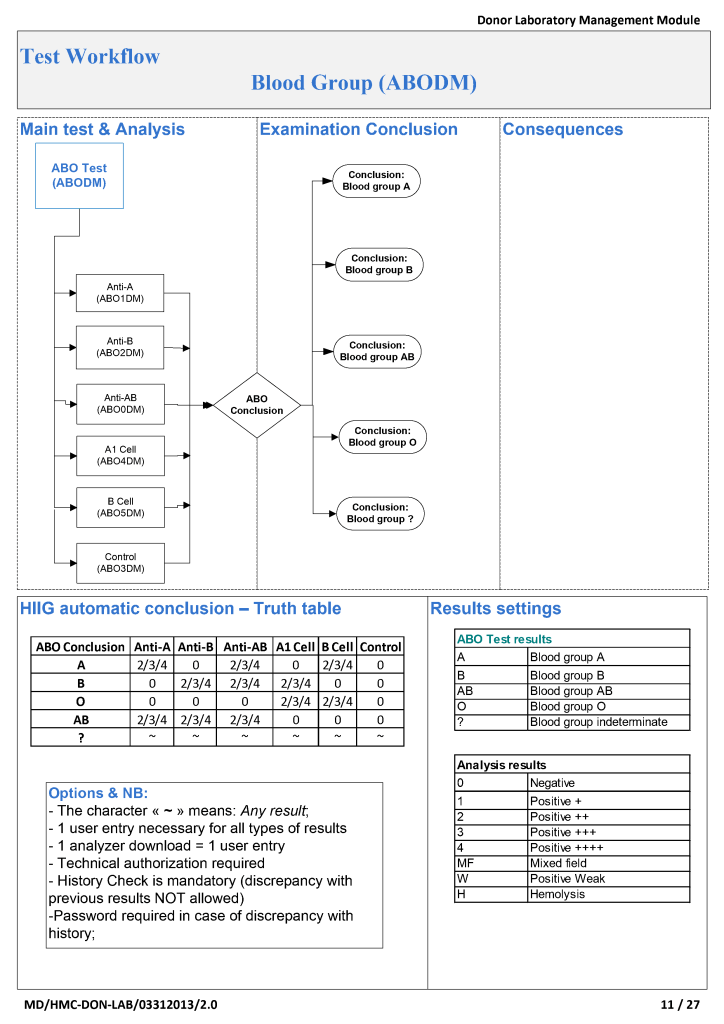
Semiquantitative results, e.g. in {0, 1+, 2+, 3+, 4+} are qualitative and could also include mixed field (mf) and hemolyzed (h).  I showed examples of this with ABO/D antigen typing in a previous post—see attachment.

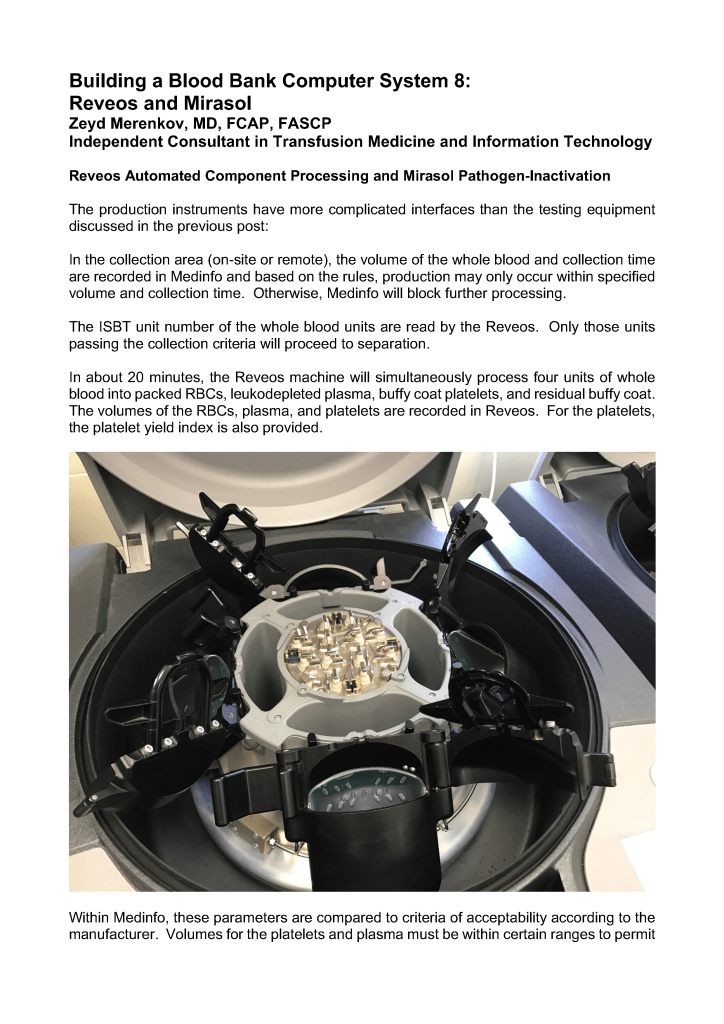
On the contrary, the results from blood production equipment may include parameters such as time of preparation, original volume, final volumes for each component, platelet yield index as an indirect measure of platelet count.  When there is pooling, the final total volume is critical to determine if pathogen-inactivation procedures and platelet additive solution can be used.  This is a much more complicated interface.