Teaching Document: Irradiating RBCs from Outside Transfusion Medicine

This is a teaching document of a process to irradiate RBC components when our irradiators are not functioning.  In our system, we used Mirasol pathogen-inactivation so our RBC units were affected.  The number of units for advance irradiation was based on our historical usage of irradiated units across our system.  The workweek is Sunday-Thursday so on Thursday special effort was made to have the minimum number of irradiated units available.

We used irradiated units for compatibility testing to avoid the possibility that the unit would be released without irradiation.

Emergency Interim Procedure:

  1. Verify the patient’s diagnosis/location:  All Hematology-Oncology patients should receive irradiated blood.  Refer to the list of diagnoses for which irradiation is indicated (attached).
  2. Only PRBCs need to be irradiated.  Mirasol-treated (pathogen-inactivated) platelets can be used directly without irradiation in accordance to Council of Europe CE regulations.
  3. Attach radiation indicator labels to the selected units as per the irradiation procedure.
  4. Send the units for irradiation to the Radiation Oncology department.
  5.  Verify that the proper dose of irradiation was received while in the Radiation-Oncology department.
  6. Keep a minimum stock of 20 group O-positive units irradiated at the start of each day AND before the start of the weekend on Thursday afternoon.  Irradiate that number of group O-positive units plus any other specific requests for blood.
  7. You should use the irradiated units for crossmatching.  DO NOT CROSSMATCH FIRST BEFORE IRRADIATING!!  If the antibody screen is positive, refer the specimen to the Transfusion Service for further processing and selection of units.
    1. Note:  If a special antigen typing is needed, we may have to irradiate after selecting the antigen-matched unit if it is not found in the group of irradiated units.
  8. If a unit is required for a child < 20 kg, it must be washed before release if the unit was irradiated more than 24 hours previously according to our irradiation policy.
Nonspecific Reactions due to Reagents Near Expiration Date

This is an updated version of a previous post.

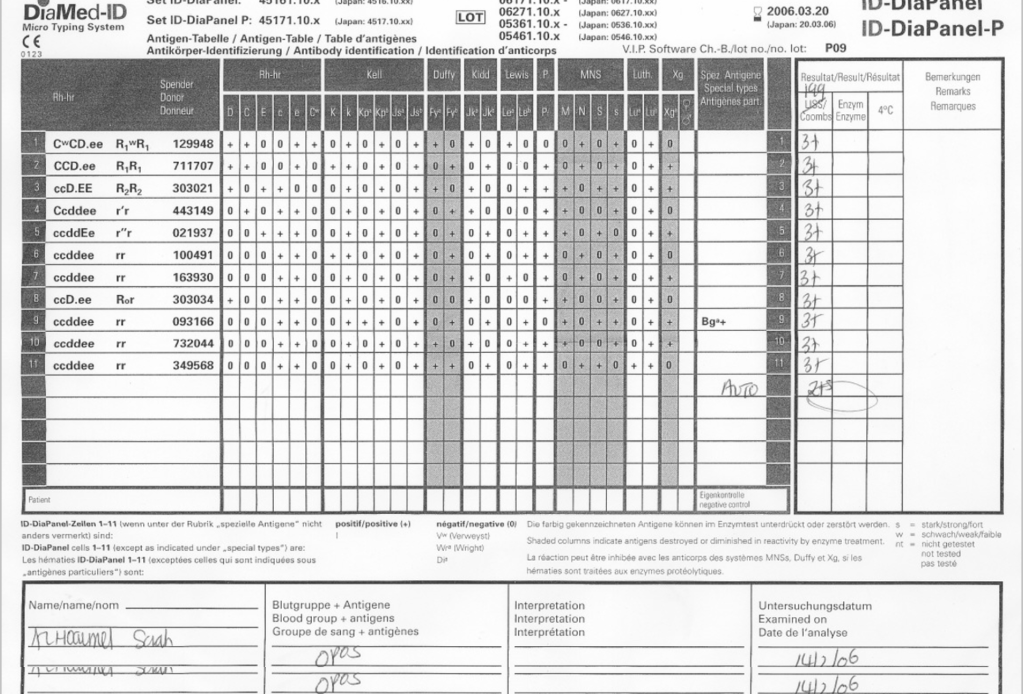
Whenever I had a “nonspecific” antibody, I had to first rule out issues with the reagents themselves. The following example shows weak to 2+ reactions in the panel cells and autocontrol.

The variability in the reactions made me initially uncomfortable about called this WAIHA. I then checked the panel details: the testing was done only six days before the panel outdate.

I told my staff to repeat the workup with the new panel expiring five weeks later. The difference is astounding!!

Remember:  if you work in the Middle East, the environmental conditions can be extreme in summer (>50C).  Do you know how your reagents were handling during transport?

My advice: if you are concerned there is a clinically significant antibody but cannot confirm it, consider repeating the workup using fresh reagents and a fresh specimen. Repeating the workup after a few days may make the detection clearer.

Original Panel with Near Expiry Reagents:

Test performed 7/2/06, reagents expire 13/2/06:

Same Patient with New Reagents and New Sample:

Test Performed 14/2/06, reagents expire 20/306:

Rare Jka Antibody

This is a repost of this rare antibody with a few new additional comments.

This is a rare anti-Jka antibody that only reacts with polyspecific AHG and only in homozygous Jka+ cell.  In the past three decades, I have only seen three of these.

Almost all anti-Jka and anti-Jkb antibodies can be detected using heavy-chain gamma specific AHG.  I prefer to use this reagent since it minimizes interference from cold antibodies.

Whenever you have a nonspecific antibody, never discount the possibility of a Kidd antibody.  Consider doing extended phenotyping and include Jka and Jkb typing and always check for dosage effect.  I have a specific post on my approach to nonspecific antibodies.

Select antibody screening cells including homozygous Jka+ and homozygous Jkb+.  This usually requires a three-cell screen.

Never forget that a negative result only means not-detected.  If there is other evidence for hemolysis, consider performing additional studies.

Physician Comments in Medinfo

Principle:

There are several different types of comments in HIIG:

  • Donor Global
  • Patient Global
  • Analytical Comments
  • Result Comments

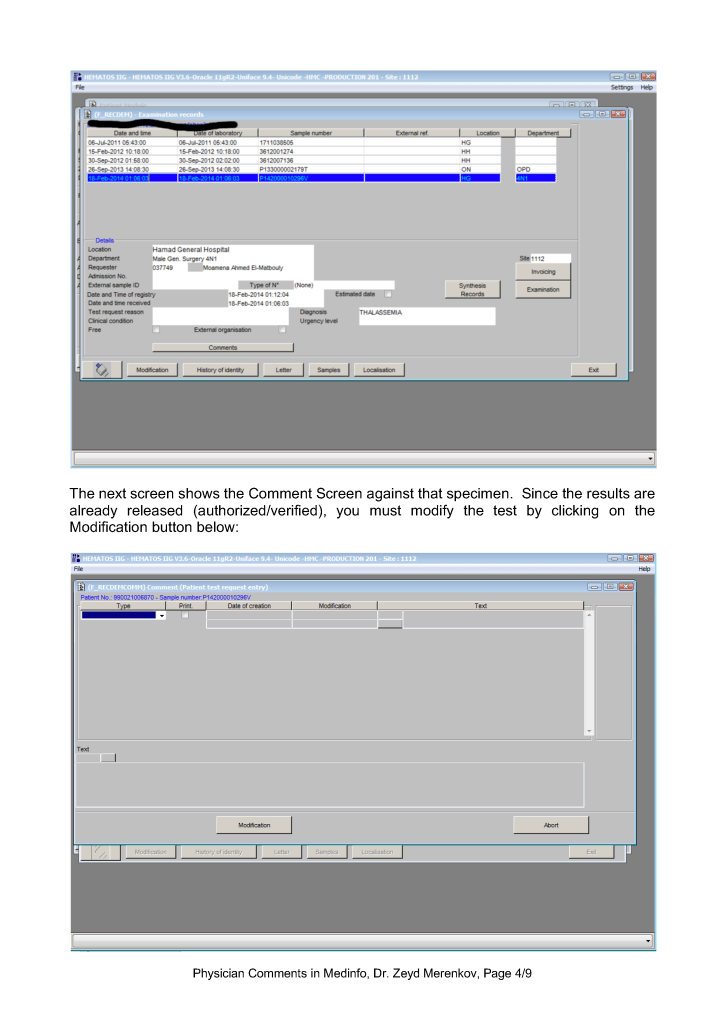
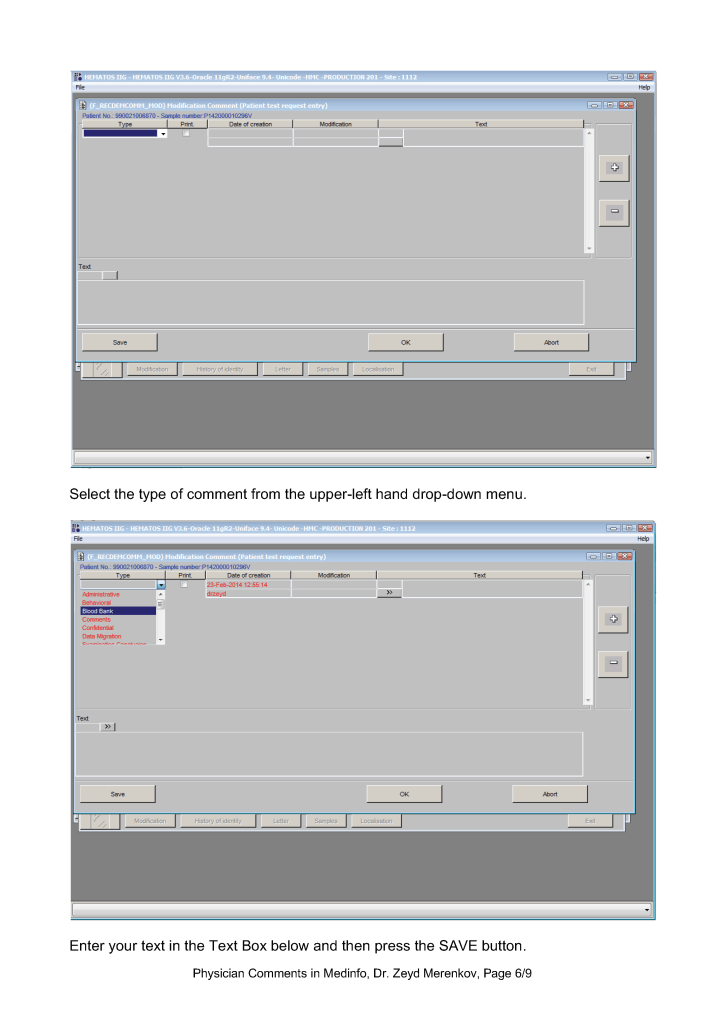
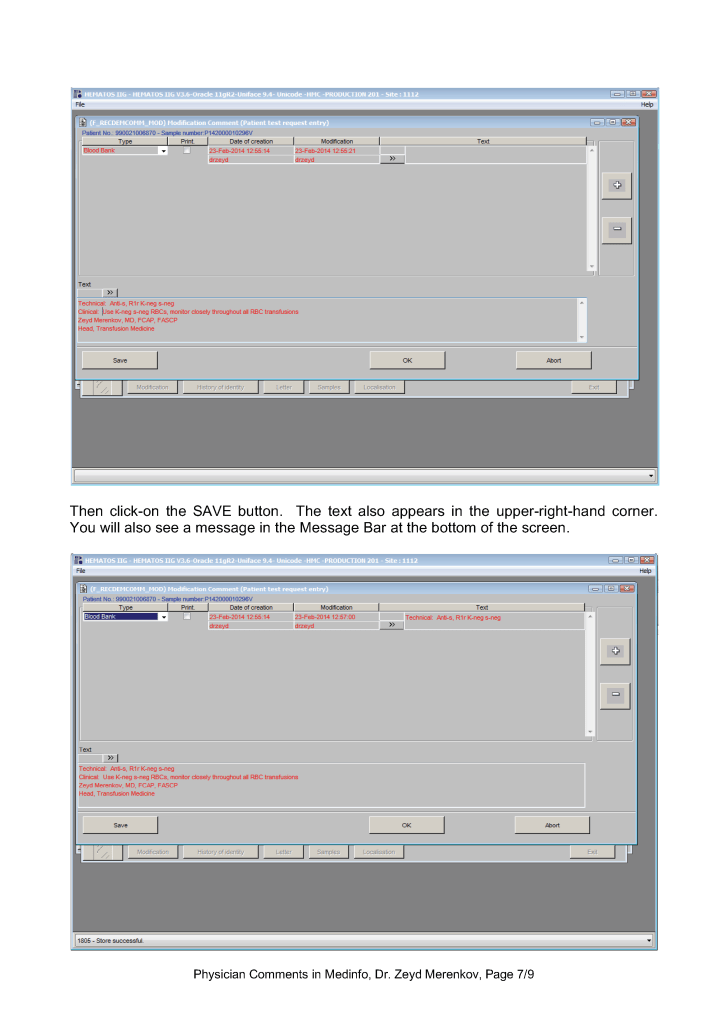
Physicians may enter any of these comment types.  Comments may be entered before or after a test is authorized/verified.  If entered after authorization, the test must be modified to accept the comment.  Only result comments are visible in the patient’s medical record.

Policy:

  1. Physicians should use comments in the following situations:
    1. Interpretations of DAT, antibody identification, ABO discrepancies
    2. Instructions for the selection of specific and/or modified blood components
    3. Donor eligibility issues (e.g. donor marker testing abnormalities and disposition)
    4. Donor reactions
    5. Telephone call documentation
    6. Donor counseling documentation
    7. Any special instructions to staff
    8. Any other situation where the transfusion physician determines it is desirable to enter a comment
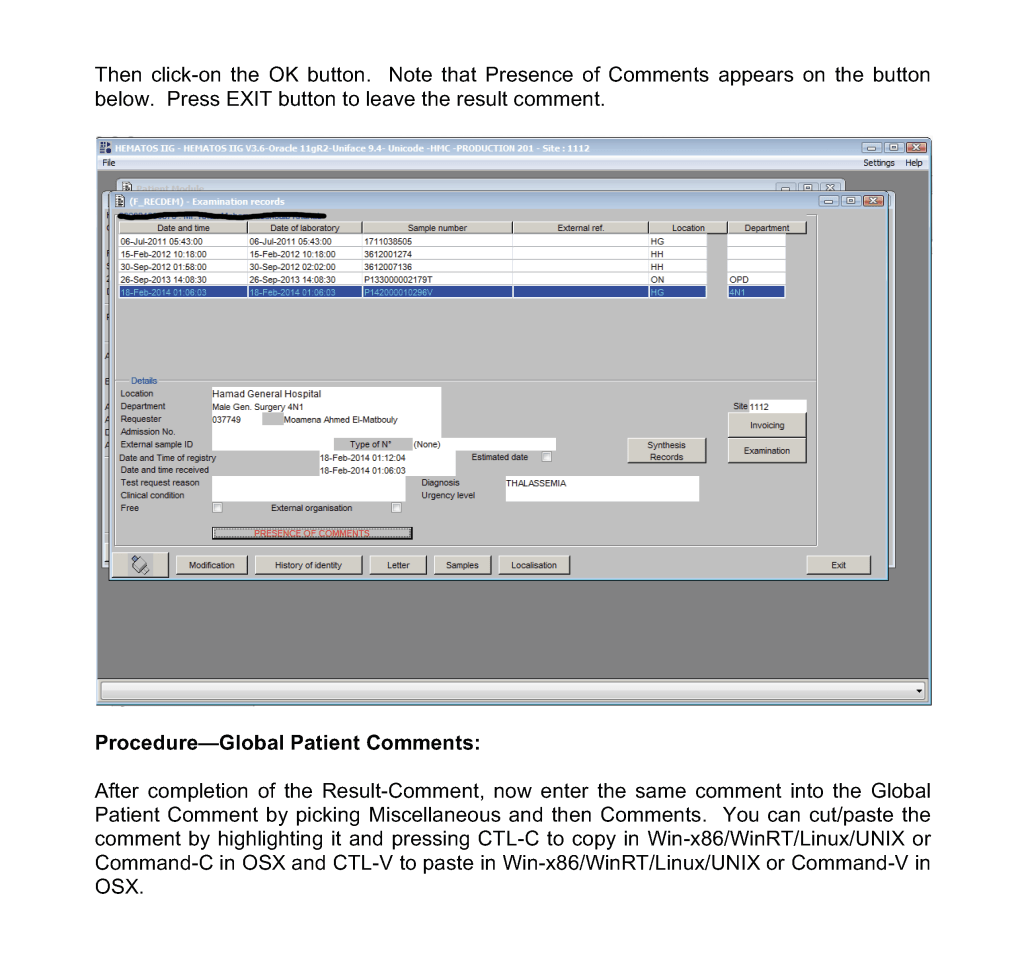
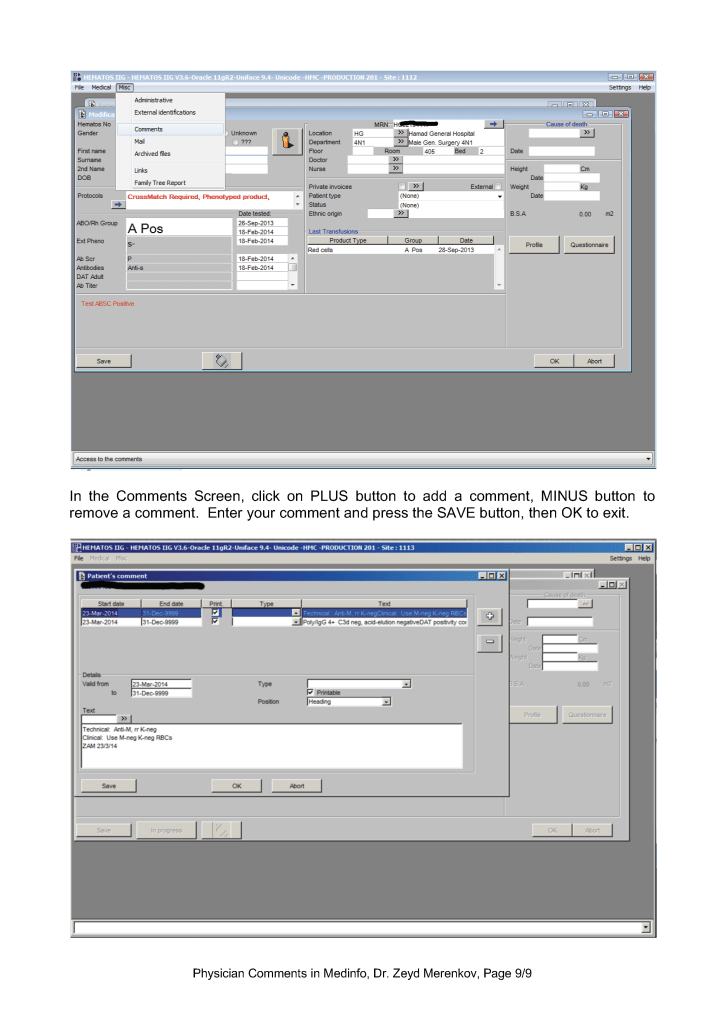
  2. Copy all result-comments and also enter then as global comments against the patient or donor record as applicable.

Procedure—Patient Result Comments After Results are Authorized/Verified:

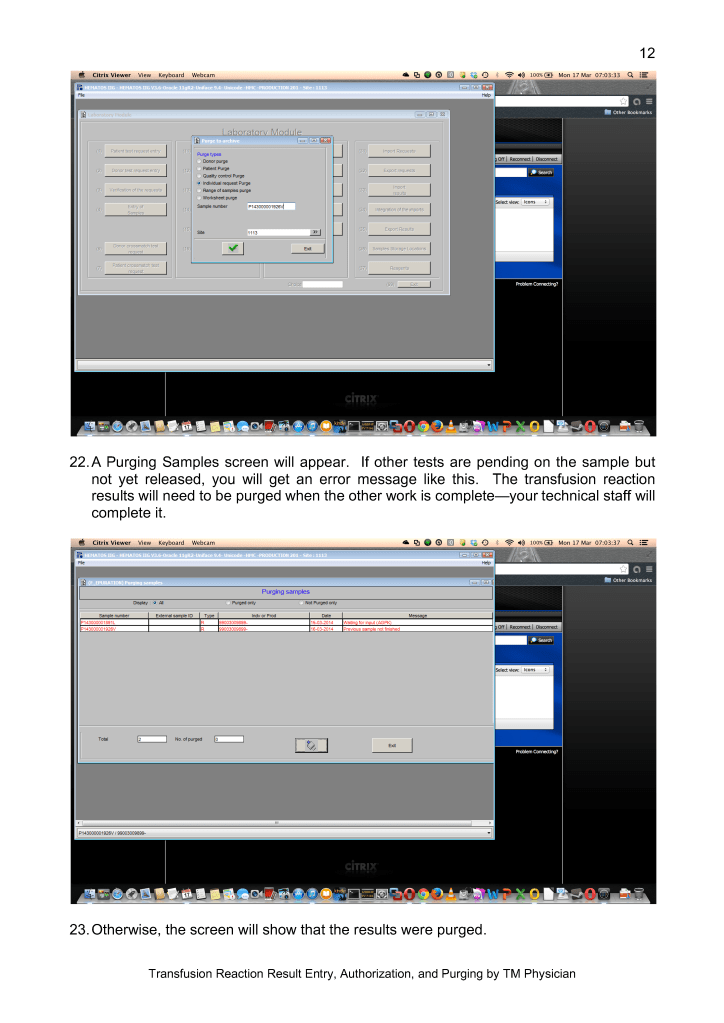
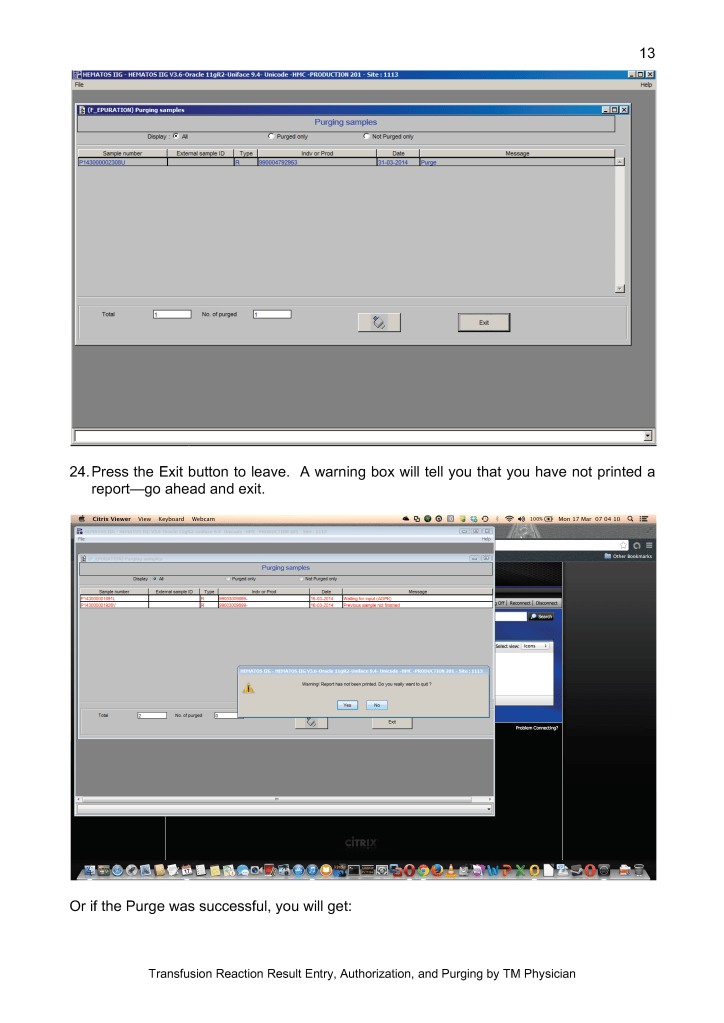
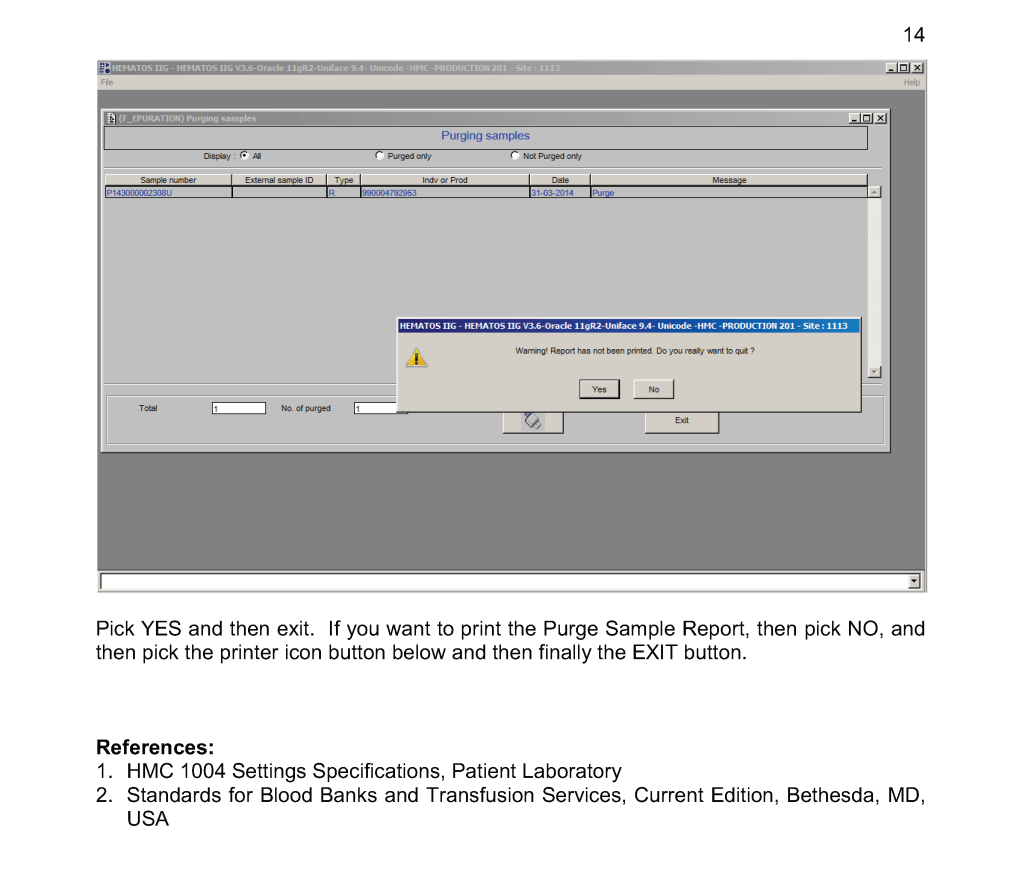
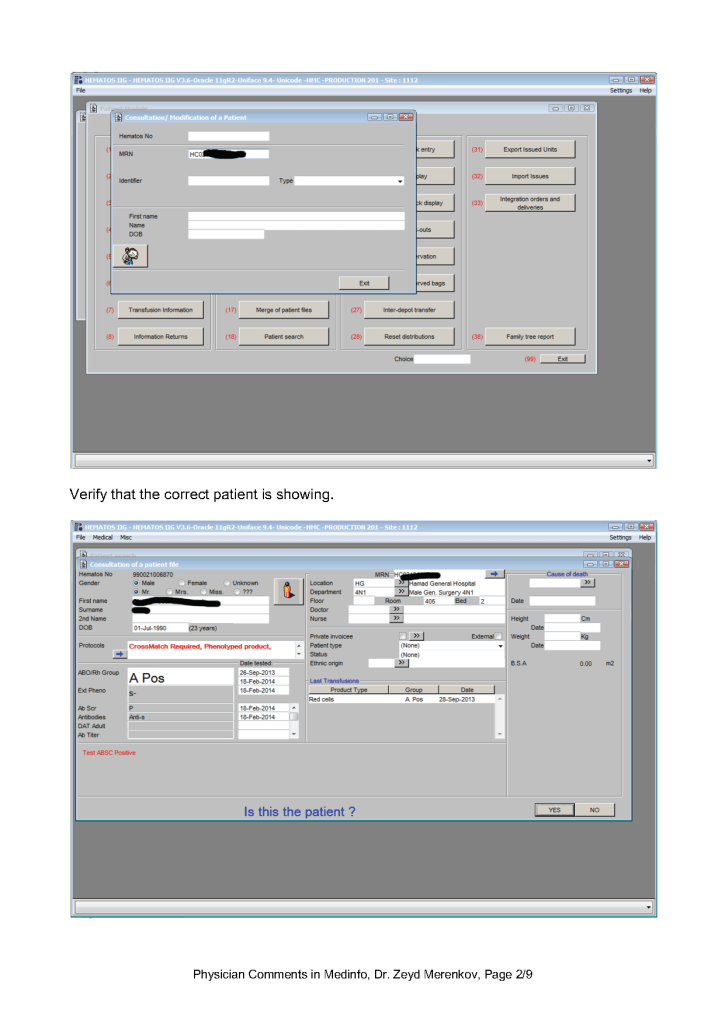
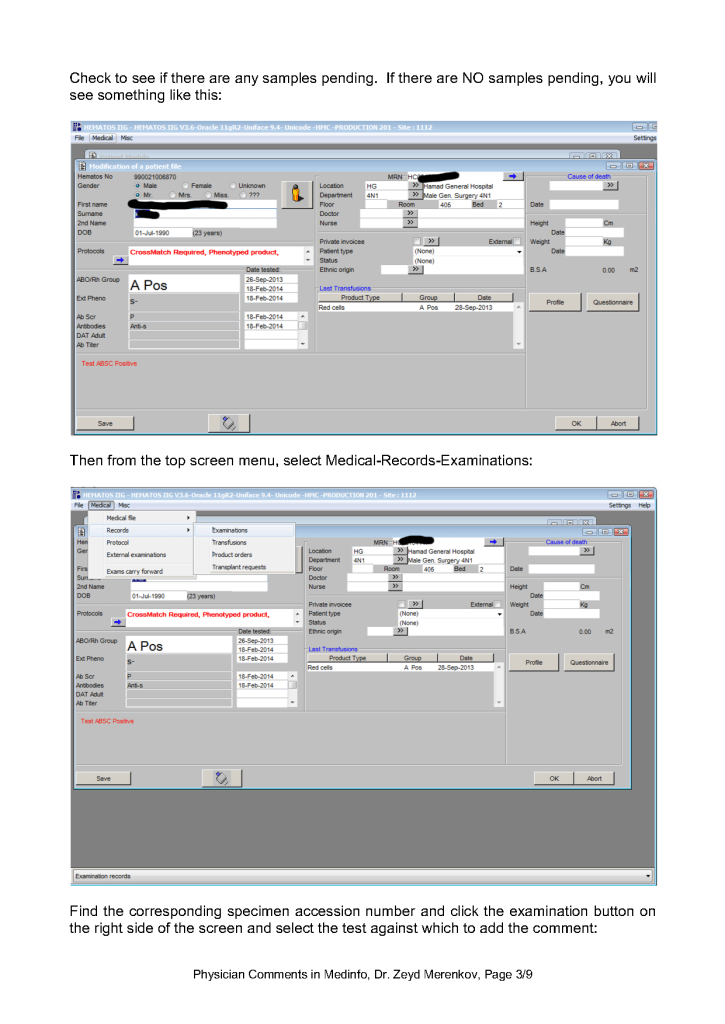
Sign into HIIG and select Patient module, Patient Consultation, and enter the patient hospital HC number.

Comments in Medinfo Hematos IIG

This post is the policy for using comments in Medinfo software.  A subsequent post will show the process of entering comments.

Principle:

There are several different types of comments in HIIG:

  • Donor Global
  • Patient Global
  • Analytical Comments
  • Result Comments
  • Contraindication Comments

Global Comments appear on the first main screen of either the donor or patient record.  The presence of comments is indicated by a bar at the bottom of the screen (in yellow or blue saying Presence of Comments.  Double-clicking opens the list of entered comments.

Examination/Results Comments appear only when you open the result to which it is attached.  You must know in advance to which result they are linked to find them.

Contraindication Comments appear when entering a donor deferral code

At HMC, we will enter examination/results comments again as global comments (donor or patient) so it is easy for staff to retrieve them and see them with all other comments.  You can do this by cut and paste.

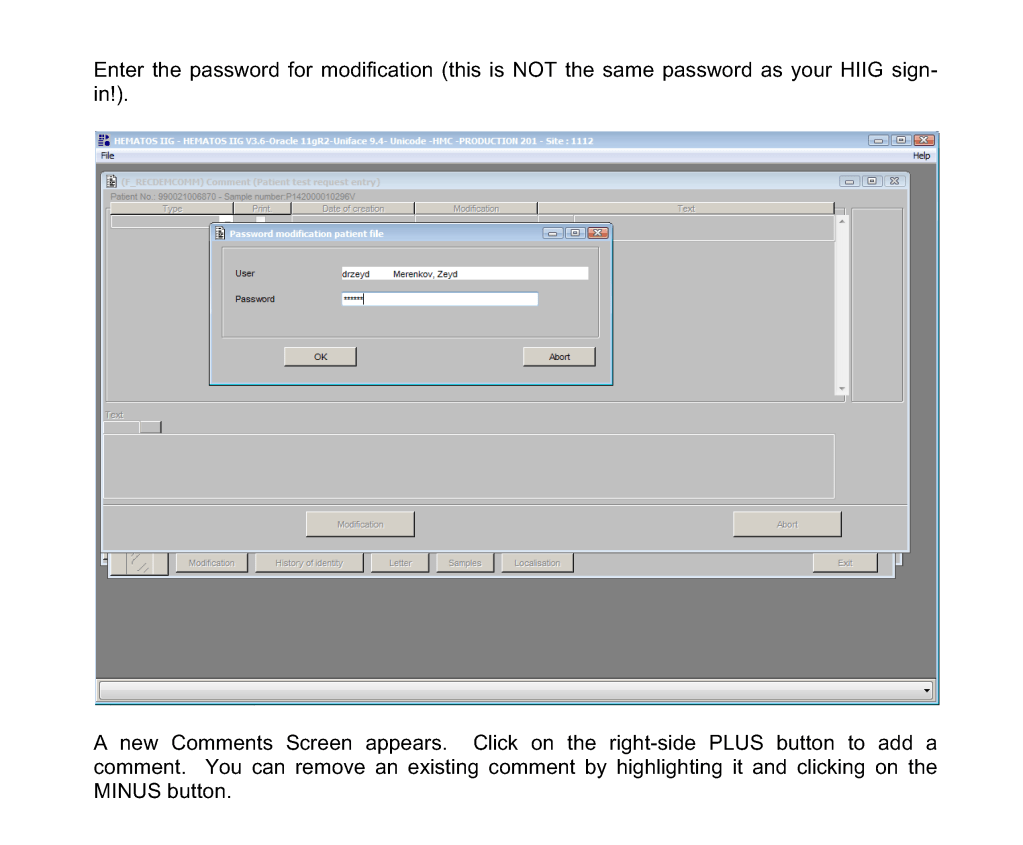
Physicians may enter any of these comment types.  Comments may be entered before or after a test is authorized/verified.  If entered after authorization, the test must be modified to accept the comment and require a special password (not the user sign-into HIIG).  Only results/examination comments are visible in the patient’s medical record.  Global, analysis, and contraindication comments are visible only in HIIG!  Donor comments are only visible in HIIG.

The presence of comments documents physician review of abnormal results as required by the various accreditation standards.

Policy:

  1. Only designated staff may enter comments.
  2. Comments entered after authorization/verification of results will modify the donor/patient record and require a special, high-level password distinctly different from the normal user password.
  3. Enter comments in the following situations:
    1. Telephone call documentation (e.g. critical values).
    2. Interpretations of donor or patient test results, transfusion reactions, etc.
    3. Instructions for the selection of specific and/or modified blood components
    4. Donor eligibility issues (e.g. donor marker testing abnormalities and disposition)
    5. Donor reactions
    6. Donor counseling documentation (e.g. donor counseled at 0930 on 24/3/14 about his abnormal result).
    7. Any special instructions to staff
    8. Any other situation where the transfusion physician/supervisor or designate determines it is desirable to enter a comment
  4. Copy all results/examination-comments and also enter then as global comments against the patient or donor record as applicable.

References:

  1. Standards for Blood Banks and Transfusion Services, Current Edition, AABB, Bethesda, MD, USA
  2. Workflows 1001-1005, Medinfo Hematos IIG, 2013-2014.

Blood Component Transport Temperature Monitoring

Principle:

Blood components must be maintained at specified temperatures to avoid hemolysis, bacterial contamination, and maintain full efficacy (e.g. coagulation factor activity.)

Policy:

  1. Freshly collected whole blood for blood component preparation must be kept between 20-24C if  platelets are to be made.  Otherwise, it must be maintained between 1 and 10 C.
  2. Prepared RBCs and thawed plasma must be transported between 1 and 10 C.
  3. Platelets (pools and apheresis), thawed cryoprecipitate, and granulocyte concentrate must be transported at 20-24 C.
  4. Frozen components (frozen RBCs, FFP, FP24, cryoprecipitate) must be kept frozen during transport.
  5. There must be an appropriate means of documenting that the proper temperature was maintained.  Examples of compliance may include:
    1. LCD stickers that change color if the component goes outside the selected temperature range.
    2. Digital temperature recording systems—Examples:
      1. TempTale ® or other temperature recording devices (added to a transport container without a temperature-controlled container)
      2. Temperature controlled transport containers with integral recording systems
      3. The recording session for each transport episode should be downloaded, reviewed and saved.
  6. If the temperature goes outside the specified temperature range, the components cannot be used for transfusion or manufacture.
  7. All devices must be validated to meet their specified temperature-recording capabilities before being used.
  8. Specific SOPs for the use of the selected monitoring devices must be prepared and in use.

Note the different temperature ranges for refrigerated components stored in the blood bank (1-6C) versus transport (1-10C).

References:

Section 5.6.5, Standards for Blood Banks and Transfusion Services, Current Edition, AABB, Bethesda, MD, USA

DAT-Positive Hemolytic Anemias

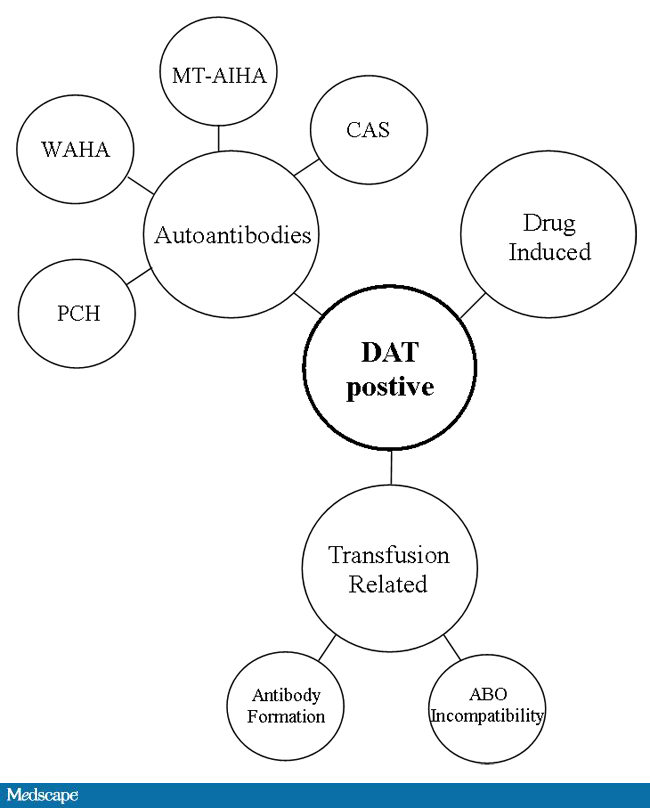
This is a helpful Medscape diagram showing causes of direct-antiglobulin-test-positive hemolytic anemias.  Note that not all cases of the conditions may consistently be DAT-positive, especially the ones that fix complement.  Again, a negative result means non-detected, not necessarily not present.

In my own test algorithm, if hemolysis is suspected, I would perform monospecific IgG and C3 DATs.  I might also include a special DAT card detecting both C3c and C3d and heavy-chains mu (IgM) and alpha (IgA) if the initial DAT is negative.  C3c positivity would tell me that active complement activation is occurring.

Handling Nonspecific Antibody Panel Reactions

Note: this is an updated version of a previous post.

Anyone reviewing antibody panels, especially in the Middle East/Gulf region, encounters many panels for which no antibody specificity is identified.  As a transfusion medicine physician who often got called during the night for release of RBCs for patients with “nonspecific” pattern, this was a big headache.

Is it “nonspecific” because there isn’t a clinically significant antibody OR the technologist did not perform the testing or its interpretation correctly?  Does it need further testing?  Do I release blood components at this time?

In general, I do not routinely use polyspecific AHG for routine testing.  My first choice is for a gamma heavy-chain specific AHG but this is not available for gels or glass beads.  Then, I select the IgG AHG even though it does react with light chains and can detect IgM cold antibody reactions.

In general, with nonspecific reactions, I recommend the following:

  1. Repeat with a gamma heavy-chain specific reagent if the initial workup was made with another type of AHG (polyspecific or whole molecule IgG).
  2. Always do enzyme panels, sometimes with both papain and ficin reagents:  many Rh antibodies are optimally detected only at enzyme (example:  R1R1 patient with only anti-E at AHG phase but anti-E and anti-c at enzyme).
  3. Perform an extended Rh/Kell/Duffy/Kidd/Kell/MNSs/P1 phenotype and specifically check for those negative typing results AND for dosage (could the antibody only be detected in homozygous cells like many anti-M are?).
  4. Perform classical room temperature, 37C, and finally AHG phase testing.  Routinely I do not do this since antibodies not detected at 37C are unlikely to be clinically significant.  Sometimes, the AHG phase reactivity is a cold antibody of high-thermal amplitude.
  5. If the Jka or Jkb antigen typings are negative, repeat using a polyspecific AHG reagent.
  6. Use additional panels from multiple manufacturers.  Some reagents detect more nonspecific reactions than others.
  7. Try other potentiators than LISS such as PEG.
  8. Check the outdate of the panel and reagents:  if less than 1 week remaining, consider repeating with fresh reagents and getting a new patient sample.

Finally, if you still cannot define the specificity, consider repeating the testing after several days.  Maybe it is a newly emerging or an anamnestic response.

I emphasize as a physician, I do not care to see all possible antibodies present in the specimen but rather only those likely to be clinically significant.  In general, there is a shortage of labor in the blood banks so I want to eliminate unnecessary work.