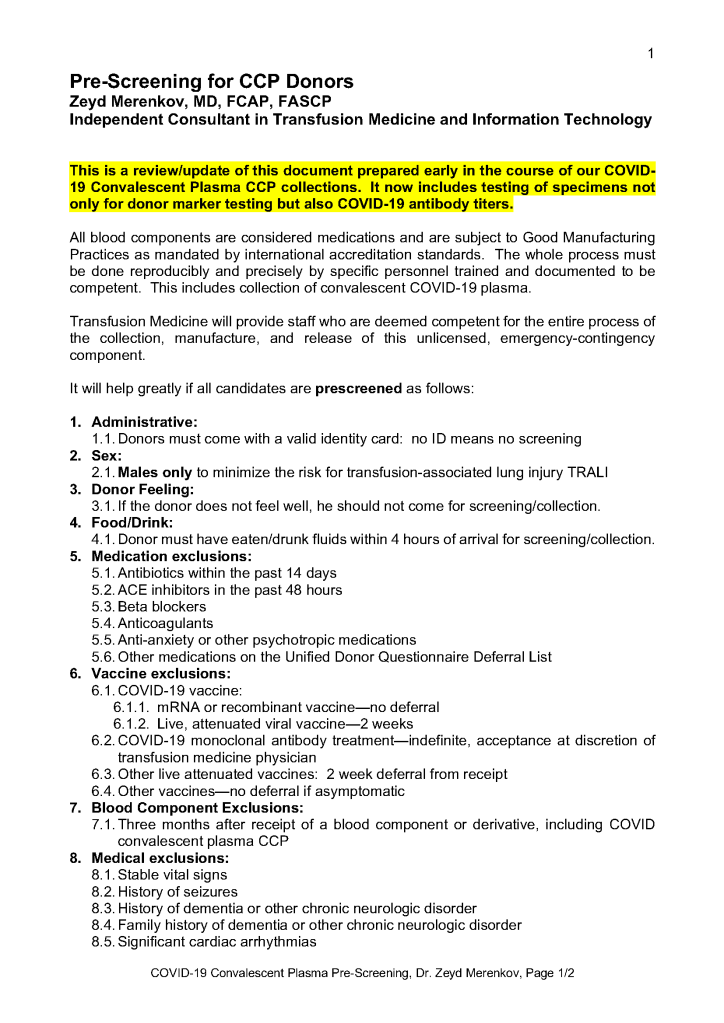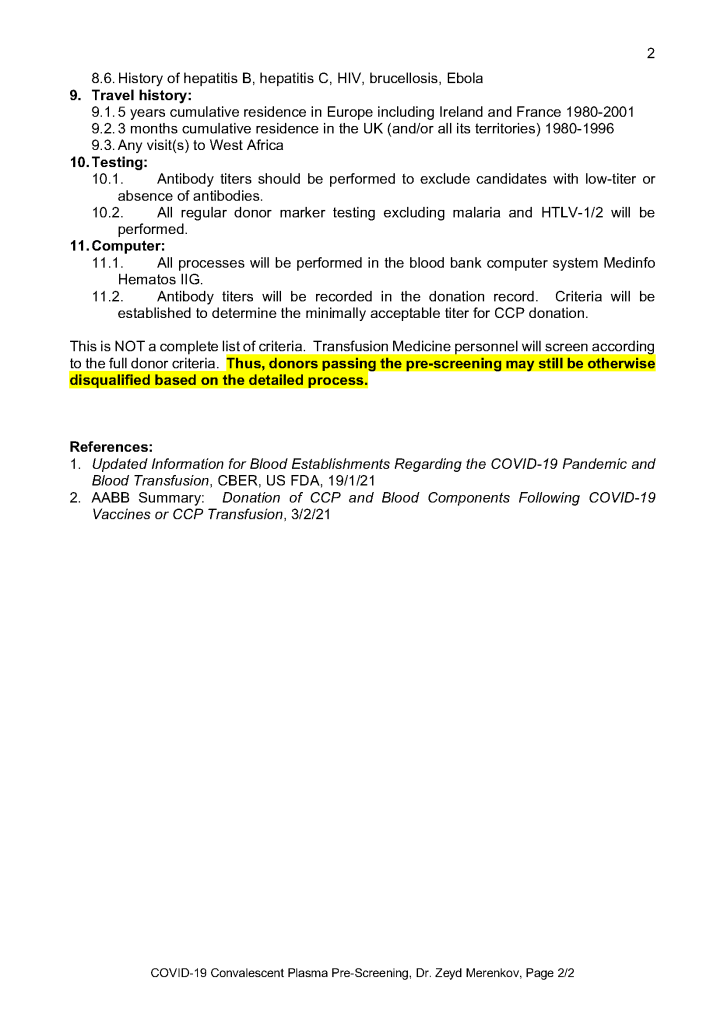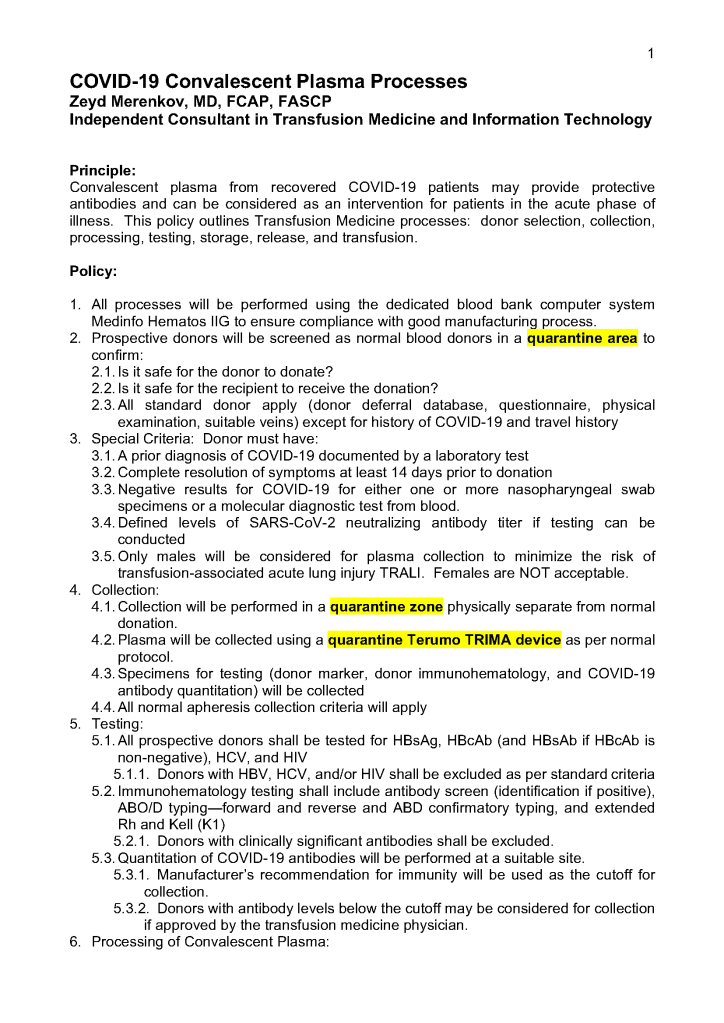
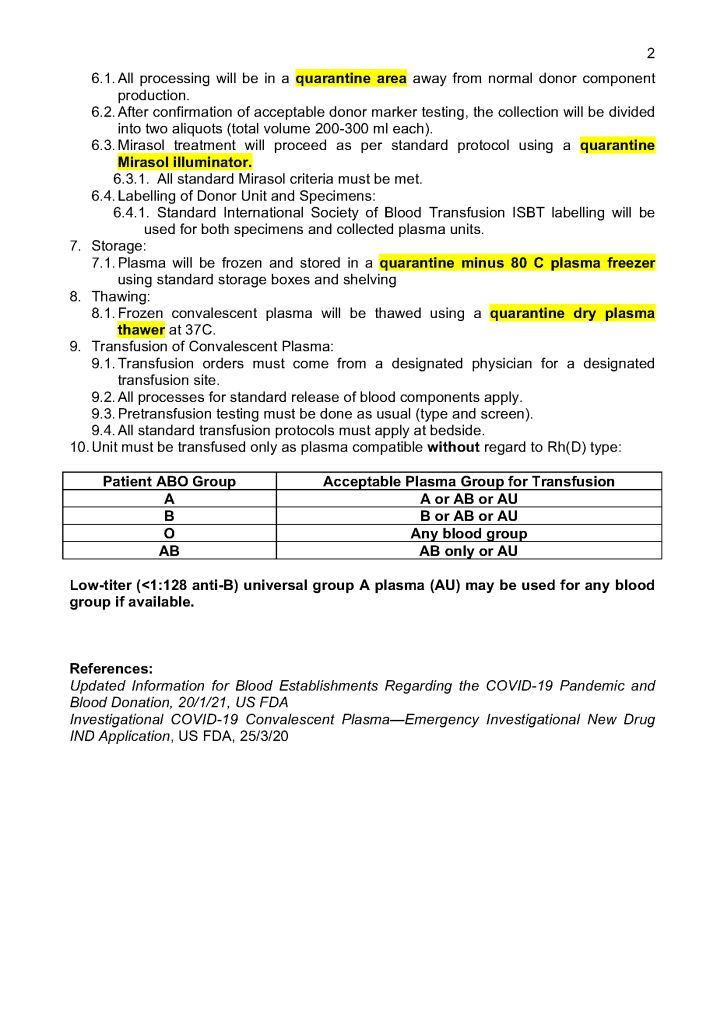

Processes and Software Building 24: Data Entry Verification

Principle:

This policy outlines steps taken to minimize the risk of data entry errors and is based on a dualistic approach:  review of results by a senior technologist and/or supervisor and various computer safeguards built into the Medinfo Hematos IIG blood bank computer HIIG system.  This policy also discusses the verification (here called authorization) and purge processes of HIIG.

Policy:

  1. Review by senior technical, supervisory, or transfusion medical staff:
    1. Designated test procedures require review by a second technologist before authorization.
    2. Complex immunohematology testing and specimens showing aberrant results (e.g. ABO/D discrepancies) are reviewed by the supervisors or designates and ultimately a transfusion medicine physician before authorization.
  2. Computer system HIIG rules:
    1. Privileges:
      1. System restricts which staff can perform specific tests
    2. Patient/donor identity:
      1. System asks end-users to verify patient/donor identity before starting any access to the patient/donor record.
      2. System performs historical database checking and flags any inconsistencies (e.g. historical ABO/D typing differences, etc.)
    3. Testing:
      1. Only selected staff have privileges to authorize or purge.
      2. ABO/D testing algorithms require entry of reactions, not interpretation of results and are compared to a truth table.
        1. Aberrant results require special review before ABO/D typing results can be authorized/purged.
        2. D-controls must be negative to allow D typing results to be authorized for liquid D-typing reagents.
      3. DAT results require appropriate controls to meet truth-table criteria.
      4. Eluates require last wash to be negative before authorization
    4. Blood components:
      1. Selection of RBC or plasma units requires two independent sample determinations within 72 hours of each other.
      2. ABO-incompatible RBC or FFP/FP24 transfusions are not allowed.
      3. Donors with any detectable antibodies are permanently deferred.
      4. Depending on the patient’s antibody history, release of RBC units may require antigen-matched units.  Examples:
        1. Mandatory matching (only antigen negative matched units allowed—no antigen positive or antigen-untyped units):  Antibodies against H, D, c, K, k, Kpa, Kpb, Jsa, Jsb, Jka, Jkb antigens, anti-PP1Pk
        2. Priority matching (incompatible or untested can be approved by a transfusion medicine physician):  C,E, e, Fya, Fyb, M, S, s
        3. Antigen matching not required:  Lea, Leb, N
      5. Least-incompatible crossmatch require special authorization to release
      6. Protocols to force irradiation or other modified components can be setup in HIIG.
    5. Donors:
      1. Donor tests have same criteria as the same test used in patient testing for controls, etc.
      2. Donor demographics are read directly from the Ministry of Interior database—no manual entry (bar code only used).

References:

  1. Workflows for Hematos IIG (1001 through 1005), 2013
  2. Standards for Blood Banks and Transfusion Services, Current Edition, AABB, Bethesda, MD, USA
  3. Guidelines to the Preparation, Use, and Quality Assurance of Blood Components, European Committee (Partial Agreement) on Blood Transfusion (CD-P-TS), Current Edition

Summary of Accomplishments at HMC 2011-2020

I resigned from HMC on 16/4/20.  Here are a set of my major accomplishments during that period. None of my work after this date has any relationship to HMC.

2011

Established automated component production using Atreus technology, plasma and platelet pathogen inactivation (Mirasol)—made HMC component production Good Manufacturing System GMP compliant

Adopted non-PCR-based NAT technology (Grifols/Novartis Tigress) and Qatar becomes world reference site for this

Based on the above, Qatar can now completely process all whole blood into blood components (red cells, platelets, and plasma) in as little as 5 hours from collection!

2011-2020:

Prepared policies and procedures for the hospital blood banks/transfusion services, blood donor center, therapeutic apheresis, and laboratory information systems to bring HMC in compliance with the Council of Europe, international AABB, and other standards.  I customized our own standards for our local needs based on them.

2012-2013

Implemented custom build of the multilingual blood bank computer system (Medinfo) for both patient and donor services, including development of interfaces to all production equipment including Atreus and Mirasol (world’s first) and a direct link to Ministry of the Interior to obtain patient demographics in English and Arabic—Qatar became the world’s first site to combine fully-interfaced, automated component production with pathogen inactivation:  Qatar becomes world reference site for this.

2013-2014

Built, validated, and implemented laboratory build of hospital information system, Cerner Millennium

2015

Replaced and updated Atreus with Reveos automated component production to allow faster throughput and capacity with a full bidirectional interface (world’s first), introduced platelet-additive solution PAS with pathogen inactivation (Mirasol)—Medinfo interfaces updated to Reveos for all equipment:  this doubles the capacity to process whole blood into components using the same physical space

2015-2019

Updated dedicated blood bank software Medinfo Hematos IIG by several versions using Division Head, LIS, and internally trained Super Users—at great cost savings to HMC by not using outside consultants (e.g. Dell Consulting)

2019

Established column absorption technology using Terumo Optia therapeutic apheresis machine for treatment of ABO-incompatible renal transplants:  I validated using the Ortho Vision MAX to perform ABO antibody titers for this system and correlated it with the reference method at Karolinska Institutet in Stockholm (manual gel) to bring rapid throughput and labor savings—Qatar being the first-site in the world to do this.  We saved money by using the same apheresis machine to use this column absorption technology (no need for second machine to use the columns)

2020

Expedited setup (two weeks total) of COVID-19 convalescent plasma production, initially manual and then fully integrated into the Medinfo computer system as a customized module with separate quarantine collection, production, and transfusion service functions

Other:

I was awarded two HMC Star of Excellence Awards:

2013—Liver Transplantation Transfusion Support

2019—ABO-Incompatible Renal Transplantation Support

TRALI/TACO Policy and Process

The following was my process at HMC Doha for TRALI/TACO.  It includes proactive measures to minimize the risk of TACO and the procedure for surveillance and workup of such cases.

In the Medinfo blood bank computer system, we did not prepare plasma or platelets from female donors.  If approved by a transfusion medicine physician, a manual override was made in exceptional cases (e.g. mother donating platelets for her child in neonatal alloimmune thrombocytopenia cases.).  In some other countries, they do HLA antibody testing to allow females to donate platelets.

I emphasize that the diagnosis of TRALI and/or TACO is clinical, but the transfusion medicine physicians must always consider the possibility whenever there is an adverse effect associated with progressive respiratory distress.

Principle:

Since TACO and TRALI are major causes of serious adverse effects from transfusions, this policy outlines actions being pro-actively taken to mitigate the risks in Transfusion Medicine.  TACO and TRALI may be difficult to distinguish so this policy addresses both.

Objectives:

  1. Implement measures to minimize TRALI and TACO
  2. Track cases of transfusion-associated acute lung injury TRALI and TACO
  3. Develop algorithms for suspected cases of TRALI and TACO

Tracking:

  1. All transfusion reactions are reviewed by the Division Head, Transfusion Medicine or his designee on a STAT basis, 24 hours a day, 7 days a week
  2. Any reactions with respiratory distress are reported as “rule-out TRALI/TAC” to the clinician
  3. All transfusion reactions are recorded in Medinfo HIIG for tracking and reporting.

Risk Management:

  1. Female blood donors routinely are only used for making RBC components (i.e. not for FFP, cryoprecipitate, or platelets).
  2. RBCs are in additive solution SAGM so only 35 ml residual plasma is present per unit.
  3. All platelet components are in platelet additive solution with only 35 ml residual plasma per component.
  4. All platelets and plasma are pathogen-inactivated which may reduce the risk of TRALI.
  5. If the female has a rare phenotype (e.g. IgA deficient, rare platelet antigen typing) she will only be considered for a directed donation of platelets or FFP/cryoprecipitate for that special-needs patient if she does not have HLA antibodies (anti-human-neutrophil antibody testing to be implemented in such cases when it is available on-site).
  6. Solvent-detergent treated plasma SDP is available for patients with a confirmed or suspected history of TRALI.
  7. All cellular components are leukodepleted (< 1E6 residual WBCs/component as per CE Standards) in the blood bank at the time of production.
  8. Blood bank computer system Medinfo Hematos IIG limits the number of components released at any one time (excluding emergencies).

Notifications:

  1. Transfusion Medicine TM will notify the outside blood supplier of any units implicated or associated with TRALI.
  2. A transfusion medicine physician will notify the most responsible physician of any workup results suggesting the possibility of TRALI/TACO.
  3. TM will notify all donors of their disqualification from blood donation based on the following algorithm.

Algorithm for Diagnosis and Management of Donors:

  1. Evaluation of the Donor and Recipient in Suspected TRALI:
    1. The medical technologist will process all transfusion reactions as STAT and immediately contact the TMS Director or physician designate with the results.
    2. The medical technologist will convey information to the TMS Director or designate about ALL blood components issued recently, especially in the last 6 hours prior to the event.
    3. The TMS Director or designate will specifically check if there is evidence of respiratory distress listed on the transfusion reaction investigation form.  If so, he will contact the responsible clinician immediately for further assessment.
    4. If the signs and symptoms suggest ALI (see Table 1 above), the TMS Director or designate will inquiry about the left atrial pressure to rule out left-sided heart failure as a cause for the pulmonary edema.
    5. Based on the clinical information, the TMS Director or designate may elect to order any or all of the following tests if available:
      1. Quarantine all remaining components from possibly implicated/associated donor(s) while the workup is in progress.
      2. Recipient HLA, platelet, and/or granulocyte antibody screen, or a crossmatch between recipient plasma/serum and donor leukocytes
      3. Donor HLA and/or platelet antibody screen, granulocyte antibody screen, crossmatch donor plasma/serum and recipient leukocytes, inter-donor crossmatch between plasma/serum of one and leukocytes of another donor.
      4. The usual algorithm to be followed is as follows:
        1. Consult patient medical record and clinical care physician to determine if the diagnosis of TRALI is likely.
        2. Check all components transfused within 6 hours prior to the onset of symptoms.’
        3. Immediately quarantine other components from the same donations and contact outside blood suppliers if indicated.
        4. Obtain donor antibody testing of only highly suspect cases, based on the clinical manifestation and initial diagnostic tests:
          1. If multiple units transfused within hours, only investigate components donated by multiparous females and/or last two units transfused.
          2. First test for presence of HLA class I and class II antibodies in donor components.
          3. If antibody positive, HLA type recipient’s lymphocytes to detect corresponding antigen or perform crossmatch with donor plasma and recipient lymphocytes.
          4. If HLA antibody negative, proceed with neutrophil-specific antibody testing of donor plasma.
        5. If matching antigen-antibody identified or if positive crossmatch, defer implicated donor immediately.
        6. If no such concordance found or if crossmatch is negative, donor eligible to continue donating.
        7. If no antibodies found in donor plasma, test recipient plasma for antibodies to HLA class I and II antigens:
          1. If recipient antibody positive, HLA type donor’s lymphocytes to detect corresponding antigen or perform crossmatch with recipient plasma and donor lymphocytes.
          2. If recipient HLA antibody negative, proceed with neutrophil-specific antibody testing of recipient plasma
  2. Donor Disposition:
    1. For donors implicated in TRALI or associated with multiple events of TRALI, one or more of the following options may be selected at the discretion of the Head, Transfusion Medicine or designate:
      1. Defer donor from donation
      2. Divert plasma for fractionation or discard plasma from future whole blood donations from that Blood and Apheresis Donor Main Questionnaire
      3. Manufacture no platelet or plasma components from that donor
      4. Wash or freeze/deglycerolize RBCs from that donor
      5. Permanently defer the donor from future plasmapheresis or plateletpheresis donations
      6. Evaluate the previous donations from that Blood and Apheresis Donor Main Questionnaire  Avoid giving the same recipient future transfusions from the same donor implicated in TRALI
      7. If the implicated unit(s) are from another facility, that blood center should be notified to initiate a workup for possible TRALI in the donor.
  3. Interpretation:
    1. The diagnosis of TRALI is not clear-cut:
      1. The AABB interim standard does not apply.  It is at the discretion of the TMS Director or designate whether to conduct donor assessments.
    2. The donor is associated with a single event of TRALI:
      1. This applies where the diagnosis of TRALI has been established based on clinical and radiographic findings:
      2. Each donor from each and every component associated with TRALI must be identified and traced.
      3. Co-components from the current donation and components from previous donations should be evaluated for recipient complications.
      4. The donors medical history should be evaluated for previous pregnancies, transfusions or other events that may have resulted in antibody development.
      5. Based on the results of this investigation, the Head, Transfusion Medicine or designate should decide:
        1. Whether to perform laboratory testing
        2. Whether to discard the remaining blood components from the donor
        3. Whether to allow or indefinitely defer the donor
    3. The donor is associated with multiple events of TRALI:
      1. This applies where the diagnosis of TRALI has been established based on clinical and radiographic findings:
      2. Each donor from each and every component associated with TRALI must be identified and traced.
      3. Co-components from the current donation and components from previous donations should be evaluated for recipient complications.
      4. The donors medical history should be evaluated for previous pregnancies, transfusions or other events that may have resulted in antibody development.
      5. Based on the results of this investigation, the TMS Director or designate should decide:
        1. Whether to perform laboratory testing
        2. Whether to discard the remaining blood components from the donor
        3. Whether to allow or indefinitely defer the donor
    4. Triage based on laboratory testing for TRALI:
      1. The donor associated with TRALI is antibody-negative:
        1. The donor may continue to donate.
      2. The donor associated with TRALI is antibody-positive but the specificity is NOT directed against a recipient antigen by either antigen typing or crossmatching (i.e. the donor is NOT implicated in TRALI—see definition above):
        1. Indefinitely defer the donor from all donations OR
        2. Allow donation of washed/frozen-deglycerolized RBCs only
      3. The donor is implicated in TRALI (see definition above):
        1. Indefinitely defer the donor from all donations OR
        2. Allow donation of washed/frozen-deglycerolized RBCs only
      4. The recipient has antibodies implicated in TRALI (determined by crossmatch or antibodies directed against specific HLA class I, HLA class 2, and/or human neutrophil antigens):
        1. The recipient must receive leukodepleted blood components
    5. TACO
      1. TACO is due to cardiac overload.  Our mitigations are to restrict release of the number of components outside emergency events.

References:

  1. AABB Association Bulletin 14-02, TRALI, Bethesda, MD, USA
  2. Han Y. and Goldfinger D., Transfusion Medicine TM 07-5 (TM-297) Checksample, American Society for Clinical Pathology, Chicago, IL, USA. July 2007
  3. Goldman M, Webert, KE, Arnold DM, et al., Transfusion Med Rev  2005; 19:2-31.
  4. Fung YL, Goodison KA, Wong JK, Minchinton RM., Investigating Transfusion-Related Acute Lung Injury (TRALI), Intern Med J. 2003 Jul;33(7):286-90.
  5. Standards for Blood Banks and Transfusion Services, Current Edition, AABB, Bethesda, MD, USA
  6. AABB Association Bulletin #05-09, Transfusion-Associated Acute Lung Injury, 11/8/05
  7. AABB Association Bulletin #05-04, Proposed Interim Standard for Deferral of Donors Implicated in TRALI, 9/3/05.
  8. TRM.42110, CAP Transfusion Medicine Checklist, 15/6/09

Processes and Software Building: Updated Convalescent COVID-19 Plasma Production

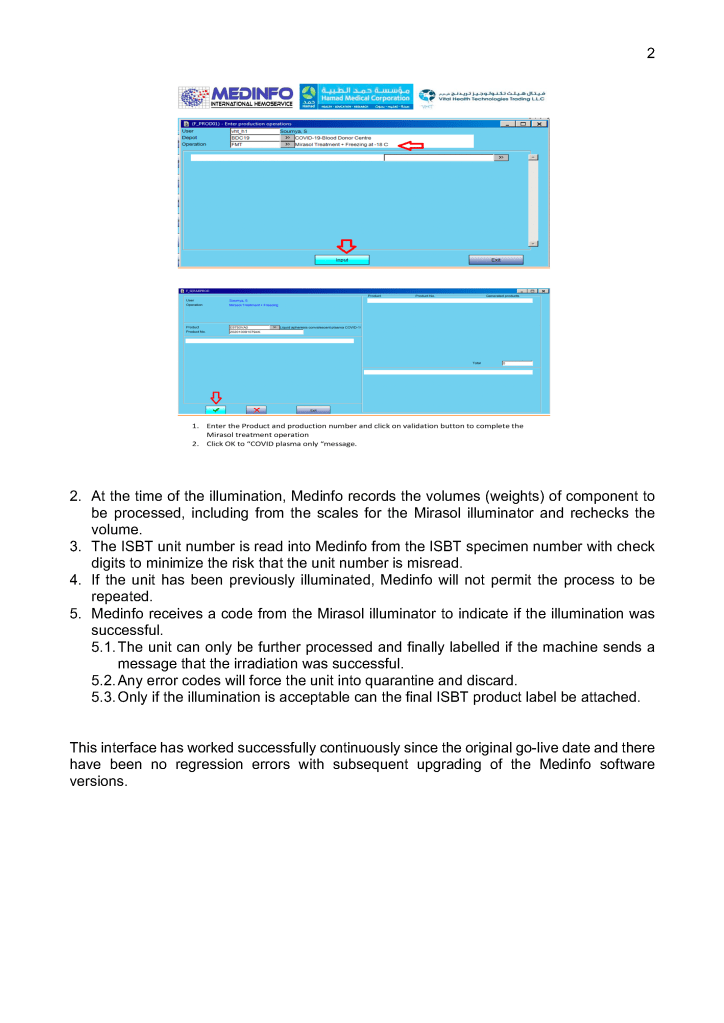
After the initial manual setup of the CCP program, the Medinfo process was set up.  The following workflow shows the production of CCP from the raw apheresis collection, including division into aliquots based on the total volume.  The plasma volumes were kept within the range for riboflavin pathogen inactivation (Mirasol).

The usual safeguards for production were also in effect for CCP.  The product could not be labelled without all criteria (donor screening, collection, marker testing) being met.  Furthermore, the inter-depot and transfusion service processes still applied.  However, all steps were done in quarantine at a location separate from the regular processes.  Also, the actual ordering and release of CCP was restricted to the quarantine hospital blood bank site.

The following outline the production process:

Autologous Transfusion and Responsibilities

This is the process I developed for HMC Doha. The Medical Director (here Head, Transfusion Medicine HTM) is actively involved in the development of policies, processes, and procedures for ALL types of autologous donation in conjunction with the National Transfusion Committee NTC.

  1. Predeposit:  Directly under the control of the HTM for all aspects:  policies, procedures, and direct performance of the procedures, including annual review of criteria
  2. Perioperative:  HTM involved in conjunction with Surgery and Anesthesia through the NTC.
  3. Intraoperative:  HTM involved in conjunction with Surgery and Anesthesia through the NTC.
  4. Postoperative:  HTM involved in conjunction with Surgery and Anesthesia through the NTC.

Background:

There are four basic types of autologous transfusion:  preoperative, perioperative hemodilution, intraoperative, and postoperative drainage/collection.  The use of all of the above techniques can significantly decrease the need for homologous blood and as an added benefit reduce the risk of the disease transmission and immunosuppressive effects of such homologous transfusions.

Preoperative collection can make available packed red blood cells, whole blood, platelets, FFP, and/or cryoprecipitate.  However, at most two units of blood per week can be collected.  RBC’s can be stored for up to 42 days in the liquid state, frozen RBC’s up to ten years, platelets up to five days, and fresh frozen plasma and cryoprecipitate up to one year.  The last collection cannot be less than 72 hours prior to the surgery time.  Units can be collected as long as the patient’s hematocrit remains above 33%.  Supplemental iron and erythropoietin can increase the number of units harvested.  The biggest obstacle to using this service is the coordination of the patient scheduling for this procedure.  The blood bank does not have the resources to prospectively analyze the surgical scheduling and make the various appointments, contact the attending physician, etc.  Thus, this service is vastly underutilized.

PHD or Perioperative hemodilution (also called acute normovolemic hemodilution) is useful in cases when the anticipated blood loss is at least one liter and the initial hematocrit is at least 34%.  This includes essentially all types of surgery, but in particular cardiac, vascular, orthopedic, and urologic cases.  The patient’s hematocrit Hct. is lowered to the range of 20-25% and the blood is replaced by crystalloid in a ratio of 3:1–i.e. three times as much fluid as blood, or in the case of colloid replacement, a 1:1 ratio of colloid plus 0.5 to 1.0 ml. of crystalloid.  Crystalloid has the advantage of being readily removed by diuretic use.  However, this technique should not be undertaken when vascular access is inadequate or appropriate monitoring devices are lacking.  The physician performing PHD must be familiar with the compensatory mechanisms normally invoked when the hemoglobin is acutely lowered.

Another new twist to PHD is the perioperative collection of platelets by a special attachment to a cell-saving machine.  This could allow collection of a typical apheresis load, about 6 to 10 units of fresh platelets for potential use.  There are currently studies underway to determine if this has particular clinical advantages to warrant the additional cost.

Intraoperative salvage may be performed with a number of canister or automated devices.  The latter is usually used when there are large volumes (usually 3 or more units) of blood to be salvaged.  Depending on the body site, the recovered material is at least filtered and may or may not be washed.  Care must be taken to collect the blood at a low suction rate and with minimal turbulence to minimize hemolysis.

Postoperative drainage collection of certain sites such as post-knee replacement surgery or chest wounds involves a canister collection device.  This blood may or may not be filtered before reinfusion.

Note that perioperative and intraoperative material can only be transfused up to six or eight hours at room temperature or 24 hours if refrigerated at 1-6 degrees (depending on the method used) post collection to minimize the risk of infection.  Intraoperative collection is usually contraindicated in cases of cancer and if the bowel has been violated.

Other Issues:

The transfusion criteria for autologous blood is the same as for allogeneic units. If you wouldn’t transfuse if no autologous blood were available, you shouldn’t transfuse because you have it!

The same compatibility testing algorithm applies both the autologous and allogeneic units.

Policy:

  1. Scope:
    1. Predeposit collection of Whole Blood/RBCs and plasma is under the authority of Transfusion Medicine.
    2. Perioperative hemodilution, intraoperative cell salvage, and postoperative drainage collection is under the authority of the National Transfusion Committee in conjunction with the Departments of Surgery and Anesthesia.
      1. Head, Transfusion Medicine will liaise with the clinical departments as needed.
      2. Transfusion Medicine may provide blood bags for perioperative hemodilution upon request.
    3. Transfusion Medicine does not receive autologous collections—perioperative, intraoperative, or postoperative drainage collection.
  2. Processes directly under Transfusion Medicine authority:
    1. Autologous collection of whole blood/RBCs (predeposit) for elective surgeries will be considered especially if the patient has a dangerous antibody for which antigen-matched units cannot be easily obtained (e.g. anti-k (cellano), anti-PP1Pk (anti-Tja), anti-H (Bombay and Para-Bombay phenotypes).
    2. Autologous collection of plasma may be considered for patients with IgA deficiency with documented specific anti-IgA antibodies.
    3. Autologous collection of platelets may be considered for patients with anti-platelet antibodies and platelet refractoriness.
    4. Other requests will be reviewed by the Head, Transfusion Medicine or designate.
    5. The final decision to proceed with items 2.1 and 2.2 will be made by the Head, Transfusion Medicine or his designate.
  3. Process for Transfusion Medicine Autologous Procedures
    1. The requesting physician shall provide a written order to the Blood Donor Center.
    2. The request will be reviewed by a transfusion medicine physician.
    3. If rejected, the requesting physician will be notified with the reason for the rejection.
    4. If approved, the donor shall be screened by the usual donation process except:
      1. Hgb >= 11 g/dl will be acceptable for whole blood collection.
      2. Females may also donate autologous plasma.
      3. The last autologous donation will be at least 72 hours before the elective procedure.
    5. Marker testing:  Components from autologous donors with confirmed positive cases of HBV, HCV, HIV, syphilis, malaria, or HTLV infection will NOT be used for autologous donation and will be destroyed.
    6. Computer:  Autologous collections will be entered as specifically as such in the Medinfo  Hematos IIG blood bank computer system and be labeled as autologous in their corresponding ISBT labels.
    7. Crossover of autologous units requires review and approval by a transfusion medicine physician–only those cases where the donor met the standard donor criteria will be considered.
    8. The transfusion criteria for autologous units shall be the same as for homologous blood.
    9. Both autologous and allogeneic units will follow the same compatibility testing algorithm.

References:

  1. Standards for Blood Banks and Transfusion Services, 29th Edition, AABB, Bethesda, MD, USA, 2014
  2. TRM.41600 CAP Checklist Standard, 2015

Processes and Software Building 9: Enforcing GMP

Enforcing Good Manufacturing Process Through A Dedicated Blood Bank Software

Blood components are a drug and like medications must be consistently produced and follow Good Manufacturing Practices GMP.  The following system that I set up for HMC Doha Qatar blood collection and processing is an example of the impact of Medinfo donor software on enhancing our safety and GMP compliance.  In earlier posts, I provided the Medinfo flowcharts for these processes.

This is an outline of the processes I built in conjunction with the Medinfo software engineers:

  1. Registration:
    1. Read the barcode on the specified picture ID (usually a Qatar Residency/Citizen card).
      1. Retrieve the prospective donor’s demographics in English and Arabic from the Ministry of Interior.
      2. Check the donor deferral database (Qatar has only one), defer if contraindicated according to the rules built into Medinfo.
    2. Choose the type of donation (apheresis or whole blood;  volunteer, directed, or autologous).
    3. Print a consent form and ISBT specimen labels for the donation.
  2. Pre-Collection Screening:
    1. Perform the donor questionnaire on-line in English or Arabic:  this has contingent fields and could exceed 60 questions depending on the answers provided.
    2. Proceed to donor physical exam (vital signs and arm check).
  3. Collection:
    1. Collect the whole blood or apheresis component and specimen tubes:  determine if the collection meets the volume requirement and time limit.
    2. Send the specimens for donor marker and donor immunohematology testing.
    3. Send the raw components for processing.
  4. Donor Marker Testing:
    1. Perform NAT, EIA, and LIA marker testing according to algorithms defined in Medinfo.
    2. Perform follow-up reflex marker testing according to Medinfo criteria.
  5. Component Processing:
    1. Process the raw whole blood in the Reveos machine into PRBCs, leukodepleted plasma, and buffy coat platelets.
    2. Filter/leukodeplete the RBCs.
    3. If marker test results pass:
      1. Pool the buffy coat platelets according to the platelet yield index for a yield of 2.4E11/dose.
      2. Add platelet additive solution PAS and pathogen inactivate (Mirasol).
      3. Pathogen inactivate the whole-blood-derived plasma.
      4. Divide the apheresis plasma into 200-250 ml aliquots and pathogen inactivate.
    4. Divide the apheresis platelets to provide a yield of 2.4E11 in each dose, then pathogen-inactivate (PAS had been added at the time of the apheresis collection).
  6. Donor Immunohematology Testing:
    1. Perform ABO/D testing and antibody screen (identification if positive):
    2. If antibody screening positive, discard the component.
      1. If ABO discrepancy, send for manual review and approval, otherwise discard.
  7. Labelling, Storage, and Transfer:
    1. If all criteria were met, attach the final ISBT label (this can only be printed based on the acceptance of each component).
    2. Place the components into storage (37C, 1-6C, or <= minus 18C).
    3. Distribute to the hospital blood banks using Inter-Depot Transfer function.

I emphasize that only if all criteria across all areas pass is the final ISBT label printed.  Medinfo is not a label printing program.  It enforces the rules ruthlessly.  My technical staff tell me that it is merciless—as it should be for patient safety.

Attachments:  None—please refer to earlier posts regarding collection, processing, donor testing, and inter-depot transfer.

28/6/20

Processes and Software Building 8: Reveos and Mirasol

Automated Component Processing:  Reveos and Mirasol Pathogen-Inactivation

The production instruments have more complicated interfaces than the testing equipment discussed in the previous post:

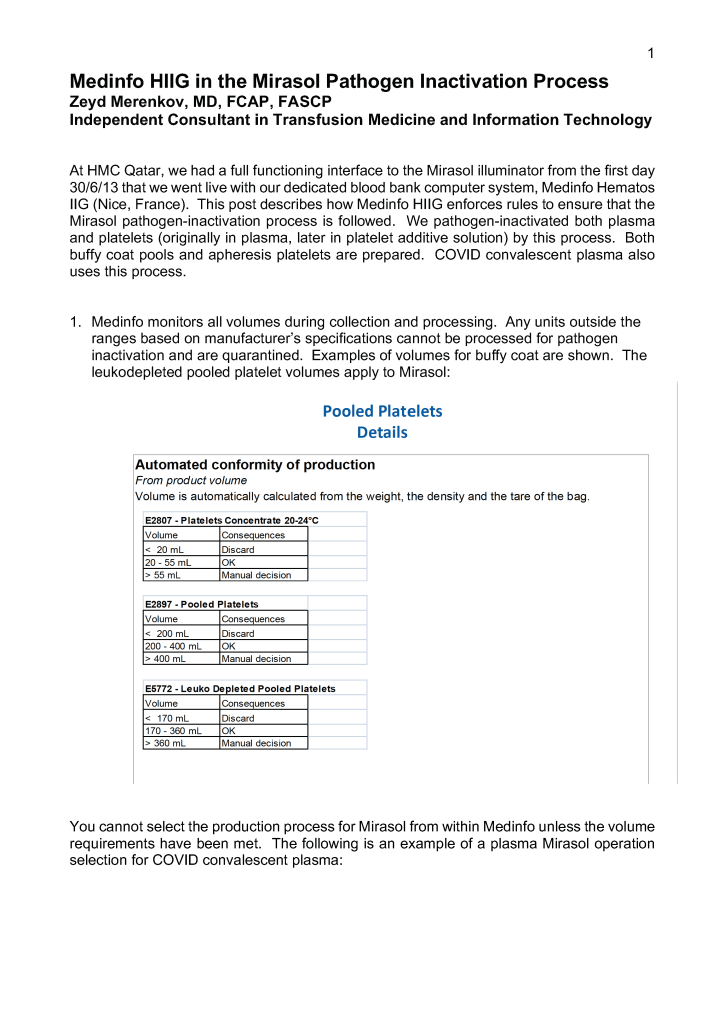
In the collection area (on-site or remote), the cvolume of the whole blood and collection time are recorded in Medinfo and based on the rules, production may only occur within specified volume and collection time.  Otherwise, Medinfo will block further processing.

The ISBT unit number of the whole blood units are read by the Reveos.  Only those units passing the collection criteria will proceed to separation.

In about 20 minutes, the Reveos machine will simultaneously process four units of whole blood into packed RBCs, leukodepleted plasma, buffy coat platelets, and residual buffy coat.  The volumes of the RBCs, plasma, and platelets are recorded in Reveos.  For the platelets, the platelet yield index is also provided.

Within Medinfo, these parameters are compared to criteria of acceptability according to the manufacturer.  Volumes for the platelets and plasma must be within certain ranges to permit pooling and pathogen inactivation and additive solution.  Medinfo will not permit these subsequent procedures if the values are out of range and the intermediate components will be discarded.

Here is a sample of Reveos acceptable ranges for component volumes:

E4207 – Whole Blood CPD 450 mL

Volume Consequences

< 400 mL Discard

400 – 500 mL OK

> 500 mL Discard

E5259 – Leukodepleted Packed Red Blood Cells

Volume Consequences

< 230 mL Discard

230 – 330 mL OK

> 330 mL Discard

E2807 – Platelets Concentrate 20-24°C

Volume Consequences

< 20 mL Discard

20 – 55 mL OK

> 55 mL Manual decision

E2555 – FP24:  Plasma Frozen <= 24h

Volume Consequences

< 170 mL Discard

170 – 360 mL OK

> 360 mL Manual decision

All these production parameters are permanently stored in Medinfo as part of the production record of that unit.  The actual location (bucket) of the whole blood unit in the Reveos is also available.

RBCs are manually leukodepleted and the final volumes recorded in Medinfo based on weight.  Based on the platelet yield index, platelets are pooled and the final volume recorded.   Those permissible volumes are next treated with platelet additive solution PAS and then pathogen inactivated.  The acceptable volumes are based on the process used, e.g. platelets in plasma versus platelets in PAS.

How a sophisticated blood bank software like Medinfo enforces good manufacturing process at all stage of production will be a future topic.

To Be Continued:

26/6/20

Manual CCP Plasmapheresis Collection

Principle:

Due to the pandemic, we will initially MANUALLY collect an experimental, investigational-use-only plasma product from apheresis donors and treat it with Mirasol.  THIS IS A EMERGENCY INTERIM PROCESS UNTIL THE MEDINFO HEMATOS IIG PROCESSES ARE PREPARED AND VALIDATED.

Policy:

  1. Good Manufacturing Practice applies:
    1. Manufacturers’ recommended processes for equipment and materials usage applies.
    2. All staff engaged in these processes must be competency assessed successfully.
  2. Pre-Screening:
    1. Clinical staff will use the prescreening document to select donors for pre-donation screening.
  3. Quarantine:
    1. All processes (day 0, day 1, day 2, and product modification and release) will be done in quarantine areas SEPARATE and DISTINCT from regular Transfusion Medicine activities.  This includes:
      1. Separate space and equipment must be provided.
        1. Equipment for this project may NOT be used for regular, non-quarantine processes
    2. Non-Transfusion Medicine staff will not be permitted in operational areas.
    3. Prospective donors will not be permitted in the processing, testing, storage, or blood bank work areas.
  4. Donation Process:
    1. Day 0:  Registration, check donor deferral database, questionnaire, physical exam including arm check, and specimen collection using ISBT specimen labels
    2. Use latest manual donor questionnaire.
    3. Day 1:  Donor marker and immunohematology testing, review of results, accept or reject donor for actual plasmapheresis
    4. Day 2:  Collect manufacturer’s recommended volume of plasma (500 ml if < 80 kg, 600 ml if >= 80 kg), aliquot, pathogen-inactivate (Mirasol), freeze at minus 80C
  5. Testing:
    1. Testing will be performed with regular blood donor specimens using ISBT specimen labels
    2. Testing must be done by donor-specific processes (not those for clinical patients)
    3. Testing must be directly interfaced to Medinfo Hematos IIG donor module
  6. Processing:
    1. Aliquoting, pathogen-inactivation, and labelling may proceed if the pre-donation screening results are acceptable.
  7. Storage:
    1. Long-term in minus 80C quarantine freezer
    2. Short-term at 1-6 C just after thawing in quarantine refrigerator
    3. Standard temperature monitoring and alarms apply
  8. Labelling:
    1. The backup manual labelling process applies
    2. The ISBT specimen label will the donor unit number
      1. Outdate will be 6 years if the product is stored at -65C, 1 year if stored at -18C
  9. Product Release:
    1. Orders must be on the PAPER requisition (old Blood Bank Order Form) with a patient prescription:
      1. No orders in Cerner
    2. Thawing plasma at 37C upon receipt of order by Transfusion Medicine staff
    3. Signing out component to clinical unit by Transfusion Medicine Staff
  10. Information Technology:  Medinfo Hematos IIG customized software to be implemented as soon as possible for all processes
  11. Not covered:  Transfusion Medicine is NOT responsible for:
    1. Triage of request for convalescent plasma
    2. Pickup and transport of components

8/4/20

Blood Donation Process Overview

This is a sample Medinfo overview document for the blood collection process for HMC Doha that I designed in conjunction with Medinfo France and Medinfo Doha. This includes, registration, donor consent, questionnaire, physical examination, and collection.