Processes and Software Building 37: Donor Marker Testing–Final Comments

This series of the processes for donor marker testing has demonstrated the complexity and flexibility of designing processes.  In Medinfo, you can custom-design the criteria based on your local, national, and international requirements.  The end-user client must specify what he wants, and I reiterate:  Be careful what you ask for, you may get it.  Seek assistance if you are uncertain of what to use.

My criteria were based on several international standards, e.g. AABB, US FDA, CE, and Australian.  I strongly recommend you start with a set of standards and localize it for your needs.

For example, US FDA/AABB do not have a screening criteria for brucellosis since it is rare in their jurisdiction.  However, it is relatively common in the Middle East so I added a donor screening question for it.  International AABB does allow for variance with US FDA criteria so if you are outside the USA, embrace this.  The advantage of customizable software allows you do localize it to your needs.  A turnkey system, e.g. from the USA, may not allow such changes.

Finally, there are emerging pathogens that are constantly changing the donor criteria (e.g. SARS-CoV-2, MERS, SARS, Zika).  The software must be robust and allow rapid alteration to meet new donor screening criteria.  This is a constant uphill battle and requires a lot of time to keep up and validate any changes.

Complete Interim Policy on Marker Testing

For your reference, the following is the complete set of marker testing algorithms I used just before I left HMC Doha:

Definitions:

Positive result for EIA means S/CO ratio >= 1.0

Positive result for LIA means particular pattern of bands as defined by the manufacturer

Indeterminate result for LIA means presence of bands not meeting positive criteria

  1. Hepatitis B:
    1. HBsAg non-negative, then:
      1. HBsAg positive with HBsAg confirmatory positive, regardless of other results:  permanent deferral, refer to Infectious Disease clinic
      2. HBsAg positive with HBsAg confirmatory borderline or negative, repeat all HBV testing after 8 weeks
      3. HBsAg borderline:  repeat all HBV testing after 8 weeks
      4. HBV-DNA positive confirmed, regardless of other results:  permanent deferral, refer to Infectious Disease clinic
    2. If HBcAb positive, repeat after 8 weeks
    3. Repeat Hepatitis B Testing After 8 weeks:
      1. HBsAg positive with HBsAg confirmatory positive:  permanent deferral, refer to Infectious Disease clinic
      2. HBsAg positive with HBsAg confirmatory borderline or negative:  permanent deferral, refer to Infectious Disease clinic
      3. HBsAg borderline, permanent deferral, refer to Infectious Disease clinic
      4. HBV-DNA positive confirmed:  permanent deferral, refer to Infectious Disease clinic
      5. HBcAb positive or borderline with negative HBsAg and negative HBV-DNA:  review HBsAb level:
        1. If HBsAb level >= 100 mIU/mL (100 IU/L), donor may be reentered
        2. If HBsAb level < 100, then recommend to donor to receive booster HBV vaccine
          1. After HBV vaccine administration, retest after 30 days:
            1. If HBsAb level >= 100, donor may be reentered
            2. If HBsAb level < 100, donor is indefinitely deferred
      6. HBsAg, HBcAb, HBsAb all negative:  reenter into donor pool
  • Hepatitis C:
    • HCV-RNA positive confirmed, regardless of other HCV results:  permanent deferral, refer to Infectious Disease clinic
    • HCV-RNA borderline:  repeat all HCV testing after 6 months
    • HCV-InnoLIA positive, regardless of other HCV results:  permanent deferral, refer to Infectious Disease clinic
    • HCV-InnoLIA indeterminate:  repeat all HCV testing after 6 months
    • HCV-Ab positive, HCV-RNA negative, do HCV-InnoLIA:
      • If HCV-InnoLIA positive, permanent deferral, refer to Infectious Disease clinic
      • If HCV-InnoLIA indeterminate or negative, repeat all HCV testing after 6 months
    • Repeat Hepatitis C Testing After 6 months:
      • HCV-RNA or HCV-InnoLIA positive:  permanent deferral, refer to Infectious Disease clinic
      • HCV-RNA or HCV-InnoLIA borderline:  permanent deferral, HCV infection not confirmed
      • HCV-Ab positive or borderline without positive HCV-RNA or positive HCV-InnoLIA:  permanent deferral, HCV infection not confirmed
      • HCV-Ab negative, HCV-RNA negative, HCV-InnoLIA negative:  reenter donor into donor pool
  • HIV Testing:
    • HIV-RNA positive confirmed, regardless of other HIV results:  permanent deferral and do HIV-InnoLIA, refer to Infectious Disease clinic
    • HIV-RNA borderline:  do HIV-InnoLIA
    • HIV-InnoLIA positive, regardless of other HIV results:  refer to Infectious Disease clinic
    • HIV-InnoLIA indeterminate:  repeat all HIV testing after 8 weeks
    • HIV Ab positive with negative HIV-RNA and/or borderline/negative HIV-InnoLIA:  repeat testing after 8 weeks
    • Repeat HIV Testing After 8 Weeks:
      • HIV RNA positive and/or HIV-InnoLIA positive, regardless of other HIV results:  refer to Infectious Disease clinic
      • HIV-InnoLIA and/or HIV antibodies indeterminate:  permanent deferral, HIV infection not confirmed
      • HIV Ab negative and HIV-RNA negative and HIV-InnoLIA negative:  reenter into donor pool
  • HTLV 1/2 Testing:
    • HTLV Antibodies positive, then do HTLV-InnoLIA:
      • HTLV InnoLIA positive for HTLV-1 and/or HTLV-2:  refer to Infectious Disease clinic
      • HTLV InnoLIA indeterminate or negative, repeat HTLV Ab and HTLV InnoLIA testing after 6 months
    • Repeat HTLV Testing After 6 Months:
      • HTLV 1/2 antibodies positive, permanent deferral and do HTLV InnoLIA
      • HTLV 1/2 antibodies indeterminate,  permanent deferral and do HTLV InnoLIA
      • HTLV InnoLIA positive for HTLV-1 or HTLV-2: refer to Infectious Disease clinic
      • HTLV InnoLIA indeterminate, donor permanently deferred.
        • Issue letter HTLV-Not Confirmed
      • HTLV 1/2 Ab negative and HTLV InnoLIA negative, reenter donor.
  • Malaria Testing:
    • Defer donor if he has been in malarial endemic zone within the past 3 months
    • If travel to malarial zone > 3 months, do malarial antibody testing:
      • Malaria antibody negative:  no deferral
      • Malaria antibody positive, perform malarial antigen test:
        • Malaria antigen test positive, refer to Infectious Disease clinic—defer until 3 years after cessation of treatment
        • Malaria antigen test negative:
          • Plasma may be collected
          • RBCs and platelets must be destroyed.
        • Repeat malarial antibodies after 3 years:
          • If malarial antibody test positive, donor must not be used for RBC components but may be used for plasma production
          • If malarial antibody test negative, reenter donor for all components
    • Defer donor if he has received malarial treatment (not prophylaxis) for 3 years
      • Perform both malarial antibody and antigen testing:
        • Defer based on section 5.2
  • Syphilis Testing:
    • Syphilis Ab test positive or indeterminate:  do InnoLIA-Syphilis test
      • InnoLIA-Syphilis test positive:  permanent deferral, refer to Infectious Disease clinic
      • InnoLIA-Syphilis test borderline or negative:  defer for 1 year, then repeat all syphilis testing.
    • Repeat Syphilis Testing after 1 Year:
      • Syphilis antibody testing negative, reenter into donor pool
      • Syphilis antibody positive or borderline:  do InnoLIA-Syphilis test
        • InnoLIA-Syphilis test positive:  permanent deferral, refer to Infectious Disease clinic
        • If InnoLIA-Syphilis borderline or negative:  permanent deferral, syphilis not confirmed

References:

  1. Revised Recommendations to Reduce the Risk of Transfusion-Transmitted Malaria, Guidance for the Industry, US Department of Health and Human Services, FDA, Center for Biologics Evaluation and Research CBER, April, 2020
  2. Use of Serologic Tests to Reduce the Risk of Transfusion-Transmitted Human T-Cell Lymphotropic Viruses Types I and II, Final Guidance for Industry, February 2020
  3. Draft Guidance for Industry:  Recommendations for Requalification of Blood Donors Deferred Because of Reactive Test Results for Antibodies to Human T-Lymphotropic Virus Types I and II (anti-HTLV-I/II), CBER, September 2018
  4. Guidance for Industry:  Nucleic Acid Testing (NAT) for Human Immunodeficiency Virus Type 1 (HIV-1) and Hepatitis C Virus (HCV): Testing, Product Disposition, and Donor Deferral and Reentry, US Department of Health and Human Services, Center for Biologics Evaluation and Research CBER, May 2010
  5. Guidance for Industry:  Requalification Method for Reentry of Blood Donors Deferred Because of Reactive Test Results for Antibody to Hepatitis B Core Antigen (Anti-HBc), US Department of Health and Human Services, Center for Biologics Evaluation and Research CBER, May 2010
  6. Product inserts, InnoLIA-Syphilis/HCV/HIV/HTLV, Immunogenetics, Singapore
  7. Malaria Section, Australian Red Cross brochure, 2007

25/8/20
Processes and Software Building 36: Donor Nucleic Acid Testing

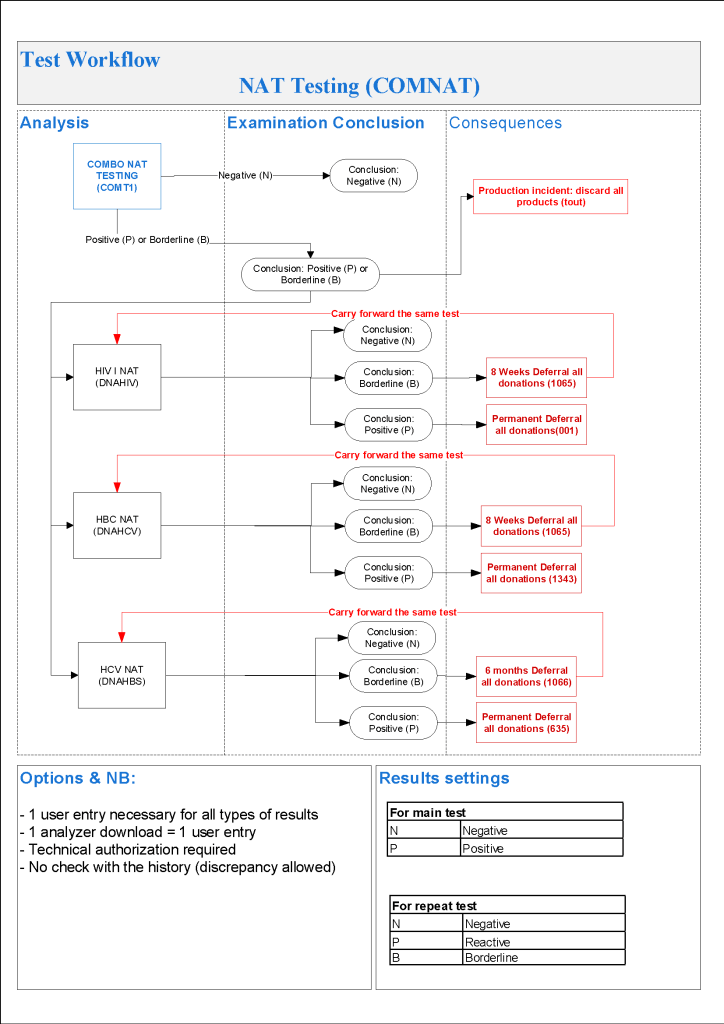
In Medinfo, criteria for donor screening may be based on one test (e.g. Hgb), a group of tests taken together (HBsAg, HBcAb, HBsAb), or separate sets of donor testing criteria.  Nucleic Acid Testing NAT is considered separate from the EIA, LIA, and Ag tests.  In any case, when there is a combination of both acceptable and deferrable results, the longest deferral is applied as the deferral or contraindication, e.g. a temporary deferral is replaced by a permanent deferral.

Our NAT testing at HMC Doha consisted of a combination combo test.  If this was non-negative, then individual HIV 1-2, HCV, and HBV NAT testing were performed.  For speed, we used single-well testing for each donor.  However, it is very easy to build pooling into the algorithm if that is preferred by the client:

To Be Continued:

24/8/20

Projective Assessment 3

As a transfusion medicine physician, I must know if I can trust my staff’s interpretation of immunohematology testing.  I may be called at night and they will provide me with results and I must use these to make a medical judgment.  If their interpretation is flawed, I might make a decision that harms the patient.

I really don’t like multiple-choice questions, but nowadays this is often the norm.  For my staff, especially senior staff and those who want to be promoted to senior staff, I have developed a series of projective exercises to help me understand their thought processes.

Here is another exercise, usually given to base medical technologists.  I have the staff review this panel and tell me to interpret it:

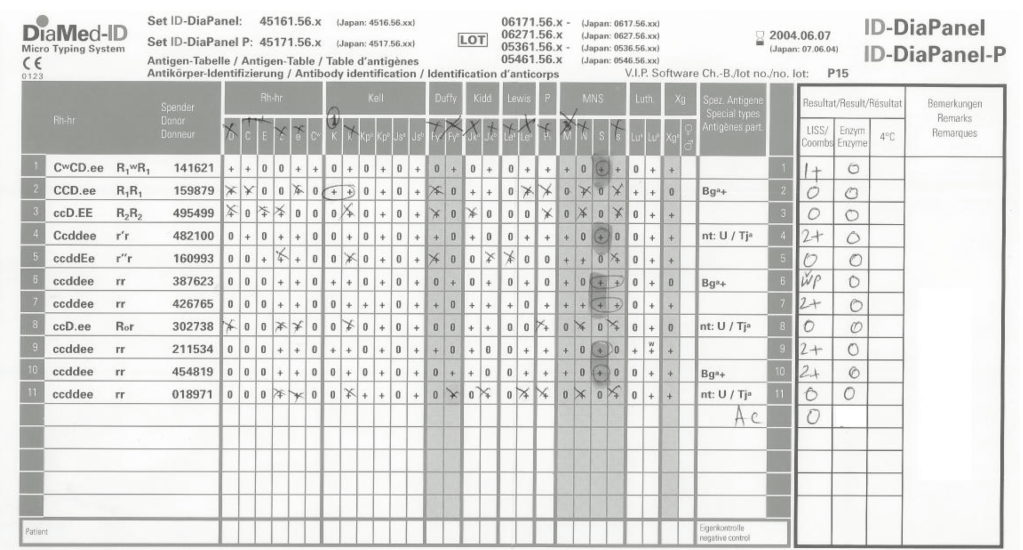
Everyone reports this is anti-S, enzyme-labile, but relatively few bother to ask for the S phenotype.  All were trained to check the phenotype as part of the workup.  I also had a version of this examination in which I only showed the AHG results.  Many did not ask to perform enzyme.

The proper answer was probable anti-S, enzyme-labile, but request S phenotype. If the enzyme had not been performed, then the enzyme panel results should be requested.

Processes and Software Building 35: Donor Malaria Test Screening

Processes and Software Building—Part 35:

Malaria Testing Donor Screening Process

Zeyd Merenkov, MD, FCAP, FASCP

Independent Consultant in Transfusion Medicine and Information Technology

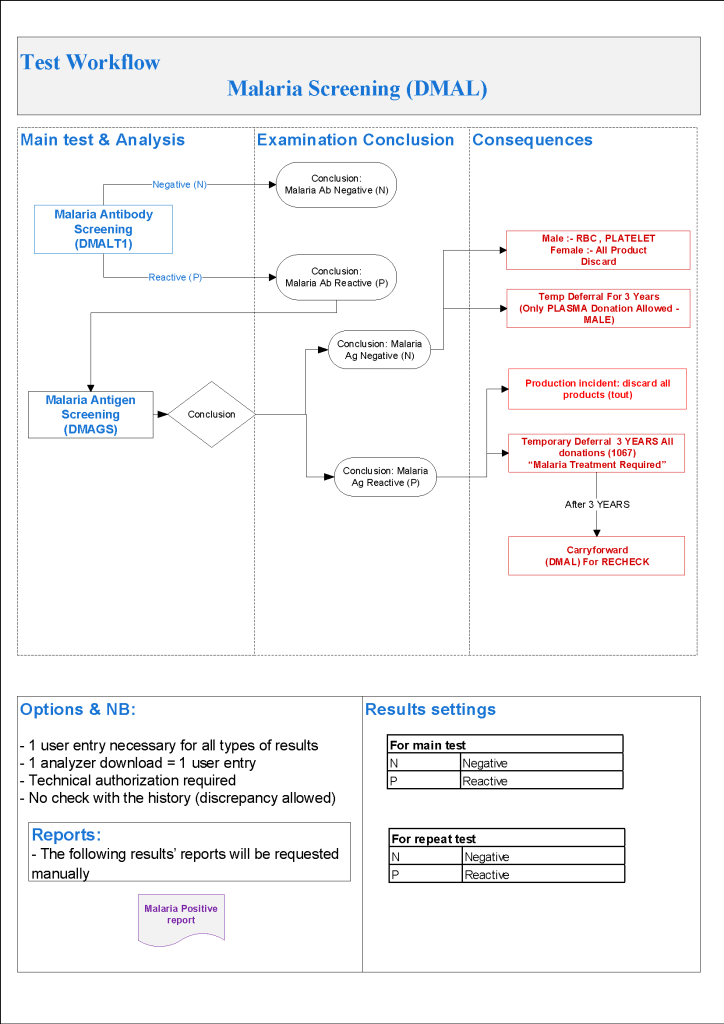
The malaria screening varies considerably by country.  I chose for Qatar to follow a combination of WHO and Australian guidelines as per the attached criteria.  We used a malaria antibody screen and malaria antigen test.  There are many alternate approaches, including using a malaria NAT.  The actual specification was:

  1. Malaria Testing:
    1. Defer donor if he has been in malarial endemic zone within the past 3 months
    2. If travel to malarial zone > 3 months, do malarial antibody testing:
      1. Malaria antibody negative:  no deferral
      2. Malaria antibody positive, perform malarial antigen test:
        1. Malaria antigen test positive, refer to Infectious Disease clinic—defer until 3 years after cessation of treatment
        2. Malaria antigen test negative:
          1. Plasma may be collected
          2. RBCs and platelets must be destroyed.
        3. Repeat malarial antibodies after 3 years:
          1. If malarial antibody test positive, donor must not be used for RBC components but may be used for plasma production
          2. If malarial antibody test negative, reenter donor for all components
    3. Defer donor if he has received malarial treatment (not prophylaxis) for 3 years
      1. After 3 years, perform both malarial antibody and antigen testing:
        1. Defer based on section 5.2

The Medinfo testing algorithm follows:

To Be Continued:

22/8/20

Projective Exercise 2

As a transfusion medicine physician, I must know if I can trust my staff’s interpretation of immunohematology testing.  I may be called at night and they will provide me with results and I must use these to make a medical judgment.  If their interpretation is flawed, I might make a decision that harms the patient.

I really don’t like multiple-choice questions, but nowadays this is often the norm.  For my staff, especially senior staff and those who want to be promoted to senior staff, I have developed a series of projective exercises to help me understand their thought processes.

Here is another exercise, usually given to base medical technologists.  I have the staff review this panel and tell me to interpret it:

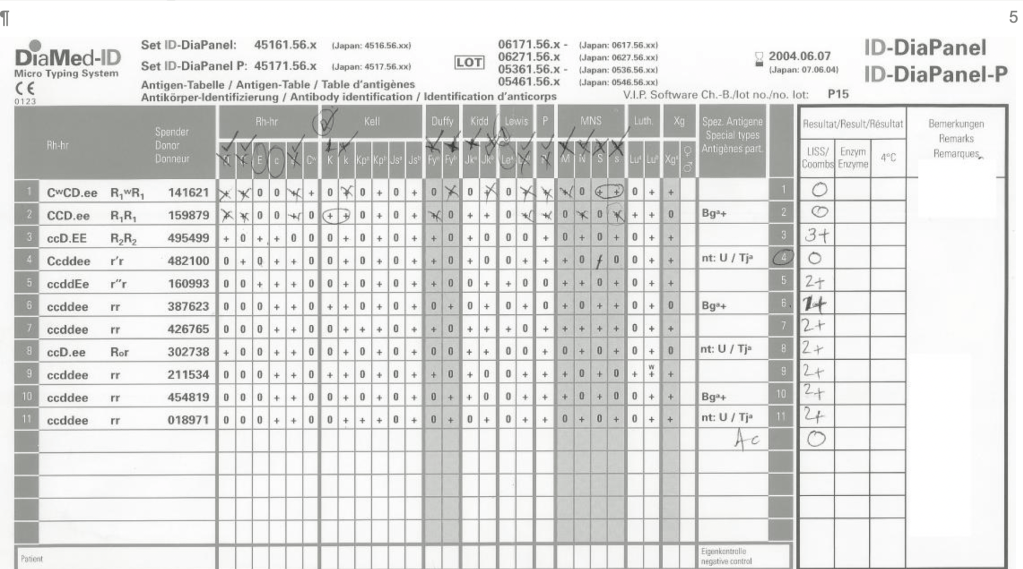
Many staff called this anti-E and anti-c.  They did not note that there is no E-positive c-negative cell.  Also, many did not see that one c-positive cell had no reaction—they did not notice that the c was heterozygous (C+c+ not c+c+).

A medical technologist must not be sloppy, but rather very meticulous.  If there are discrepancies in the panel, they must rule out dosage, zygosity, etc.  They should not name an antibody specificity with only one antigen-positive cell.

To Be Continued:

22/8/20

Processes and Software Building 34: Donor Syphilis Testing

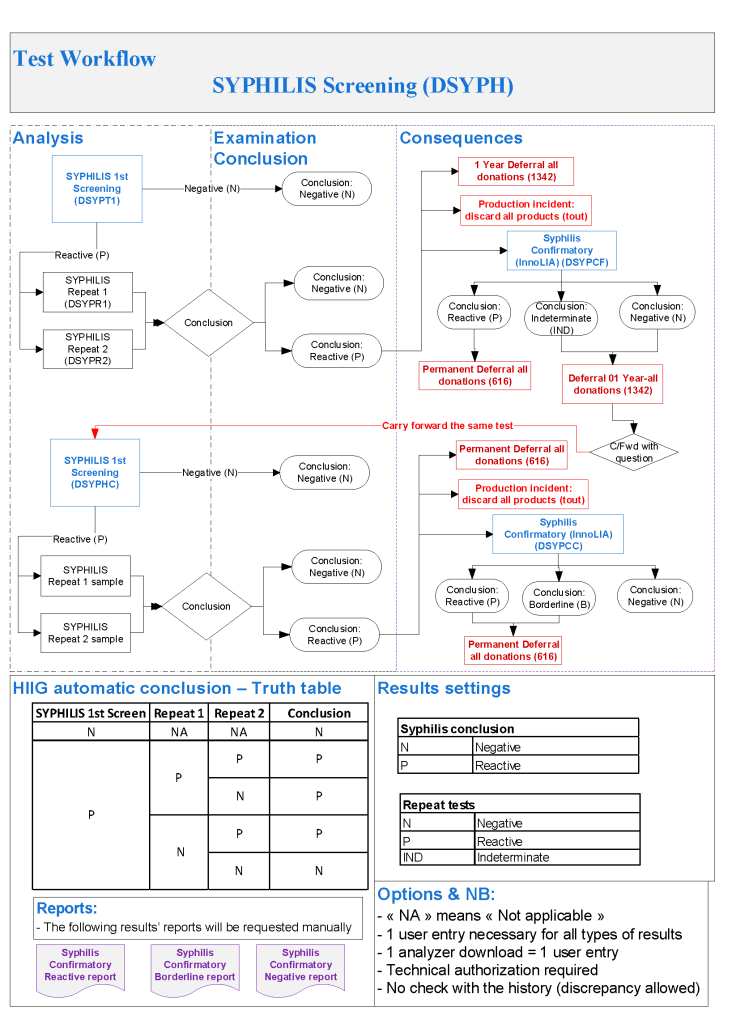
Syphilis testing uses a screening test (we used an EIA methodology to detect cardiolipin) and a confirmatory test a syphilis linear immunoblot assay LIA.

I emphasize that any test methodologies and testing algorithms can be designed in Medinfo.  This is what I selected during the time I was HMC Doha.

My algorithm specification was:

  1. Syphilis Testing:
    1. Syphilis Ab test positive or indeterminate:  do InnoLIA-Syphilis test
      1. InnoLIA-Syphilis test positive:  permanent deferral, refer to Infectious Disease clinic
    2. InnoLIA-Syphilis test borderline or negative:  defer for 1 year, then repeat all syphilis testing.
    3. Repeat Syphilis Testing after 1 Year:
      1. Syphilis antibody testing negative, reenter into donor pool
      2. Syphilis antibody positive or borderline:  do InnoLIA-Syphilis test
        1. InnoLIA-Syphilis test positive:  permanent deferral, refer to Infectious Disease clinic
        2. If InnoLIA-Syphilis borderline or negative:  permanent deferral, syphilis not confirmed

This was translated into Medinfo processes as follows:

To Be Continued:

21/8/20

Projective Exercise 1

As a transfusion medicine physician, I must know if I can trust my staff’s interpretation of immunohematology testing.  I may be called at night and they will provide me with results and I must use these to make a medical judgment.  If their interpretation is flawed, I might make a decision that harms the patient.

I really don’t like multiple-choice questions, but nowadays this is often the norm.  For my staff, especially senior staff and those who want to be promoted to senior staff, I have developed a series of projective exercises to help me understand their thought processes.

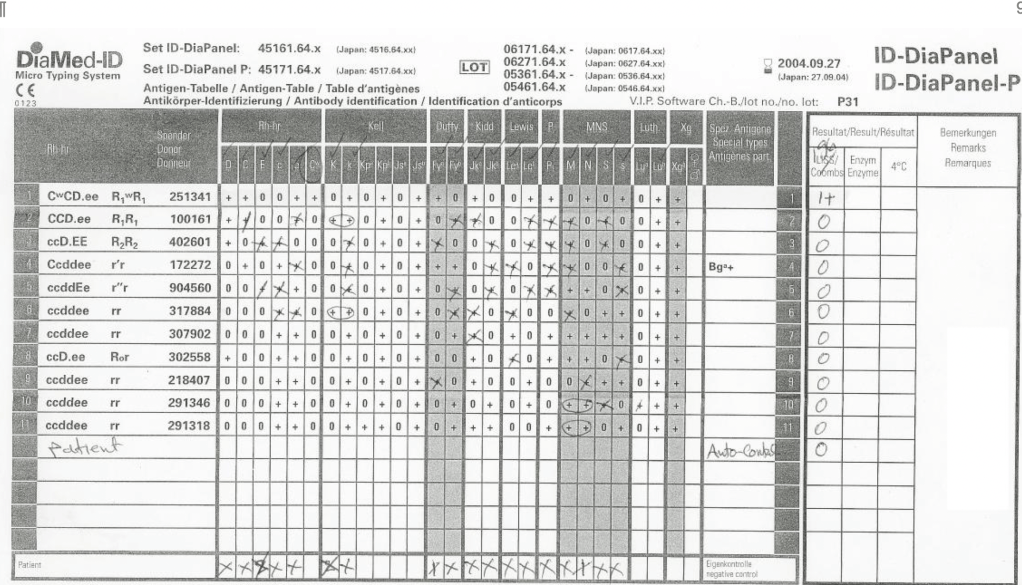
Here is a sample exercise.  I have the staff review this panel and tell me to interpret it:

Most of them answer that this is an anti-Cw without hesitation.  However, they are basing that on only one Cw-positive cell.

More astute ones indicate it might be anti-Cw but ask to test additional Cw-positive cells and perform an enzyme panel.  These are the ones that I will consider for promotion now.

Laboratory Data Analyst

This is an updated job description of what I used at NGHA Riyadh for a Systems Administrator for laboratory software. Such a person will have software privileges as agreed by the hospital information systems department. In our system there, there was a separate laboratory information systems section LIS:

Basic Function:

To analyze laboratory databases and prepare reports to optimize laboratory utilization and management

Principal Duties:

  1. Maintains and secures the laboratory information server (to be distinguished from the LIS hardware) and its associated databases
  2. Uses downloaded database files from laboratory computer system to prepare reports as deemed necessary by and as prioritized by the Pathology Chairman, Laboratory Operations Administrator, and/or Portfolio Head, LIS, which may include but is not limited to:
    1. Cost containment (implementation of CEO directives)
    2. Internal laboratory and external hospital committees (as requested by them)
    3. OVA statistical analysis
    4. Specimen referrals to outside laboratories
    5. Specimen referrals from other hospitals or hospital systems
    6. ER Stat Laboratory utilization reports
    7. Laboratory Utilization Committee, including STAT turn-around-time and critical values
    8. Quality Improvement-Accreditation Portfolio
    9. Test utilization metrics
    10. Any other reports requested/approved by the Portfolio, LIS, Laboratory Operations Administrator, and/or Chairman
  3. Assists in the management of the document control program for the laboratory
  4. Assists in the management of the intellectual property control program for the laboratory
  5. Performs any other assignments as directed by the Pathology Chairman, Laboratory Operation Administrator, and/or Portfolio Head, LIS

Essential & Preferred Education & Experience:

  1. B.S. degree or higher in computer science including coursework in networking, database structure, and management
  2. Experience (at least two years) in operating enterprise-level (e.g. Oracle, IBM DB2), business-level (Postgresql, MySQL, Microsoft SQL Server) databases as well as Microsoft Access® desirable
  3. Fluency in English (high-level) essential, fluency in Arabic desirable
  4. Experience (at least one year) in working with databases in a variety of operating systems (Win32/64, Linux, UNIX) desirable
  5. Experience (at least one year) in working in a hospital laboratory environment desirable, not necessarily as a laboratory technologistLa
  6. Must be self-reliant and disciplined to operate independently and have excellent organizational and interpersonal skills to relate to a wide variety of laboratory and hospital personnel

Degree of Responsibility:

This is a middle-level management position within the Department of Pathology and Laboratory Medicine.  The analyst must be self-reliant and disciplined to operate independently, have excellent organizational and interpersonal skills to relate to a wide variety of laboratory and hospital personnel.

18/8/20

Whole Blood

In my long career, there have been cycles in transfusion practice.  Today’s dogma becomes yesterday’s heresy and then later again the dogma.  Just consider the selection of blood components before the introduction of cyclosporine for intended renal transplant recipients.

In training, I was told NEVER, NEVER use the intended donor’s blood for the renal recipient.  This would immunize him against the donor tissue antigens and cause the transplant to fail.

Several years later after cyclosporine, we were doing a booming business of directed RBC transfusions from the donor to his/her recipient.

Just a few years ago, I used blood component therapy for all, especially trauma patients.  Give the victim what he lacks:  for oxygen-carrying capacity, RBCs;  for volume crystalloid;  for low protein albumin;  for coagulopathy FFP, factor concentrates, cryoprecipitate;  for thrombocytopenia, platelets.

Most recent studies now mention the danger of giving too much crystalloid, etc.  It talks about using fresh whole blood to provide all of the above in less volume.  Results from trauma and military studies are encouraging and may be better than individual component therapy.

There are special considerations for whole blood:

  1. 21-day outdate for the RBCs
  2. Platelet functionality limited after 7 days
  3. Use of group O, low-ABO-titer

Pathogen-inactivation of whole blood is CE-approved by riboflavin (Mirasol).  Terumo BCT is developing an exciting technology to first use Mirasol and then make components using the Reveos automated component system—RBCs, plasma, and platelets.  This is an ongoing project so for now the only CE-approved project is use as whole blood.  Such Mirasol-treated whole blood has been shown to prevent malaria transmission in Ghana.

From my review of the literature, these are my specifications as of this date 18/8/20:

  1. Use/ordering restricted to trauma and selected ICU/surgery suites
  2. Only male donors
  3. 7 day outdate
  4. Group O, Anti-A and anti-B IgM titers, both <= 1/256
  5. Leukodepleted < 1E6 residual WBCs

What level of anti-A and anti-B titers is acceptable?  The titer was set as low as 1:32 but at recent THOR meeting 1:256 has been used.  In Qatar in a pilot study, I found that about 50% of our donors had titers < 1:256.  The issue is that each time the donor presents himself/herself, we must repeat the titer—it is not stable.

Of course, performing even just a saline-titer is time consuming.  The only practical way for us in Doha would have been to use an automated titration option on an immunohematology analyzer—in our case, the Ortho Vision MAX, which could perform 1 titration run in about 30 minutes, and the instrument cannot be used for any other testing during the process.

I personally would perform leukodepletion to conform to CE, but you need a special whole blood filter that removes WBCs but spares the platelets.  Terumo BCT has such a filter that achieves <1E6 residual WBCs.  Never use a standard RBC leukodepletion filter since it will remove BOTH platelets and WBCs—this would defeat the purpose of using whole blood.

At HMC Doha, female donors were only used for packed RBC production—all plasma and platelets were discarded.  Some centers do HLA antibody screens and allow negative females to donate.

Finally, many groups do not leukodeplete at all.  I am concerned about the risk of adverse reactions and TRALI so I would conform to CE and do it.

Whichever conditions you stipulate, it is easy to create the process in Medinfo.  The most important thing is to know what you want to specify.

19/8/20

Processes and Software Building 33: HBV Donor Testing

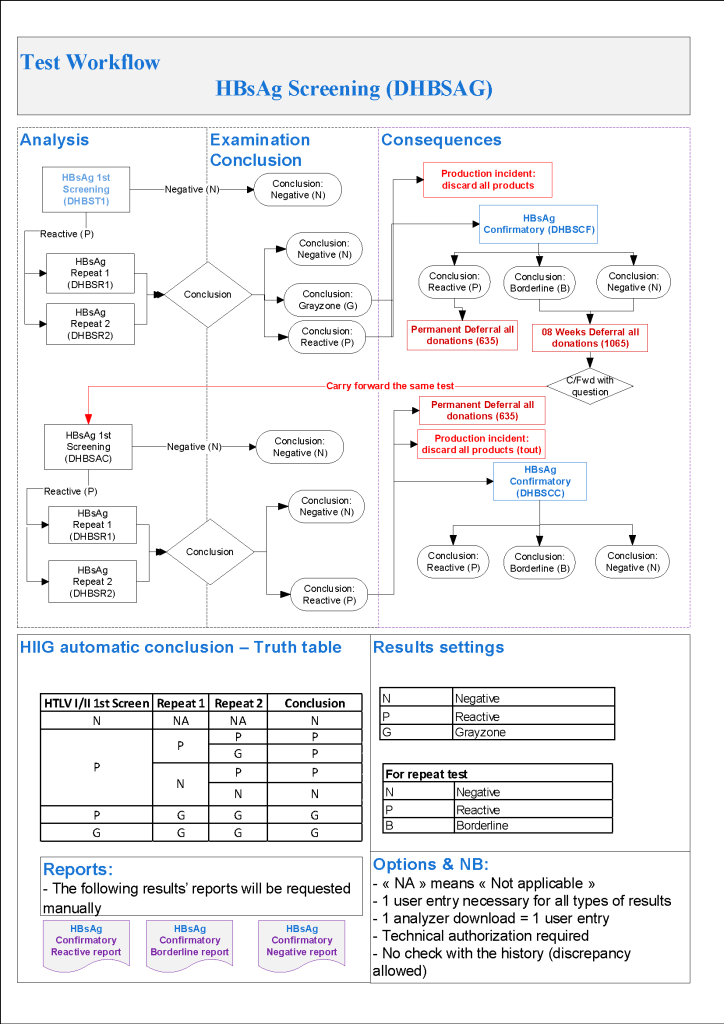
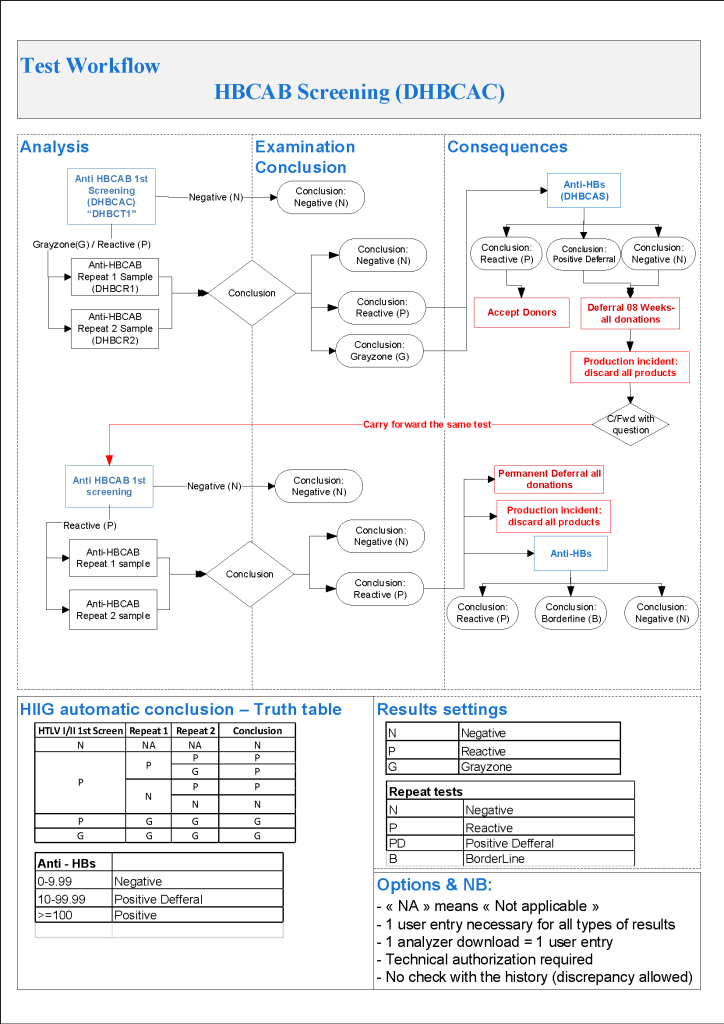
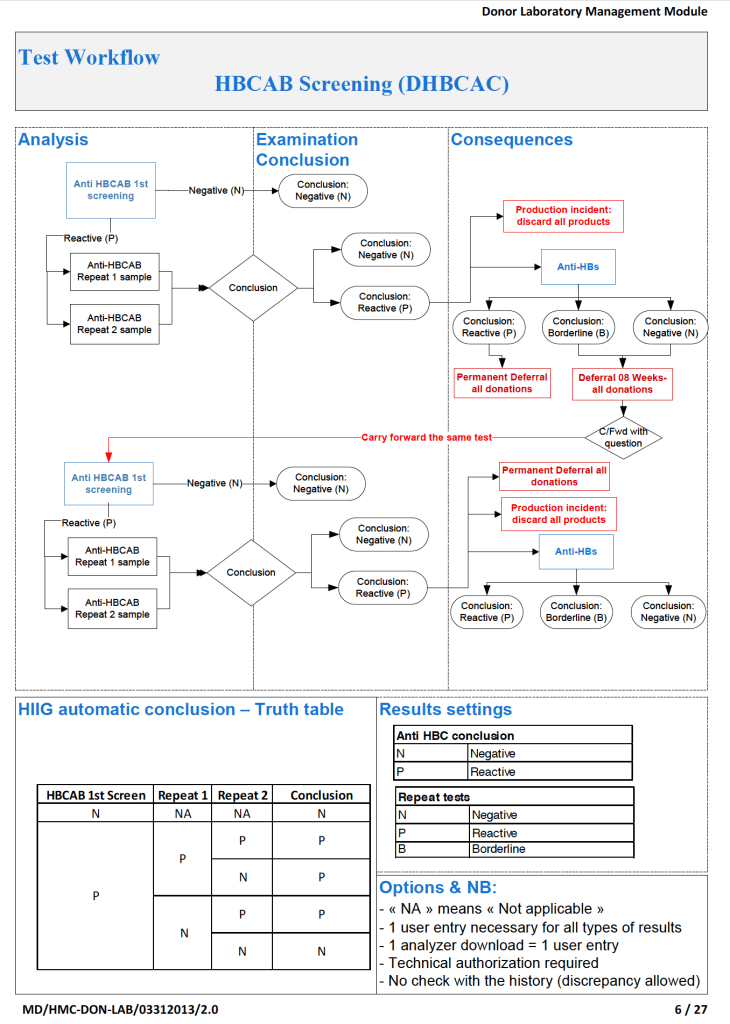
Hepatitis B donor screening consists of HBsAg and HBcAb for all donors, the latter to detect the window period.  In the USA, a non-negative HBcAb result will trigger a deferral.  In the Gulf area/KSA, there HBV was positive higher than in the West so there was a high rate of HBcAb positivity often from recovered HBV infection.

Here was my last algorithm before I left HMC Doha, which allowed use of donors with protective titers of HBsAb.  Note that the WHO cut-off for this is 10 IU/L whereas we used 100 IU/L as our threshold:

  1. Hepatitis B:
    1. HBsAg non-negative, then:
      1. HBsAg positive with HBsAg confirmatory positive, regardless of other results:  permanent deferral, refer to Infectious Disease clinic
      2. HBsAg positive with HBsAg confirmatory borderline or negative, repeat all HBV testing after 8 weeks
      3. HBsAg borderline:  repeat all HBV testing after 8 weeks
      4. HBV-DNA positive confirmed, regardless of other results:  permanent deferral, refer to Infectious Disease clinic
    2. If HBcAb positive, repeat after 8 weeks
    3. Repeat Hepatitis B Testing After 8 weeks:
      1. HBsAg positive with HBsAg confirmatory positive:  permanent deferral, refer to Infectious Disease clinic
      2. HBsAg positive with HBsAg confirmatory borderline or negative:  permanent deferral, refer to Infectious Disease clinic
      3. HBsAg borderline, permanent deferral, refer to Infectious Disease clinic
      4. HBV-DNA positive confirmed:  permanent deferral, refer to Infectious Disease clinic
      5. HBcAb positive or borderline with negative HBsAg and negative HBV-DNA:  review HBsAb level:
        1. If HBsAb level >= 100 mIU/mL (100 IU/L), donor may be reentered
        2. If HBsAb level < 100, then recommend to donor to receive booster HBV vaccine
          1. After HBV vaccine administration, retest after 30 days:
            1. If HBsAb level >= 100, donor may be reentered
            2. If HBsAb level < 100, donor is indefinitely deferred
      6. HBsAg, HBcAb, HBsAb all negative:  reenter into donor pool

Here is the HBcAb and HBsAb part of the algorithm:

Previously, we had we had disqualified any donor with a nonnegative HBcAb:

To Be Continued: 

18/8/20