COVID-19 Convalescent Plasma CCP Site Registration

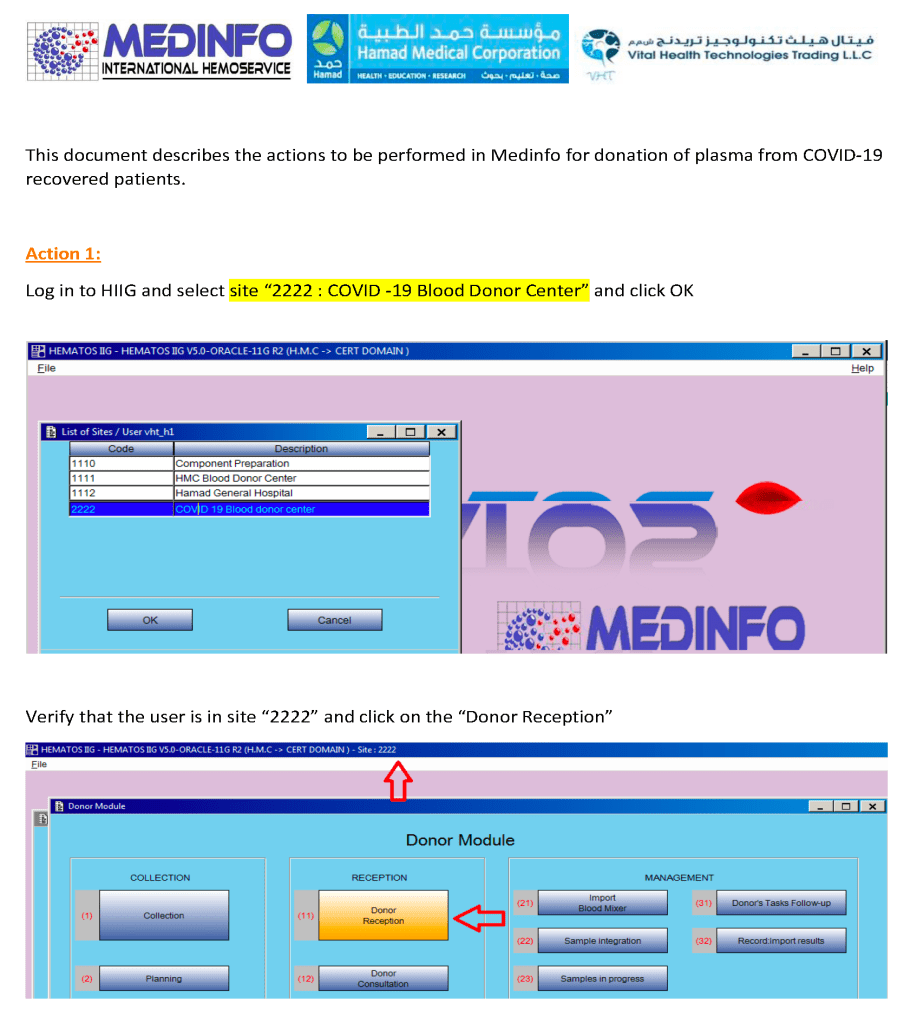
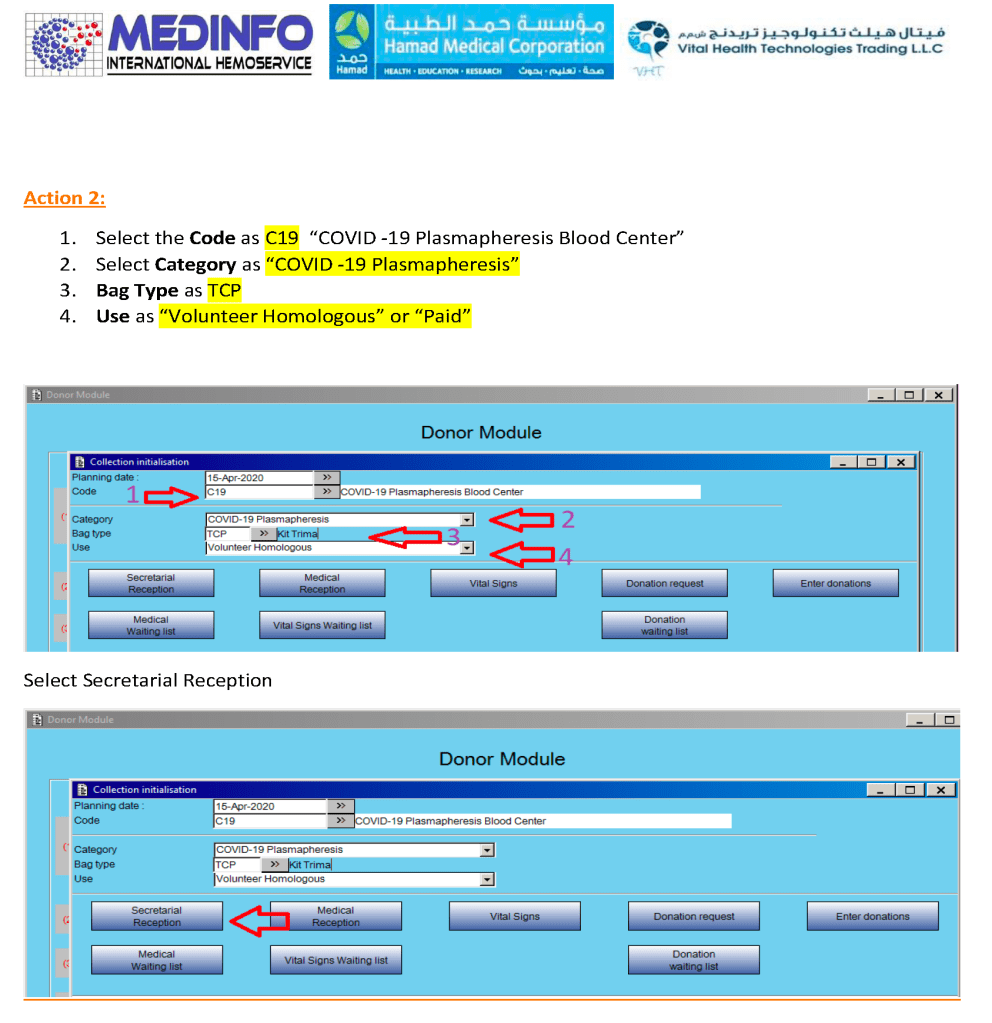
I designed a completely quarantined process for collection, processing, and release of CCP at HMC Doha.  This document shows the Medinfo process for site registration as a separate donor center code.

CCP could only be collected at this special site and only the apheresis bag could be used for collection.  Regular donation options were not available at this CCP site nor was CCP collection an option at the regular donation sites.

4/1/21

Therapeutic Apheresis Policy

This has been revised to recommend the use of a continuously recording portable vital signs device such as Umana’s UT1M (GPI, Italia) which includes PAO2 and heart rhythm measurements.

Principle:

All therapeutic apheresis procedures are potentially life-threatening and must only occur by an order from a transfusion medicine physician with experience/competence in such procedures.

Definitions:

  • Referring Physician is the clinical physician requesting a therapeutic apheresis procedure.
  • Transfusion Medicine Physician is a physician in the Transfusion Medicine Section with medical privileges for therapeutic apheresis procedures.  This includes the Head, Transfusion Medicine, consultants in Transfusion Medicine, and designated specialist physicians in Transfusion Medicine.  The final decision to accept/reject the patient is made by the transfusion medicine physician.
  • Covering Physician is the clinical physician designated by the referring physician to be physically present and covering the patient in case of any adverse reactions during a therapeutic apheresis procedure.
  • Apheresis Nurses are nurses in Transfusion Medicine who are designated by this section for performing therapeutic apheresis procedures.
  • Medical Privileges are determined by Transfusion Medicine in conjunction with the medical privileging by the Medical Director.

Policy:

  1. The referral physician will discuss the request for a therapeutic apheresis with the designated transfusion medicine physician.  The referral physician must certify that the patient can tolerate the procedure based on his medical condition.
  2. The transfusion medicine physician will review the patient’s clinical and laboratory data, with special note of the history of allergies, medications, previous transfusion reactions, and current vital signs.
  3. Vascular access will be initially assessed by the apheresis nurse.  Any questionable situations will be reviewed by the transfusion medicine physician.
  4. The following laboratory values (less than 24 hours old) must be available before the procedure may begin:
    1. CBC including platelet count
    2. PT and APTT
    3. Fibrinogen
    4. Serum calcium
    5. Serum protein and albumin
    6. LDH for TTP cases
  5. A valid type and screen must have been done within the previous three days of the procedure.
  6. Upon review of # 2 through 5, the transfusion medicine physician will determine if the procedure is indicated and will communicate this to the referral physician, who will sign written order in the patient chart.  Appropriate replacement fluids will also be mutually agreed upon in advance of the procedure and ordered by the transfusion medicine physician.  The order specification must include:
    1. Name of procedure and specification (e.g. therapeutic plasma exchange, isovolemic)
    2. Replacement fluid type and volume (e.g. 3 liters 5% albumin, 2 liters, FFP, cryoprecipitate, normal saline)
    3. Blood component orders if indicated (e.g. RBC exchange) and timing (before, during, and/or after the procedure)
    4. Calcium replacement (e.g. 2 grams calcium gluconate IV in 100 ml normal saline to run during the procedure)
    5. Any special laboratory testing post-procedure
  7. The apheresis nurse will follow the orders of the necessary prescribed replacement fluids (FFP, albumin, PPF) in the quantities necessary for the exchange.
  8. The referring physician will obtain the signed, informed consent from the patient.
  9. If vascular access is unsatisfactory, the referring physician will obtain the proper access (central line, AV shunt, etc.).
  10. The referring physician will arrange for a physician member of his team to be present at the actual therapeutic procedure.  This physician designate will be responsible to treat any complications arising from the procedure.
  11. Vital signs and weight will be obtained before starting the procedure.
  12. If the procedure is outside an intensive care unit and the patient is critically ill, consider the use of a portable attached monitoring patch (such as the Umana UT1M device).  The device will give alarm if any measurement is outside the defined ranges.
    1. If any blood components are administered, keep the patch attached to detect TRALI/TACO and other adverse transfusion reactions.
  13. When approved by the Blood Bank Director or designate with proper venous access and informed consent, the apheresis may start the procedure in the presence of the patient’s covering physician.  The procedure will be performed in a designated hospital area.
  14. The procedure must be documented on the appropriate therapeutic apheresis order and procedure worksheets.

References:

  1. Standards for Blood Banks and Transfusion Services Current Edition, AABB, Bethesda, MD, USA
  2. CAP Standard TRM.42245 regarding therapeutic apheresis procedures

Revised 3/1/21

International Perspective

When I first moved overseas from the United States, I brought the perspective of my American training and experience.  I saw everything in my new blood bank through those eyes.

Yet, most of my staff were not American or even North American.  Few were even native in English, and most of those  were not American.  They had different qualifications, many of which would not have been accepted by the American schemes.  Still, they functioned well.

I also worked with the US military technologist staff during Gulf War One.  Some did not even have a Bachelor’s degree;  yet, they performed the work well.

I used many technologies that were not yet (or never) US FDA approved such as gel or glass bead typings and pooled buffy coat platelet production.  There were rare reagents I could buy off the shelf (e.g. anti-Tja/PP1Pk).

Later, I adopted pathogen-reduction technology (Mirasol), automated component production (Atreus then Reveos), and platelet additive solution.  I achieve a level of good manufacturing practice that would have been difficult to achieve by the FDA-approved methods.

My perspective had changed.  In the Middle East, I studied many frameworks and came to the conclusion that the best approach was to customize them to our local needs.  My particular experience was to start with one framework, i.e. Council of Europe CE, and then localize it.

To do this, I could not use an American turnkey blood bank software for either the donor or patient operations.  I needed a flexible system that could be customized to my needs.  Again, I chose a CE-marked system, Medinfo Hematos IIG that had already been adapted to many frameworks.

It is much easier to work solely within one system such as FDA.  However, if I had done that, I would have lost so much flexibility and not had a system optimized for local conditions.  I would not have used Mirasol, Reveos, Diamed, and many other reagents.

One big disappointment at such international meetings is the perspective by one country’s regulatory agency that they feel its regulations and framework will work well overseas.  I would wager that those people were not well acquainted with international conditions.

Another frustration was attending another international meeting in which the presenters apologized for the source of information since it came from a foreign country (France) and not their own (United States).

No country has a monopoly on what is best for everyone.  To share our experiences and compare is so valuable.  No one assume his way is the best.  In my career, I have had the richest experiences studying other perspectives and my organizations have benefited greatly from the exchange.  We can all learn from each other.  We are citizens of the world.

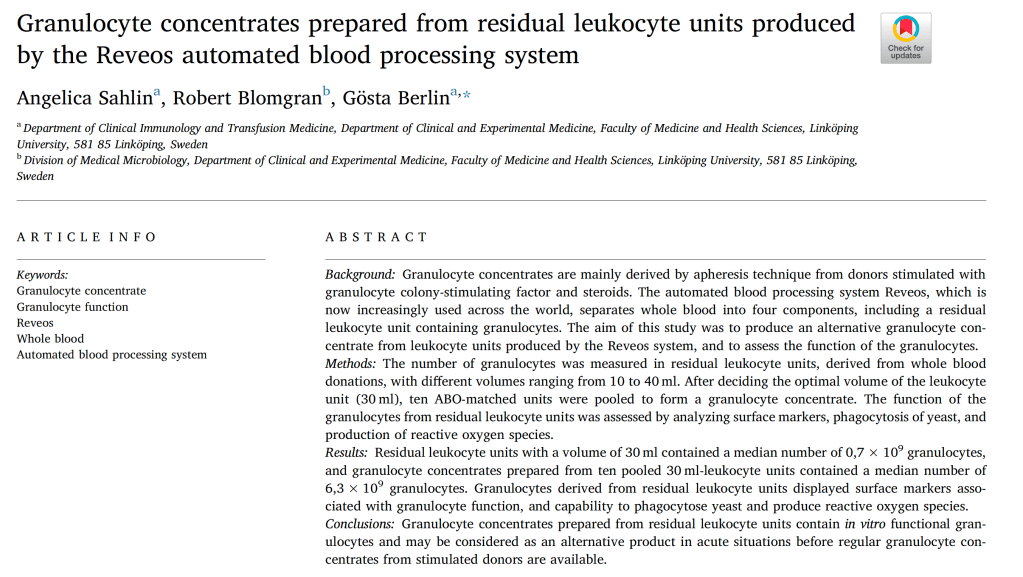
Reposted: Granulocyte Concentrates Prepared from Reveos Buffy Coats

The Reveos buffy coat is not approved for clinical use.  In my laboratory, I have offered this discard product to the stem cell laboratory and researchers as a quality control QC and a substrate to extract CD34+ cells for expansion and modification.

In this article (abstract attached) from Transfusion and Apheresis Science 59 (2020) 102682, the authors study pools of ABO-identical Reveos buffy coats for their granulocyte functionality and as a possible emergency replacement for granulocyte concentrates when the latter are not available.

I want to thank Terumo BCT (Brussels, Belgium) for referring me to this article and to the authors for a very interesting paper.

1/1/21

Medinfo COVID Convalescent Plasma Workflow Revisited

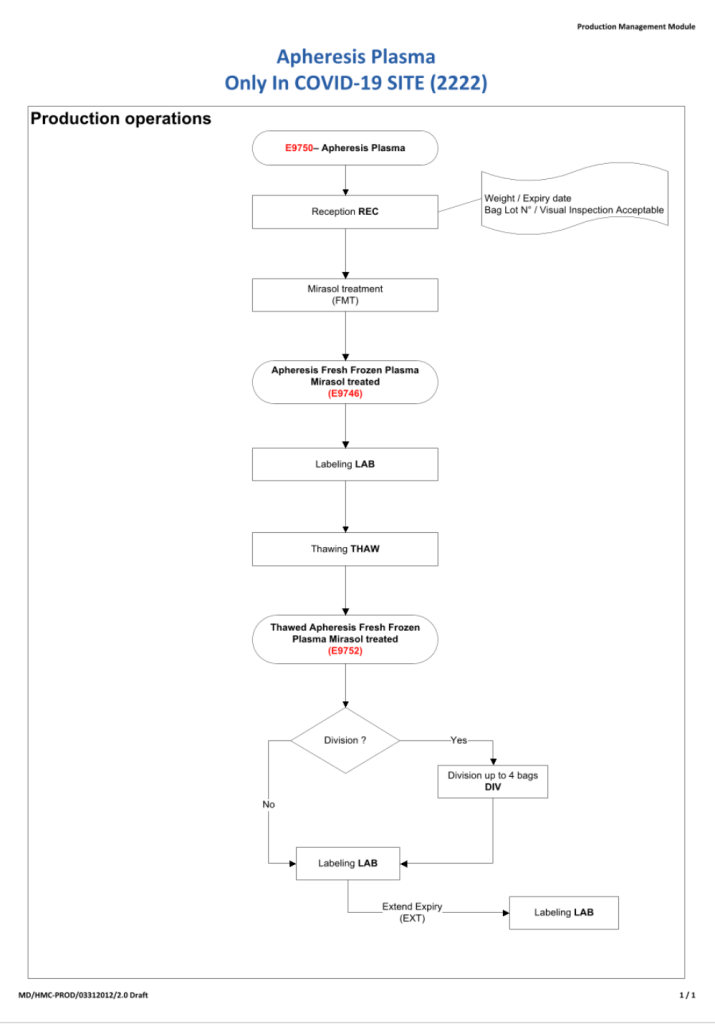
It now has been over eight 8 months since I prepared the CCP workflow in Medinfo.  It was built on the framework of the manual CCP process including donor prescreening with an abbreviated donor questionnaire.  It was really quite simple and used the donor and patient modules to create quarantine areas for donor screening, collection, processing, and hospital patient blood bank release.

Here are my current comments on the process:

Donor Qualification:

I would still exclude malaria and HTLV from the donor questionnaire and would update to UDQ 2.1.  Since these donors have recovered from a potentially life-threatening illness, I would keep the Hgb threshold at 11 g/dl.

Donor Collection:

In the future, I would consider using one of the soon-to-be-released portable devices that continuously monitor vital signs with pO2 and EKG lead to rule out asymptomatic pulmonary or cardiac problems.

I would also consider using low-ABO-titer, group A, universally to meet the demand for group B and AB patients.

Donor Testing:

There is still no need to segregate and separately test CCP donor specimens from regular blood donor specimens.  I would perform SARS-CoV-2 antibody testing and set a threshold for qualifying donors—that threshold will be based on the manufacturer’s recommendations.  However, if the treating physician wanted to use a low-titer unit, I would permit this.

Donor Processing:

There is no need to change this from the current processes.  Keep the CCP processing separate from the regular operations.

CCP Plasma Release:

I would keep the quarantine release and restrict it to the locations used for treating COVID-19 patients

Medinfo Software Modifications:

I would record the IgG and IgM titers for SARS-CoV-2 antibodies in each donation record.  This would include testing and entering the results on donations prior to this testing.  ISBT labels should include this antibody titer.

Hospital Information Software Modifications:

Set up restricted CCP ordering for the actual treating physicians only.  Also provide the ISBT code and shortened descriptors to it if necessary (certain HIS vendors still cannot read ISBT codes natively).

The original CCP workflow is attached for reference.

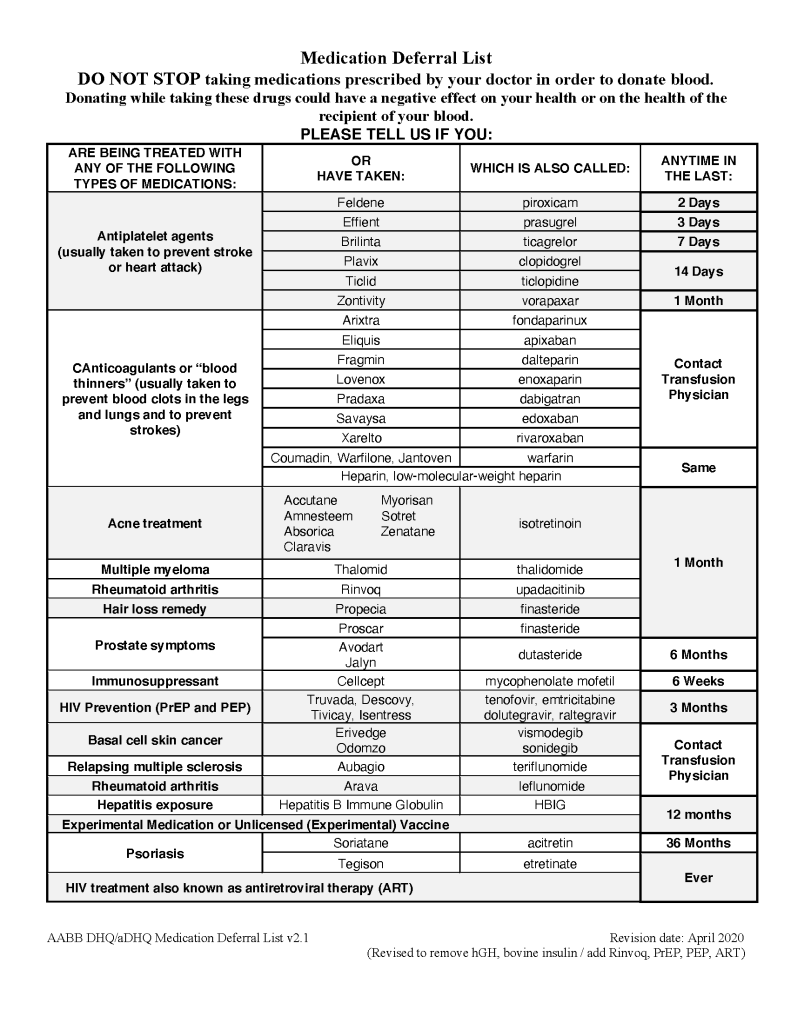
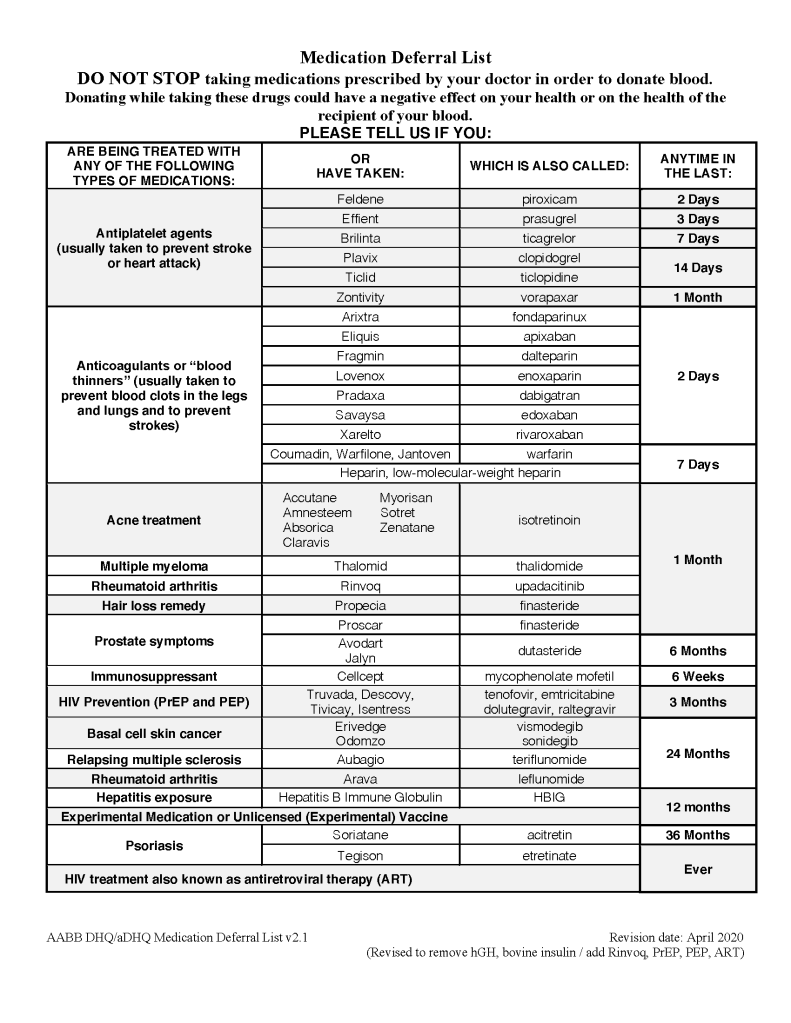
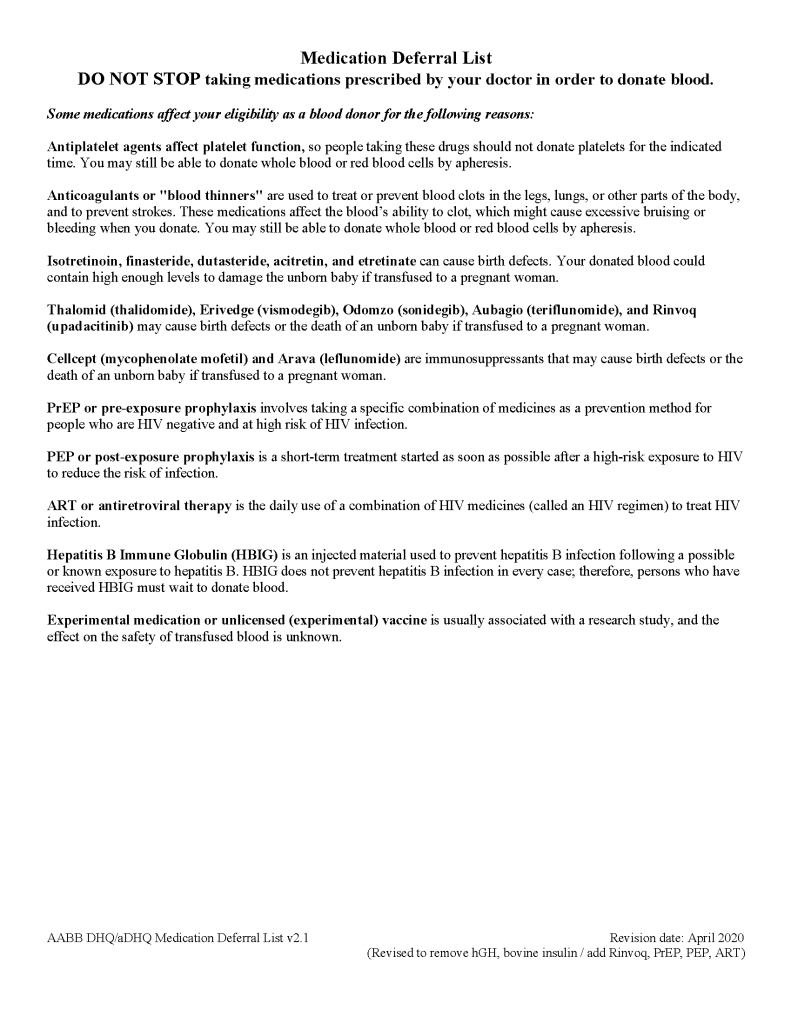
Donor History Medication Deferral List UDQ 2.1

This table and explanatory page shows the Uniform Donor Questionnaire latest version 2.1, which includes deferral for both pre- and post-exposure HIV prophylaxis.

I am showing 2 versions of this deferral list:

  1. My modification referring certain medications to the transfusion medicine physician for review that are otherwise permitted in the original 2.1 list.
  2. The original UDQ 2.1 list that permits patients taking anticoagulants and other medications.

I would prefer for the donor screening transfusion medicine physician to review the reasons for these anticoagulants and other medications before deciding whether to accept the donor.

Manual Collection of COVID-19 Convalescent Plasma

This process was originally done in the first phase of CCP collection.  I have updated it to include SARS-CoV-2 antibody testing.

Principle:

Due to the pandemic, we will initially MANUALLY collect an experimental, investigational-use-only plasma product from apheresis donors and treat it with Mirasol.  THIS IS A EMERGENCY INTERIM PROCESS UNTIL THE MEDINFO HEMATOS IIG PROCESSES ARE PREPARED AND VALIDATED.

Policy:

  1. Good Manufacturing Practice applies:
    1. Manufacturers’ recommended processes for equipment and materials usage applies.
    1. All staff engaged in these processes must be competency assessed successfully.
  2. Pre-Screening:
    1. Clinical staff will use the prescreening document to select donors for pre-donation screening.
  3. Quarantine:
    1. All processes (day 0, day 1, day 2, and product modification and release) will be done in quarantine areas SEPARATE and DISTINCT from regular Transfusion Medicine activities.  This includes:
      1. Separate space and equipment must be provided.
        1. Equipment for this project may NOT be used for regular, non-quarantine processes
    2. Non-Transfusion Medicine staff will not be permitted in operational areas.
    3. Prospective donors will not be permitted in the processing, testing, storage, or blood bank work areas.
  4. Donation Process:
    1. Day 0:  Registration, check donor deferral database, questionnaire, physical exam including arm check, and specimen collection using ISBT specimen labels
    2. Use latest manual donor questionnaire.
    3. Day 1:  Donor marker and immunohematology testing, review of results, accept or reject donor for actual plasmapheresis
    4. Day 2:  Collect manufacturer’s recommended volume of plasma (500 ml if < 80 kg, 600 ml if >= 80 kg), aliquot, pathogen-inactivate (Mirasol), freeze at minus 80C
  5. Testing:
    1. Testing will be performed with regular blood donor specimens using ISBT specimen labels
    2. Testing must be done by donor-specific processes (not those for clinical patients)
      1. Exclude malaria and HTLV testing.
    3. Testing must be directly interfaced to Medinfo Hematos IIG donor module
    4. CCP COVID antibody testing:
      1. SARS-CoV-2 antibody testing to be performed to determine cut-off for donor eligibility for CCP collection.
      2. Use of donors with antibody levels below threshold is at the discretion of the treating clinician.
  6. Processing:
    1. Aliquoting, pathogen-inactivation, and labelling may proceed if the pre-donation screening results are acceptable.
  7. Storage:
    1. Long-term in minus 80C quarantine freezer
    2. Short-term at 1-6 C just after thawing in quarantine refrigerator
    3. Standard temperature monitoring and alarms apply
  8. Labelling:
    1. The backup manual labelling process applies
    2. The ISBT specimen label will the donor unit number
      1. Outdate will be 6 years if the product is stored at -65C, 1 year if stored at -18C
  9. Product Release:
    1. Orders must be on the PAPER requisition (old Blood Bank Order Form) with a patient prescription and signed by a physician designated to treat COVID patients.
      1. No orders in Cerner
    2. Thawing plasma at 37C upon receipt of order by Transfusion Medicine staff
    3. Signing out component to clinical unit by Transfusion Medicine Staff to locations treating COVID-19 patients.
  10. Information Technology:  Medinfo Hematos IIG customized software to be implemented as soon as possible for all processes
  11. Not covered:  Transfusion Medicine is NOT responsible for:
    1. Triage of request for convalescent plasma
    2. Pickup and transport of components

References:

  1. Level 1-4 documents for donation, testing, processing, and release of blood components
  2. COVID-19 Plasma Donor Prescreening Document, 8/4/20

COVID-19 Convalescent Plasma Donor Pre-Screening

All blood components are considered medications and are subject to Good Manufacturing Practices as mandated by international accreditation standards.  The whole process must be done reproducibly and precisely by specific personnel trained and documented to be competent.  This includes collection of convalescent COVID-19 plasma.

Transfusion Medicine will provide staff who are deemed competent for the entire process of the collection, manufacture, and release of this unlicensed, emergency-contingency component.

It will help greatly if all candidates are prescreened to exclude the following candidates:

  1. Administrative:
    1. Donors must come with a valid Qatari identity card:  no ID means no screening
  2. Sex:
    1. Males only to minimize the risk for transfusion-associated lung injury TRALI
  3. Donor Feeling:
    1. If the donor does not feel well, he should not come for screening/collection.
  4. Food/Drink:
    1. Donor must have eaten/drunk fluids within 4 hours of arrival for screening/collection.
  5. Medication exclusions:
    1. Antibiotics within the past 14 days
    2. ACE inhibitors in the past 48 hours
    3. Beta blockers
    4. Anticoagulants
    5. Anti-anxiety or other psychotropic medications
    6. Other medications on the attached list
  6. Medical exclusions:
    1. Stable vital signs
    2. History of seizures
    3. History of dementia or other chronic neurologic disorder
    4. Family history of dementia or other chronic neurologic disorder
    5. Significant cardiac arrhythmias
    6. History of hepatitis B, hepatitis C, HIV, brucellosis, Ebola
  7. Travel history:
    1. 5 years cumulative residence in Europe including Ireland and France 1980-2001
    2. 3 months cumulative residence in the UK (and/or all its territories) 1980-1996
    3. Any visit(s) to West Africa

This is NOT a complete list of criteria.  Transfusion Medicine personnel will screen according to the full donor criteria.  Thus, donors passing the pre-screening may still be otherwise disqualified based on the detailed process.

Policy: Selection of Components for ABO-Incompatible Renal Transplants

Principle:

Kidneys have strong expression of ABO type and must be matched the same way as RBC components.  In the case of ABO-incompatible renal transplants, we must not give significant amounts of plasma incompatible to the ABO type of the donor kidney.  Plasma must also be compatible with the patient’s ABO type for RBC transfusions.  The amount of residual plasma in PRBCs is limited since we use an additive solution SAGM.  Likewise, platelet components are suspended in platelet additive solution with only minimal residual plasma.  Cryoprecipitate has only minimal plasma and is given without regard to the patient’s ABO type.

All of the following rules can be built into the blood bank computer system Medinfo without hard coding.

Policy:

  1. RBC components:  Use ABO-compatible RBCs in SAGM.  DO NOT USE WHOLE BLOOD!!
  2. Platelet components in platelet additive solution PAS (normally available component):  Any ABO type may be given
  3. Platelet components in plasma:  Only group AB platelets may be used.
  4. Plasma (any type FFP, FP24, solvent-detergent treated, or thawed):  Only group AB plasma may be used
  5. Cryoprecipitate:  Any ABO type including mixed types may be used, mixed types are preferable to neutralize the minimal ABO-incompatible plasma.

References:

  1. Standards for Blood Banks and Transfusion Services, AABB, Current Edition, Bethesda, MD USA
  2. Technical Manual, AABB, Current Edition, Bethesda, MD, USA

My Experience: Blood Bank Considerations for Setting Up ABO-Incompatible Renal Transplantation

Setting up ABO-incompatible renal transplants is a major undertaking and requires close coordination between Transfusion Medicine and the clinical team.  This post addresses my experience in setting up this program in 2019 at HMC in Qatar.

Like any process involving titration, it is best to automate it to minimize inter-technologist variability.  Unfortunately, doing both IgG and IgM titers takes up to 1 hour per machine and totally monopolizes the machine during that interval.  I did not have sufficient staff to even consider doing the titrations manually.  Performing automated titers disrupted my workflow so I encouraged the clinicians to send the specimens for off-peak processing.

Titration:

  1. Obtain the full clinical protocol and especially note the thresholds for transplantation.
  2. Determine the methodologies used at the reference site.  Can you do this at your local site or do you have to use an alternative method?
  3. Do you have equipment to automatically titer?  Doing both IgG and IgM may monopolize an immunohematology analyzer for one hour?  How will this affect your other testing?
  4. Regardless if it is the same method, you must still correlate your titers with the protocol site, both IgG and IgM.
  5. If you are using multiple analyzers for titration, you must do a comparison study between them.  How much does the titer vary?

Columns:

  1. Determine column inventory and order the A, B, and AB columns.  You must order enough to finish the course of treatment.  It may take weeks to get additional columns, depending on your supply chain.  Each column costs thousands of euros.
  2. Where are you going to store the columns?  Ours needed 2-8C storage.  Can you keep them away from quarantined products and patient specimens?
  3. Are your columns single-use? 
  4. If multi-use, who is going to restore them after use?  How do you ensure that it is dedicated for the right patient?

Apheresis Equipment:

  1. How are you going to attach the column to the apheresis equipment?
  2. Will you use your therapeutic apheresis equipment like Terumo Optia directly or will you use a second machine (e.g. Medicap)?
  3. Do you have all the clamps, tubing, and holder for the column?

Staffing:

  1. Do you have sufficient apheresis nurses to perform the procedures?  You may be running the apheresis for up to 8 hours.  How does this impact your other procedures or donor center operations?  Our pool of apheresis nurses was very limited.  They also covered routine blood donation.  How will doing this process impact your regular donation and other apheresis operations—donor and therapeutic?
  2. Do you have sufficient supplies of ACD-A anticoagulant and calcium gluconate?

Specimen Collection:

  1. Perform titrations expeditiously:  Can you finish titration testing before the next scheduled procedure?  In our institution, we collected specimens at 0400 and had them directly brought to the blood bank for testing.  Results were ready at 0600 so the clinicians could decide early if another procedure was needed.

Table of Permissible ABO Types:

  1. Define acceptable blood products by blood type—take into consideration pathogen inactivation and platelet additive solution if used.  At our institution, all RBCs were in additive solution and all platelets were pathogen-inactivated in platelet additive solution PAS so residual ABO antibodies were minimal in the final components.  Since the platelets contain only minimal plasma, we did not concern ourselves with matching their ABO type with the donor kidney.  Otherwise, platelet types with plasma compatible to the donor kidney must be selected.

Software:

  1. Prepare a truth table for acceptable ABO component types based on #16 above.
  2. Include the titer cutoff for IgG and IgM antibodies in the organ transplant module.

Selection of blood component for ABO-incompatible renal transplantation is discussed in a separate post that will follow.

25/12/20