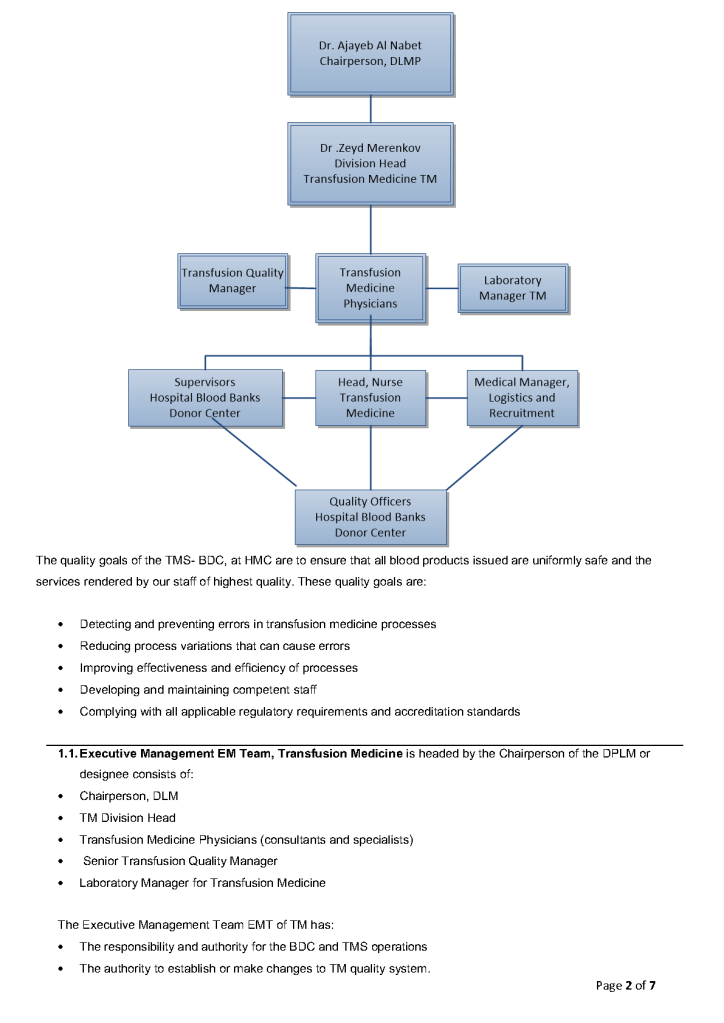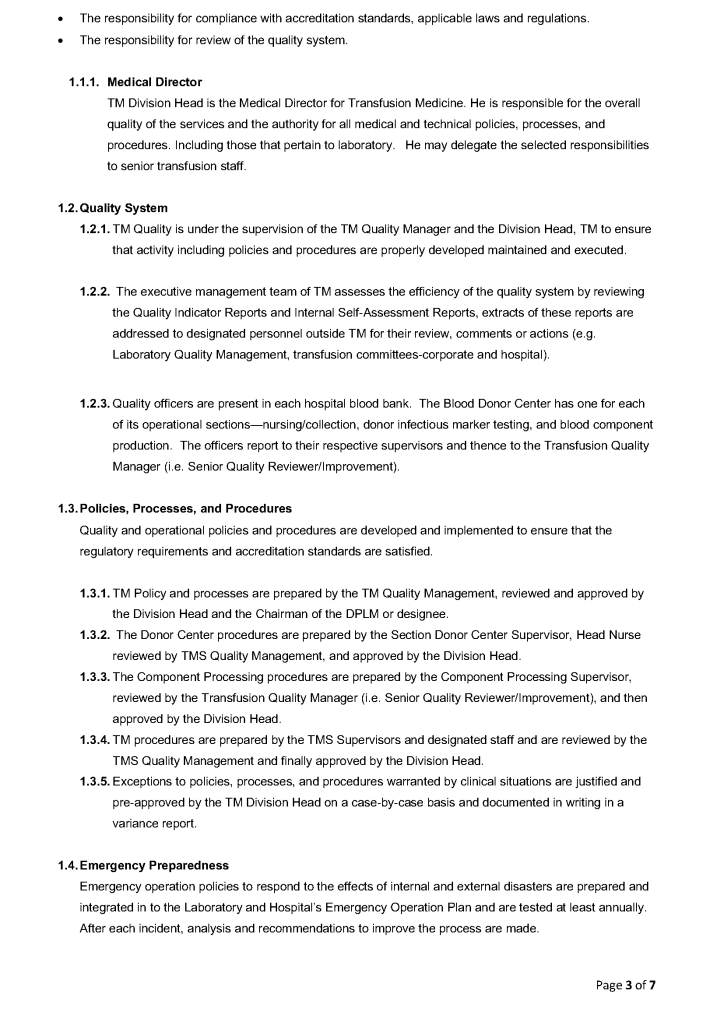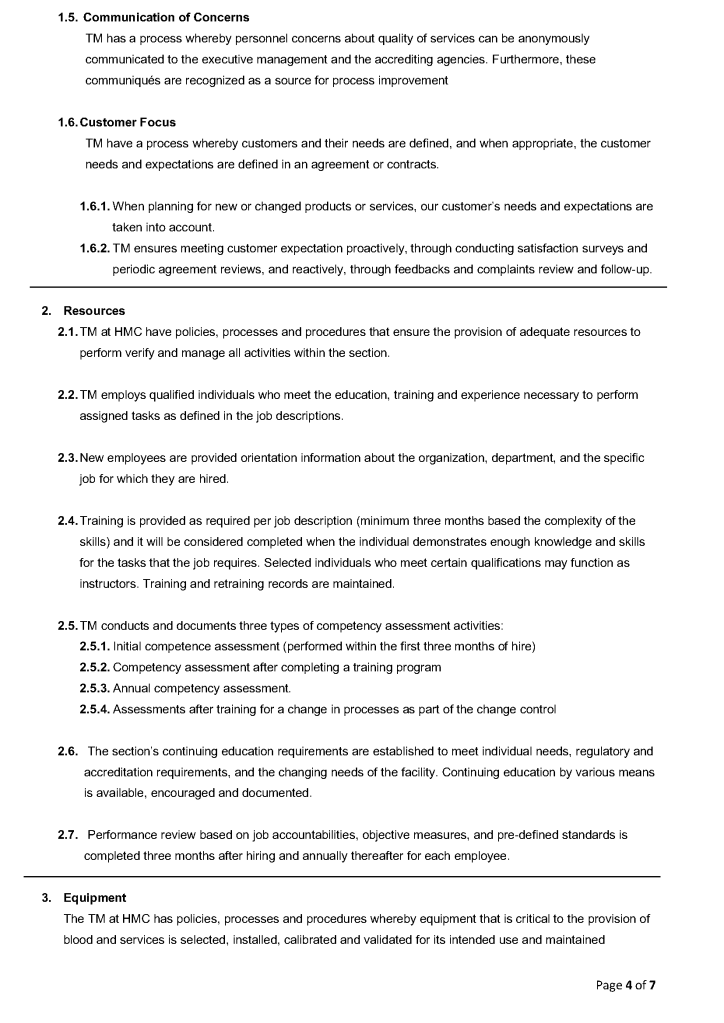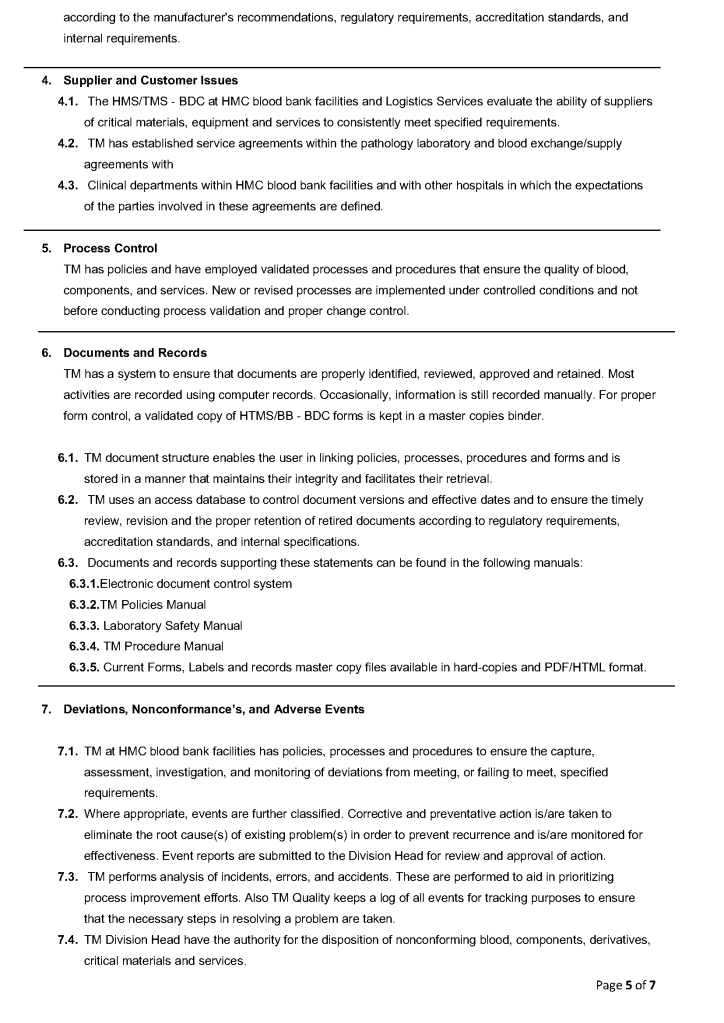
Look-Back of Patients and Donors

Principle:

Using the Medinfo Hematos IIG program, it is easy to perform look-back for patients who have developed an infectious disease that might have been transmitted by a blood component.  Likewise, if a donor develops an infectious disease that is transmissible to patients, we can check which patient(s) received blood components from the incriminated donor.  The time interval for checking will vary according to local regulations.

Policy:

  1. If a patient is reported to have developed an infectious disease which might have been transmitted by a blood component transfusion:
    1. Review the patient’s infectious marker testing data.
    2. Review the patient’s transfusion history, especially for any transfusions at outside institutions or any other body fluid exposures.
    3. Look up the transfusion history in Medinfo HIIG.
    4. Determine which transfusions occurred during the deferral period for that disease.  Examples:
      1. HBV—6 months
      2. HCV—6 months
      3. HIV—2 months
      4. Malaria—6 months
      5. HTLV—6 months
      6. Syphilis—12 months
    5. Look up the donors for each donation during the specified interval.
    6. Check each donor’s donation records for:
      1. Infectious disease marker testing
      2. Questionnaires—any irregularities noted?
    7. Call donors back for repeat testing (only on advice of the investigating transfusion medicine physician)
    8. Collate all results and prepare an interpretative report.
    9. Interpretative report must be reviewed/released by the Head, Transfusion Medicine.
    10. Submit the report to Infectious Disease and the patient’s most responsible physician
    11. If any irregularities are found, assess processes to make any improvements in an attempt to minimize future risk.
    12. Prepare an OVA according to HMC procedures.
  2. If donor develops an infectious disease:
    1. Review the donor’s infectious marker testing results.
    2. Check if the donor had any body fluid exposures.
    3. Obtain new specimen from the donor.
    4. Look up all components made from that donor.
    5. Determine which transfusions occurred during the incubation period for that disease.  Examples:
      1. HBV—6 months
      2. HCV—6 months
      3. HIV—2 months
      4. Malaria—6 months
      5. HTLV—6 months
      6. Syphilis—12 months
    6. Recheck the complete donor history including infectious disease marker testing and questionnaire
    7. If samples are available from the interval, repeat donor marker testing on it.
    8. Look up the patient/recipients for each donation during the specified interval
    9. Check each patient’s records for infectious disease marker testing results
    10. Call patients back for repeat testing (only on advice of the investigating transfusion medicine physician in conjunction with the Infectious Disease department.)
    11. Collate all results and prepare an interpretative report.
    12. Interpretative report must be reviewed/released by the Head, Transfusion Medicine.
    13. Submit the report to Infectious Disease and the patient’s most responsible physician
    14. If any irregularities are found, assess processes to make any improvements in an attempt to minimize future risk.
    15. Prepare an OVA according to HMC procedures.

Reference:

Standards for Blood Banks and Transfusion Services, Current Edition, Bethesda, MD, USA
Opinion: Vendor Compatibility with ISBT Codes

While I was  Division Head, Laboratory Information Systems LIS elsewhere, we serviced a client hospital not using Medinfo for its patient hospital blood/transfusion services.  It used the blood bank module of a hospital information system’s laboratory system.

In their service level agreement, they wanted a complete list of all the ISBT product E codes that we used.  I found this strange and told them their system must have access to the ISBT database so they should have no problem in reading our codes directly.

The same hospital system was in use for our hospital system (excluding our blood banks, which used Medinfo and had no such problems.)  I discovered that this hospital system could NOT read any ISBT codes natively for the end-users, e.g. departments outside the blood bank.  Without informing us, the nursing staff were manually entering “something” into their system.   That something could be anything:  the system would accept any series of alphanumeric characters.  They could select any type for each component (e.g. RBC for a platelet, plasma for an RBC, etc.).  They had no reliable record of transfusion!

In fact, in that hospital information system, ISBT codes could only be read in their blood bank module, which we did not use at all.  That vendor subsequently purchased another software to read the labels, but I discovered that the new “solution” software still could not directly access the ISBT database!!  They still had no functionality to read ISBT labels on the wards!!  You still had to hard-code it into their system.

Thus, we were forced to give the new client a list of our current E codes.  I warned them that we did change these codes (e.g. when we adopted platelet additive solution).  It was their responsibility to change the “hard code” into their blood bank module of that vendor.

As regards our hospital information system, we had to “hard code” the ISBT codes into the order requests so they could use that to document the transfusion.  We also had to provide the descriptor for each and every code.

To this day, I am astounded that a modern hospital system still cannot read ISBT codes natively.  Surely, they could license a copy of the ISBT database—or at least let the end-user client license it and upload it into their system.

I am skeptical of a “one-size-fits-all” comprehensive, Swiss Army Knife like software that has some limited functionalities but lacks the details needed for actually using blood components.  I wonder if the compromises made to build this system make it similarly mediocre for other functionalities outside the blood bank sphere.

I consider myself very fortunate to have elected NOT to use this patient transfusion service module and go with a full-feature blood bank system.

Conclusion:

Be careful about trusting the vendor’s promises.  Check to see how they handle the ISBT labels.

17/10/20

Opinion: Advantages of Using Both the Medinfo Donor and Patient Modules

The donor module of Medinfo includes recruitment, logistics, registration, donor screening, collection, marker testing, donor immunohematology, and component production.  There is also a module for inter-depot transfer of blood units from the donor center to the hospital end-users.

The patient module includes patient testing (ABO/D typing, antibody screen, antibody identification), direct antiglobulin test, elution, component modification (washing, aliquoting, pooling), allocation/reservation of blood components for a patient, release of blood components, and their return.

Some sites elect to use their laboratory system’s blood bank module in conjunction with Medinfo donor module.  In this case, they receive each and every unit into their laboratory blood bank module and do all patient activities in it.  There is no link between patient and donor module.  They will have to monitor and transfer inventories in their laboratory system.

At a site using integrating both the donor and patient modules of Medinfo, they will be able to track units across the system to any hospital blood bank.  They will have access to the rules-based system to generate algorithms for use of blood components based on user-defined criteria.  They can instantly perform look back of donor units associated with adverse effects, and be able to rapidly quarantine components subject to recall from the manufacturer or product incidents.  Here are some examples of this functionality:

Example 1:  The hematologists want all their patients to receive leukodepleted irradiated RBCs and platelets at a site not using pathogen-inactivation.  Medinfo can prepare an algorithm by site, clinical diagnosis, or other criteria which will block release of those components that are not irradiated and leukodepleted.  Blood Bank staff will not be able to release anything else.  The donor module can prepare customized component or modification can take place in the hospital blood bank.

Example 2:  During production, it is discovered that units prepared in one of the centrifuges (or automated component equipment Reveos) became contaminated with a foreign substance.  In Medinfo.  In Medinfo, all units prepared during the affected time interval can be immediately quarantined across the system including all hospital blood banks and thus prevent their being transfused.

Example 3:  A patient has developed hepatitis C after transfusion.  Using the transfusion history, one can retrieve data on all transfused units.  The entire production process can be reviewed for each unit, including donor marker testing.  If a unit is implicated, then all patients receiving other components from that donor can be immediately identified for follow-up.

If a disaster occurs, one can quickly check Medinfo’s cumulative stock display of all components at all sites—donor unit and all hospital blood banks.  One can initiate transfer of units from unaffected sites to the disaster location.  This can be updated as frequently as needed—within seconds!

There are probably ways to accomplish this by using the laboratory information system, but it will be slower and require separate communication to the Medinfo donor site.  There will be no seamless integration and delay.

In summary, there are many advantages to using both donor and patient Medinfo modules.  Even at sites where there was separate transfusion service functionality, I elected to use both modules together for seamless integration.  It would be very time-consuming to manually check between the laboratory and Medinfo donor module.  Medinfo’s patient module offers has strong safeguards to prevent release of untested or partially tested units (example:  release of Kell-untested RBCs to a patient with anti-Kell) and a very robust electronic (computer) crossmatch.

11/10/20

Contacting the Transfusion Physician with Transfusion Reaction Workup Results

Principle:

The physician on-call for the blood bank requires a certain minimum amount of data to determine the significance of a suspected transfusion reaction and to decide if further testing is required.

Policy:

  1. DO NOT call the transfusion physician about a transfusion reaction until the following data is ready:
    1. Patient name and hospital number
    2. Patient age and diagnosis and location
    3. Previous transfusion history including antibodies and previous transfusion reactions
    4. Vital signs (BP, temperature, pulse, and respiratory rate) before AND after the transfusion
    5. Clinical symptoms (e.g. fever, chills, rash, urticaria, dyspnea, hematuria, etc.)
    6. Repeat ABO and D type on the post-transfusion specimen
    7. Direct antiglobulin/Coombs test (DAT) on the post-transfusion specimen
    8. DAT on the pretransfusion specimen if the post-transfusion specimen is DAT-positive
    9. Results of hemolysis check on pre- and post-transfusion plasma/serum
  2. The transfusion physician may order additional testing based on the above results.

Donor Center Materials and Equipment Strategy

This is the policy I developed for HMC Doha Blood Donor Center:

Policy:

  1. This policy applies to all blood donor processing (including reagents, materials, equipment) in the Blood Donor Center.
    1. Immunohematology testing and donor infectious disease marker testing are not included.
  2. Equipment and reagents must be selected to meet/exceed productions standards set by the Council of Europe, International AABB, HMC policies and procedures, and Qatari law.
  3. Each equipment must have a fully functioning, reliable, bidirectional interface to Medinfo Hematos IIG and be fully interfaced
    1. Vendor is responsible to pay for the interface licensing for each piece of equipment.
  4. Materials/reagents/equipment must cover the following functionalities:
    1. Automated separation of whole blood and apheresis components into:
      1. Packed RBCs in additive solution
      2. Buffy coat derived platelet pools
      3. Apheresis-derived platelets, plasma, and/or RBCs
      4. Fresh frozen and FP24 plasma
    2. Pathogen inactivation of whole blood, platelets, plasma, RBCs
    3. Cryoprecipitate
    4. Cryo-poor plasma
    5. Frozen RBCs (high-glycerol method)
    6. Washed RBCs
    7. Thawed plasma
    8. Irradiated RBCs
    9. Reconstituted whole blood (PRBCs and thawed plasma)
    10. Leukodepletion of ALL components to current and future CE standards
  5. Equipment must have/meet:
    1. CE mark or equivalent (FDA, CSA, etc.)
    2. Sufficient throughput for the workload in the area assigned
    3. Scalability:  A path of upgrading to larger capacity/throughput equipment using the same reagent line of the vendor
    4. A minimum of two of each equipment type must be obtained to minimize disruption of blood supply.
  6. Vendors:
    1. Vendors must offer 24/7 service on critical equipment for donor blood component and patient compatibility testing
    2. Vendors who do not meet qualification standards must not be used.

References:

  1. Standards for Blood Banks and Transfusion Services, Current Edition, AABB, Bethesda, MD, USA
  2. Guide to the Preparation, Use, and Quality Assurance of Blood Components, European Committee (Partial Agreement) on Blood Transfusion (CD-P-TS), European Directorate for the Quality of Medicines and Healthcare, Current Edition, Strasbourg, France

Opinion: Selecting a Site to Assess a Candidate Software

You have already sent out an RFP (request for proposal) for a laboratory software and have received several responses.  Regardless what the vendor provides, you need to contact a comparable site to your own and assess how well the solution is working.

The key word is COMPARABLE.  The site should have similar functionality (breadth of test and process menus), test and activity volume.  If you have multiple sites, does the candidate site have the same?

Technically, to assess response time, you should select a site that uses the same platform (e.g. Microsoft SQL Server, Oracle, etc.) and operating system (Windows, Linux, UNIX, etc.)

At one institution I worked at, they went on a site visit, but it used the software on a different platform (UNIX). They wanted to use it on Microsoft SQL Server.  They were happy with the observed response times during the visit, but when they installed it on their chosen platform, it was very slow.  You cannot compare an apple to an orange (or in this case to a prune).

I would ask to speak to key players at the site visit without the vendor being present.  Hopefully, they will be honest with you about their experiences.  I was once very surprised that I was asked to allow for a site visit for a non-blood bank software for which I had serious concerns.  I would not serve as a site visit.

26/9/20

Laboratory Software from Hell 1

In my career, I have dealt with many different laboratory software vendors.  Regretfully, not all encounters have been straight-forward. 

Things that bother me:

  • Current state:  whoever prepared it for the client, didn’t care or understand the local processes and came up with a generic:  order it, collect it, receive it, do it, report it for each and every test
  • No training for super users:  more like lambs being led to the slaughter
  • No discussion of options:  pushing client to take the default settings
  • Corrections to build:  only giving one shot to do it right, further corrections cost $$
  • Scenarios:  vendor shows specially crafted scenarios that “work” but when you ask the vendor to do a random, non-scripted scenario, it crashes
  • Scalability:  limited scalability on client’s chosen platform
  • Reference site does not match the test volume or activities of the client, uses different platform, and thus cannot be compared

I will give further examples in upcoming posts.

18/9/20

External Disaster Plan

Principle:

Maintaining an adequate blood supply and expedited compatibility testing are critical in disaster planning.  This plan is assuming that the Blood Donor Center is functional and can process donors and make components.

Medinfo Hematos IIG System is critical to monitoring inventory, preparing blood components expeditiously using Good Manufacturing Processes, and distributing blood components in a timely controlled manner.

Policy:

  1. Determinate total available blood supply across all locations by using the Cumulative Stock Display program in Medinfo Hematos IIG.
    1. Recheck stock at least every hour during the disaster.
  2. At each transfusion service site, in conjunction with the Transfusion Medicine Consultant:
    1. Cancel reservations for elective surgical and non-emergency medical cases of affected ABO/D types.
    2. Retain reservations for antigen-matched, oncology, NICU, and high-risk obstetrical cases.
  3. Inform Manager for Donor Recruitment/Logistics to send SMS, radio, and television messages for blood donors—all types.
  4. Contact ALL staff and have them report to duty.
    1. At Blood Donor Center, the Head Nurse, Recruitment Manager, Supervisor, Component Processing, and Supervisor, Marker Testing will contact their respective staff.
    2. At various hospital blood bank transfusion services, the site supervisor will contact all staff.
  5. Process blood components using automated component technology (Reveos).
  6. Perform all donor marker testing including single-well NAT.
    1. Abbreviation of donor testing is only at the discretion of the Head, Transfusion Medicine.
  7. Send blood components using Inter-Depot Transfer function of Medinfo.
  8. Transfusion Services:
    1. Release blood component according to the various protocols as needed:
      1. Massive transfusion protocol
      2. Emergency release
      3. STAT
      4. Priority
      5. Routine
  9. Compatibility testing will be electronic, immediate-spin, or full AHG as per our protocols.

References:

  1. Standards for Blood Banks and Transfusion Services, Current Edition, AABB, Bethesda, MD, USA
  2. Guidelines to the Preparation, Use, and Quality Assurance of Blood Components, European Committee (Partial Agreement) on Blood Transfusion (CD-P-TS), Current Edition

Revised 10/9/20

Review of Product Inserts

This is a policy I made for NGHA Jeddah many years ago but is still useful today.

Principle:

All technical staff are required to read and understand the manufacturer package inserts that apply to the procedures that they perform.  This policy establishes a means of documenting compliance with this requirement.

Policy Details:

  1. Technical staff are defined as anyone who uses the reagent in the performance of a procedure or process or anyone reviews or supervises that process or procedure.  This includes the supervisor, medical technologists, medical technicians, nurses, phlebotomists, and assistants.
  2. All technical staff are required to read and understand ALL product inserts for each procedure applicable to the section(s) that they work in—apheresis, donor room, component preparation, and/or transfusion service.
  3. If they have any questions about a particular insert, they should refer it to the supervisor, senior technologist (Med Tech 1), or in the latter’s absence, the blood bank medical director/section head.
  4. Each staff member must sign the Manufacturer’s Package Insert Review Form for that particular policy/procedure, including his signature, employee identification number, and date.
  5. Each Manufacturer’s Package Insert Review Form will be retained with a copy of the package insert by the Blood Bank Supervisor in a special file while the material is being used and for at least five (5) years after a new or revised manufacturer package insert is applicable.
  6. A new Manufacturer’s Package Insert Review Form should be used for each revision of the insert.

Insert Review Form

Type of Insert:  New  Revised
Product Name:
Date of Insert:

I have read this insert and understand its contents and accept responsibility for following its instructions and directions.

Staff Name & Badge #–PRINT!SignatureDate