My Experience with Medinfo Hematos IIG Software for Patients and Donors

HMC Doha 2011-2020:  Set-up of both donor and patient modules including inter-depot transfer:

Donor:

Implemented COVID-19 convalescent plasma CCP production at HMC Doha over two-week period, February-March, 2020 including full integration with software

Donor collection, donor marker testing, donor immunohematology testing, inter-depot transfer between production site and hospitals and hospital-hospital transfers, ISBT labelling and specimen

Collection Interface (read-only) with Qatar Ministry of Interior to obtain both English and Arabic demographic information from donors

Establishing world’s first interfaces (bidirectional as required) with Terumo BCT Atreus and Reveos automated blood processing equipment, Mirasol pathogen-inactivation/platelet additive solution, Terumo Trima Accel donor apheresis machine, Terumo mixer-shaker donor collection device

Patient:

Implemented a CCP quarantine patient blood bank separate from regular hospital blood banks) for thawing and releasing of CCP plasma

Patient module including all compatibility testing, ABO/D typing, extended antigen typings, direct and indirect antiglobulin testing (antibody screens), antibody identifications, eluate, component modifications (thawing, pooling, aliquoting), interfacing of Diamed automated gel testing

Establishing algorithms for emergency release, electronic crossmatching, automated patient specimen titration with Ortho Vision MAX, prophylactic antigen matching, ensuring irradiation of blood components or use of pathogen-inactivation as required, allocation rules by algorithm, required and optional antigen matching in presence of antibodies

Development of bidirectional interface between Medinfo patient module and Cerner Millennium laboratory module (permitting order of transfusion tests and blood component orders in Cerner, transmission to Medinfo patient module for testing and allocation of components, and then sending test results and component status back to Cerner)

Common:

Developing current and future states to develop the workflows to prepare software processes

Validation testing, initial/user acceptance testing, follow-up validations

NGHA Riyadh 2009-2010:  Set up of both donor and patient modules including inter-depot transfer:

Donor:

Collection, marker testing, immunohematology testing, component production, inter-depot transfer between production site and hospitals and hospital-hospital transfers, ISBT labelling and specimens

Patient:

Patient module including all compatibility testing, ABO/D typing, extended antigen typings, direct and indirect antiglobulin testing (antibody screens), antibody identifications, eluate, component modifications (thawing, pooling, aliquoting), interfacing of Diamed automated gel testing

Please refer to my website https://drzeydbloodbank.com for specific posts on Medinfo software process building.  On the right hand side from the bottom TAGS menu, pick Medinfo Hematos IIG to see those articles.
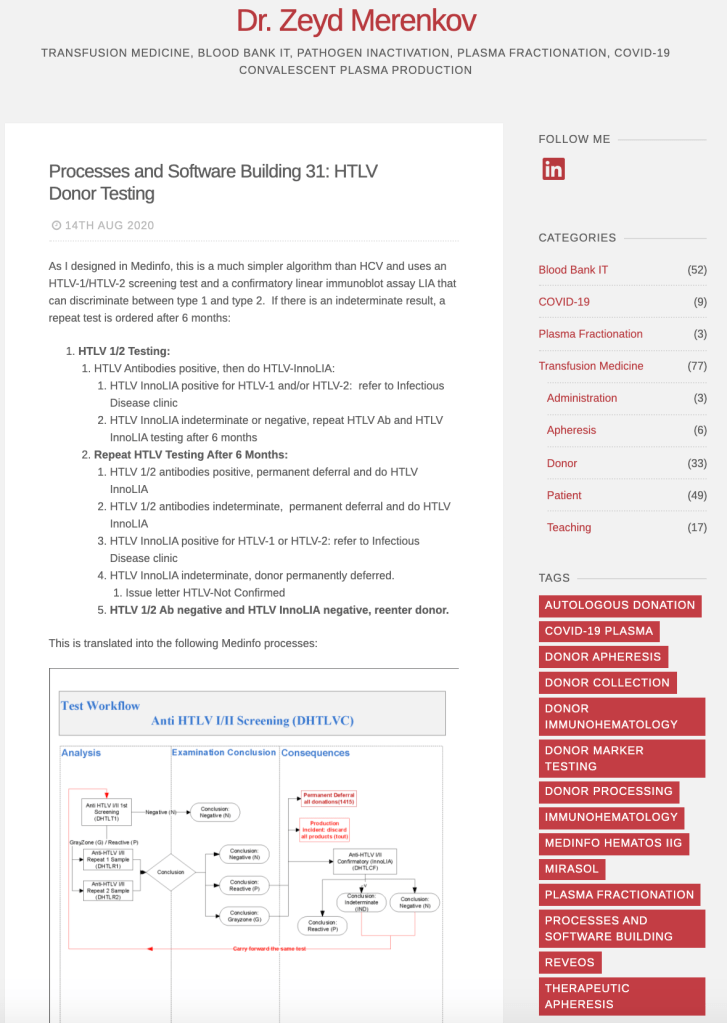
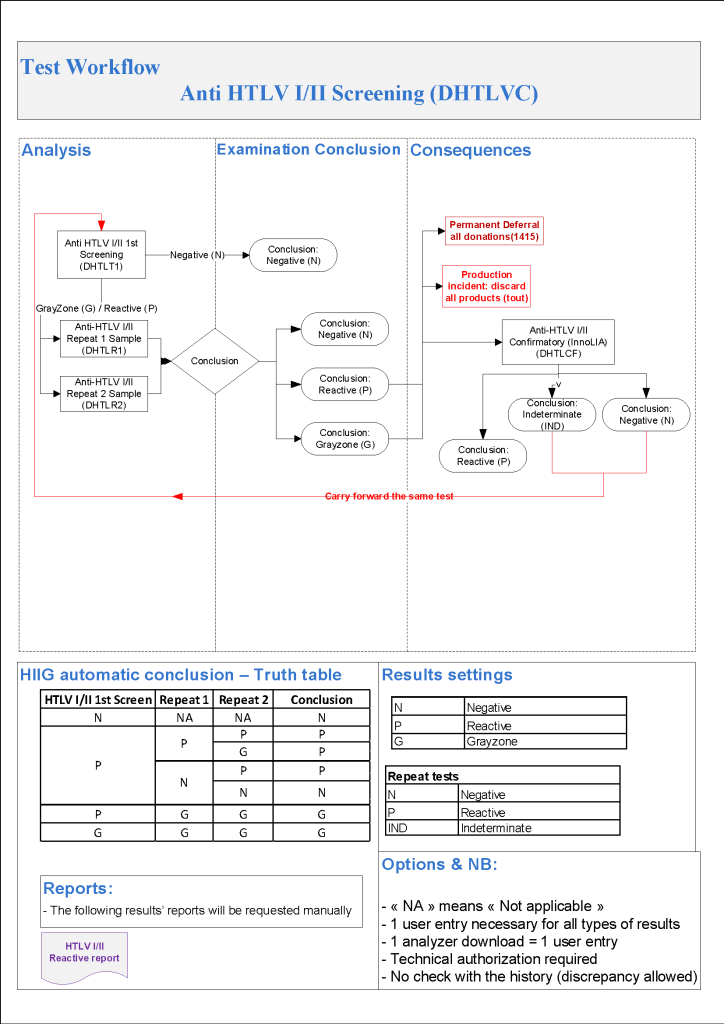
Processes and Software Building 31: HTLV Donor Testing

As I designed in Medinfo, this is a much simpler algorithm than HCV and uses an HTLV-1/HTLV-2 screening test and a confirmatory linear immunoblot assay LIA that can discriminate between type 1 and type 2.  If there is an indeterminate result, a repeat test is ordered after 6 months:

  1. HTLV 1/2 Testing:
    1. HTLV Antibodies positive, then do HTLV-InnoLIA:
      1. HTLV InnoLIA positive for HTLV-1 and/or HTLV-2:  refer to Infectious Disease clinic
      2. HTLV InnoLIA indeterminate or negative, repeat HTLV Ab and HTLV InnoLIA testing after 6 months
    2. Repeat HTLV Testing After 6 Months:
      1. HTLV 1/2 antibodies positive, permanent deferral and do HTLV InnoLIA
      2. HTLV 1/2 antibodies indeterminate,  permanent deferral and do HTLV InnoLIA
      3. HTLV InnoLIA positive for HTLV-1 or HTLV-2: refer to Infectious Disease clinic
      4. HTLV InnoLIA indeterminate, donor permanently deferred.
        1. Issue letter HTLV-Not Confirmed
      5. HTLV 1/2 Ab negative and HTLV InnoLIA negative, reenter donor.

This is translated into the following Medinfo processes:

To Be Continued:

15/8/20

Handling of Placenta Previa in the Blood Bank

The following protocol is the one I made for National Guard Health Affairs in Riyadh and has been updated to include the use of a blood bank computer system.

Medinfo has an emergency mode that facilitates release of blood components even if all the usual testing is not available

If Medinfo software is used, one can write a protocol based on the diagnosis of placenta previa to automatically allocate the blood and keep it on hold at all times.

Ward Responsibilities:

  1. As soon as a patient with high-risk placenta previa is identified, order type and crossmatch for 4 units PRBCs.
  2. Immediately forward the specimen and its requisition to the blood bank for expedited processing.  BE CERTAIN TO INDICATE ON THE FORM AND/OR IN THE COMPUTER SYSTEM THAT THIS IS A PLACENTA PREVIA CASE!!
  3. Send a new specimen for crossmatching every 3 days until delivery.
  4. Phone the blood bank immediately when blood is needed for the patient before coming to the Blood Bank.  DO THIS BEFORE SENDING SOMEONE TO THE BLOOD BANK TO PICK UP THE BLOOD!

Blood Bank Responsibilities:

  1. Check the order comments for placenta previa.
  2. Handle all such requests as emergency or STAT.
  3. Enter a comment in the computer that this is a placenta previa case.
  4. Verify that the specimen has been properly collected and labelled.
  5. If the specimen is not acceptable, request new specimen.
  6. In emergencies, use emergency release/emergency mode in Medinfo.
  7. If specimen valid:
    1. Perform ABO/Rh typing and antibody screen if one is not available within the past 3 days.
    1. Check for previous history of ABO/Rh typing and antibodies—performed by blood bank computer system.
  8. Allocate 4 units, electronic crossmatch or full AHG as indicated by our rules.
    1. Provide antigen-matched units accordingly.
  9. When the ward calls that a placenta previa patient needs blood, immediately prepare the blood for release.  This is an emergency request of the highest priority.  VERBAL REQUESTS FOR BLOOD IN THESE CASES ARE ACCEPTABLE.
    1. Use emergency mode/emergency release in Medinfo if all the testing is not done or current.

Processes and Software Building 30: Donor HCV Screening Tests

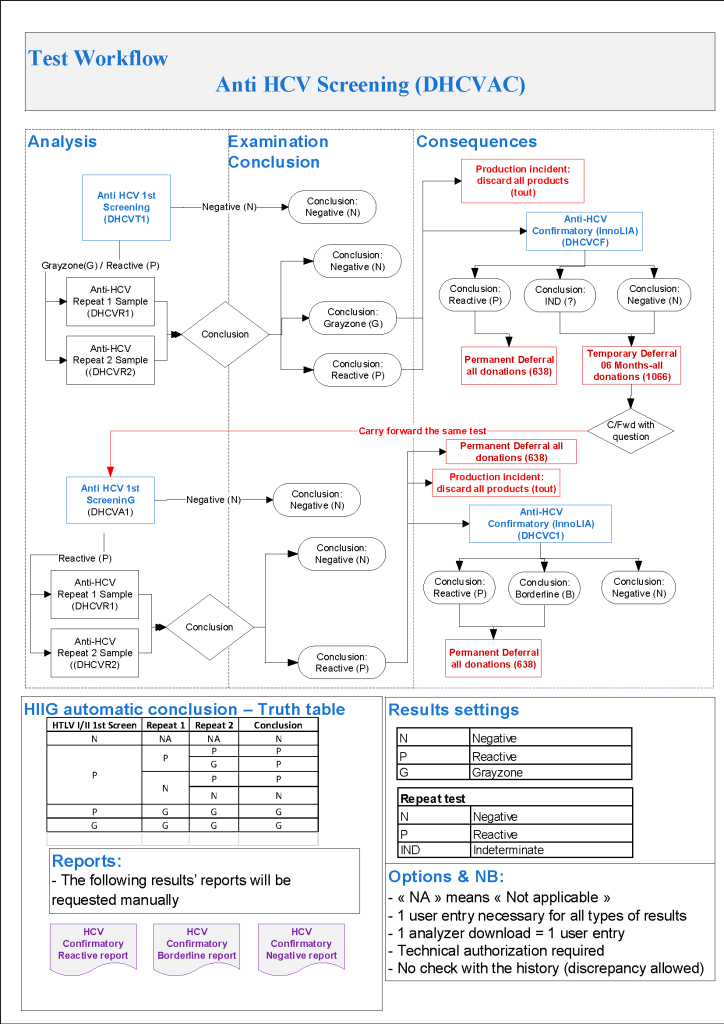
The testing algorithms may trigger additional testing, repeat of current testing at some future date, or permanent deferral.  One of the most complex processes is for HCV testing.  The following criteria are based on US FDA CBER guidelines, but are modified for the availability of test methodologies not licensed in the USA.

For HCV, we use the following testing in all donors:

  1. HCV antibody EIA
  2. HCV NAT
  3. If any of the tests are non-negative, then we do the HCV LIA immunoblot assay. 

HCV LIA is more sensitive than RIBA-3 (now no longer performed in the USA) but is not available in the USA.  This test has been incorporated into the testing algorithm from CBER:

  1. Hepatitis C:
    1. HCV-RNA positive confirmed, regardless of other HCV results:  permanent deferral, refer to Infectious Disease clinic
    2. HCV-RNA borderline:  repeat all HCV testing after 6 months
    3. HCV-InnoLIA positive, regardless of other HCV results:  permanent deferral, refer to Infectious Disease clinic
    4. HCV-InnoLIA indeterminate:  repeat all HCV testing after 6 months
    5. HCV-Ab positive, HCV-RNA negative, do HCV-InnoLIA:
      1. If HCV-InnoLIA positive, permanent deferral, refer to Infectious Disease clinic
      2. If HCV-InnoLIA indeterminate or negative, repeat all HCV testing after 6 months
    6. Repeat Hepatitis C Testing After 6 months:
      1. HCV-RNA or HCV-InnoLIA positive:  permanent deferral, refer to Infectious Disease clinic
      2. HCV-RNA or HCV-InnoLIA borderline:  permanent deferral, HCV infection not confirmed
      3. HCV-Ab positive or borderline without positive HCV-RNA or positive HCV-InnoLIA:  permanent deferral, HCV infection not confirmed
      4. HCV-Ab negative, HCV-RNA negative, HCV-InnoLIA negative:  reenter donor into donor pool

Note that indeterminate HCV results may be carried forward repeatedly by CBER rules but I decided to permanently defer the donor after 2 cycles of indeterminate results.  The donor must wait SIX MONTHS before the next round of testing.  Should he/she return before that time, those results may not be used for determining donor eligibility (unless the results have become clearly positive).

To Be Continued:

10/8/20

Processes and Software Building 29: Donor Marker Testing Overview

Donor marker testing algorithms are very complex and serve multiple objectives:

  1. Is the blood safe for the recipient, i.e. minimize likelihood of disease transmission?
  2. How do we to counsel the affected donor?  Does he need referral for treatment or follow-up?

Often the donor disposition is unclear based on a single encounter and a temporary deferral must be triggered so the current results may be compared to future ones, usually after 8 weeks, 6 months, or one year—depending on the pathogen in question.

Regretfully, the significance of reactions that do not meet the criteria for positivity may be unclear.  It is very difficult to explain to the donor that he has abnormal results and cannot donate but we as physicians do not know what their significance is.

Thus, the testing algorithms may trigger current additional testing, temporary deferral with repeat of testing at some future date, or permanent deferral.

At my previous positions, I started with the AABB/FDA CBER Uniform Donor Questionnaire UDQ and then modified it to include some advanced methodologies not available in the USA.

In the next series of posts I will elaborate on the processes developed for this for each marker.

To Be Continued

9/8/20

Processes and Software Building 28: Donor Questionnaire

Donor Collection 6

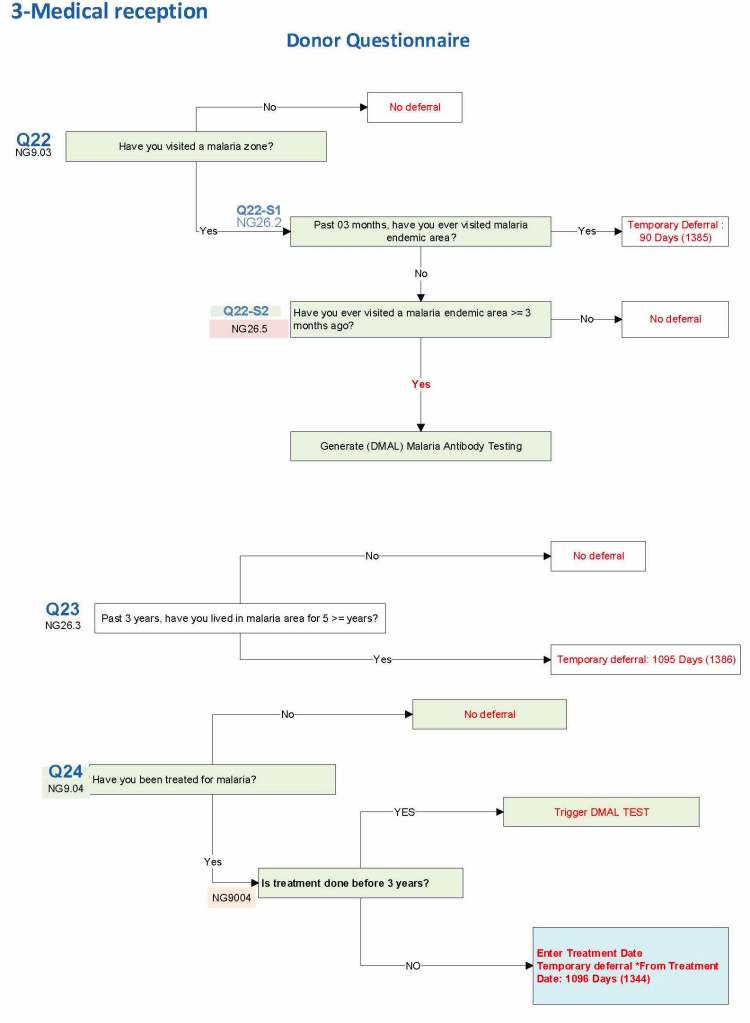
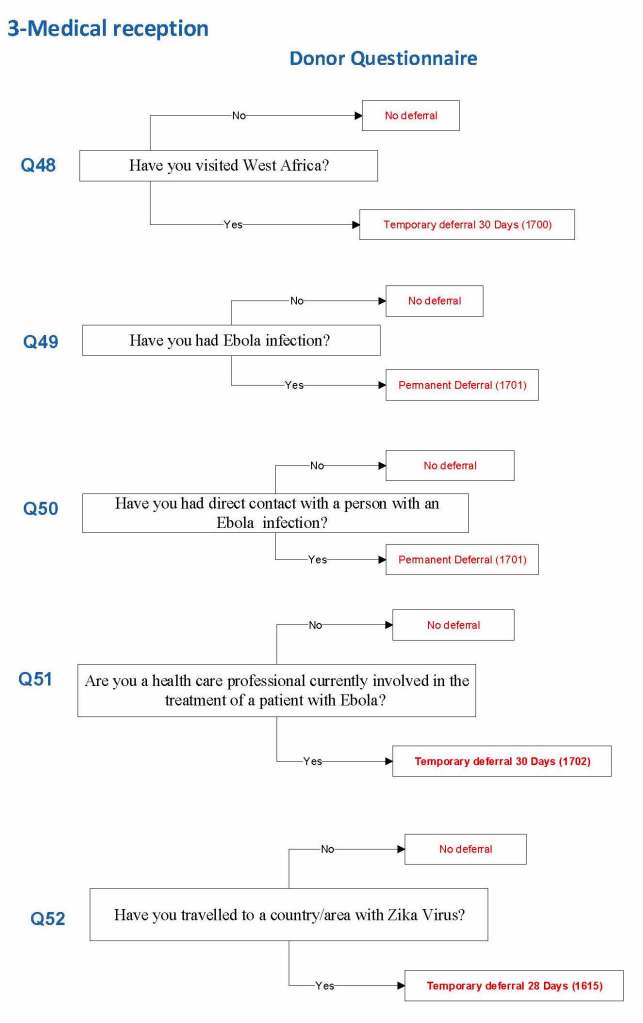
I started building this using the Uniform Donor Questionnaire UDQ from the AABB;  however, I modified it to include coverage for Chikungunya, Zika, etc. and to include enhanced processes for malaria based on the Australian Red Cross.

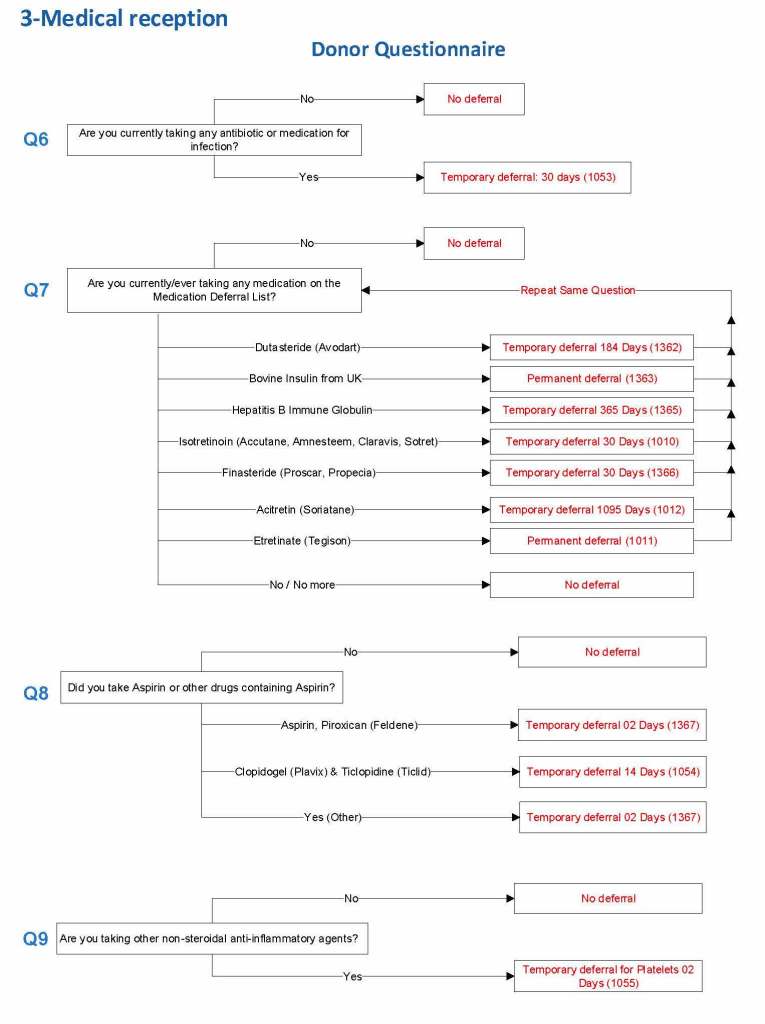
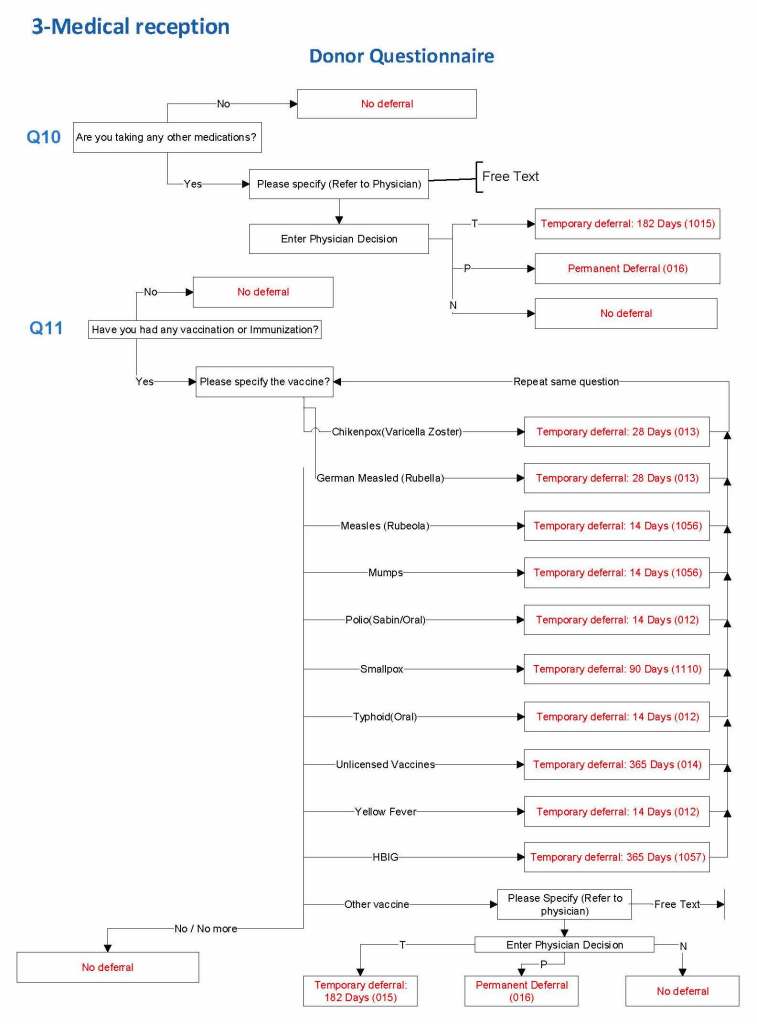
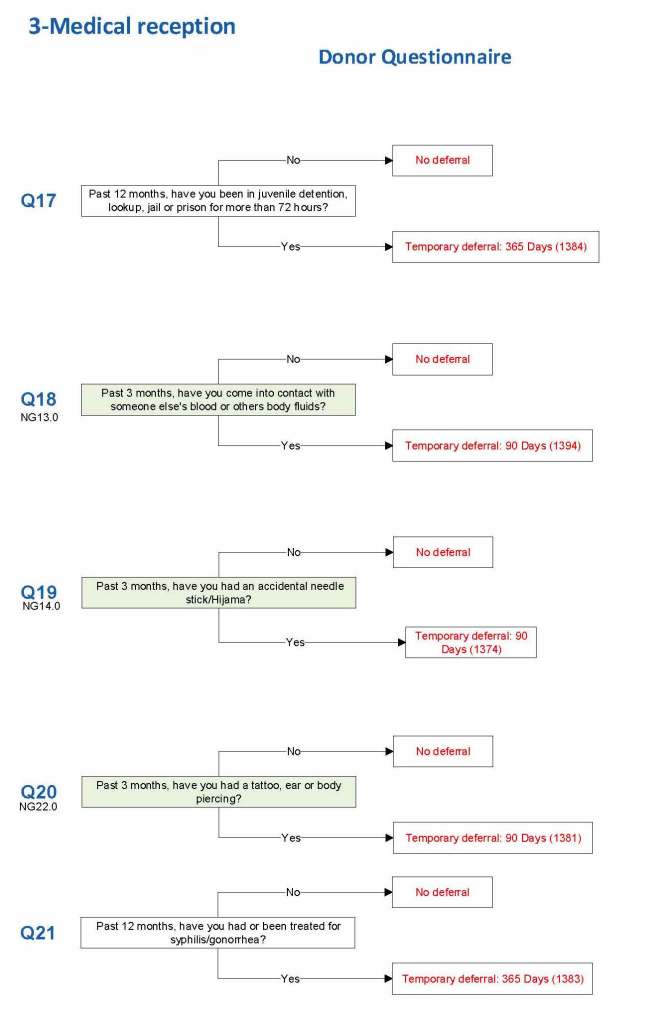
For each screening question, I prepared the exact wording (usually the UDQ’s) and set the deferral to temporary (how many days) or permanent.

Some questions were more open-ended, and the interviewer manually entered a medication, surgical procedure, etc.  The transfusion physician would review this and assign a temporary (specifying the interval) or permanent deferral.

The questionnaire was constantly being updated by changes.  My role was to review different accreditation systems (AABB, CE, etc.) and the World Health Organization’s websites.  I would then prepare an interim policy and pass the specifications for the changes to the Medinfo software engineer and when ready, finally to the Super Users for testing.  If there was an urgent change, the whole process could be completed in less than one day including validation testing.

The following shows examples of the software processes:

  1. Medications
  2. Body fluid exposures
  3. Vaccinations
  4. Malaria
  5. Ebola/Zika

I emphasize that all of these settings are user-definable (at least in jurisdictions that permit all open, non-turnkey software).

Medication Questions:

Vaccinations:


Blood and Body Fluid Exposures:

Malaria Example:  DMAL refers to the malaria antibody test.


Ebola and Zika Examples:

7/8/20

Processes and Software Building 27 Donor Center 5

Building the Software Processes for the Donor Collection 5: Donor Physical Examination and Adverse Reaction Reporting

Donor Physical Examination and Adverse Reactions

Donor physical examination, along with the donor questionnaire, are important both for donor and patient safety.  In general:

Is it safe for the donor to donate?

Is it safe for the patient to receive the blood even if it is safe for the donor to donate.

Any donor who does not feel well must not donate.  This may be the single most important step in ensuring a safe blood supply.

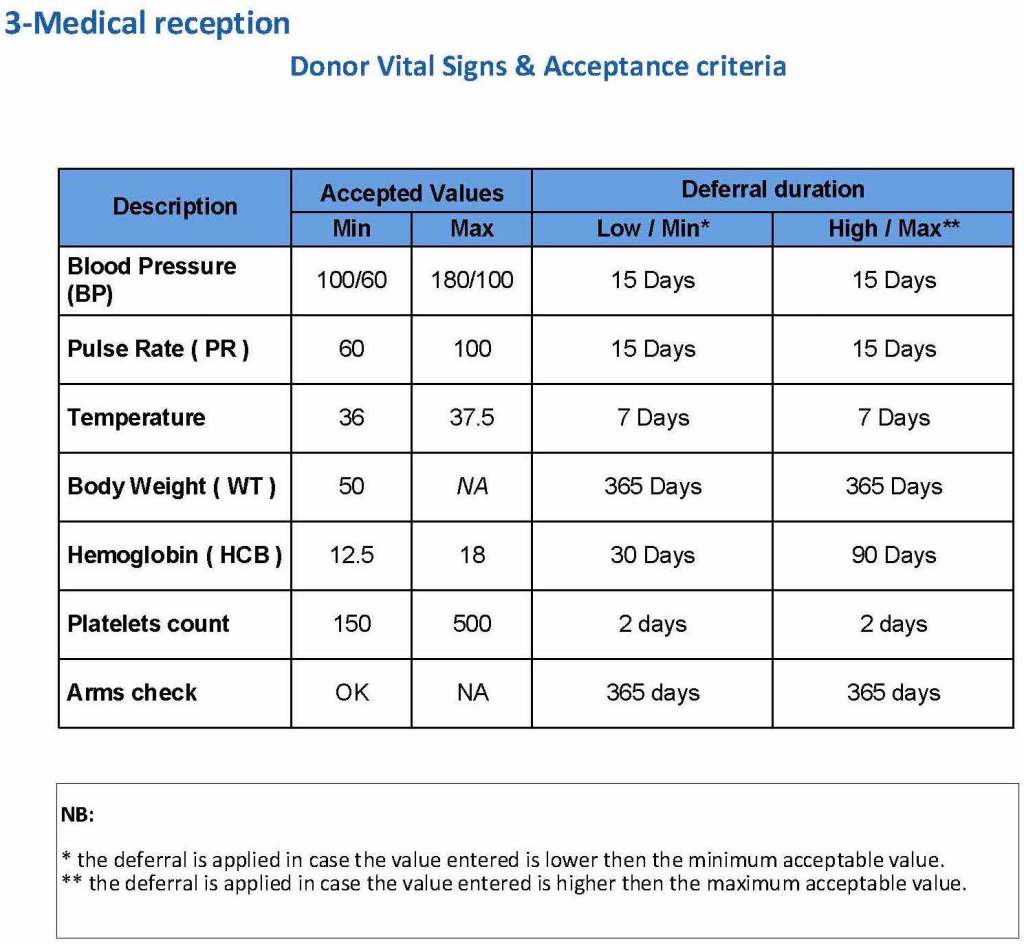
The donor physical examination includes the vital signs (blood pressure, pulse, temperature, heart rate, and temperature).  I have attached a sample set of criteria for review.  All are user-definable.  Note how the arm examination is also included (looking for scarring, skin lesions, etc.)

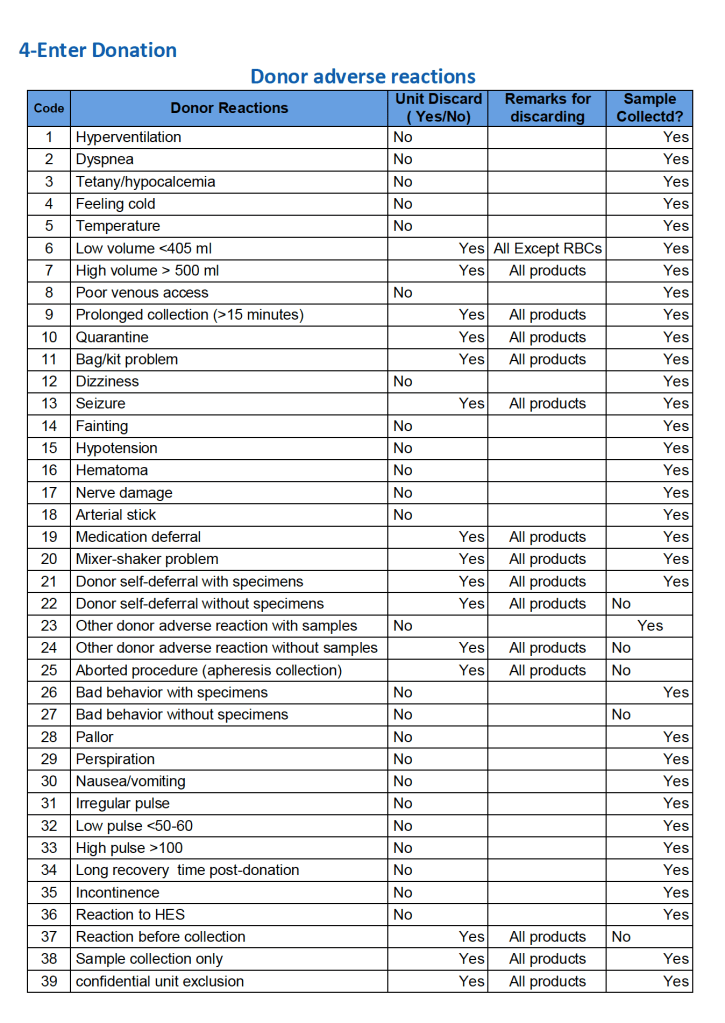
For all types of donations, there may be adverse reactions.  These must be documented in the record along with the disposition of the donation.  Will the donor need an extended deferral if the RBCs in the apheresis run are not returned?  This can be built from the reaction documentation.  Note the following sample table of reactions.

To Be Continued

5/8/20

Processes and Software Building 26: Donor Collection 4

Deferral Intervals for Each Donation Type

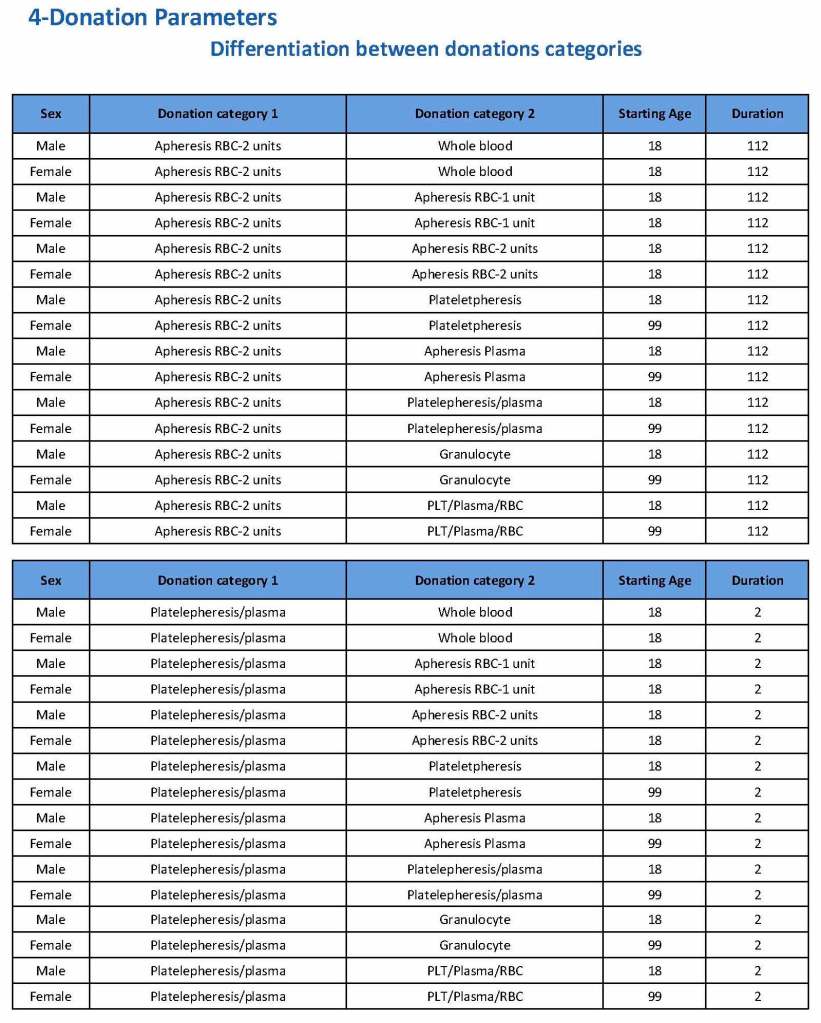
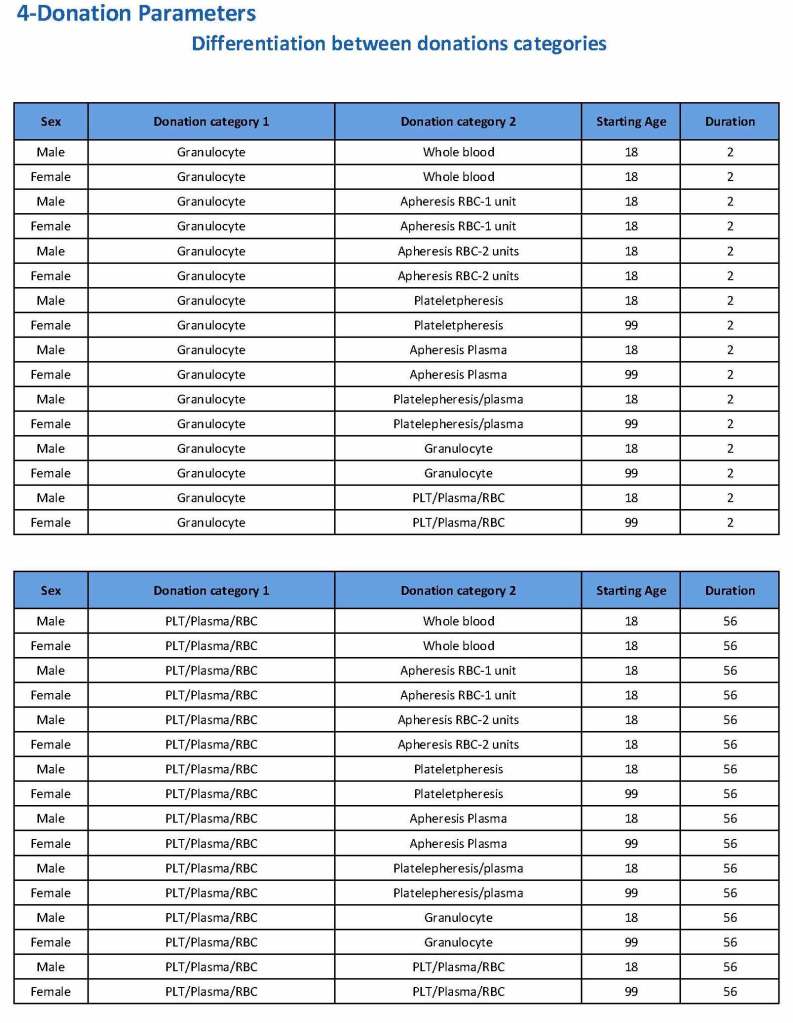
Donation can be whole blood or apheresis-based.  The sex and age for each donation type is specified.  At HMC, we did not accept females for platelet or plasma donations, so the starting age is listed as 99 years.  Otherwise, in accordance with Qatari law, the starting age for donation is 18.  All these parameters are user-definable, and a transfusion medicine physician can override the rules if necessary.

For each and every combination of donations, the deferral interval must be specified.  Examples follow.  The temporary deferral period is in days:

Previous donation whole blood, current donation whole blood:  56

Previous donor platelets, current donation whole blood:  2

Previous donation whole blood, current donation platelets:  56

Also note how for each possible combination there is an entry for male AND female.  Females are restricted to whole blood donation and only RBCs will be made from the collection.

If there is a collection incident and the apheresis procedure is not completed, the interval will be set to 56 days.  This will be covered in the post on donor adverse effect reporting.

To Be Continued:

3/8/20

Daratumumab Anti-CD38 Interference with Compatibility Testing

Principle:

Daratumumab is a monoclonal antibody that binds to CD38 antigen, which is expressed weakly on the surface of all RBCs.  It may thus cause a positive direct antiglobulin test DAT and so interfere with compatibility testing if an antiglobulin phase is required.

This effect may persist up to 6 months after discontinuing the drug.  The monoclonal antibody does not interfere with routine ABO/D typing.

Special techniques (neutralization of CD38 antibodies by CD38 anti-idiotypic antibodies, or soluble CD38 antigen) may remove the panreactivity but are not generally available.  DTT, a sulfhydryl reagent may denature the native CD38 antigen on RBCs but it should be used under a biologic hood.

Kell antigens will be denatured so Kell antibodies cannot be detected after treatment so Kell-negative RBCs should be used.  In the Gulf Area, this is about 72% of RBCs. In the Medinfo software a rule to require K-negative RBCs has been built.

Policy:

  1. The clinical services must inform Transfusion Medicine of patients who will be receiving daratumumab therapy BEFORE treatment is started.
  2. Transfusion Medicine staff will enter a general comment (i.e. not associated with a particular result) in the patients Medinfo HIIG record:  PATIENT ON DARATUMUMAB.
  3. If not already done, Transfusion Medicine staff will perform an extended antigen typing:  at least C, c, E, e, K, k, Kpa, Jka, Jkb, Fya, Fyb ,M, N, S, s, Lea, Leb, P1—even if no antibodies are currently identified.
  4. Transfusion Medicine staff will send each such patient’s record to a Transfusion Medicine Physician to determine the blood type including extended antigens to match for future transfusions.
  5. When compatibility testing is requested, perform it as per our SOPs.
  6. If available, prepare DTT-treated cells for testing but realize that this will denature Kell antigens.  Use K-nell RBCs.
    1. Medinfo has a rule to automatically require K-negative RBCs if this medication is used.
  7. Release least “incompatible” RBCs must be approved by the Transfusion Medicine Physician.
  8. When the DAT becomes negative (i.e. up to SIX months after cessation of Daratumumab therapy), routine compatibility testing and RBC selection will apply.

References:

Trick or Treatment, Anti-CD38 Reactivity and How to Treat It, AABB Satellite Symposium transcript, U. Cincinnati and RedMedEd, October, 2015 (attachment)

Processes and Software Building 25–Donor Collection 3

Donation Type and Bag Parameters

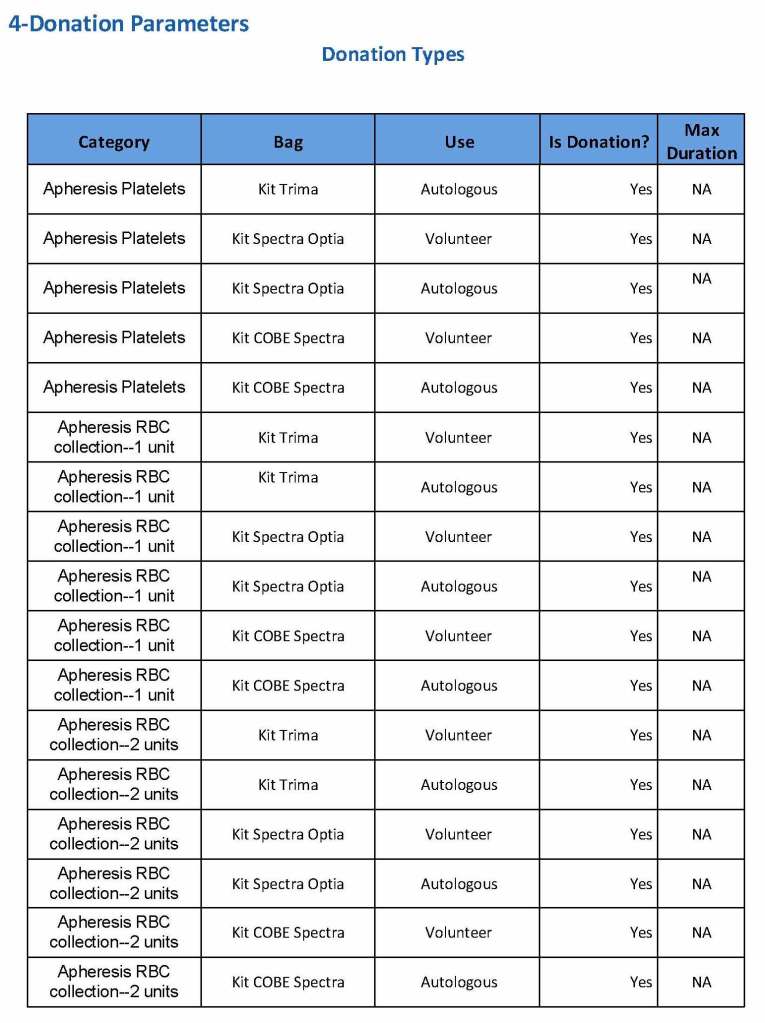
At the time of registration, the type of donation must be specified.  In my last position, this could include whole blood for automated Reveos, whole blood for cryoprecipitate, plasmapheresis, COVID 19 convalescent plasmapheresis, plateletpheresis, concurrent platelet and plasmapheresis, concurrent platelet, plasma, and RBC apheresis, RBC apheresis-one unit, and RBC apheresis-2 units.

There is also a specimen-only donation without actual collection that includes database check, assignment of an ISBT specimen number, donor questionnaire, physical examination, and specimen collection only..

We specified which bag or kit could be used for each type of donation so when it was selected, only that bag type would be accepted by Medinfo

For each of these types we must specify what type of donation is permitted:  volunteer, autologous, or directed.

Finally, we must indicate the maximum length of the procedure permitted.  This applied to whole blood only and we set this at 15 minutes—this is user definable.

The following are a sample set of parameter settings for the above:

Note how we included contingencies for old bag sets and equipment (that we later discontinued) and for granulocyte collection (which we did not actually perform).

To Be Continued:

1/8/20