COVID-19 Convalescent Plasma CCP Series Introduction

I will be posting a detailed series about the manual and software-enhanced COVID-19 processes that I set up in Qatar at HMC Doha in March-April 2020.

In this series I will provide you with screen shots of my Medinfo Hematos IIG software design for each step in the process:  collection, processing, testing, inter-depot transfer, and hospital transfusion service/blood bank release.

This GMP-compliant software-enhanced system is based on the manual system I set up in early March 2020 at HMC.

I want to thank Medinfo Hematos IIG for their rapid response to building this parallel system based on my standard processes in so short a time (two weeks) and my special thanks to the software engineering team at Vital Health Technologies, the agent for Medinfo in Qatar.

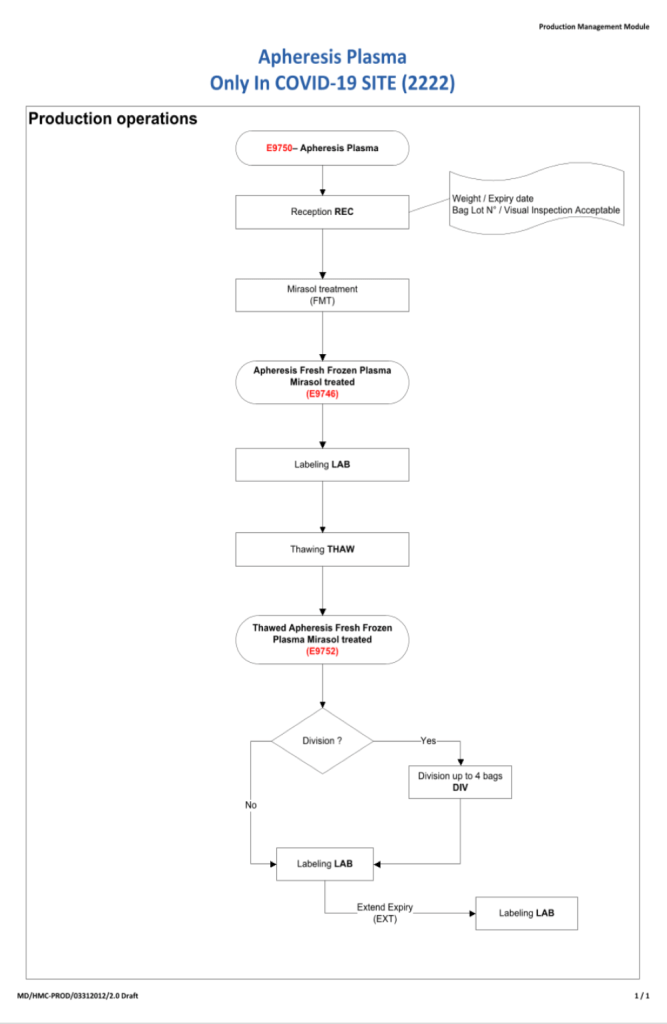
To start the series, I am providing the basic workflow for the system.  As is normal in Medinfo software design, a full mapping of the processes are made.  This workflow shows the new CCP ISBT codes and the quarantine collection and processing steps.  The donor testing (marker and immunohematology) processes are similar to those for regular donor units.

This is basically the same process both manually and in the software.  I always say:

A good software process is based on a good manual process!!

Please note the following workflow for our initial discussion.

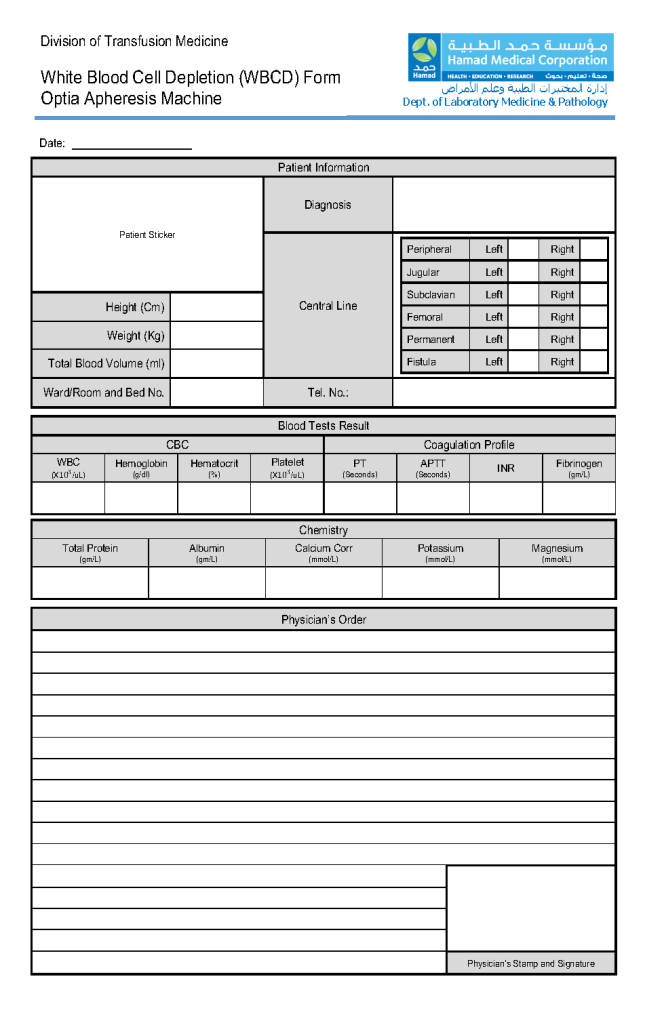
Leukodepletion Apheresis Form

This form is the result of a collaborative effort between my therapeutic apheresis team and me. I want to thank Dr. Saloua Al Hmissi, Consultant, Transfusion Medicine, and Ms. Mini Paul, Head Apheresis Nurse for all their efforts.

This form can be readily converted into a computer data entry form–depending on your software’s capabilities.

Use of Universal Low-Titer Group A Plasma

Principle:

Since group AB plasma is in short supply, use of group A plasma with low anti-B titers may be substituted based on inventory levels.

Policy:

  1. If the AB inventory is low, we will test group A donors at the time of collection for anti-B titers.
    1. The numbers to be tested will depend on the level of the shortage and the availability of equipment to perform titration.
  2. Use the automated analyzer to perform saline anti-B.
    1. If the saline titer is less than or equal to 1:64, the plasma may be used for recipients of any ABO blood group and will be labelled as group AU—A Universal.
  3. Process the unit routinely and perform pathogen-inactivation.
  4. Medinfo Hematos IIG will only label for universal use if the titer is below the cutoff.
    1. The ISBT label must explicitly show group AU plasma and the actual anti-B titer.
  5. Allocation rules for low-titer group A plasma will be identical to group AB except:
    1. For neonates, preferentially use group AB.
    2. For children < 20 kg, use ABO-compatible plasma (non-group AB) before selecting group AB or if not available, low-titer A in that order.
  6. Donors must have a new anti-B titer performed each donor encounter.

References:

  1. Technical Manual, Current Edition, Bethesda, MD, USA
  2. Standards for Blood Banks and Transfusion Services Current Edition, AABB, Bethesda, MD, USA

Framework for Establishing the Use of Universal Low-Titer Group A Plasma

This post outlines a framework for establishing the use of low-titer group A plasma as a universal donor.  Manual titering large number of donor specimens in my organization is not practical.  Using an automated system will also increase the precision of the results.

Process:

  1. Select a cut-off anti-B titer.  This should be determined by the blood bank medical director.
    1. I selected saline 1:64 based on recent THOR (Thrombosis Hemostasis Oxygenation Research) meetings
  2. Perform a survey of the anti-B titers in your blood donor population.
    1. At my sites, about 50% had titers less than or equal to 1:64.
    2. Determine how stable the titer is:
      1. For serial donor plasmapheresis, how long could you accept the donor as low-titer?
      2. Does the titer change between whole blood donations?
  3. Determine the target inventory level for universal plasma (group AB and low-titer A) based on current/past usage.
  4. Assess availability of automated immunohematology analyzers for titration.
    1. Titration may take up to 30 minutes per sample, during which time the machine cannot be used for any other purpose.
  5. Add a new blood type AU (for group A universal) for plasma in your blood typing algorithm.
    1. AU should be used interchangeably with group AB.
  6. Software:
    1. Set up new truth table in your blood bank computer system.
    2. Validate the modification in your blood bank donor and patient modules.
    3. Update ISBT code for this new product, verify your transfusion service module can read this.

Special notes:

  1. At my last location, we had only 3 analyzers capable of doing the titration.  Thus, we could only do 6 titrations per hour at the expense of stopping all other testing.  You will have to coordinate the titration with your other immunohematology testing.  Also, verify if all these equipment interface to your production software.  In my system, any test (including titration) could be performed at any location and its results be used for production purposes.
  2. Donor ABO antibody titers may fluctuate.  I would not use previous results to qualify a donor to be AU.  I would repeat the anti-B titer each donor encounter.  If I collect donor plasmapheresis, I would determine for how long the titer can be used (see 2.2.1 above).

References:

  1. Technical Manual, Current Edition, Bethesda, MD, USA
  2. Standards for Blood Banks and Transfusion Services Current Edition, AABB, Bethesda, MD, USA
  3. Medinfo Hematos IIG Donor Production Module

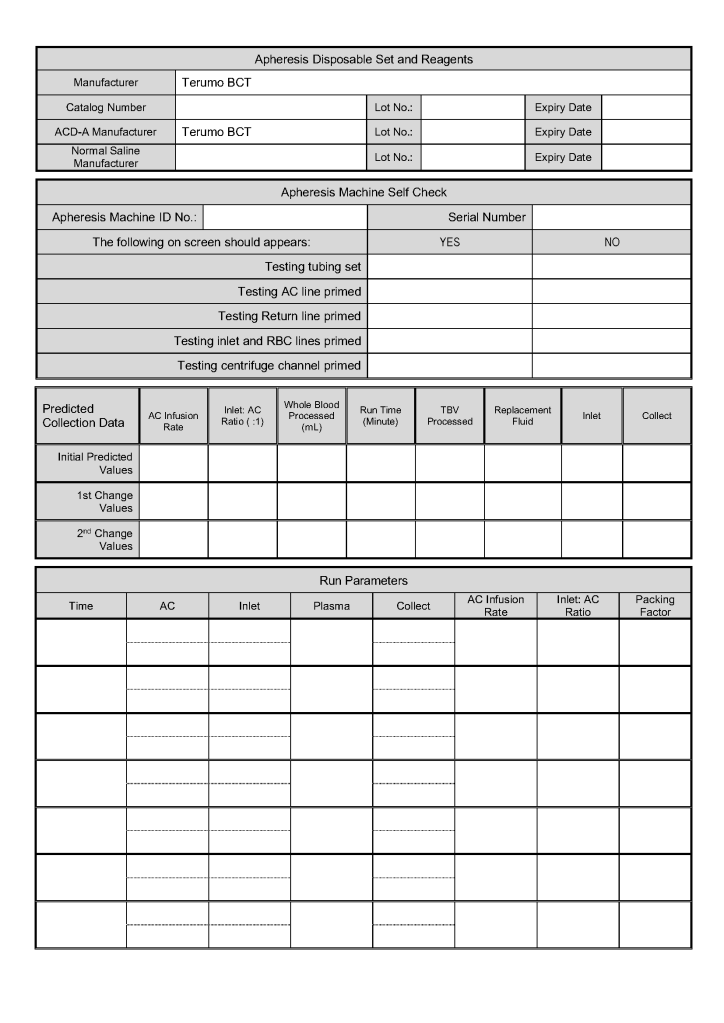
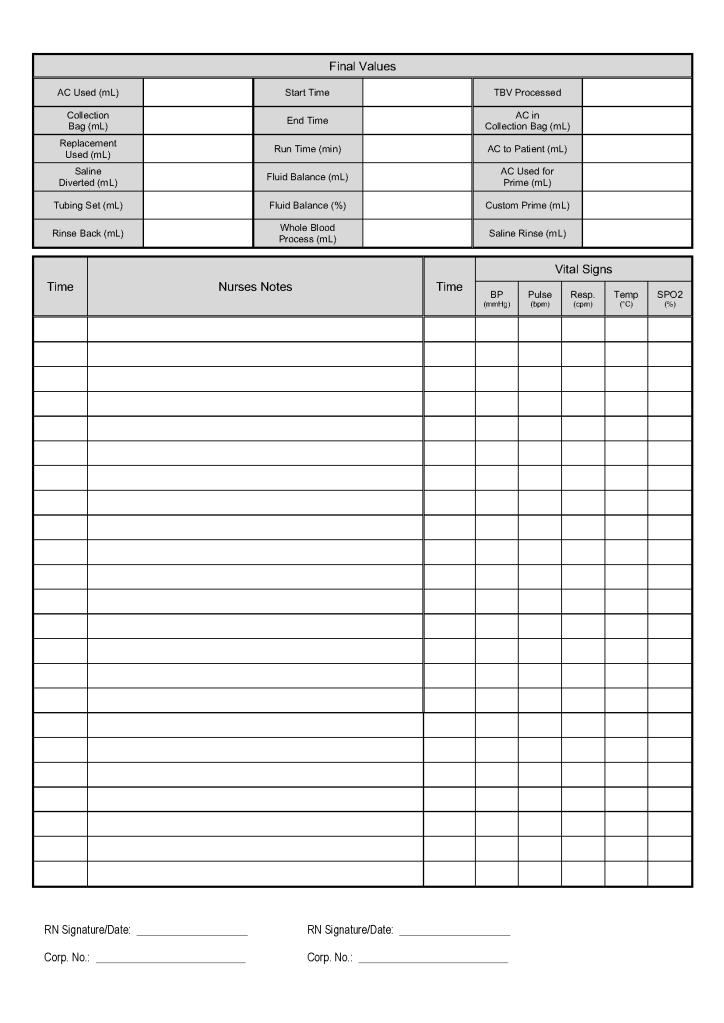
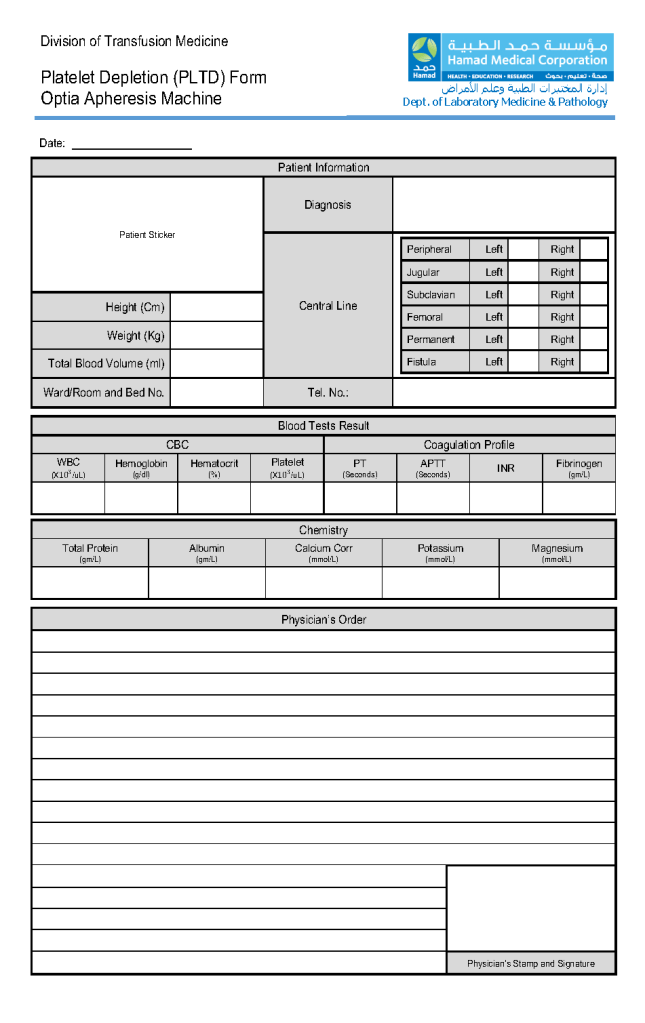
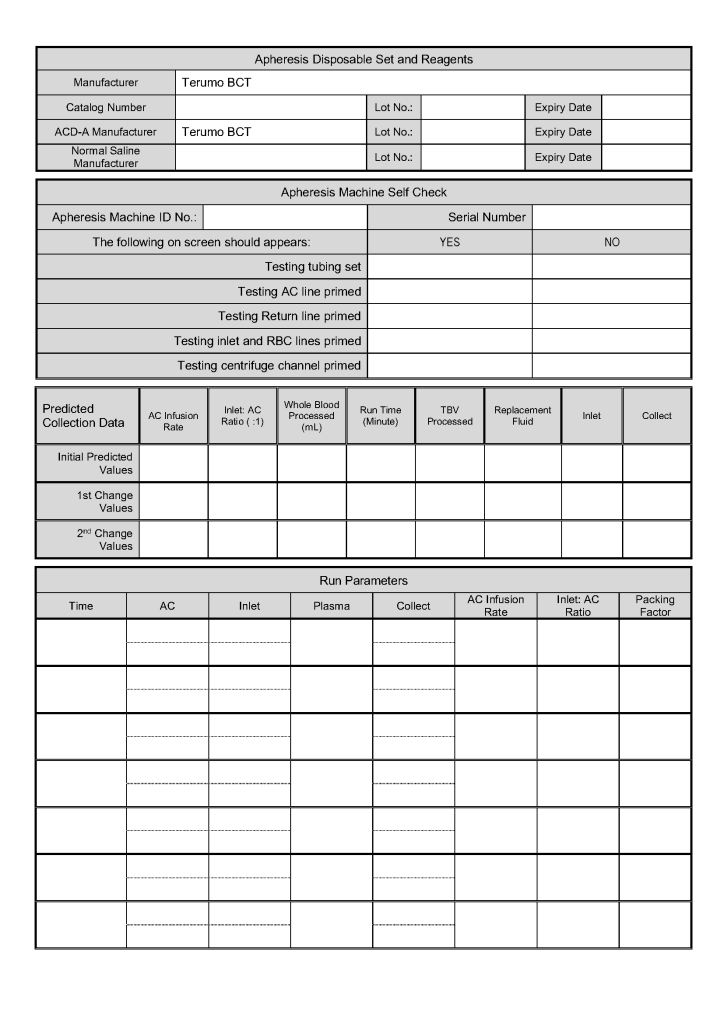
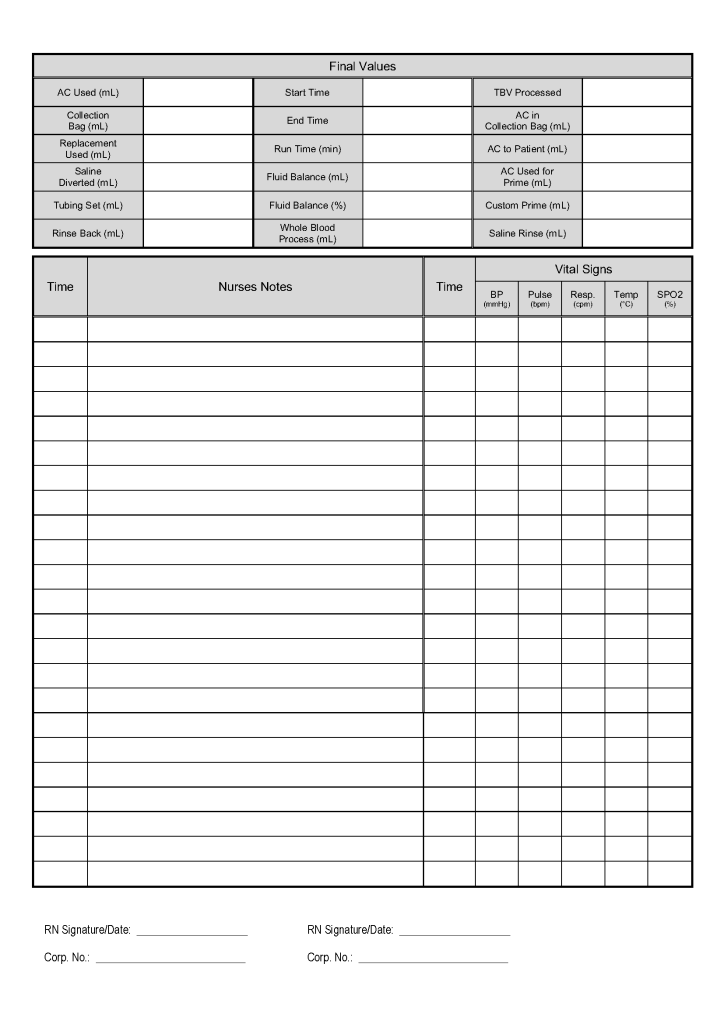
Platelet Depletion Apheresis Form

This is the apheresis form used for reductive thrombapheresis developed by my apheresis team and me. In particular, I want to thank Dr. Saloua Al Hmissi, Consultant Transfusion Medicine, and Ms. Mini Paul, Head Apheresis Nurse, all their hard work.

The attached form can be developed into a computer entry form if one has a suitable hospital information system. It is organized so that the apheresis nurse can quickly enter the data on one screen. Never forget that our goal is treat the patient–not spend all of our time on data entry!!

20/12/20

Data Entry Verification: Updated Version

This is an update from the previous version posted to include low-titer group A FFP/FP24 and low ABO-titer group O whole blood.

Principle:

This policy outlines steps taken to minimize the risk of data entry errors and is based on a dualistic approach:  review of results by a senior technologist and/or supervisor and various computer safeguards built into the Medinfo Hematos IIG blood bank computer HIIG system.  This policy also discusses the verification (here called authorization) and purge processes of HIIG.

Policy:

  1. Review by senior technical, supervisory, or transfusion medical staff:
    1. Designated test procedures require review by a second technologist before authorization.
    2. Complex immunohematology testing and specimens showing aberrant results (e.g. ABO/D discrepancies) are reviewed by the supervisors or designates and ultimately a transfusion medicine physician before authorization.
  2. Computer system HIIG rules:
    1. Privileges:
      1. System restricts which staff can perform specific tests
    2. Patient/donor identity:
      1. System asks end-users to verify patient/donor identity before starting any access to the patient/donor record.
      2. System performs historical database checking and flags any inconsistencies (e.g. historical ABO/D typing differences, etc.)
    3. Testing:
      1. Only selected staff have privileges to authorize or purge.
      2. ABO/D testing algorithms require entry of reactions, not interpretation of results and are compared to a truth table.
        1. Aberrant results require special review before ABO/D typing results can be authorized/purged.
        2. D-controls must be negative to allow D typing results to be authorized for liquid D-typing reagents.
      3. DAT results require appropriate controls to meet truth-table criteria.
      4. Eluates require last wash to be negative before authorization
    4. Blood components:
      1. Selection of RBC or plasma units requires two independent sample determinations within 72 hours of each other.
      2. ABO-incompatible RBC or FFP/FP24 transfusions are not allowed.
      3. Titer-based ABO blood group selection:
        1. Low titer group A FFP may be used as universal plasma like group AB.
        2. Group O whole blood with low anti-A and anti-B titers may be used for all ABO types.
        3. Acceptable titer threshold is specifically defined as parameters in Medinfo.
      4. Donors with any detectable clinically significant antibodies are permanently deferred.
      5. Depending on the patient’s antibody history, release of RBC units may require antigen-matched units.  Examples:
        1. Mandatory matching (only antigen negative matched units allowed—no antigen positive or antigen-untyped units):  Antibodies against H, D, c, K, k, Kpa, Kpb, Jsa, Jsb, Jka, Jkb antigens, anti-PP1Pk
        2. Priority matching (incompatible or untested can be approved by a transfusion medicine physician):  C,E, e, Fya, Fyb, M, S, s
        3. Antigen matching not required:  Lea, Leb, N
      6. Least-incompatible crossmatch require special authorization to release
      7. Protocols to force irradiation or other modified components can be setup in HIIG.
    5. Donors:
      1. Donor tests have same criteria as the same test used in patient testing for controls, etc.
      2. Donor demographics are read directly from the Ministry of Interior database—no manual entry (bar code only used).

References:

  1. Workflows for Hematos IIG (1001 through 1005), 2013-2020
  2. Standards for Blood Banks and Transfusion Services, Current Edition, AABB, Bethesda, MD, USA
  3. Guidelines to the Preparation, Use, and Quality Assurance of Blood Components, European Committee (Partial Agreement) on Blood Transfusion (CD-P-TS), Current Edition

Preventing Graft vs. Host Hemolytic Anemia

Principle:

Donor lymphocytes in an organ transplant may make antibodies and cause a clinically significant hemolytic anemia, i.e. a graft vs. host hemolytic anemia GVHHA.  Optimal handling in these cases should include antibody screening/identification for all potential donors and recipients.  The transfusion medicine physician should review the results for possible issues of antibody/antigen incompatibilities to proactively select matched blood components and avoid GVHHA.

In the Medinfo blood bank computer system, we can make custom rules to ensure release of only antigen-matched units as needed.

Policy:

  1. Perform antibody screen and identification (if indicated) for all prospective organ donors and recipients.
  2. If the organ donor has clinically significant antibodies, check if the recipient has the corresponding antigens.  If so, select RBC units negative for the donor antibody specificities. 

Example:  Donor has anti-Kell (K1) and patient is K1-positive.  Use only K1-negative RBCs post-transplant.

  • Send the case to the transfusion medicine physician to review.  He will contact the clinicians as indicated.
  • Create a rule in Medinfo forcing the antigen matching.

References:

  1. Technical Manual, Current Edition, Bethesda, MD, USA
  2. Standards for Blood Banks and Transfusion Services Current Edition, AABB, Bethesda, MD, USA

Patient D-Typing Algorithm Using Ortho Monoclonal Cocktail Reagents

Principle:

We must select D-negative RBC units for transfusion if the patient is truly D-negative or if he/she is a partial D since transfusion of a partial D positive unit may induce antibodies against any part of the D molecule.  Thus, for patients, we will consider patients with partial D as D-negative.  Note that this is NOT the usual practice in the USA;  however, AABB Standards do allow that we do NOT test patients for weak D and give D-negative RBCs instead.

Background:

Ortho Diagnostics Reagents use two different monoclonal antibody cocktails that react variably with the antigen D (Rh1)—these are found on the card:  Anti-A/B/A,B/D/D/Ctrl:

Anti-D/Anti-RH1—IgM monoclonal antibody clone D7B8 can detect most examples of weak and partial D including weak D types 1, 2, 3, 4.0, and D categories II, III, IV, V, VII, DBT, and R0HarIt does NOT detect category VI.  Retest positive reactions of 2+ or less by an alternate method.

Anti-D/Anti-RH1—IgM monoclonal antibody RUM1 can detect most examples of weak and partial D including weak D types 1, 2, 3, 4.0, and D categories II, III, IV, V, VII, DBT, and R0HarIt does NOT detect category VI.  Retest positive reactions of 2+ or less by an alternate method.

Policy:

  1. Follow the manufacturer’s instruction for storage, handling, and usage of all reagents.
  2. If the D-control is positive, the reactions are indeterminate, repeat by another method.
  3. Run both anti-D reagents listed—do not use the donor typing algorithm or reagents.
  4. Use the following table for interpretation and further actions if needed:
Pattern #Anti-D/D7B8Anti-D RUM1D-Interpretation
1PositivePositiveD-positive
2PositiveNegativeDo additional testing
3NegativePositiveDo additional testing
4NegativeNegativeD-negative  

If the reaction is 2+ or less with either the Ortho anti-D/D7B8 reagent or anti-D/RUM1 or if the patterns 2 or 3 above, repeat by another manufacturer’s reagents.  In the meantime, consider the patient as D-negative.

Medinfo-Ortho interface settings for Patient Testing:

Anti-D/D7B8Anti-D RUM1D-Interpretation
3, 43, 4D-positive
3, 40~
03, 4~
00D-negative
~~~

Note all of the following:

  1. If the result is D-indeterminate, use D-negative RBCs.
  2. No reagents may be able to detect all D variants.
  3. ~ means any other value for that reagent (1+, 2+, mf, hemolyzed)
  4. Note that this new algorithm makes a 2+ reactivity as indeterminate with Anti-D/D7B8 or Anti-D/RUM1.

References:

  1. Publication e631300291, Product Insert, Anti-A/B/A,B/D/CDE/Control Card, 2010, Ortho Clinical Diagnostics, High Wycombe, Buckinghamshire/UK
  2. Standards for Blood Banks and Transfusion Services, Current Edition, AABB, Bethesda, MD, USA

Opinion: Handling Incorrect Physician Orders

Most of the non-transfusion-medicine physicians with whom I have worked have had only limited training in placing component or hospital blood bank orders.  In previous posts I have discussed this and suggested that all physicians who may possibly order blood bank tests or blood components should have a training and documented competence on a periodic basis.  Only a very few physicians, mainly hematologists and some organ transplant physicians, have placed reliable orders.

Before we had a blood bank computer system, we received orders on a manual paper requisition.  If there were errors, my technical staff and I corrected the order.  Any changes were made by me in my capacity as the blood bank medical director.  The ordering physicians and I had good relations and they had no problem with this—in fact, many were afraid of the blood bank and felt happy to be relieved of the responsibility.

In the current software era, what happens depends on how the order is placed.  Can the technical staff and I correct the order directly or must we each and every time contact the physician to revise his/her order?  Do my staff have to cancel each erroneous order and wait for the corrected order?  This could slow down the work process and prevent release of blood components in a timely manner.

Should the non-blood bank physician be allowed to order our complicated esoteric transfusion tests directly—e.g. ordering extended antigen typings or antibody identifications or elutions?   What if they order something unnecessary or inappropriate?

At a recent hospital position as Division Head of Transfusion Medicine, I discovered that the Hospital Information System HIS was very slow for all blood bank orders.  The physicians complained, I would allow them to bypass the HIS and use the manual backup system in critical situations.  If we had been forced to cancel the order and have the physician reorder, this would have greatly disrupted the work process.

We did not use the HIS at all in Transfusion Medicine.  We had patient and donor modules in the dedicated blood bank system Medinfo.  We had a limited ordering interface from the HIS to Medinfo for blood components and some basic testing (e.g. ABO/D typing, DAT, type and screen/group and save, cord blood testing, and transfusion reaction workups).  All work was done in the dedicated blood bank system.

All components were leukodepleted to < 1E6, all platelet and plasma were Mirasol pathogen-inactivated, all platelets were in platelet additive solution PAS.

The doctors did not order the specific blood component, rather they indicated a preference, e.g.

  • Packed RBCs
  • Platelets (adult dose of 2.4 E11)
  • Plasma
  • Cryoprecipitate

The following appeared as an order comment in the blood bank system:

  • The specific number or amount of the each component type
  • Preferences for pooled vs. apheresis platelets, washed RBCs, irradiated RBCs.

The blood bank staff could review the doctor’s request and order in Medinfo as per our internal protocols under my responsibility.  In effect, I was modifying the orders when needed just as I had done under our manual system.  This included type, modification, and quantity.  Yet now, I did not have to change any orders since the doctors had only indicated preferences.

For blood bank testing orders, we had our own internal algorithms for the workups.  The doctors could not order antibody identifications, elutions, or any antigen typings other than ABO/D.  They latter were triggered by the screening test results.

This system allowed us to avoid cancellations due to physician errors.  I was very comfortable taking the responsibility to alter the orders for best patient care.  If a physician did not agree with our algorithms, they could discuss the issue with one of the transfusion physicians, or ultimately appeal to me.  I was fortunate that there were no legal issues with this approach where I practiced.

In summary, my recommendations are:

  1. Have the doctors order a preference for the type of blood component.  They still order the quantity and can request modifications such as washing or irradiating or apheresis-derived or buffy coat pool platelets.  The actual allocation is made by blood bank staff under my direction.
  2. Offer algorithmic based testing.  Doctors only order basic testing which triggers reflex algorithms.  Most of the test menu is not orderable directly by the physicians (example:  an antibody identification is triggered by a non-negative antibody screen.

9/12/20

Off-Line Donor Medinfo Transactions

Principle:

When you cannot establish a direct link to the live Medinfo program, you must arrange for the local Medinfo engineers to create a local server that will have the current Medinfo donor database for use at outside campaigns where the internet connection cannot be used.  This can also be used if for some reason the Blood Donor Center link is down in order to register donors and check the donor deferral database.

Policy:

  1. For each outside campaign, there should be a pre-campaign visit to verify the availability of internet to connect to Medinfo.
    1. If the internet connection is working, use Medinfo using the 4G access points.  Otherwise:
    2. If none, inform the Medinfo engineers to prepare a local server on one of the laptops at least ONE DAY in advance of the campaign.
      1. Give Medinfo engineers the laptop to download the database and software.  This will be the offline server for the campaign.
      2. Link the offline server to the other portable computers for the campaign (see the corresponding Medinfo job aid).
      3. Use the local network (offline server and other portable computers) for registering donors.
      4. Upon return to the Blood Donor Center, upload the data.
      5. Continue the regular processes after uploading.

Note:  When the offline data is uploaded into Medinfo main database, it will be checked against the latest donor deferral database.  The latter will be applied for the donation.