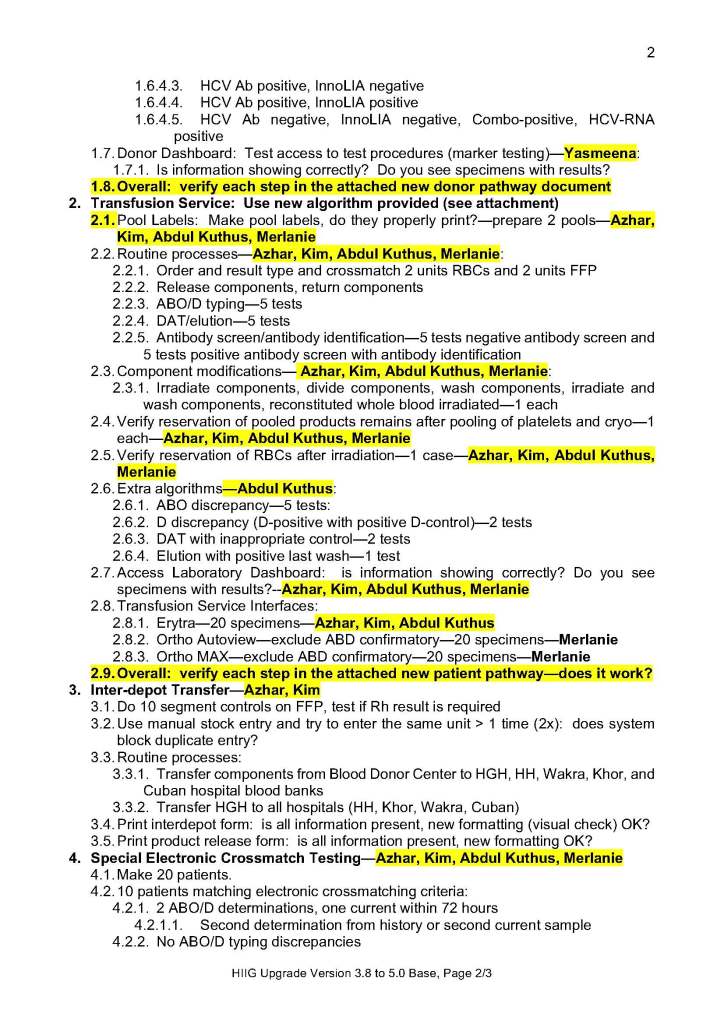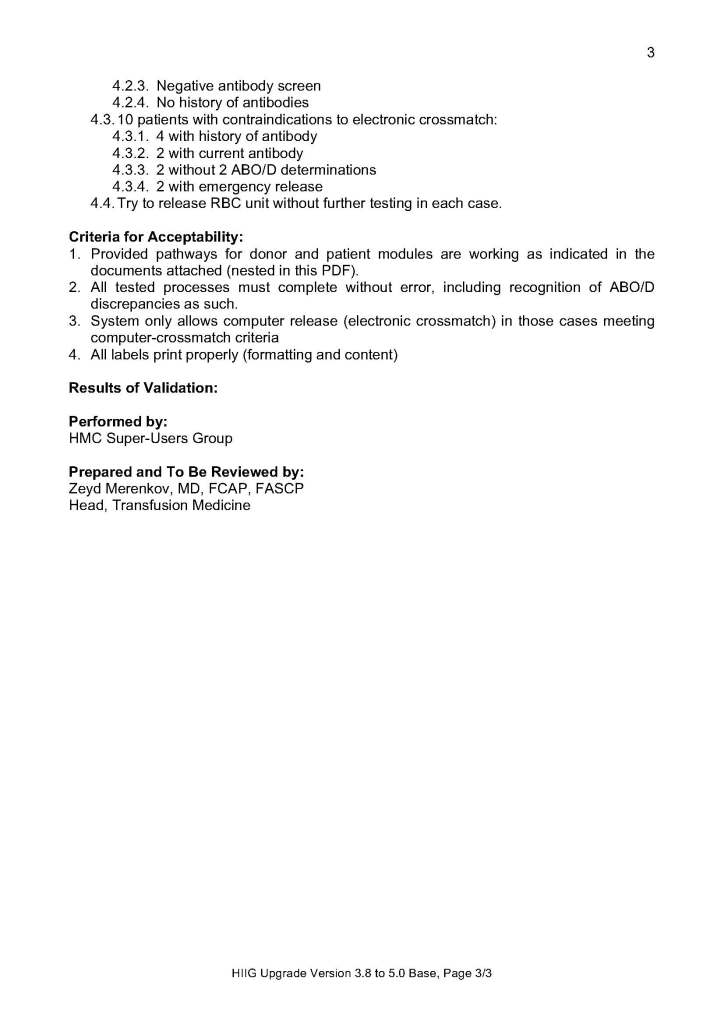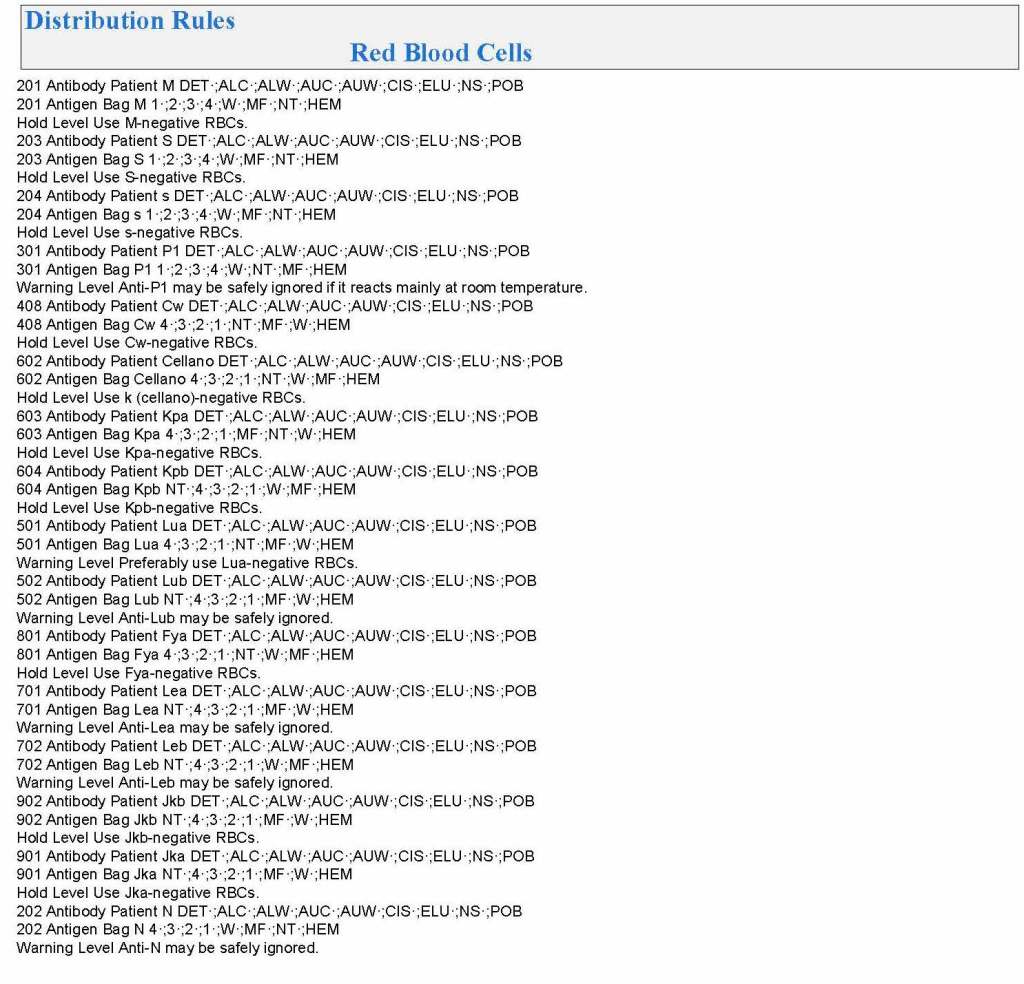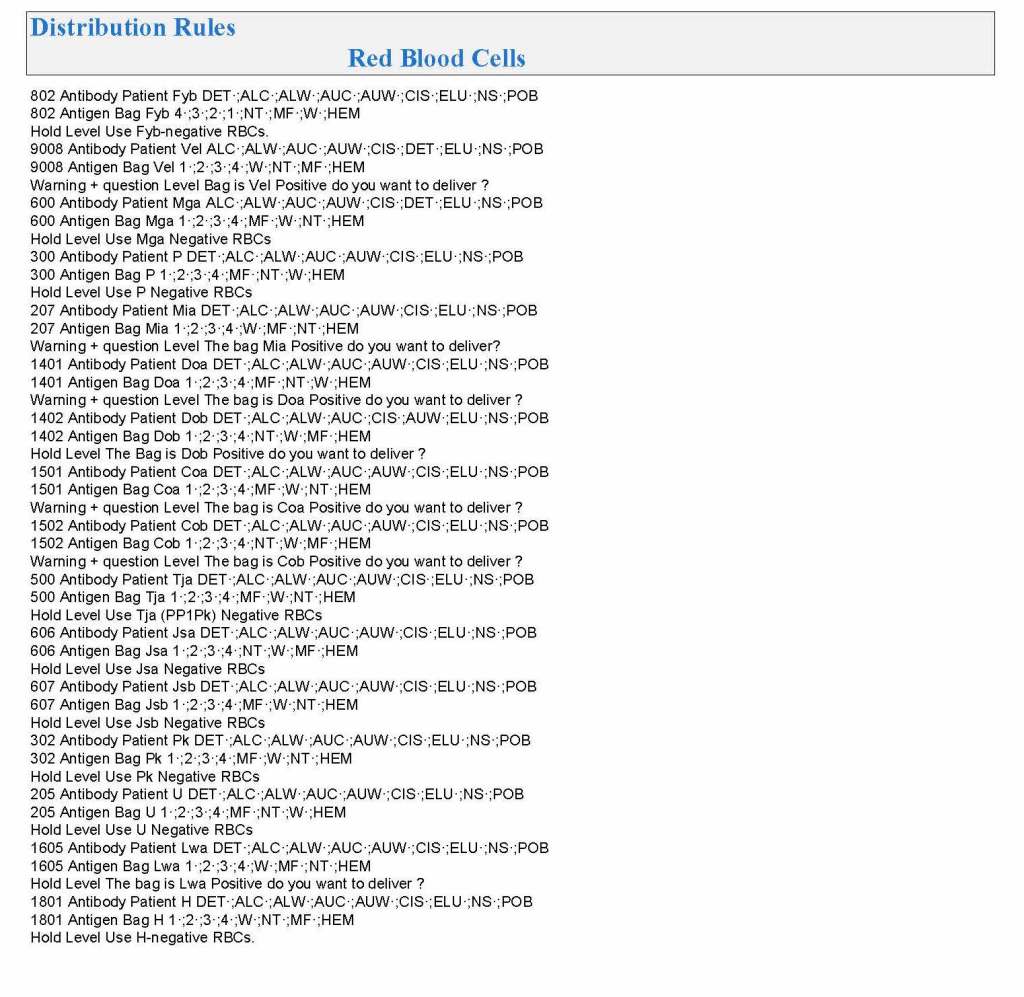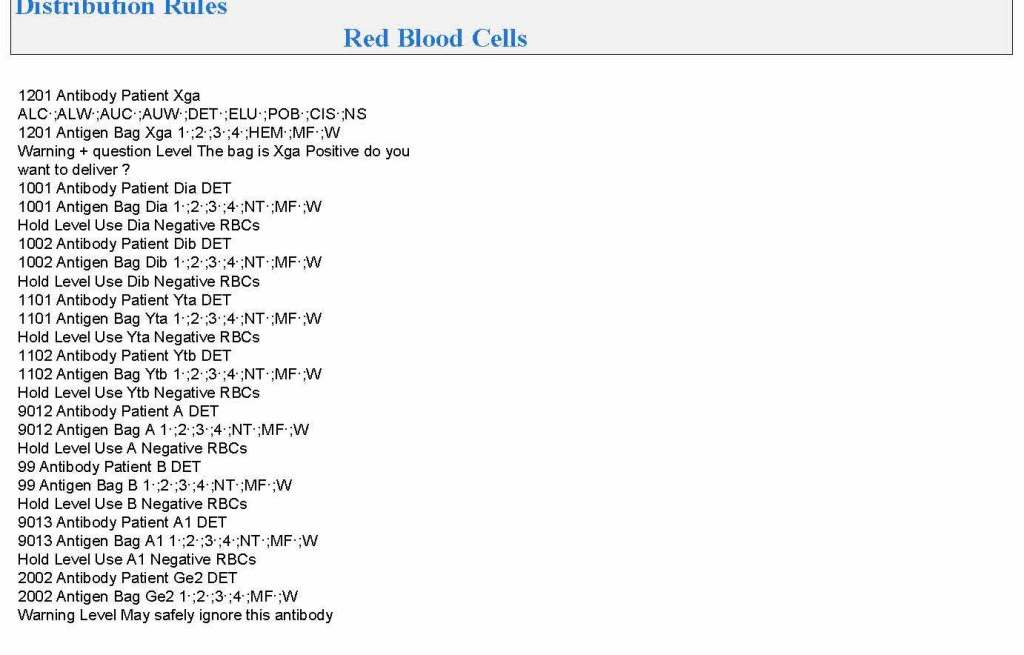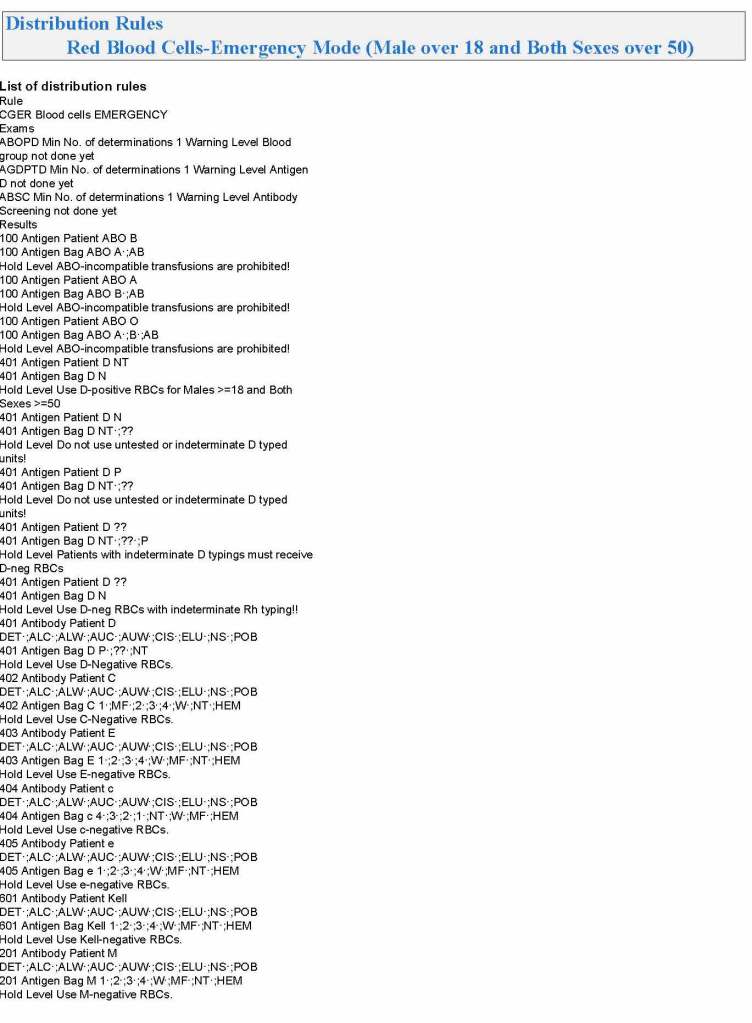
Processes and Software Building 4: Super Users

It is critical to engage the technical, medical , and (blood bank) nursing staff in this process,  That is why it is so important to identify a core of computer-literate users to help with the building and testing/validation.

I don’t mean finding staff who can already program or code.  Rather, I mean staff that are astute with knowing their work processes and who had good skills with Microsoft Office and Windows or equivalent.  I did not expect them to understand database structure or use structured query language.  They were chosen for their ability to learn quickly and their meticulousness.

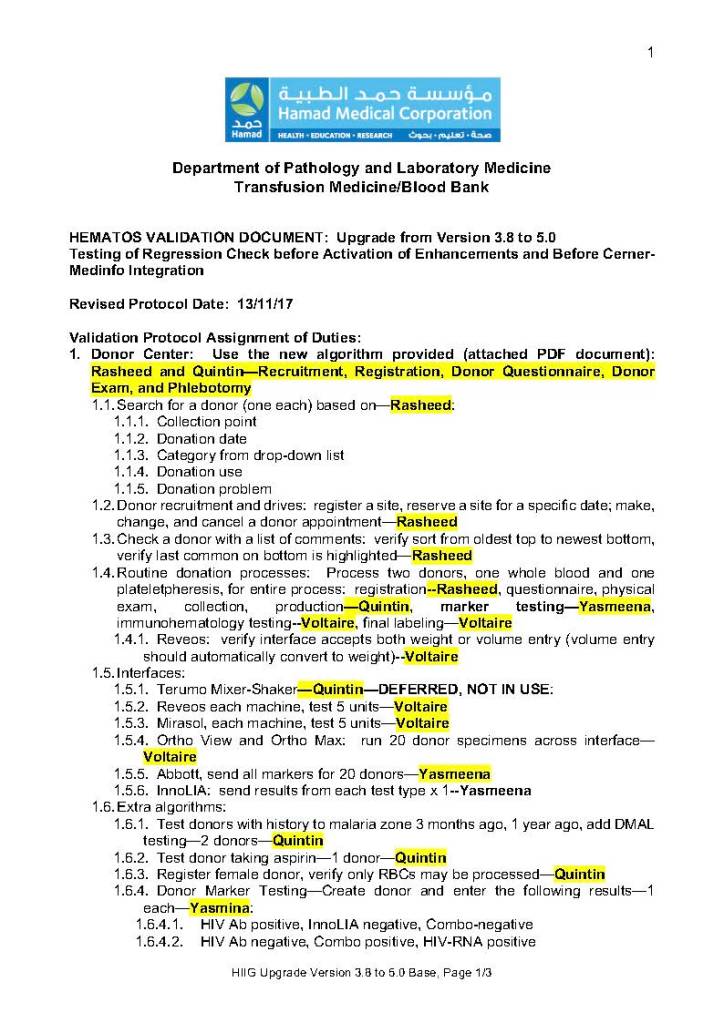
For our blood bank system, I chose computer-literate technical staff to be involved in the build from the very beginning.  They learned how to test each module and to some degree support it.  These became my Super-Users and to this day support the system for many tasks.  These staff served as the system administrators and worked directly with me as the Division Head for Laboratory Information Systems.  They were not full-time and still had their other clinical/technical duties.  They liaised with the software vendors engineers.

Our blood bank system was NOT a turnkey system.  It was custom designed according to our workflows.  There were NO default settings!!  We had to be remember, ‘Be careful what you ask for, you might get it!’  In some countries, approved systems are turnkey and may allow only few changes to the core structure and thus may not be this optimized for the needed workflow;  often only cosmetic changes are permitted.

When we built our first dedicated blood bank computer system, the company would take a module and completely map out the current processes collaboratively with me.  After this, I analyzed the critical control points and started to map out the improved computer processes that would take over.  After that we would build that those processes in the software and test it.  If it failed, we would correct it and test again…and again if necessary.  Fortunately, the blood bank vendor did not charge us when we made mistakes.

Sadly, another vendor (non-blood bank), only gave limited opportunities to make settings.  If wrong, there might be additional charges to make corrections.  This other vendor really pushed the client to accept the default settings regardless whether or not they actually fit.  End-users were selected to make and approve the settings, but they were only minimally trained on how to make the settings.  It was a journey of the end-users being led to the slaughter—and being blamed for their settings when they accepted the vendor’s recommendations—they usually selected the defaults.  There wasn’t enough time for trial and error and correction.

The blood bank system Super Users were an important part of our process.  They were an integral part of the implement team and could propose workflows, changes, etc.—subject to my approval.  They learned the system from the start and developed invaluable skills that allowed them to support the system after the build.  Also, they could serve to validate the system according to the protocols I prepared.  Moreover, I took responsibilities for their activities and they were not left out to hang.

Every hospital blood bank location and the blood donor center had Super-Users.  These included:

  1. Blood Donor Center:
    1. Administrative Clerk for donor registration, consent, ISBT specimen labels, creation of new donors and patients for validation purposes
    2. Apheresis/Donor Nurse for donor questionnaire, donor physical examination, and donor collection
    3. Medical technologist for donor marker testing
    4. Medical technologists for blood component production including Reveos, Mirasol, platelet additive solution, pooling, and leukodepletion
    5. Medical technologist for donor immunohematology testing
    6. Medical technologist for inter-depot transfer of blood components
  2. Hospital Blood Banks and Transfusion Centers:
    1. At least one technologist at each site for inter-depot transfer, component medication (washing, irradiating, aliquoting, reconstituted whole blood), immunohematology testing, component allocation and release

The cost of using these staff?  They were paid overtime and were relieved of other duties when working on Super User duties.  This was much cheaper than hiring outside consultants who may or may not know our system well enough to perform these tasks.

By having a Super User at each site, I in effect had an immediate local contact person for troubleshooting problems who could work with the technical/nursing staff.  We did not rely on the corporate IT department for support and worked directly with the software vendor.  Response time was excellent this way.

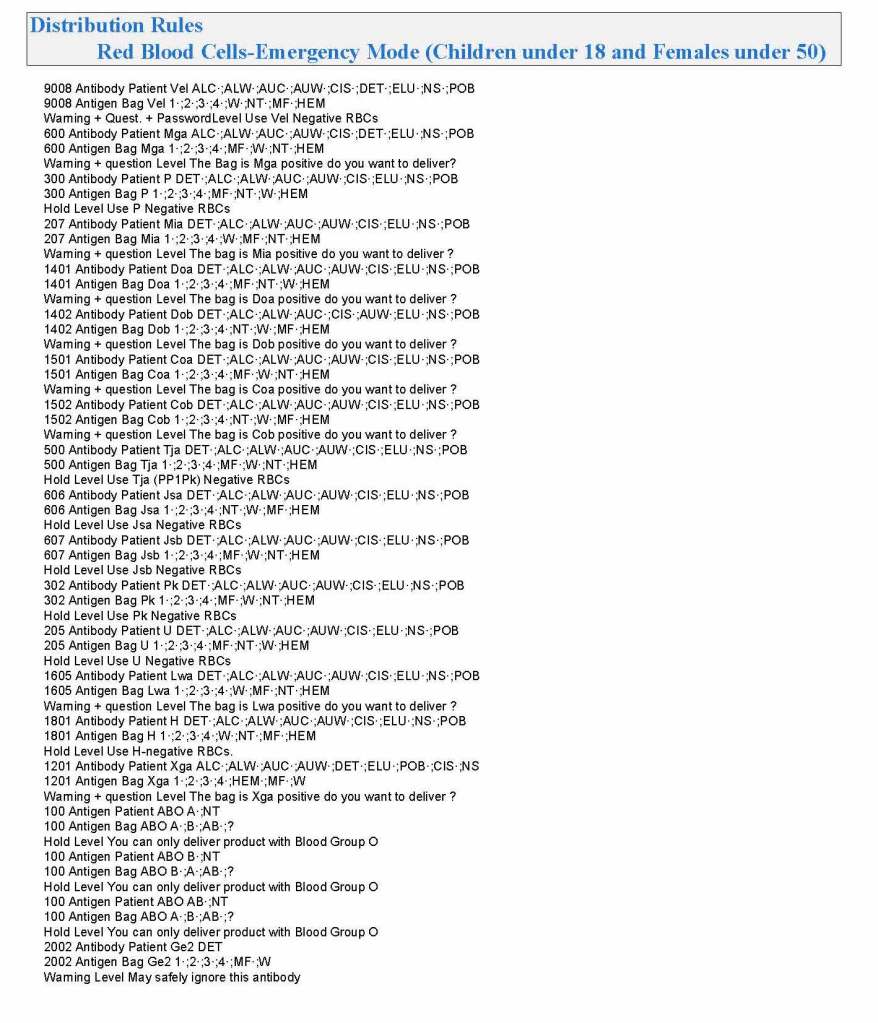
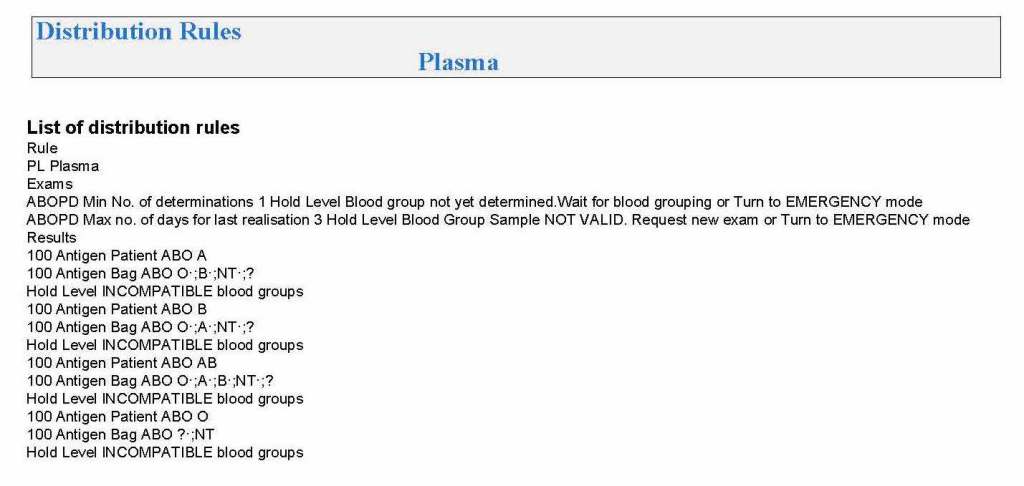
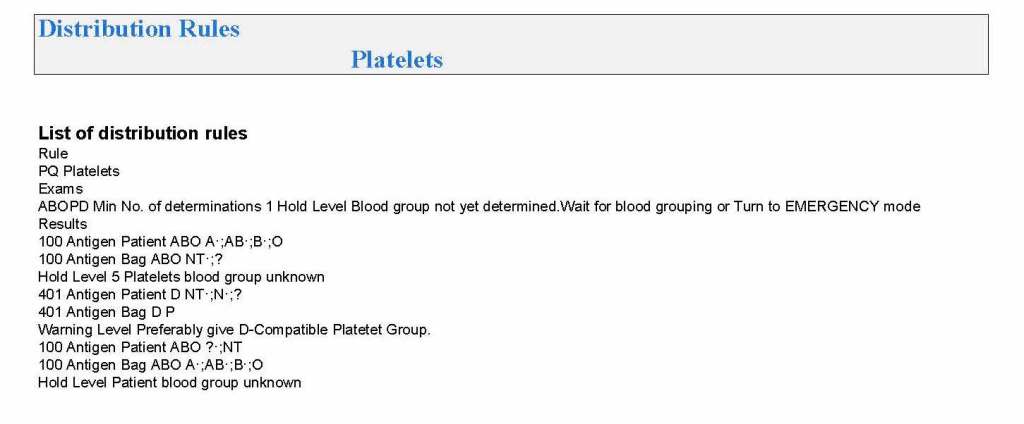
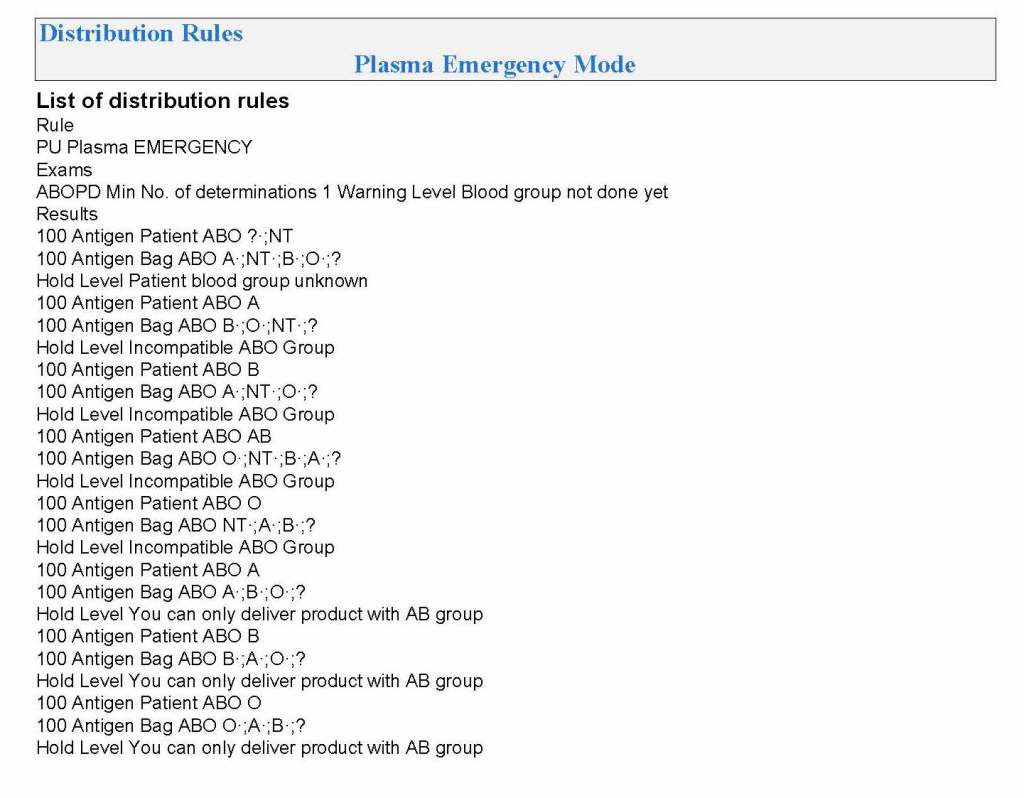
The following document is a sample document of the assigned Super User duties during a validation.

To Be Continued:

22/6/20
Processes and Software Building 3: Current State

Processes and Software Building—Part Three

Using the current state to build a new work flow can be a difficult task and balancing act.  If one changes it too much, it may be difficult for the staff to cope.  If too little, then why bother at all?  Still, we had to take the time to analyze our current system and identify areas  of improvement.  When building a new computer system, we didn’t want to capture our current system with its flaws in concrete.  Buying a new system is costly and it would be very hard to change it again,  This had to be done right.

Also, whether or not you have a pre-existing software may affect your choices.  In my opinion, it is easier to learn something new than to make some changes to a system that everyone has already learned.  Learning is easier than unlearning and relearning.

First, I studied the new system’s capabilities and took note of the features I would like to adopt to improve the current processes.  I did this especially at the critical control points.  I also studied our incident reports:  where had there been nonconformances?  How could I change things for the better, i.e. with increased safety and compliance to international standards?

I did not want to throw out a successful manual system, just to optimize it.  I tried to pick out those manual processes that worked and build those into the new workflows.  What I wanted was a system recognizable and familiar to the staff but with enhancements with the least amount of change to reach our goals. Make the least number of changes to meet the objectives!

Although the vendor did some initial testing, this was insufficient to accept the system.  I didn’t want the vendor to just show me some scenarios that they concocted.  I was always suspicious when any vendor chose their own examples and not others.  Could it be that the other processes did not work as desired?  I always insisted that I give the vendor representative scenarios and have them show me how the system reacted. This happened repeatedly with the non-blood bank software vendor so an atmosphere of distrust persisted throughout the general laboratory system (but not the blood bank) build.

It is daunting task to know what settings to make.  At one of my previous institutions, the administration recognized that they needed additional expertise from someone experienced in the new system.  They hired an outside firm in addition to the software vendor.  Still, even this was not sufficient to make the proper settings and testing.  We had to rely on ourselves!

Ultimately, the laboratory had to thoroughly test the system,  The only way to do this was to use our own resources.  Only we could test its actual functionality to the proper degree to ensure safety.  Still, where could we get the resources to do this?  Outside consultants were very expensive, especially if they have to live on-site for extended periods.  The only answer was to make use of our internal resources, i.e. our staff.

To be continued:

21/6/20

Processes and Software Building 2: Documenting Processes

My previous post emphasized how important it is to map the current state across all processes as the first step to optimize current operations and prepare for a new computer system.

One non-blood bank (hospital LIS) software vendor submitted the following as a complete representation of all current processes—across more than 4,000 tests and hundreds of instruments:

  1. Order something
  2. Collect specimen
  3. Receive specimen
  4. Perform test
  5. Report test

This was the same for each of the tests in the different sections of the laboratory—be it blood bank, anatomic pathology, chemistry, hematology, etc.  I was flabbergasted!  What were we paying for?

As Head of the Laboratory Information Systems, I rejected this.  I would have been ashamed to submit this to a client as a sufficient current state.  Even more astounding was the fact that that vendor actually mainly used the same four-step flow chart for the tests in their new computer build!!

As painful and time-consuming as it is, one must develop a specific flow for each process.  This could include:

  1. Specimen condition and acceptability criteria
  2. Possible results for each part of the test
  3. Interpretation of each result
  4. Control results
  5. Acceptability criteria
  6. Truth table
  7. Reflex testing triggered by the results

When we built our first dedicated blood bank computer system, the company would take a module and completely map out the current processes collaboratively with me.  After this, I analyzed the critical control points and started to map out the improved computer processes that would take over.  I did not want to throw out the successful manual system, just to optimize it.  After that we would build that those limited processes in the software and test it.  If it failed, we would correct it, and the vendor didn’t charge us extra for the corrections.  It was a beautiful collaboration.

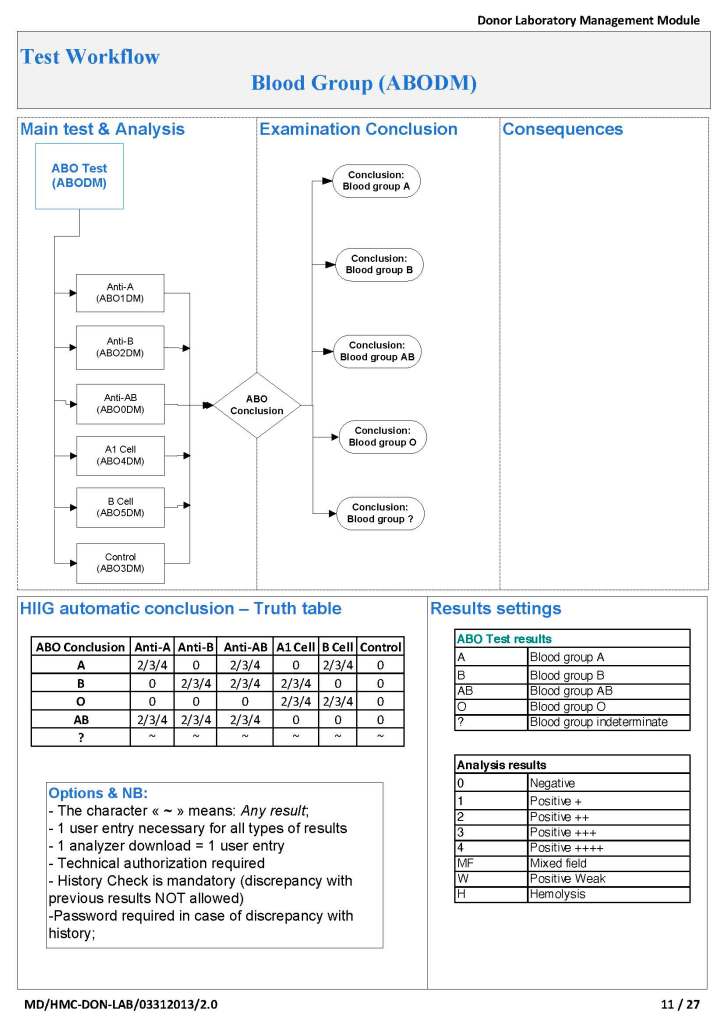
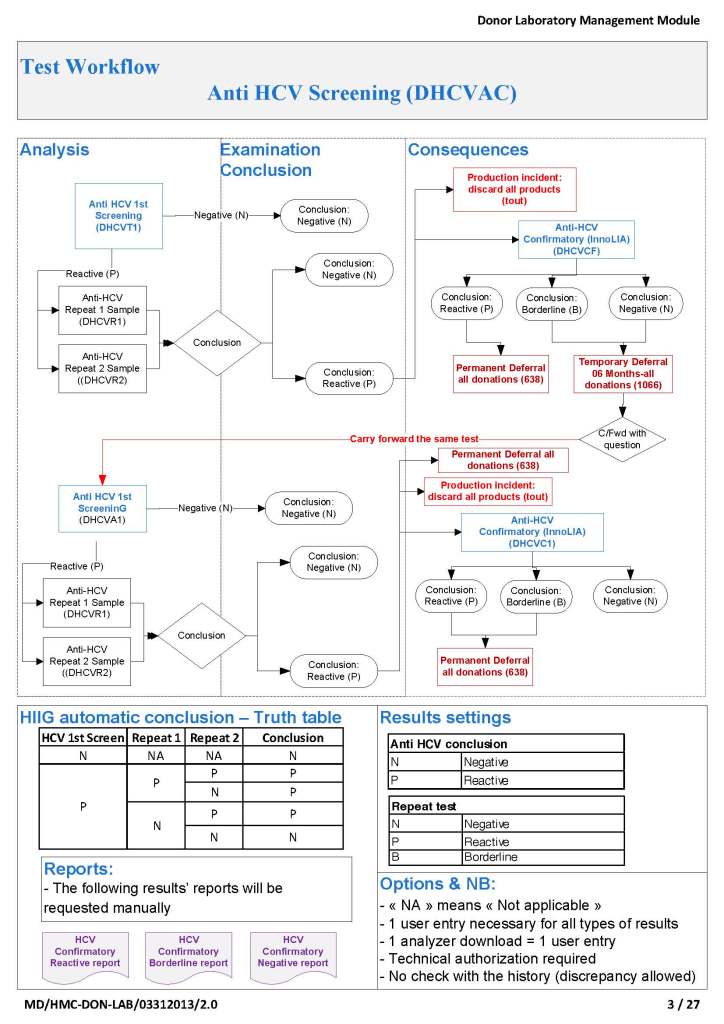
To illustrate these points, I am showing two process flows:  one for the ABO typing (forward and reverse) for donors and the other a complex testing algorithm flow for HCV donor marker testing.  These are from previous builds and have been updated subsequently.

ABO Typing: Attachment One

This consisted of six individual tests forward (anti-A, anti-B, anti-A,B), two reverse (A1 cells and B cells) and a control.  The acceptable tests for automatic typing were in {0, 2, 3, 4}, other results (mixed field, weak, 1+, hemolysis) required a manual interpretation.  There is a truth table for interpretation of all six results together.

Donor HCV Testing:  Attachment Two

This is a more complicated flow that includes multiple tests (HCV-antibody EIA, HCV-LIA, and HCV-NAT).  Results may trigger reflex testing immediately (abnormal HCV EIA triggers HCV-LIA, abnormal HCV-NAT triggers HCV-LIA, etc.) or repeat testing after six months for indeterminate results.

In each case, every possible result is listed and its interpretation and acceptability criteria.

In summary, it may take considerable time to map out all your processes, but this is time well spent and allows you build your system accurately.  There will be few surprises this way.

To Be Continued:

20/6/20

Processes and Software Building 1: Overview

In the next series of posts, I will elaborate on how I built the processes and settings for a blood bank computer system in conjunction with the vendor’s software engineers.

If you don’t know exactly what you are doing, how can you improve it?  Regardless whether you have laboratory software, you still need to optimize processes, determine critical control points, and plan improvements based on that.  A good manual system is the foundation for a good software build.

I was never taught in medical school how to do this.  I learned on-the-job at a time when software was quite rudimentary and mainly to record results.

Staffing:

For our first system, we used medical technologists to make settings for and administrate.  We thought that only those with a technical background in the field could do this.  It was moderately successful.  There was some antagonism between the technologist computer staff and the hospital computer department.  The technologists did not have a background in databases and programming;  the IT staff did not know the laboratory and were frustrated in dealing with the laboratory staff.

Later, to help reconciliate the two when a new hospital system was installed, we tried a different approach.  We found a database professional who was a very good listener.  Although he had no technical background, he could listen and map out the processes.  He was well-liked by the technologists who saw that he just wanted to understand their work and help them.  He was very successful in this endeavor.  I strongly recommend a software engineer as the lead in the project, one who can work with technical and medical staff to map out processes.

Unifying Processes Across Multiple Sites;

If your organization covers multiple sites, it is best to unify your processes as much as possible.  We built our dedicated blood bank system AFTER we had done this so the processes (except for some equipment differences) were the same everywhere.   This allowed us to move work between institutions quickly and makes system administration easy.

At one organization, they built the system based on the processes at the first site to go live, which was a small hospital with less than 10% of the work.  It was not designed for the high-volume sites, and this was major problem as the larger sites were implemented.

Capturing the Current State:

Most importantly, I cannot emphasize enough the need to capture the current state.  Take the time to do this properly and thoroughly.  This will help you whether or not you are building a computer system or just optimizing your manual processes.

At one institution in a non-blood bank system build, the administrative decision was to rush and not wait to complete this task so the actual processes were not captured—I actually rejected the proposed current state but was overruled.  The institution did not unify their processes as much as possible across sites.  The result was a suboptimal system that many/most people do not like:  should you blame the build or the limitations of the underlying software?

To be continued:

19/6/19

Inter-Depot Transfer: Further Thoughts

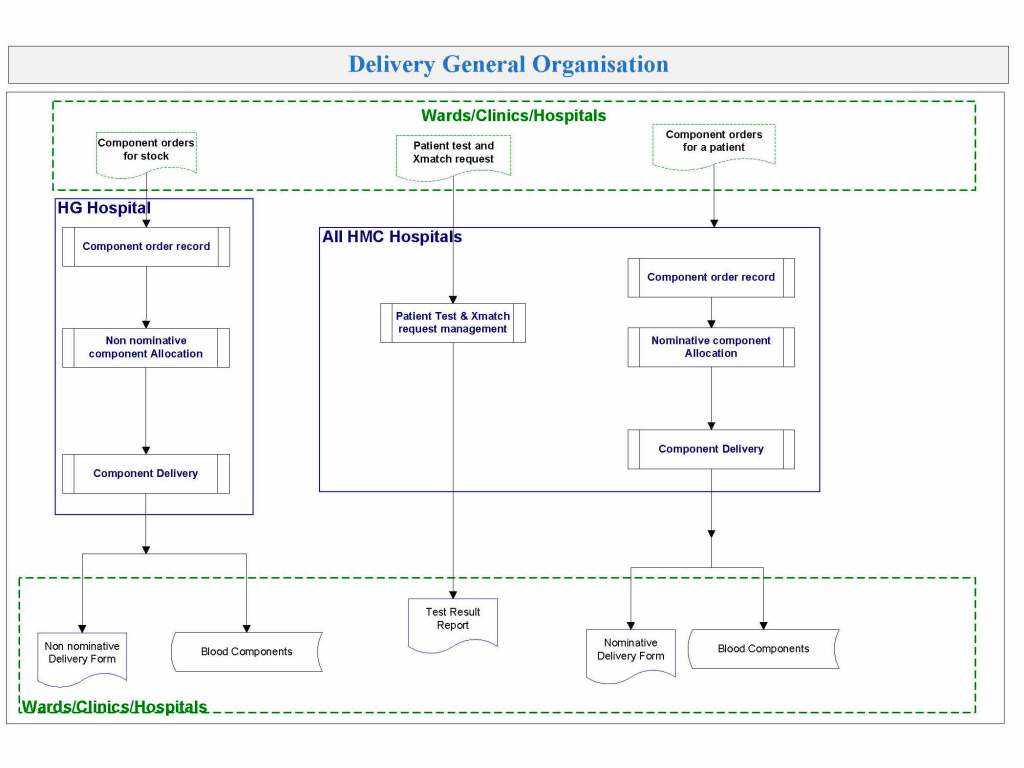
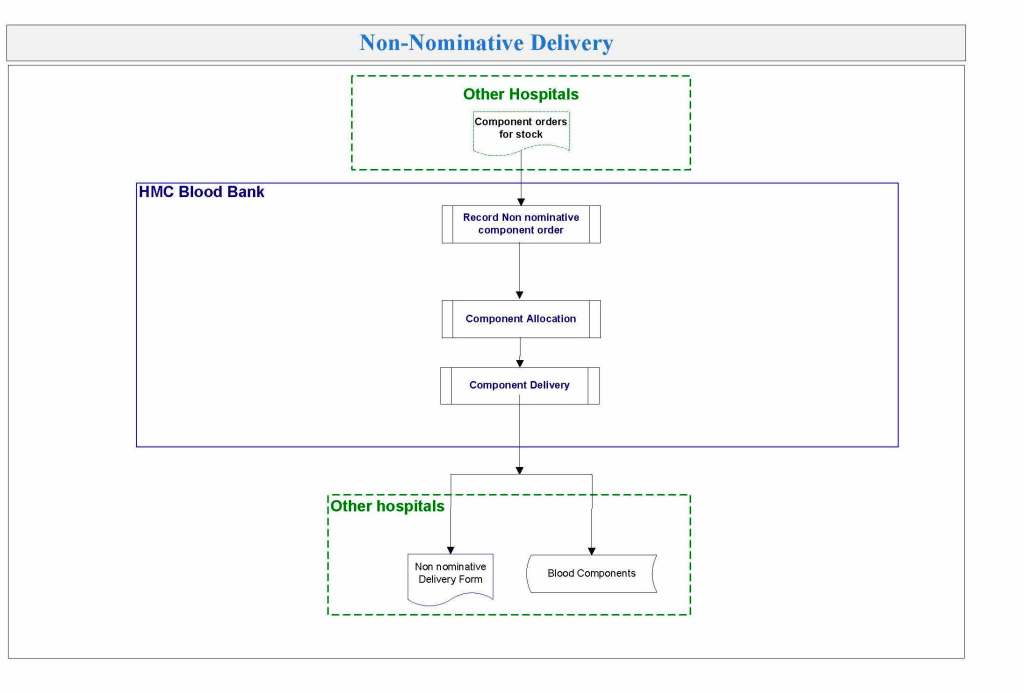
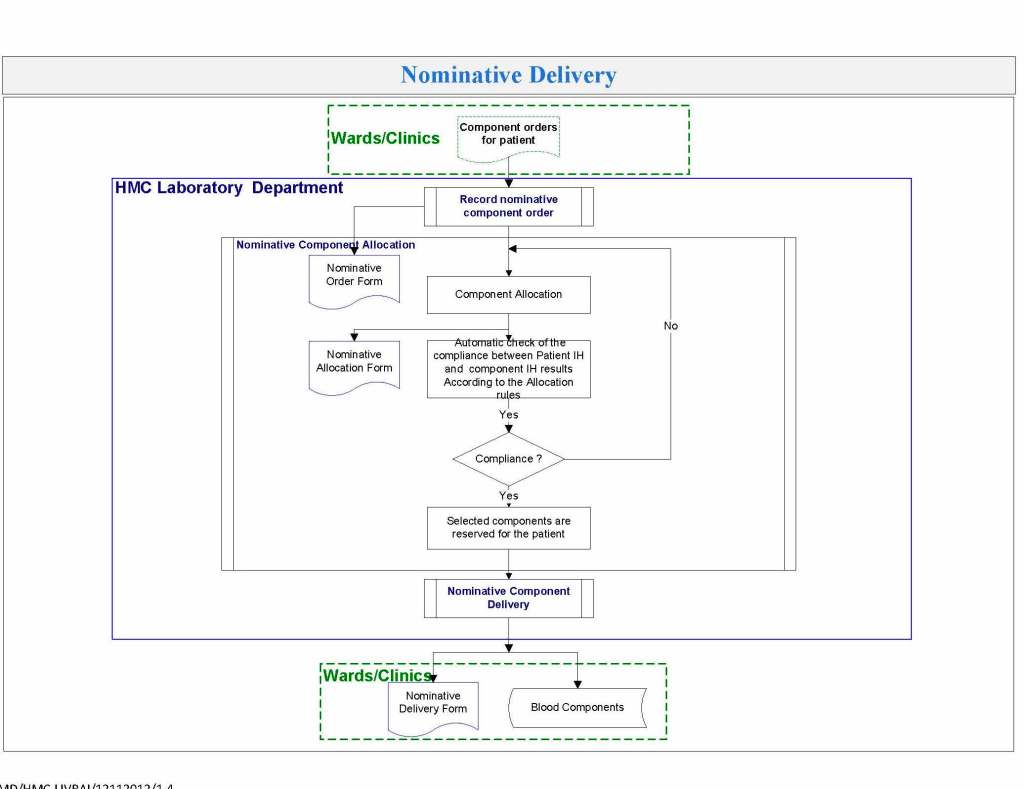
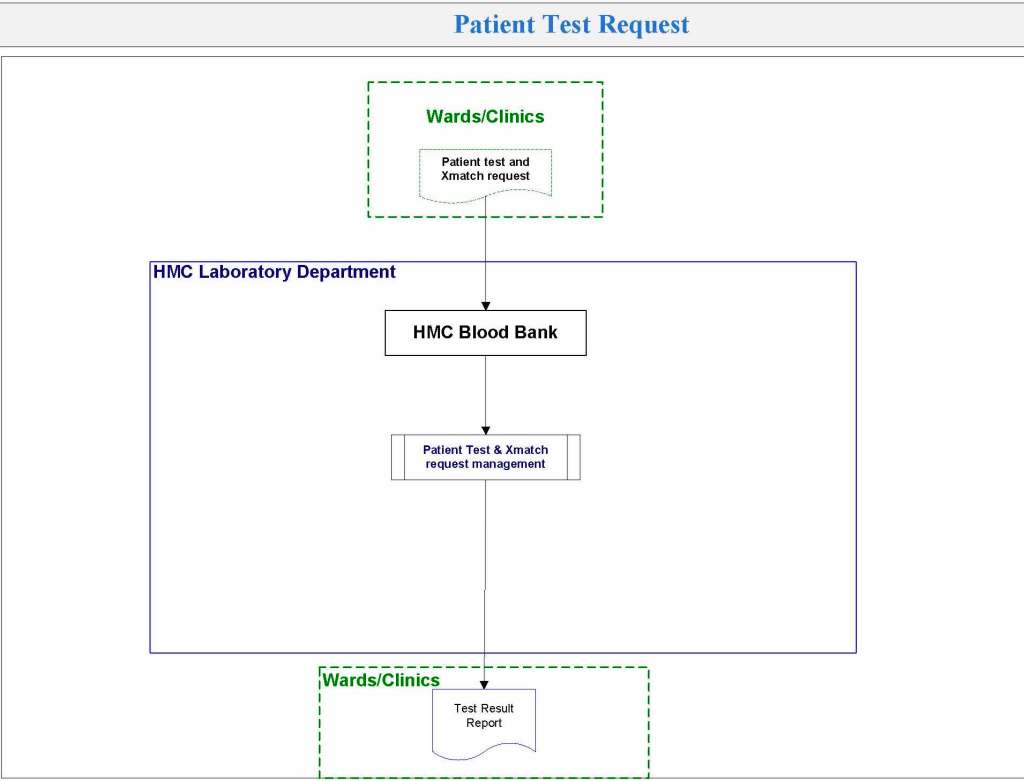
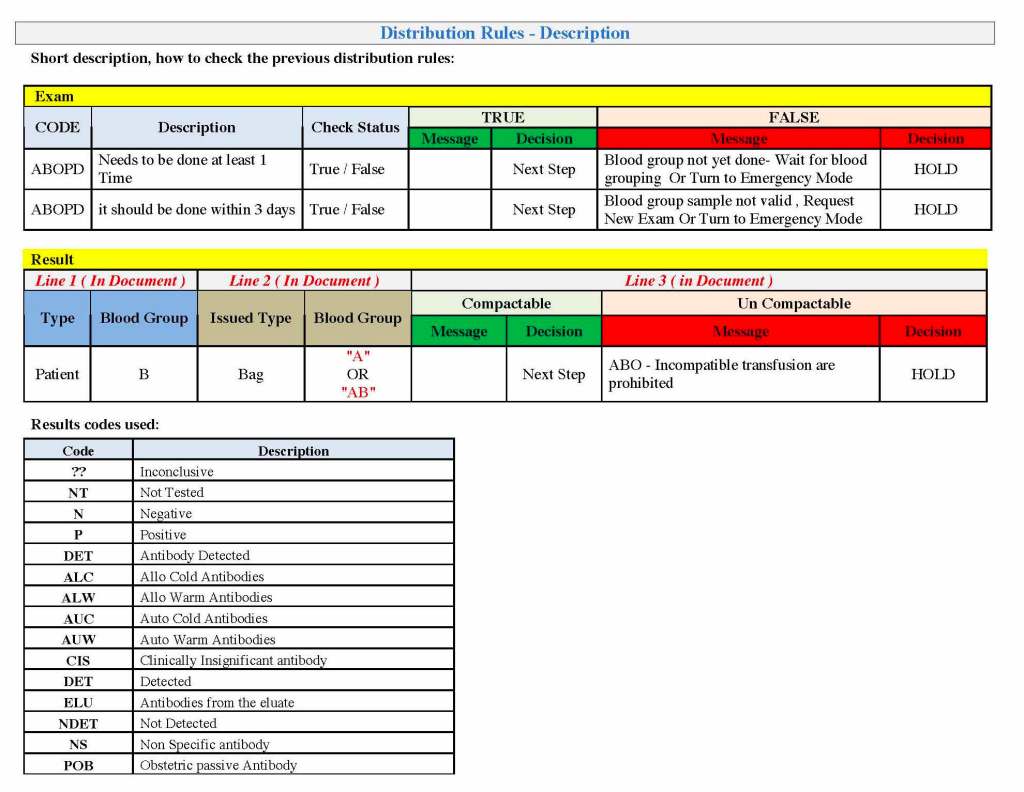
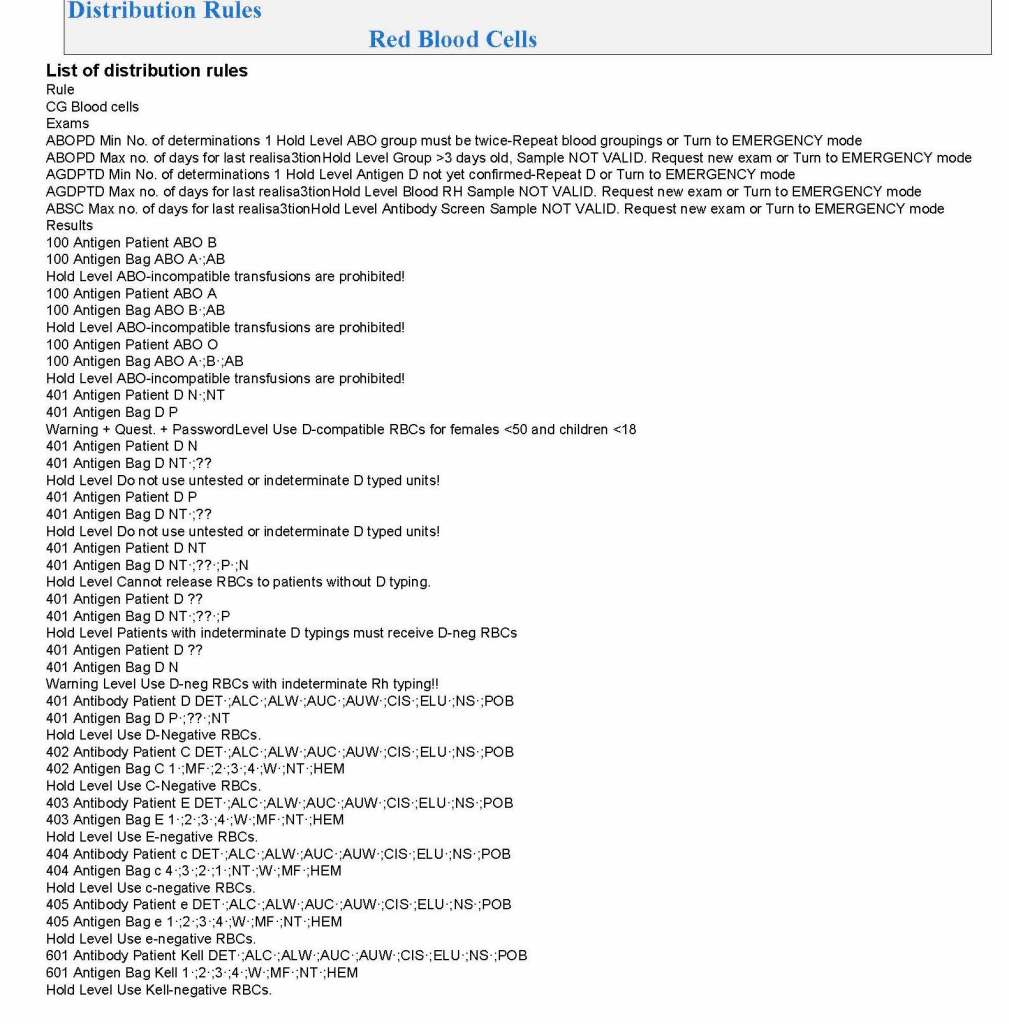
In my recent post, I provided sample flows and parameter mapping for delivery of blood components.  The final components from the component preparation center may be sent to various depots (freestanding location and/or hospital blood banks.  There should be complete traceability for every step (from donor reception, collection, testing, and processing) transport between locations, and finally the exact storage site, which might include which refrigerator/freezer/incubator and even shelf/position number for each component is stored.  The end of that document showed rules for type/antigen matching.

For disaster planning, rapid inventory enumeration by type is very important.  This can be very time-consuming manually.  With our Hematos blood bank system, we could quickly get total inventory across the Qatar or by hospital in less than one minute.  We could also quickly find antigen-matched units across the system and reserve it at any one site for another if necessary.

Smart blood bank dispensing refrigerators, as offered by Haemonetics and Angelatoni, may also serve as depots and take the place of a hospital blood bank for some dispensing.  These solutions can also capture vital information about the storage conditions of the components and prevent release if the storage criteria are not met.  They can also interface with blood bank computer systems and use the main system’s logic for the dispensation rules.

Upon receipt at the hospitals from the blood processing center, the forward ABO and D typing must be confirmed.  We used D reagents which detected partial D so that we would call such donor units as D-positive.  However, if a patient type reagent insensitive to partial D types were used, it is possible for a unit to be typed as D-negative whereas in the donor center it might be D-positive.  Sometimes, nothing types consistently as D-positive:  all you can say is that with a particular reagent and lot number, there is or isn’t reactivity.

The greatest complexity is for RBCs since potentially so many antigens exist.  Criteria for matching/ignoring certain antigens must be made.  Critically significant antibodies such as the Kell, Duffy, Kidd, and certain Rh (D and c) must be antigen matched.  A robust blood bank computer system can enforce these rules.

For other components, antigen/typing may be less important.  In fact, in most situations, any type of platelets can be given to anyone (except neonates).  Despite the potentially incompatible plasma, there is rarely significant hemolysis.  In fact, if pooling platelets without regard to blood types is done, a platelet transfusion is a common cause of a positive direct antiglobulin test DAT—something that is not clinically significant.  No one died of a positive DAT by itself for this reason.

Specific rules for compatible plasma types are important, but nowadays, low-titer group A plasma may be used like universal AB plasma.  The challenge is to be able to perform the ABO titration (specifically anti-B) quickly—titration can be a slow process, even with automated equipment.  A similar situation for low-titer, universal group O whole blood requires both anti-A and anti-B titration (I will return to this topic in a future post).

RBC Antigen Matching

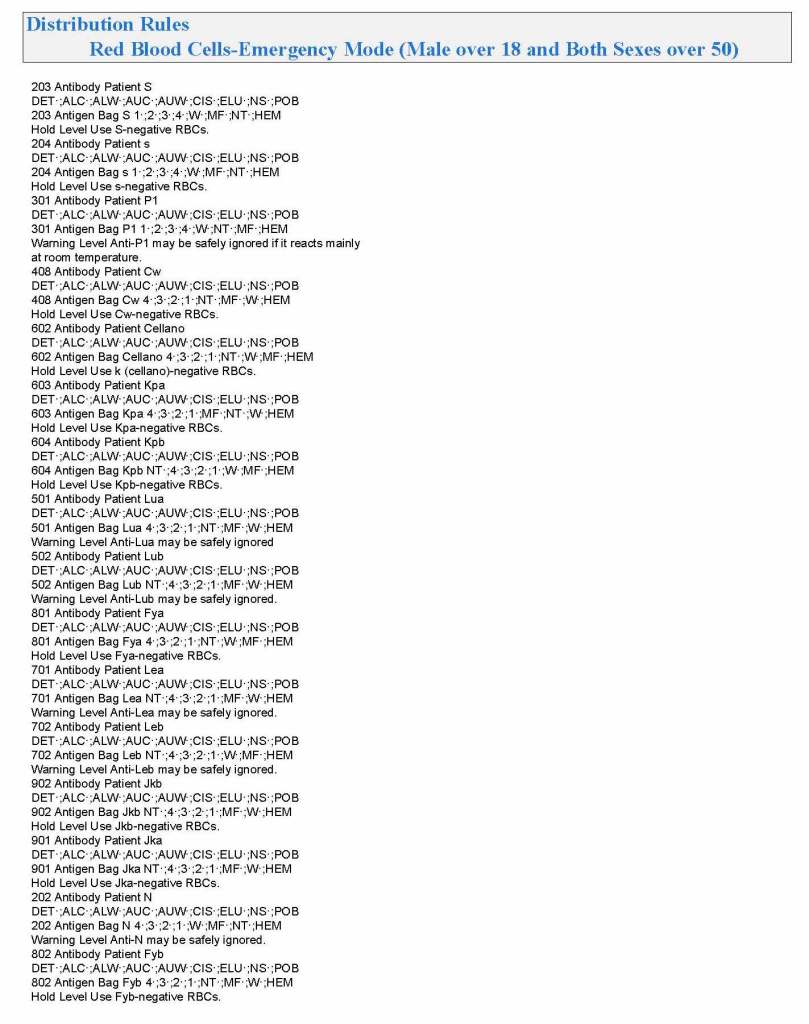
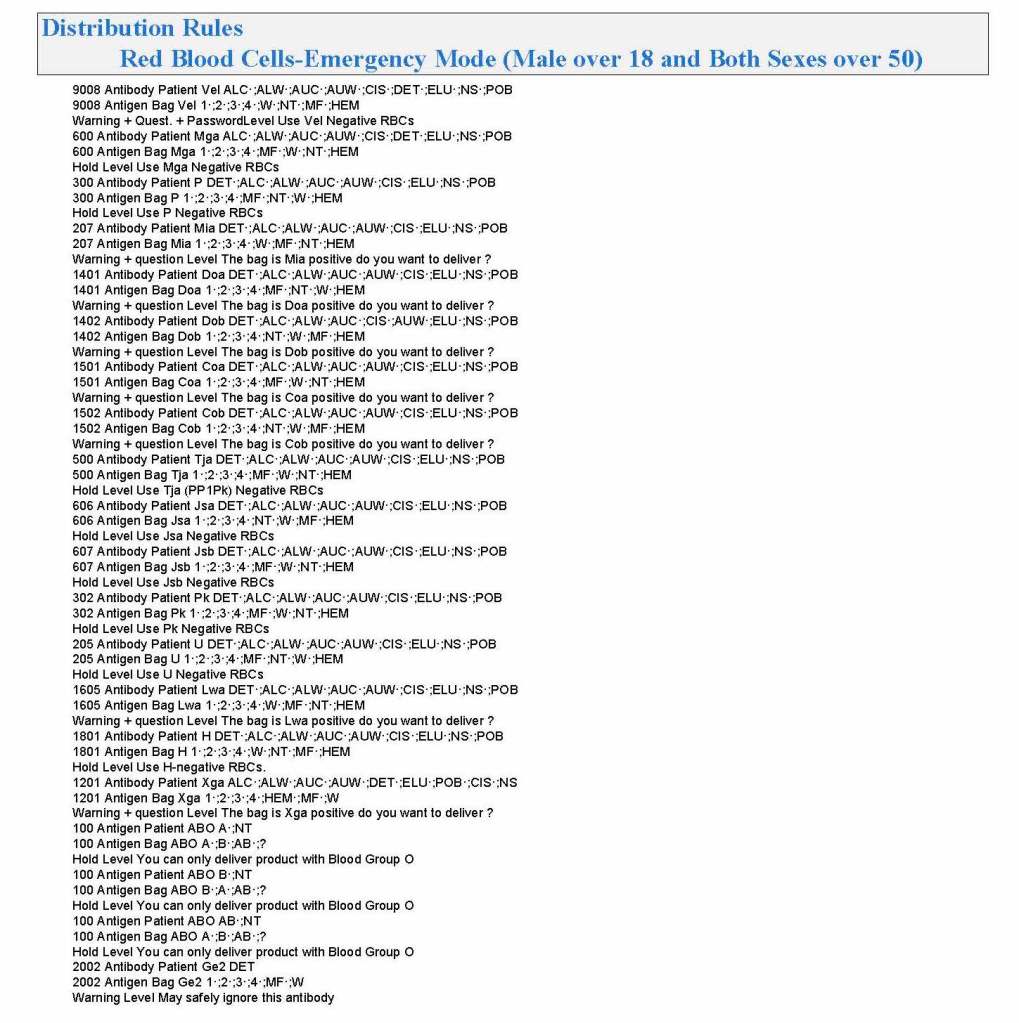
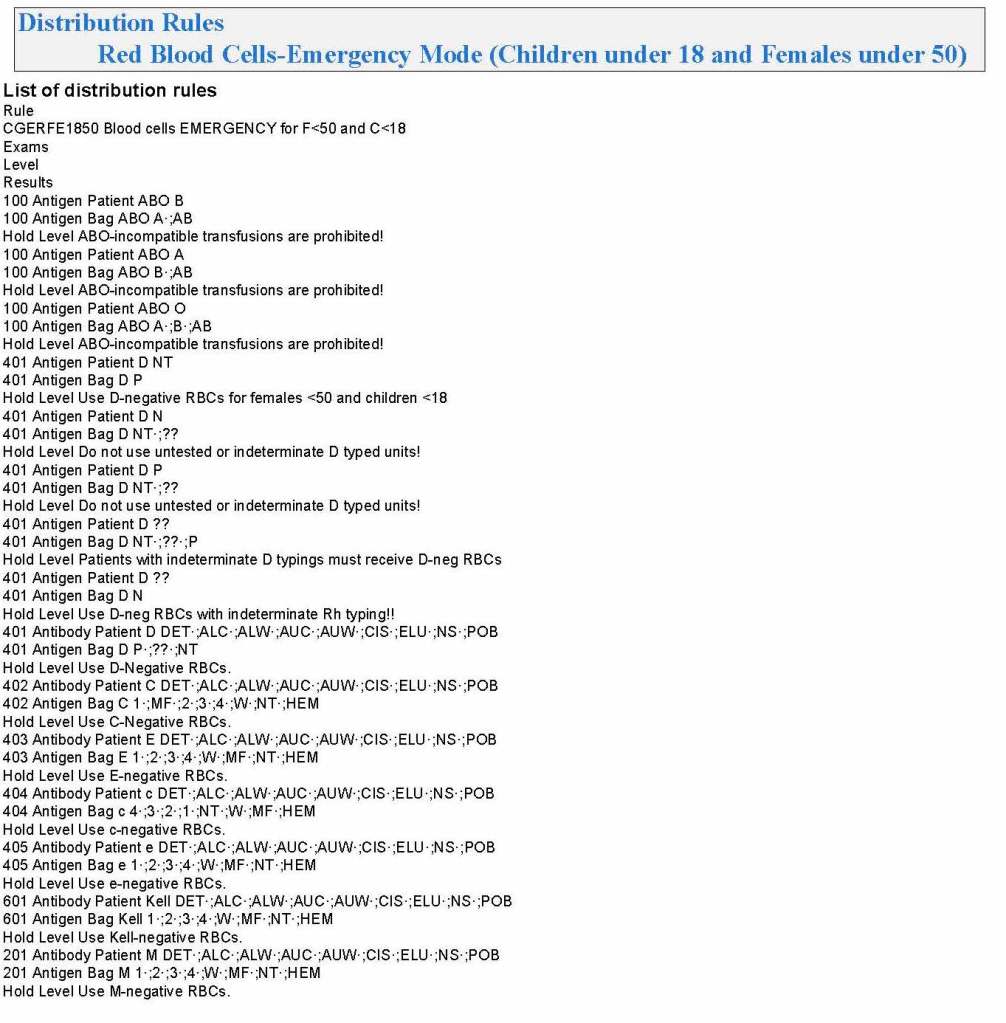
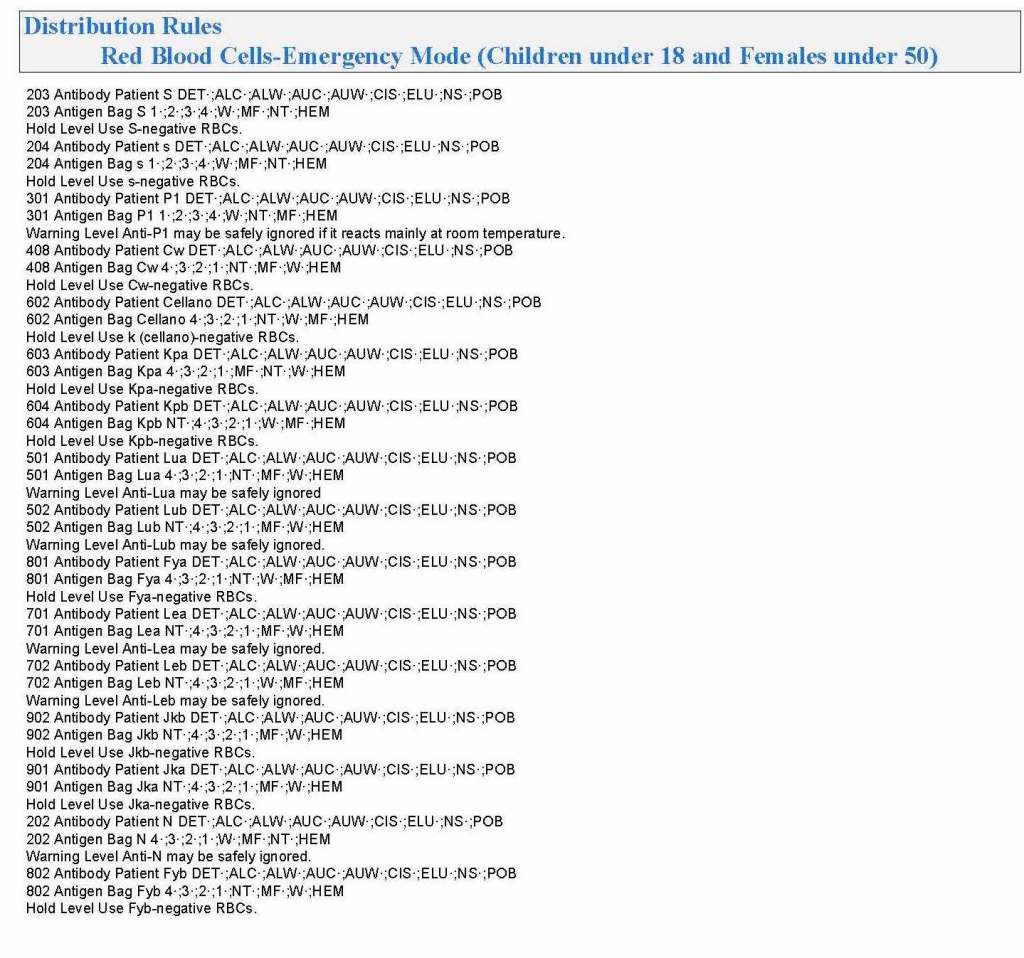
In the previous post, the Medinfo document for Inter-Depot transfer had many pages of rules for matching RBC antigens.  Multiple actions were available:

  1. Forced Match, no release of untested or antigen-mismatch (e.g. anti-Kell requires specifically tested K-negative RBCs).
  2. Match Optional (e.g. anti-Lea/Leb does not require Lewis-matched blood):  system would flag a comment showing the antibody specificity, user would respond Y/N, and select units
  3. Least-Incompatible (e.g. WAIHA):  requires sufficient privilege (senior technical or transfusion physician) to authorize release
  4. Permitted Incompatible (e.g. give C-positive to patient with anti-C in times of shortage or complex multiple antibodies without fully matched blood available):  requires sufficient privilege to release
  5. Fully Allowed (e.g. group O RBCs to group A, AB, B patients)—no flagging, allocation of units permitted
  6. Prohibited Under Any Circumstance—NO Override Permitted (e.g. group O for Bombay Oh, c-positive for anti-c, K-positive for anti-K)

To avoid mistakes, the blood bank computer system enforced the rules.  There was no mercy.  Only specific individuals could override this( in many cases, but certain allocations (e.g. group O RBCs to a Bombay Oh patient) were not permitted under any circumstances.

Prophylactic Antigen Matching:

Please also refer to my prophylactic antigen matching post made last week for the rules I selected for Qatar.

Prophylactic antigen matching is common in Europe.  I have been doing this during the many years I have worked in the Middle East.  Most patients were not local nationals but transient.  They would return to their home countries where blood bank testing (antibody screening/identification/antigen matching) or intrauterine exchanges might not be always available.

For pregnant patients, we would prophylactically match K-negative and c-negative—regardless if there were antibodies detected—R1R1 units for R1R1 patients.  At the end of my time in Qatar, we had several pregnant women with various Rh deletions, so we added routine extended Rh(D) and Kell typing to all.

For sickle cell patients, especially African type, I would prophylactically match Rh antigens (D, C, c, E, e) and Kell because of the polymorphisms in the CE gene, some of which may lead to pan-Rh antibodies.

I would consider selective prophylactic antigen matching in chronically transfused populations, again regardless if clinically significant antibodies were detected.

If a patient makes any antibody, regardless if is clinically significant or not, I would consider that patient as a candidate for prophylactic antigen matching (but NOT necessarily for a clinically insignificant antibody).

In Qatar, blood bank services (testing and components) were not charged to the patient.  In many other parts of the world, blood bank is a cost center.  No prophylactic antigen matching may be routinely performed.  If it is done, it must be charged to the patient or the hospital must assume the cost.  I have gone to conferences in such locales where not even R1R1 patients were not matched and subsequently developed anti-c, which complicated management.  It would have been cheaper to do the antigen matching than to pay for the consequences of the alloimmunization.

Overview: Inter-Depot Transfer and Allocation of Blood Components

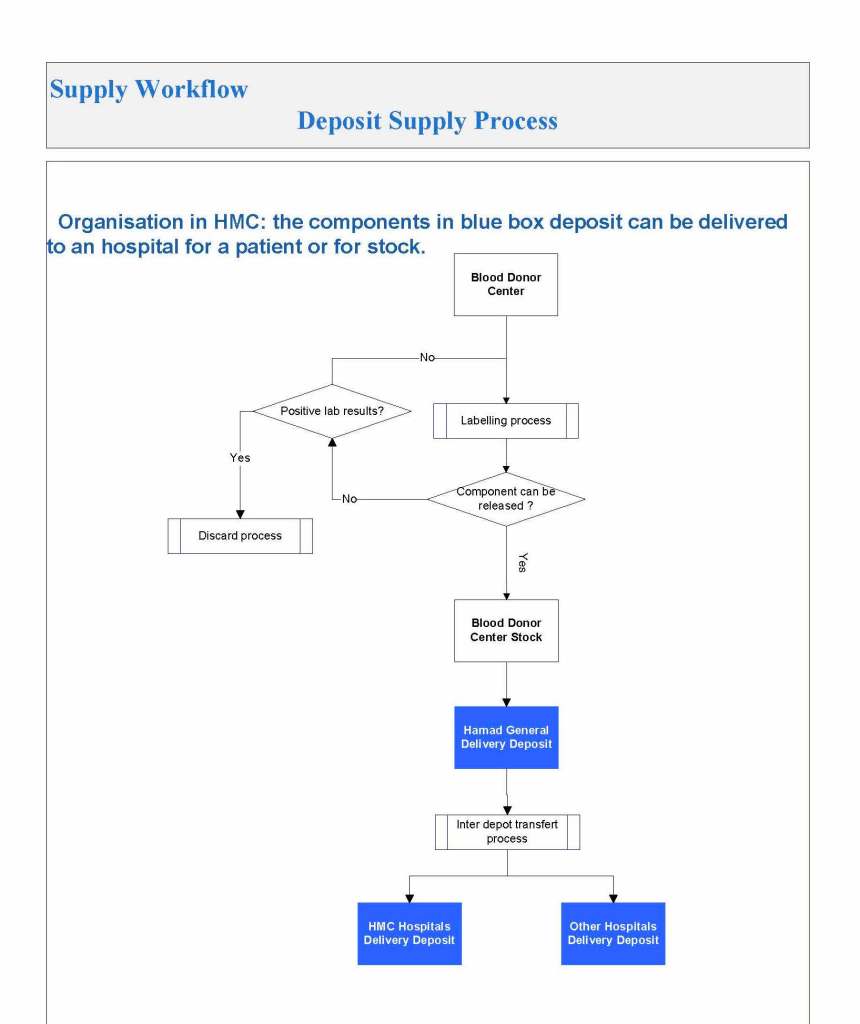
While I was working in Qatar, this was the overall process for transfer and allocation of blood components. Once they were finally labelled (only possible if all criteria had been meet), they were transferred from the Blood Donor Center BDC to Hamad General Hospital Blood Bank, from which they were distributed to all hospital blood banks in Qatar. Similarly, units could be transferred between the various hospital blood banks.

One could track components as being in:

  1. BDC
  2. Transit BDC to HGHBB
  3. HGHBB inventory
  4. Transit HGHBB to another hospital blood bank
  5. Transit between any two hospital blood banks

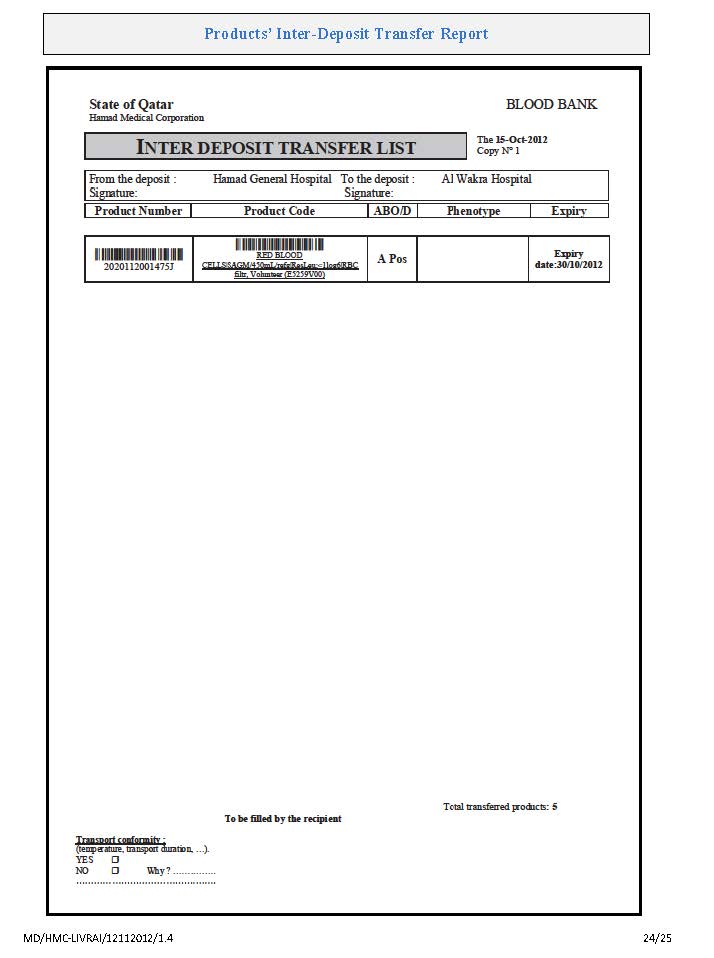
An inventory manifest would be printed to show all transferred units.

For patient use, allocation rules applied which would determine if an electronic or a full antiglobulin-phase crossmatch could be used and whether specific antigen-matched components were required.

There were also separate rules for emergency release if the standard criteria could not be met.

Plasma Fractionation Project Considerations

I have been involved with planning for several plasma fractionation projects in the Middle East.

Many clients expressed the interest in using local plasma to make plasma derivatives (e.g. factor concentrates, intravenous gamma globulin, albumin), feeling that local plasma was safer than using imported plasma.  Some of these are in short supply in the world market so the only way to ensure their uninterrupted availability is to consider manufacture them for local consumption.

Still, the major issue today is that it is difficult for any country in the region to collect enough plasma to make such a project feasible.  When I first considered such planning, we were looking for as much as 250,000 liters annually.  Since then, there are newer technologies that allow much smaller batches to be cost-effective.  Alternatively, one could charge higher prices for using smaller batches from local plasma.

Still, it is likely that plasma must be imported to sustain a plant.  There are different regulations for plasma donor qualification country-to-country.  Many of these jurisdictions may do less screening and testing than is done for normal blood and apheresis donors.  Other countries use their blood donors with the same requirement for both commercial plasma and blood donations.

In this era of emerging infectious diseases, I personally favor using the stringent blood donor criteria—same as routine collections.  It is not what we know, but the unknown pathogens that are potentially the most dangerous.

In addition to building a fractionation plant, one must train staff for this highly technical operation.  This may require developing a special curriculum to prepare students for these jobs.

To export the plasma to certain regions, one may have to use plasma quarantine.  This requires a robust blood bank production software such as Medinfo to track serial donations

There are other processes to consider:  how to develop a transport network to keep plasma frozen at minus 80C viable in a region that reaches very high ambient temperatures.

I would recommend a graded approach to develop such an industry.  First I would negotiate a plasma self-sufficiency arrangement followed by recruiting neighboring countries to participate in a manufacturing plant.  Technology for such a plant is complex so establishing a joint venture with one of the plasma industry companies is essential.  Some manufacturers are very keen to develop extra capacity since there is a world-wide shortage of plasma fractionation and are even willing to help obtain external plasma sources for such a plant.

Such a plant is an excellent way to develop local talent to run such a plant, including training of local staff to be the industrial engineers in the plasma fractionation process.  It would take approximately two years of training to prepare engineers on-site at a plasma fractionation site if they have studied the necessary science and mathematics subjects.

Such a program would take several years of planning and development.  Some of the major steps needed include:

  1. Acquiring software for a blood center with plasma brokering capabilities.
  2. Passing accreditations such as international AABB and CE for transfusion medicine to allow export of our plasma to the external manufacturing site in the initial plasma self-sufficiency phase
  3. Identifying extended sources of plasma to feed a manufacturing plant.
  4. Preparing a curriculum suitable for training local nationals as staff for the plant.
  5. Establishing a joint venture to share technology with a major plasma company to design, build, and operate a plasma fractionation plant.

I would be glad to discuss the matter in more detail if there is further interest.

Active Inventory Management: Further Discussion

Yesterday’s post showed my active blood inventory management scheme for my previous position in Qatar.  I thought today I would elaborate on how I adjust the inventory based on critical shortages and planning for disasters and other major events.

I always review the critical shortages to check for atypical usage (e.g. a disaster situation) or production issues (equipment breakdown, shortage of donors during holiday period).

If it is due to increased utilization, I try to adjust the critical and desirable inventories upward to cover the shortfall for future events.  However, it is not always possible if the event is a one-of-a-kind situation unlikely to recur.  Also, I must take into account the available resources (supplies, kits, manpower, equipment) to see if I can cope with the increase.

If it is due to resource issues, I see if I can bolster those by recommending increases or improving utilization of what is available.

Very important is through-put:  How quickly can I produce components from whole blood or apheresis components?  This was one of the major reasons we shifted away from PCR to other NAT testing with single-well processes since to minimize the need to make additional runs (Grifols Panther System).  Also, automated component processing can greatly speed production (one Reveos can process four whole blood units in about 23 minutes or about 12 units in 75 minutes.)  Those staff can be busy with other tasks while the machines are working.

In the system I developed in Qatar, we could complete processing into components (RBCs, buffy coat platelet pools, leukodepleted plasma)–Reveos 3C Program, all marker and immunohematology testing, leukoreduction of the pools and RBCs, Mirasol pathogen inactivation, and platelet additive solution in as little as five hours!!  There is great need for speed in a place that must be 100% self-sufficient in all blood components. We could even further reduce the total processing time if we only made RBCs and plasma, Reveos 2C Program

In rapid turn-around events, it is most helpful to have a robust blood bank computer system that can scale to the challenge.  Also, it must mercilessly enforce all the rules starting with donor qualification, screening, collection through testing and production.  At times of emergency, it is difficult to meet Good Manufacturing Processes manually.

After each major shortage, I recommend a “post-mortem” analysis of the situation with senior donor and quality staff to analyze our processes and see if we can further optimize them for the future.  A report is prepared and reviewed by me as the Division Head/Medical Director of the Blood Bank.  If possible, we implement our recommendations.  If not, I request additional resources from the Administration.

As regards Disaster Planning, I always asked Administration how many victims did they want to save?  When I got the response, I always try to adjust inventory by two extra RBCs and one adult platelet dose (> 2E11) per salvageable victim.  This may come at the expense of increased wastage, especially in a region that cannot export the excess, unused stock.

The exasperating issue is that I didn’t get a clear answer on this last point.  What number should I use?  I made a spreadsheet showing calculations for a variety of endpoints, e.g. 100, 500, 1000 treatable victims and sent this to Administration to consider.

Blood Component Inventory Management

Principle:

Levels of blood inventory must be maintained to meet usual and unexpected needs and yet still minimize component wastage.  The HMC Blood Donor Center is the only source of blood components in Qatar.  Because Qatar’s demand for blood components is rapidly increasing, we must assess our desirable and critical inventory levels at frequent intervals.

Definitions:

HGHBB:  HGH Transfusion Service/Blood Bank

HIIG:  Hematos IIG dedicated blood bank computer software by Medinfo (Nice, France)

TMP:  Transfusion Medicine Physician

Policy:

  1. Establishing desirable and critical inventory levels:
    1. At least once per year, a review of blood component usage must be made to determine both desirable and minimal (critical) inventory levels for all blood components by group.
    2. Determine the maximal daily usage of each component in this period.
    3. Add 10% as a buffer to the maximal usage to determine the critical inventory level.
    4. Add 50% as a buffer to the maximal usage to determine the desirable inventory level.
    5. After each disaster and after every period of “critical” shortage, reassess the critical and desirable inventory levels.
    6. Minimally, even if there are no disasters or critical shortages, the recalculation of critical and desirable inventory levels must still occur at least once per year.
    7. Contact the HIIG software engineer to change the desirable and critical inventory levels in the computer (cumulative stock entry screen).
  2. Preventing shortages:
    1. Maintain adequate stocks of blood bags, Mirasol, and platelet additive solution,  reagents, functioning equipment with backup site (at least two of EIA and NAT analyzers, two Reveos and two Mirasol machines)
    2. Request additional resources (space and staffing) as far as possible in advance.
    3. Develop an additional testing/processing site for blood components (requested but not effected)
  3. During shortages:
    1. Inventory depot (currently HGHBB) technical staff will contact the Senior Consultant/Division Head, Transfusion Medicine or designate on-call whenever there is a critical shortage of any blood component:
    2. Depending on the severity of the shortage in consultation with the Division Head/Senior Consultant, Transfusion Medicine or TMP on-call will liaise with the key technical, nursing, and recruitment staff.
      1. Donor Recruitment:  Medical Manager, Recruitment/Logistics
      2. Nursing/Apheresis:  Head Nurse, Blood Donor Center
      3. Donor Marker Testing:  Supervisor, Donor Marker Testing
      4. Blood Component Processing:  Supervisor or Senior Technologist, Processing
      5. Hospital Transfusion Services:  Supervisor of Blood Depot (currently at HGHBB) and supervisors of all other hospital transfusion services/blood banks
      6. Medinfo HIIG Software Support/VHT Services:
    3. Depending on the severity of the shortage various actions may be approved by the Senior Consultant/Division Head, Transfusion Medicine:
      1. Transfusion Physician/Medical:
        1. Refer to Medical Director to review all requests for the critically short component(s) and provide initial triage usage
        2. Maintain close contact with clinical team(s) about request, emphasize need to minimize ordering if possible
        3. Refer cases of catastrophic blood use to a multidisciplinary ad-hoc team of physicians as designated by the Corporate Transfusion Committee and Medical Director (appointment of ad-hoc team currently under consideration by Medical Director)

As of this date (23/9/19), the Medical Director has not yet appointed a triage team for severe blood shortages.  The Transfusion Medicine physicians DO NOT serve as gatekeeper at these times.  It must be a committee including clinical medical staff who are the principal end-users of blood components

  • Recruitment:
    1. Mobilize recruitment/registration/aide staff
    2. Generate SMS lists to contact donors of the affected component type
    3. Contact media (radio, TV) and hospital intranet to put out messages to recruit donors
    4. Prepare mobile blood donor vehicles for emergency donor campaigns
    5. Arrange emergency transport of prepared units to affected site
    6. Extend Blood Donor Center hours of operation
    7. Nursing:
      1. Mobilize nursing/phlebotomy staff
      2. Extend staff working hours as needed
      3. Reschedule therapeutic apheresis cases as determined by the TMP
    8. Marker Testing:
      1. Mobilize staff to perform extra infectious marker testing run
    9. Component Processing:
      1. Mobilize staff for component processing (including filtration, pathogen-inactivation, and use of platelet-additive solution)
    10. Inventory Depot/Hospital Transfusion Services/Blood Banks:
      1. Maintain critical inventory level monitoring
      2. Report to Senior Consultant/Division Head, Transfusion Medicine or TMP on acute inventory levels
      3. Cancel non-emergency requests for critically short components
      4. Release components on expedited basis (MTP, emergency release, immediate-spin crossmatch, etc.)
    11. Computer:
      1. Medinfo/VHT software engineers to monitor system, provide support as needed
  • Notifications:
    1. Contact the Chairperson, DPLM, and/or the HMC Medical Director as needed, especially if stocks are in danger of depletion.
    2. Any alterations in the blood orders must be communicated to the patient’s most responsible physician by TM technical staff, TMP, or Senior Consultant/Division Head Transfusion Medicine
  • Post-Event Analysis
    1. Review effectiveness of all actions taken
    2. Modify process based on review
    3. Update Interim Policy
    4. Request additional resources as required

Attachment:

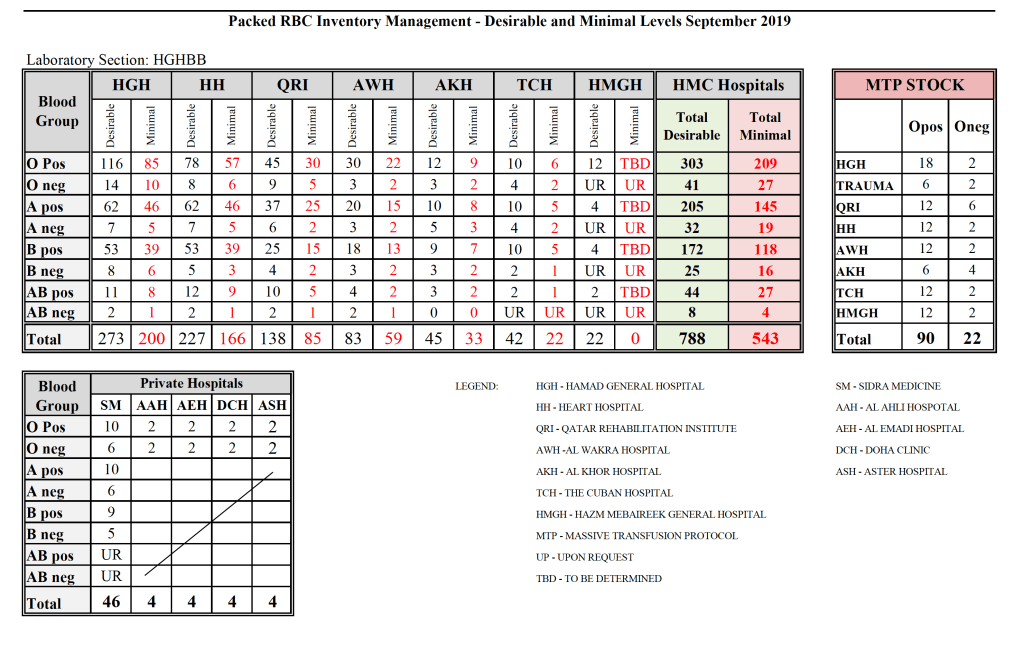
Current inventory calculation (follows)

References:

  1. Standards for Blood Banks and Transfusion Services, Current Edition, AABB, Bethesda, MD, USA
  2. Guidelines to the Preparation, Use, and Quality Assurance of Blood Components, European Committee (Partial Agreement) on Blood Transfusion (CD-P-TS), 17th Edition, 2013