Transfusion Medicine Lectures for Pediatric Fellows

In my time at the Saudi National Guard Health Affairs and at HMC Qatar, I offered the pediatric fellows a series of lectures of 1-2 hours duration.  The following list has been updated to cover current topics of interest, including COVID-19 convalescent plasma.

  1. Transfusing blood components for physicians—what do you need to know
  2. Recognizing and treating adverse effects of transfusion
  3. Blood components and derivatives—what you need to know
  4. Blood filters, irradiation, aliquoting, and washing blood components
  5. Pathogen inactivation and platelet additive solutions
  6. COVID-19 and the blood supply, COVID-19 convalescent plasma
  7. Indications for blood components and monitoring efficacy
  8. Patient blood management:  minimizing transfusions
  9. Blood group serology and compatibility—what you need to know
  10. Adult vs. pediatric transfusion medicine:  special considerations for the pediatrics
  11. Hemolytic disease of the fetus and newborn
  12. Rh immunoprophylaxis:  RhIG, fetomaternal hemorrhage
  13. Platelet refractoriness:  prevention and treatment
  14. Hemoglobinopathy:  component selection for pediatric patients
  15. Therapeutic apheresis, focused on pediatric age group
  16. Stem cell transplantation
  17. Transfusion-transmitted diseases
  18. Emerging pathogens:  ZIKA, Chikungunya, Dengue

25/2/21
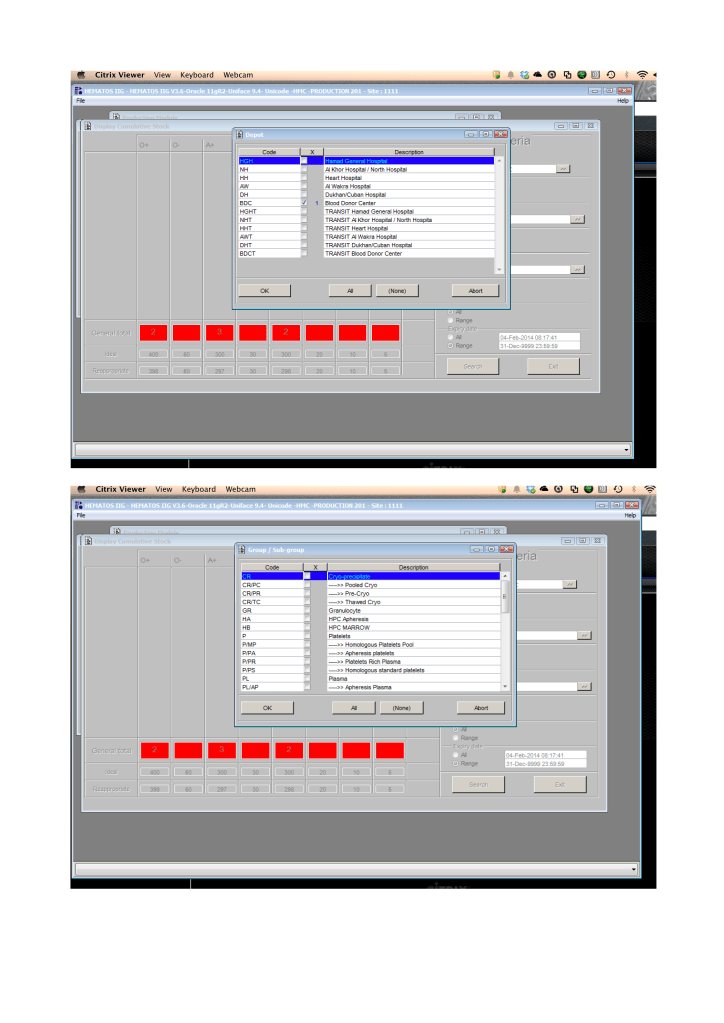
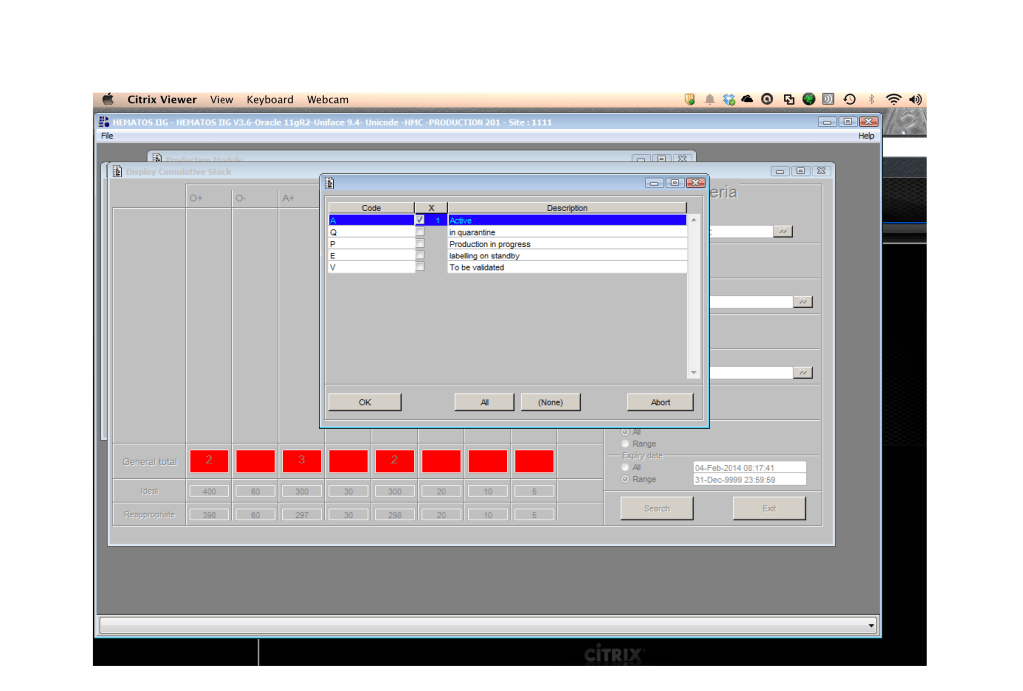
Traceability of Processes in Transfusion Medicine using Medinfo Hematos IIG

Principle:

As part of good manufacturing process, we must trace everything in Transfusion Medicine, from registration through release of components.  The adoption of the Medinfo Hematos IIG computer system allows us to document anyone and everyone who “touches” the blood components and all processes.

Policy:

  1. Each staff member must use his/her personal log-in to sign into Medinfo Hematos IIG HIIG).  Each transaction is recorded with the User ID.
  2. Through the Medinfo Hematos IIG  computer system, we can trace:
    1. Each staff member who handled every step of every process.
    2. Which equipment was used in processing
    3. Which materials were used, including serial number of blood bags and selected reagents
    4. For each component, the donor is identified, including review of all test results, physical examinations, and questionnaire
    5. For each patient, all components received (from which each donor can be traced) and all testing results including transfusion reactions and any applicable protocols
    6. For each reagent lot numbers, expiration dates
    7. For each blood component, test results, serial numbers of blood, transfer, and pathogen-inactivation bags, dates and types of all modifications, including any changes in component outdates, disposition of unit (transfused, discarded, quarantined, etc.)
  3. Units can be quarantined based on each of the above parameters to block release to and/or usage at all blood transfusion services/hospital blood banks.
  4. Upon request of the Division Head, Transfusion Medicine/LIS, designated Transfusion Medicine and HIIG staff have access to trace any of the above.
  5. All traceability incidents will be reported as variances and documented according to standard procedures.

References:

  1. Workflow processes for Medinfo HIIG, Current Versions
  2. Standards for Blood Banks and Transfusion Services, Current Edition, AABB, Bethesda, MD, USA

Use of Expired Reagents

This is a sample document for use of expired reagents I wrote for HMC Qatar.

Principle:

Due to logistics issues including the long distance between suppliers in Europe and North America and Qatar and the importation/customs clearance of critical materials, Transfusion Medicine has developed a contingency variance policy to minimize disruption of the essential transfusion medicine testing and component preparation.  Approval for use of outdated reagents in special circumstances is not meant to be an excuse for untimely monitoring and improper ordering of supplies.

Definition:

Rare Reagent:  Any reagent that is either used uncommonly or is in short supply and difficult to obtain in a timely matter.

Policy:

  1. Maintain a minimum six (6) months’ supply of each reagent when feasible.
    1. This cannot be done for short-outdate reagents such as reagent red cells for panels and antibody screens.
  2. If an in-date reagent is not available for use, then an outdated reagent may be considered for use if:
    1. It passes an in-run quality control including negative and positive controls as applicable specific for the test in question.
    1. Supervisor reviews the results and approves their use:
      1. Results using such outdated reagents may only be used if they pass the validation rules in that procedure.
    1. The Division Head, Transfusion Medicine, or designate reviews the supervisor’s recommendations and approves their use.
  3. All such variances must be documented as follows:
    1. Variance document form
    1. In the comments for results within the Medinfo Hematos IIG software.

References:

Sections 1.3.2 and 7.0, Standards for Blood Banks and Transfusion Services, Current Edition, AABB, Bethesda, MD, USA

Validation of Reporting Formats

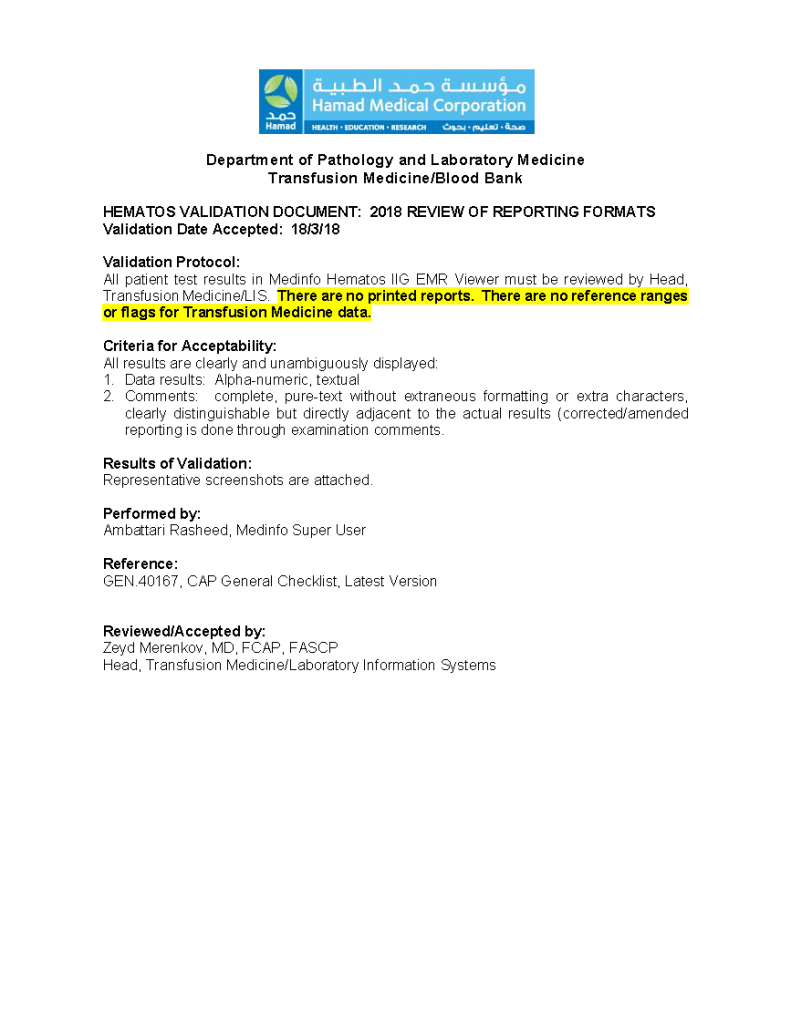
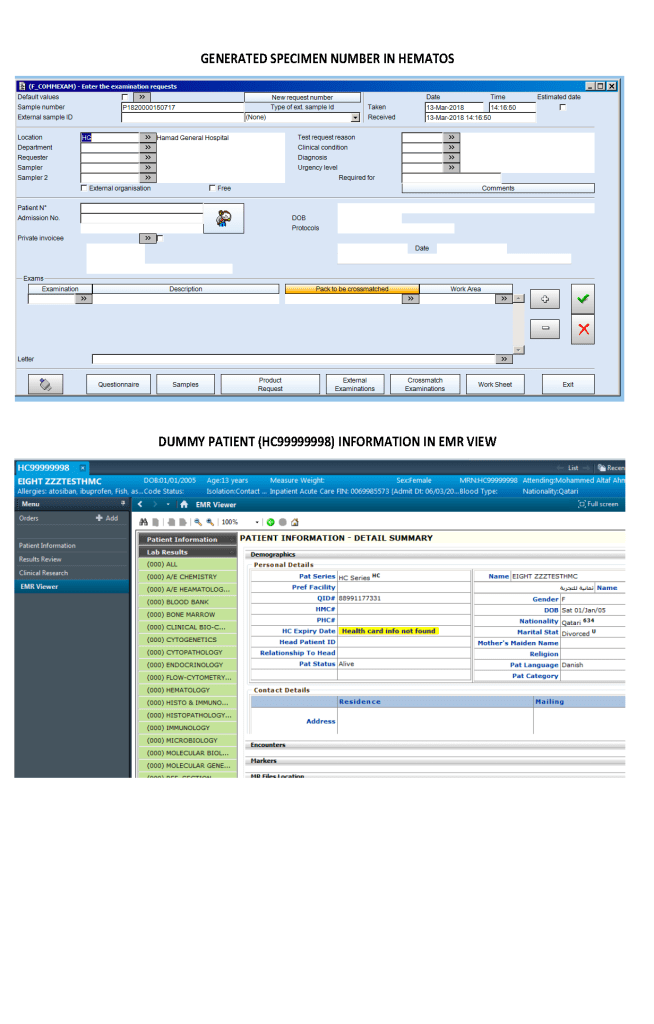
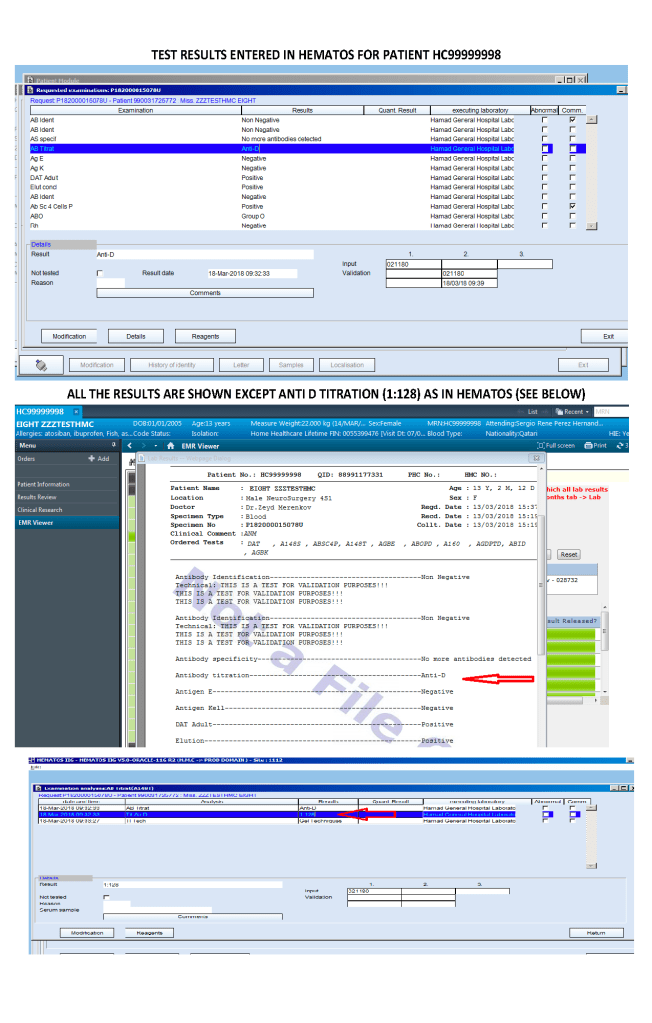
The attached PDF illustrates a sample validation of reporting formats for transfusion service testing.  The validation criteria are explicitly stated.  The evidence, in forms of screen shots, is attached to the PDF.  The data is reviewed and then accepted by me as the Division Head, Laboratory Information Systems.

Please note in this sample, no actual patient data was used.  All testing was done in a non-production environment.

Here are the embedded screenshots:

Opinion: Software Permissions for Blood Bank Staff

In my career, I have worked with many different hospital and laboratory computer systems.  One of my greatest frustrations has been providing software permissions to staff at all levels, from clerical, nursing, technical, and medical—inside and outside the blood bank.

The software permissions that I am specifically referring to are those with the blood bank software.  These I directly controlled as Division Head of Transfusion Medicine and Laboratory Information Systems.  I am not talking about virtual private networks or Citrix or cloud-based software controlled by the hospital IT department.

Here are some examples of inappropriate permissions:

  • All staff share the same access, regardless of position or department
  • Technical staff, including non-blood bank staff have global access to all functions
  • Non-blood bank staff can modify test results or comments

The golden rule is to only give access that is needed for each staff’s job designation.  Staff must sign an agreement not to access the system except for work and not release anything to non-designated personnel.

I recommend separating privileges by:

  • Blood bank vs non-blood bank staff
  • Blood bank section and location
  • Technical privileges by rank:  trainee vs base technologist vs senior technologist vs supervisor vs technical director
  • Medical privileges by rank:  residents/fellows, junior medical staff, senior staff, head of sections/directors

Permissions within a test category may include test ordering, result entry, verification/authorization, and/or purging.  In the donor center, it may include registration, donor qualification, collection, donor marker testing, donor immunohematology, component processing, component modification, and/or inter-depot transfer of components.  Management tools included in the software may also be restricted to high-level staff.

In this time of COVID and staffing shortages, we may be training new staff to work in the blood bank.  During their training, these trainees can be competency assessed and be given access to limited functions.  In Medinfo Hematos IIG, you can give staff custom permissions test-by-test so for example, if they are deemed competent for ABO/D typing, you could restrict their access to only those tests as an interim measure.

Having customized access for each employee can be nightmare for the systems administrators so this granular special access must be kept to a minimum.  However, it is good to know that you do have this capability if needed.