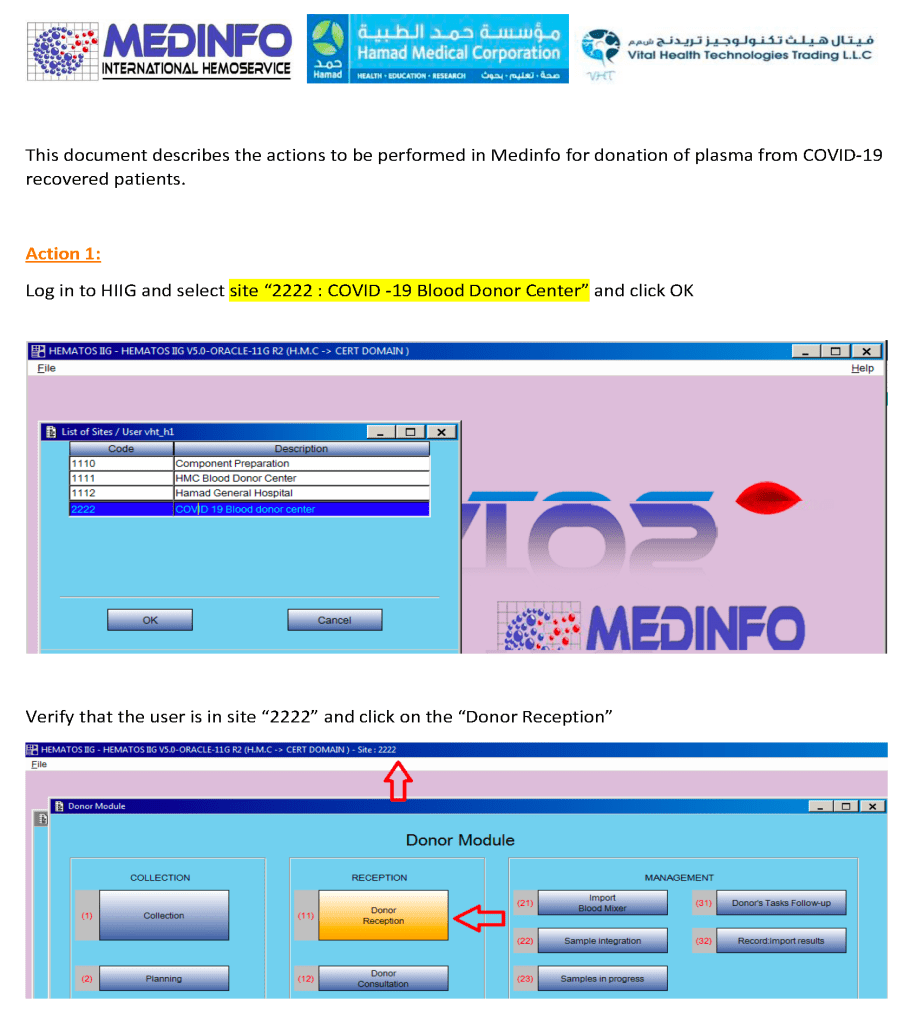
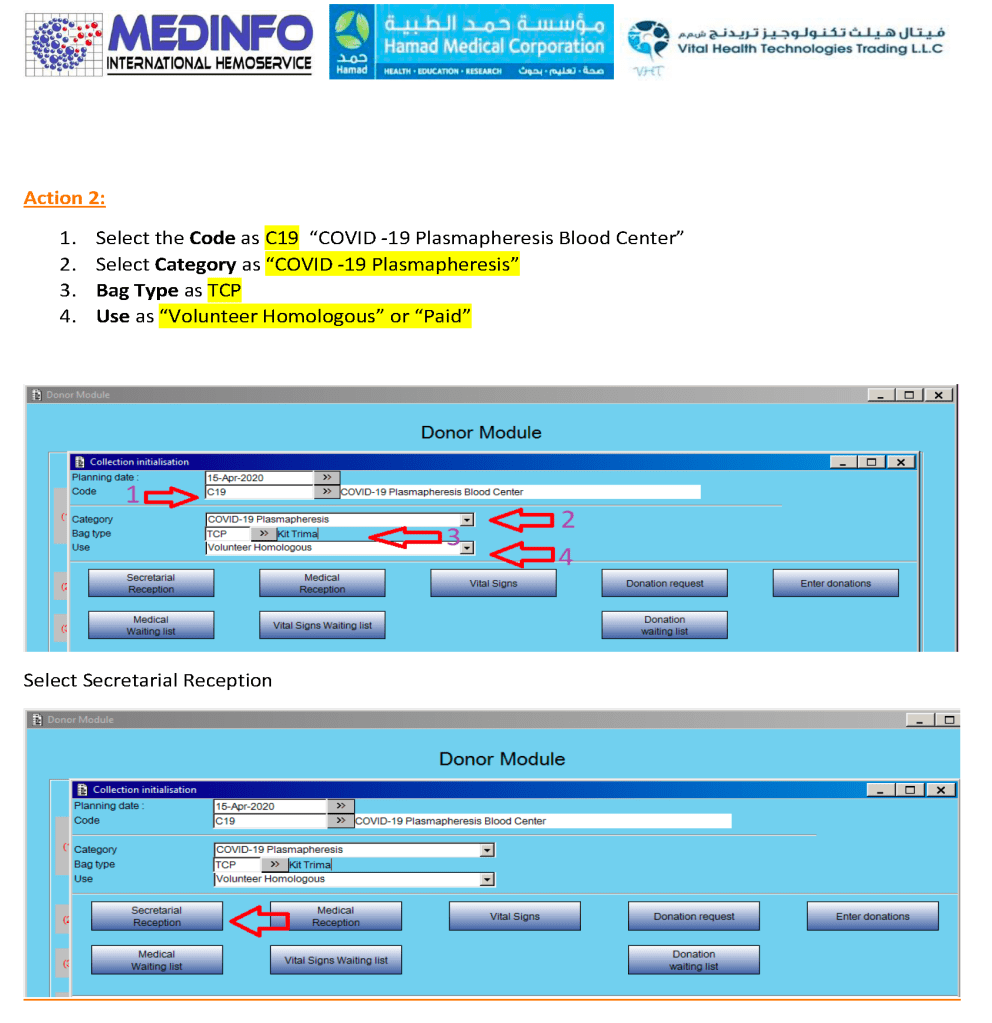
COVID-19 Convalescent Plasma CCP Donor Registration

I designed a completely quarantined process for collection, processing, and release of CCP at HMC Doha.  This document shows the Medinfo process for donor registration as a separate donor center code.

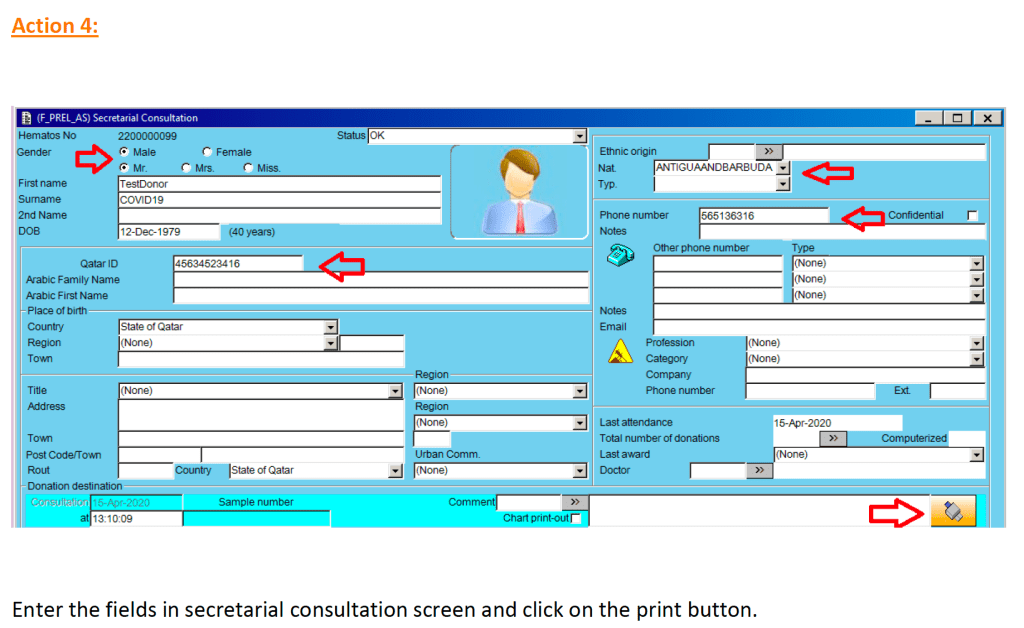
Check donor history and donor deferral database.  If there is no previous encounter, generate a new donor file:

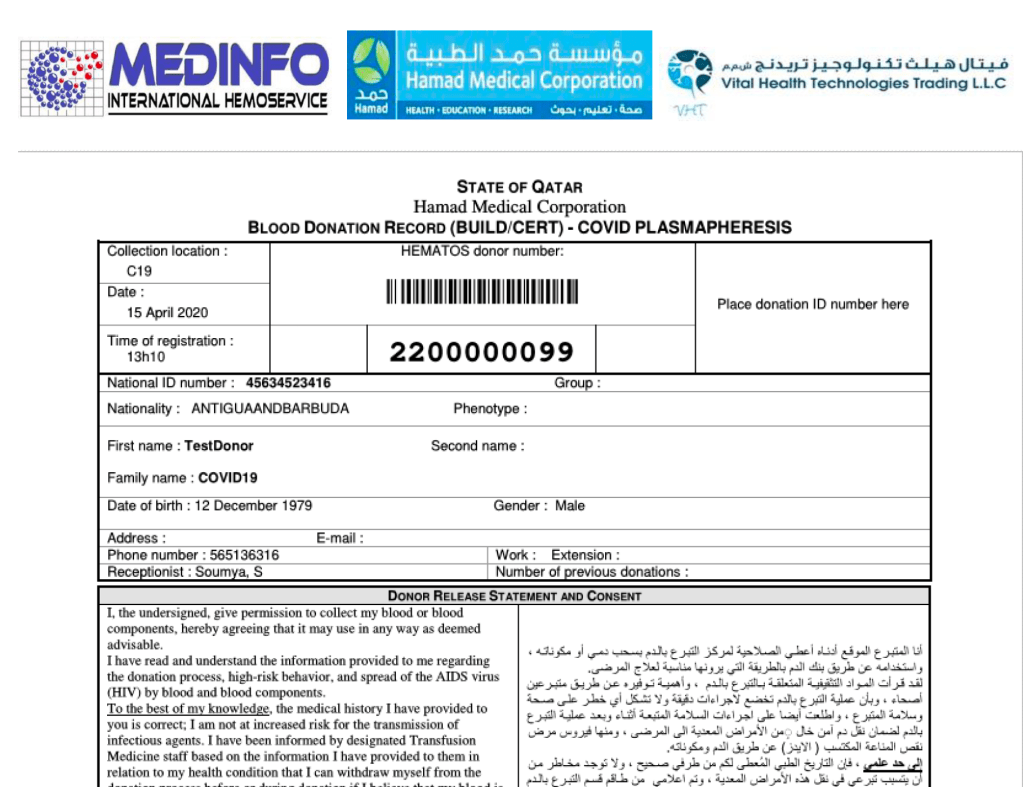
At the completion of this action, the Blood Donation Record with the donor unit number (in this example 2200000099) and consent form in English and Arabic is generated.

CCP could only be collected at this special site and only the apheresis bag could be used for collection.  Regular donation options were not available at this CCP site nor was CCP collection an option at the regular donation sites.

8/1/21

Further Thoughts on Inter-Depot Transfer, Blood Delivery, Type and Antigen Matching

In my recent post, I provided sample flows and parameter mapping for delivery of blood components.  The final components from the component preparation center may be sent to various depots (freestanding location and/or hospital blood banks.  There should be complete traceability for every step (from donor reception, collection, testing, and processing) transport between locations, and finally the exact storage site, which might include which refrigerator/freezer/incubator and even shelf/position number for each component is stored.  The end of that document showed rules for type/antigen matching.

For disaster planning, rapid inventory enumeration by type is very important.  This can be very time-consuming manually.  With our Medinfo Hematos blood bank system, we could quickly get total inventory across the Qatar or by hospital in less than one minute.  We could also quickly find antigen-matched units across the system and reserve it at any one site for another if necessary.

Smart blood bank dispensing refrigerators, as offered by Haemonetics and Angelatoni, may also serve as depots and take the place of a hospital blood bank for some dispensing.  These solutions can also capture vital information about the storage conditions of the components and prevent release if the storage criteria are not met.  They can also interface with blood bank computer systems and use the main system’s logic for the dispensation rules.  In Medinfo, they can be added as a hospital blood bank site.

Upon receipt at the hospitals from the blood processing center, the forward ABO and D typing must be confirmed.  We used D reagents which detected partial D so we would call such donor units as D-positive.  However, if a patient type reagent insensitive to partial D types is used, it is possible for a unit to be typed as D-negative whereas in the donor center it might be D-positive.  Sometimes, nothing types consistently as D-positive:  all you can say is that with a particular reagent and lot number, there is or isn’t reactivity.

The greatest complexity is for RBCs since potentially so many antigens exist.  Criteria for matching/ignoring certain antigens must be made.  Critically significant antibodies such as the Kell, Duffy, Kidd, and certain Rh (D and c) must be antigen matched.  A robust blood bank computer system can enforce these rules.

For other components, antigen/typing may be less important.  In fact, in most situations, any type of platelets can be given to anyone (except neonates).  Despite the potentially incompatible plasma, there is rarely significant hemolysis.  In fact, if pooling platelets without regard to blood types is done, a platelet transfusion is a common cause of a positive direct antiglobulin test DAT—something that is not clinically significant.  No one died of a positive DAT by itself for this reason.

Specific rules for compatible plasma types are important, but nowadays, low-titer group A plasma may be used like universal AB plasma.  The challenge is to be able to perform the ABO titration (specifically anti-B) quickly—titration can be a slow process, even with automated equipment.  A similar situation for low-titer, universal group O whole blood requires both anti-A and anti-B titration (I will return to this topic in a future post).  With Medinfo, I can define rules (e.g. IgM titer < 1:64) to accept these units as a universal type for all ABO groups.

Special rules can be built into the software so that production, transfer, storage, and release of COVID convalescent plasma CCP are only performed at special quarantine sites by designated personnel.  This means there can be dedicated transport pathways built into the inter-depot transfer process to keep this inventory separate at all times.

Logistics and Processes for a COVID-19 Convalescent Plasma Program

I prepared the following plan for a CCP program for HMC Qatar in March, 2020.  The workflow is divided into four (4) modules:

  1. Registration/Interview/Physical Examination/Apheresis Collection
  2. Donor Marker Testing and Immunohematology Testing
  3. Production/Aliquoting/Pathogen-Inactivation/Storage
  4. Product Thawing/Product Release

Module 1:

  1. Collection/registration/screening must be in a separate area from regular blood and apheresis donations.
  2. Donors must provide consent.
  3. ISBT specimen labels must be used on each tube collected.
  4. We need a minimum of two apheresis nurses, one for the registration/screening/post-donation observation and one for the actual apheresis procedure.
  5. If there will be multiple serial donors, then we need a waiting area (each donor at least 2 meters apart).
  6. Donor screening must be in sound-proof area so that other waiting donors cannot hear the interview/questionnaire process.
  7. Amount that can be collected depends on body weight:  500 ml for <80 kg and 600 ml for >= 80 kg, collection may occur twice per week
  8. Collection time includes 15 minutes for registration/interview/physical examination, 60-75 minutes and 15 minutes for cleanup/disinfection before the next case, approximately 2 hours per donation.
  9. A post-donation observation area (minimum 15 minutes after collection) with apheresis nurse nearby in case of reactions is needed if there will be multiple donors.
  10. Specimens will

Module 2:

  1. Donor testing and donor immunohematology will be done with other donor specimens in our regular location

Module 3:

  1. Apheresis collection must be processed and stored separately from regular blood/apheresis donations.
  2. Processing will occur only after the results are shown to meet all criteria.
  3. Pre-collection testing (test-only donation) would permit processing without waiting for results.
  4. Storage at minus 80C may be for a minimum of six (6) years but this may be extended if needed.
  5. All acceptable components will have a final ISBT label—no products without the ISBT label will be transfused.  The ISBT label indicates that the unit meets all donor criteria for convalescent plasma.

Module 4:

  1. Product modification (thawing) and release (sign out from blood bank) must be in a separate area(s) from the regular hospital blood bank.
  2. Release of convalescent plasma follows the same process as regular component release
  3. Transfusion of convalescent plasma at the patient’s bedside follows same process as regular component transfusion
  4. Nursing and other staff performing the transfusion must pass competency assessment.
  5. Plasma will be transfused as ABO-identical or compatible unless low ABO-titer group A is used.
  6. Plasma must be free of clinically significant antibodies

Workflow Considerations:

  1. Donors must be restricted to the waiting, collection, or post-donation observation areas.
  2. Donors must NOT pass through production, testing, or component release areas (just as they are currently restricted in the Blood Donor Center and HMC hospital blood banks/transfusion services).

Logistics:

  1. Throughput is a maximum of 4 donors (2000 to 2400 ml plasma) per eight-hour shift with one apheresis nurse and one donor apheresis (Trima) machine.
  2. The processes are scalable with additional staff and machines (e.g. with 3 machines and nurses, then 12 donors and 6000 to 7200 ml of plasma collected).
  3. Thawing of 1-2 units of plasma takes up to one hour.  Contact the quarantine blood bank at least one hour before the desired pick-up time.
  4. The four modules above can be in separate areas not adjacent to one another.  Modules 1, 3, and 4 must be quarantine areas where access is limited.  Module 2 can be performed with regular donor specimens using standard precautions.
  5. We can provide training for transfusion of blood components and competency assessment to any location transfusing this product.

Information Technology:

  1. All modules will be connected to the Medinfo Hematos IIG dedicated blood bank computer system.
  2. All records of collection/production/testing/storage/modification/release will be stored therein.
  3. All ordering of convalescent plasma components will be through Medinfo.
  4. External test results (e.g. future antibody titering) can be added to the component information.
  5. Links to the Hospital Information System (Cerner) may be considered after the Medinfo processes are fully functional.

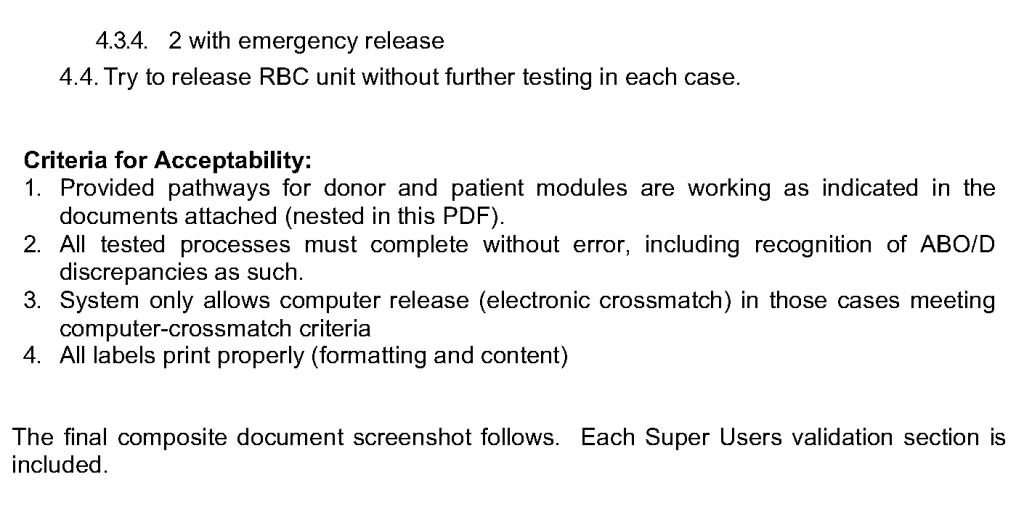
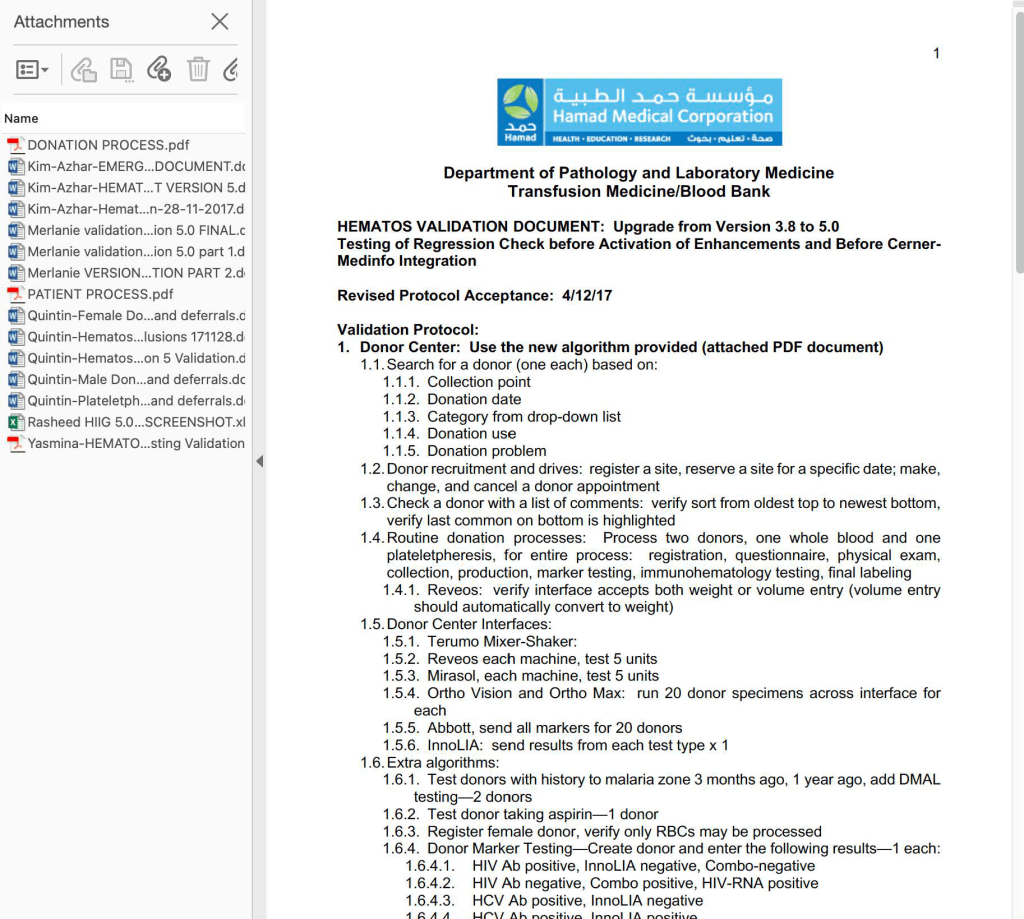
COVID-19 Convalescent Plasma CCP Site Registration

I designed a completely quarantined process for collection, processing, and release of CCP at HMC Doha.  This document shows the Medinfo process for site registration as a separate donor center code.

CCP could only be collected at this special site and only the apheresis bag could be used for collection.  Regular donation options were not available at this CCP site nor was CCP collection an option at the regular donation sites.

4/1/21

Medinfo COVID Convalescent Plasma Workflow Revisited

It now has been over eight 8 months since I prepared the CCP workflow in Medinfo.  It was built on the framework of the manual CCP process including donor prescreening with an abbreviated donor questionnaire.  It was really quite simple and used the donor and patient modules to create quarantine areas for donor screening, collection, processing, and hospital patient blood bank release.

Here are my current comments on the process:

Donor Qualification:

I would still exclude malaria and HTLV from the donor questionnaire and would update to UDQ 2.1.  Since these donors have recovered from a potentially life-threatening illness, I would keep the Hgb threshold at 11 g/dl.

Donor Collection:

In the future, I would consider using one of the soon-to-be-released portable devices that continuously monitor vital signs with pO2 and EKG lead to rule out asymptomatic pulmonary or cardiac problems.

I would also consider using low-ABO-titer, group A, universally to meet the demand for group B and AB patients.

Donor Testing:

There is still no need to segregate and separately test CCP donor specimens from regular blood donor specimens.  I would perform SARS-CoV-2 antibody testing and set a threshold for qualifying donors—that threshold will be based on the manufacturer’s recommendations.  However, if the treating physician wanted to use a low-titer unit, I would permit this.

Donor Processing:

There is no need to change this from the current processes.  Keep the CCP processing separate from the regular operations.

CCP Plasma Release:

I would keep the quarantine release and restrict it to the locations used for treating COVID-19 patients

Medinfo Software Modifications:

I would record the IgG and IgM titers for SARS-CoV-2 antibodies in each donation record.  This would include testing and entering the results on donations prior to this testing.  ISBT labels should include this antibody titer.

Hospital Information Software Modifications:

Set up restricted CCP ordering for the actual treating physicians only.  Also provide the ISBT code and shortened descriptors to it if necessary (certain HIS vendors still cannot read ISBT codes natively).

The original CCP workflow is attached for reference.

COVID-19 Convalescent Plasma CCP Series Introduction

I will be posting a detailed series about the manual and software-enhanced COVID-19 processes that I set up in Qatar at HMC Doha in March-April 2020.

In this series I will provide you with screen shots of my Medinfo Hematos IIG software design for each step in the process:  collection, processing, testing, inter-depot transfer, and hospital transfusion service/blood bank release.

This GMP-compliant software-enhanced system is based on the manual system I set up in early March 2020 at HMC.

I want to thank Medinfo Hematos IIG for their rapid response to building this parallel system based on my standard processes in so short a time (two weeks) and my special thanks to the software engineering team at Vital Health Technologies, the agent for Medinfo in Qatar.

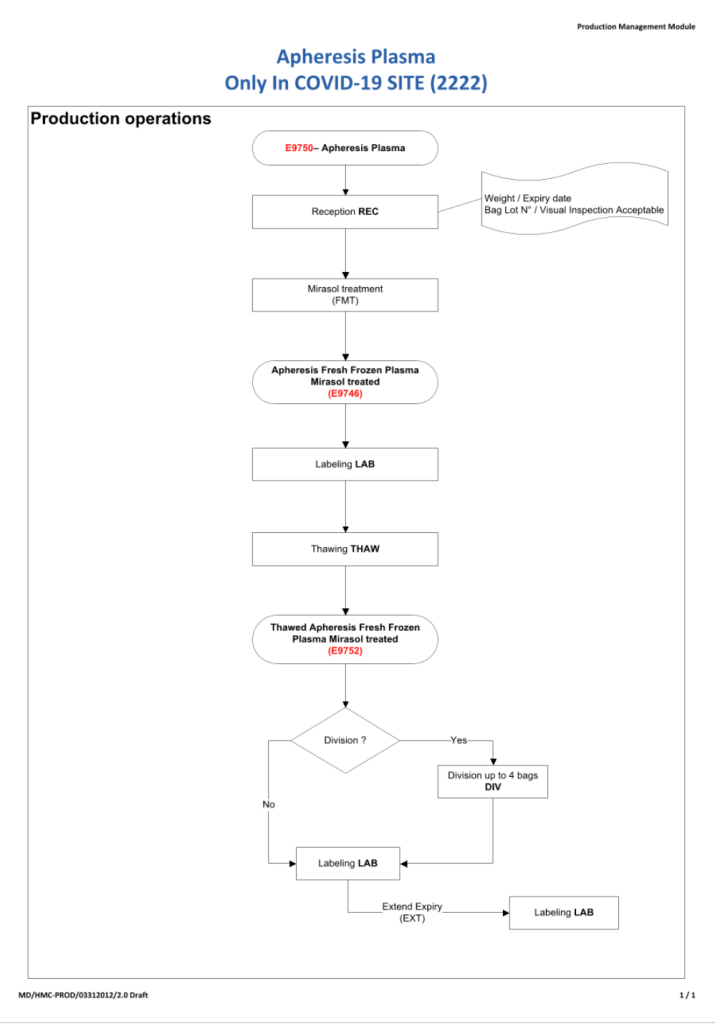
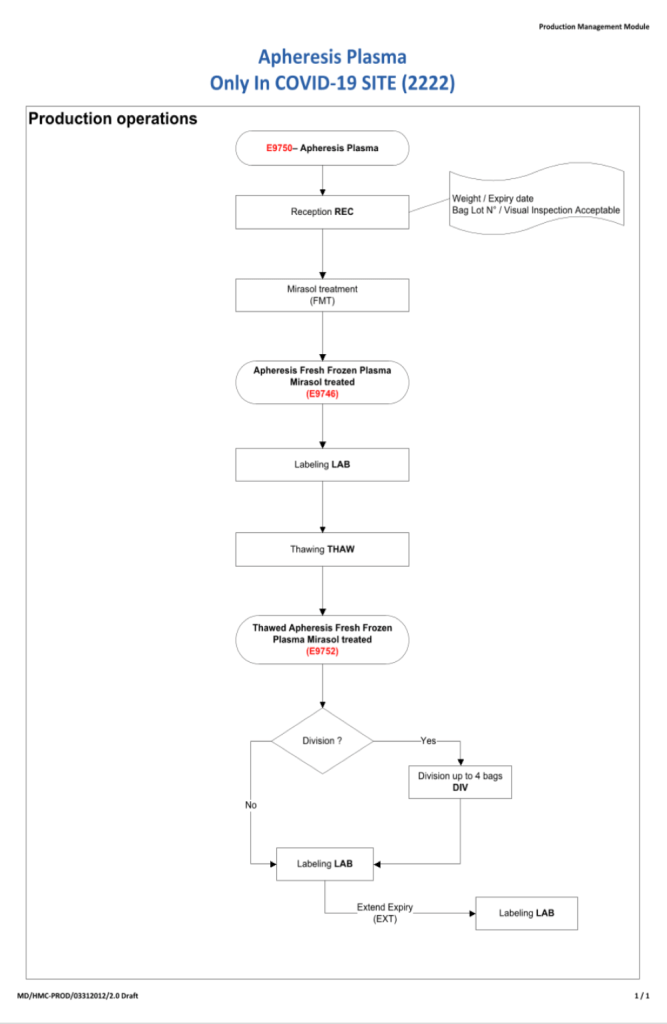
To start the series, I am providing the basic workflow for the system.  As is normal in Medinfo software design, a full mapping of the processes are made.  This workflow shows the new CCP ISBT codes and the quarantine collection and processing steps.  The donor testing (marker and immunohematology) processes are similar to those for regular donor units.

This is basically the same process both manually and in the software.  I always say:

A good software process is based on a good manual process!!

Please note the following workflow for our initial discussion.

Preventing Graft vs. Host Hemolytic Anemia

Principle:

Donor lymphocytes in an organ transplant may make antibodies and cause a clinically significant hemolytic anemia, i.e. a graft vs. host hemolytic anemia GVHHA.  Optimal handling in these cases should include antibody screening/identification for all potential donors and recipients.  The transfusion medicine physician should review the results for possible issues of antibody/antigen incompatibilities to proactively select matched blood components and avoid GVHHA.

In the Medinfo blood bank computer system, we can make custom rules to ensure release of only antigen-matched units as needed.

Policy:

  1. Perform antibody screen and identification (if indicated) for all prospective organ donors and recipients.
  2. If the organ donor has clinically significant antibodies, check if the recipient has the corresponding antigens.  If so, select RBC units negative for the donor antibody specificities. 

Example:  Donor has anti-Kell (K1) and patient is K1-positive.  Use only K1-negative RBCs post-transplant.

  • Send the case to the transfusion medicine physician to review.  He will contact the clinicians as indicated.
  • Create a rule in Medinfo forcing the antigen matching.

References:

  1. Technical Manual, Current Edition, Bethesda, MD, USA
  2. Standards for Blood Banks and Transfusion Services Current Edition, AABB, Bethesda, MD, USA

Patient D-Typing Algorithm Using Ortho Monoclonal Cocktail Reagents

Principle:

We must select D-negative RBC units for transfusion if the patient is truly D-negative or if he/she is a partial D since transfusion of a partial D positive unit may induce antibodies against any part of the D molecule.  Thus, for patients, we will consider patients with partial D as D-negative.  Note that this is NOT the usual practice in the USA;  however, AABB Standards do allow that we do NOT test patients for weak D and give D-negative RBCs instead.

Background:

Ortho Diagnostics Reagents use two different monoclonal antibody cocktails that react variably with the antigen D (Rh1)—these are found on the card:  Anti-A/B/A,B/D/D/Ctrl:

Anti-D/Anti-RH1—IgM monoclonal antibody clone D7B8 can detect most examples of weak and partial D including weak D types 1, 2, 3, 4.0, and D categories II, III, IV, V, VII, DBT, and R0HarIt does NOT detect category VI.  Retest positive reactions of 2+ or less by an alternate method.

Anti-D/Anti-RH1—IgM monoclonal antibody RUM1 can detect most examples of weak and partial D including weak D types 1, 2, 3, 4.0, and D categories II, III, IV, V, VII, DBT, and R0HarIt does NOT detect category VI.  Retest positive reactions of 2+ or less by an alternate method.

Policy:

  1. Follow the manufacturer’s instruction for storage, handling, and usage of all reagents.
  2. If the D-control is positive, the reactions are indeterminate, repeat by another method.
  3. Run both anti-D reagents listed—do not use the donor typing algorithm or reagents.
  4. Use the following table for interpretation and further actions if needed:
Pattern #Anti-D/D7B8Anti-D RUM1D-Interpretation
1PositivePositiveD-positive
2PositiveNegativeDo additional testing
3NegativePositiveDo additional testing
4NegativeNegativeD-negative  

If the reaction is 2+ or less with either the Ortho anti-D/D7B8 reagent or anti-D/RUM1 or if the patterns 2 or 3 above, repeat by another manufacturer’s reagents.  In the meantime, consider the patient as D-negative.

Medinfo-Ortho interface settings for Patient Testing:

Anti-D/D7B8Anti-D RUM1D-Interpretation
3, 43, 4D-positive
3, 40~
03, 4~
00D-negative
~~~

Note all of the following:

  1. If the result is D-indeterminate, use D-negative RBCs.
  2. No reagents may be able to detect all D variants.
  3. ~ means any other value for that reagent (1+, 2+, mf, hemolyzed)
  4. Note that this new algorithm makes a 2+ reactivity as indeterminate with Anti-D/D7B8 or Anti-D/RUM1.

References:

  1. Publication e631300291, Product Insert, Anti-A/B/A,B/D/CDE/Control Card, 2010, Ortho Clinical Diagnostics, High Wycombe, Buckinghamshire/UK
  2. Standards for Blood Banks and Transfusion Services, Current Edition, AABB, Bethesda, MD, USA

Off-Line Donor Medinfo Transactions

Principle:

When you cannot establish a direct link to the live Medinfo program, you must arrange for the local Medinfo engineers to create a local server that will have the current Medinfo donor database for use at outside campaigns where the internet connection cannot be used.  This can also be used if for some reason the Blood Donor Center link is down in order to register donors and check the donor deferral database.

Policy:

  1. For each outside campaign, there should be a pre-campaign visit to verify the availability of internet to connect to Medinfo.
    1. If the internet connection is working, use Medinfo using the 4G access points.  Otherwise:
    2. If none, inform the Medinfo engineers to prepare a local server on one of the laptops at least ONE DAY in advance of the campaign.
      1. Give Medinfo engineers the laptop to download the database and software.  This will be the offline server for the campaign.
      2. Link the offline server to the other portable computers for the campaign (see the corresponding Medinfo job aid).
      3. Use the local network (offline server and other portable computers) for registering donors.
      4. Upon return to the Blood Donor Center, upload the data.
      5. Continue the regular processes after uploading.

Note:  When the offline data is uploaded into Medinfo main database, it will be checked against the latest donor deferral database.  The latter will be applied for the donation.