This Powerpoint file summarizes the past previous posts about the use of automated components, pathogen inactivation, and their synergism with the blood bank computer software Medinfo Hematos IIG




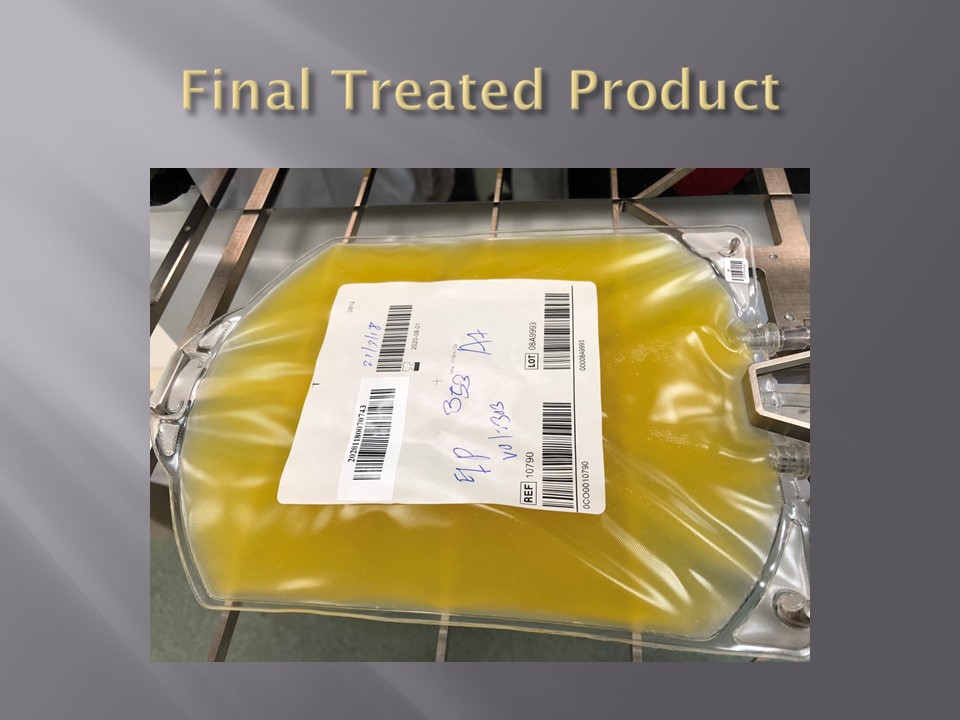

Riboflavin-based pathogen inactivation
This Powerpoint file summarizes the past previous posts about the use of automated components, pathogen inactivation, and their synergism with the blood bank computer software Medinfo Hematos IIG
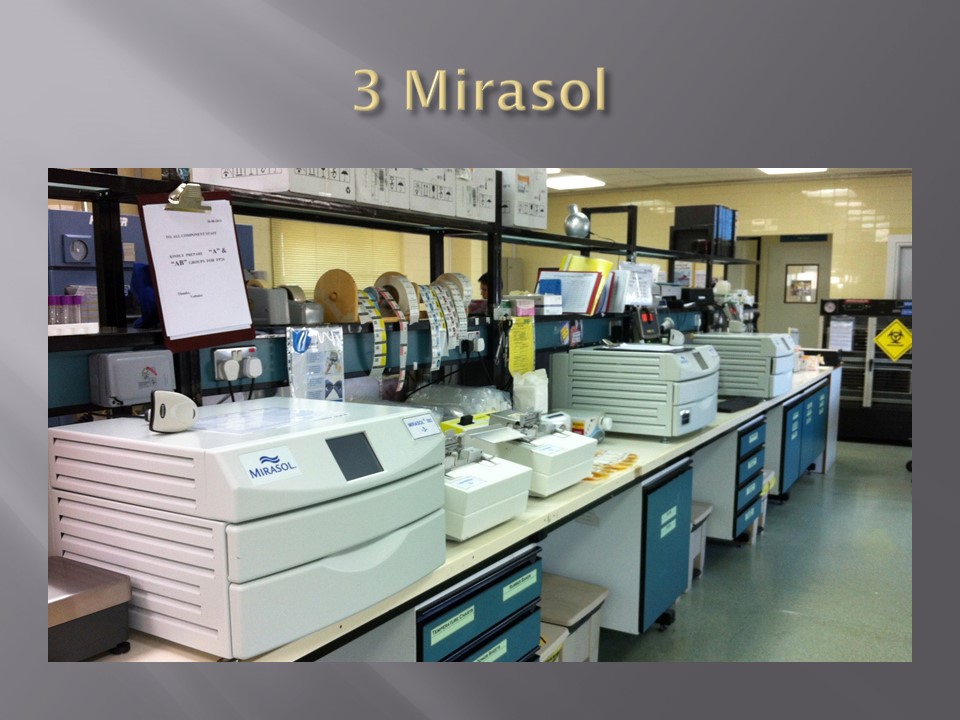
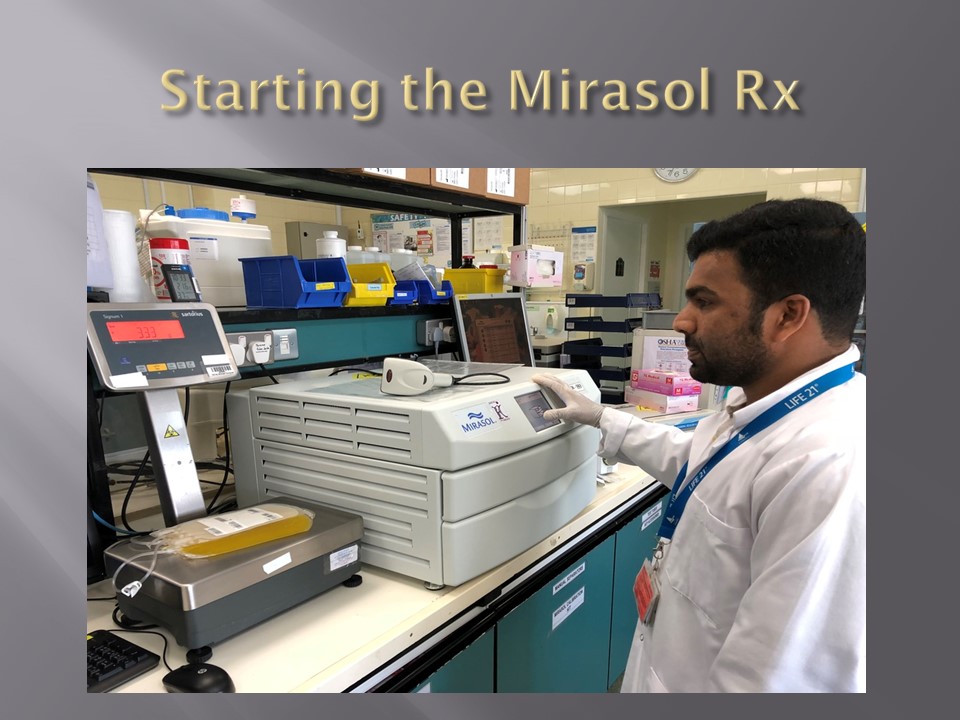
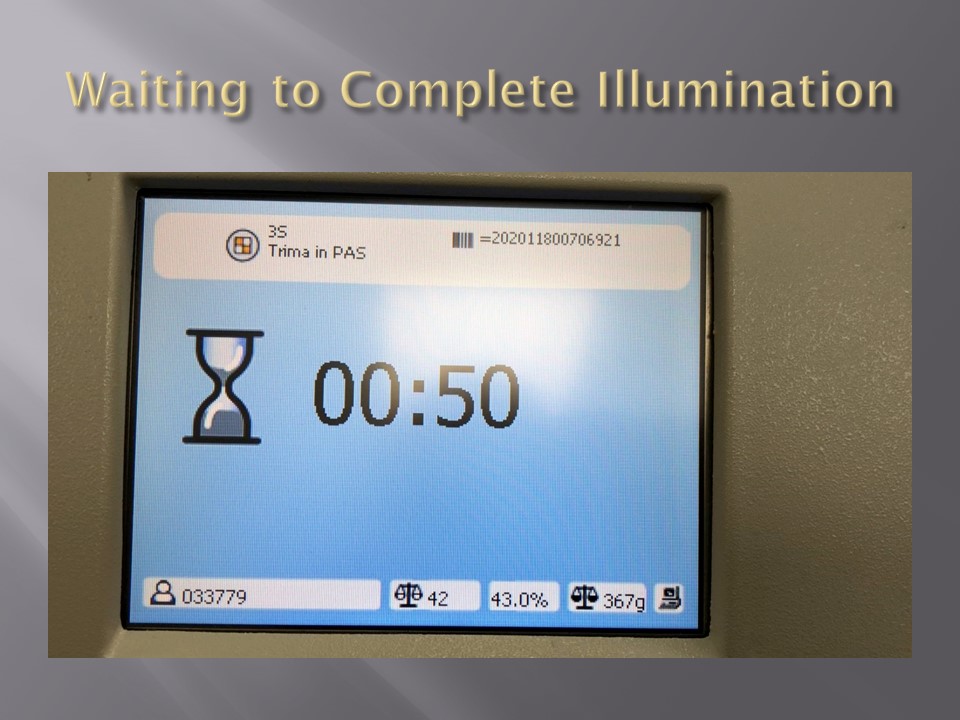
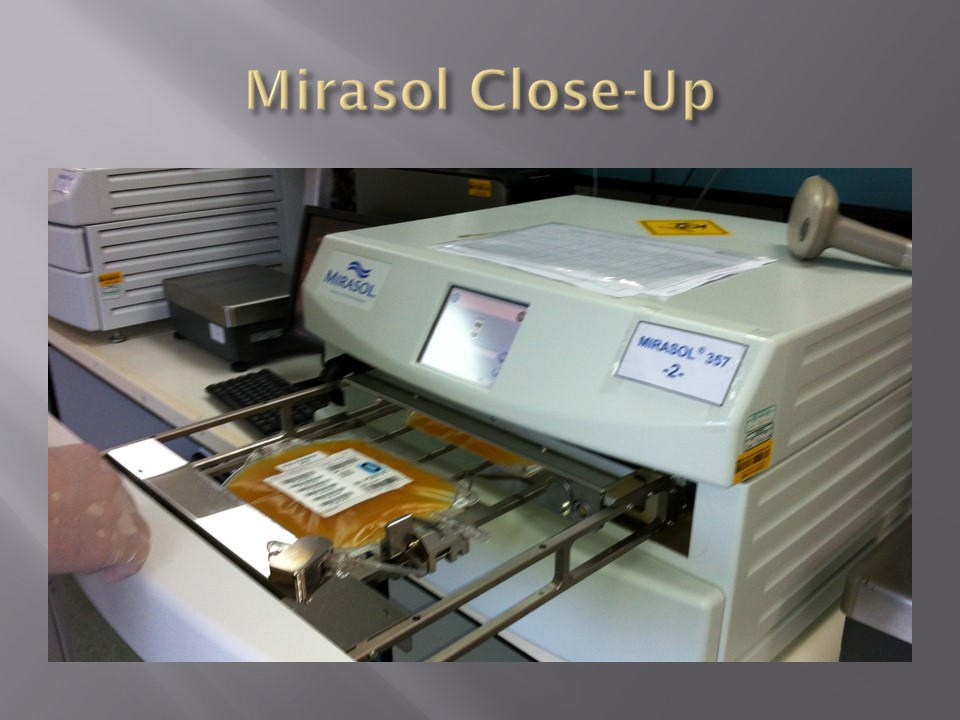
Automated Component Processing: Reveos and Mirasol Pathogen-Inactivation
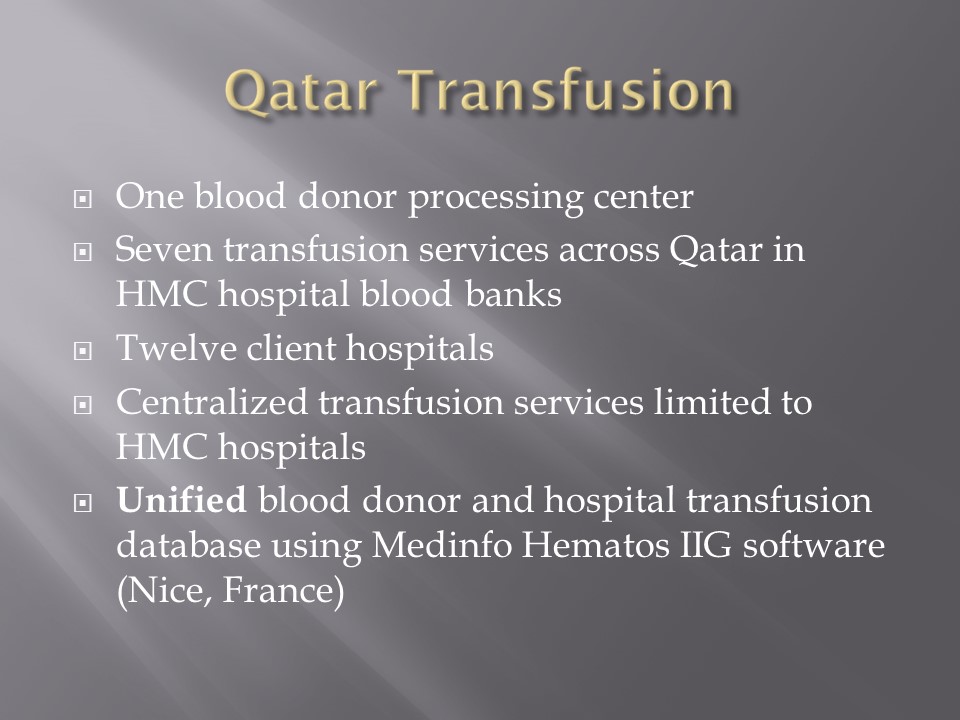
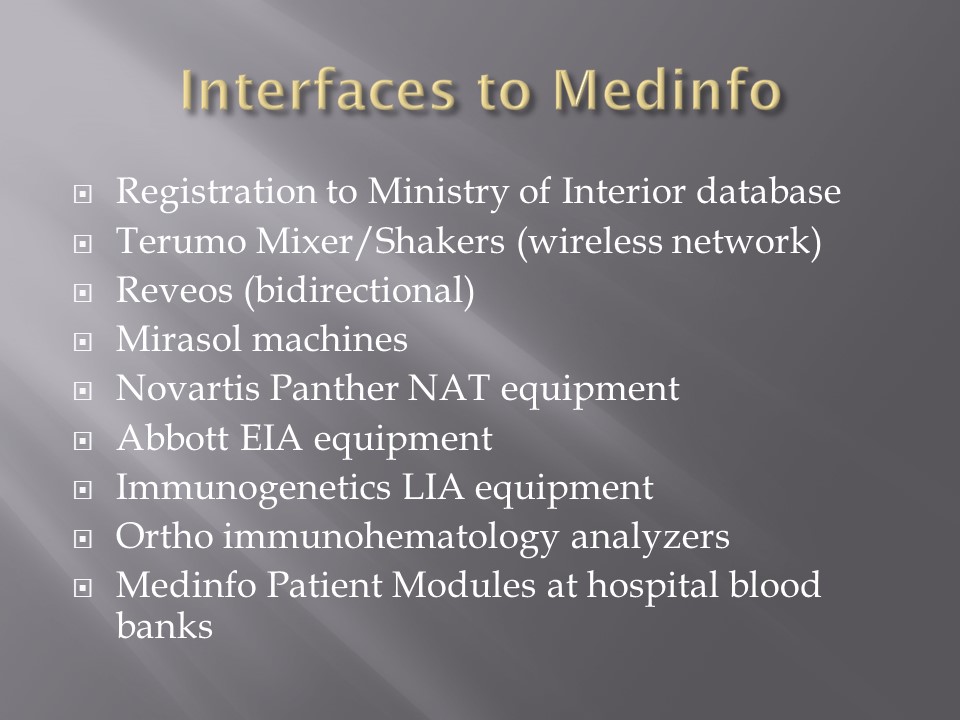
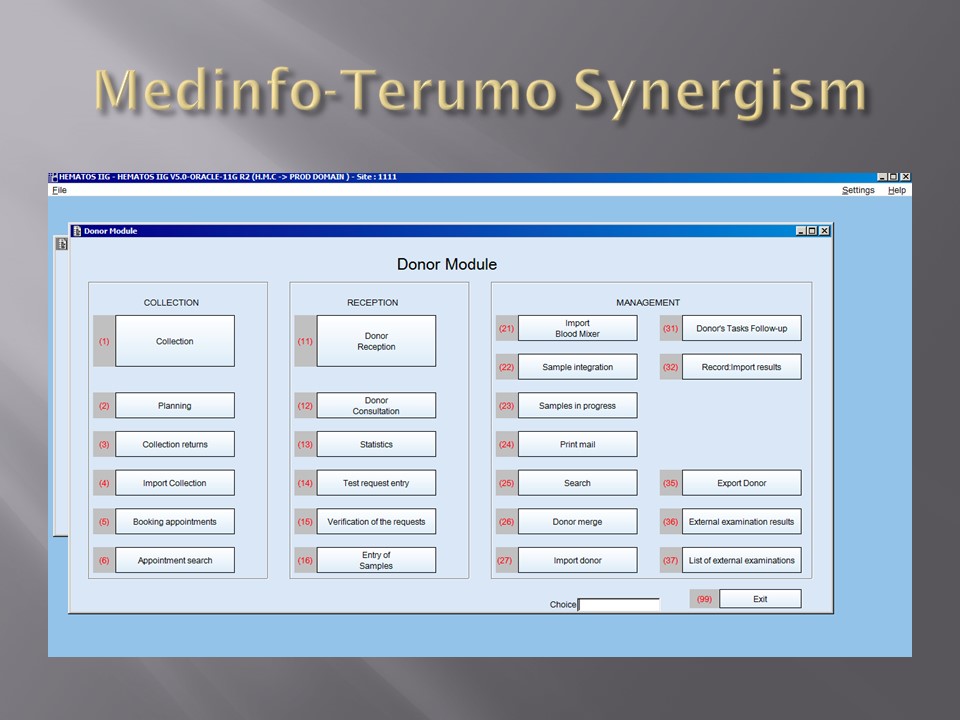
The production instruments have more complicated interfaces than the testing equipment discussed in the previous post:
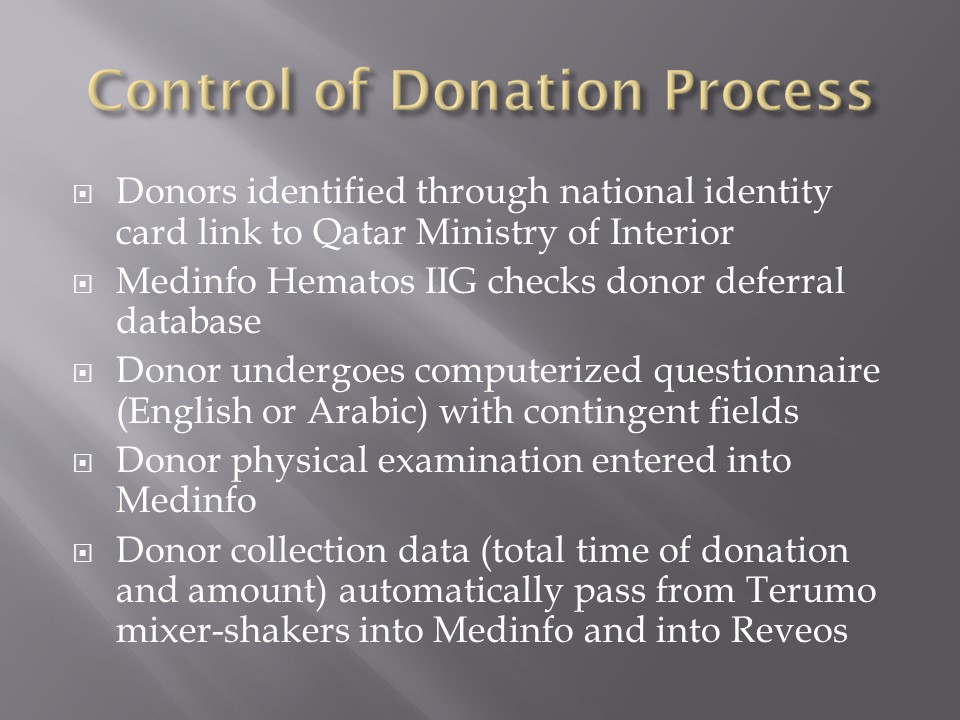
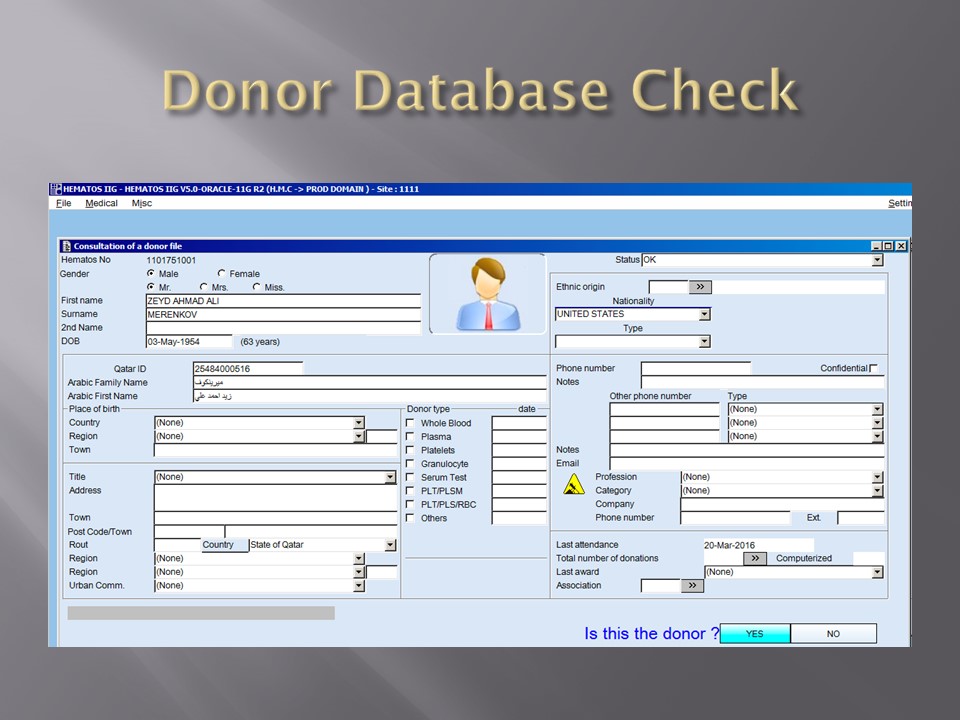
In the collection area (on-site or remote), the cvolume of the whole blood and collection time are recorded in Medinfo and based on the rules, production may only occur within specified volume and collection time. Otherwise, Medinfo will block further processing.
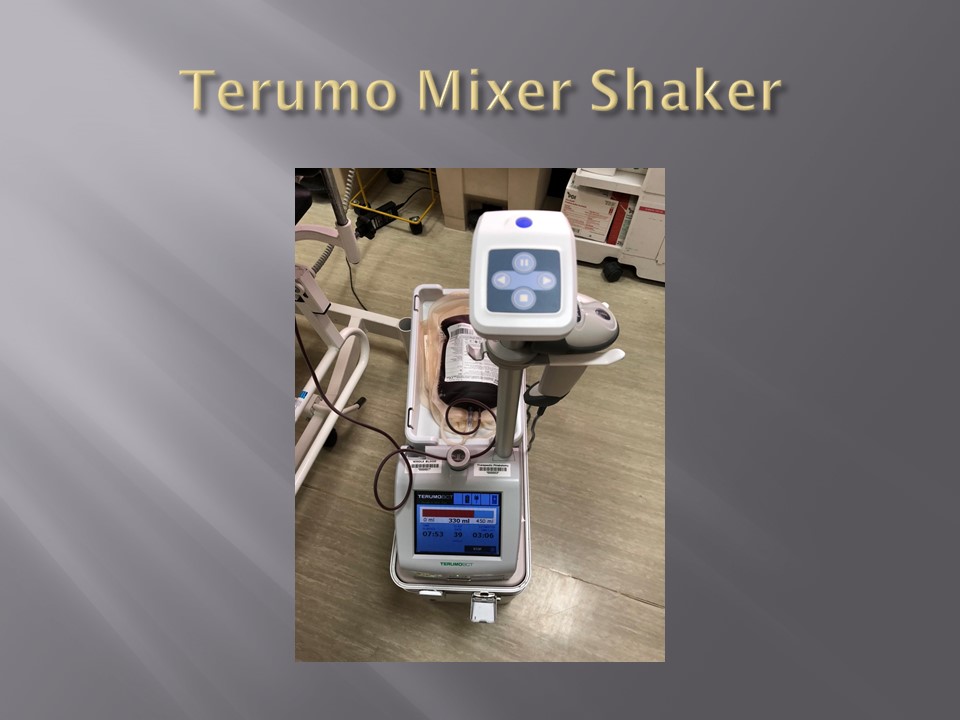
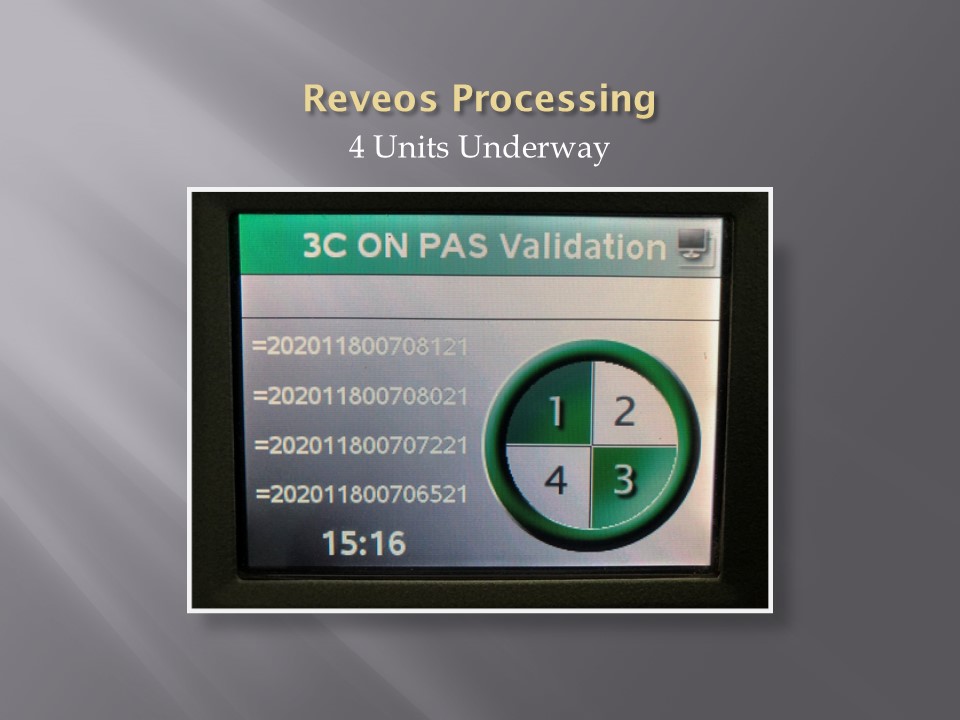
The ISBT unit number of the whole blood units are read by the Reveos. Only those units passing the collection criteria will proceed to separation.
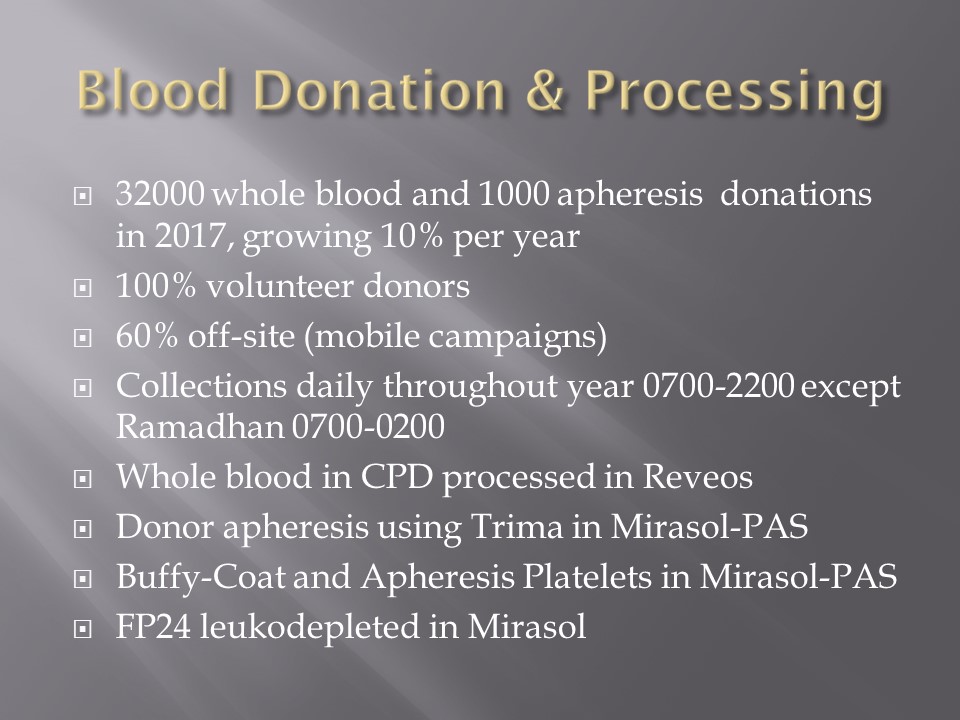
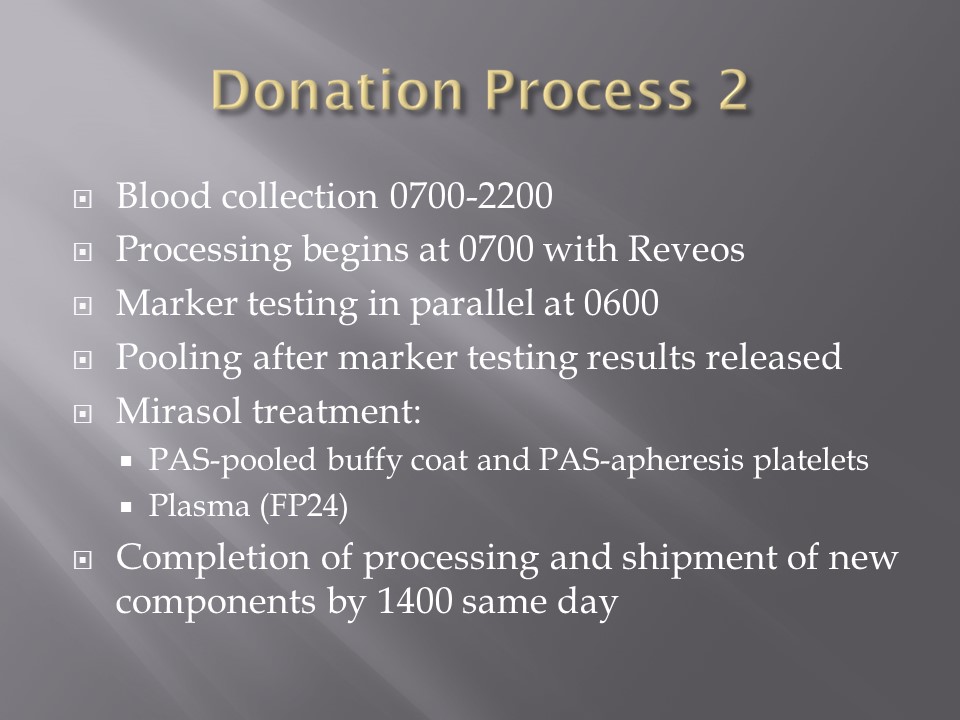
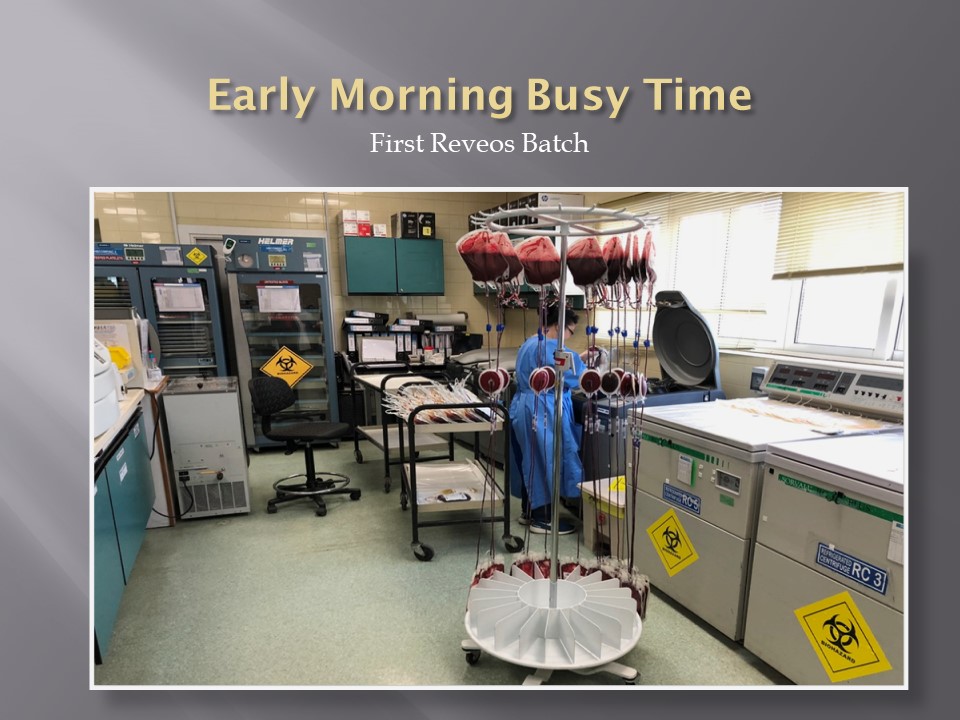
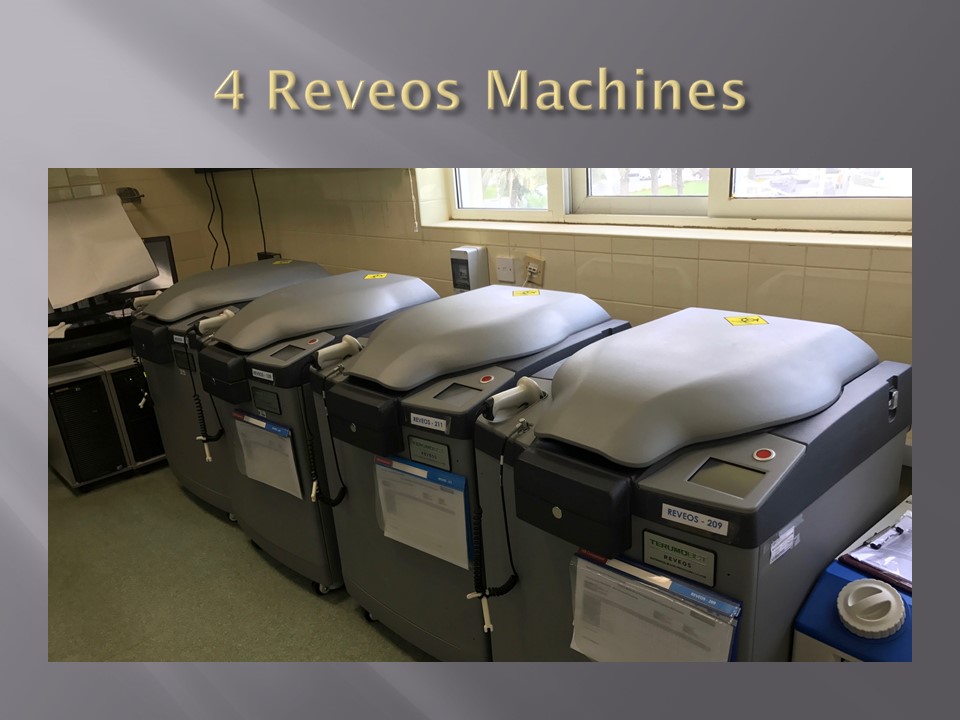
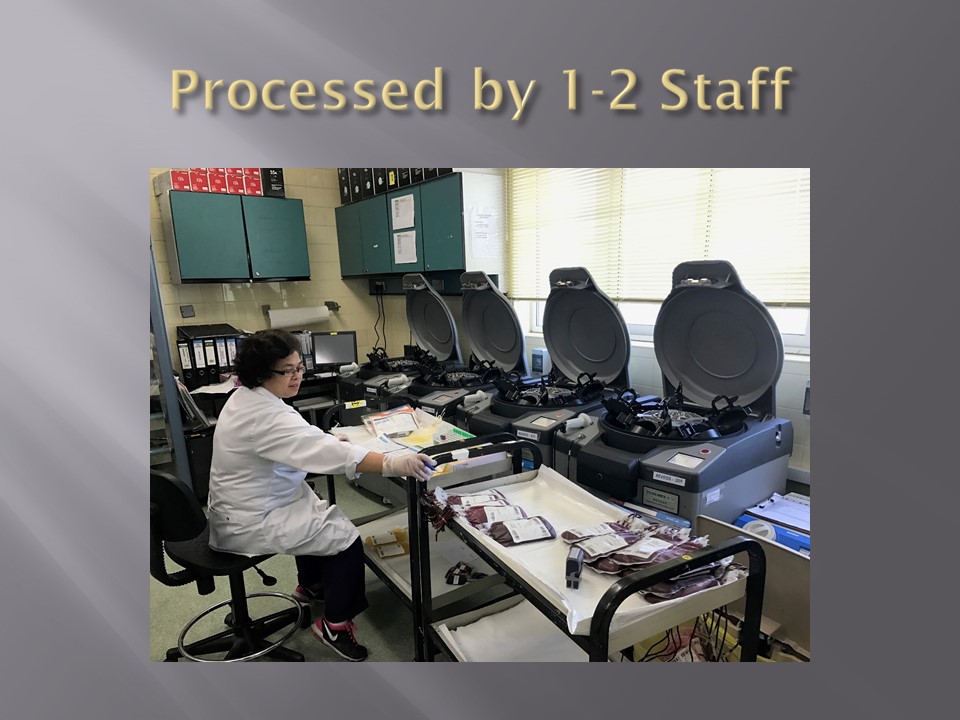
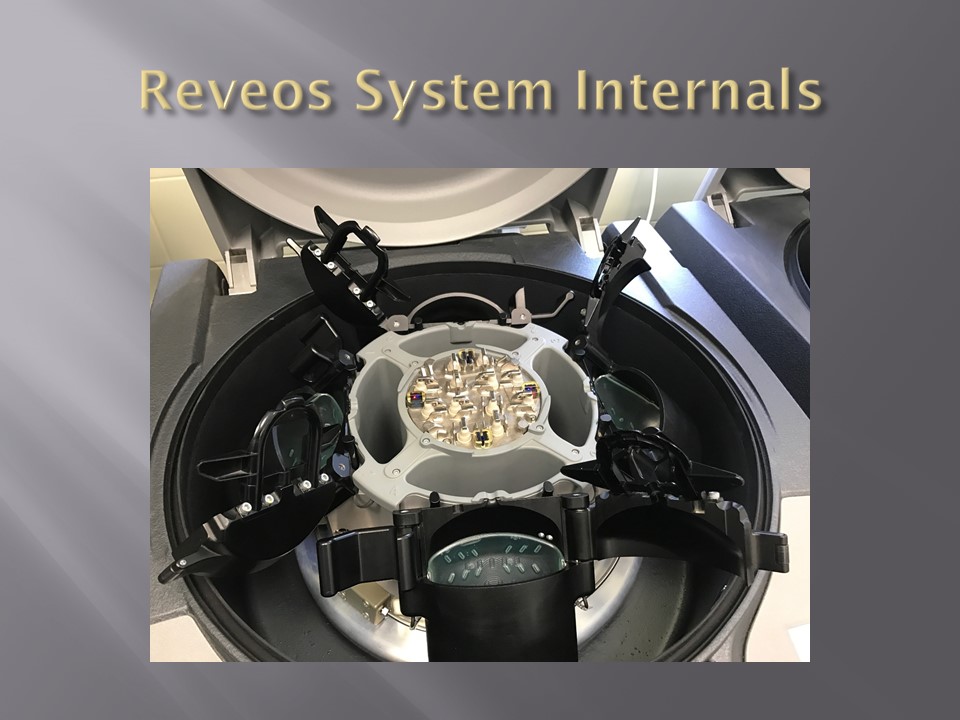
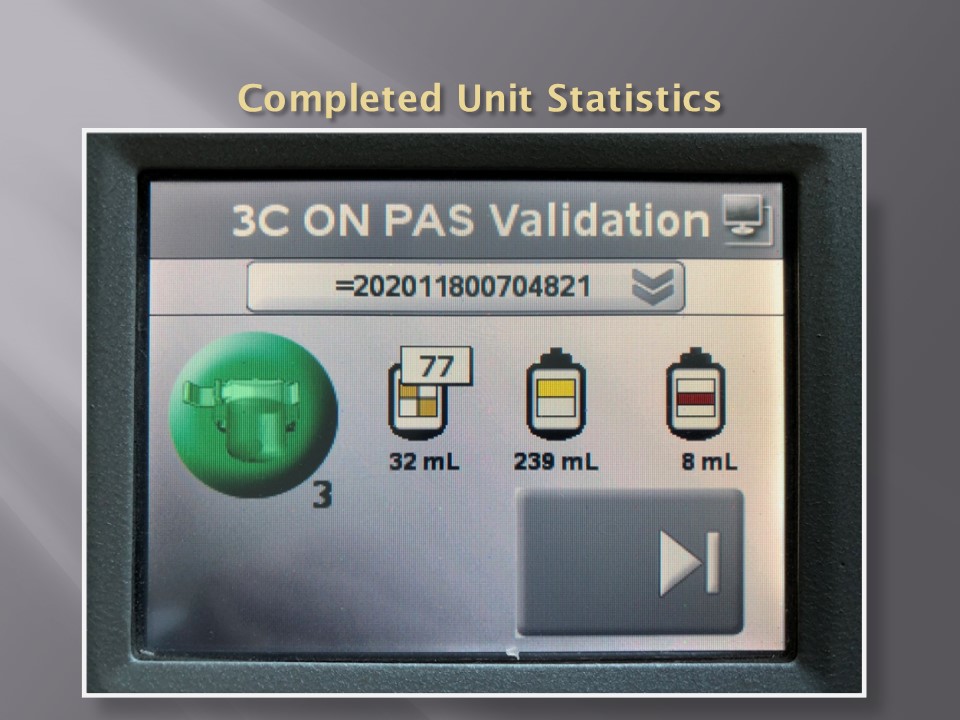
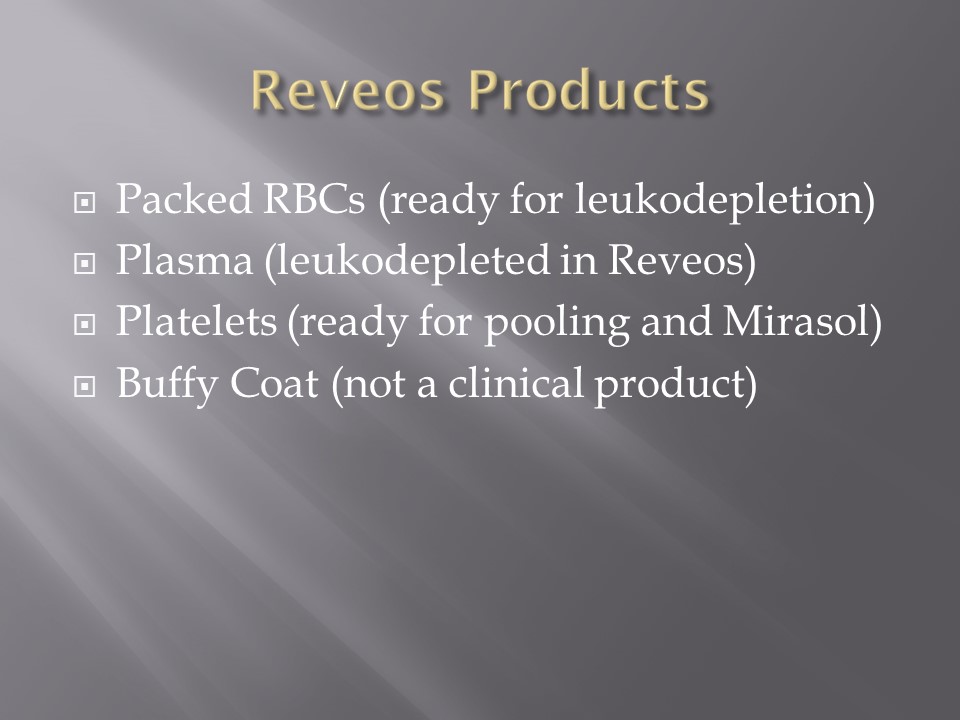
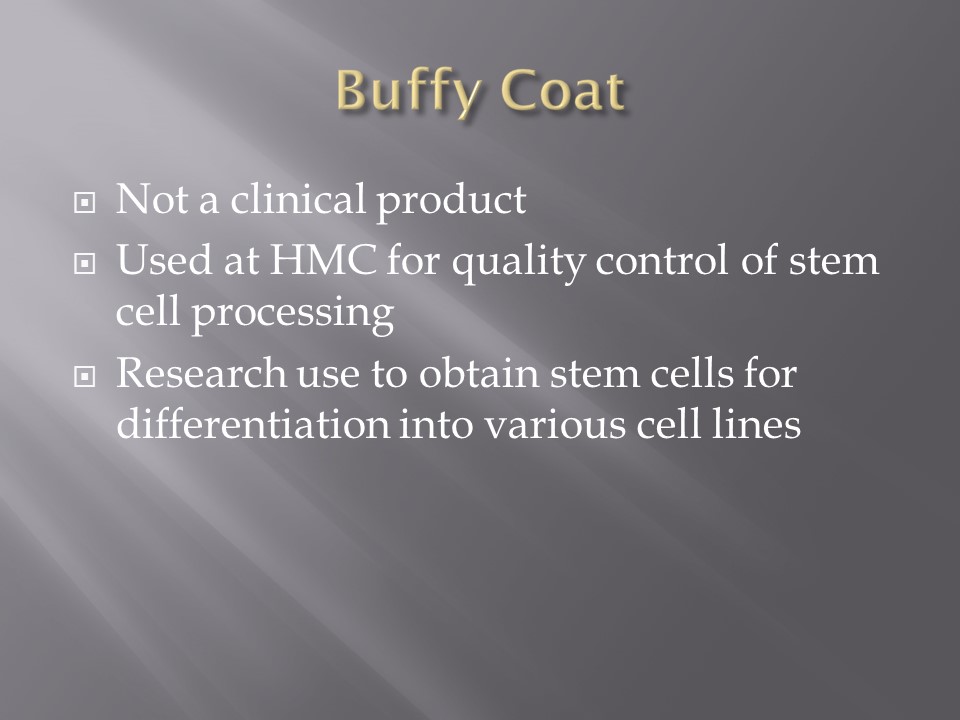
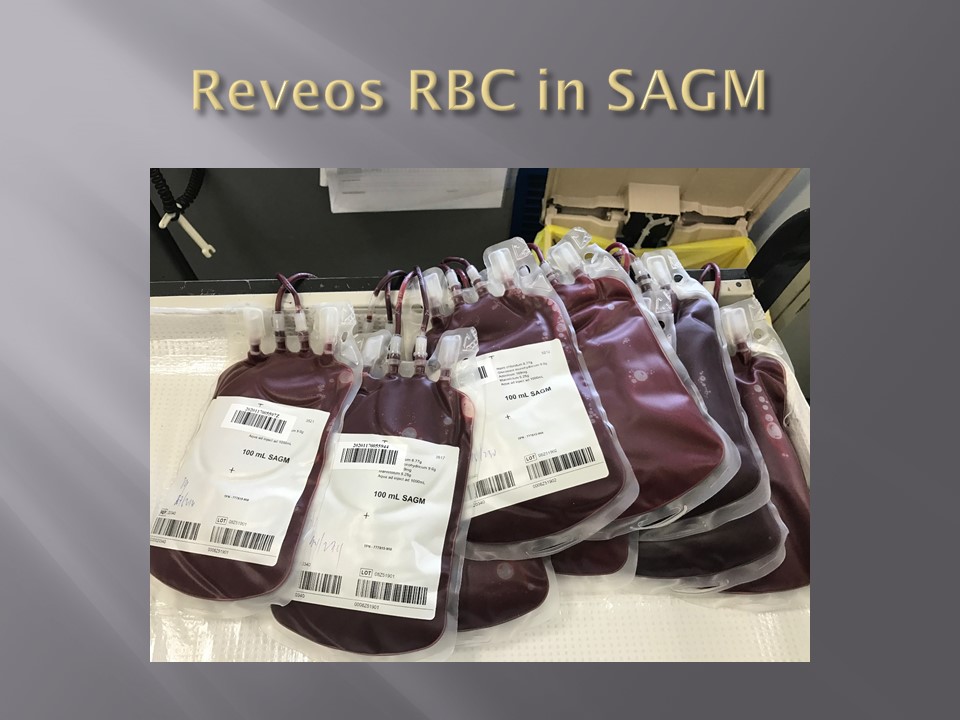
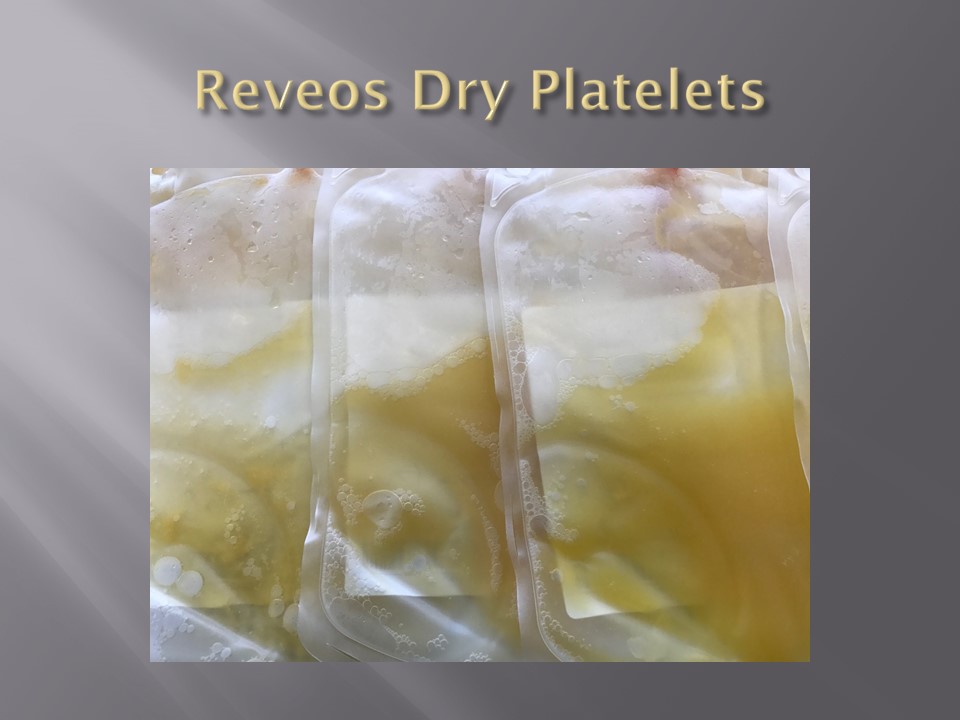
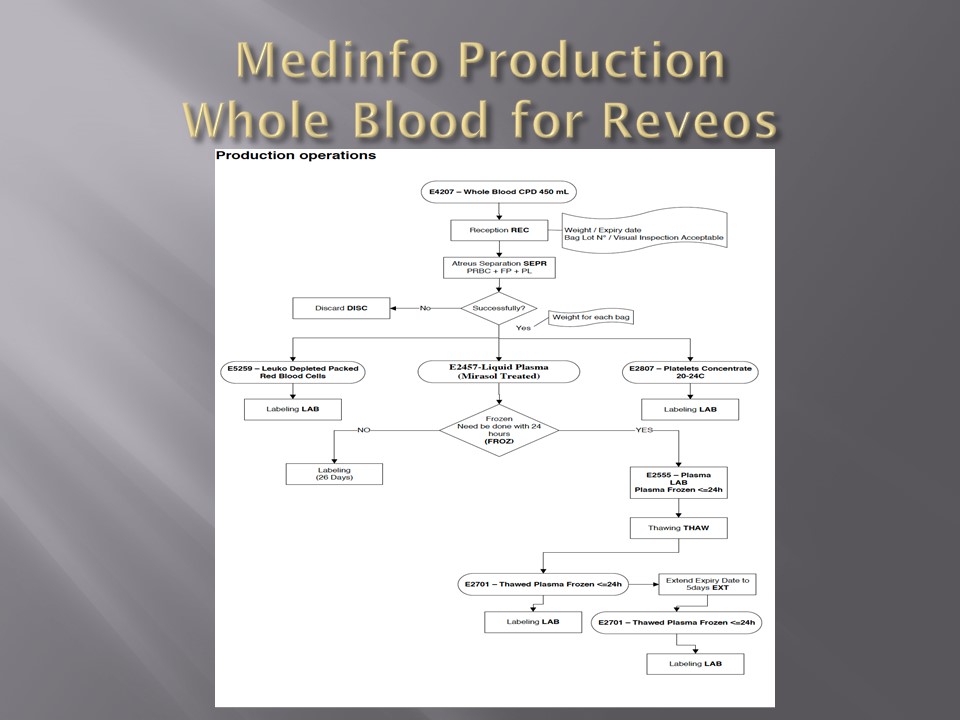
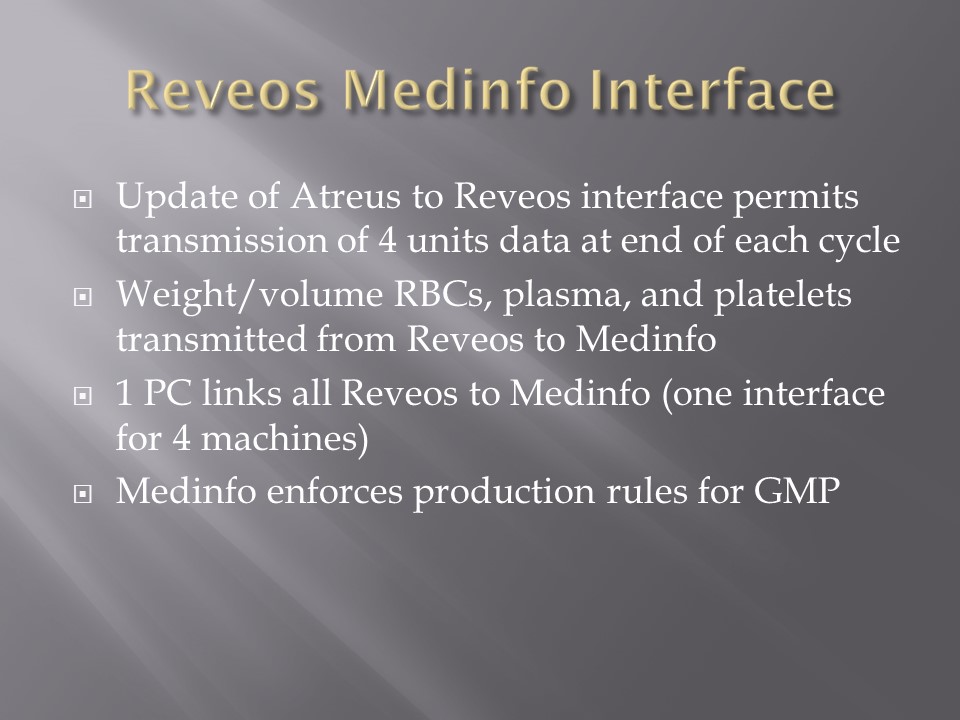
In about 20 minutes, the Reveos machine will simultaneously process four units of whole blood into packed RBCs, leukodepleted plasma, buffy coat platelets, and residual buffy coat. The volumes of the RBCs, plasma, and platelets are recorded in Reveos. For the platelets, the platelet yield index is also provided.
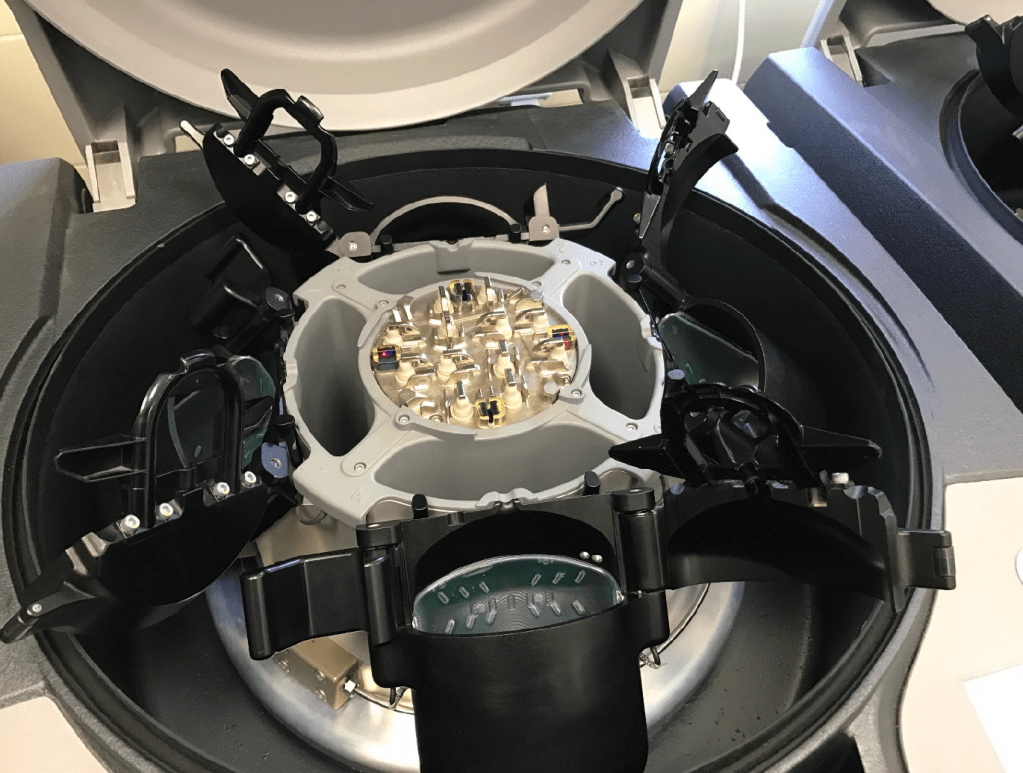
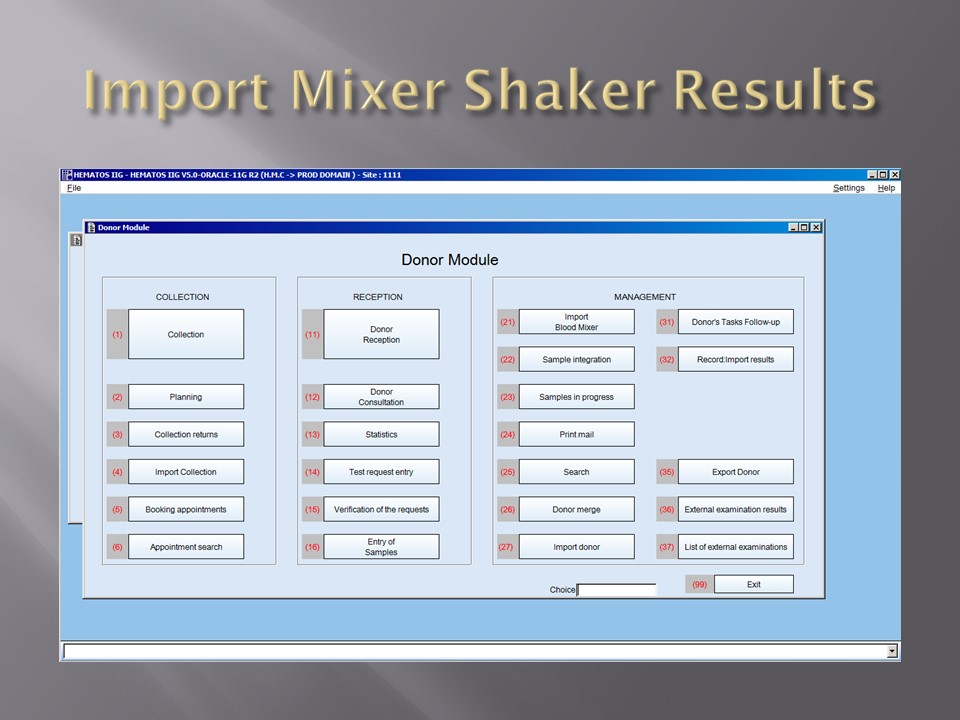
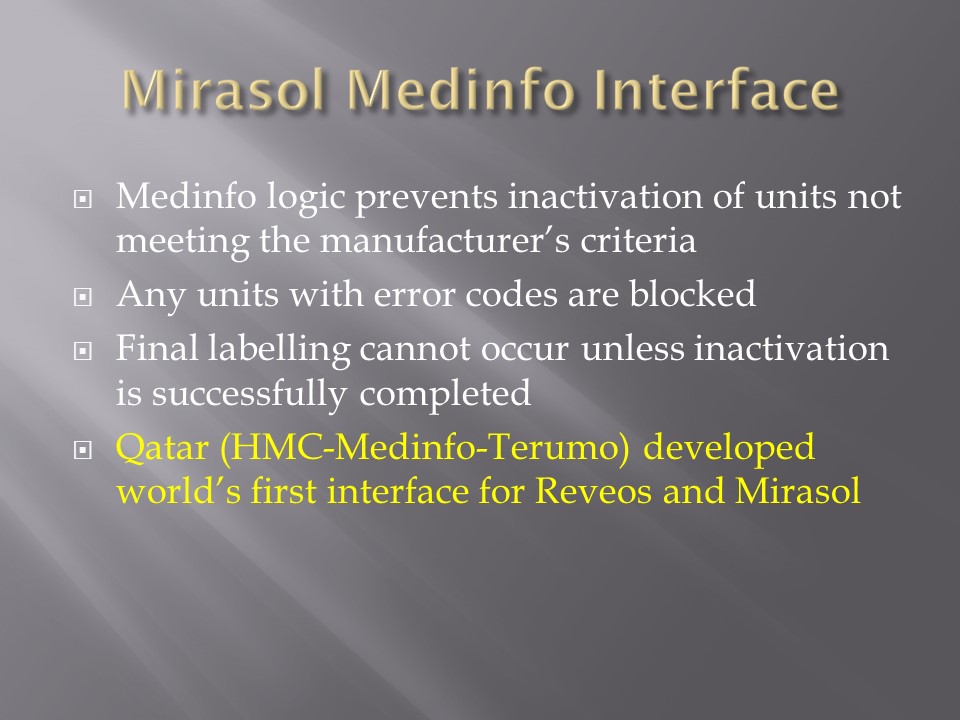
Within Medinfo, these parameters are compared to criteria of acceptability according to the manufacturer. Volumes for the platelets and plasma must be within certain ranges to permit pooling and pathogen inactivation and additive solution. Medinfo will not permit these subsequent procedures if the values are out of range and the intermediate components will be discarded.
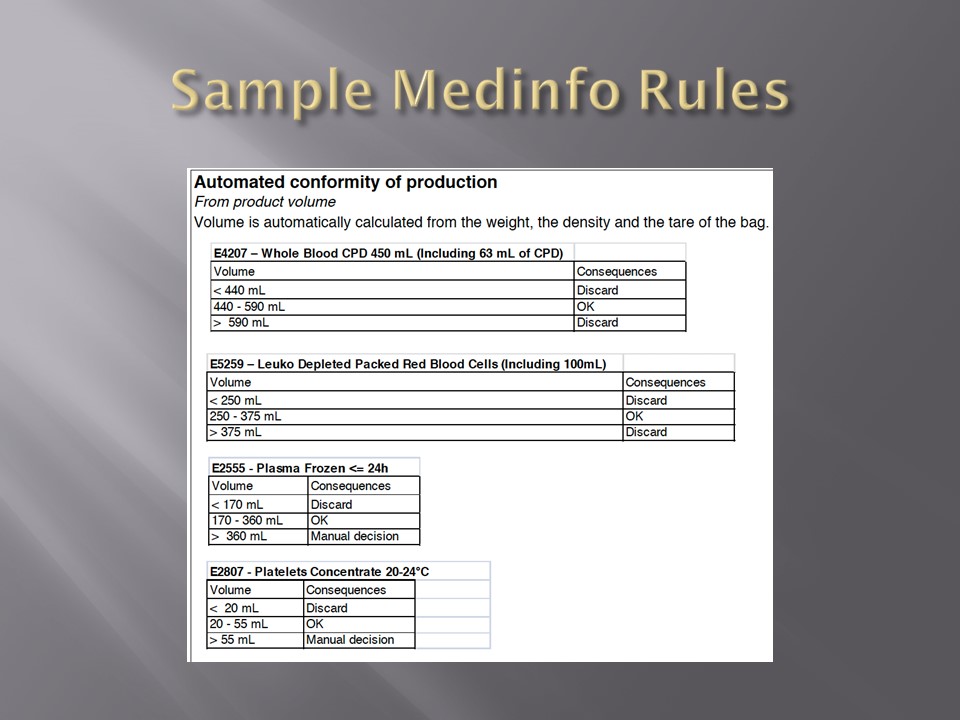
Here is a sample of Reveos acceptable ranges for component volumes:
E4207 – Whole Blood CPD 450 mL
Volume Consequences
< 400 mL Discard
400 – 500 mL OK
> 500 mL Discard
E5259 – Leukodepleted Packed Red Blood Cells
Volume Consequences
< 230 mL Discard
230 – 330 mL OK
> 330 mL Discard
E2807 – Platelets Concentrate 20-24°C
Volume Consequences
< 20 mL Discard
20 – 55 mL OK
> 55 mL Manual decision
E2555 – FP24: Plasma Frozen <= 24h
Volume Consequences
< 170 mL Discard
170 – 360 mL OK
> 360 mL Manual decision
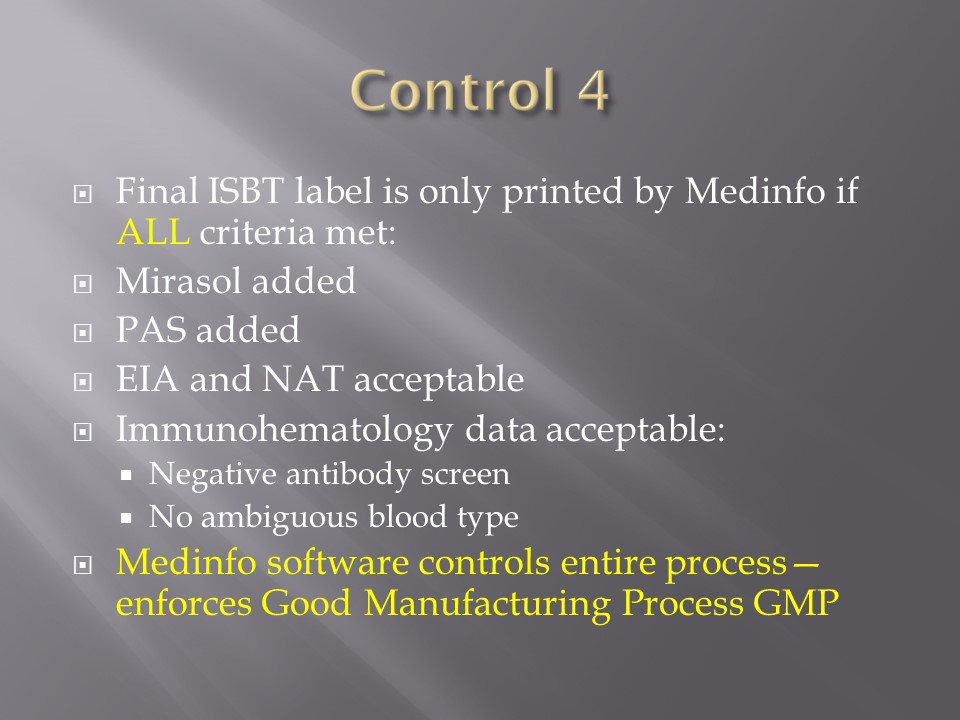
All these production parameters are permanently stored in Medinfo as part of the production record of that unit. The actual location (bucket) of the whole blood unit in the Reveos is also available.
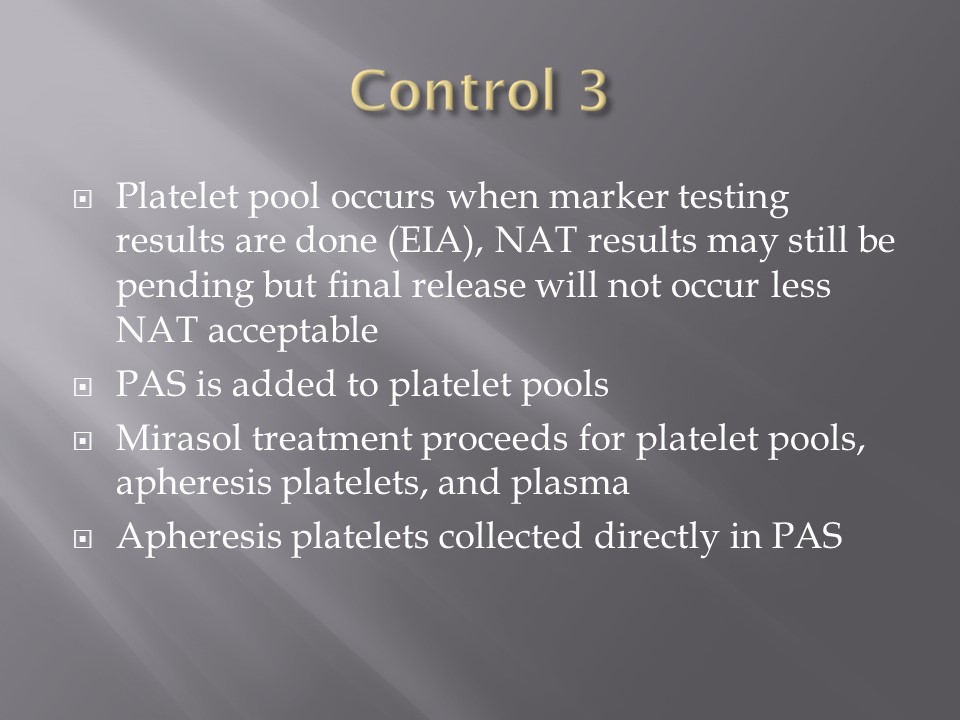
RBCs are manually leukodepleted and the final volumes recorded in Medinfo based on weight. Based on the platelet yield index, platelets are pooled and the final volume recorded. Those permissible volumes are next treated with platelet additive solution PAS and then pathogen inactivated. The acceptable volumes are based on the process used, e.g. platelets in plasma versus platelets in PAS.
How a sophisticated blood bank software like Medinfo enforces good manufacturing process at all stage of production will be a future topic.
To Be Continued:
26/6/20
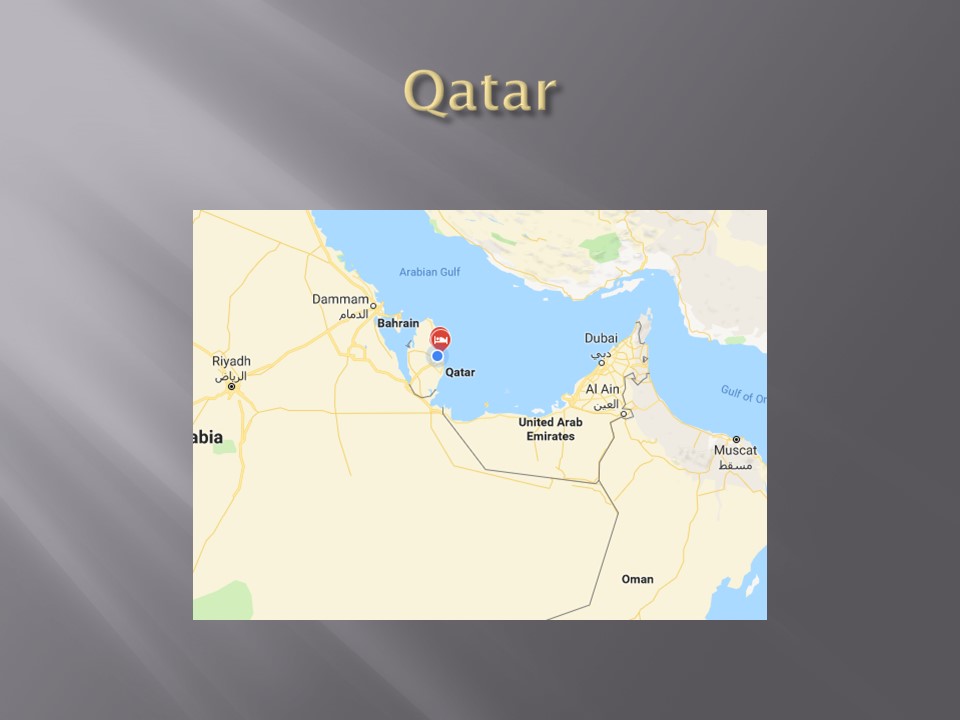
Yesterday’s post showed my active blood inventory management scheme for my previous position in Qatar. I thought today I would elaborate on how I adjust the inventory based on critical shortages and planning for disasters and other major events.
I always review the critical shortages to check for atypical usage (e.g. a disaster situation) or production issues (equipment breakdown, shortage of donors during holiday period).
If it is due to increased utilization, I try to adjust the critical and desirable inventories upward to cover the shortfall for future events. However, it is not always possible if the event is a one-of-a-kind situation unlikely to recur. Also, I must take into account the available resources (supplies, kits, manpower, equipment) to see if I can cope with the increase.
If it is due to resource issues, I see if I can bolster those by recommending increases or improving utilization of what is available.
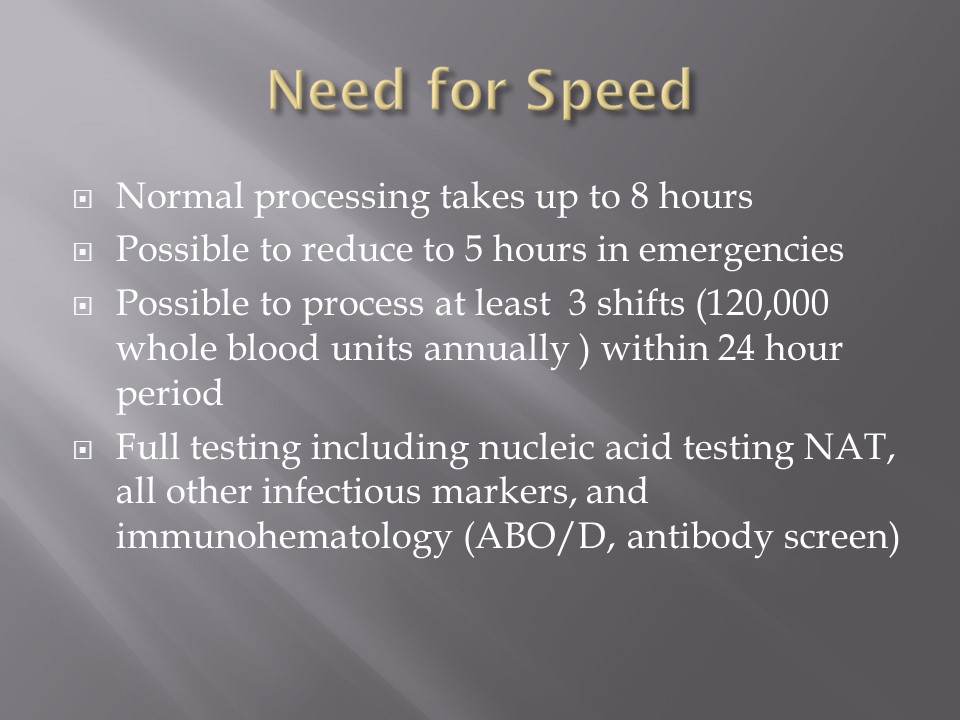
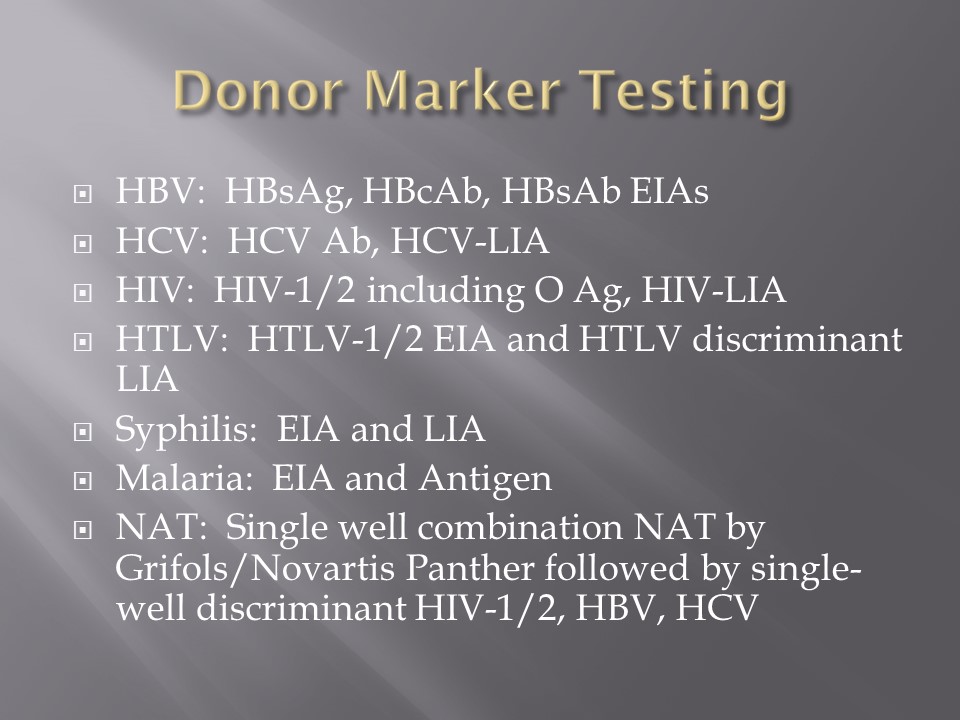
Very important is through-put: How quickly can I produce components from whole blood or apheresis components? This was one of the major reasons we shifted away from PCR to other NAT testing with single-well processes since to minimize the need to make additional runs (Grifols Panther System). Also, automated component processing can greatly speed production (one Reveos can process four whole blood units in about 23 minutes or about 12 units in 75 minutes.) Those staff can be busy with other tasks while the machines are working.
In the system I developed in Qatar, we could complete processing into components (RBCs, buffy coat platelet pools, leukodepleted plasma)–Reveos 3C Program, all marker and immunohematology testing, leukoreduction of the pools and RBCs, Mirasol pathogen inactivation, and platelet additive solution in as little as five hours!! There is great need for speed in a place that must be 100% self-sufficient in all blood components. We could even further reduce the total processing time if we only made RBCs and plasma, Reveos 2C Program
In rapid turn-around events, it is most helpful to have a robust blood bank computer system that can scale to the challenge. Also, it must mercilessly enforce all the rules starting with donor qualification, screening, collection through testing and production. At times of emergency, it is difficult to meet Good Manufacturing Processes manually.
After each major shortage, I recommend a “post-mortem” analysis of the situation with senior donor and quality staff to analyze our processes and see if we can further optimize them for the future. A report is prepared and reviewed by me as the Division Head/Medical Director of the Blood Bank. If possible, we implement our recommendations. If not, I request additional resources from the Administration.
As regards Disaster Planning, I always asked Administration how many victims did they want to save? When I got the response, I always try to adjust inventory by two extra RBCs and one adult platelet dose (> 2E11) per salvageable victim. This may come at the expense of increased wastage, especially in a region that cannot export the excess, unused stock.
The exasperating issue is that I didn’t get a clear answer on this last point. What number should I use? I made a spreadsheet showing calculations for a variety of endpoints, e.g. 100, 500, 1000 treatable victims and sent this to Administration to consider.
Principle:
Due to the pandemic, we will initially MANUALLY collect an experimental, investigational-use-only plasma product from apheresis donors and treat it with Mirasol. THIS IS A EMERGENCY INTERIM PROCESS UNTIL THE MEDINFO HEMATOS IIG PROCESSES ARE PREPARED AND VALIDATED.
Policy:
8/4/20
I am an independent consultant in Transfusion Medicine. Effective 16 April 2020, I am no longer associated with Hamad Medical Corporation or the State of Qatar.
I am willing to consider other opportunities in Transfusion Medicine (donor, patient, apheresis) and blood bank informatics.
Just before leaving HMC, I established the COVID19 convalescent plasma program with full good manufacturing practices using Medinfo Hematos IIG blood bank software.
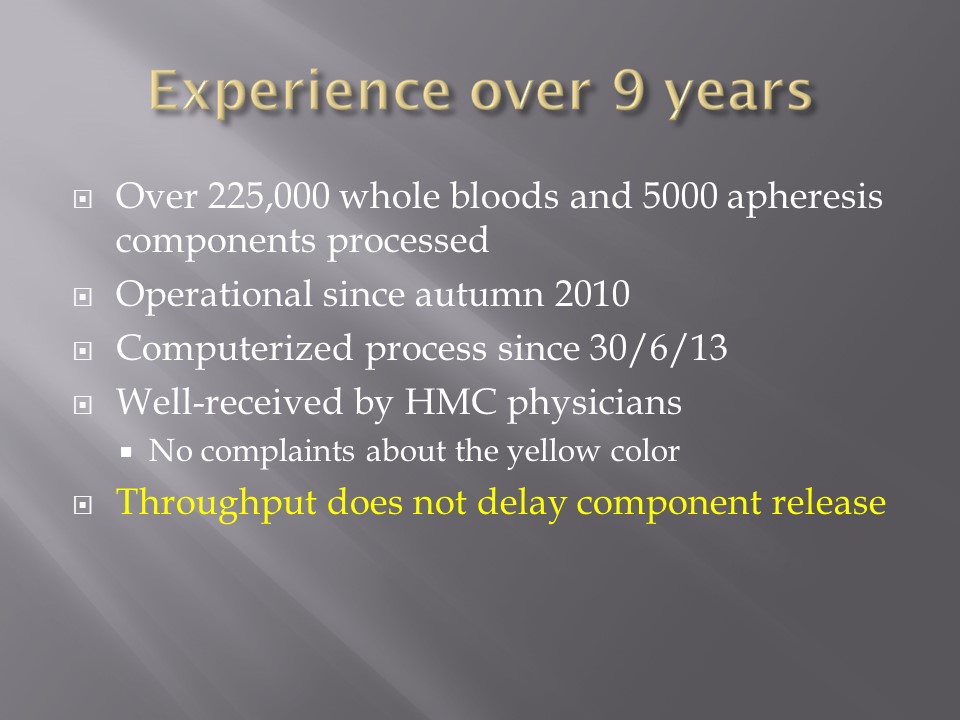
I have 10 year’s experience in pathogen inactivation and blood component automated production. I established the first site using Terumo Atreus (later Reveos) with Mirasol pathogen inactivation AND platelet additive solution. I established Medinfo interfaces with all production equipment to achieve GMP.
I have worked with laboratory information systems, especially but not limited to blood bank systems (donor, component processing, donor marker testing, pathogen inactivation, platelet additive solutions) and serve as the Head of the Medinfo IIG (Nice, France) Software Users Group.
I was involved with planning for the national plasma fractionation project in Saudi Arabia. I have worked with this industry while I was practicing in the United States.
It is my philosophy to start with an international framework (e.g.FDA, CE) and localize it for the country’s particular needs. My operation sites have served as international reference sites for combined IT and medical/technical processes.
 Dr. Zeyd Merenkov