Look-Back of Patients and Donors

Principle:

Using the Medinfo Hematos IIG program, it is easy to perform look-back for patients who have developed an infectious disease that might have been transmitted by a blood component.  Likewise, if a donor develops an infectious disease that is transmissible to patients, we can check which patient(s) received blood components from the incriminated donor.  The time interval for checking will vary according to local regulations.

Policy:

  1. If a patient is reported to have developed an infectious disease which might have been transmitted by a blood component transfusion:
    1. Review the patient’s infectious marker testing data.
    2. Review the patient’s transfusion history, especially for any transfusions at outside institutions or any other body fluid exposures.
    3. Look up the transfusion history in Medinfo HIIG.
    4. Determine which transfusions occurred during the deferral period for that disease.  Examples:
      1. HBV—6 months
      2. HCV—6 months
      3. HIV—2 months
      4. Malaria—6 months
      5. HTLV—6 months
      6. Syphilis—12 months
    5. Look up the donors for each donation during the specified interval.
    6. Check each donor’s donation records for:
      1. Infectious disease marker testing
      2. Questionnaires—any irregularities noted?
    7. Call donors back for repeat testing (only on advice of the investigating transfusion medicine physician)
    8. Collate all results and prepare an interpretative report.
    9. Interpretative report must be reviewed/released by the Head, Transfusion Medicine.
    10. Submit the report to Infectious Disease and the patient’s most responsible physician
    11. If any irregularities are found, assess processes to make any improvements in an attempt to minimize future risk.
    12. Prepare an OVA according to HMC procedures.
  2. If donor develops an infectious disease:
    1. Review the donor’s infectious marker testing results.
    2. Check if the donor had any body fluid exposures.
    3. Obtain new specimen from the donor.
    4. Look up all components made from that donor.
    5. Determine which transfusions occurred during the incubation period for that disease.  Examples:
      1. HBV—6 months
      2. HCV—6 months
      3. HIV—2 months
      4. Malaria—6 months
      5. HTLV—6 months
      6. Syphilis—12 months
    6. Recheck the complete donor history including infectious disease marker testing and questionnaire
    7. If samples are available from the interval, repeat donor marker testing on it.
    8. Look up the patient/recipients for each donation during the specified interval
    9. Check each patient’s records for infectious disease marker testing results
    10. Call patients back for repeat testing (only on advice of the investigating transfusion medicine physician in conjunction with the Infectious Disease department.)
    11. Collate all results and prepare an interpretative report.
    12. Interpretative report must be reviewed/released by the Head, Transfusion Medicine.
    13. Submit the report to Infectious Disease and the patient’s most responsible physician
    14. If any irregularities are found, assess processes to make any improvements in an attempt to minimize future risk.
    15. Prepare an OVA according to HMC procedures.

Reference:

Standards for Blood Banks and Transfusion Services, Current Edition, Bethesda, MD, USA
Policy: ISBT Component Label Usage

Principle:

Blood components will only receive final ISBT labels for the purpose of transfusion upon completion of the production processes specific for that component and will be specifically prepared by the Medinfo Hematos IIG software in accordance to Council of Europe CE Standards.

An improper label, be it for the wrong unit, or improper designation can have catastrophic results to the recipient.  This is why this is such a CONTROLLED process under Medinfo Hematos IIG.  There are label-printing softwares available that do not follow these rules, but I consider them dangerous to use since these safeguards are not enforce—they are NOT permitted here.

Policy:

  1. The formatting of ISBT labels is addressed in the Interim Policy: ISBT Labels (a previous post).
  2. The selection of the ISBT E codes will be made by the Division Head, Transfusion Medicine and Laboratory Information Systems.
  3. Blood component labels, either final or in-process are ISBT-specific and may only be generated by the Hematos IIG computer system.
  4. The ISBT specimen are generated at the time of donor registration.
    1. ISBT specimen labels are of limited number and cannot be reprinted by operational staff.
      1. Reprinting is only allowed by Transfusion LIS with approval of the Division Head, Transfusion Medicine/Laboratory Information System
  5. Final ISBT blood component labels may only be attached at the successful completion of component processing according to the HIIG workflow processes specific for each component.
  6. ISBT labels are also generated and attached after component modification (washing, irradiating, aliquoting, pooling) in accordance with the respective HIIG workflow processes.
    1. Multiple modifications may be performed before the final ISBT label is generated by HIIG.
  7. No modifications of the HIIG-generated ISBT labels is permitted.
  8. No manual corrections or attachment of additional, non-ISBT labels is permitted.
  9. During computer down-times, manual (non-ISBT) labels may be generated internally and will be replaced by the formal ISBT label using Manual Stock Entry after resumption of HIIG.
  10. For solvent-detergent-treated plasma SDP (e.g. Octaplas), the following applies:
    1. SDP (Octaplus) ISBT labels are prepared and attached by the manufacturer Octapharma during the manufacturing process and will be used/read as such.
    2. Thawed SDP will receive a new ISBT label at the time of thawing.

References:

  1. HIIG Workflows, Component Processing, 1002
  2. Standards for Blood Banks and Transfusion Services, Current Edition, AABB, Bethesda, MD, USA
  3. Policy:  ISBT Labels, Current Edition—previously posted
  4. TRM.43625 CAP Checklist

20/10/20

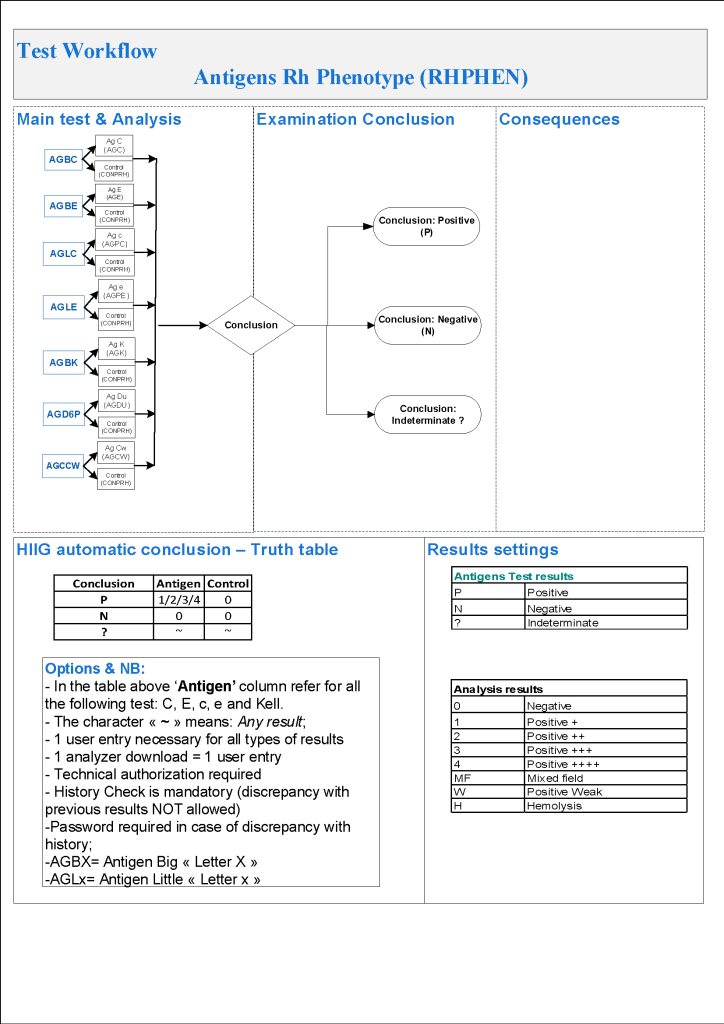
Processes and Software Building 53: Donor Extended Rh and Kell Typing

For this typing, I always had both automated and manual methods set up on the blood bank computer system Medinfo Hematos IIG.  The automated method had a bidirectional interface between Medinfo and the instrument.   Medinfo did not need a separate middleware.  A truth table was prepared for acceptable results for automatic interpretation.  Other results had to be manually interpreted by someone with the appropriate security level.

It was standard in my donor processing laboratory that extended Rh typing (EeCc) and Kell were performed.  We were in a region with many sickle cell and thalassemia patients.  Having all RBC units pre-typed in the Blood Donor Center expedited selection and release in the hospital blood bank—especially for matching K-negative units to K-negative patients and extended Rh phenotypes for sickle cell patients.

The manual testing option is structured similarly.  Within Medinfo, it is easy to change the methodology or have more than one methodology if the system is so built.  Thus, if the analyzer for this typing was down, the staff could select the manual methodology.  Likewise, if one testing center went off-line, the work could be completed at another site—no need to repeat testing already completed from the first site.  This flexibility could apply to any test in system.

The manufacturer’s recommendations for the particular reagents in use were strictly followed.  Most importantly, Medinfo can be configured for any set of reagent values.

Please refer to the sample flowchart which also includes Cw and DVI+ typing.  The same process could apply to patient testing, but some reagents would use a DVI- reagent.

18/10/20

Processes and Software Building 52: Donor Antibody Screening

For donor antibody screening, I always had both automated and manual methods set up on the blood bank computer system Medinfo Hematos IIG.  The automated method had a bidirectional interface between Medinfo and the instrument.   Medinfo did not need a separate middleware.  A truth table was prepared for acceptable results for automatic interpretation.  Other results had to be manually interpreted by someone with the appropriate security level.

I did not use pooled cells, but instead 2, 3, or 4 cell screens at various times based on the available reagents.  Personally, I prefer a 3 or 4 cell screen which is more sensitive—I want homozygous Jka and Jkb cells present.  All positive cases had an antibody identification performed.  According to my medical decision, I did not routinely allow any donor to be collected if he/she had a positive antibody screen.  Some standards would permit the use of RBCs from such a case, but this was not my preference.  In cases with rare phenotypes, I would allow production of RBCs (e.g. Bombay donor with anti-H, patient with anti-Tja (PP1Pk)) for patients with those rare types.

The manual testing option is structured similarly.  Within Medinfo, it is easy to change the methodology if the system is so built.  Thus, if the analyzer for antibody screening is down, the staff can select the manual methodology.  Likewise, if one testing center goes off-line, the world can be completed at another site—no need to repeat testing already completed from the first site.  This flexibility can apply to any test in system.

The manufacturer’s recommendations for the particular reagents in use were strictly followed.  Controls were included.  Most importantly, Medinfo can be configured for any set of reagent values.

Also note that Medinfo will check for the donor’s previous testing history and compare results.  If there are discrepancies, this will require manual review.  Normally, a donor with a positive antibody history is indefinitely deferred.  The transfusion medicine physician could remove such a deferral if indicated.

Refer to the following flow diagram for a three-cell  and four-cell screens.

16/10/20

Policy: ISBT Specimen Labelling Audit

Principle:

ISBT specimen labels have a check-digit to reduce the risk of misreading the label.  They are generated by the blood bank computer system Medinfo.  Normally one group of labels is printed for all needs (donor unit, marker testing, donor immunohematology, and donor processing.  Reprinting the same number is restricted to minimize the risk of using the wrong label on a specimen or unit.  These labels are NOT used for patient testing.

ISBT specimen labels are only printed at the time of donor registration.  We must securitize them so that they are not used for other, potentially malicious purposes.  Remember:  a labelling mistake may cause fatality in a patient receiving the wrong blood component.

Policy:

  1. ISBT specimen labels are only for blood donor specimens, initially labelling of donor collections, and intermediate processing of components.
  2. They must be applied to the primary specimens directly at the donor’s bedside.
  3. They must be applied to aliquots from the original ISBT-labelled tubes.
  4. They may NOT be applied to any other specimen (e.g. for routine laboratory testing outside Transfusion Medicine)
    1. If an ISBT label not corresponding to the correct donor is discovered, an OVA or event report must be generated and investigated immediately.
  5. If additional ISBT labels are needed, this must be documented on a specific audit sheet with signature of the person taking the extra labels and a second person to witness their removal.  It will also be noted in the Medinfo system for auditing purposes.
  6. The audit sheet must be kept in a secure place for future reference in Blood Donor Center.

14/10/20

ISBT Labels

Principle:

ISBT labels are ONLY GENERATED THROUGH MEDINFO HEMATOS IIG SOFTWARE.  We do not buy preprinted labels or have a separate label-generating program.  ISBT labels are only attached to blood components after production of new or modification of existing blood components and are only printed if the Good Manufacturing Process GMP criteria are met and confirmed by the software.

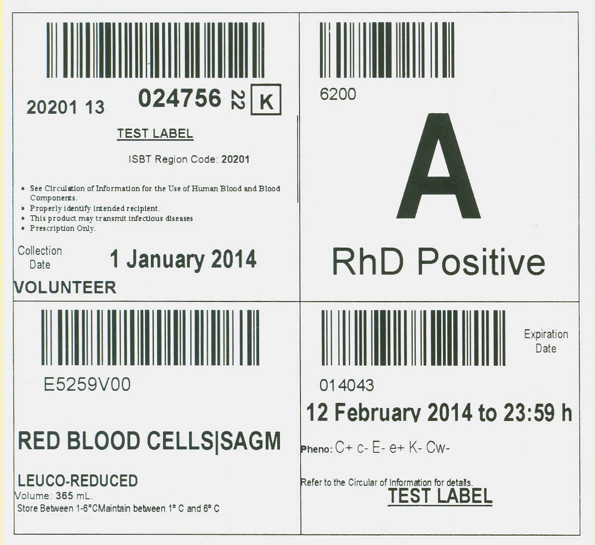
The ISBT component label measures 10 x 10 cm and is divided into FOUR quadrants:

  1. Upper left:  Donor Unit number:  20201 (site location) then two digits for the year (e.g. 13) followed by the donor encounter number followed by a check digit.  Reference is made to the Circular of Information, patient identification, risk of disease transmission, and prescription-only status.
  2. Upper right:  ABO/D type
  3. Lower left:  E code corresponding to the component type specification, the designation of origin (volunteer vs directed vs autologous vs paid donation) plus the division number.  E codes are taken from the ISBT master database.  We use CE-approved codes (NOT US FDA).
  4. Lower right:  Expiration date and time using 24 hour system plus any other phenotype data and other testing.

ISBT Specimen Labels:

ISBT specimen labels are used for all samples at the time of donor collection and include a separate check digit to confirm that the barcode is properly read.  ISBT specimens can be used in all parts of Medinfo Hematos IIG software;  however, non-Medinfo systems not complying with the safety features of the Council of Europe (worst case scenario is Cerner Millennium and all other American software) may not be able to read them.

Since we do not preprint ISBT labels, there are no phase-out of labels, they are only printed immediately upon need.  As component production changes frequently, the actual ISBT designation from the ISBT database for the new component is used by Medinfo.

Policy:

  1. All blood components and solvent-detergent treated plasma SDP must be labelled with ISBT labels.
  2. All donor specimen labels must meet the ISBT standard, including the check-digit.
  3. No blood components may be dispensed to patients unless there is an ISBT label corresponding to the final component, including ALL modifications (aliquoting, irradiation, washed, pathogen-inactivated, etc.)
  4. No one should write anything on an ISBT label:  If there has been a change in the component, perform the modification through Medinfo HIIG and reprint the label.
  5. Do NOT attach any other labels to an ISBT label.
  6. Ensure that the final ISBT label at the time of dispensing is on-top of all other ISBT labels.
  7. The ISBT sequences will be reset each year at 2359 hours on 31 December by the Medinfo software engineer.
  8. The choice of E codes is made by the Division Head, Transfusion Medicine/LIS using the ISBT master database.

References:

  1. Guide to the Preparation, Use, and Quality Assurance of Blood Components, European Committee (Partial Agreement on Blood Transfusion, CD-P-PS, Current Edition
  2. Standards for Blood Banks and Transfusion Services, Current Edition, AABB, Bethesda, MD, USA
  3. TRM.43600 and 43625 CAP Checklist, 2016

Opinion: Advantages of Using Both the Medinfo Donor and Patient Modules

The donor module of Medinfo includes recruitment, logistics, registration, donor screening, collection, marker testing, donor immunohematology, and component production.  There is also a module for inter-depot transfer of blood units from the donor center to the hospital end-users.

The patient module includes patient testing (ABO/D typing, antibody screen, antibody identification), direct antiglobulin test, elution, component modification (washing, aliquoting, pooling), allocation/reservation of blood components for a patient, release of blood components, and their return.

Some sites elect to use their laboratory system’s blood bank module in conjunction with Medinfo donor module.  In this case, they receive each and every unit into their laboratory blood bank module and do all patient activities in it.  There is no link between patient and donor module.  They will have to monitor and transfer inventories in their laboratory system.

At a site using integrating both the donor and patient modules of Medinfo, they will be able to track units across the system to any hospital blood bank.  They will have access to the rules-based system to generate algorithms for use of blood components based on user-defined criteria.  They can instantly perform look back of donor units associated with adverse effects, and be able to rapidly quarantine components subject to recall from the manufacturer or product incidents.  Here are some examples of this functionality:

Example 1:  The hematologists want all their patients to receive leukodepleted irradiated RBCs and platelets at a site not using pathogen-inactivation.  Medinfo can prepare an algorithm by site, clinical diagnosis, or other criteria which will block release of those components that are not irradiated and leukodepleted.  Blood Bank staff will not be able to release anything else.  The donor module can prepare customized component or modification can take place in the hospital blood bank.

Example 2:  During production, it is discovered that units prepared in one of the centrifuges (or automated component equipment Reveos) became contaminated with a foreign substance.  In Medinfo.  In Medinfo, all units prepared during the affected time interval can be immediately quarantined across the system including all hospital blood banks and thus prevent their being transfused.

Example 3:  A patient has developed hepatitis C after transfusion.  Using the transfusion history, one can retrieve data on all transfused units.  The entire production process can be reviewed for each unit, including donor marker testing.  If a unit is implicated, then all patients receiving other components from that donor can be immediately identified for follow-up.

If a disaster occurs, one can quickly check Medinfo’s cumulative stock display of all components at all sites—donor unit and all hospital blood banks.  One can initiate transfer of units from unaffected sites to the disaster location.  This can be updated as frequently as needed—within seconds!

There are probably ways to accomplish this by using the laboratory information system, but it will be slower and require separate communication to the Medinfo donor site.  There will be no seamless integration and delay.

In summary, there are many advantages to using both donor and patient Medinfo modules.  Even at sites where there was separate transfusion service functionality, I elected to use both modules together for seamless integration.  It would be very time-consuming to manually check between the laboratory and Medinfo donor module.  Medinfo’s patient module offers has strong safeguards to prevent release of untested or partially tested units (example:  release of Kell-untested RBCs to a patient with anti-Kell) and a very robust electronic (computer) crossmatch.

11/10/20

Processes and Software Building 51: Donor D Typing

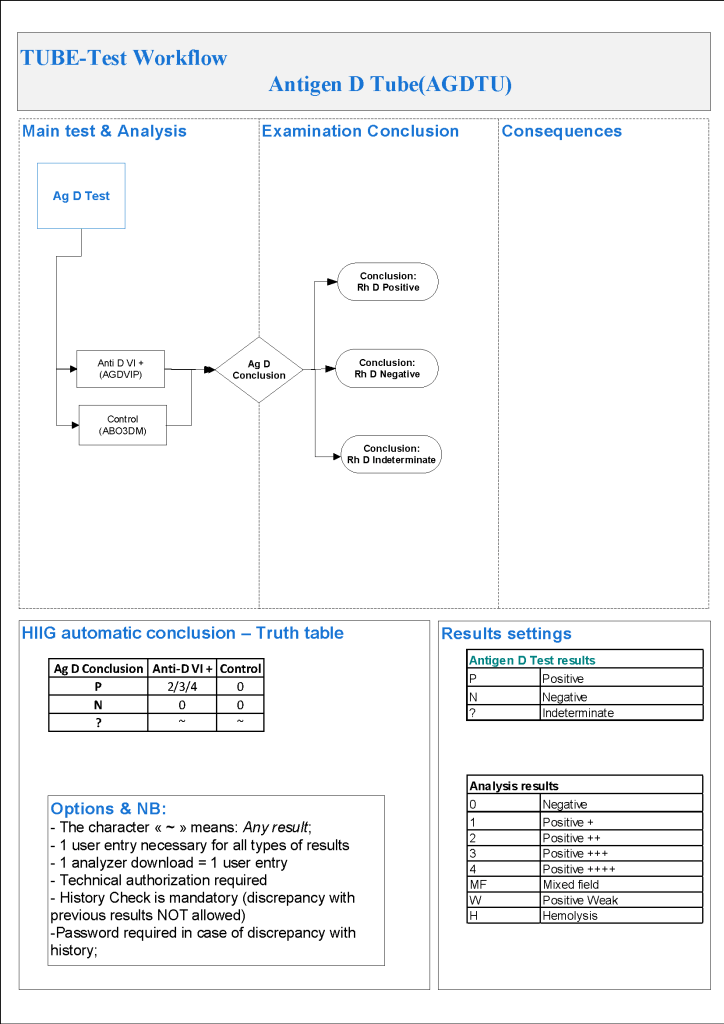
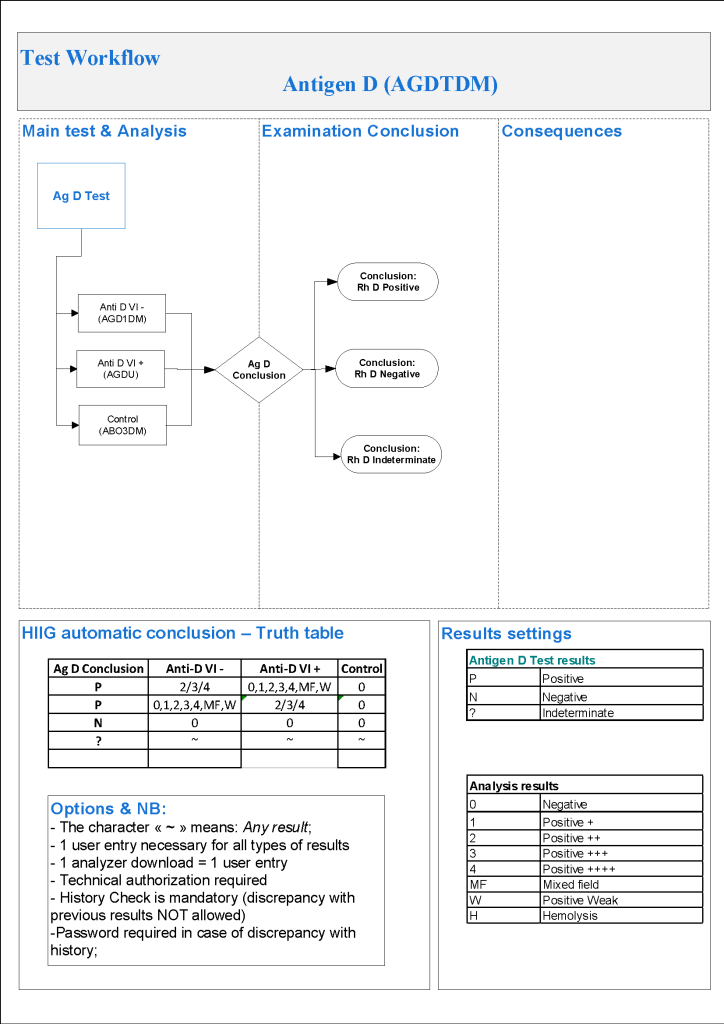
For donor D typing, I always had both automated and manual methods set up on the blood bank computer system Medinfo Hematos IIG.  The automated method had a bidirectional interface between Medinfo and the instrument.   Medinfo did not need a separate middleware.  A truth table was prepared for acceptable results for automatic interpretation.  Other results had to be manually interpreted by someone with the appropriate security level.

For donors, I wanted reagents sensitive for partial or mosaic D types since any D epitopes are potentially immunogenic.  With some reagents, this meant using a DVI+ reagent and others both DVI+ and DVI- reagents.

The manual testing option is structured similarly.  Within Medinfo, it is easy to change the methodology if the system is so built.  Thus, if the analyzer for D typing is down, the staff can select the manual methodology.  Likewise, if one testing center goes off-line, the world can be completed at another site—no need to repeat testing already completed from the first site.  This flexibility can apply to any test in system.

The manufacturer’s recommendations for the particular reagents in use were strictly followed.  One used the range {0, 1, 2, 3, 4, Mixed Field, Weak} as acceptable.  Another used {0, 2, 3, 4}.  Controls were included.  Most importantly, Medinfo can be configured for any set of reagent values.

The attached flows show two different testing systems as examples of what can be built in the Medinfo system.

9/10/20

Opinion: Blood Bank Software Design Should Be Based on Technical, Medical, and Nursing Experience

In my career directing laboratory and blood bank software, I have encountered software that had major features which were difficult to find (hidden in a nested menu system) or named ambiguously.  To this day, I wonder what feedback was provided from the potential end-users—or if any had been requested by the developers.  I will give some examples.

Example 1:

A major hospital system wanted to implement a third-party add-on to a new software covering all major disciplines.  It would provide evidence-based diagnostic assistance (e.g. what algorithm to follow in diagnosing crushing chest pain).  A lot of time was devoted to focusing it for local practices—physicians in many disciplines were involved.  However, the end-users were not engaged in how this expert system was to be accessed.  The end result was that only few physicians actually used the system.  Even in the training period for the new hospital system, this important detail was not emphasized so most physicians did not know how to access it!!

Example 2:

A major hospital system including laboratory and nursing modules had nursing design/build the transfusion reporting system, i.e. recording the actual transfusion information:  component type, start/end and frequency of transfusion.  The nursing informatics staff did not understand anything about ISBT codes or frequency of transfusion.  The transfusing nurses could type anything into the component type, ISBT field, specify frequencies of transfusion from one second to many years, and record different ABO/D types each time they checked the patient’s vital signs—and not compare to the historical or current blood types.  We also discovered that the system could not read ISBT codes at all!

The system had been built without consulting Transfusion Medicine.  We only discovered the errors it was demonstrated when we considered building therapeutic apheresis reporting into it.  I refused to allow my apheresis nurses to use it, and eventually it was scrapped.

Conclusion:

In my builds with Medinfo Hematos IIG, I early engaged my staff (medical, technical, and nursing) to review and critique—and help with the actual build construction to maximize its usability.  This is very important when the staff have many primary languages to ensure that the everyone understands the wording properly.

The presentation of the data is very important to optimize pattern recognition and make proper decisions.  If the data is scattered over many pages, interpretation is impeded.  This is why I prefer a summary dashboard of information for both donor and patient data to facilitate my decision making.

In summary, make certain end-users with the appropriate background are engaged in the building/design process.  They are not there for database design, but to promote usability.  This will greatly improve the final product and facilitate patient and donor care.

Processes and Software Building 50: Donor ABO Confirmatory Typing

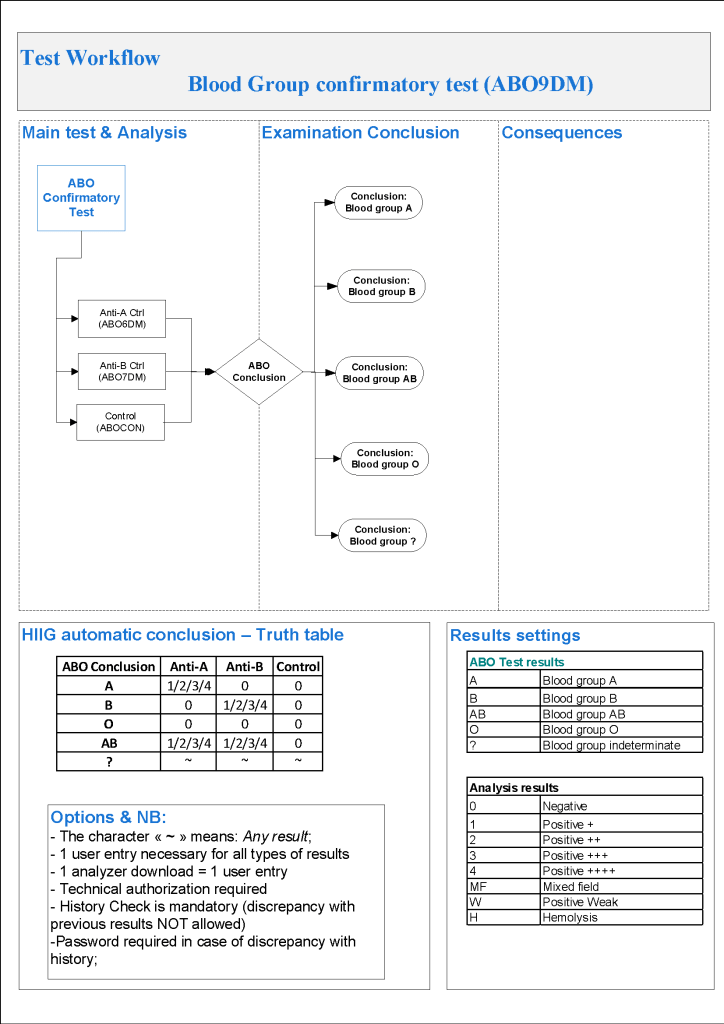
For donor ABO confirmatory typing, I always had both automated and manual methods set up on the blood bank computer system Medinfo Hematos IIG.  The automated method had a bidirectional interface between Medinfo and the instrument.   Medinfo did not need a separate middleware.  A truth table was prepared for acceptable results for automatic interpretation.  Other results had to be manually interpreted by someone with the appropriate security level.

The manual testing option is structured similarly.  Within Medinfo, it is easy to change the methodology if the system is so built.  Thus, if the analyzer for ABO typing is down, the staff can select the manual methodology.  Likewise, if one testing center goes off-line, the world can be completed at another site—no need to repeat testing already completed from the first site.  This flexibility can apply to any test in system.

The manufacturer’s recommendations for the particular reagents in use were strictly followed.  One used the range {0, 1, 2, 3, 4} as acceptable.  Another used {0, 2, 3, 4}.  Controls were included.  Most importantly, Medinfo can be configured for any set of reagent values.  Refer to the following flow diagram.

Confirmatory testing also includes D typing.  That will be considered in a future post.

6/10/20