DAT and Selection of RBC Units for Transfusion

This is an update of a previous post.

Principle:

In 1984 effective with the 13th Edition AABB Standards, the requirements for performing a direct antiglobulin test and autocontrol for compatibility testing were eliminated.  The DAT is very important to detect delayed hemolytic transfusion reactions, certain autoimmune conditions, and drug-related hemolysis.

Since that time, the immediate-spin crossmatch and now the electronic computer paperless crossmatch may be used for most compatibility testing in place of the classic, antiglobulin-phase (indirect antiglobulin test) crossmatch.

If an antiglobulin phase (IAT) crossmatch is performed, an RBC unit with a positive DAT will cause a false-positive reaction.  Since most crossmatching does not include the IAT, it will not be affected by the DAT status of a donor unit.

Policy:

  1. Donor RBC units will NOT be routinely tested for DAT as part of component processing.
  2. The type of compatibility testing selected for a particular patient should be the technically simplest one (no need to do extra work unless so instructed by the transfusion medicine consultant/designate):
  3. Do a full antiglobulin-phase IAT crossmatch if ANY of the following applies:
    1. There are no two independent ABO/D typings on the patient during the current admission.
    2. The ABO/D type of the current admission does not match the historical information.
    3. The patient has a detectable antibody at 37C
    4. The patient has a history of a clinically significant antibody but no current antibody
    5. Whenever the consultant, transfusion medicine/designate requests it.
    6. Whenever the Medinfo HIIG record so indicates (in comment section)
  4. Do the immediate-spin crossmatch if ALL of the following apply:
    1. Only one determination of the ABO/D type
    2. The historical ABO/D type agrees with the current type.
    3. There are no antibodies reacting at 37C AND there is no history of antibodies at 37C.
  5. Use the computer/electronic crossmatch if ALL of the following apply:
    1. There are two determinations of the ABO/D type and they both agree with each other.
    2. The historical ABO/D type agrees with the current type.
    3. There are no antibodies reacting at 37C AND there is no history of antibodies at 37C.
  6. When to do a DAT on a donor unit:
    1. Patient antibody screen is negative but the full AHG crossmatch is incompatible.
    2. Part of a transfusion reaction workup where the AHG crossmatch of donor cells and patient serum is incompatible.
    3. Whenever the consultant, transfusion medicine/designate requests it.
  7. If a donor unit is found with a positive DAT:
    1. Required testing and review:
    2. Test with polyspecific and monospecific IgG and C3d antisera
    3. Perform an acid-elution.
    4. Send the results to the transfusion medicine consultant/designate for review.
    5. The reviewer will enter his review in HIIG in the Donor Consultation Section both as global donor comment and a result-specific comment against the antibody screen result.
    6. Use of the DAT-positive donor unit:
      1. Most of the time you will not know if the donor RBC unit is DAT-positive since we mainly use the electronic crossmatch.  It will be used if all criteria are met.
      2. Otherwise, select another RBC unit for the AHG crossmatch.
      3. The final decision to use the DAT-positive unit will be made by the Transfusion Medicine consultant/designate.

Important:  Don’t do a classic AHG/IAT phase crossmatch unless you have to do it  (see conditions above.)  A donor unit with a DAT is unlikely to be clinically significant and may be transfused safely to the patient in most situations.  Patients receiving electronic-crossmatch and immediate-spin crossmatch are receiving units with positive DAT without incident.

References:

  1. Standards for Blood Banks and Transfusion Services, Current Edition, AABB, Bethesda, MD, USA
  2. Guidelines to the Preparation, Use, and Quality Assurance of Blood Components, European Committee (Partial Agreement) on Blood Transfusion (CD-P-TS), Current Edition
  3. Technical Manual, Current Edition, AABB, Bethesda, MD, USA, 2012

Knowing Your Technical Staff

As a transfusion medicine physician, I was always being called to make decisions at all times when I was on-call.  This could be for qualifying donors, therapeutic apheresis, or most commonly to analyze complex immunohematology situations and transfusion reactions.

I had to make decisions on data that was presented to me by my staff on the phone.  I had to rely on the technical staff performing the test.  If I made a decision on their findings and their findings were incorrect, I was still responsible for the error as head of the department.

Nowadays with a blood bank computer system, I could remotely access the data as it appeared in the computer.  Still, how could I be sure that it was correct?

Based on my many years of experience, I have learned that I needed to know the capabilities of each staff member and to what extent I could rely on their results.  Not everyone could do complex cases.

I also listened to how they presented the data to me.  If it was disorganized or if they sounded uncertain, that was a red flag that something was wrong and I should be very careful about using the results.  In such cases, I told the staff member to call a senior person to repeat the work.  Of course, I did this in a delicate, face-savings way not to hurt the staff’s feeling.  I usually told them to collect a new specimen and have a second senior person to repeat the workup.

I also had to know the context of the workload at the time of the consultation.  Were there shortages of staff, were the staff stressed out, was there too much work for them to properly perform?  In those situations, I would authorize additional staff to come in and repeat the work.  I was very worried when outside hospital staff used to scream at my staff (usually junior doctors) and upset them.  In the emotional distress, they could make a dangerous mistake.  One of my roles was to serve as a counselor and de-stress my staff.

In summary, if you do not feel your staff can handle the work properly, don’t rely on the output.  Repeat the work, defuse the stress, fix the workload, etc.  As the transfusion medicine physician, it is also your neck on the line.  You are responsible to determine if you can trust the results to make a medical judgment.

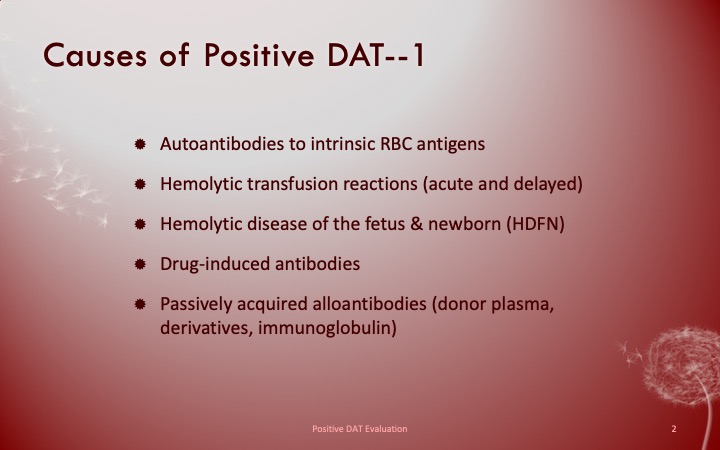
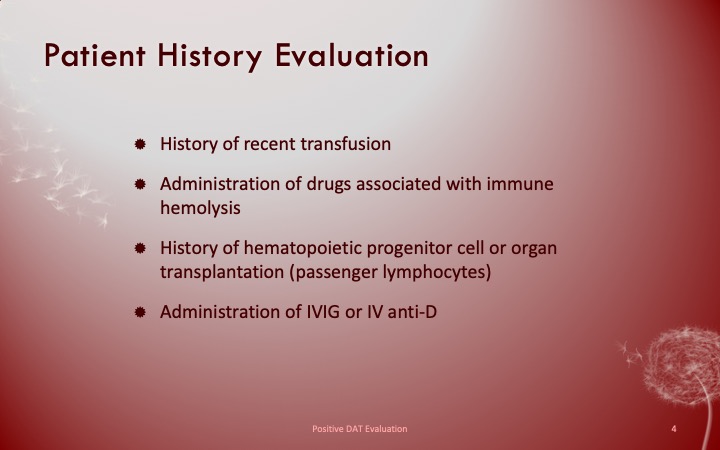
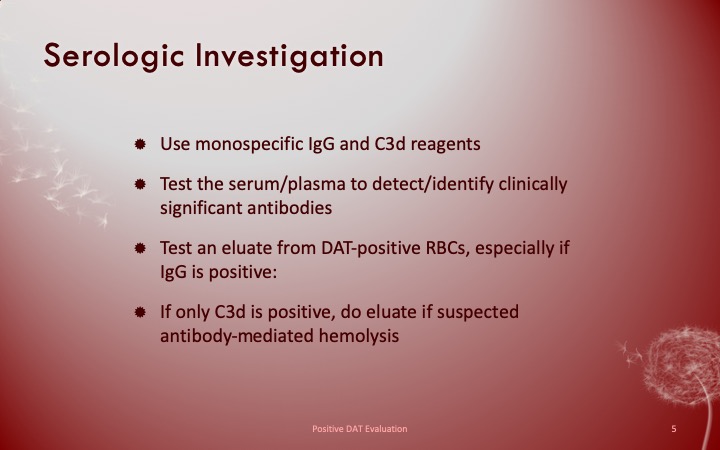
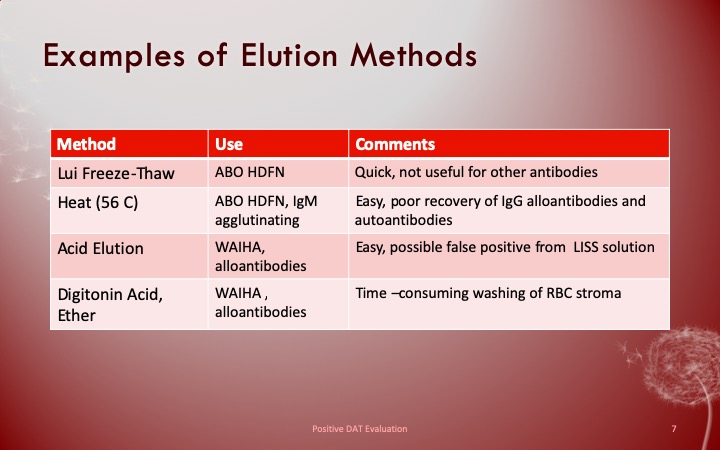
Evaluation of a Positive Direct Antiglobulin Test

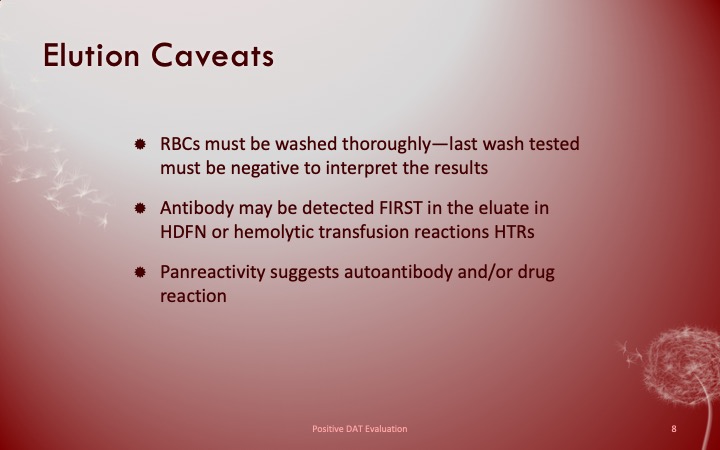
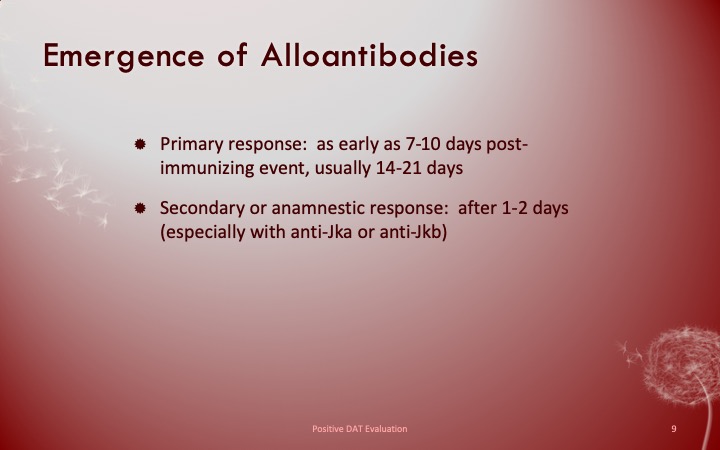
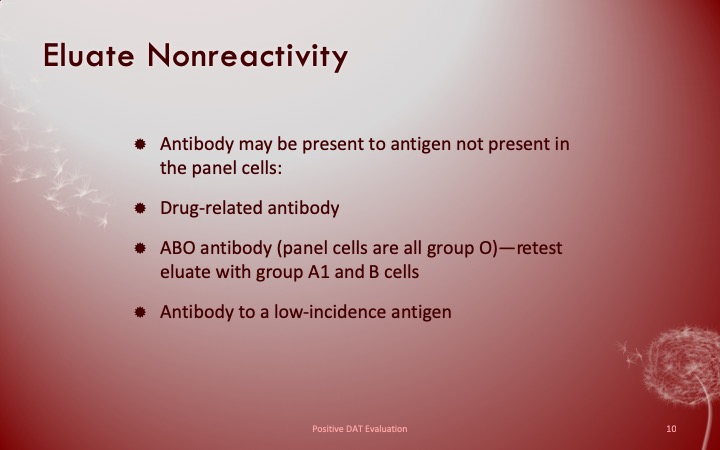
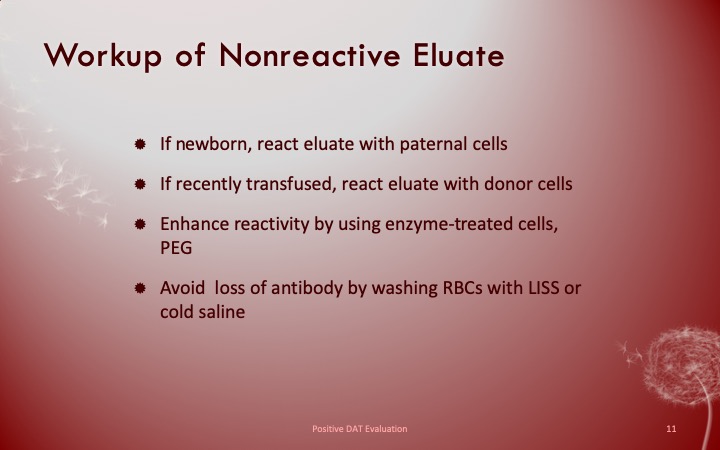
This presentation is from my time at National Guard Health Affairs Riyadh and suggests an algorithm to assess the clinical significance of the reaction. In my opinion, the essence of immunohematology testing is the antiglobulin test so I would spend much time with technical and medical staff, including trainees/fellows (even those not based in transfusion medicine) to make certain they understood how to interpret it.

If it is a neonate and the mother is ABO-incompatible, always test against reagent A1 and B cells.

Serologic Controls

In old days of only polyclonal reagents, QC of reagents took significant time.  This has been simplified and easier since the introduction of monoclonal cocktail reagents.

Controls may be explicit (a specific control provided by the manufacturer) or implicit (implied by at least one negative reaction in the well of a gel card).

In order to properly interpret test results:

  • Always follow manufacturer’s recommendations for performance of test AND use of controls.
  • Use only the manufacturer’s specified control for testing.  For example, do not substitute 6% albumin as the D-control if the manufacturer provides a specific control.
  • Use manufacturer’s criteria for control validity.

Make certain test results meet the criteria for interpretation.  Do not accept negative results for IAT typing if DAT is strongly positive (blocking antibody).

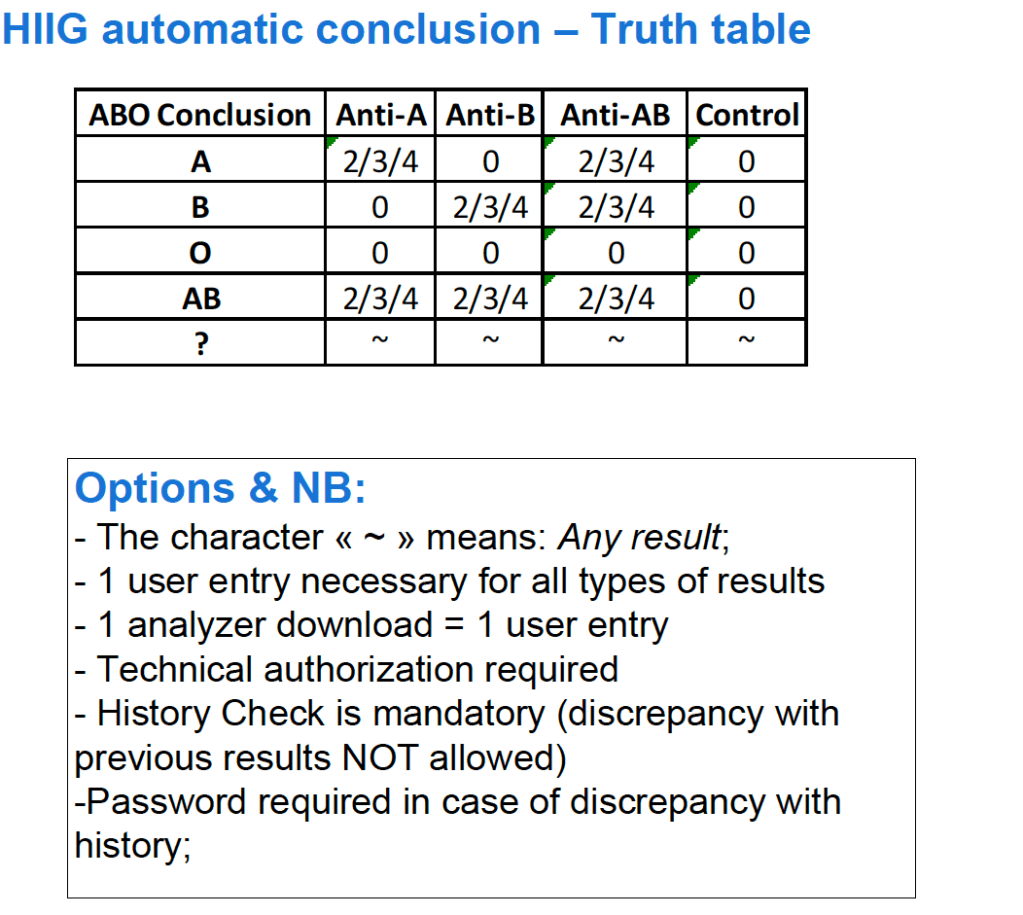
For both manual and automated tests, you can build the control criteria directly into your blood bank computer system’s truth table of results.  This way the system will enforce the criteria and prevent false interpretations:

Example of control for ABO typing:

Blocking Antibodies

This is a revised version of a previous post.

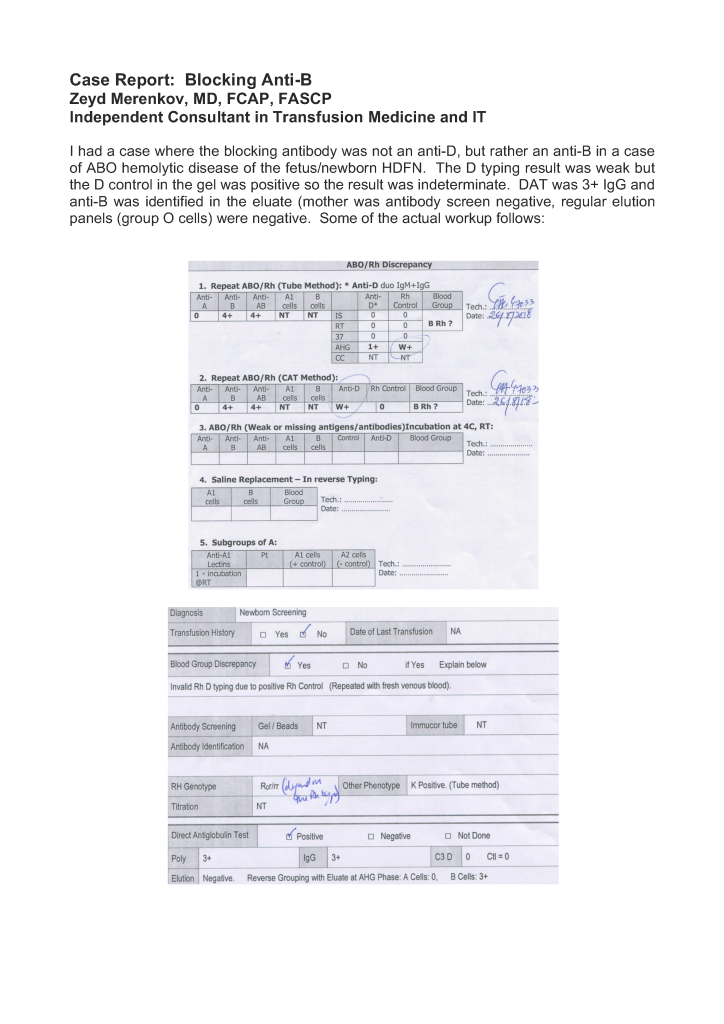
If there is strong antibody binding to an RBC, this may interfere with a typing reagent attaching to the cell and cause a false-negative, i.e. a “blocking” antibody.  Such cells may interfere with the indirect antiglobulin test IAT, i.e. the antibody screen.  The autocontrol and direct antiglobulin test DAT will be strongly positive.

The manufacturer’s instructions for using its reagents should be strictly followed in the presence of a strongly positive DAT.  If there is no reaction with the typing reagent, the result must be indeterminate.

One could try a (relatively) nondestructive elution method such as gentle-heat elution to remove some of the antibody and then retype the cells.  I have found this to be a simple and effective method for my staff to use.  Just remember that despite being “gentle,” there will still be some hemolysis present, but here it is the cells we are trying to save.

Usually, we find this situation in a neonate born of a mother with anti-D.  The baby has a strong DAT but the D typing is negative.  Check the D control carefully:  if it is positive, the result is indeterminate, try another method.  Usually gel/glass bead methods are subject to less interference.  Finally, there is always the classic saline anti-D!

In Medinfo software with a blocking antibody, a nonnegative control will trigger a manual review of the results.  There will be no automatic release.

Here is my process for handling blocking antibodies, which I set up for HMC Doha:

INTERIM POLICY:  ANTIGEN TYPINGS IN PRESENCE OF STRONGLY POSITIVE DIRECT ANTIGLOBULIN TEST (DAT):  RULE OUT BLOCKING ANTIBODY

Principle:

Antigen typing of cells with large amounts of coating antibody (i.e. strongly positive DAT 3-4+) may not always be possible because the bound antibody may block available antigen sites.  This policy is to clarify how to recognize and handle such situations.

Policy:

  1. Always follow the manufacturer’s instructions for the use of the typing reagent.
    1. In particular, note whether a control must be run with the test (e.g. D-control, D-diluent, etc.) or if it is included in the gel or glass bead card.
      1. If a control is required, use exactly what the manufacturer recommends.
      2. DO NOT SUBSTITUTE ANYTHING ELSE AS THE CONTROL!!
  2. Interpret the reactions exactly as the manufacturer indicates.
  3. If the test is invalid because of the control or any other reason, report the antigen typing as indeterminate and send for Transfusion Medicine Physician TMP review.
  4. If the DAT is 3-4+ and the antigen typing shows no reaction (apparent negative), send the case to the Transfusion Medicine Physician for review and final interpretation.  DO NOT ENTER THE RESULT AS NEGATIVE UNLESS THE TMP INSTRUCTS YOU TO DO THIS!!
  5. To rule out a blocking antibody, a special elution to gently remove the coating antibody may be needed so that the RBCs can then be typed (not acid glycine technique—rather use gentle heat elution.)  The Transfusion Medicine Physician will decide whether to do this additional testing.

References:

  1. Standards for Blood Banks and Transfusion Services, Current Edition, AABB, Bethesda, MD, USA
  2. Technical Manual, Current Edition, AABB, Bethesda, MD, USA
  3. Guidelines to the Preparation, Use, and Quality Assurance of Blood Components, European Committee (Partial Agreement) on Blood Transfusion (CD-P-TS), Current Edition

Overextending Oneself—Two Case Studies in the Blood Bank

One has to learn when enough is enough.  There are times when there are staff shortages but the conscientious staff wants to be the Super-Tech and handle all the work, whether or not there are sufficient resources.  This is a big gamble, and there may be serious consequences for the over-achiever and for the patient.

Anecdote #1:  Chicago Blizzard of 1979 (13-14 January):

When I was in my residency training in Chicago, I was in the blood bank during the blizzard of January, 1979.  The following tragedy occurred.

Suse was one of the best blood bank technologists that I have ever known, extremely conscientious and very meticulous—and very fast at doing things.  She was a workaholic.  Suse’s whole life centered on her job at our academic medical center—so much so that she had an apartment near the hospital complex.  In mid-January, a snow storm was predicted with an estimated snowfall of about 5 cm. total.  Actually, that night a blizzard developed and around a meter of snow fell with white-out conditions and zero visibility.  Preoperative patients had been admitted the night before based on the low snowfall prediction.

The next day was chaos.  Essentially only staff who lived near the hospital complex could report to work.  Suse came in and saw all the pending preoperative blood requests.  She decided to “double-up” and work on two cases at one time.  In the rush, she mixed up test tubes and issued ABO-incompatible blood for a surgical case.  The surgeon noted the abnormal oozing of blood at the operative site and stopped the transfusion.  Hematuria developed, but the patient survived.

Suse was suspended pending investigation.  Based on her excellent work record, she was offered to return to work.  Unfortunately, she became very depressed and was afraid to return since she feared she would make another mistake.  She never worked in the blood bank again.

Anecdote #2:  Shortage of Blood at Major Hospital:

1991 in another country, a large hospital complex was suffering a shortage of blood.  A large number of donors were called and the available staff were overwhelmed with work.  One donor phlebotomist decided to collect whole blood from two different donors simultaneously and in the confusion, mixed up the sample tubes for donor marker testing.

Unfortunately, one of those donors was HBsAg positive, but with the specimen mix-up was marked as negative.  The unit of blood was transfused, and the recipient developed fulminant hepatitis B and died.

Analysis:

In both these systems, there were processes in effect not to work on two patient specimens or collect two donors at one time, but the staff took short-cuts.

No one is super-human.  Don’t try to cut corners and handle more than one patient at a time.  Your intention may be good, but you will be judged by the consequences.  No one will care about the extenuating circumstances.  You will be blamed.  I tell my staff that if they cannot handle the workload, they should contact me as the Division Head, Transfusion Medicine, to triage the cases for them.  My role is to bring these events to the higher authorities to get the resources we need to do the work properly and safely.

Case Report: Overwashing During Elution

Note:  This is a repost.

I cannot emphasize enough proper technique in doing the washing during the elution process.  We are usually concerned about too little washing and thus possibly residual reactions in the last wash.  However, aggressive overwashing may remove the bound antibody resulting in a negative result.

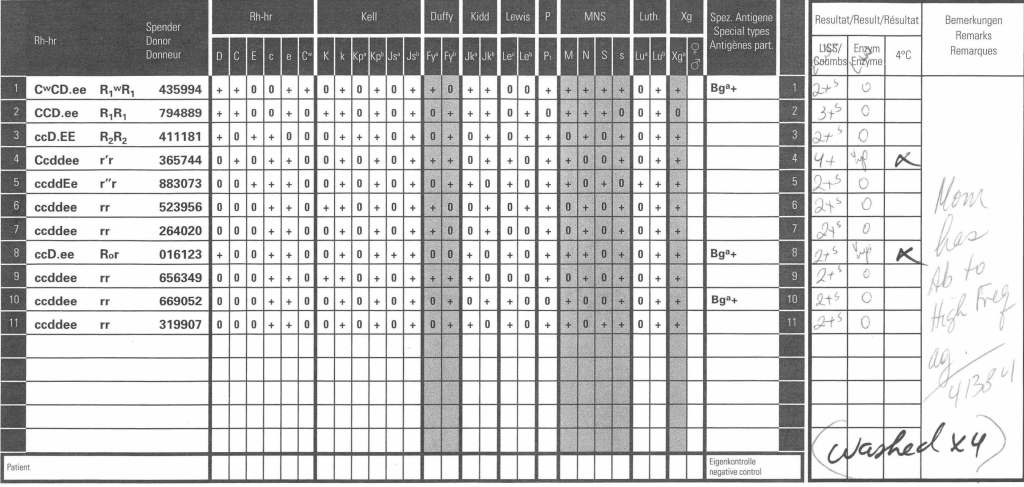
Here is an example of anti-PP1Pk (alias anti-Tja).  The mother’s panel shows an antibody to a high prevalence/incidence antigen with negative autocontrol and no lability at enzyme phase:

The neonate’s DAT was weak positive at polyspecific and IgG monospecific phases.  An eluate was performed.  Here is the result after washing four (4) times:

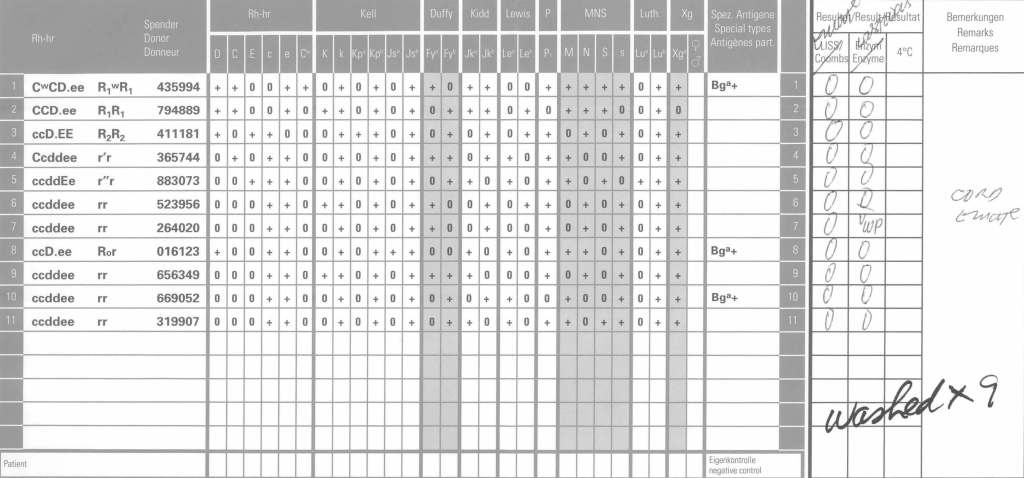
Since 2 cells in the last wash were very weakly positive, the washing was continued for a total of 9 times with the following results:

Even then there was very weak positivity in one cell, but the eluate was negative.  We had washed away the attached antibodies.

My Opinion: Use of Enzyme Panels

This is an updated version of a previous post.

Working for many years in the Middle East/Gulf, I have encountered significant antibodies that can only be detected at enzyme phase.  This is especially true of Rh system antibodies, particularly anti-c in an R1R1 patient.  I have attached an example.

The reasons I strongly recommend this practice are:

  1. Weak Rh system antibodies (as above)
  2. Confirmation of enzyme-labile antibodies, especially if there may be combinations of enzyme-labile and enzyme-resistant antibodies (e.g. anti-Fya and anti-c).

It is also important to consider which enzyme to use:  bromelin, ficin, or papain usually and sometimes trypsin or chymotrypsin.  They do not always attack at the same site.

In addition to most common MNSs and Duffy system antibodies, many Kell antibodies (e.g. K or K1, Kpa) are labile with papain:  however, with ficin they may be partially labile, unaffected, or even enhanced.

Using enzymes is a double-edged sword since they may enhance cold antibodies and thus cause nonspecific reactions.  Thus, I know many of you may not routinely include them in your workups.

It is essential to follow the manufacturer’s recommendations for their use.  If you make your own enzyme-treated cells and prolong the incubation, you may get false positivity.  You should also be careful about using potentiators with enzyme-treated cells—normally I run them in saline.

Since anti-c may cause severe hemolysis and severe hemolytic disease of the newborn, I am especially vigilant in my R1R1 patients, particularly females of child-bearing age and all chronically transfused patients.  I prophylactically match R1R1 patients with R1R1 RBCs in these categories, regardless if either anti-E or anti-c are expressed.  I have seen many examples where the anti-c is only detected at enzyme phase.

It is my practice to always include an enzyme panel.  I would be very interested to know your practices?  When do you use enzymes?