SARS-CoV-2 Vaccines and Donor Qualification

Principle:

Under AABB and FDA rules in the Uniform Donor History Questionnaire, unlicensed, investigational vaccines have a 12-month deferral or as indicated by a responsible physician.  In light of the anticipated vaccination trials for COVID-19, this policy gives interim guidance until more definitive information is available.

For COVID-19 Convalescent Plasma CCP donation, investigational vaccine recipients should not donate COVID-19 convalescent plasma until further information is available about their antibody profile.

Policy:

Any donor who has received a COVID-19 (SARS-CoV-2) vaccine will be deferred as follows:

  1. Whole blood or apheresis donation (except COVID-19 convalescent plasma):
    1. Live, attenuated vaccine:  14 days post vaccination
    2. Non-replicating, inactivated, or RNA-based vaccine:  NO DEFERRAL
  2. COVID-19 Convalescent Plasma CCP Donation:  DO NOT ACCEPT

Reference:

Text from the AABB Weekly Report:

Novel Coronavirus Update, Regulatory Update:  Investigational Vaccines and Deferral for Donor of Blood and Convalescent Plasma, AABB Weekly Report, 7 August 2020

“FDA recognizes AABB’s DHQ which includes unlicensed (experimental) vaccines on the medication deferral list as a 12-month deferral or as indicated by the responsible physician.

“For routine blood donation, the responsible physician may wish to consider the potential infectious risk associated with the vaccines, and the use of short deferral periods (e.g., 14 days) for live attenuated vaccines and no deferral for non-replicating, inactivated or RNA-based vaccines.

“We agree that no deferral is necessary for routine blood donors who might have received the mRNA-1273 Moderna vaccine.

“At this time, we suggest that individuals who have received a COVID-19 investigational vaccine should not donate COVID-19 convalescent plasma until further information is available about their antibody profile.”
CMV Prophylaxis Policy

I developed this policy for HMC Doha where most of the local population are CMV-seropositive. Note that I used the CE definition of <1E6 instead of the American <5E6.

Principle:

Since most of the local population (>90%) are CMV-seropositive, it is impractical to rely on CMV-negative donors as our basis for CMV prophylaxis.  Instead, we perform universal leukodepletion and pathogen-inactivation to greatly reduce this risk:

  1. CMV transmission risk can be lowered to a level comparable to using CMV-seronegative components by universal leukodepletion to levels <1E6.
  2. Pathogen inactivation greatly reduces (at least 2 log10) the number of organisms with nucleic acid (DNA or RNA) and is used for all platelet (pools and apheresis) and plasma components.
  3. Platelet additive solution reduces the amount of original plasma to about 35 ml and further reduces donor exposure to foreign material.

Policy:

  1. All blood components (platelets, plasma, RBCs) are universally leukodepleted to residual levels below 1E6.
  2. All platelet and plasma components are pathogen-inactivated using the Mirasol system (riboflavin added and then exposed to ultraviolet light).
  3. All platelet components (pooled buffy coat and apheresis) are prepared in platelet additive solution PAS.

References:

  1. Technical Manual, AABB, Current Edition, Bethesda, Maryland, USA
  2. Standards for Blood Banks and Transfusion Services, Current Edition, AABB, Bethesda, Maryland, USA
  3. Guidelines to the Preparation, Use, and Quality Assurance of Blood Components, European Committee (Partial Agreement) on Blood Transfusion (CD-P-TS), Current Edition

Processes and Software Building 46: Reconstituted Whole Blood

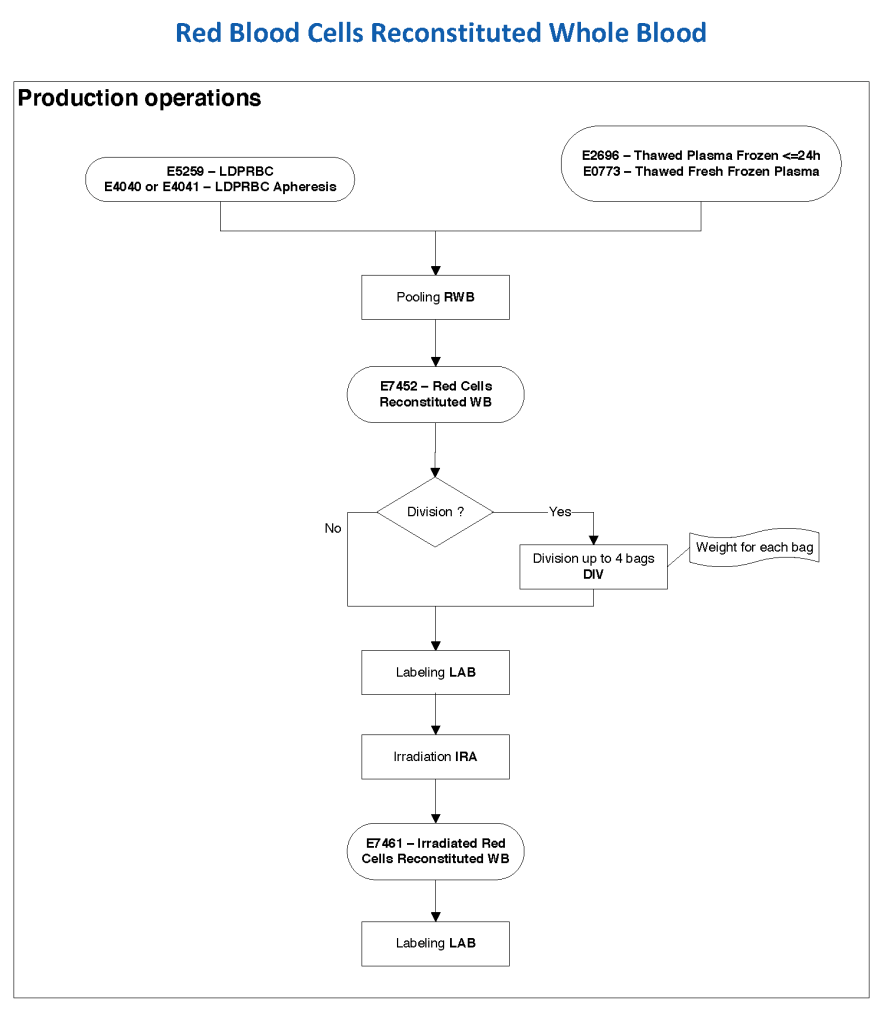
Exchange transfusions using reconstituted whole blood were much more common in the past.  Much of the time IVIG now takes care of hemolytic disease of the fetus/newborn HDFN.

In Medinfo, we took a fresh (<= 14 day old) packed RBC in SAGM, group O, Rh-compatible and mixed it with a unit of group AB plasma—the desired hematocrit could be achieved by adjusting the amount thawed plasma that we added.  The product could then be aliquoted and irradiated.  Note that I medically chose to use either FP24 or FFP.

Here is the Medinfo process:

19/9/20

Processes and Software Building 45: Modifying RBC Components

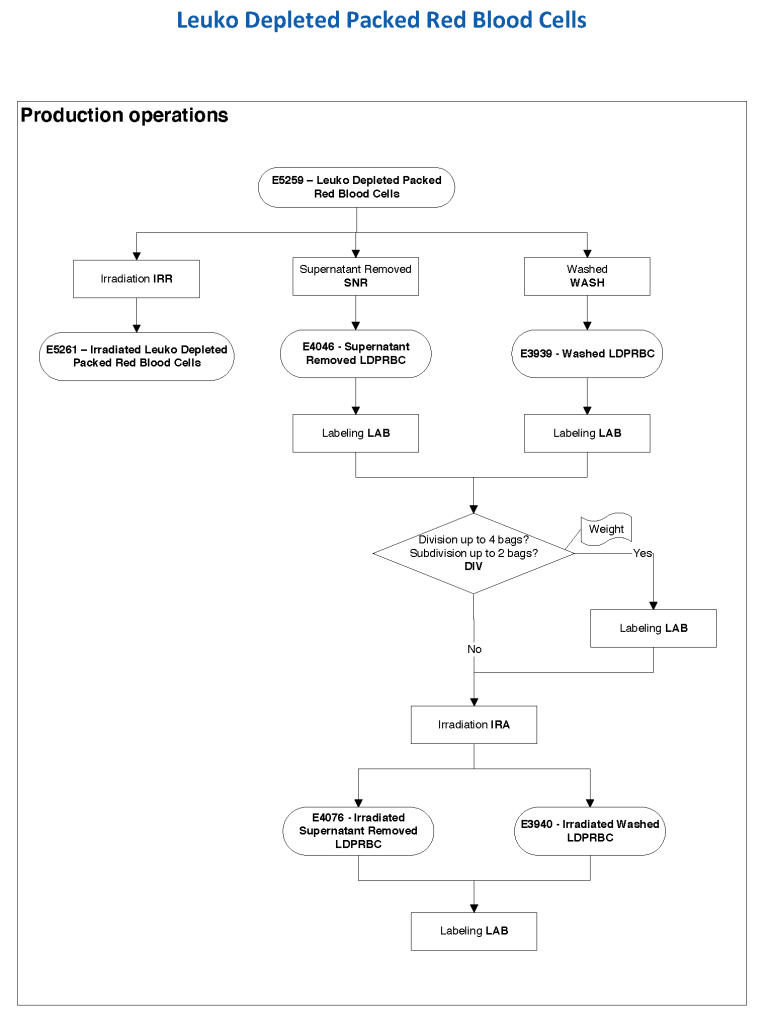
Components may be modified either in the Blood Donor Center or in the hospital blood bank.  In either case, they use the PRODUCTION section of Medinfo to perform these operations.

These operations may include:

  • Irradiation
  • Tight-packing (removal of the supernatant, especially for intrauterine or neonatal transfusions)
  • Washing
  • Aliquoting (division of the primary RBC bag and possibly further division of one of the secondary bags)
  • Final labelling of the modified component

The weight of the component is converted to the volume by the software.

The end-user can specify which modified components were available.  As with any ISBT-labelled products, any changes will trigger a new ISBT E code and label.

16/9/20

Policy: ABO-Incompatible Plasma for Infants

Principle:

HMC Blood Donor Center used platelets (buffy coat pools) and/or apheresis-derived suspended in PAS (platelet additive solution).  In each platelet pool or apheresis platelet, less than 35 ml (average < 20%) of the original plasma. This was much less than would remain if volume-reduced platelets had been prepared by centrifugation. Furthermore, the platelets would NOT be traumatized by the centrifugation.

Policy:

  1. For neonates (< 4 months old) and infants (<20 kg), we will give preference to use plasma-compatible platelet and plasma type.
  2. In any case, PAS-suspended platelets will be used with little residual plasma (far less than if we had centrifuged them).
  3. In the rare event that plasma-compatible platelet types are not available, the transfusion medicine physician must approve the release.

References:

  1. Standards for Blood Banks and Transfusion Services, Current Edition, AABB, Bethesda, MD, USA
  2. Guide to the Preparation, Use, and Quality Assurance of Blood Components, European Committee (Partial Agreement) on Blood Transfusion, Council of Europe, Strasbourg, France

Processes and Software Building 44: Pooling Components

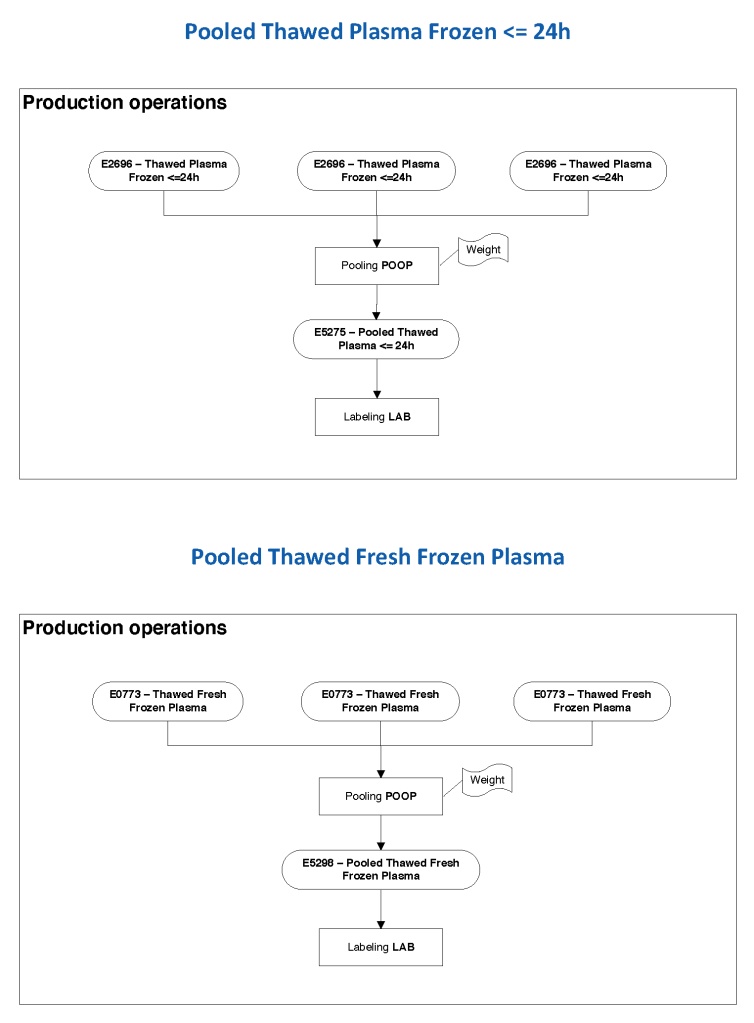
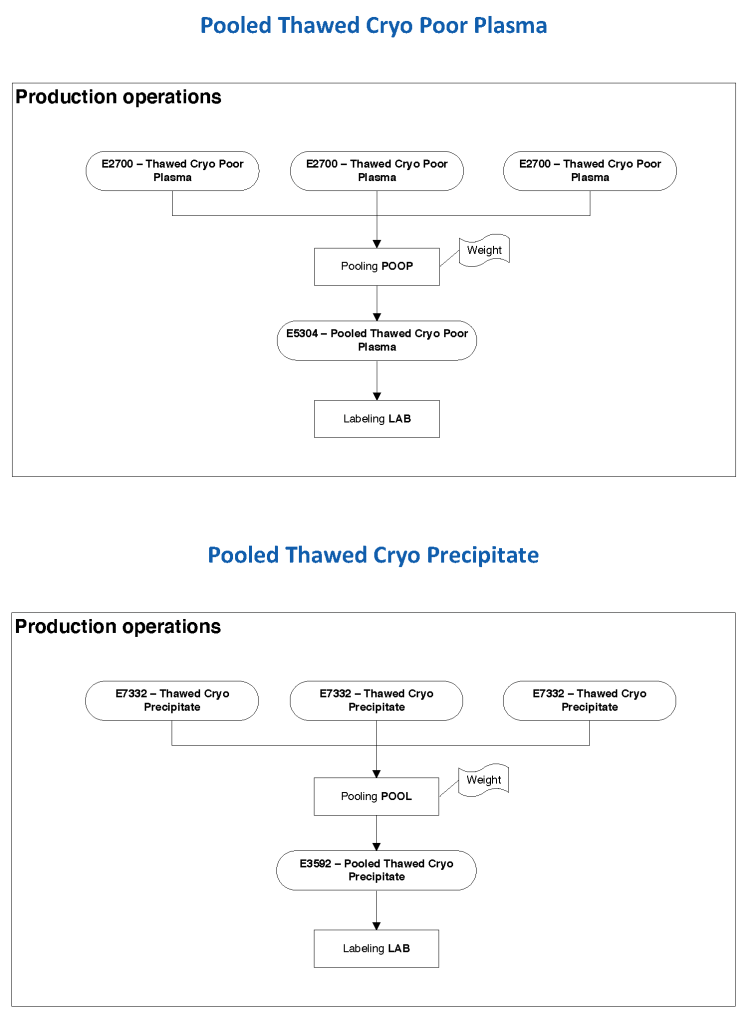
Medinfo Hematos IIG has a pooling operation that can be used for pooling platelets, plasma, cryoprecipitate, etc.  It is a one-step operation.  In the set-up, one specifies the maximum number of components to pool together for each component type.  In general, they are of the same ABO type;  however, at HMC Doha I did allow mixed ABO platelet pools to avoid wastage of platelets that would otherwise be discarded—this may not be allowed in all jurisdictions.

The following examples show pooling of FFP, FP24, cryoprecipitate, and cryo-poor plasma:

13/9/20

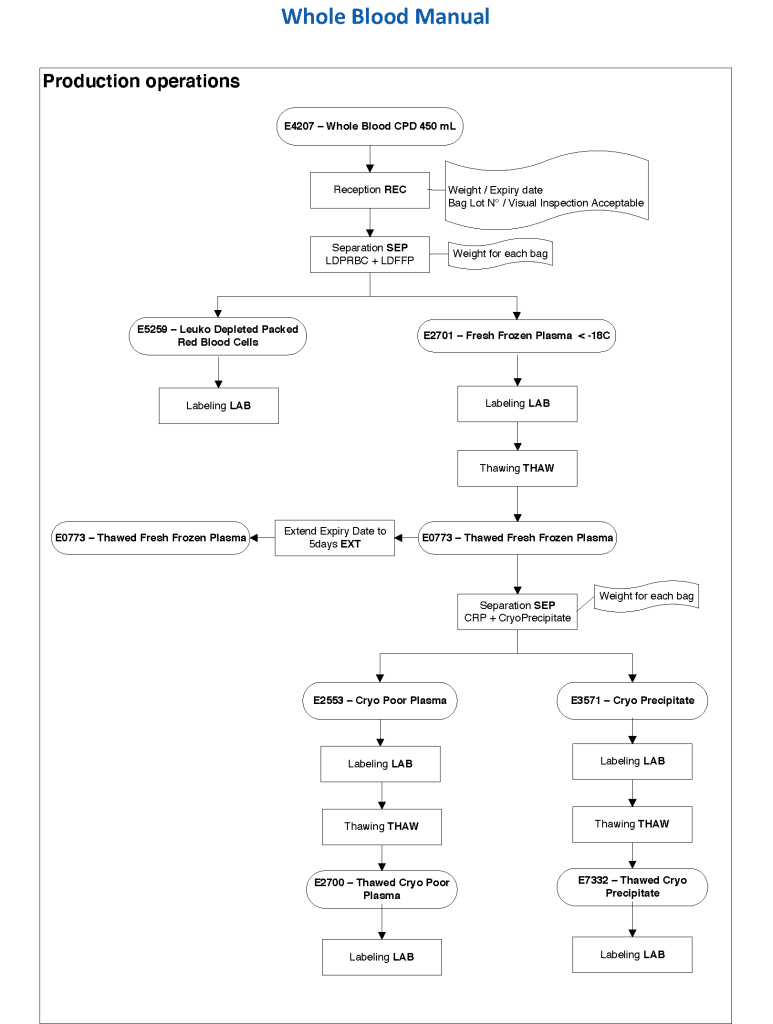
Processes and Software Building 43: Manual Whole Blood Processing

This was the HMC methodology for manual whole blood processing to prepare packed RBCs, plasma, cryoprecipitate, and cryo-poor plasma using blood bank centrifuges (not Reveos).  It did not include preparing platelets since we did not have manual buffy coat processing equipment.  In this algorithm we did not specifically release whole blood as a final product (although we did have the capability of activating this in emergency situations).

10/9/20

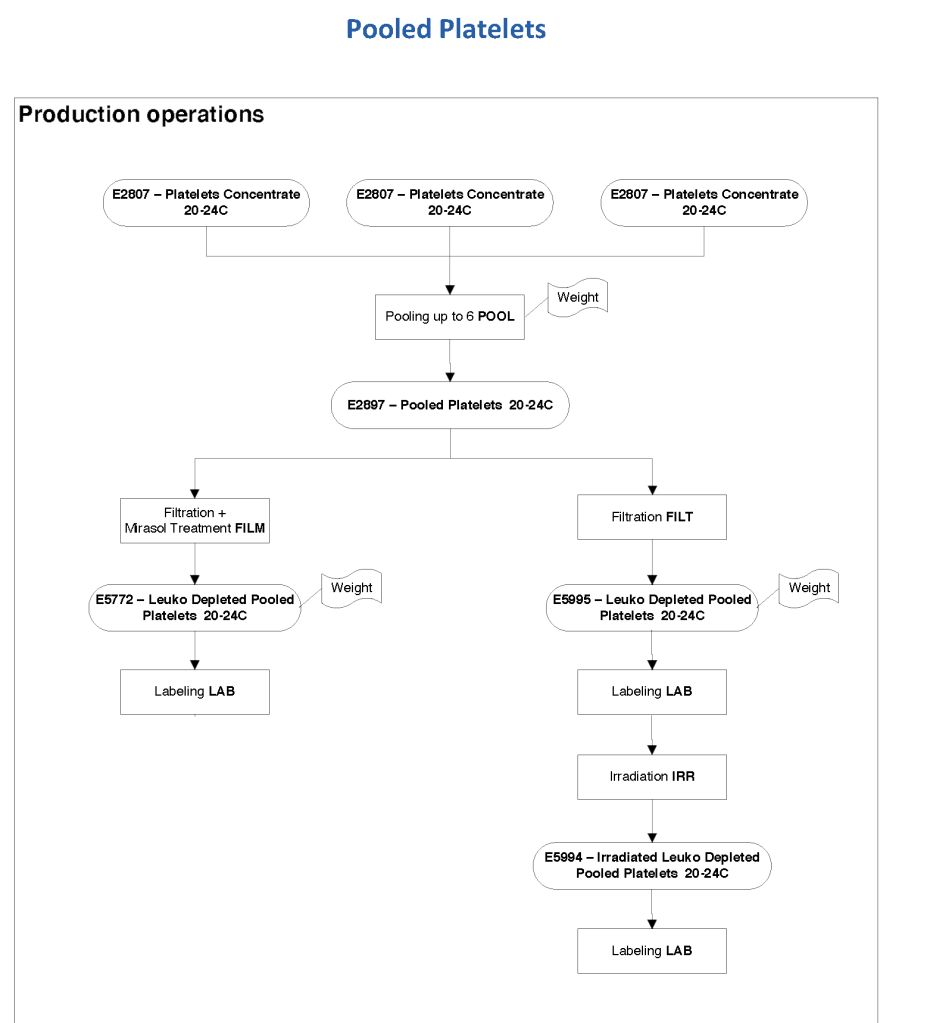
Processes and Software Building 42: Platelet Pooling

Outside the USA, platelet pools stored at room temperature may be valid for up to 7 days, especially if pathogen-inactivation is used.  The following workflow shows both Mirasol pathogen-inactivated and standard platelets.  The standard platelets are then irradiated.  Both types can be aliquoted.

A major advantage in using a specific blood bank computer software is to enforce the Good Manufacturing Process.  Medinfo is merciless:  there are no exceptions without authorization and that is restricted by the security policies.

In the recent Reveos post, the upper and lower platelet volume specifications were discussed.  The platelets are weighed and the volume is calculated.  If a manual or another method for preparing platelets is used, then the according values can be specified.

To Be Continued:  8/9/20

Review of Product Inserts

This is a policy I made for NGHA Jeddah many years ago but is still useful today.

Principle:

All technical staff are required to read and understand the manufacturer package inserts that apply to the procedures that they perform.  This policy establishes a means of documenting compliance with this requirement.

Policy Details:

  1. Technical staff are defined as anyone who uses the reagent in the performance of a procedure or process or anyone reviews or supervises that process or procedure.  This includes the supervisor, medical technologists, medical technicians, nurses, phlebotomists, and assistants.
  2. All technical staff are required to read and understand ALL product inserts for each procedure applicable to the section(s) that they work in—apheresis, donor room, component preparation, and/or transfusion service.
  3. If they have any questions about a particular insert, they should refer it to the supervisor, senior technologist (Med Tech 1), or in the latter’s absence, the blood bank medical director/section head.
  4. Each staff member must sign the Manufacturer’s Package Insert Review Form for that particular policy/procedure, including his signature, employee identification number, and date.
  5. Each Manufacturer’s Package Insert Review Form will be retained with a copy of the package insert by the Blood Bank Supervisor in a special file while the material is being used and for at least five (5) years after a new or revised manufacturer package insert is applicable.
  6. A new Manufacturer’s Package Insert Review Form should be used for each revision of the insert.

Insert Review Form

Type of Insert:  New  Revised
Product Name:
Date of Insert:

I have read this insert and understand its contents and accept responsibility for following its instructions and directions.

Staff Name & Badge #–PRINT!SignatureDate


Sample Resident Examination for Donor Center

Reading Assignments:

  • Chapters 5-9:  Blood Donation and Collection in Technical Manual, 16th Edition
  • Standards for Blood Banks and Transfusion Services, AABB, 25th Edition

Study Questions:

  1. Which of the following candidates is acceptable for donation?
    1. Saudi, visited Sudan 11 months ago as part of National Guard exchange
    2. Saudi former student lived in UK for 2 years from 1993-95
    3. Normotensive taking amlodipine and valsartan
    4. Psoriatic using Tegison
    5. Male adult using ibuprofen for lower back pain
    6. Female 4 weeks post-partum
    7. Husband of patient with recent onset of hepatitis B infection
    8. Male stopped taking ampicillin one week ago for acute pharyngitis
    9. Donor with WBC count 12000/cmm but otherwise normal
  2. Which of the following donors is suitable for autologous donation?
    1. Cataract surgery patient
    2. Well, but had gastroenteritis 3 days ago
    3. Pregnant with Hgb 11 g/dl
    4. CGL patient with Hgb 13 g/dl
    5. Hodgkin’s disease patient Hgb 12 for exploratory laparotomy
    6. Patient with rare antibody anti-Tja, Hgb 13 for cholecystecomy
  3. How do you handle the following events?
    1. Donor draw fills bag with bright red blood in 30 seconds
    2. Donor faints when needle is shown
    3. Lipemic serum during donor plateletpheresis session
    4. Donor with numbness and tingling of extremities during donor apheresis session
  4. How would you handle the following therapeutic phlebotomy requests?
    1. Hgb 22 g/dl, suspected polycythemia rubra vera
    2. Hgb 13, suspected hemochromatosis patient
    3. Hgb 16, renal failure patient post-erythropoietin treatment
    4. Unstable angina, Hgb 9
  5. What is the final volume of each of the following blood components?
    1. Whole blood
    2. Packed RBCs—state hematocrit as well
    3. Washed RBCs
    4. Irradiated packed cells
    5. Platelet pool—state number of platelets
    6. FFP
    7. Cryo-poor plasma
    8. Cryoprecipitate
  6. What are the outdates of each of the following components?
    1. Packed RBCs
    2. Platelet pool
    3. FFP frozen at -35C
    4. Granulocyte concentrate
  7. Which donor units are acceptable for transfusion?
    1. HBsAg negative, HBcAb positive, HBsAb > 20 IU/liter
    2. HCV Ab positive, RIBA-3 negative, HCV-RNA negative
    3. Syphilis positive, FTA-ABS negative

Revised:

29/8/20