Minimizing Plasma Wastage

Principle:

Plasma products (FFP, FP24, thawed plasma) are only available in limited quantities so wastage must be minimized.  Thawed plasma has full factor activity for 24 hours; after 24 hours, all factors are still present at near normal levels except factors VIII and V.  AABB Standards permit continued usage of thawed plasma stored between 1-6 Celsius as the component, “thawed plasma” for 5 days.

Thawed plasma may also be prepared directly at the time of production (i.e. without freezing) for certain cases (MTP, liver transplant protocol, plasma exchange) to shorten the release time.  It is called liquid plasma since it was never frozen but should be considered equivalent to thawed FP24 if used within 24 hours or thawed plasma if used between 24 and 120 hours.

Liquid plasma, as we use here, is prepared directly from plasma treated with Mirasol and generally used within 5 days;  however, in Medinfo HIIG, this plasma may have an outdate of 26 days in accordance with 21CFR610.53, but it is not used beyond five days except if approved by the Senior Consultant/Division Head of Transfusion Medicine.  Since it is used within 5 days, it is equivalent to thawed plasma.

Definitions:

Responsible blood bank physician: specialist or consultant physician on-call at the time the discrepancy is detected

Policy Details:

  1. Plasma is dispensed without regard to the Rh(D) of the donor.
  2. Check if thawed plasma or liquid plasma (<5 days) is available first.
  3. Do not thaw plasma until the clinical service is ready to transfuse it.
    1. Tell clinical service to contact transfusion service 2-3 hours before intended transfusion time.
    2. Exceptions: liver transplant surgery, massive transfusion protocol, therapeutic apheresis, class 1 emergency requests
  4. If thawed plasma or liquid plasma is kept in the blood bank but not  used:
    1. Reassign to another patient of compatible ABO type as thawed FFP/FFP24 if < 24 hours post-thaw or <24 hours of production if liquid plasma (see attached table).
    2. If thawed > 24 hours or liquid plasma between 24 and 120 hours post processing, reassign component as thawed plasma and use for up to 5 days.  It is preferable to use thawed plasma < 24 hours old for neonates.
  5. Thawed >120 hours post-thawing and/or liquid plasma > 120 hours post-production should be discarded.
  6. Plasma usage and wastage will be monitored and reported to the Transfusion Committee.

Note:

Thawed plasma released from transfusion service should be discarded if returned.

References:

  1. Technical Manual, Current Edition, Bethesda, MD, USA
  2. Standards for Blood Banks and Transfusion Services Current Edition, AABB, Bethesda, MD, USA
  3. 21CFR610.531(c):  Whole Blood and Blood Components Storage Temperatures and Dating Periods, Current Version

PERMISSIBLE FFP/FP24/THAWED PLASMA SUBSTITUTIONS

PATIENT BLOOD TYPEUSE THE FOLLOWING:
  
OALL BLOOD TYPES
AA or AB
BB or AB
ABAB

24/10/20

Policy: ISBT Component Label Usage

Principle:

Blood components will only receive final ISBT labels for the purpose of transfusion upon completion of the production processes specific for that component and will be specifically prepared by the Medinfo Hematos IIG software in accordance to Council of Europe CE Standards.

An improper label, be it for the wrong unit, or improper designation can have catastrophic results to the recipient.  This is why this is such a CONTROLLED process under Medinfo Hematos IIG.  There are label-printing softwares available that do not follow these rules, but I consider them dangerous to use since these safeguards are not enforce—they are NOT permitted here.

Policy:

  1. The formatting of ISBT labels is addressed in the Interim Policy: ISBT Labels (a previous post).
  2. The selection of the ISBT E codes will be made by the Division Head, Transfusion Medicine and Laboratory Information Systems.
  3. Blood component labels, either final or in-process are ISBT-specific and may only be generated by the Hematos IIG computer system.
  4. The ISBT specimen are generated at the time of donor registration.
    1. ISBT specimen labels are of limited number and cannot be reprinted by operational staff.
      1. Reprinting is only allowed by Transfusion LIS with approval of the Division Head, Transfusion Medicine/Laboratory Information System
  5. Final ISBT blood component labels may only be attached at the successful completion of component processing according to the HIIG workflow processes specific for each component.
  6. ISBT labels are also generated and attached after component modification (washing, irradiating, aliquoting, pooling) in accordance with the respective HIIG workflow processes.
    1. Multiple modifications may be performed before the final ISBT label is generated by HIIG.
  7. No modifications of the HIIG-generated ISBT labels is permitted.
  8. No manual corrections or attachment of additional, non-ISBT labels is permitted.
  9. During computer down-times, manual (non-ISBT) labels may be generated internally and will be replaced by the formal ISBT label using Manual Stock Entry after resumption of HIIG.
  10. For solvent-detergent-treated plasma SDP (e.g. Octaplas), the following applies:
    1. SDP (Octaplus) ISBT labels are prepared and attached by the manufacturer Octapharma during the manufacturing process and will be used/read as such.
    2. Thawed SDP will receive a new ISBT label at the time of thawing.

References:

  1. HIIG Workflows, Component Processing, 1002
  2. Standards for Blood Banks and Transfusion Services, Current Edition, AABB, Bethesda, MD, USA
  3. Policy:  ISBT Labels, Current Edition—previously posted
  4. TRM.43625 CAP Checklist

20/10/20

Opinion: Vendor Compatibility with ISBT Codes

While I was  Division Head, Laboratory Information Systems LIS elsewhere, we serviced a client hospital not using Medinfo for its patient hospital blood/transfusion services.  It used the blood bank module of a hospital information system’s laboratory system.

In their service level agreement, they wanted a complete list of all the ISBT product E codes that we used.  I found this strange and told them their system must have access to the ISBT database so they should have no problem in reading our codes directly.

The same hospital system was in use for our hospital system (excluding our blood banks, which used Medinfo and had no such problems.)  I discovered that this hospital system could NOT read any ISBT codes natively for the end-users, e.g. departments outside the blood bank.  Without informing us, the nursing staff were manually entering “something” into their system.   That something could be anything:  the system would accept any series of alphanumeric characters.  They could select any type for each component (e.g. RBC for a platelet, plasma for an RBC, etc.).  They had no reliable record of transfusion!

In fact, in that hospital information system, ISBT codes could only be read in their blood bank module, which we did not use at all.  That vendor subsequently purchased another software to read the labels, but I discovered that the new “solution” software still could not directly access the ISBT database!!  They still had no functionality to read ISBT labels on the wards!!  You still had to hard-code it into their system.

Thus, we were forced to give the new client a list of our current E codes.  I warned them that we did change these codes (e.g. when we adopted platelet additive solution).  It was their responsibility to change the “hard code” into their blood bank module of that vendor.

As regards our hospital information system, we had to “hard code” the ISBT codes into the order requests so they could use that to document the transfusion.  We also had to provide the descriptor for each and every code.

To this day, I am astounded that a modern hospital system still cannot read ISBT codes natively.  Surely, they could license a copy of the ISBT database—or at least let the end-user client license it and upload it into their system.

I am skeptical of a “one-size-fits-all” comprehensive, Swiss Army Knife like software that has some limited functionalities but lacks the details needed for actually using blood components.  I wonder if the compromises made to build this system make it similarly mediocre for other functionalities outside the blood bank sphere.

I consider myself very fortunate to have elected NOT to use this patient transfusion service module and go with a full-feature blood bank system.

Conclusion:

Be careful about trusting the vendor’s promises.  Check to see how they handle the ISBT labels.

17/10/20

Policy: ISBT Specimen Labelling Audit

Principle:

ISBT specimen labels have a check-digit to reduce the risk of misreading the label.  They are generated by the blood bank computer system Medinfo.  Normally one group of labels is printed for all needs (donor unit, marker testing, donor immunohematology, and donor processing.  Reprinting the same number is restricted to minimize the risk of using the wrong label on a specimen or unit.  These labels are NOT used for patient testing.

ISBT specimen labels are only printed at the time of donor registration.  We must securitize them so that they are not used for other, potentially malicious purposes.  Remember:  a labelling mistake may cause fatality in a patient receiving the wrong blood component.

Policy:

  1. ISBT specimen labels are only for blood donor specimens, initially labelling of donor collections, and intermediate processing of components.
  2. They must be applied to the primary specimens directly at the donor’s bedside.
  3. They must be applied to aliquots from the original ISBT-labelled tubes.
  4. They may NOT be applied to any other specimen (e.g. for routine laboratory testing outside Transfusion Medicine)
    1. If an ISBT label not corresponding to the correct donor is discovered, an OVA or event report must be generated and investigated immediately.
  5. If additional ISBT labels are needed, this must be documented on a specific audit sheet with signature of the person taking the extra labels and a second person to witness their removal.  It will also be noted in the Medinfo system for auditing purposes.
  6. The audit sheet must be kept in a secure place for future reference in Blood Donor Center.

14/10/20

ISBT Labels

Principle:

ISBT labels are ONLY GENERATED THROUGH MEDINFO HEMATOS IIG SOFTWARE.  We do not buy preprinted labels or have a separate label-generating program.  ISBT labels are only attached to blood components after production of new or modification of existing blood components and are only printed if the Good Manufacturing Process GMP criteria are met and confirmed by the software.

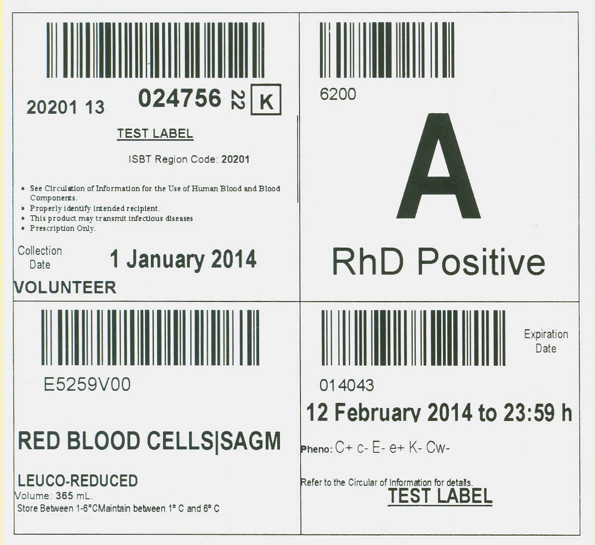
The ISBT component label measures 10 x 10 cm and is divided into FOUR quadrants:

  1. Upper left:  Donor Unit number:  20201 (site location) then two digits for the year (e.g. 13) followed by the donor encounter number followed by a check digit.  Reference is made to the Circular of Information, patient identification, risk of disease transmission, and prescription-only status.
  2. Upper right:  ABO/D type
  3. Lower left:  E code corresponding to the component type specification, the designation of origin (volunteer vs directed vs autologous vs paid donation) plus the division number.  E codes are taken from the ISBT master database.  We use CE-approved codes (NOT US FDA).
  4. Lower right:  Expiration date and time using 24 hour system plus any other phenotype data and other testing.

ISBT Specimen Labels:

ISBT specimen labels are used for all samples at the time of donor collection and include a separate check digit to confirm that the barcode is properly read.  ISBT specimens can be used in all parts of Medinfo Hematos IIG software;  however, non-Medinfo systems not complying with the safety features of the Council of Europe (worst case scenario is Cerner Millennium and all other American software) may not be able to read them.

Since we do not preprint ISBT labels, there are no phase-out of labels, they are only printed immediately upon need.  As component production changes frequently, the actual ISBT designation from the ISBT database for the new component is used by Medinfo.

Policy:

  1. All blood components and solvent-detergent treated plasma SDP must be labelled with ISBT labels.
  2. All donor specimen labels must meet the ISBT standard, including the check-digit.
  3. No blood components may be dispensed to patients unless there is an ISBT label corresponding to the final component, including ALL modifications (aliquoting, irradiation, washed, pathogen-inactivated, etc.)
  4. No one should write anything on an ISBT label:  If there has been a change in the component, perform the modification through Medinfo HIIG and reprint the label.
  5. Do NOT attach any other labels to an ISBT label.
  6. Ensure that the final ISBT label at the time of dispensing is on-top of all other ISBT labels.
  7. The ISBT sequences will be reset each year at 2359 hours on 31 December by the Medinfo software engineer.
  8. The choice of E codes is made by the Division Head, Transfusion Medicine/LIS using the ISBT master database.

References:

  1. Guide to the Preparation, Use, and Quality Assurance of Blood Components, European Committee (Partial Agreement on Blood Transfusion, CD-P-PS, Current Edition
  2. Standards for Blood Banks and Transfusion Services, Current Edition, AABB, Bethesda, MD, USA
  3. TRM.43600 and 43625 CAP Checklist, 2016

Donor Center Materials and Equipment Strategy

This is the policy I developed for HMC Doha Blood Donor Center:

Policy:

  1. This policy applies to all blood donor processing (including reagents, materials, equipment) in the Blood Donor Center.
    1. Immunohematology testing and donor infectious disease marker testing are not included.
  2. Equipment and reagents must be selected to meet/exceed productions standards set by the Council of Europe, International AABB, HMC policies and procedures, and Qatari law.
  3. Each equipment must have a fully functioning, reliable, bidirectional interface to Medinfo Hematos IIG and be fully interfaced
    1. Vendor is responsible to pay for the interface licensing for each piece of equipment.
  4. Materials/reagents/equipment must cover the following functionalities:
    1. Automated separation of whole blood and apheresis components into:
      1. Packed RBCs in additive solution
      2. Buffy coat derived platelet pools
      3. Apheresis-derived platelets, plasma, and/or RBCs
      4. Fresh frozen and FP24 plasma
    2. Pathogen inactivation of whole blood, platelets, plasma, RBCs
    3. Cryoprecipitate
    4. Cryo-poor plasma
    5. Frozen RBCs (high-glycerol method)
    6. Washed RBCs
    7. Thawed plasma
    8. Irradiated RBCs
    9. Reconstituted whole blood (PRBCs and thawed plasma)
    10. Leukodepletion of ALL components to current and future CE standards
  5. Equipment must have/meet:
    1. CE mark or equivalent (FDA, CSA, etc.)
    2. Sufficient throughput for the workload in the area assigned
    3. Scalability:  A path of upgrading to larger capacity/throughput equipment using the same reagent line of the vendor
    4. A minimum of two of each equipment type must be obtained to minimize disruption of blood supply.
  6. Vendors:
    1. Vendors must offer 24/7 service on critical equipment for donor blood component and patient compatibility testing
    2. Vendors who do not meet qualification standards must not be used.

References:

  1. Standards for Blood Banks and Transfusion Services, Current Edition, AABB, Bethesda, MD, USA
  2. Guide to the Preparation, Use, and Quality Assurance of Blood Components, European Committee (Partial Agreement) on Blood Transfusion (CD-P-TS), European Directorate for the Quality of Medicines and Healthcare, Current Edition, Strasbourg, France

Processes and Software Building 47: Apheresis Plasma

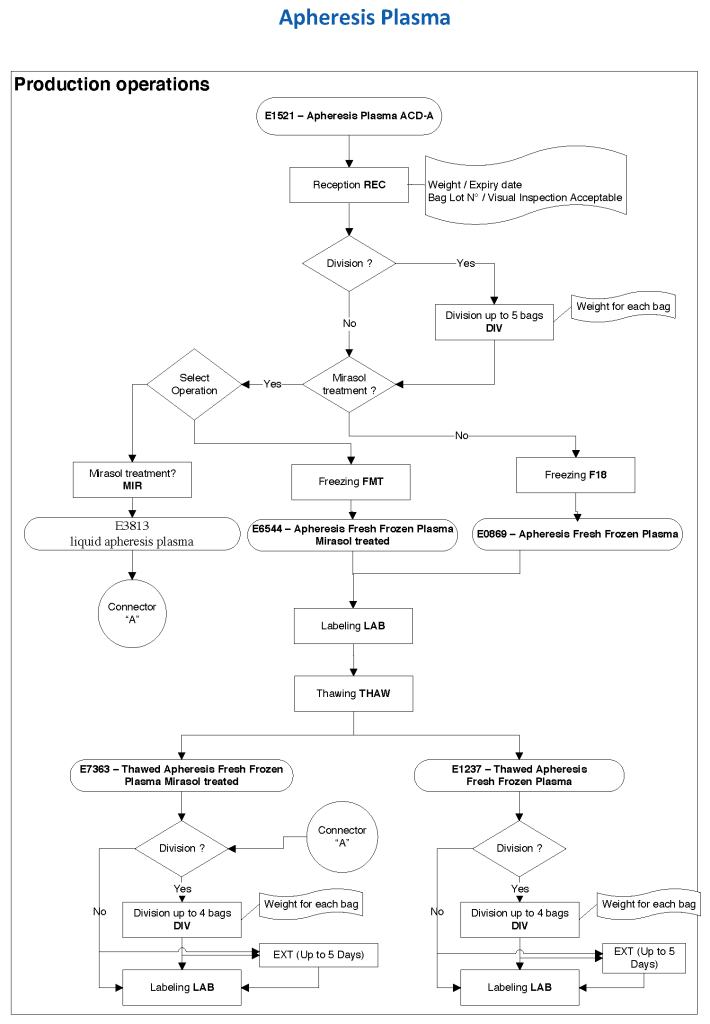
At HMC during my tenure, all plasma products—whole-blood and apheresis-derived were pathogen inactivated with riboflavin (Mirasol).  In our software processes, I had options to release both Mirasol-treated and untreated (the latter in emergencies) and to aliquot either as needed.  The same processes applied to COVID-19 convalescent plasma CCP except that they were performed in a quarantine production area.  There were specific ISBT codes for CCP.

24/9/20

SARS-CoV-2 Vaccines and Donor Qualification

Principle:

Under AABB and FDA rules in the Uniform Donor History Questionnaire, unlicensed, investigational vaccines have a 12-month deferral or as indicated by a responsible physician.  In light of the anticipated vaccination trials for COVID-19, this policy gives interim guidance until more definitive information is available.

For COVID-19 Convalescent Plasma CCP donation, investigational vaccine recipients should not donate COVID-19 convalescent plasma until further information is available about their antibody profile.

Policy:

Any donor who has received a COVID-19 (SARS-CoV-2) vaccine will be deferred as follows:

  1. Whole blood or apheresis donation (except COVID-19 convalescent plasma):
    1. Live, attenuated vaccine:  14 days post vaccination
    2. Non-replicating, inactivated, or RNA-based vaccine:  NO DEFERRAL
  2. COVID-19 Convalescent Plasma CCP Donation:  DO NOT ACCEPT

Reference:

Text from the AABB Weekly Report:

Novel Coronavirus Update, Regulatory Update:  Investigational Vaccines and Deferral for Donor of Blood and Convalescent Plasma, AABB Weekly Report, 7 August 2020

“FDA recognizes AABB’s DHQ which includes unlicensed (experimental) vaccines on the medication deferral list as a 12-month deferral or as indicated by the responsible physician.

“For routine blood donation, the responsible physician may wish to consider the potential infectious risk associated with the vaccines, and the use of short deferral periods (e.g., 14 days) for live attenuated vaccines and no deferral for non-replicating, inactivated or RNA-based vaccines.

“We agree that no deferral is necessary for routine blood donors who might have received the mRNA-1273 Moderna vaccine.

“At this time, we suggest that individuals who have received a COVID-19 investigational vaccine should not donate COVID-19 convalescent plasma until further information is available about their antibody profile.”

CMV Prophylaxis Policy

I developed this policy for HMC Doha where most of the local population are CMV-seropositive. Note that I used the CE definition of <1E6 instead of the American <5E6.

Principle:

Since most of the local population (>90%) are CMV-seropositive, it is impractical to rely on CMV-negative donors as our basis for CMV prophylaxis.  Instead, we perform universal leukodepletion and pathogen-inactivation to greatly reduce this risk:

  1. CMV transmission risk can be lowered to a level comparable to using CMV-seronegative components by universal leukodepletion to levels <1E6.
  2. Pathogen inactivation greatly reduces (at least 2 log10) the number of organisms with nucleic acid (DNA or RNA) and is used for all platelet (pools and apheresis) and plasma components.
  3. Platelet additive solution reduces the amount of original plasma to about 35 ml and further reduces donor exposure to foreign material.

Policy:

  1. All blood components (platelets, plasma, RBCs) are universally leukodepleted to residual levels below 1E6.
  2. All platelet and plasma components are pathogen-inactivated using the Mirasol system (riboflavin added and then exposed to ultraviolet light).
  3. All platelet components (pooled buffy coat and apheresis) are prepared in platelet additive solution PAS.

References:

  1. Technical Manual, AABB, Current Edition, Bethesda, Maryland, USA
  2. Standards for Blood Banks and Transfusion Services, Current Edition, AABB, Bethesda, Maryland, USA
  3. Guidelines to the Preparation, Use, and Quality Assurance of Blood Components, European Committee (Partial Agreement) on Blood Transfusion (CD-P-TS), Current Edition

Processes and Software Building 46: Reconstituted Whole Blood

Exchange transfusions using reconstituted whole blood were much more common in the past.  Much of the time IVIG now takes care of hemolytic disease of the fetus/newborn HDFN.

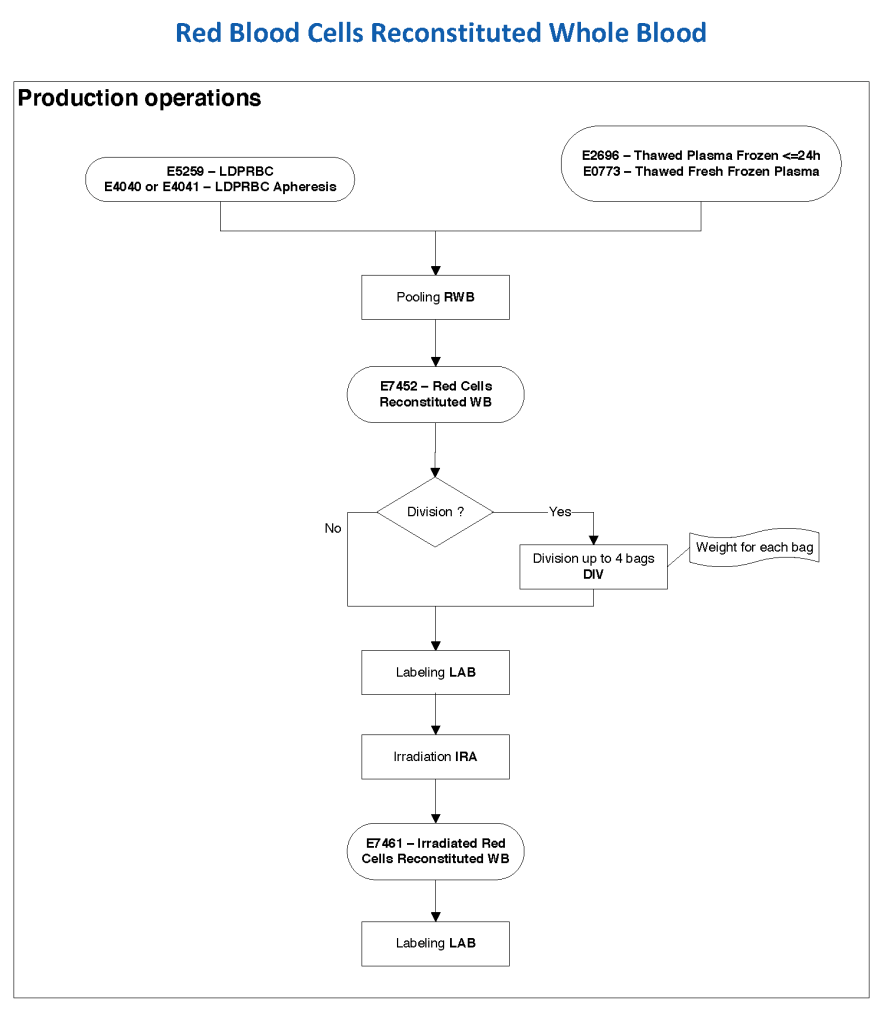
In Medinfo, we took a fresh (<= 14 day old) packed RBC in SAGM, group O, Rh-compatible and mixed it with a unit of group AB plasma—the desired hematocrit could be achieved by adjusting the amount thawed plasma that we added.  The product could then be aliquoted and irradiated.  Note that I medically chose to use either FP24 or FFP.

Here is the Medinfo process:

19/9/20