My Ten Years of Experience with Mirasol

I originally adopted this technology because of the plethora of new emerging pathogens.  In addition, I have been concerned about unknown pathogens that have not yet been discovered.  It is not what we know, it is what we don’t know that bothered me.

It is now 10 years since I started using riboflavin-based pathogen inactivation.  Our adoption of the technology was as follows:

  • 2010 pooled buffy coat and apheresis platelets, both suspended in plasma
  • 2012 whole-blood derived plasma and apheresis plasma
  • 2015 pooled buffy coat and apheresis platelets, both suspended in platelet additive solution PAS

Buffy coat platelet pools and whole-blood-derived plasma were both prepared with automated blood component technology, originally with the Terumo Atreus and later with Terumo Reveos system.  We were the first site worldwide to use automated production with the Mirasol system.

After 10 years and over 300,000 donor collections, no documented infectious agent transmission has been noted.  Our average platelet loss has been 4%.  There has been no increase in adverse reactions to plasma or platelets compared the time before we adopted these technologies.  Physicians accepted the products readily.

Mirasol adoption allowed us to discontinue irradiation of platelets and extend our outdate to 7 days.  We did not need a specific bacterial detection system.  Pending regulations in the USA will require stringent bacterial detection processes that are not necessary if a pathogen-inactivation system is being used.

Terumo sent its own engineers to set up and validate the system.  They also trained all the staff in the actual pathogen-inactivation processes and helped us to perform the validations.

When adopting pathogen inactivation, we compared Mirasol with its competitor and selected it for the following reasons:

  • Loss of platelets is low (about 4%)—lower than its competitor product.
  • There is no need to remove the riboflavin from the final product.

In our system, our goal was rapid processing of units.   With Mirasol, we did not have remove the riboflavin from the final product.  The competitor product requires at least 6 hours post-treatment to remove the psoralen agent.  We could immediately use the Mirasol product after treatment!

In our Reveos-Mirasol system, we can process whole blood into packed red cells in SAGM, buffy coat platelets, and plasma in a total of 5 hours including all testing with Mirasol treatment and platelet additive solution PAS.

We originally used the system manually, but in 2013, Terumo in conjunction with Medinfo Hematos IIG developed an interface to the Mirasol illuminator.  The latter device would transmit the successful completion of the illumination to the software.  Any errors in the illumination would block release of the blood component from Medinfo.  Medinfo also monitored the component volumes to prevent treatment of units outside Terumo’s recommendation ranges.

Adoption of platelet additive solution PAS gives us a final product with minimal residual plasma which potentially can reduce plasma reactions and TRALI/TACO.  It also minimizes our need to reduce the volume of platelet components for pediatric patients, especially in cases with ABO-incompatible plasma

Adopting any system of pathogen inactivation requires meticulous monitoring of component volumes to ensure they are within the range for the treatment.  The use of a blood bank software greatly facilitates this.

We make both buffy coat and apheresis platelets. The change from plasma-suspended to PAS-suspended platelets went smoothly.  Special training for Trima apheresis staff to use the new processes was provided by Terumo.

Throughout this time interval, Terumo has provided excellent technical support and educational activities for all staff.  Despite the COVID pandemic, Terumo has been able to deliver supplies to meet our needs so there was no interruption in production.

We started COVID convalescent plasma CCP production at the end of winter 2020.  We set up a parallel but separate quarantine system of collection and processing, originally manual but later controlled by the dedicated blood bank software Medinfo Hematos IIG.  All CCP units have been treated with Mirasol.

In the future, I hope Mirasol will close the loop by providing a pathogen-inactivation process for red blood cells so all components can be treated.  The CE mark for pathogen inactivation of whole blood is exciting and I hope that component preparation from this product will be offered.

In summary, our blood bank system had an excellent, synergistic relationship with Terumo and Medinfo to provide the highest quality product that is currently licensed.  I hope we will all continue to work together to improve the patient care.
Operational Effects of the COVID Pandemic–My Experience in Qatar

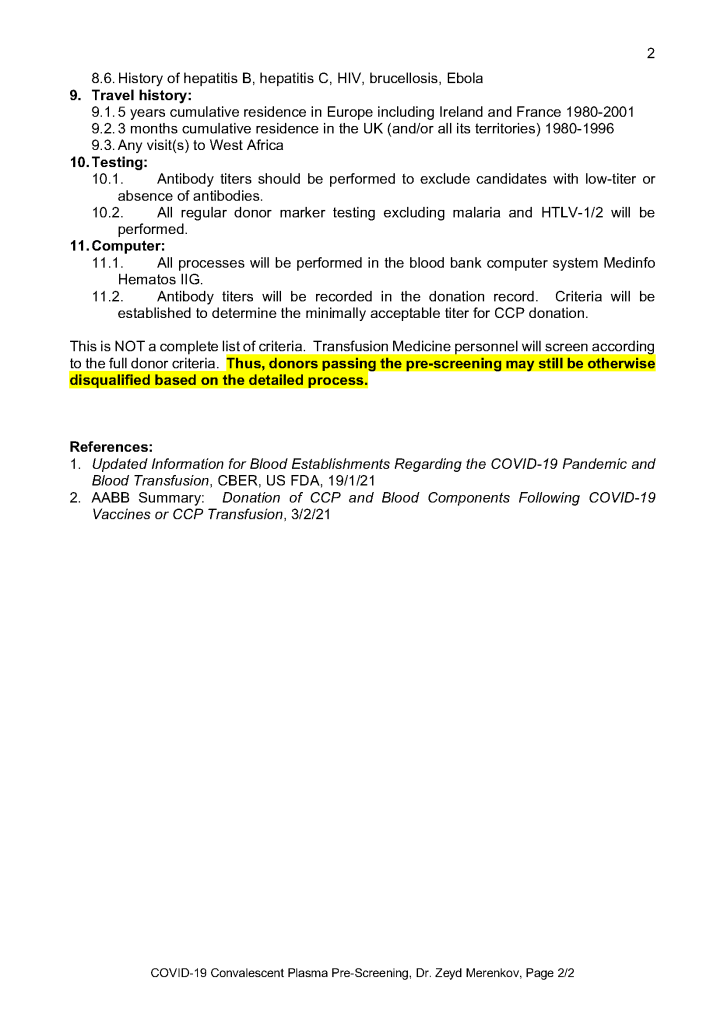
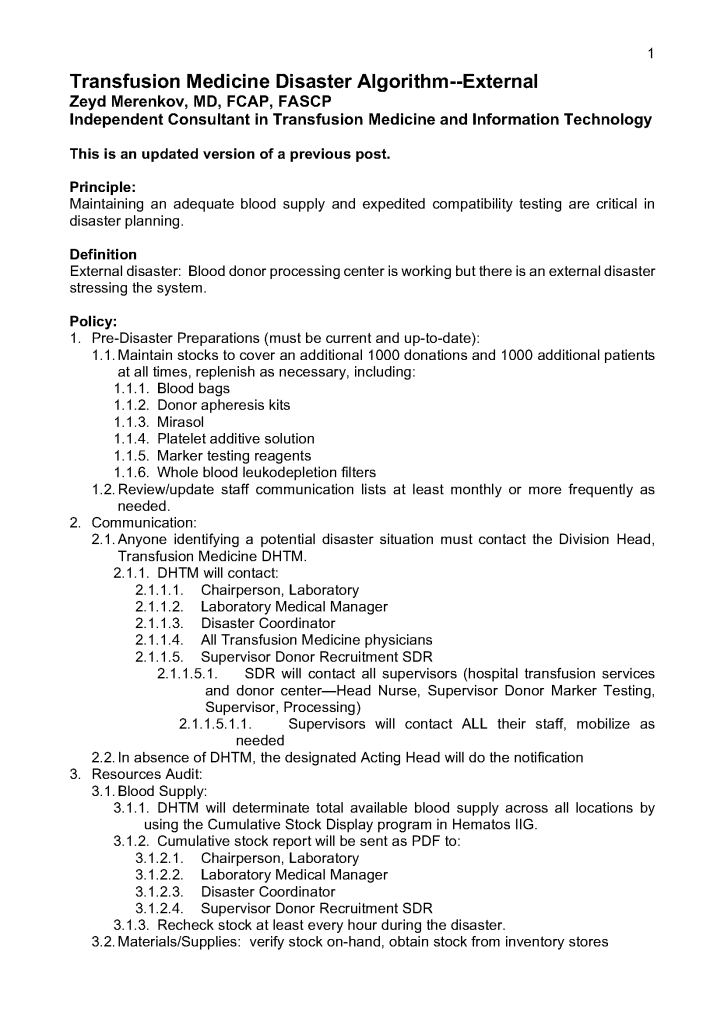
The COVID-19 pandemic imposed new challenges to our system.  In general, these could be divided into:

  1. Decreased donors
  2. COVID vaccine effects
  3. Decreased available staff
  4. Shortages of supplies
  5. More demands on donor apheresis staff—CCP
  6. More demands on donor processing staff—CCP
  7. More demands on hospital transfusion service/blood bank staff—CCP

There were fewer donors in the early phase and the nurses also had to add a large number of donor plasmapheresis collections for COVID convalescent plasma CCP.  Still they had to maintain all donor and therapeutic apheresis services with no increase in staff.  Although elective procedures had been cancelled, there were still obstetrical, oncologic, and trauma services in full action.

Many of our staff were on leave when the borders were closed.  Some had to wait months before they could return to work.  Others had COVID-19 infection and were quarantined for several weeks.  This further reduced staffing.  We could not just hire outside staff since considerable training is involved in these processes.

I dedicated a separate donor collection space for the CCP program away from the regular donors as well as a quarantine processing area.  Similarly, the CCP plasma was kept segregated from the regular plasma supply and a specially designed location was identified for release of this product.  Working for this program diverted resources from blood collection to this special project, again without increasing resources.

With disruptions to shipments of supplies, including the Reveos whole blood kits and Trima donor apheresis sets, we had to rely on our large in-home inventory until the situation stabilized.  We prescreened the CCP donor candidates before we would collect them to avoid wastage of kits.

Fortunately, our throughput was minimally affected because our equipment and processes had always stressed speed.  We used single-well NAT testing to minimize the need of additional runs.  Also, we used Reveos automated component processing to greatly speed production (one Reveos can process four whole blood units in about 23 minutes or about 12 units in 75 minutes.)  One technologist could operate all 4 of our machines simultaneously and perform other tasks while the machines were working.

In the system I developed in Qatar, we could complete processing into components (RBCs, buffy coat platelet pools, leukodepleted plasma), all marker and immunohematology testing, leukoreduction of the pools and RBCs, Mirasol pathogen inactivation, and platelet additive solution in as little as five hours.

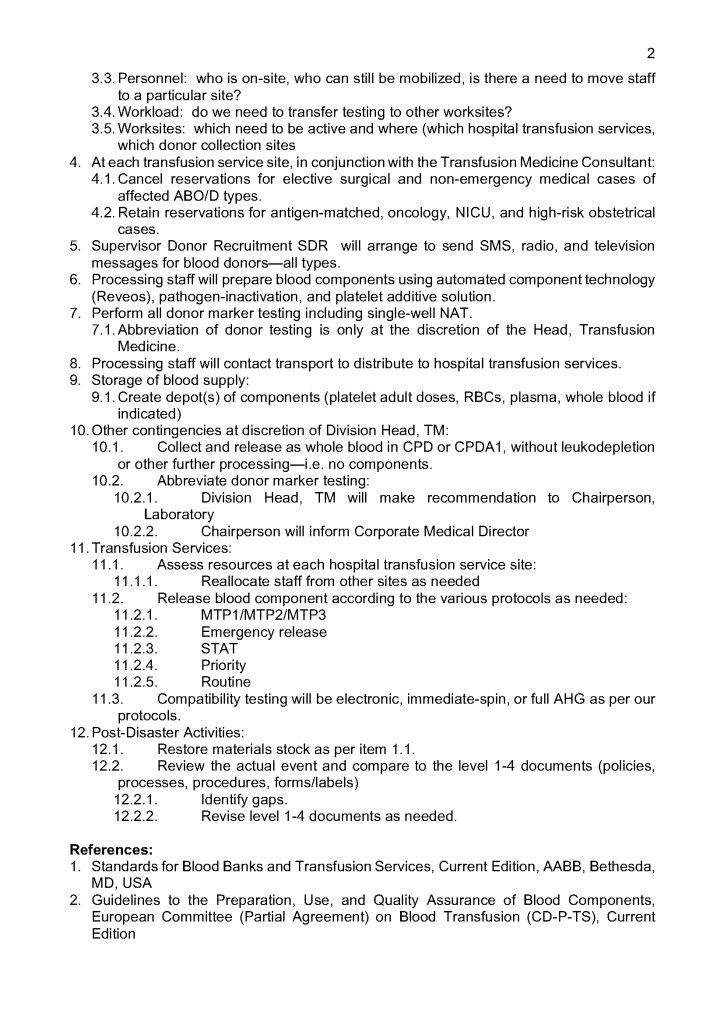
In rapid turn-around events, it is most helpful to have a robust blood bank computer system that can scale to the challenge.  Also, it must mercilessly enforce all the rules starting with donor qualification, screening, collection through testing and production.  At times of emergency, it is difficult to meet Good Manufacturing Processes manually.

I had built parallel separate donor collection, donor processing, and transfusion service/hospital blood bank processes specifically for CCP and had to staff them with available personnel, limited our capability to process regular donors.  The blood bank computer software restricted CCP use to designated physicians and transfusing locations.  For those interested, there is a separate series of posts about the CCP project and its implementation in the dedicated blood bank Medinfo HIIG.

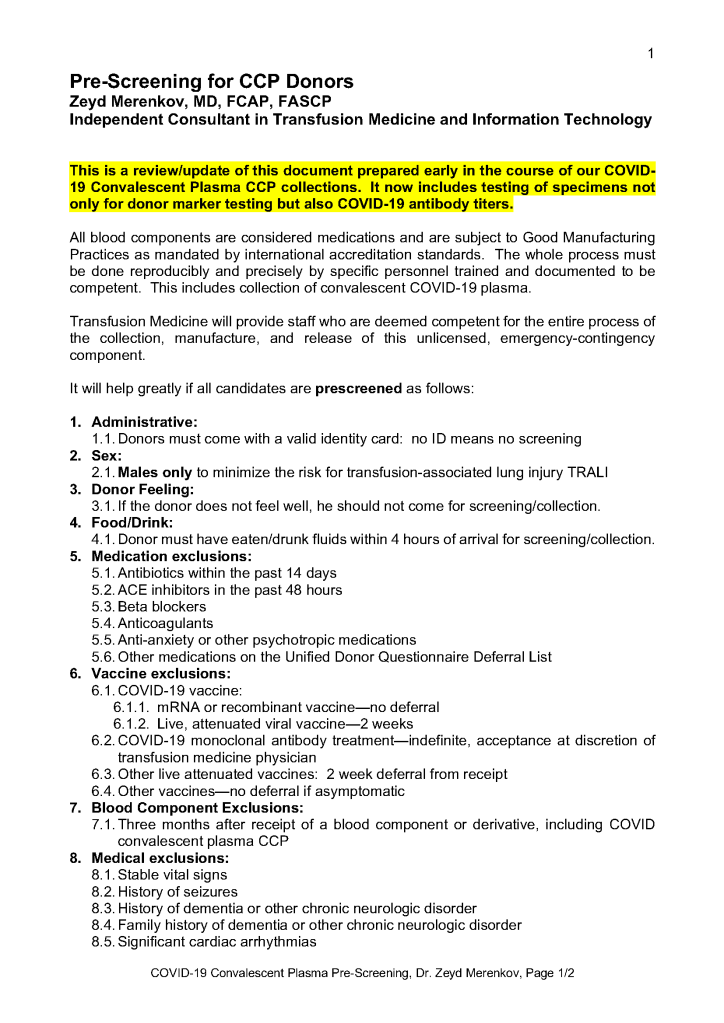
COVID-19 vaccinations should have minimal effect in donor qualification since mRNA or antigen-based ones do not cause donor deferral.  Live attenuated COVID vaccines will defer donors for 2 weeks by current rules—the same as other live vaccines.  Donors who had previously received CCP will be deferred for three (3) months after last receiving this product.

In summary, the COVID pandemic reduced staffing and affected donor recruitment.  We had production mitigations to maximize throughput.  The system was stressed by the reduced staffing and special demands to produce CCP.  However, the extent of our automation allowed us to maintain throughput throughout the crisis.

Blood Component Transport Temperature Monitoring

Principle:

Blood components must be maintained at specified temperatures to avoid hemolysis, bacterial contamination, and maintain full efficacy (e.g. coagulation factor activity.)

Policy:

  1. Freshly collected whole blood for blood component preparation must be kept between 20-24C if  platelets are to be made.  Otherwise, it must be maintained between 1 and 10 C.
  2. Prepared RBCs and thawed plasma must be transported between 1 and 10 C.
  3. Platelets (pools and apheresis), thawed cryoprecipitate, and granulocyte concentrate must be transported at 20-24 C.
  4. Frozen components (frozen RBCs, FFP, FP24, cryoprecipitate) must be kept frozen during transport.
  5. There must be an appropriate means of documenting that the proper temperature was maintained.  Examples of compliance may include:
    1. LCD stickers that change color if the component goes outside the selected temperature range.
    2. Digital temperature recording systems—Examples:
      1. TempTale ® or other temperature recording devices (added to a transport container without a temperature-controlled container)
      2. Temperature controlled transport containers with integral recording systems
      3. The recording session for each transport episode should be downloaded, reviewed and saved.
  6. If the temperature goes outside the specified temperature range, the components cannot be used for transfusion or manufacture.
  7. All devices must be validated to meet their specified temperature-recording capabilities before being used.
  8. Specific SOPs for the use of the selected monitoring devices must be prepared and in use.

Note the different temperature ranges for refrigerated components stored in the blood bank (1-6C) versus transport (1-10C).

References:

Section 5.6.5, Standards for Blood Banks and Transfusion Services, Current Edition, AABB, Bethesda, MD, USA

SARS-CoV-2 Antibody for CCP in Medinfo Hematos IIG

When I started my COVID-19 convalescent plasma CCP collection in early March, 2020, there were few antibody tests available.  However, I anticipated that eventually we would want to include antibody results with the donor record.  Antibody results were not used originally at all in the criteria for CCP acceptability for release.

There are many assays by type of antibody (total, IgG, IgA, IgM) and quantitation by titer and/or signal-cutoff ration S/CO.  Any of these parameters may be used to define rules for acceptability to complete production and/or allocate to patients.  Instrumentation used for titering/quantitation may be interfaced to the blood bank software.

Here is my generic approach to including these results with the donation record.  In Medinfo HIIG, it is possible enter test results retrospectively and these can be used set rules for acceptability.  Please consult with my detailed post on using rules against parameters.

All of this is easily implemented since all test information will be stored as parameters.  From these parameters we can construct rules for:

  • Low titer CCP
  • High titer CCP
  • Acceptability for patient allocation

Also, one can override the rules if the clinician and the transfusion medicine physician agree.  For example, there is a severe shortage of group B CCP so use of low-COVID-antibody titer group B CCP could be allowed.

The key is to build whatever test methodology you use and include the manufacturer’s cutoff for low versus high titer interpretation.  These results can be printed on the ISBT label as well.  One can easily build multiple methodologies and acceptability criteria if different tests are used at different testing sites in your system—just as can be done for other tests (ABO/D, antibody screen, etc.)  If one changes methodologies in the future, Medinfo will still use the same rules that applied for the day of production.

Here are some sample test rules:

Example 1:  Total COVID antibody > 160 is high titer:

  • If antibody >= 160, label as high-titer CCP and use for patient allocation.
  • If antibody < 160, label as low-titer, physician must override for patient allocation

Example 2:  IgG antibody with S/CO ratio > 12 is high-titer:

  • If S/CO >= 12 label as high-titer CCP and use for patient allocation.
  • If S/CO < 12, label as low-titer and discard.

Example 3:  IgG and IgM antibodies must have S/CO > 12:

  • If BOTH IgG and IgM antibody measurements have S/CO >12, use for patient allocation.
  • Otherwise, discard unit.

Another option would be just to record the quantitation for each antibody type and list this on the ISBT label and permit its release regardless of the value.  One could also permit low-anti-B titer group A plasma with whatever rules you set up.

Opinion: Software Permissions for Blood Bank Staff

In my career, I have worked with many different hospital and laboratory computer systems.  One of my greatest frustrations has been providing software permissions to staff at all levels, from clerical, nursing, technical, and medical—inside and outside the blood bank.

The software permissions that I am specifically referring to are those with the blood bank software.  These I directly controlled as Division Head of Transfusion Medicine and Laboratory Information Systems.  I am not talking about virtual private networks or Citrix or cloud-based software controlled by the hospital IT department.

Here are some examples of inappropriate permissions:

  • All staff share the same access, regardless of position or department
  • Technical staff, including non-blood bank staff have global access to all functions
  • Non-blood bank staff can modify test results or comments

The golden rule is to only give access that is needed for each staff’s job designation.  Staff must sign an agreement not to access the system except for work and not release anything to non-designated personnel.

I recommend separating privileges by:

  • Blood bank vs non-blood bank staff
  • Blood bank section and location
  • Technical privileges by rank:  trainee vs base technologist vs senior technologist vs supervisor vs technical director
  • Medical privileges by rank:  residents/fellows, junior medical staff, senior staff, head of sections/directors

Permissions within a test category may include test ordering, result entry, verification/authorization, and/or purging.  In the donor center, it may include registration, donor qualification, collection, donor marker testing, donor immunohematology, component processing, component modification, and/or inter-depot transfer of components.  Management tools included in the software may also be restricted to high-level staff.

In this time of COVID and staffing shortages, we may be training new staff to work in the blood bank.  During their training, these trainees can be competency assessed and be given access to limited functions.  In Medinfo Hematos IIG, you can give staff custom permissions test-by-test so for example, if they are deemed competent for ABO/D typing, you could restrict their access to only those tests as an interim measure.

Having customized access for each employee can be nightmare for the systems administrators so this granular special access must be kept to a minimum.  However, it is good to know that you do have this capability if needed.

Universal Low-Titer Group O Whole Blood

Principle:

Fresh group O whole blood has viable platelets, plasma, and RBCs.  Fresh whole blood may provide better resuscitation than individual components.  It can replace MTP component therapy of separate RBCs, plasma, and platelets.  We will use low ABO-titer whole blood units (here called O universal OU) in selected trauma cases, based on availability.

Testing for low-titer (both low-titer anti-A and anti-B) units is time-consuming and monopolizes the automated immunohematology analyzers.  This is the rate-limiting step.

Policy:

  1. Stock a limited number of OU whole bloods at the trauma/emergency room sites—based on inventory needs.
  2. Allow up to 2 doses (2 OU units/patient) before reverting to the MTP protocol.
  3. Prepare allocation rules to allow group OU whole blood and group O RBCs to be used for ALL ABO types except Oh, Ah, Bh.
  4. Medinfo Hematos IIG will use the new allocation rules for OU in emergency release situations only.  It will not be allowed for routine use.

References:

  1. Technical Manual, Current Edition, Bethesda, MD, USA
  2. Standards for Blood Banks and Transfusion Services Current Edition, AABB, Bethesda, MD, USA

Setting Up Universal Low-Titer Group O Whole Blood

This post outlines a framework for establishing the use of universal group O whole blood.  Manual titering large number of donor specimens in my organization is not precise.  Using an automated system will also increase the precision of the results.  The rate-limiting step is the ability to do the anti-A and anti-B titers.

Process:

  1. Select cut-offs for anti-A anti-B titer.  This should be determined by the blood bank medical director.
    1. I recommend saline 1:64 for both titers based on recent THOR (Thrombosis Hemostasis Oxygenation Research) meetings
  2. Assess availability of automated immunohematology analyzers for titration.
    1. Titration may take up to 30 minutes per sample, during which time the machine cannot be used for any other purpose.
  3. Perform a survey of the anti-A and anti-B titers in your blood donor population.
    1. At my sites, about 50% had titers less than or equal to 1:64.
    2. Determine how stable the titer is:
      1. Does the titer change between whole blood donations?
  4. Prepare as follows:
    1. Collect whole blood units in CPD.
    2. Filter with a platelet-sparing whole blood leukodepletion filter.
  5. Add a new blood type OU (for group O whole blood universal) for plasma in your blood typing algorithm.
  6. Establish new allocation rules to permit group OU whole blood for all ABO types.
  7. Software:
    1. Set up new truth table in your blood bank computer system.
    2. Validate the modification in your blood bank donor and patient modules.
    3. Update ISBT code for this new product, verify your transfusion service module can read this.
  8. Determine the target inventory level for universal plasma (group AB and low-titer A) based on current/past usage.
    1. I started with a trial of a small inventory of 8 units to cover 4 patients each receiving a maximum of 2 units at one trauma site.
    2. Consider a dose of two as equivalent to an MTP dose in an adult.
    3. If more than 2 units  are needed, revert to the MTP protocol.

Special notes:

  1. At my last location, we had only 3 analyzers capable of doing the titration.  Thus, we could only do 6 titrations per hour at the expense of stopping all other testing.  You will have to coordinate the titration with your other immunohematology testing.  Also, you must verify if all these equipment can interface to your production software.  In my system, any test (including titration) could be performed at any location and its results be used for production purposes.
  2. Donor ABO antibody titers may fluctuate.  I would not use previous results to qualify a donor to be OU.  I would repeat the anti-A and anti-B titer each donor encounter.

References:

  1. Technical Manual, Current Edition, Bethesda, MD, USA
  2. Standards for Blood Banks and Transfusion Services Current Edition, AABB, Bethesda, MD, USA
  3. Medinfo Hematos IIG Donor Production Module