
Syphilis and Gonorrhea Donor Deferrals

Principle:

Syphilis, caused by the spirochete Treponema pallidum (T. pallidum), is most often acquired after sexual contact with an infected individual.  Syphilis can also be transmitted from mother to child or, rarely, transmitted by transfusion of blood or blood components from donors with active syphilis.

There are two different types of serologic assays for syphilis:  nontreponemal assays and treponemal assays:

Nontreponemal assays (e.g. VDRL, RPR, ART) are nonspecific and detect “reagin” antibodies directed against an antigen called cardiolipin that is present in a variety of tissues.  Antibodies to cardiolipin appear in the serum of persons with active syphilis or with other medical conditions. However, some individuals who were previously infected with syphilis but successfully treated maintain low levels of antibody to cardiolipin for a long time.

Treponemal assays include enzyme immunoassays (EIA), fluorescent treponemal antibody “absorbed” assays (FTA-ABS), Treponema pallidum microhemagglutination assays (MHA-TPA) and Treponema pallidum particle agglutination assays (TP-PA).  Treponemal assays test for antibodies to antigens that are specific to treponemes.  Treponemal assays are most useful in identifying recent and past syphilis infections.  They are not generally useful in monitoring the response to antibiotic therapy.  With some exceptions, positive results of tests for specific treponemal antibodies remain positive throughout an individual’s life regardless of whether the individual is currently infected or has been cured following successful treatment.  Retesting sera that are reactive in nontreponemal assays using a specific treponemal test is valuable in distinguishing true-positive results that indicate active syphilis infection from biological false-positive results due to other conditions.

Current testing requirements for syphilis are found in 21 CFR 610.40(a)(2).  Individuals who test reactive with a screening test for syphilis must be deferred (21 CFR 610.41(a)) and notified of their deferral (21 CFR 630.40).  You must further test each donation found to be reactive by a donor screening test, except you are not required to perform further testing of a donation found to be reactive by a treponemal screening test for syphilis

Policy:

  1. Assess donors for a history of syphilis or gonorrhea or treatment for syphilis or gonorrhea in the past 3 months.
  2. Defer for 3 months after completion of treatment, an individual with a history of syphilis or gonorrhea or treatment for syphilis or gonorrhea in the past 3 months.
  3. After this 3-month period, the individual may be eligible to donate provided the individual meets all donor eligibility criteria.
  4. Testing and Management if a nontreponemal assay is used to screen for syphilis:
    1. If the nontreponemal screening test is nonreactive, the donor is considered to be negative for syphilis infection.  You may use the donation, provided it meets all other donation suitability requirements
    2. If the nontreponemal screening test is reactive, you must defer the donor indefinitely unless evaluated for reentry.
    3. Reentry from reactive nontreponemal test:
      1. Perform testing using a treponemal assay:
        1. If treponemal assay is negative, then reenter donor.
        2. If treponemal assay is positive, consider as an indefinite deferral.
      2. You may reenter the donor if the donor subsequently reports being treated for syphilis, provided that the treatment was successful and completed at least 3 months before the next donation; and the donor meets all donor eligibility criteria.
      3. Alternatively, the donor may be reentered without treatment if your responsible physician determines that the donor never had syphilis based on subsequent medical evaluation and diagnostic testing for syphilis (i.e., the screening results were falsely positive), and the donor meets all donor eligibility criteria.
      4. You may use either an FDA-cleared nontreponemal screening test or an FDA-cleared treponemal screening test to test the reentered donor’s subsequent donations.
      5. The donor remains indefinitely deferred if the donor was not treated for syphilis or was not medically evaluated for reentry.
  5. Testing and Management if a treponemal assay is used to screen for syphilis:
    1. If the treponemal screening test is nonreactive, the donor is considered to be negative for syphilis infection and you may release the donation, provided it meets all donation suitability requirements, and retain the donor.
    2. If the treponemal screening test is reactive, further testing is not required, and you must defer the donor indefinitely unless evaluated for reentry.
    3. Reentry if a reactive treponemal assay is used to screen for syphilis:
      1. Perform another treponemal screening test that is different from the initial treponemal screening test used.
      2. If negative, reenter the donor.
      3. If positive, defer the donor indefinitely unless the following applies:
        1. Test the sample from the donor which was positive on the additional treponemal screening test using a nontreponemal screening test to assess whether the donor has an active infection.
          1. If the nontreponemal screening test result is negative, the results are consistent with recovery or cure from a previous syphilis infection.
          2.  If the nontreponemal screening test is positive, the results are consistent with an active or recently treated syphilis infection.
          3. In either case, you may reenter the donor if the donor subsequently reports being treated for syphilis, provided the treatment was successful and completed at least 3 months before the next donation; and the donor meets all donor eligibility criteria.
        2. Alternatively, the donor may be reentered if your responsible physician determines that the donor never had syphilis based on subsequent medical evaluation and diagnostic testing for syphilis (i.e., previous test results were falsely positive), and the donor meets all donor eligibility criteria.
        3. You may use either a nontreponemal screening test or a treponemal screening test that has been cleared by FDA for such intended use to test the reentered donor’s subsequent donations.
        4. The donor remains indefinitely deferred if the donor was not treated for syphilis or was not medically evaluated for reentry.

Reference:

Recommendations for Screening, Testing and Management of Blood Donors and Blood and Blood Components Based on Screening Tests for Syphilis—Guidance for Industry,  U.S. Department of Health and Human Services Food and Drug Administration Center for Biologics Evaluation and Research CBER,  December, 2020

New US CBER Guidance for Syphilis and Gonorrhea: December 2020

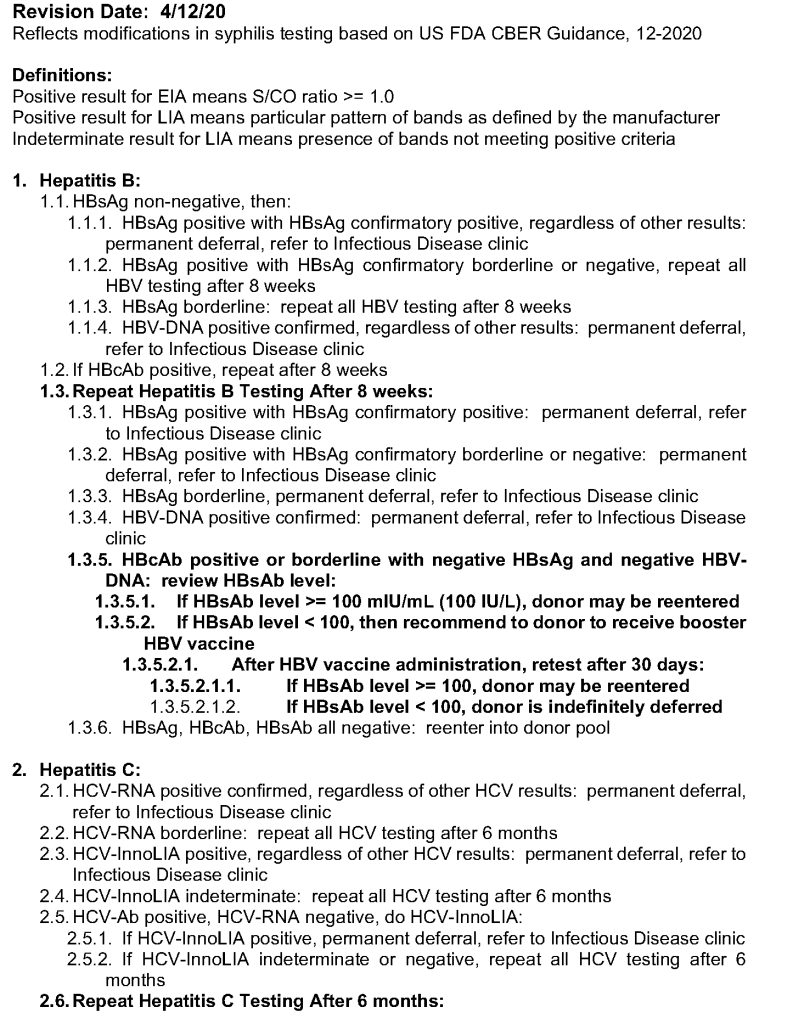
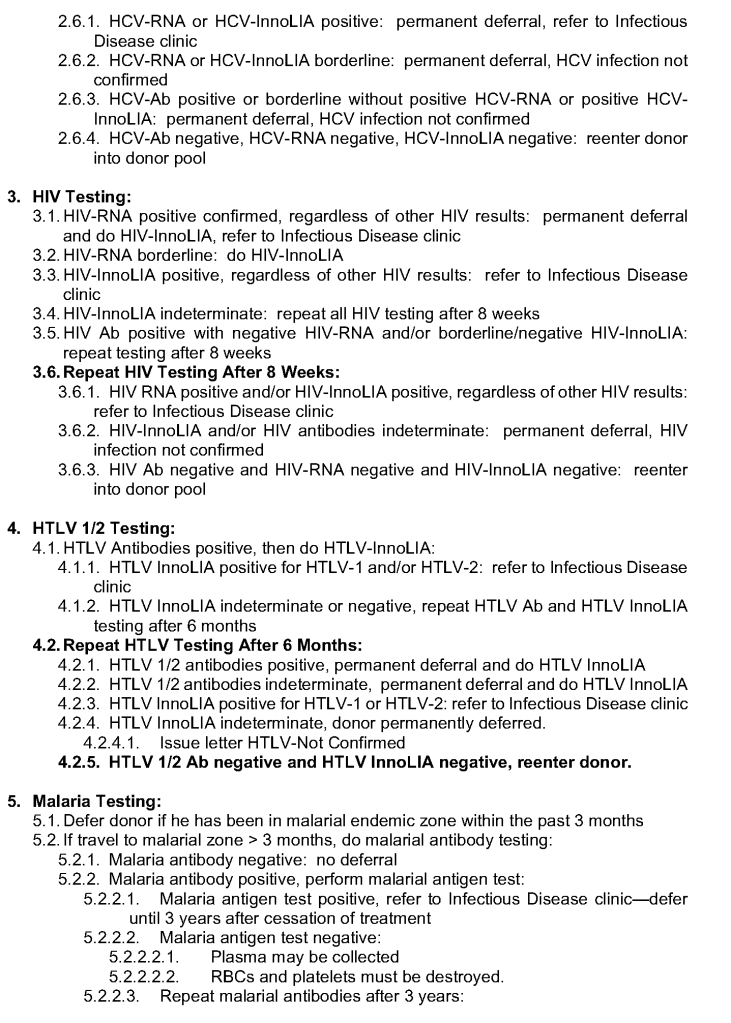
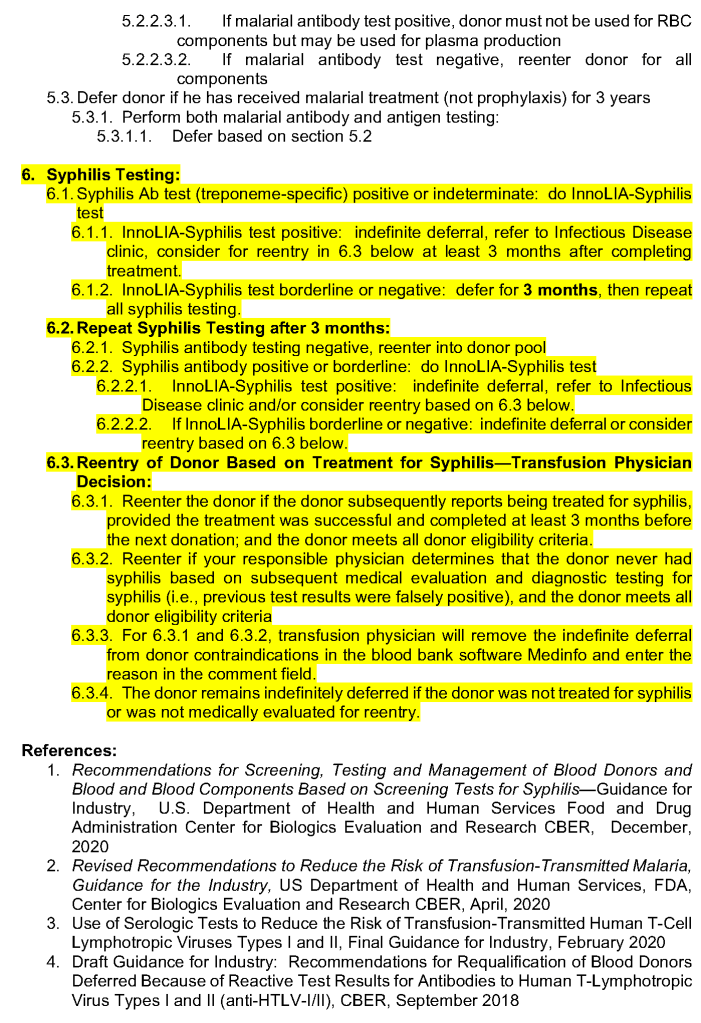
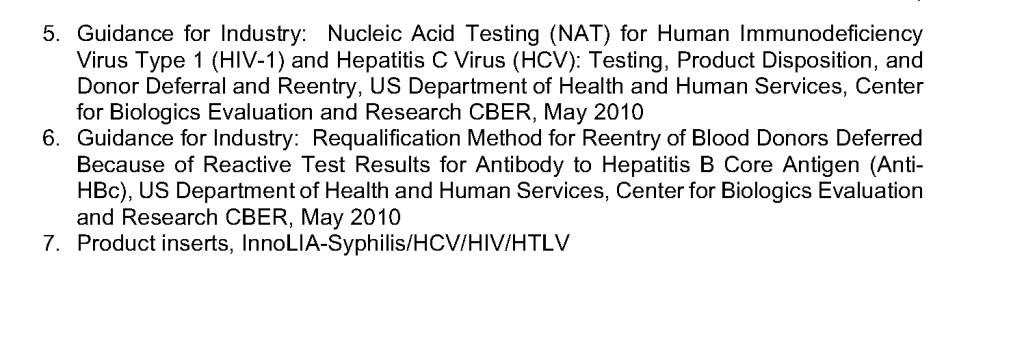
This is non-binding CBER guidance is a complicated algorithm that involves using treponemal and non-treponemal assays.  Re-entry pathway options are also provided.  I will be posting a summary and its implementation into my previous donor marker testing algorithms. Please see attached PDF link.

CBER Guidance Syphilis and Gonorrhea, December 2020

Logistics and Processes for a COVID-19 Convalescent Plasma Program

I prepared the following plan for a CCP program for HMC Qatar in March, 2020.  The workflow is divided into four (4) modules:

  1. Registration/Interview/Physical Examination/Apheresis Collection
  2. Donor Marker Testing and Immunohematology Testing
  3. Production/Aliquoting/Pathogen-Inactivation/Storage
  4. Product Thawing/Product Release

Module 1:

  1. Collection/registration/screening must be in a separate area from regular blood and apheresis donations.
  2. Donors must provide consent.
  3. ISBT specimen labels must be used on each tube collected.
  4. We need a minimum of two apheresis nurses, one for the registration/screening/post-donation observation and one for the actual apheresis procedure.
  5. If there will be multiple serial donors, then we need a waiting area (each donor at least 2 meters apart).
  6. Donor screening must be in sound-proof area so that other waiting donors cannot hear the interview/questionnaire process.
  7. Amount that can be collected depends on body weight:  500 ml for <80 kg and 600 ml for >= 80 kg, collection may occur twice per week
  8. Collection time includes 15 minutes for registration/interview/physical examination, 60-75 minutes and 15 minutes for cleanup/disinfection before the next case, approximately 2 hours per donation.
  9. A post-donation observation area (minimum 15 minutes after collection) with apheresis nurse nearby in case of reactions is needed if there will be multiple donors.
  10. Specimens will

Module 2:

  1. Donor testing and donor immunohematology will be done with other donor specimens in our regular location

Module 3:

  1. Apheresis collection must be processed and stored separately from regular blood/apheresis donations.
  2. Processing will occur only after the results are shown to meet all criteria.
  3. Pre-collection testing (test-only donation) would permit processing without waiting for results.
  4. Storage at minus 80C may be for a minimum of six (6) years but this may be extended if needed.
  5. All acceptable components will have a final ISBT label—no products without the ISBT label will be transfused.  The ISBT label indicates that the unit meets all donor criteria for convalescent plasma.

Module 4:

  1. Product modification (thawing) and release (sign out from blood bank) must be in a separate area(s) from the regular hospital blood bank.
  2. Release of convalescent plasma follows the same process as regular component release
  3. Transfusion of convalescent plasma at the patient’s bedside follows same process as regular component transfusion
  4. Nursing and other staff performing the transfusion must pass competency assessment.
  5. Plasma will be transfused as ABO-identical or compatible unless low ABO-titer group A is used.
  6. Plasma must be free of clinically significant antibodies

Workflow Considerations:

  1. Donors must be restricted to the waiting, collection, or post-donation observation areas.
  2. Donors must NOT pass through production, testing, or component release areas (just as they are currently restricted in the Blood Donor Center and HMC hospital blood banks/transfusion services).

Logistics:

  1. Throughput is a maximum of 4 donors (2000 to 2400 ml plasma) per eight-hour shift with one apheresis nurse and one donor apheresis (Trima) machine.
  2. The processes are scalable with additional staff and machines (e.g. with 3 machines and nurses, then 12 donors and 6000 to 7200 ml of plasma collected).
  3. Thawing of 1-2 units of plasma takes up to one hour.  Contact the quarantine blood bank at least one hour before the desired pick-up time.
  4. The four modules above can be in separate areas not adjacent to one another.  Modules 1, 3, and 4 must be quarantine areas where access is limited.  Module 2 can be performed with regular donor specimens using standard precautions.
  5. We can provide training for transfusion of blood components and competency assessment to any location transfusing this product.

Information Technology:

  1. All modules will be connected to the Medinfo Hematos IIG dedicated blood bank computer system.
  2. All records of collection/production/testing/storage/modification/release will be stored therein.
  3. All ordering of convalescent plasma components will be through Medinfo.
  4. External test results (e.g. future antibody titering) can be added to the component information.
  5. Links to the Hospital Information System (Cerner) may be considered after the Medinfo processes are fully functional.

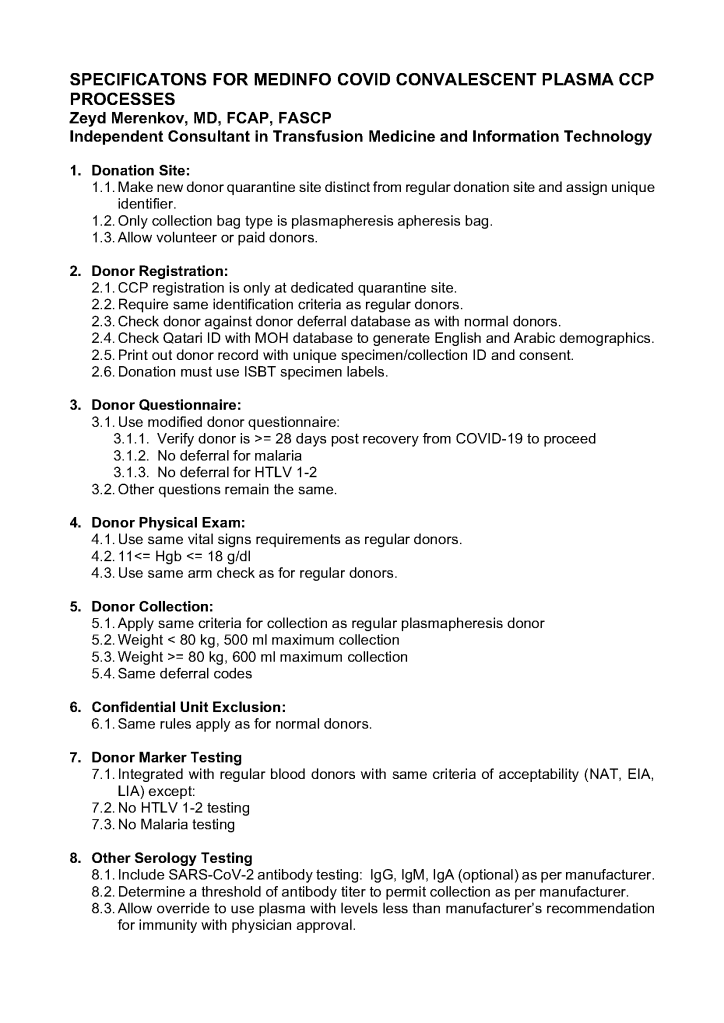
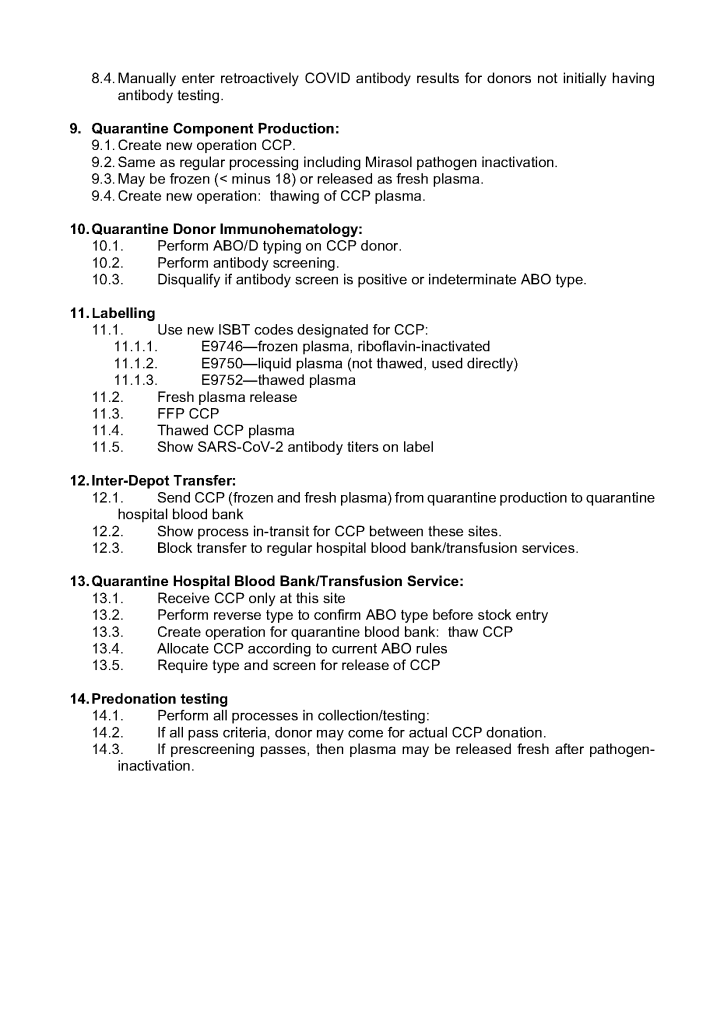
Medinfo COVID Convalescent Plasma Workflow Revisited

It now has been over eight 8 months since I prepared the CCP workflow in Medinfo.  It was built on the framework of the manual CCP process including donor prescreening with an abbreviated donor questionnaire.  It was really quite simple and used the donor and patient modules to create quarantine areas for donor screening, collection, processing, and hospital patient blood bank release.

Here are my current comments on the process:

Donor Qualification:

I would still exclude malaria and HTLV from the donor questionnaire and would update to UDQ 2.1.  Since these donors have recovered from a potentially life-threatening illness, I would keep the Hgb threshold at 11 g/dl.

Donor Collection:

In the future, I would consider using one of the soon-to-be-released portable devices that continuously monitor vital signs with pO2 and EKG lead to rule out asymptomatic pulmonary or cardiac problems.

I would also consider using low-ABO-titer, group A, universally to meet the demand for group B and AB patients.

Donor Testing:

There is still no need to segregate and separately test CCP donor specimens from regular blood donor specimens.  I would perform SARS-CoV-2 antibody testing and set a threshold for qualifying donors—that threshold will be based on the manufacturer’s recommendations.  However, if the treating physician wanted to use a low-titer unit, I would permit this.

Donor Processing:

There is no need to change this from the current processes.  Keep the CCP processing separate from the regular operations.

CCP Plasma Release:

I would keep the quarantine release and restrict it to the locations used for treating COVID-19 patients

Medinfo Software Modifications:

I would record the IgG and IgM titers for SARS-CoV-2 antibodies in each donation record.  This would include testing and entering the results on donations prior to this testing.  ISBT labels should include this antibody titer.

Hospital Information Software Modifications:

Set up restricted CCP ordering for the actual treating physicians only.  Also provide the ISBT code and shortened descriptors to it if necessary (certain HIS vendors still cannot read ISBT codes natively).

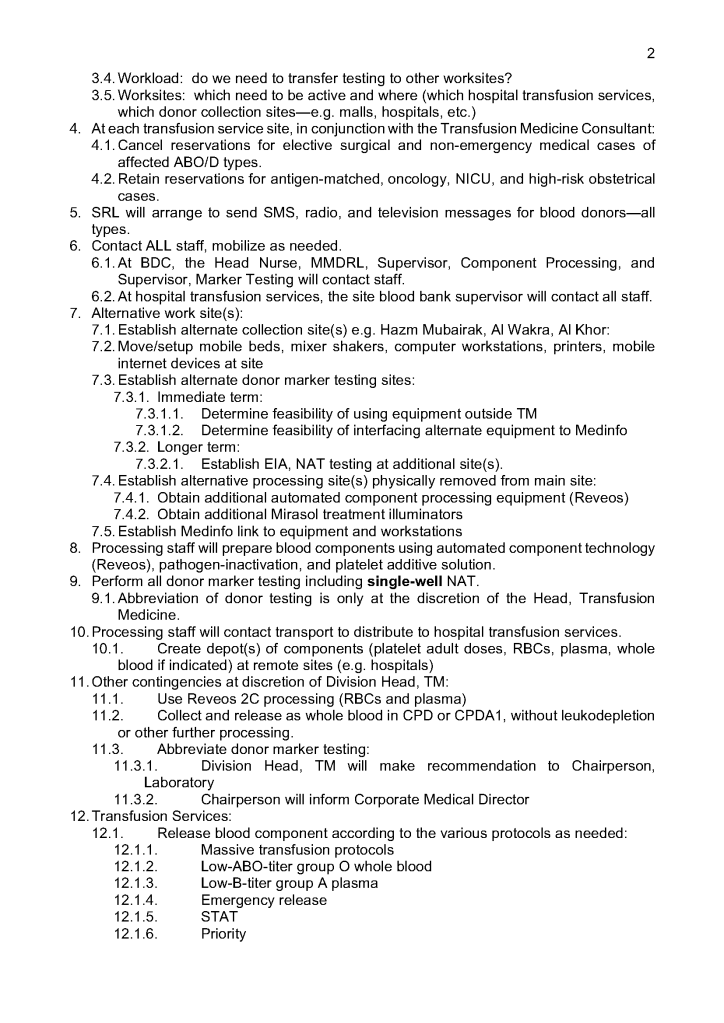
The original CCP workflow is attached for reference.
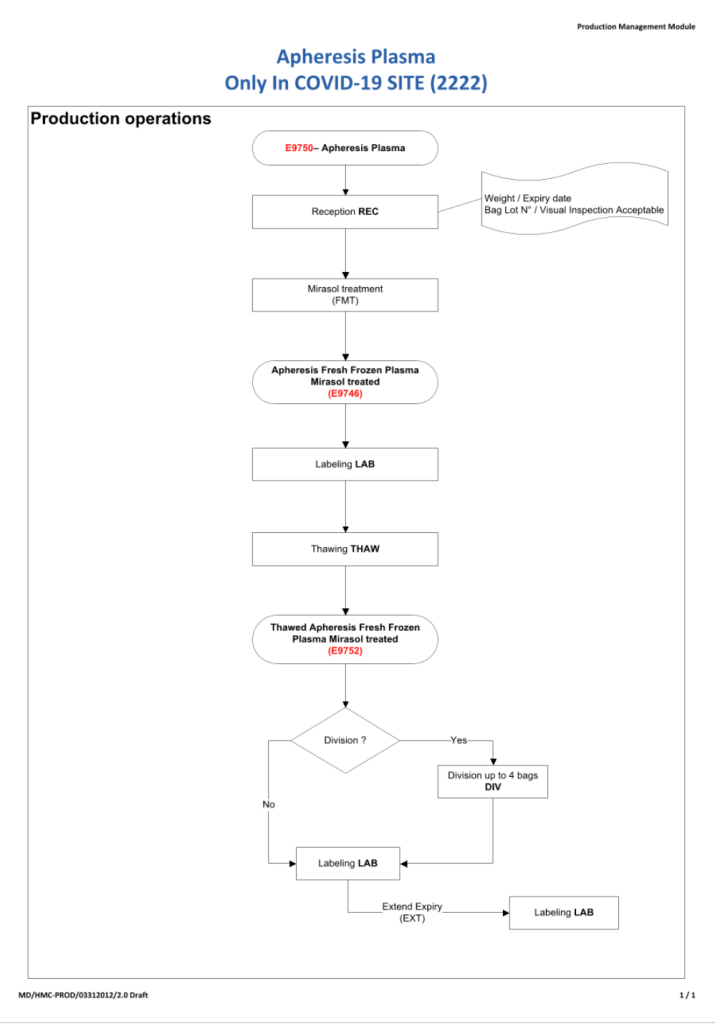
Manual Collection of COVID-19 Convalescent Plasma

This process was originally done in the first phase of CCP collection.  I have updated it to include SARS-CoV-2 antibody testing.

Principle:

Due to the pandemic, we will initially MANUALLY collect an experimental, investigational-use-only plasma product from apheresis donors and treat it with Mirasol.  THIS IS A EMERGENCY INTERIM PROCESS UNTIL THE MEDINFO HEMATOS IIG PROCESSES ARE PREPARED AND VALIDATED.

Policy:

  1. Good Manufacturing Practice applies:
    1. Manufacturers’ recommended processes for equipment and materials usage applies.
    1. All staff engaged in these processes must be competency assessed successfully.
  2. Pre-Screening:
    1. Clinical staff will use the prescreening document to select donors for pre-donation screening.
  3. Quarantine:
    1. All processes (day 0, day 1, day 2, and product modification and release) will be done in quarantine areas SEPARATE and DISTINCT from regular Transfusion Medicine activities.  This includes:
      1. Separate space and equipment must be provided.
        1. Equipment for this project may NOT be used for regular, non-quarantine processes
    2. Non-Transfusion Medicine staff will not be permitted in operational areas.
    3. Prospective donors will not be permitted in the processing, testing, storage, or blood bank work areas.
  4. Donation Process:
    1. Day 0:  Registration, check donor deferral database, questionnaire, physical exam including arm check, and specimen collection using ISBT specimen labels
    2. Use latest manual donor questionnaire.
    3. Day 1:  Donor marker and immunohematology testing, review of results, accept or reject donor for actual plasmapheresis
    4. Day 2:  Collect manufacturer’s recommended volume of plasma (500 ml if < 80 kg, 600 ml if >= 80 kg), aliquot, pathogen-inactivate (Mirasol), freeze at minus 80C
  5. Testing:
    1. Testing will be performed with regular blood donor specimens using ISBT specimen labels
    2. Testing must be done by donor-specific processes (not those for clinical patients)
      1. Exclude malaria and HTLV testing.
    3. Testing must be directly interfaced to Medinfo Hematos IIG donor module
    4. CCP COVID antibody testing:
      1. SARS-CoV-2 antibody testing to be performed to determine cut-off for donor eligibility for CCP collection.
      2. Use of donors with antibody levels below threshold is at the discretion of the treating clinician.
  6. Processing:
    1. Aliquoting, pathogen-inactivation, and labelling may proceed if the pre-donation screening results are acceptable.
  7. Storage:
    1. Long-term in minus 80C quarantine freezer
    2. Short-term at 1-6 C just after thawing in quarantine refrigerator
    3. Standard temperature monitoring and alarms apply
  8. Labelling:
    1. The backup manual labelling process applies
    2. The ISBT specimen label will the donor unit number
      1. Outdate will be 6 years if the product is stored at -65C, 1 year if stored at -18C
  9. Product Release:
    1. Orders must be on the PAPER requisition (old Blood Bank Order Form) with a patient prescription and signed by a physician designated to treat COVID patients.
      1. No orders in Cerner
    2. Thawing plasma at 37C upon receipt of order by Transfusion Medicine staff
    3. Signing out component to clinical unit by Transfusion Medicine Staff to locations treating COVID-19 patients.
  10. Information Technology:  Medinfo Hematos IIG customized software to be implemented as soon as possible for all processes
  11. Not covered:  Transfusion Medicine is NOT responsible for:
    1. Triage of request for convalescent plasma
    2. Pickup and transport of components

References:

  1. Level 1-4 documents for donation, testing, processing, and release of blood components
  2. COVID-19 Plasma Donor Prescreening Document, 8/4/20

COVID-19 Convalescent Plasma Donor Pre-Screening

All blood components are considered medications and are subject to Good Manufacturing Practices as mandated by international accreditation standards.  The whole process must be done reproducibly and precisely by specific personnel trained and documented to be competent.  This includes collection of convalescent COVID-19 plasma.

Transfusion Medicine will provide staff who are deemed competent for the entire process of the collection, manufacture, and release of this unlicensed, emergency-contingency component.

It will help greatly if all candidates are prescreened to exclude the following candidates:

  1. Administrative:
    1. Donors must come with a valid Qatari identity card:  no ID means no screening
  2. Sex:
    1. Males only to minimize the risk for transfusion-associated lung injury TRALI
  3. Donor Feeling:
    1. If the donor does not feel well, he should not come for screening/collection.
  4. Food/Drink:
    1. Donor must have eaten/drunk fluids within 4 hours of arrival for screening/collection.
  5. Medication exclusions:
    1. Antibiotics within the past 14 days
    2. ACE inhibitors in the past 48 hours
    3. Beta blockers
    4. Anticoagulants
    5. Anti-anxiety or other psychotropic medications
    6. Other medications on the attached list
  6. Medical exclusions:
    1. Stable vital signs
    2. History of seizures
    3. History of dementia or other chronic neurologic disorder
    4. Family history of dementia or other chronic neurologic disorder
    5. Significant cardiac arrhythmias
    6. History of hepatitis B, hepatitis C, HIV, brucellosis, Ebola
  7. Travel history:
    1. 5 years cumulative residence in Europe including Ireland and France 1980-2001
    2. 3 months cumulative residence in the UK (and/or all its territories) 1980-1996
    3. Any visit(s) to West Africa

This is NOT a complete list of criteria.  Transfusion Medicine personnel will screen according to the full donor criteria.  Thus, donors passing the pre-screening may still be otherwise disqualified based on the detailed process.

Bacterial Risk Control Strategies for Platelets—USA

I am attaching the US Center for Biologics Evaluation and Research CBER Guidance for Industry revision dated December 2020 to replace the one issued in September 2019.

This is a very detailed document that will require US blood centers to comply with newer more stringent safeguards to minimize the risk of bacterial contamination of platelet components.

The easiest way to comply is to universally pathogen-inactivate all platelet components:  then the rest of the algorithm does not apply.  I am happy that for over 10 years I have used pathogen-inactivation (riboflavin-based Mirasol, Terumo BCT) and not experienced any bacterial sepsis from platelet or plasma components.

For those of us practicing outside the USA, please note:

The US still does not permit pooled, buffy coat platelets to have either a 5 or 7 day outdate.  For pooled components stored at 20-24 C, the FDA only allows a four-hour outdate, regardless what the rest of the world permits.  Thus, the USA mainly uses apheresis platelets.

If you have pathogen-inactivated platelets, you are so fortunate that you don’t have to follow these other recommendations to have a low risk of bacterial contamination.

Reference:

Bacterial Risk Control Strategies for Blood Collection Establishments and Transfusion Services to Enhance the Safety and Availability of Platelets for Transfusion, Guidance for Industry, U.S. Department of Health and Human Services, Food and Drug Administration, Center for Biologics Evaluation and Research, September 2019 updated December 2020

CBER Guidance for Bacterial Contamination Guidance, Revised December 2020 (PDF)