Process: Donor Notification of Abnormal Results

Enumeration:  5.8.2

Principle:

AABB requires that all donors be notified and counseled of abnormal test results in a timely manner.  Notifications should be done based on required AABB and/or CE protocols including the requirements for follow-up testing at specified intervals.

Process:

  1. Blood components prepared from donors with abnormal blood results will be discarded according to current SOPs unless a variance is approved by a transfusion medicine physician.
  2. Abnormal results will be handled according to the current Abnormal Marker Testing Algorithm in effect.
    1. Additional testing after specified time intervals may be necessary depending on the initial results.
  3. Medinfo Hematos IIG will automatically follow the donor marker testing abnormal result algorithm and quarantine the affected units.
  4. All abnormal test results will be reviewed by the Division Head, Transfusion Medicine or other Transfusion Medicine Physician in a timely manner upon completion of the testing algorithm and any other additional testing that has been ordered.
  5. A Transfusion Medicine physician will counsel the affected donor.
  6. Counseling will only be performed when the ALL specified test results are available.
  7. Donors will be counseled as soon as possible but within 8 weeks of completion of the test algorithm.
    1. All counselling must be done confidentially.
    1. A letter for the donor explaining the contraindication will be prepared and given to the donor at the time of the counselling session.
    1. Positive identification of the donor must be confirmed before counselling or releasing any results.
    1. If the donor cannot be contacted, details of the contact attempts will be added to the donor’s records in Medinfo Hematos IIG.
  8. Donors will be offered referral to the appropriate clinic (e.g. Infectious Disease) for treatment and/or further assessment.

References:

  1. Standards for Blood Banks and Transfusion Services, Current Edition, AABB, Bethesda, MD, USA
  2. Guidelines to the Preparation, Use, and Quality Assurance of Blood Components, European Committee (Partial Agreement) on Blood Transfusion (CD-P-TS), Current Edition
  3. Guidance for Industry, Donors of Blood and Blood Components, Small Entity Compliance Guide, US Department of Health and Human Services, Food and Drug Administration,  Center for Biologics Evaluation and Research, June 2011
  4. Interim Policy Abnormal Marker Testing Algorithm, Current Edition
Policy: Donor Notification of Abnormal Results

Enumeration:  5.8

Principle:

AABB requires that all donors be notified and counseled of abnormal test results in a timely manner.  Notifications should be done based on required AABB and/or CE protocols including the requirements for follow-up testing at specified intervals.

Policy:

  1. All policies and processes must meet applicable local and national standards and laws as well as international accreditation standards (e.g. JCI, CAP, AABB, CE, ISO).
  2. Donors with abnormal results will be counselled after the completion of the testing algorithm.
  3. Testing algorithm built with Medinfo Hematos IIG blood bank donor software will be used.
  4. All abnormal test results will be reviewed by the Division Head, Transfusion Medicine or other Transfusion Medicine Physician in a timely manner upon completion of the testing algorithm and any other additional testing.
  5. A Transfusion Medicine physician will counsel the affected donor confidentially in a timely manner.
  6. If the donor cannot be contacted, details of the contact attempts will be added to the donor’s records in Medinfo.
  7. Donors will be offered referral to the appropriate clinic (e.g. Infectious Disease) for treatment and/or further assessment.

References:

  1. Standards for Blood Banks and Transfusion Services, Current Edition, AABB, Bethesda, MD, USA
  2. Guidelines to the Preparation, Use, and Quality Assurance of Blood Components, European Committee (Partial Agreement) on Blood Transfusion (CD-P-TS), Current Edition
  3. Guidance for Industry, Donors of Blood and Blood Components, Small Entity Compliance Guide, US Department of Health and Human Services, Food and Drug Administration,  Center for Biologics Evaluation and Research, June 2011
  4. Interim Policy Abnormal Marker Testing Algorithm, Current Edition
Policy: Donor Marker Testing

Enumeration:  5.7

Policy:

  1. All policies, processes, and procedures must comply with Qatari, HMC, and applicable accreditation standards (i.e. AABB, CAP, and JCI).
  2. All donors will have samples tested for infectious disease marker testing according to the applicable international standards.
  3. All testing will follow manufacturer’s recommended testing methods.
  4. The specific algorithms will be programmed into the Hematos IIG software.
  5. Whenever possible, tests performed on automated equipment will sent to Hematos IIG by validated software interfaces.
  6. All abnormal results will be reviewed by a transfusion medicine physician.
  7. Donors will be deferred based on specific algorithms which will be programmed into Hematos IIG software.

References:

  1. HMC 1001 Setting Specification, Version 1.5, Hematos IIG, Medinfo
  2. Standards for Blood Banks and Transfusion Services, Current Edition, AABB, Bethesda, Maryland, USA

Summary of Accomplishments at Hamad Medical Corporation 2011-2020

2011

Established automated component production using Atreus technology, plasma and platelet pathogen inactivation (Mirasol)—made HMC component production Good Manufacturing System GMP compliant

2011

Qatar is the first to adopt non-PCR-based NAT technology (Grifols/Novartis Tigress) and becomes world reference site for this

2011

Based on the above, Qatar can now completely process all whole blood into blood components (red cells, platelets, and plasma) in as little as 5 hours from collection!

2011-2020:

I established policies and procedures for the hospital blood banks/transfusion services, blood donor center, therapeutic apheresis, and laboratory information systems to bring HMC in compliance with the Council of Europe, international AABB, and other standards.  I customized our own standards for our local needs based on them.

2012-2013

Implemented custom build of the multilingual blood bank computer system (Medinfo) for both patient and donor services, including development of interfaces to all production equipment including Atreus and Mirasol (world’s first) and a direct link to Ministry of the Interior to obtain patient demographics in English and Arabic—Qatar became the world’s first site to combine fully-interfaced, automated component production with pathogen inactivation:  Qatar becomes world reference site for this.

2013-2014

Built, validated, and implemented laboratory build of hospital information system, Cerner Millennium

2015

Replaced and updated Atreus with Reveos automated component production to allow faster throughput and capacity with a full bidirectional interface (world’s first), introduced platelet

additive solution PAS with pathogen inactivation (Mirasol)—Medinfo interfaces updated to Reveos for all equipment:  this doubles the capacity to process whole blood into components using the same physical space

2015-2019

Updated dedicated blood bank software Medinfo Hematos IIG by several versions using Division Head, LIS, and internally trained Super Users—at great cost savings to HMC by not using outside consultants (e.g. Dell Consulting)

2019

Established column absorption technology using Terumo Optia therapeutic apheresis machine for treatment of ABO-incompatible renal transplants:  I validated using the Ortho Vision MAX to perform ABO antibody titers for this system and correlated it with the reference method at Karolinska Institutet in Stockholm (manual gel) to bring rapid throughput and labor savings—Qatar being the first-site in the world to do this.  We saved money by using the same apheresis machine to use this column absorption technology (no need for second machine to use the columns)

2020

Expedited setup (two weeks total) of COVID-19 convalescent plasma production, initially manual and then fully integrated into the Medinfo computer system as a customized module with separate quarantine collection, production, and transfusion service functions

Other:

I was awarded two HMC Star of Excellence Awards:

2013—Liver Transplantation Transfusion Support

2019—ABO-Incompatible Renal Transplantation Support

Extracts from the WHO HTLV-1 Key Facts Document 3-2021

The World Health Organization WHO just released a Key Facts document on HTLV-1 infection (references below) as follow up to their February, 2020 Technical Report.  Here are some highlights for blood bankers:

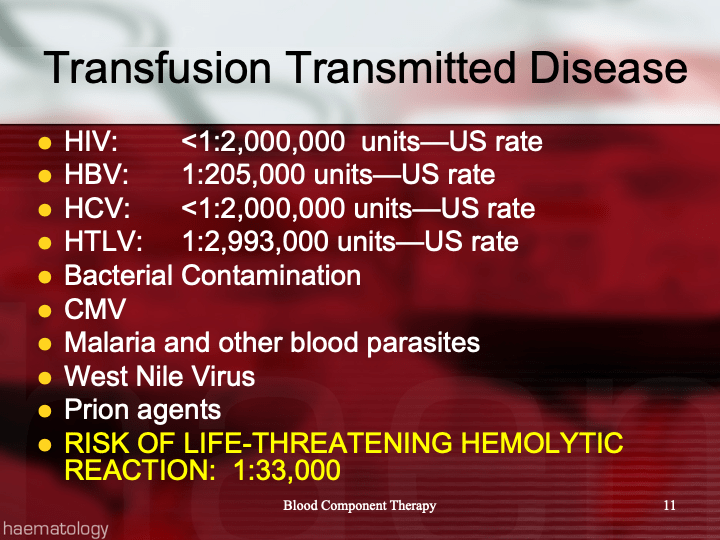
HTLV-1 is efficiently transmitted by blood transfusion with a rate of 28-63% from a donor with HTLV-1 and up to 87% from a tissue transplant. 

Testing can be made more complicated due to the length of time between contracting the virus andthe seroconversion required for the virus to appear on tests. This period has been reported to be aslong as 65 days.

Mandatory HTLV-1 antibody screening of all blood donations has been implemented in 23 countries.

Because HTLV-1 is almost always cell associated, leukoreduction may be as effective as blood donation screening in preventing transmission.

Following current practices, screening tests for HTLV-1 should be followed by confirmatory tests for the diagnosis of HTLV-1.  Most screening tests use immunoassays, which rely on detecting anti-HTLV-1 antibodies. Commonly used confirmatory tests detect antibody responses to specific HTLV-1antigens.  Test types include the Western Blot, radioimmunoprecipitation assay (RIA) and linear immunoblot assay LIA.  However, the Western Blot test has been found to give unreliable results.  Several  studies have proposed transitioning from using Western Blot for confirmation in routine testing to using line immunoassay or NAT.

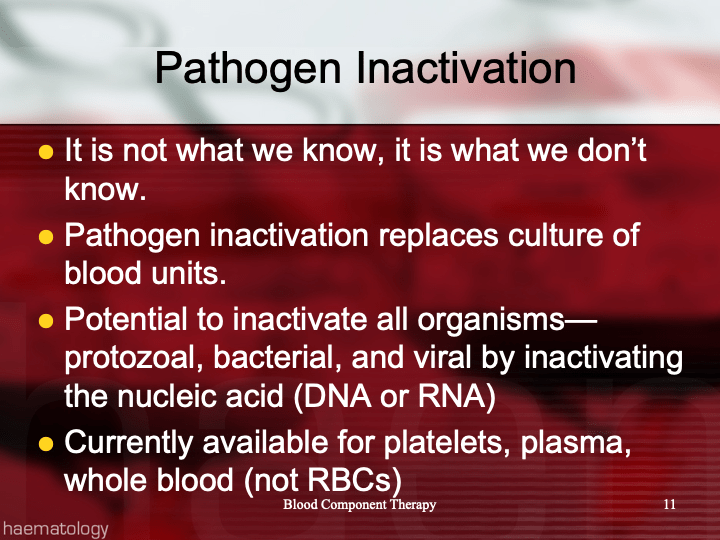
In my laboratory in Qatar, we detected approximately 8-10 cases of infection per year on a donor testing base of 36,000 for the year 2019.  These were confirmed cases by LIA.  In addition to the universal leukodepletion of all components to the CE-mandated level of < 1E6, we also pathogen-inactivated platelet components and plasma.

References:

  1. Technical Report Human T-Lymphotrophic Virus Type 1, WHO, February 2020
  2. Key Facts Human T-Lymphotrophic Virus Type 1, WHO, 3/3/21

Operational Effects of the COVID Pandemic–My Experience in Qatar

The COVID-19 pandemic imposed new challenges to our system.  In general, these could be divided into:

  1. Decreased donors
  2. COVID vaccine effects
  3. Decreased available staff
  4. Shortages of supplies
  5. More demands on donor apheresis staff—CCP
  6. More demands on donor processing staff—CCP
  7. More demands on hospital transfusion service/blood bank staff—CCP

There were fewer donors in the early phase and the nurses also had to add a large number of donor plasmapheresis collections for COVID convalescent plasma CCP.  Still they had to maintain all donor and therapeutic apheresis services with no increase in staff.  Although elective procedures had been cancelled, there were still obstetrical, oncologic, and trauma services in full action.

Many of our staff were on leave when the borders were closed.  Some had to wait months before they could return to work.  Others had COVID-19 infection and were quarantined for several weeks.  This further reduced staffing.  We could not just hire outside staff since considerable training is involved in these processes.

I dedicated a separate donor collection space for the CCP program away from the regular donors as well as a quarantine processing area.  Similarly, the CCP plasma was kept segregated from the regular plasma supply and a specially designed location was identified for release of this product.  Working for this program diverted resources from blood collection to this special project, again without increasing resources.

With disruptions to shipments of supplies, including the Reveos whole blood kits and Trima donor apheresis sets, we had to rely on our large in-home inventory until the situation stabilized.  We prescreened the CCP donor candidates before we would collect them to avoid wastage of kits.

Fortunately, our throughput was minimally affected because our equipment and processes had always stressed speed.  We used single-well NAT testing to minimize the need of additional runs.  Also, we used Reveos automated component processing to greatly speed production (one Reveos can process four whole blood units in about 23 minutes or about 12 units in 75 minutes.)  One technologist could operate all 4 of our machines simultaneously and perform other tasks while the machines were working.

In the system I developed in Qatar, we could complete processing into components (RBCs, buffy coat platelet pools, leukodepleted plasma), all marker and immunohematology testing, leukoreduction of the pools and RBCs, Mirasol pathogen inactivation, and platelet additive solution in as little as five hours.

In rapid turn-around events, it is most helpful to have a robust blood bank computer system that can scale to the challenge.  Also, it must mercilessly enforce all the rules starting with donor qualification, screening, collection through testing and production.  At times of emergency, it is difficult to meet Good Manufacturing Processes manually.

I had built parallel separate donor collection, donor processing, and transfusion service/hospital blood bank processes specifically for CCP and had to staff them with available personnel, limited our capability to process regular donors.  The blood bank computer software restricted CCP use to designated physicians and transfusing locations.  For those interested, there is a separate series of posts about the CCP project and its implementation in the dedicated blood bank Medinfo HIIG.

COVID-19 vaccinations should have minimal effect in donor qualification since mRNA or antigen-based ones do not cause donor deferral.  Live attenuated COVID vaccines will defer donors for 2 weeks by current rules—the same as other live vaccines.  Donors who had previously received CCP will be deferred for three (3) months after last receiving this product.

In summary, the COVID pandemic reduced staffing and affected donor recruitment.  We had production mitigations to maximize throughput.  The system was stressed by the reduced staffing and special demands to produce CCP.  However, the extent of our automation allowed us to maintain throughput throughout the crisis.

Teaching Document: Validation Process

This is a teaching document for medical technology and transfusion fellows to explain the general structure of a validation.

Principle:

All validations must be planned.  A validation protocol must be prepared with specific criteria for acceptance.  All validations with attached evidence must approved by the Head, Transfusion Medicine.

Policy:

  1. A written validation protocol must be prepared in the advance and at least including the following:
    1. Specific parameters and number of iterations to be performed
    1. Designated staff to perform validation
    1. Documentary evidence of the testing
    1. Specific acceptability criteria
  2. The completed validation protocol must be submitted to the Division Head, Transfusion Medicine, or designee for review.
  3. Once the validation plan has been reviewed, it must be performed by the designated staff.
    1. Software validations will be performed in a specific test environment, not in the live, production system.
  4. The completed validation document, including screenshots of the software functionality if applicable, must be submitted to the Division Head, Transfusion Medicine for review.
  5. The equipment or software may only be used if the acceptability are met AND the validation is approved by the Division Head, Transfusion Medicine or designee.
  6. The completed validation protocol will be stored in the document control system.

Reference:

Standards for Blood Banks and Transfusion Services, Current Edition, Bethesda, MD, USA

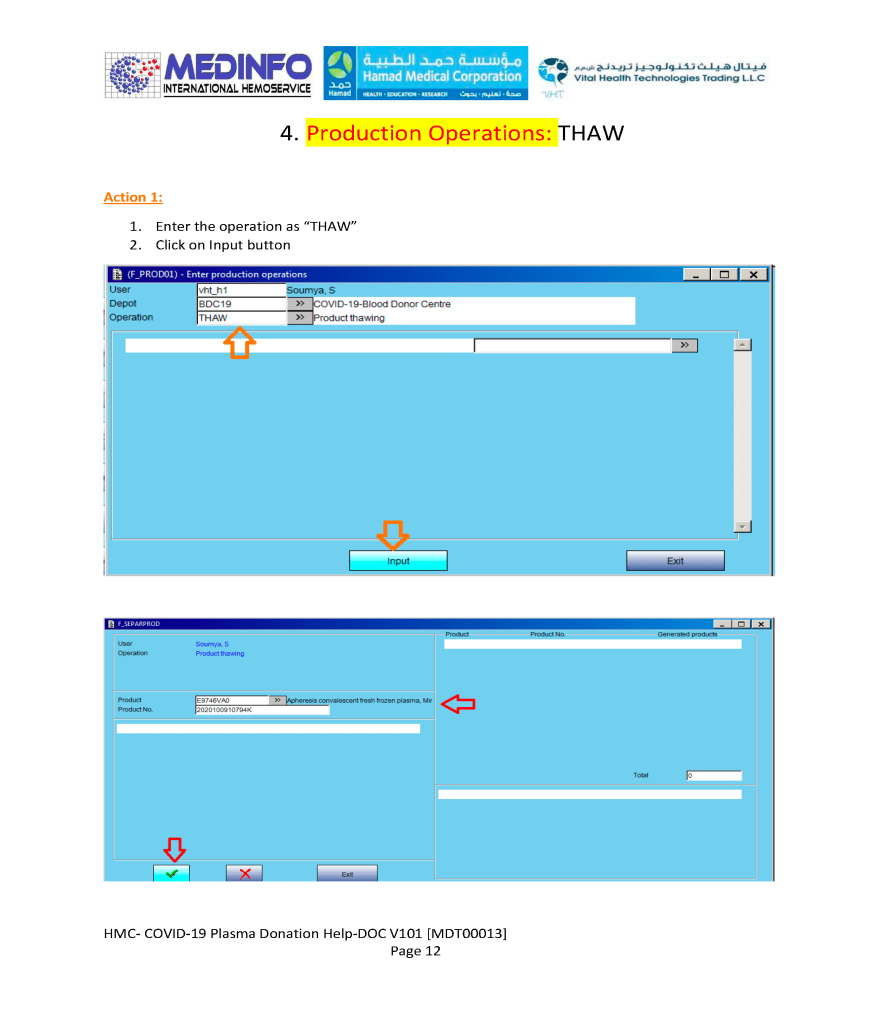
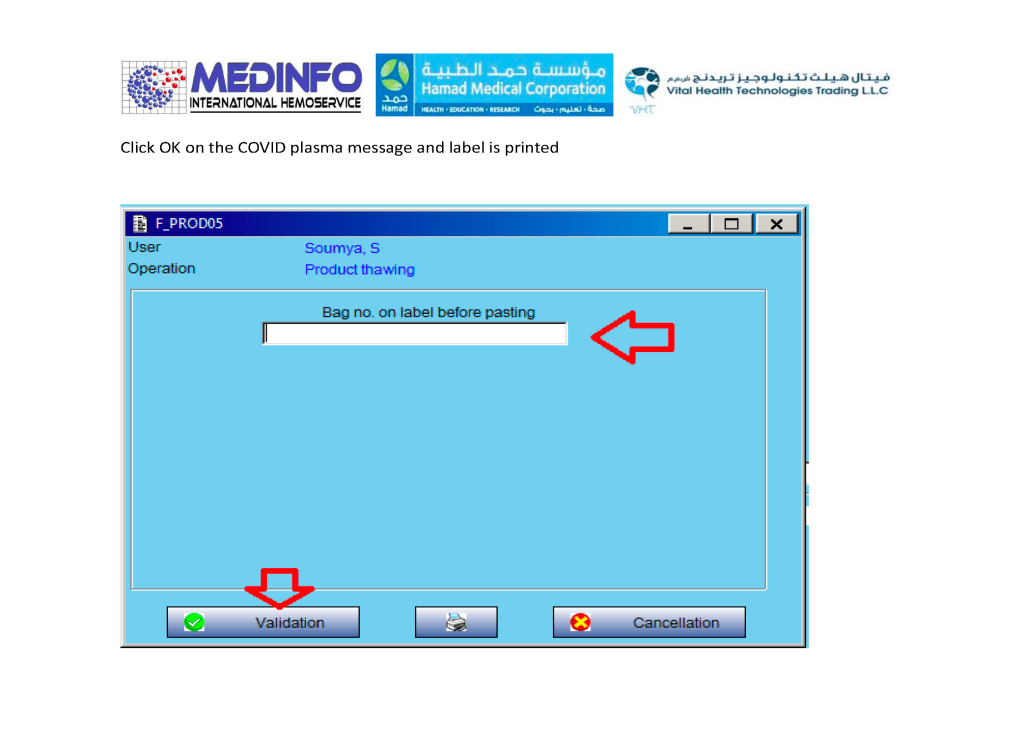
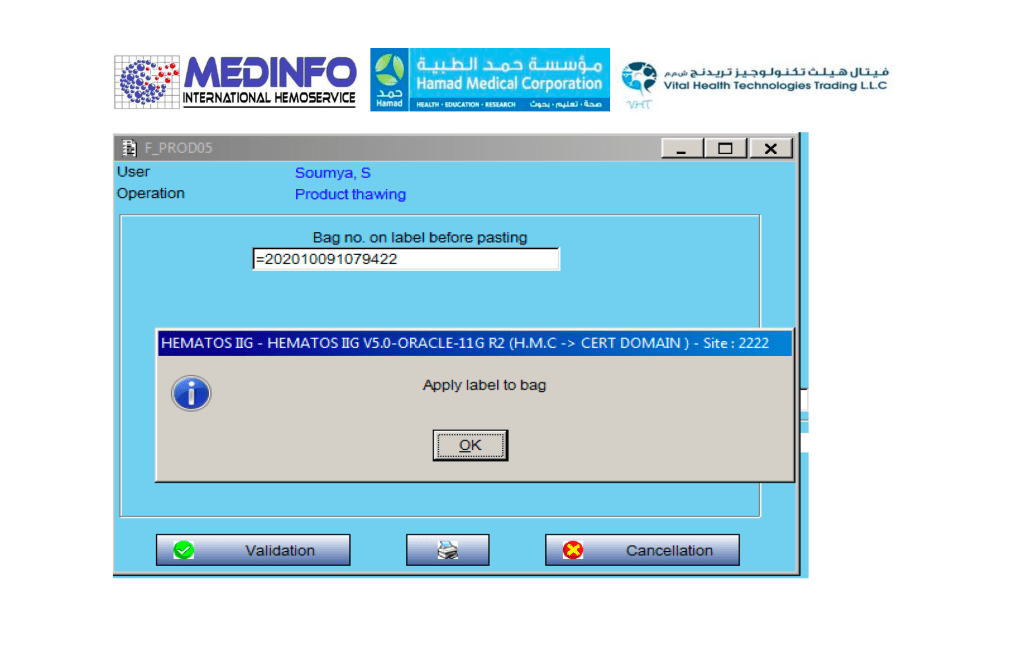
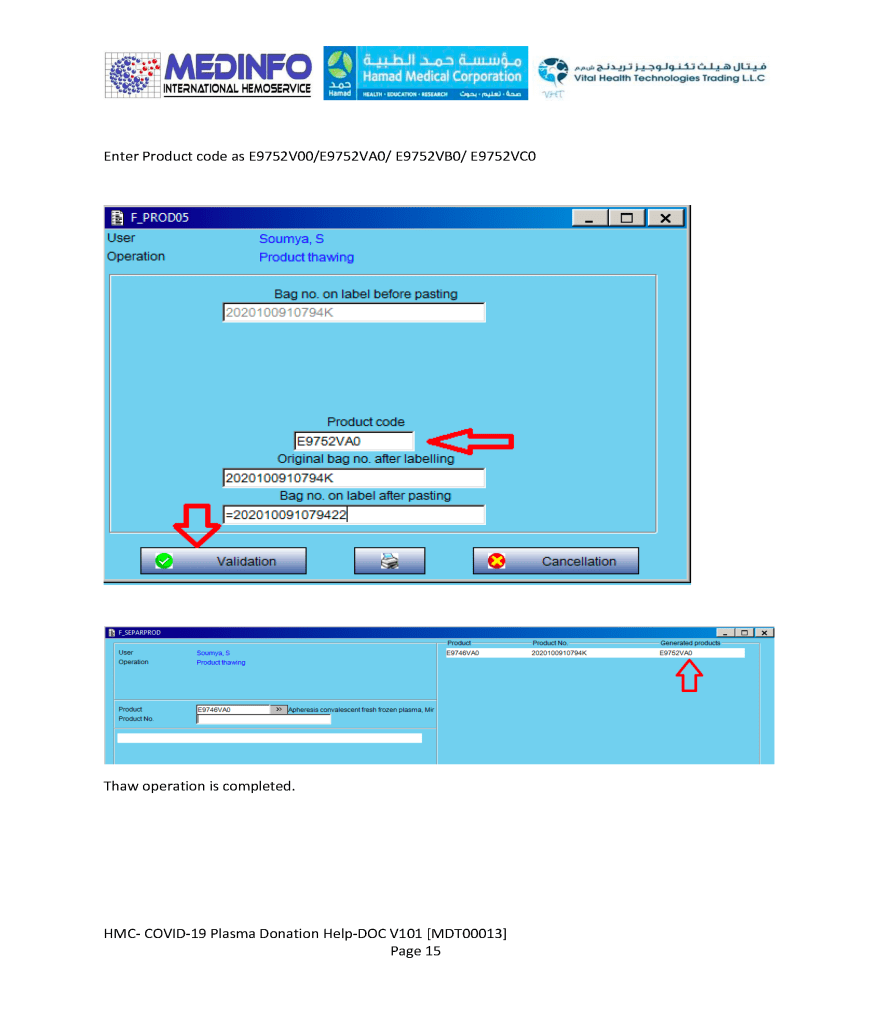
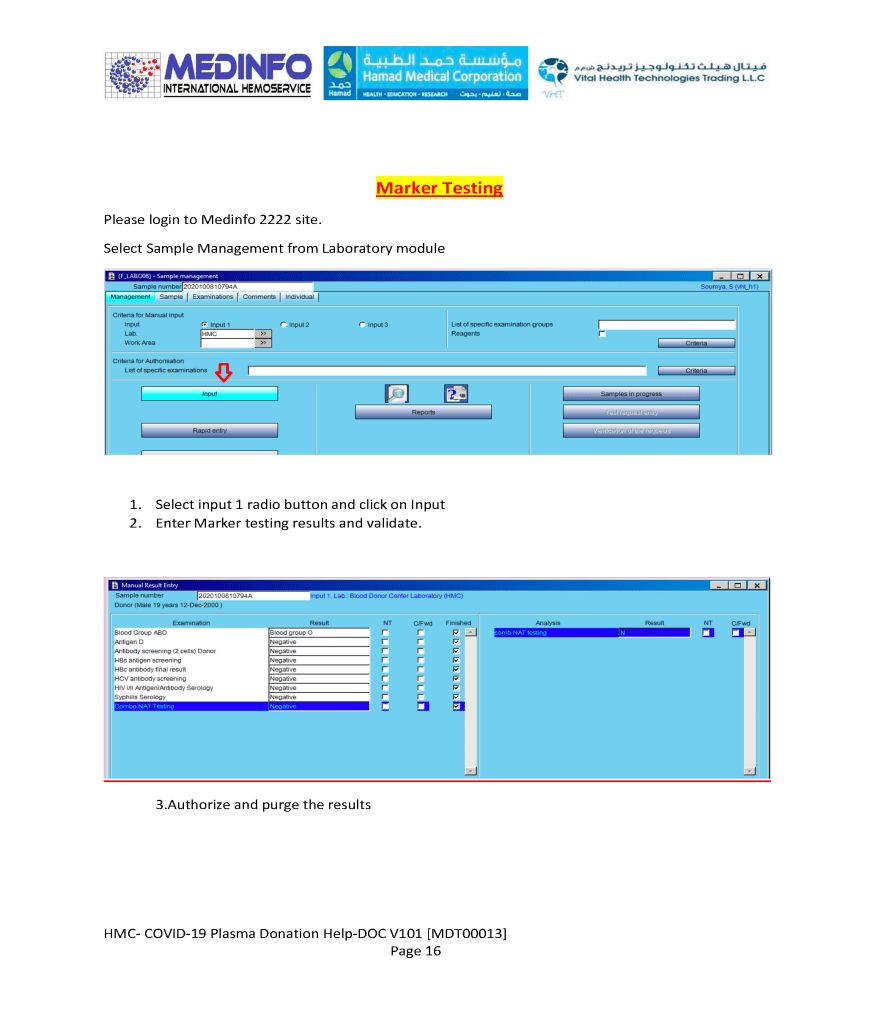
COVID-19 Convalescent Plasma CCP Thawing and Marker Testing

This is a part of a continuing series of posts on the actual Medinfo design of the CCP donation and release processes and covers CCP plasma thawing/labelling and donor marker testing.  It highlights specific changes made for the parallel CCP system.

Thus, the machine interfaces for testing are the same as for regular testing and are not included in this document. Likewise, donor immunohematology testing is the same as for regular donors and is not addressed here