Antiglobulin Reagents

Antiglobulin reagents are used to detect molecules bound to the RBC surface.  What they detect depends on their specificity.  Such detection can be performed in the routine immunohematology laboratory or elsewhere such as flow cytometry.  This discussion is for the blood bank laboratories, both routine and reference immunohematology.

This is how I classify and use the various reagents in my daily practice:

  • Routine use—DAT testing and compatibility testing
  • Antibody identification
  • Drug-related hemolysis and transfusion reaction workups
  • Special assays:  DAT-negative AIHA, prediction of clinical significance of reaction by IgG subclass determination

There are many types of antiglobulin reagents:

  • Polyspecific:  IgG and complement usually C3d but sometimes C3b specificity included
  • Whole Molecule IgG including mu heavy chains and kappa and lambda light chains
  • Monospecific gamma heavy chain, mu heavy chain, alpha heavy chain, C3c, C3d, C3b
  • IgG subclass:  IgG1 IgG3

Whole molecule IgG detects class-specific mu heavy chains AND light chains kappa and lambda.  Since kappa and lambda are found on all immunoglobulin classes, whole molecule reagents can detect IgM so there may be weak staining with cold antibodies that are not clinically significant.

C3d is the final breakdown product of C3b and does not cause hemolysis.  Its presence merely means that at some time—unspecified—complement was fixed.  C3c is an intermediate product in the breakdown pathway.  If detected, C3c positivity means ACTIVE complement fixation was occurring at the time of specimen collection.

General Use:

Routine DAT testing:

  • Polyspecific:  if positive, then use
  • Monospecific IgG and monospecific C3 reagents

Antibody workups:

Routine:  antibody screens and AHG crossmatch (if indicated)

  • Polyspecific
  • Gamma heavy-chain monospecific

Monospecific gamma heavy chain is preferred to minimize non-clinically significant, cold antibody interference.

Complicated—where detection of complement reactivity is especially important:

Polyspecific for drug-related hemolysis and transfusion reactions

Difficult antibody workups, e.g. to rule out anti-Jka and/or anti-Jkb

Specialty Reference Procedures:

  • DAT-negative AIHA:  mu heavy chain, alpha heavy chain for IgM and IgA mediated hemolysis (rare), C3c to detect active complement fixation
  • Predicting clinical significance:  IgG1 IgG3

Complement fixation may be important in various drug-related hemolysis and some transfusion reactions so I always use a polyspecific reagent in these situations.  Most antibodies can be detected by gamma heavy-chain specific reagents;  however, there are rare examples of anti-Jka and anti-Jkb which are only detected by complement.  Whenever I have a nonspecific reaction in an Jka-negative or Jkb-negative patient, I repeat the AHG panel using polyspecific reagents.  I do not use polyspecific routinely because of the nonspecific and non-clinically significant cold antibodies.

One way to assess for the clinical significance of an antibody is to determine its IgG subclass.  In general, IgG3 antibodies may fix complement and cause severe hemolysis.  Both IgG1 and IgG3 antibodies cross the placenta and may cause hemolytic disease of the fetus/newborn.

In summary, when reviewing immunohematologic reactions using AHG, I always remember to check which type of AHG reagent was used.  I always keep multiple types of AHG reagents in the laboratory for the reasons explained above.

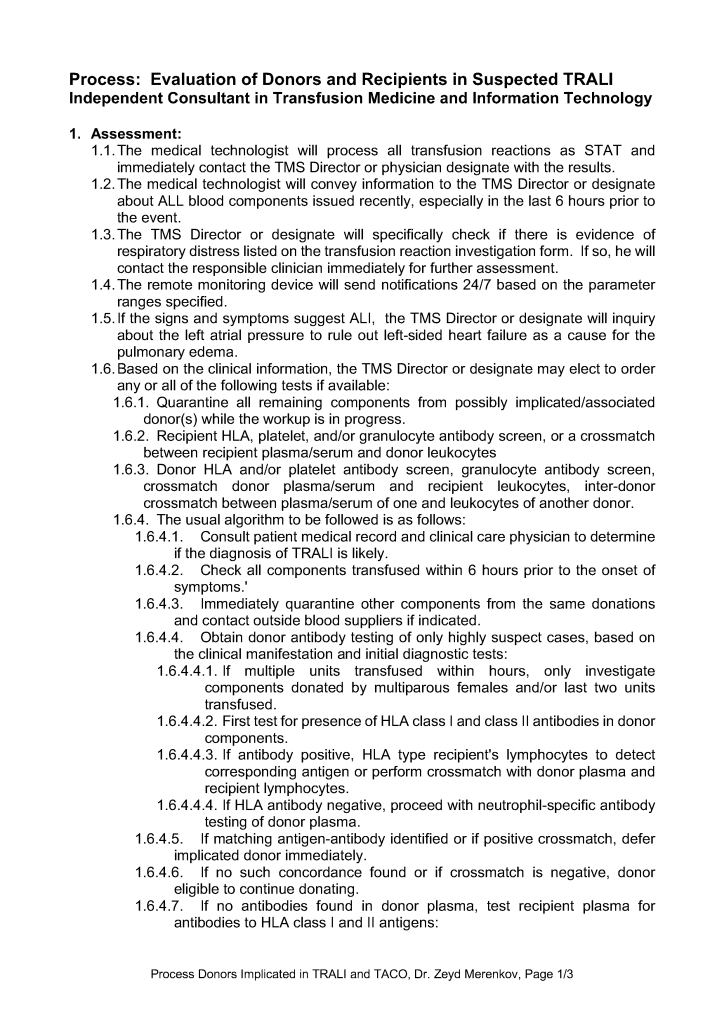
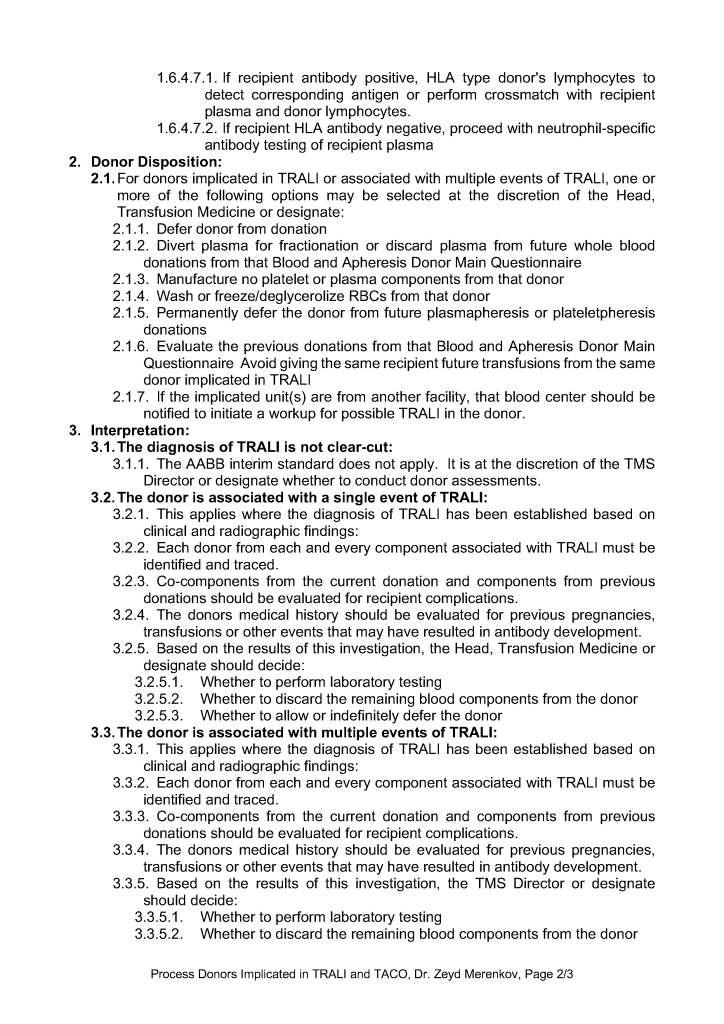
TRALI TACO

This is a revision of a previous post, incorporating an updated definition of Transfusion-Associated Cardiac Overload TACO from the National Healthcare Safety Network, Biovigilance Component Hemovigilance Module Surveillance Protocol,  Version 2.6.

Time: Appreciating Testing and Component Release Times

This is a revised version of a previous post.

I have had many medical students, residents, and fellows rotate through my Transfusion Medicine section.  Hardly anyone has any interest in making my discipline his/her career.  It is a required rotation or an “easy” rotation during which the trainee may take his vacation.  The trainee will cram for the examination and then promptly forget it.

I left practice in the USA in 1990, in what I consider the golden age of laboratory medicine.  We had supervisors for each laboratory section.  In the blood bank, we had many staff with SBBs or who were SBB students.  We were very self-sufficient in handling immunohematology problems except for rare blood types or antibodies to high incidence/prevalence antigens.

When I returned to visit my old laboratory, I sensed a deprofessionalization of the laboratory and blood bank in particular.  Blood Bank now is a cost center, not an area of revenue.  Why hire experienced blood bankers for most hospitals?  Send the antibody workups to the Blood Center.  There are limited jobs for transfusion medicine consultants.  Minimize testing, don’t do extended antigen typings, etc.

Nowadays, I feel like one of the dinosaurs marching into oblivion like in Walt Disney’s Fantasia film, the section called The Rite of Spring.  Who will replace those retiring?  Have you ever noted the average age of attendees at the AABB annual convention?  I feel young when I go there (and don’t worry about the gray hair!)

I want to attract new doctors and scientists to Transfusion Medicine.  I really try, but most have no interest and look on their rotations as a necessary evil.

I have lowered my expectations for most medical trainees in Transfusion Medicine.  They don’t like it, they just want to pass it, and move on.  What must I impress them with for their future careers?  What is essential for them to remember?

I have had both pathology and non-pathology trainees.  Surgical and ob/gyn doctors used to spend one month whereas the hematology and pathology residents/fellows spent on average three months.  The few interested in the field might do multiple rotations.

I still gave them lectures on a variety of topics, especially how to transfuse blood components, basic ABO/Rh antigens, compatibility testing, and direct antiglobulin testing.  They would forget most of this, but I wanted them to remember TURN-AROUND-TIMES:

Examples:

HOW LONG DOES IT TAKE TO PERFORM THE TEST?  TO FIND COMPATIBLE BLOOD?  TO THAW THE PLASMA?  RELEASE AN MTP SHIPMENT?  TO PERFORM A TRANSFUSION REACTION WORKUP BEFORE RELEASING MORE BLOOD?

I am not discouraging people from entering the field, but I am a realist to know that few will share my passion for serology or want to take call on difficult immunohematology cases.  At least if they understand the pressure the technical staff are in and these turn-around-times this will make both their work as clinicians and mine as transfusion medicine more congenial.

Opinion: Outside Accreditation and Quality Consultants

Sometimes, you may not have adequate resources for a project so you will consider hiring an outside consultant.  During my career, I have used several outside consultants for projects ranging from installing a new general laboratory computer system to assisting in getting international accreditations.

For a complex accreditation process such as AABB, I have used such consultants to audit operations in the donor center including processing and testing, hospital blood banks, and stem cell laboratory.  They are high-level technical specialists with highest blood bank qualifications (e.g. SBB(ASCP) or equivalent) and have considerable experience in practice of blood banking and quality systems.  They have been AABB Assessors so they can give you a dry-run accreditation assessment.

Depending on the project, you may need one or a group of consultants.  I have worked with both individual consultants and groups.  A group can complete the tasks quicker but this is not always necessary.  Organizations such as AABB have many different consultants with different types of expertise so you can select the most appropriate individuals to form a team for your needs.

These specialists can audit your operations and propose a model and if you want, actually help you to implement the processes.  They can help you with the accreditation formalities, especially if you do not have any staff with experience in the process.  It all depends how much you can spend.

In the Middle East, to bring in such consultants may mean expensive air fares, hotels, meals, plus the actual costs of doing the consulting.  This is a major investment for your organization but it is well worth it to expedite the process.  There are local consultants available as well and using them may greatly help with the expenses.

Although it is expensive upfront, it can be cheaper in the long run by establishing the appropriate framework in the first place.  You can engage the consultants to actually do much of the work themselves, but it is better for them to offer a train the trainer experience, i.e. engage your own technical staff to learn new skills and then have them cross-train the rest of the staff. 

Based on the findings, your local staff can implement the changes.  You can then consider rehiring the consultants to verify that the work has been done properly.

I have used both individual consultants and groups through AABB Consulting.  My staff and I have learned much from such interactions, and I highly recommend their use when local expertise is not available.

Case Study: Importance of Enzyme Panels in RBC Antibody Workups

I am a strong believer in performing both AHG and enzyme panels together in routine antibody workups.  I especially feel this is important when the patient is R1R1 since I always want to rule out anti-c.  Sometimes, anti-c is only identified in the enzyme phase.

This is a case from my files of an R1R1 patient with the following results:

Antibody Screen:

AHG Panel:

Enzyme Panel (Ficin):

This anti-S is enzyme-labile but anti-c is revealed, only reacting at enzyme phase.  The patient was Kell-negative so I selected S-negative, R1R1 K-negative RBCs for transfusion.  Anti-c can be a dangerous antibody causing severe hemolytic disease of the fetus/newborn and sever hemolytic transfusion reaction.  If only the AHG panel had been performed, the anti-c would have been missed.

Hypotonic Saline to Phenotype Multiply Transfused Sickle Cell Patient

Nowadays, if we have a multiply transfused patient with a complex antibody pattern, we might resort to RBC genotyping to help us resolve the antibody issues.  Fortunately, there is one situation where we can quickly phenotype the patient by using hypotonic saline to lyse the transfused RBCs since the sickle cells are resistant.

The results can be quite clean and easy to interpret as in the following example using 0.4% saline:

It is a lot cheaper to make dilute saline than an RBC genotype—and much quicker!

Management of Acute Transfusion Reactions

This was a teaching document for medical students and residents I made for NGHA Riyadh. I have updated it for leukodepleted components and platelet additive solution.

Immediate Steps for All Reactions:

  1. Stop Transfusion.
  2. Keep IV Open with 0.9% NaCl.
  3. Verify correct unit was given to correct patient.
  4. Notify attending physician and blood bank

After Transfusion is Terminated (except mild allergic, see below):

  1. Send report of reaction, freshly collected blood, and urine samples with blood unit and administration set to blood bank.
Reaction TypeSigns and SymptomsEtiologyClinical Action
Allergic (mild)Pruritus, urticaria (hives)Antibodies to plasma proteinsSteps 1-3 above; administer antihistamines (PO, IM, or IV); resume transfusion if improved; if no improvement in 30 minutes treat as below.
Allergic (moderate to severe)Hives, dyspnea, abdominal pain, hypotension, nausea, anaphylaxisAntibodies to plasma proteins, including IgA (patient has anti-IgA antibodies)Steps 1-5 above; administer antihistamines, epinephrine, vasopressors, and corticosteroids as needed; avoid future reactions by premedication and consider use of washed red cells if refractory.
Febrile (mild to moderate)Fever, chills, rigors, anxiety, mild dyspneaAntibodies to leukocyte antigens, (mostly HLA): cytokinesSteps 1-5 above; mild—administer antipyretics as needed; avoid future reactions by premedication and use of leukodepleted red cells and platelets
Acute lung injuryFever, chills, dyspnea, respiratory failureAntibodies form donor plasma to recipient WBCs; less commonly recipient antibodies to donor WBCsSupportive therapy for respiratory failure, oxygen, mechanical ventilation, leukodepleted blood components, consider use of solvent detergent plasma, minimize plasma transfusions (use platelets in additive solution and leukodepleted RBCs in additive solution).
Acute hemolyticAnxiety, chest pain, flank pain, dyspnea, chills, fever, shock, unexplained bleeding, hemoglobinemia/ hemoglobinuria, cardiac arrestHemolytic transfusion reaction; usually due to ABO incompatibilitySteps 1-5 above; treat shock with vasopressors, IV fluids, corticosteroids as needed; maintain airway; increase renal blood flow (IV fluids; furosemide); maintain a brisk diuresis; monitor renal status for acute renal failure. Monitor coagulation status for DIC; administer blood components as needed after etiology is clear.
Septic / toxicChills, fever, hypotensionBacteria in contaminated bloodSteps 1-5 above; treat shock with vasopressors, IV fluids, culture patient and blood bag,antibiotics.