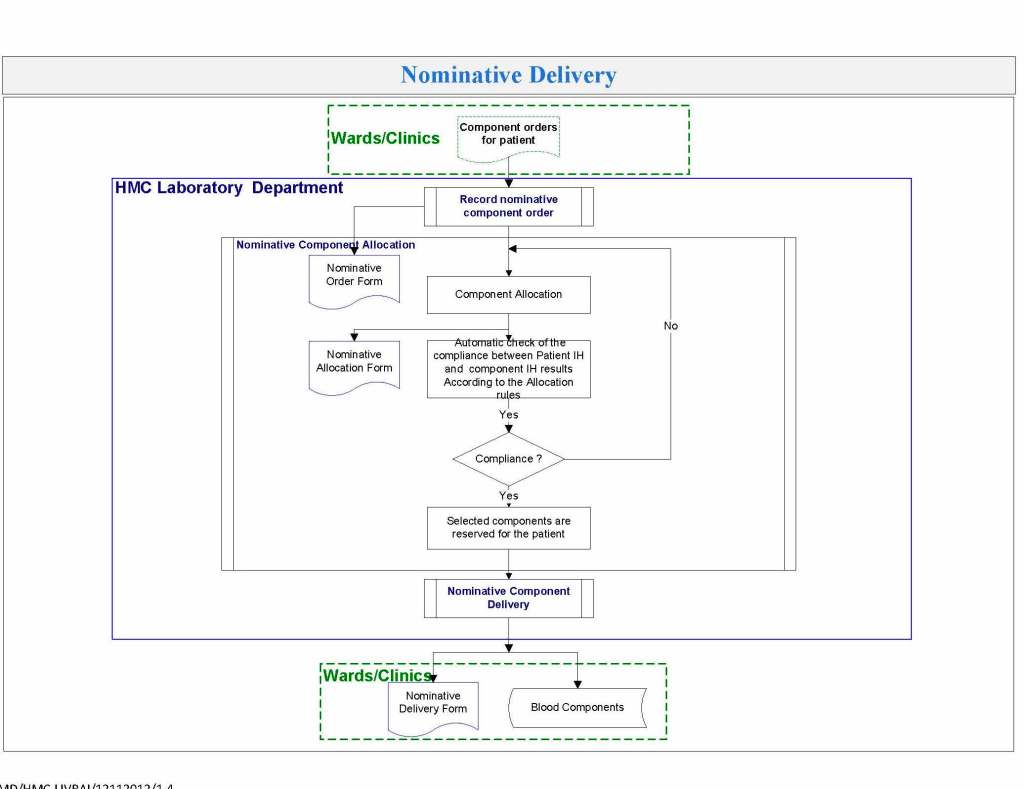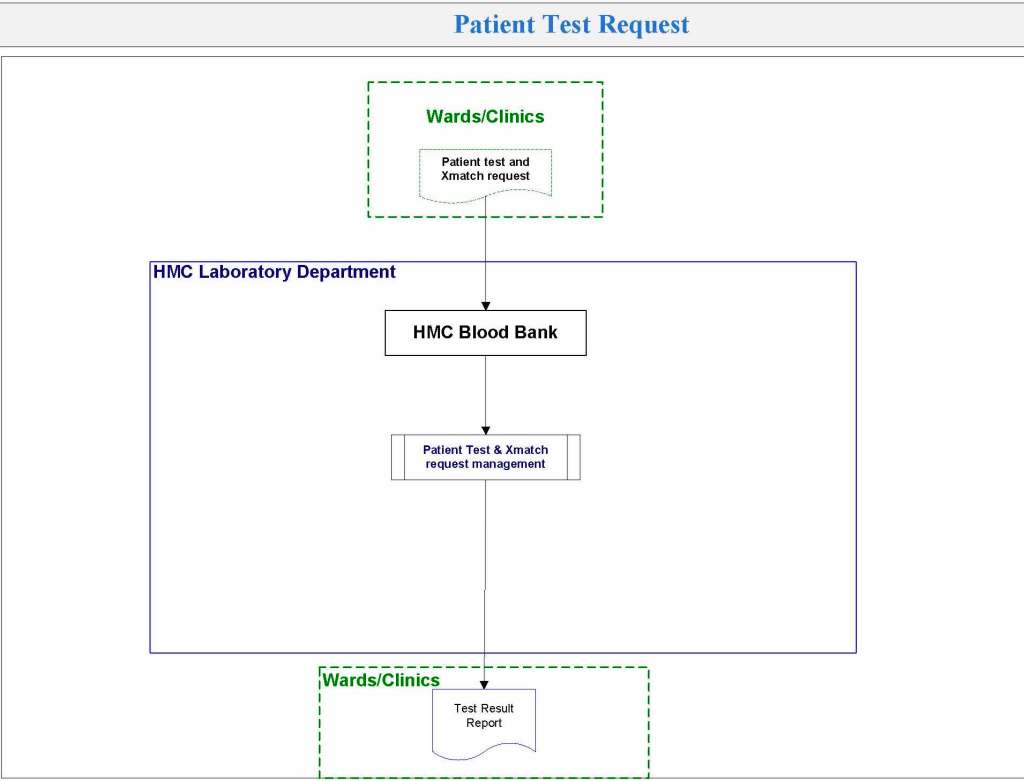
Processes and Software Building 11: Middleware and Truth Tables

I try never to forget that in most cases, the simplest solution is the best.  This applies to software as well.  The ideal situation is to have one interface to the blood bank software.

In many laboratory softwares, there is a middleware to interpret the raw data as it comes out of the equipment which may reformat it and interpret it.  This approach means that you have to have one interface then middleware and then finally the software.

Inevitably, both the middleware and the laboratory software will need updating.  Can you assume that they will still work after either or both are updated?  Will there be regression errors?

A good example of regression errors is the Microsoft Windows Feature Update (sometimes referred to as the Update from Hell!).  Previously working functionality gets broken, data can be lost, etc.

In Medinfo, you store a truth table of possible results and interpretations.  Medinfo will directly read the machine interface data, interpret it according to the rules you make.  The data can be numeric or alphanumeric or both.  Each test, each equipment can have its own unique rules if necessary.

In my opinion, it is best to avoid middleware if your blood bank software can perform this function directly.  When you upgrade it, it is much less likely to show errors—and you only have to deal with one vendor.  Can you be certain that the middleware vendor and the blood bank software vendor will work well together to resolve any issues?

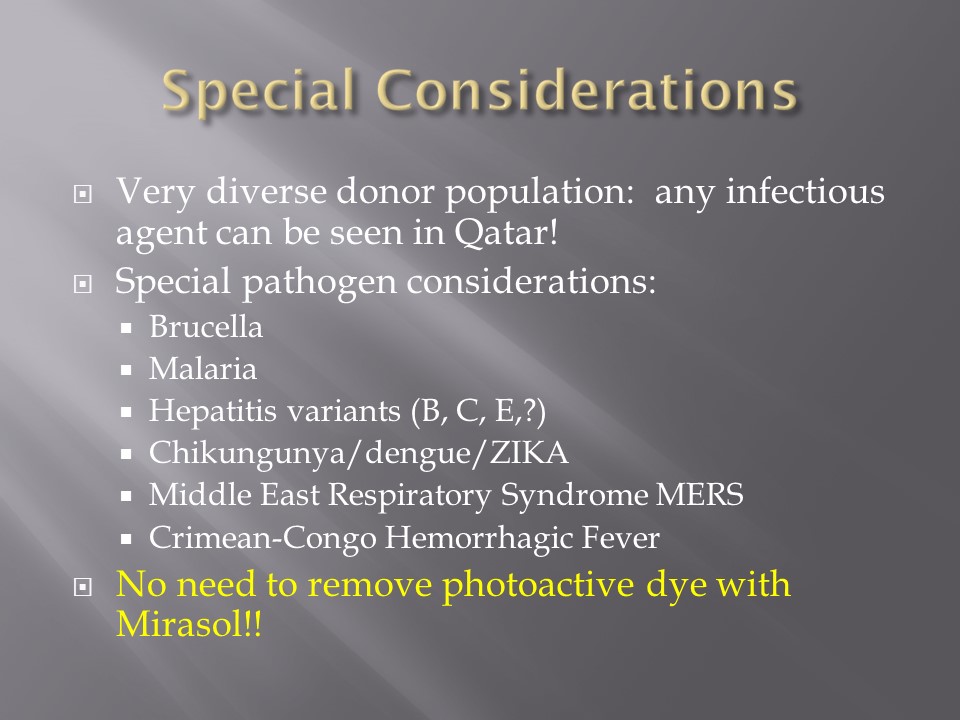
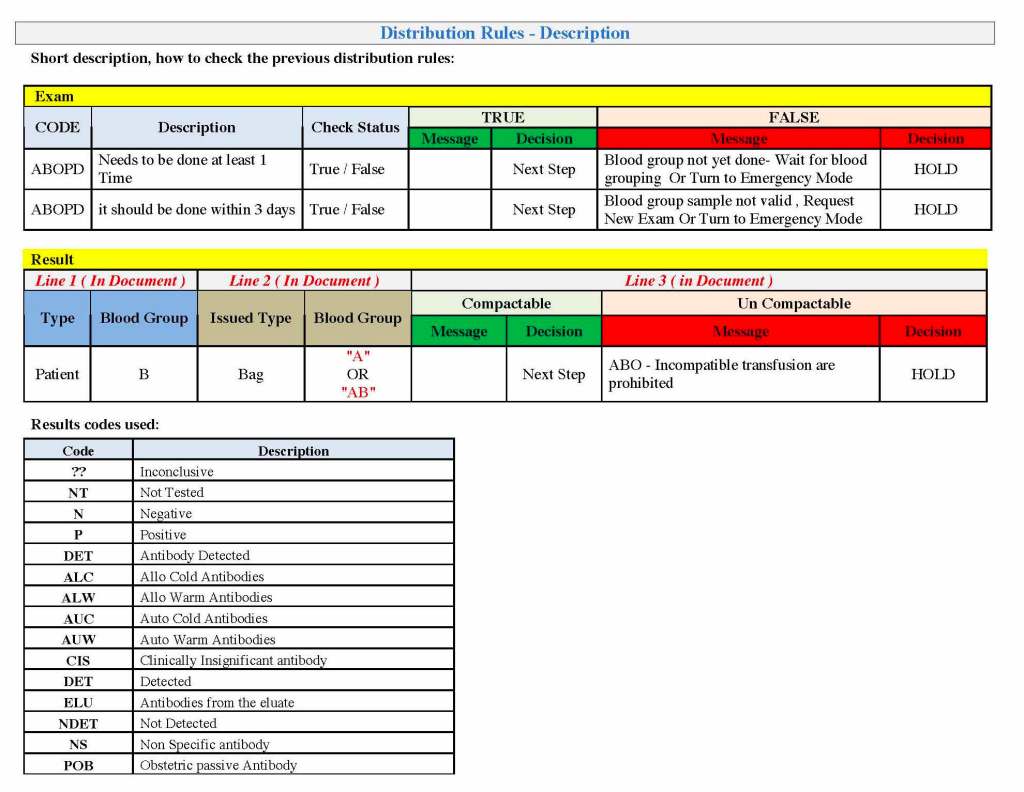
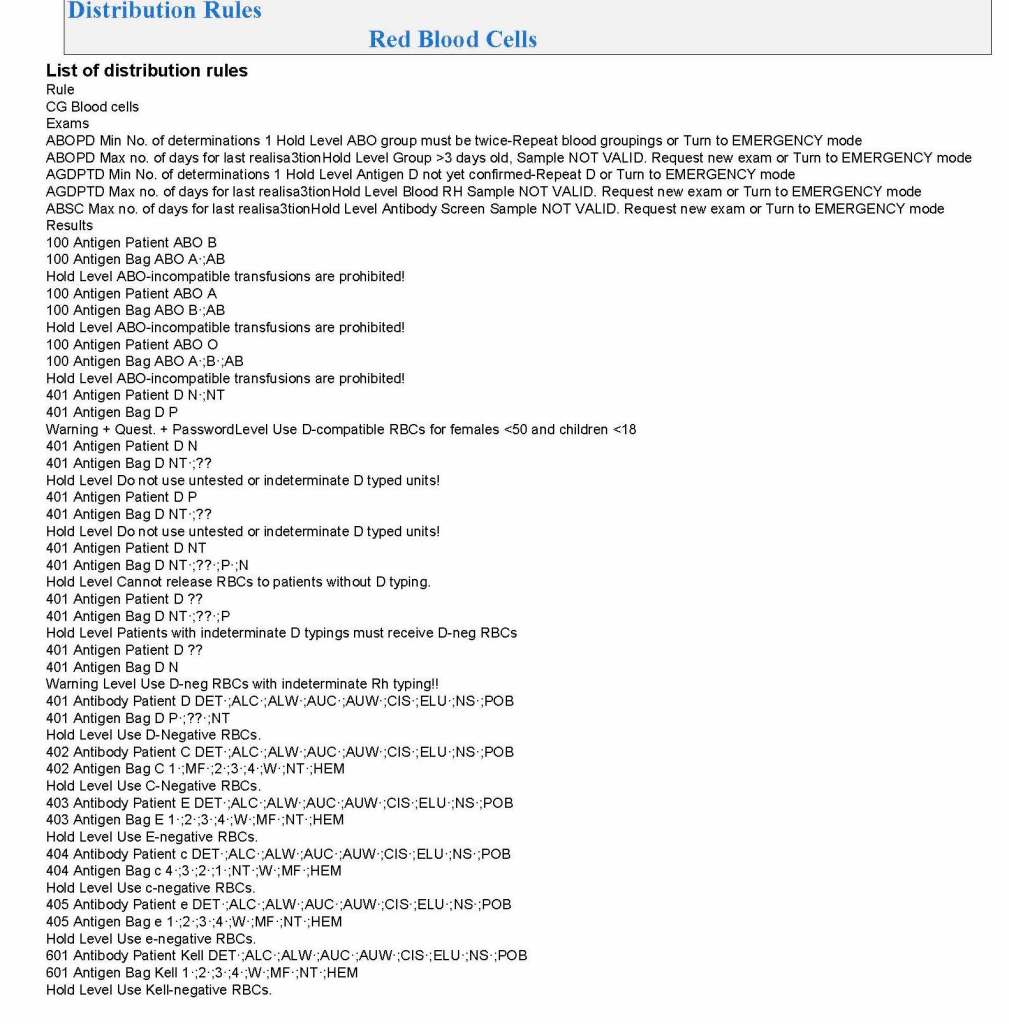
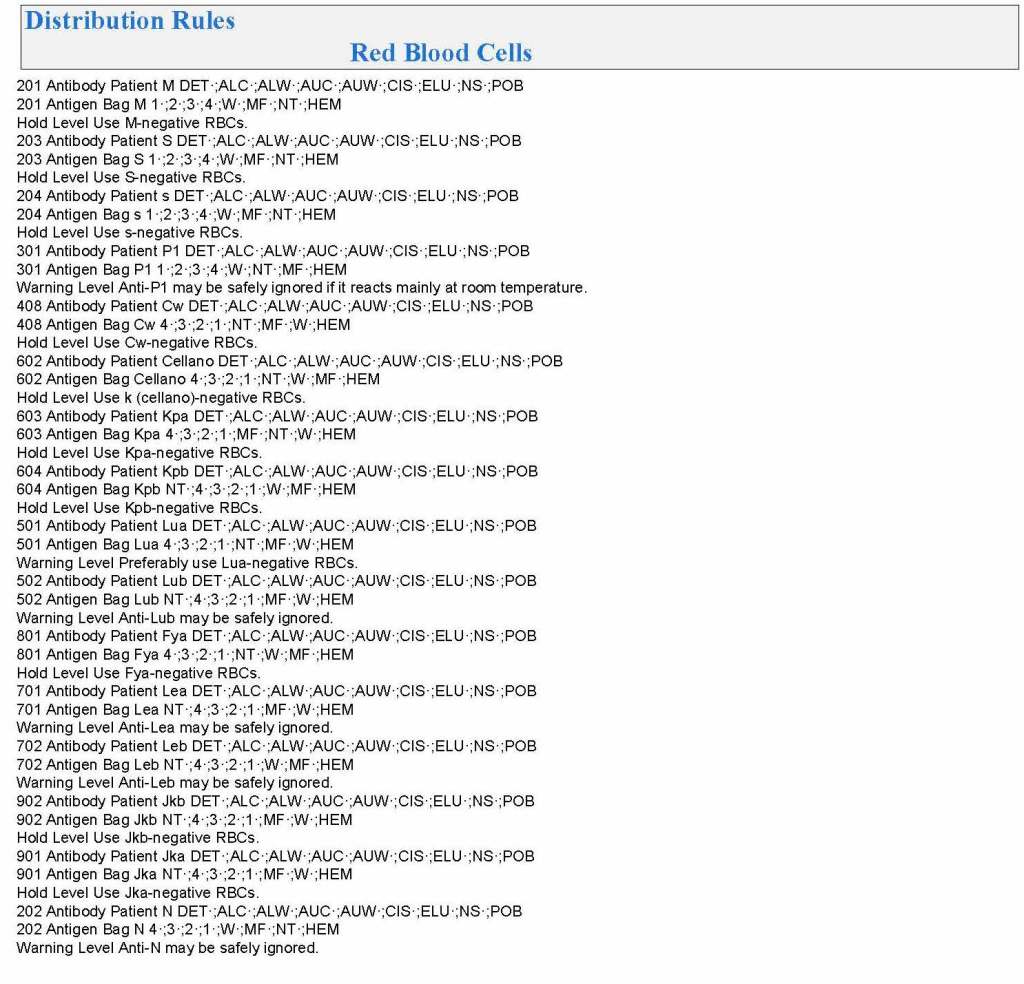
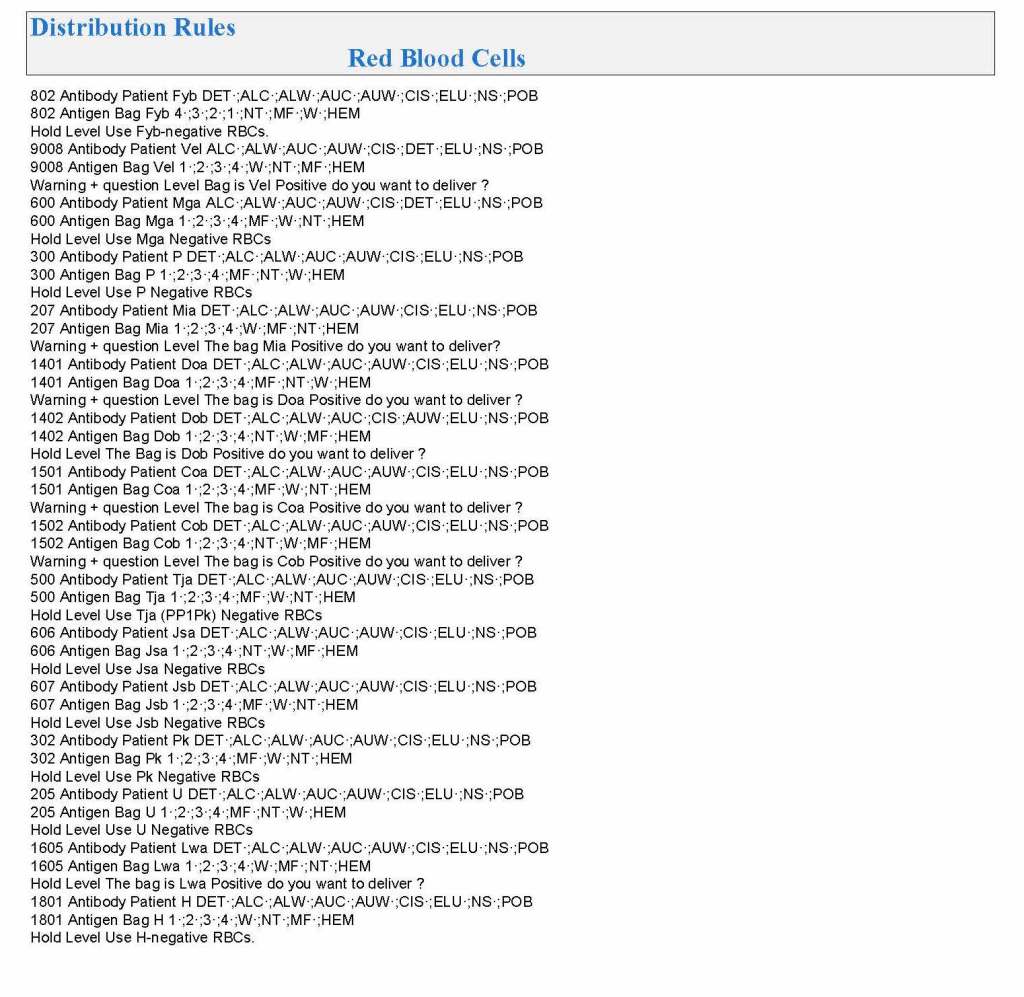
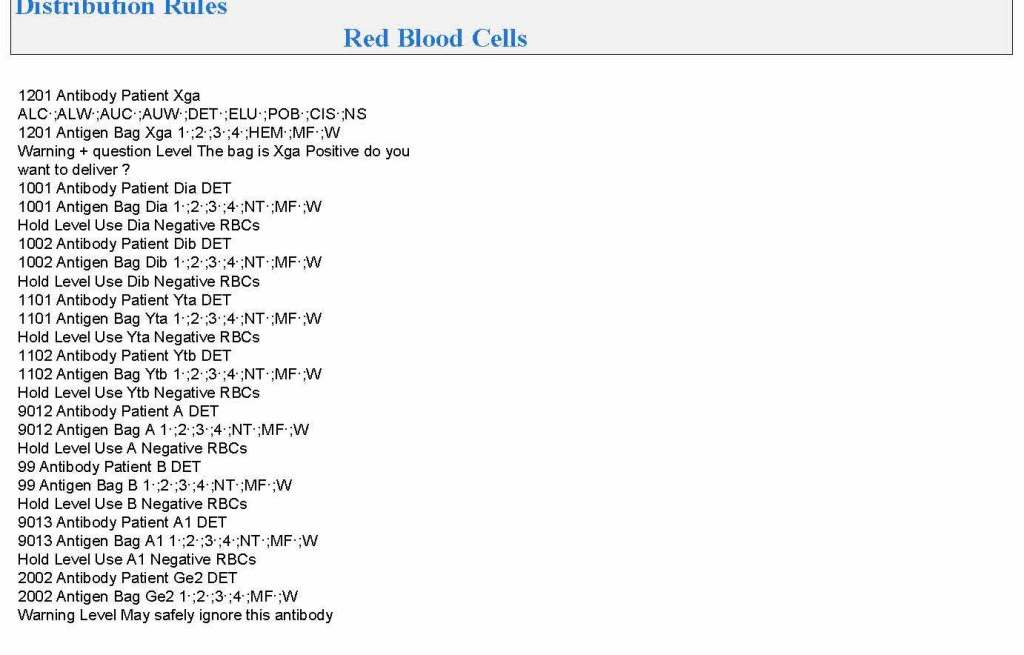
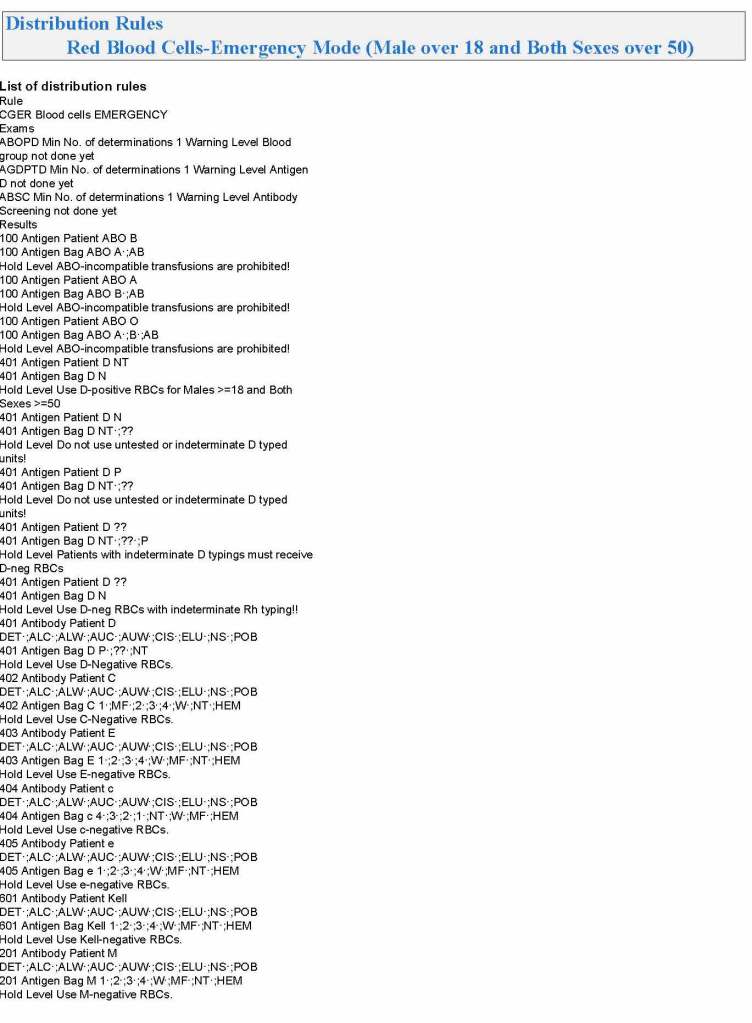
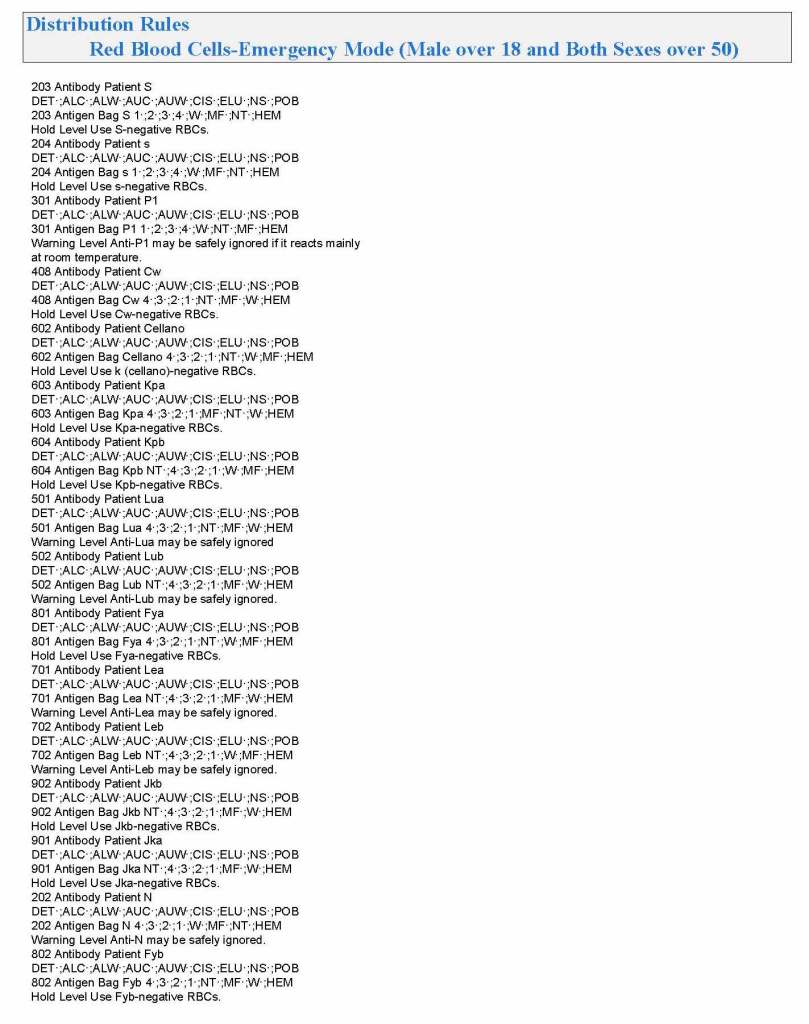
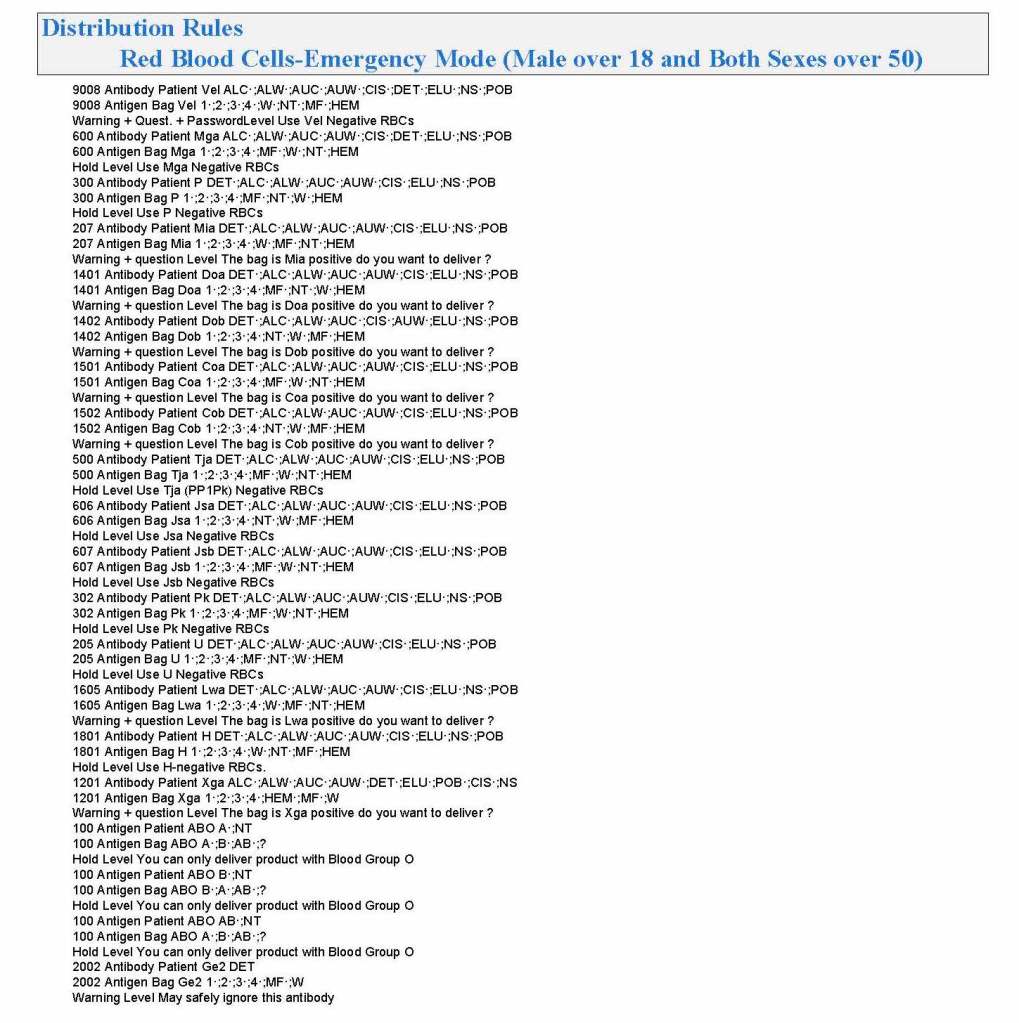
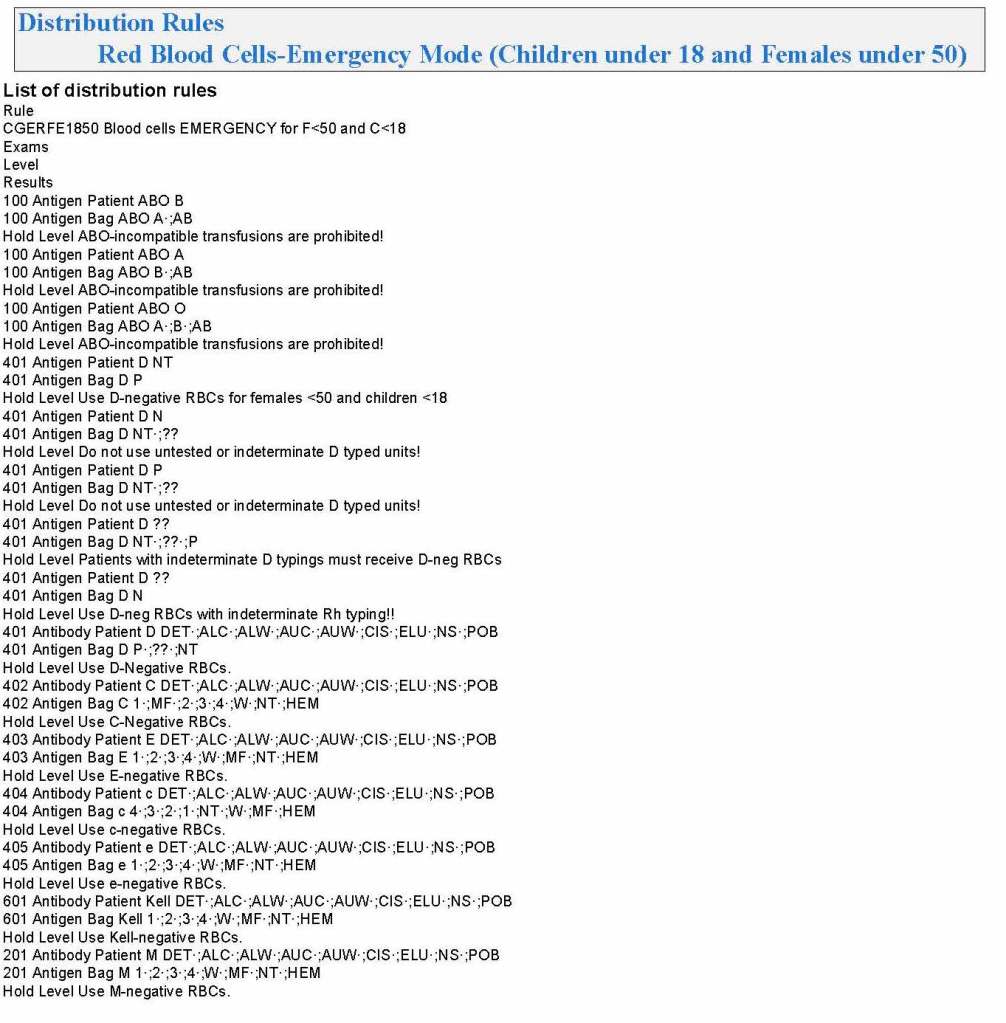
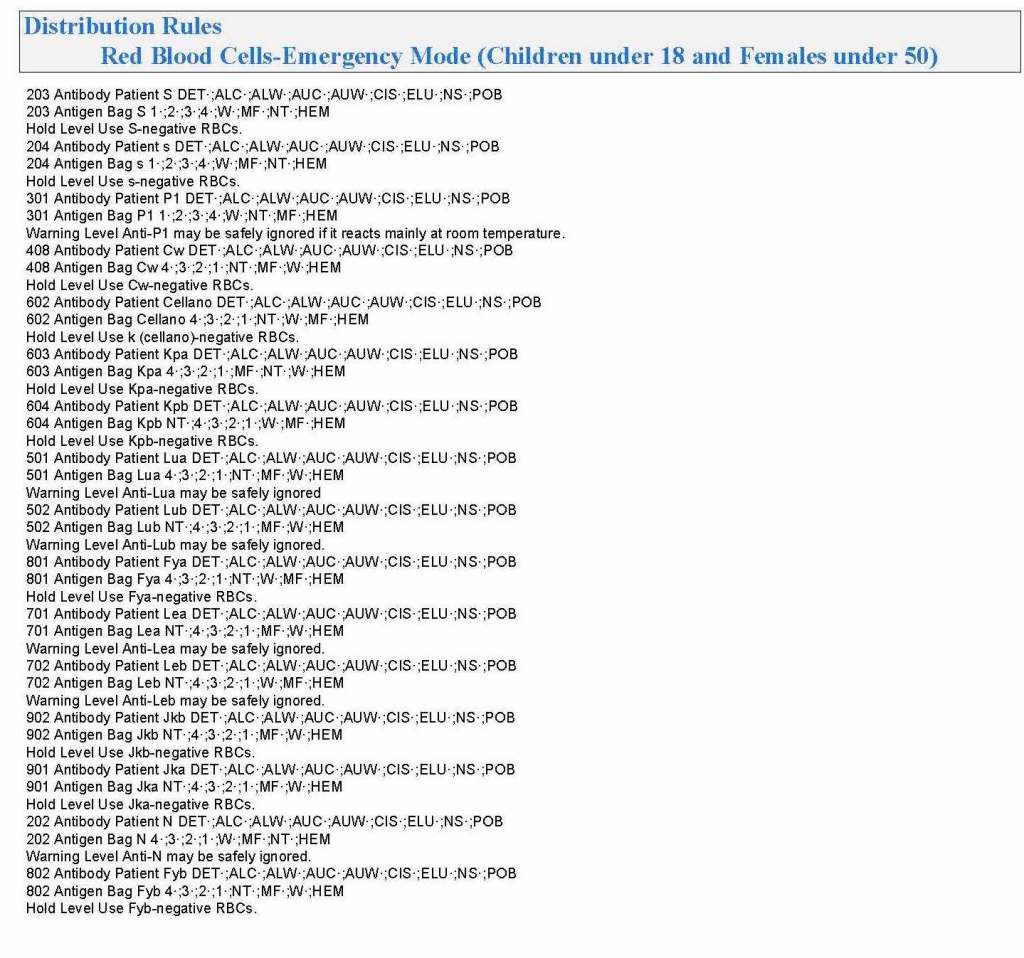
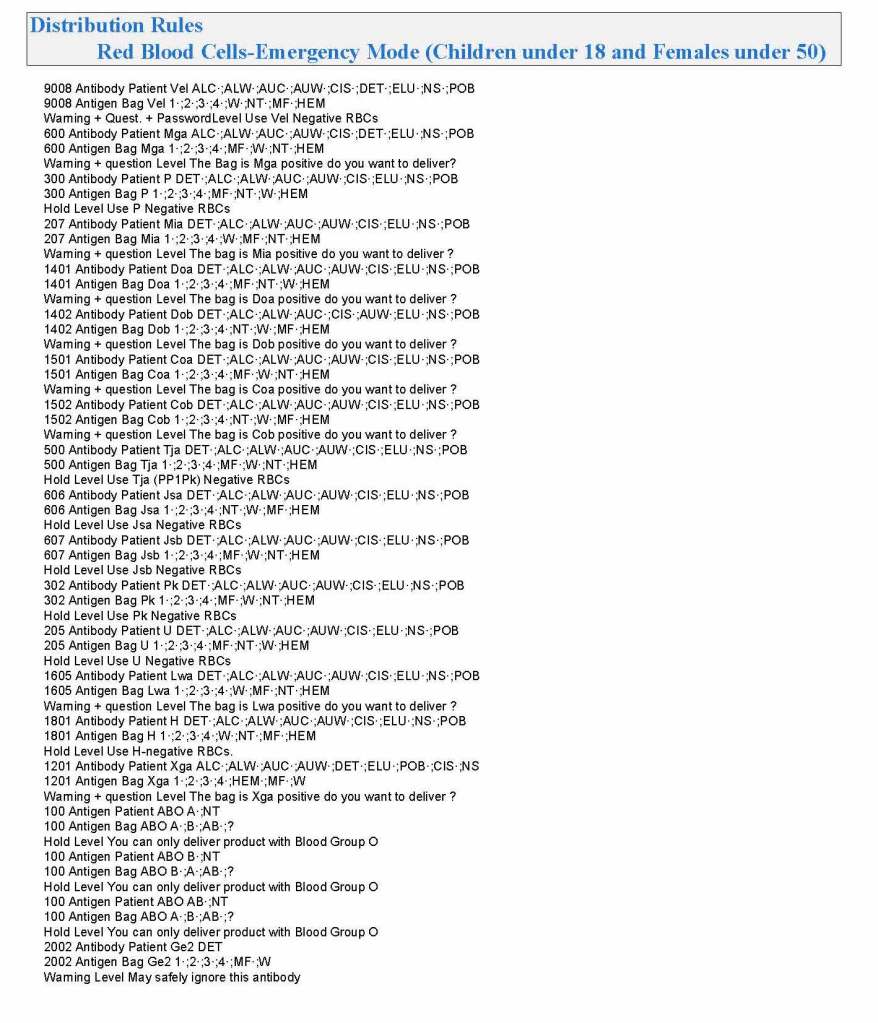
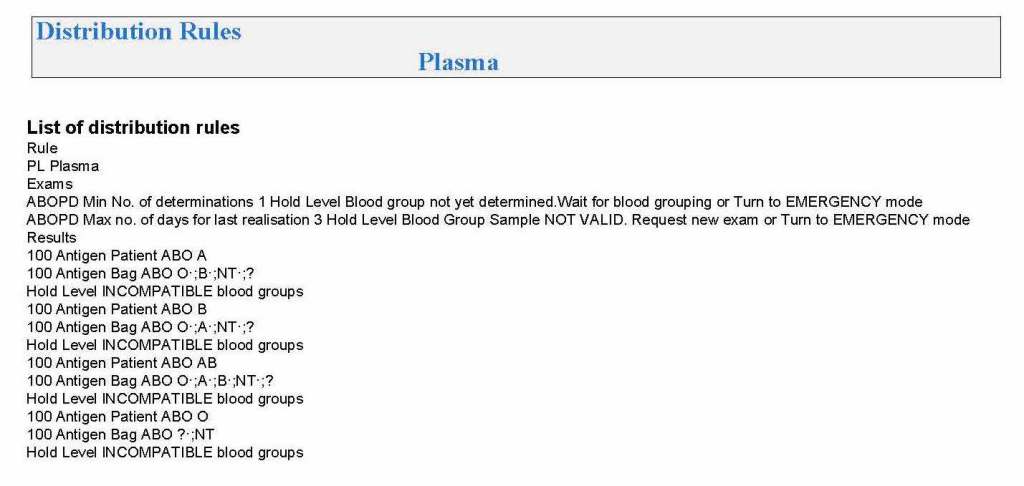
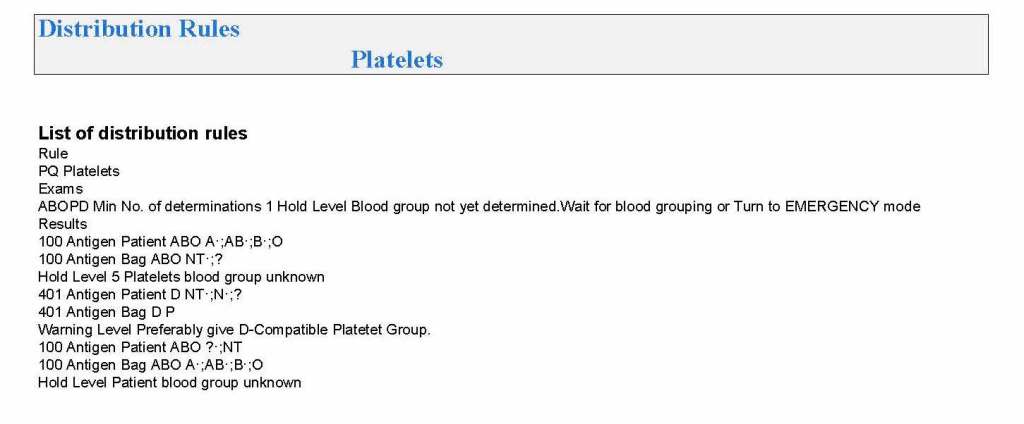
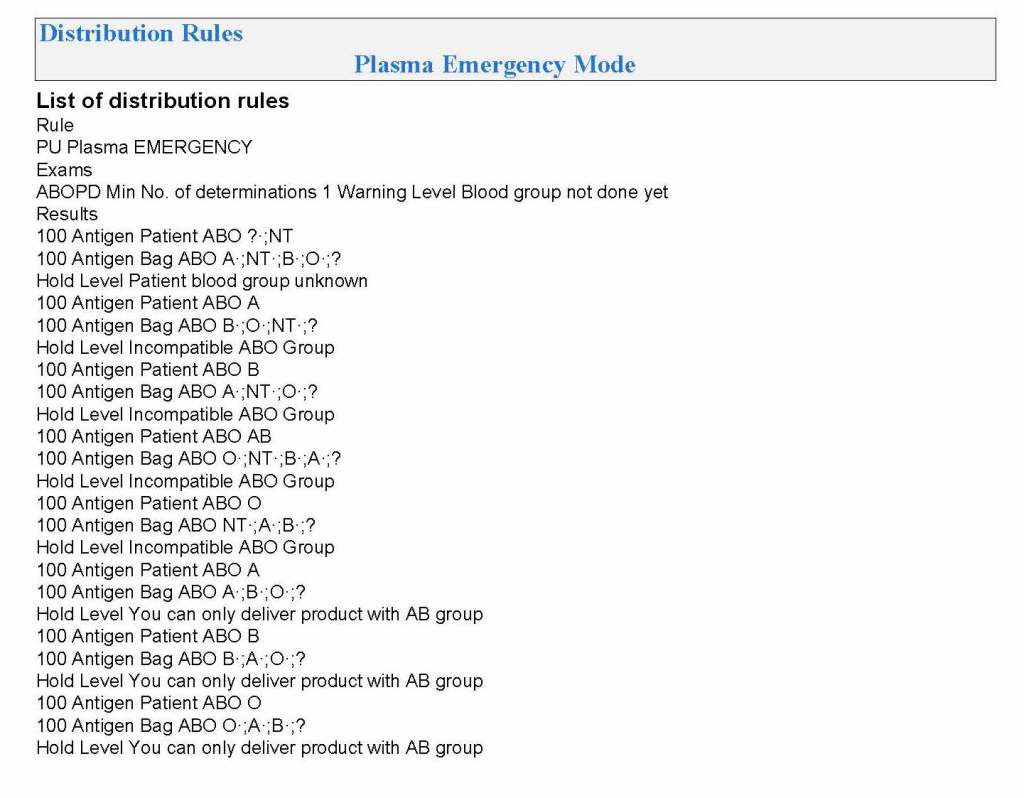
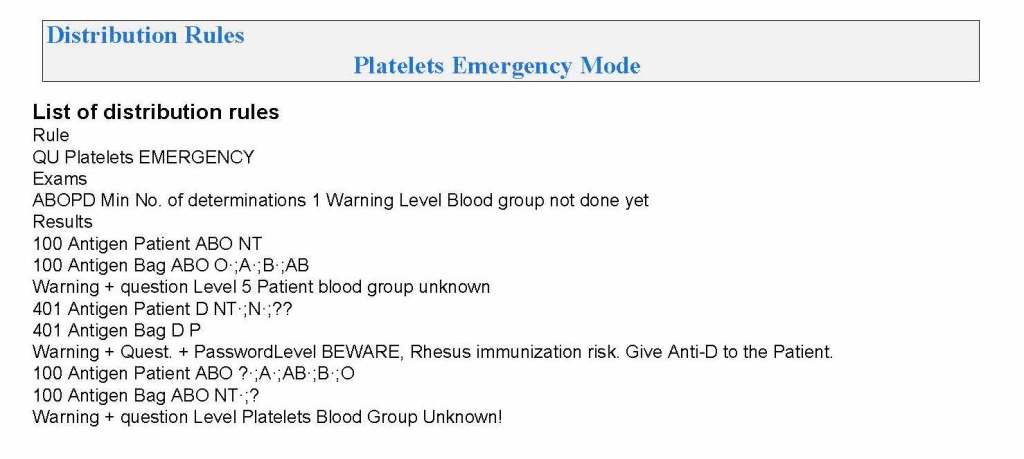
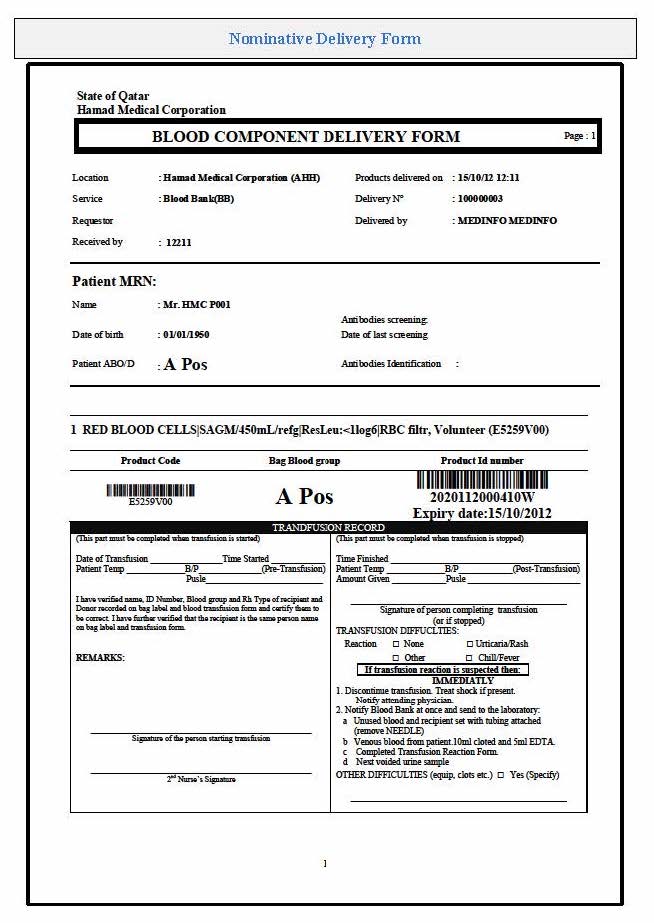
The following are some examples of truth tables, i.e. the rules for interpretation and disposition of interface results actually used at HMC Doha during my tenure there:

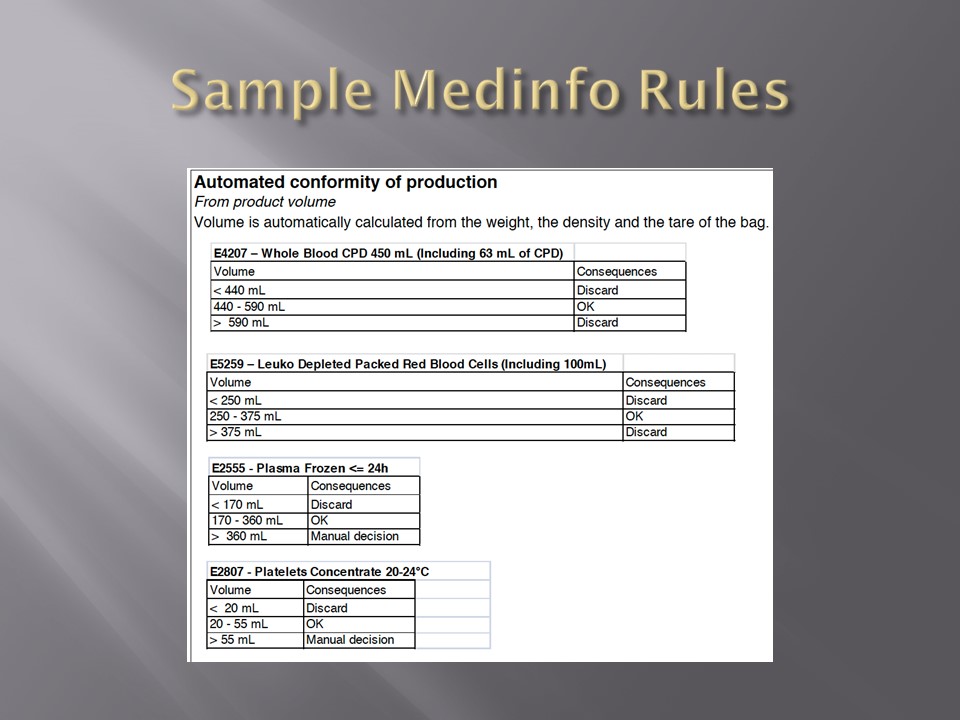
Example 1:  Blood Component Production Truth Table

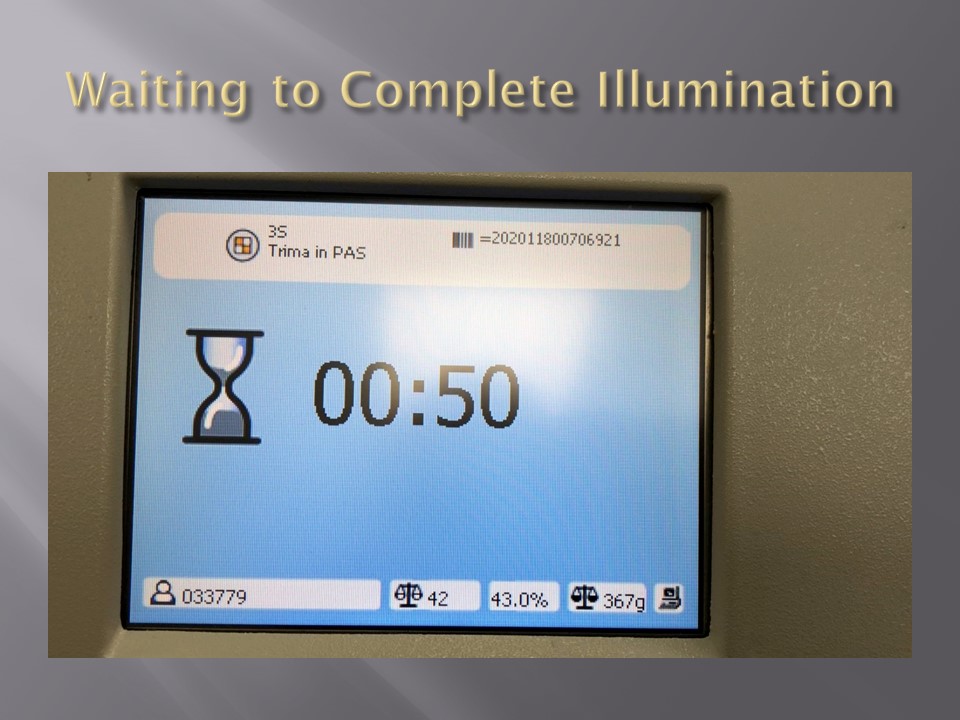
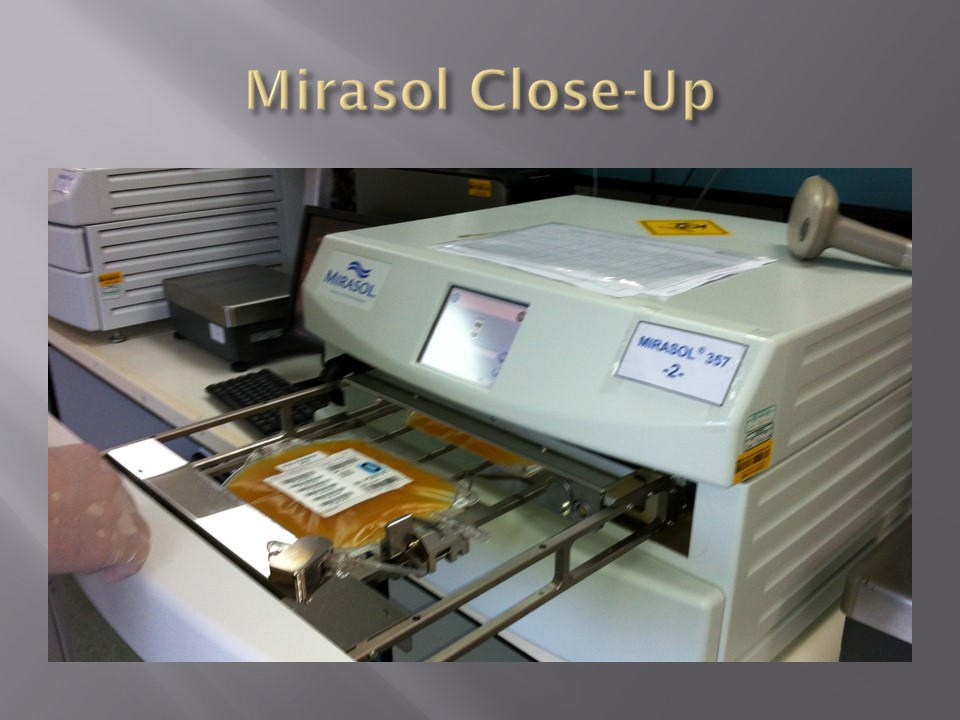
Production can only proceed if the volumes are within the specified ranges.  This is very important if you are going to perform pathogen-inactivation since the ultraviolet illuminator requires a specific range, even more so if you are adding Mirasol (riboflavin) and PAS (platelet additive solution).


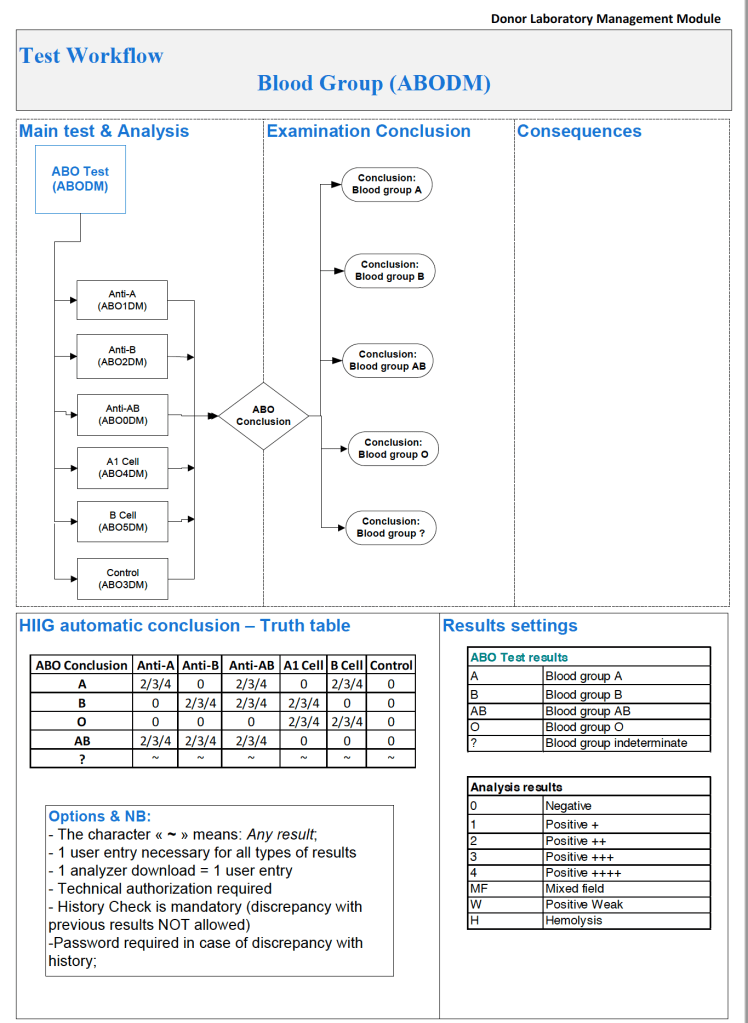
Example 2: ABO/D Antigen Typing:

One manufacturer’s requirements:

Example 3:  Complicated D Typing Algorithm:

The acceptable range for automatic interpretation is much more complicated for D typing with the Ortho Vision MAX and uses 3 different monoclonal cocktails:
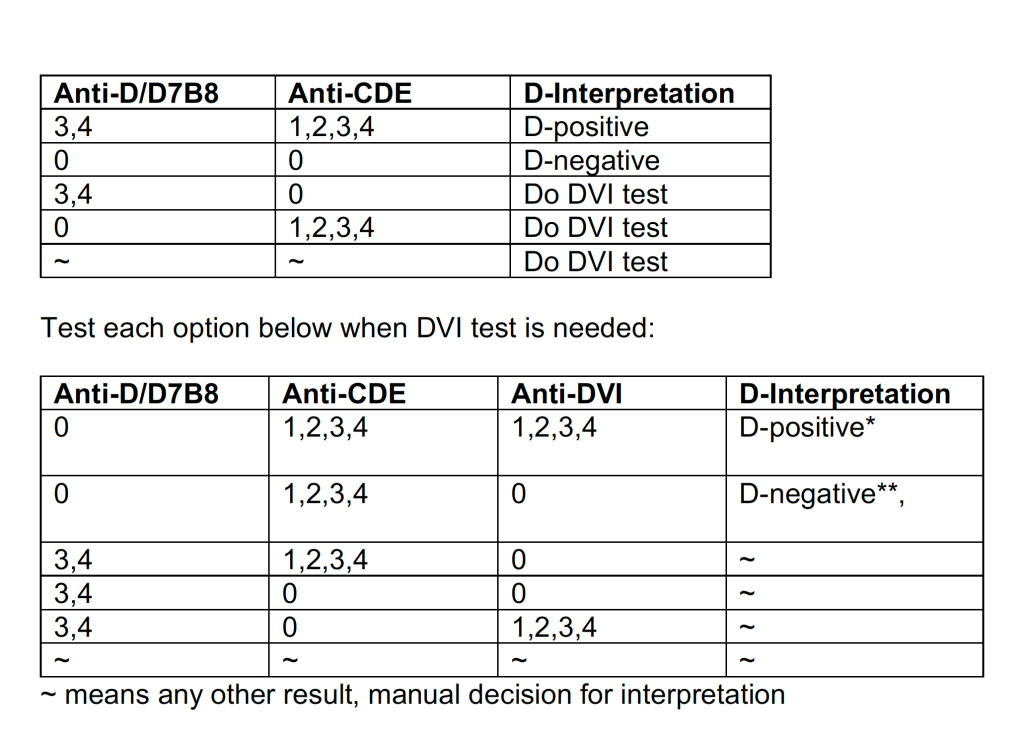
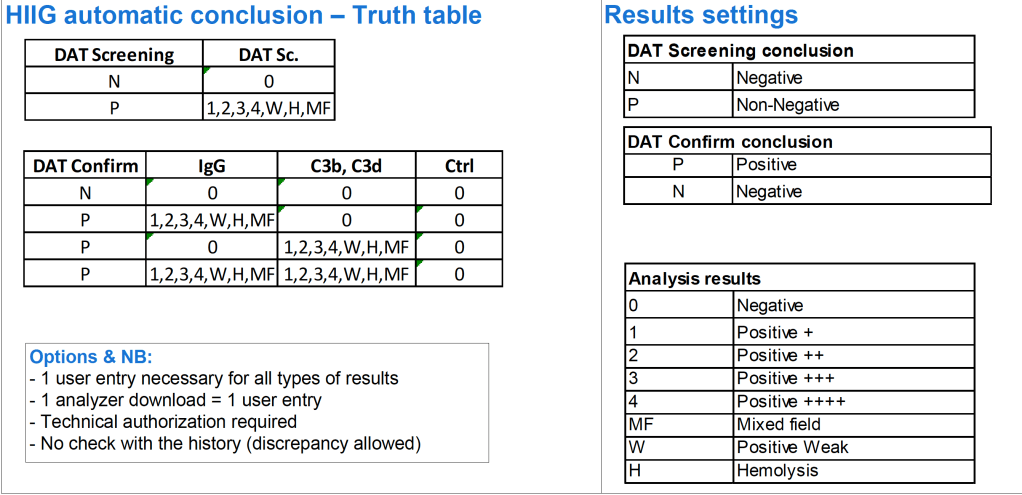
Example 4:  Direct Antiglobulin Test Algorithm:

Both alphanumeric and numeric results are used.
Example 5:  Four-Cell Antibody Screen:

Truth table for interpretation requires both alphanumeric and numeric results:


Conclusion:

If you are fortunate to have a dedicated blood bank software, you may not need middleware.  Otherwise, you may need to use it for linking to general laboratory systems.  Hopefully, your vendors will cooperate with each other.

To Be Continued:

2/7/20

Processes and Software Building 9: Enforcing GMP

Enforcing Good Manufacturing Process Through A Dedicated Blood Bank Software

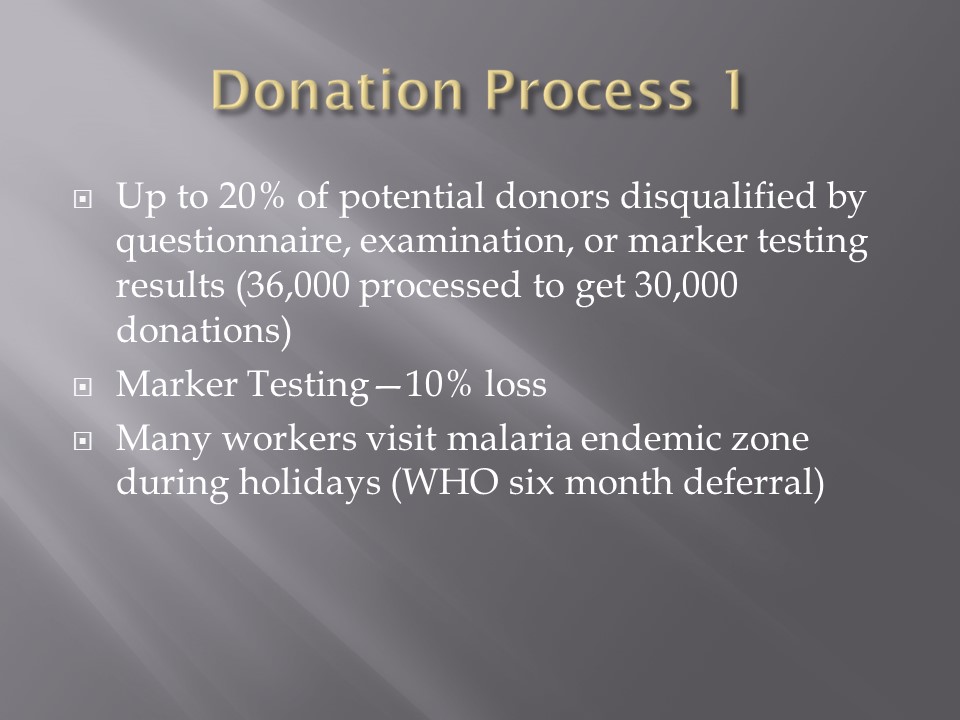
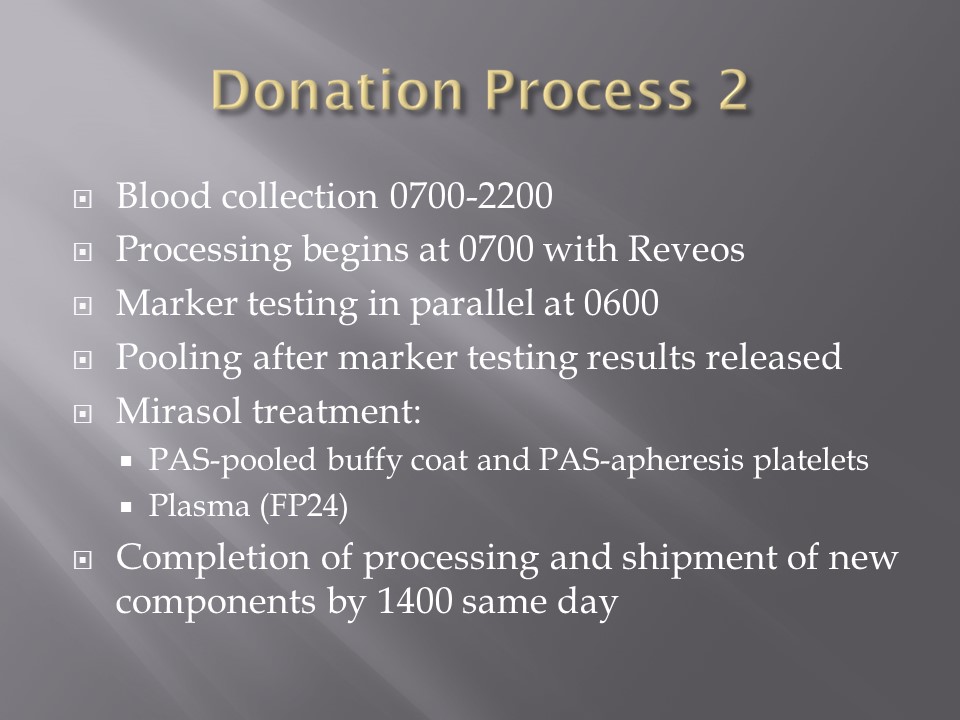
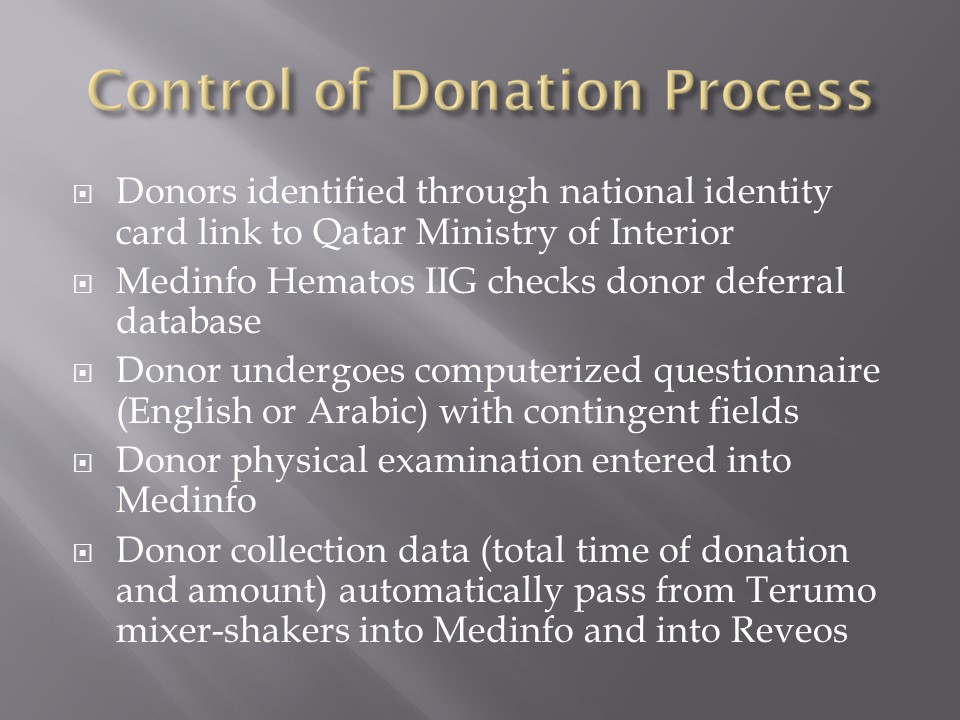
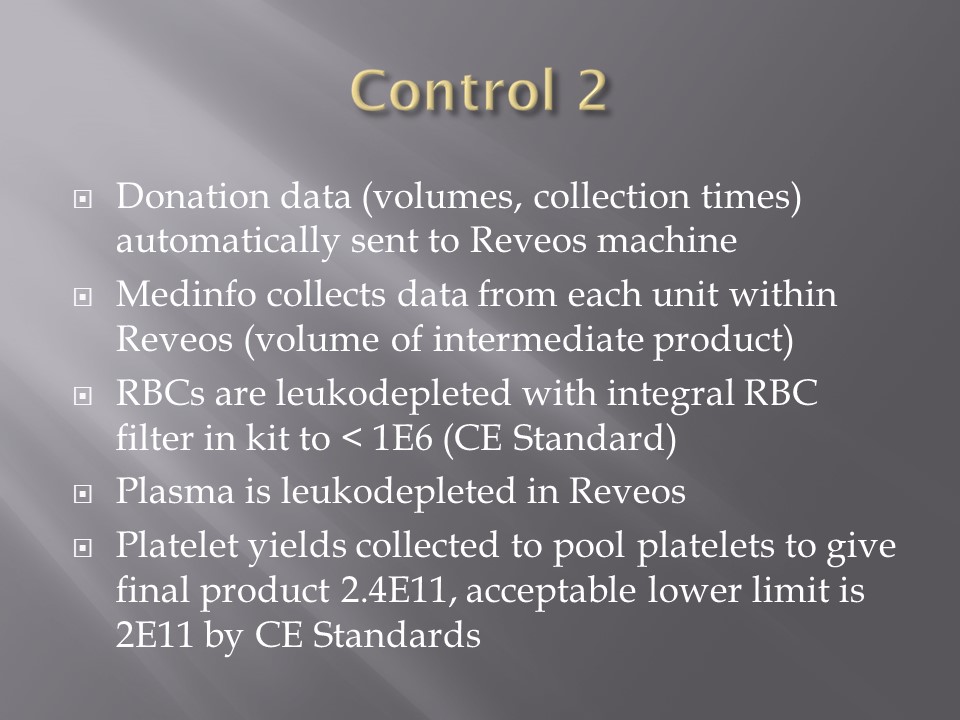
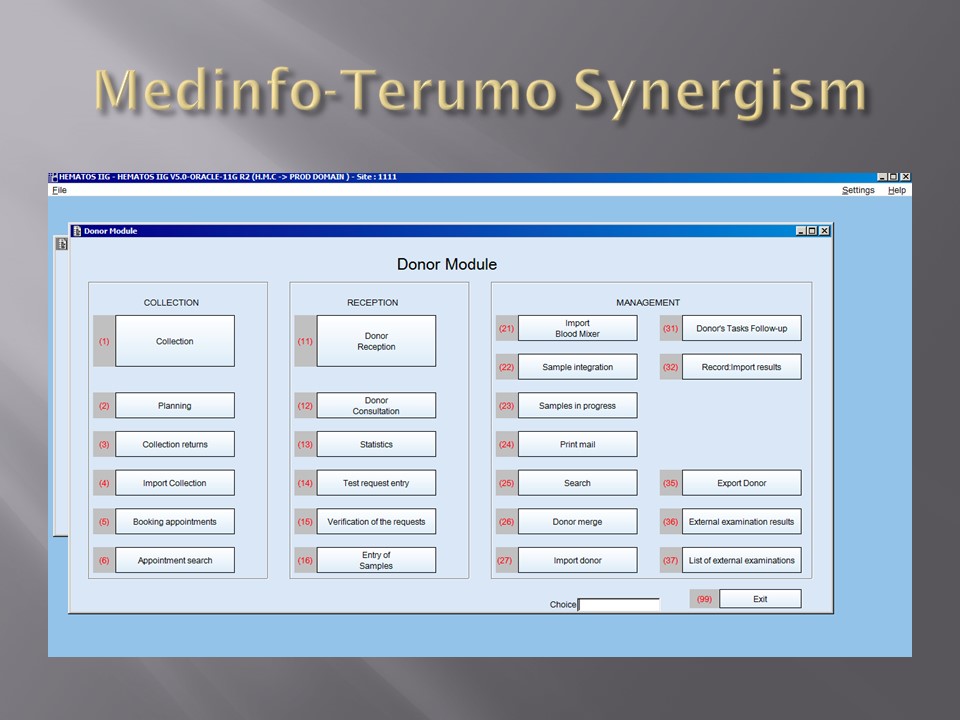
Blood components are a drug and like medications must be consistently produced and follow Good Manufacturing Practices GMP.  The following system that I set up for HMC Doha Qatar blood collection and processing is an example of the impact of Medinfo donor software on enhancing our safety and GMP compliance.  In earlier posts, I provided the Medinfo flowcharts for these processes.

This is an outline of the processes I built in conjunction with the Medinfo software engineers:

  1. Registration:
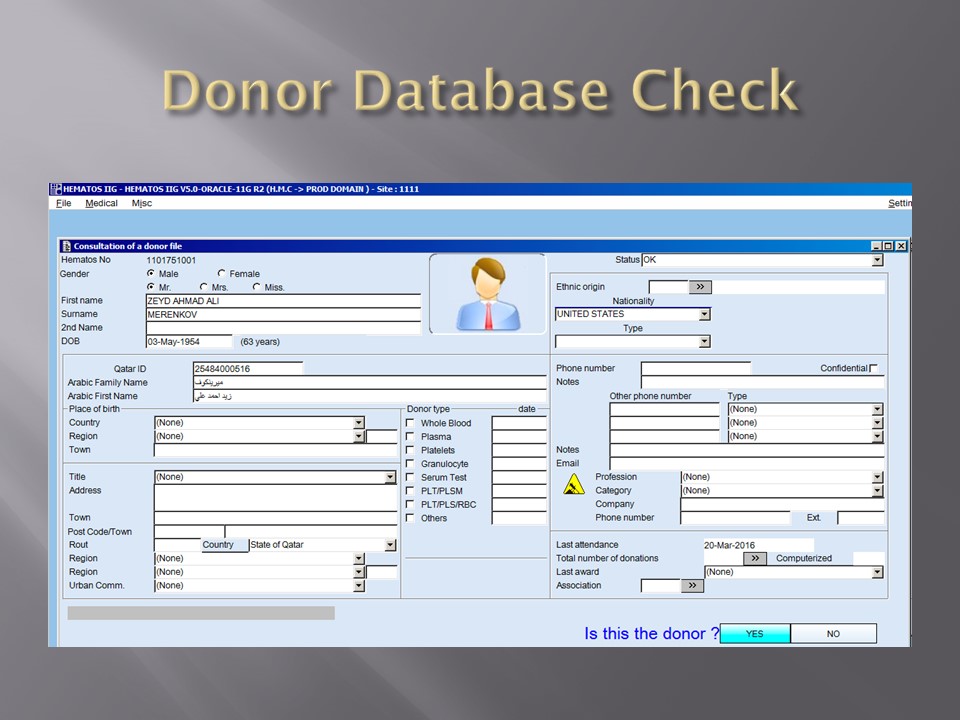
    1. Read the barcode on the specified picture ID (usually a Qatar Residency/Citizen card).
      1. Retrieve the prospective donor’s demographics in English and Arabic from the Ministry of Interior.
      2. Check the donor deferral database (Qatar has only one), defer if contraindicated according to the rules built into Medinfo.
    2. Choose the type of donation (apheresis or whole blood;  volunteer, directed, or autologous).
    3. Print a consent form and ISBT specimen labels for the donation.
  2. Pre-Collection Screening:
    1. Perform the donor questionnaire on-line in English or Arabic:  this has contingent fields and could exceed 60 questions depending on the answers provided.
    2. Proceed to donor physical exam (vital signs and arm check).
  3. Collection:
    1. Collect the whole blood or apheresis component and specimen tubes:  determine if the collection meets the volume requirement and time limit.
    2. Send the specimens for donor marker and donor immunohematology testing.
    3. Send the raw components for processing.
  4. Donor Marker Testing:
    1. Perform NAT, EIA, and LIA marker testing according to algorithms defined in Medinfo.
    2. Perform follow-up reflex marker testing according to Medinfo criteria.
  5. Component Processing:
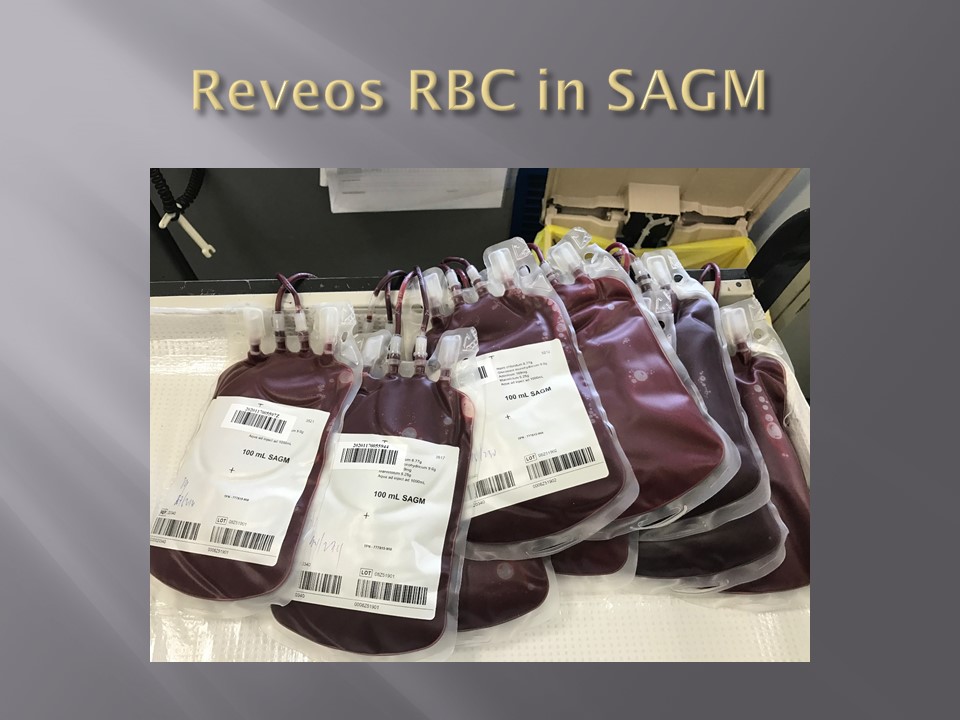
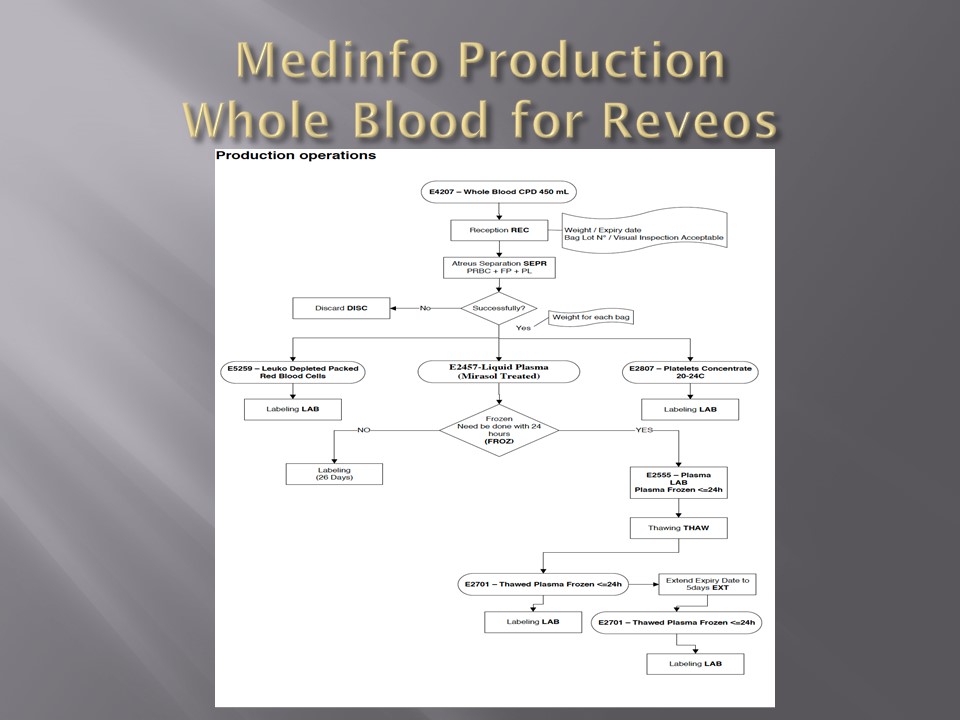
    1. Process the raw whole blood in the Reveos machine into PRBCs, leukodepleted plasma, and buffy coat platelets.
    2. Filter/leukodeplete the RBCs.
    3. If marker test results pass:
      1. Pool the buffy coat platelets according to the platelet yield index for a yield of 2.4E11/dose.
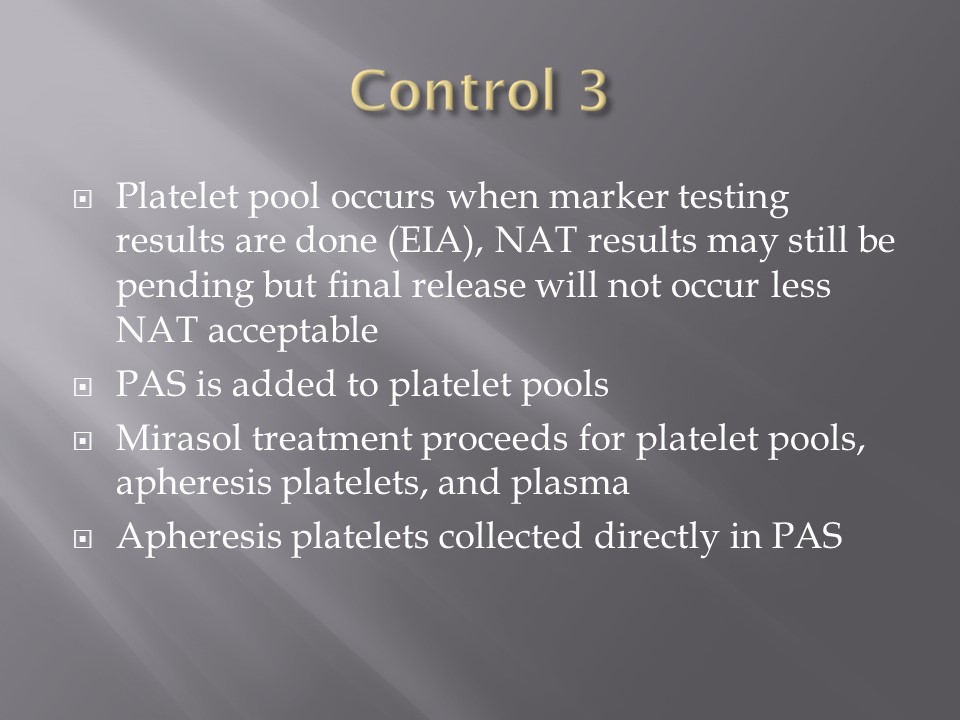
      2. Add platelet additive solution PAS and pathogen inactivate (Mirasol).
      3. Pathogen inactivate the whole-blood-derived plasma.
      4. Divide the apheresis plasma into 200-250 ml aliquots and pathogen inactivate.
    4. Divide the apheresis platelets to provide a yield of 2.4E11 in each dose, then pathogen-inactivate (PAS had been added at the time of the apheresis collection).
  6. Donor Immunohematology Testing:
    1. Perform ABO/D testing and antibody screen (identification if positive):
    2. If antibody screening positive, discard the component.
      1. If ABO discrepancy, send for manual review and approval, otherwise discard.
  7. Labelling, Storage, and Transfer:
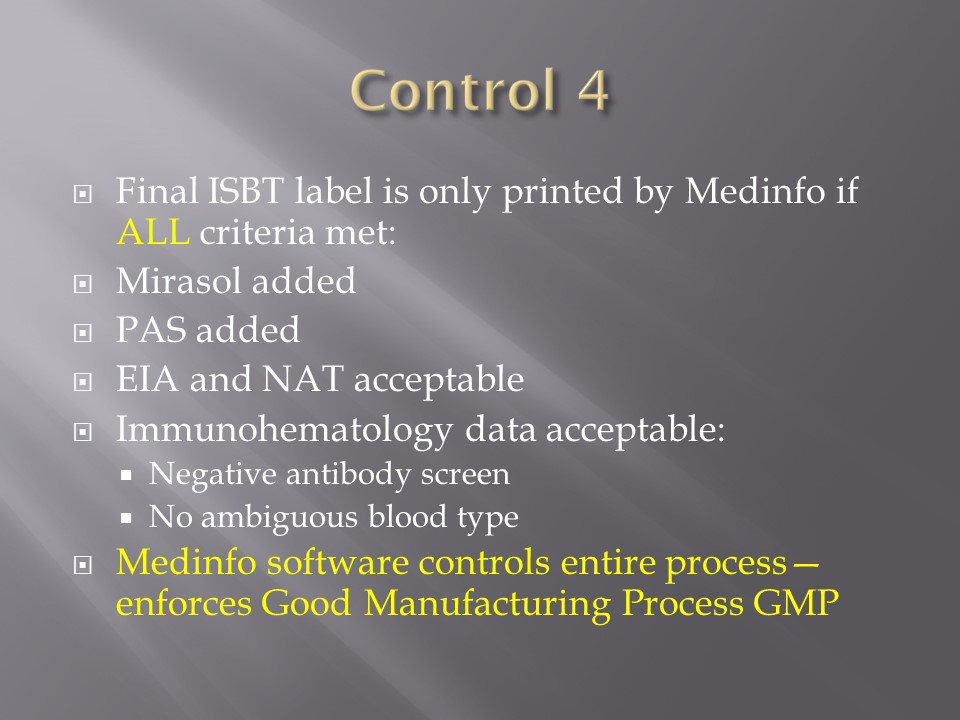
    1. If all criteria were met, attach the final ISBT label (this can only be printed based on the acceptance of each component).
    2. Place the components into storage (37C, 1-6C, or <= minus 18C).
    3. Distribute to the hospital blood banks using Inter-Depot Transfer function.

I emphasize that only if all criteria across all areas pass is the final ISBT label printed.  Medinfo is not a label printing program.  It enforces the rules ruthlessly.  My technical staff tell me that it is merciless—as it should be for patient safety.

Attachments:  None—please refer to earlier posts regarding collection, processing, donor testing, and inter-depot transfer.

28/6/20
Processes and Software Building 8: Reveos and Mirasol

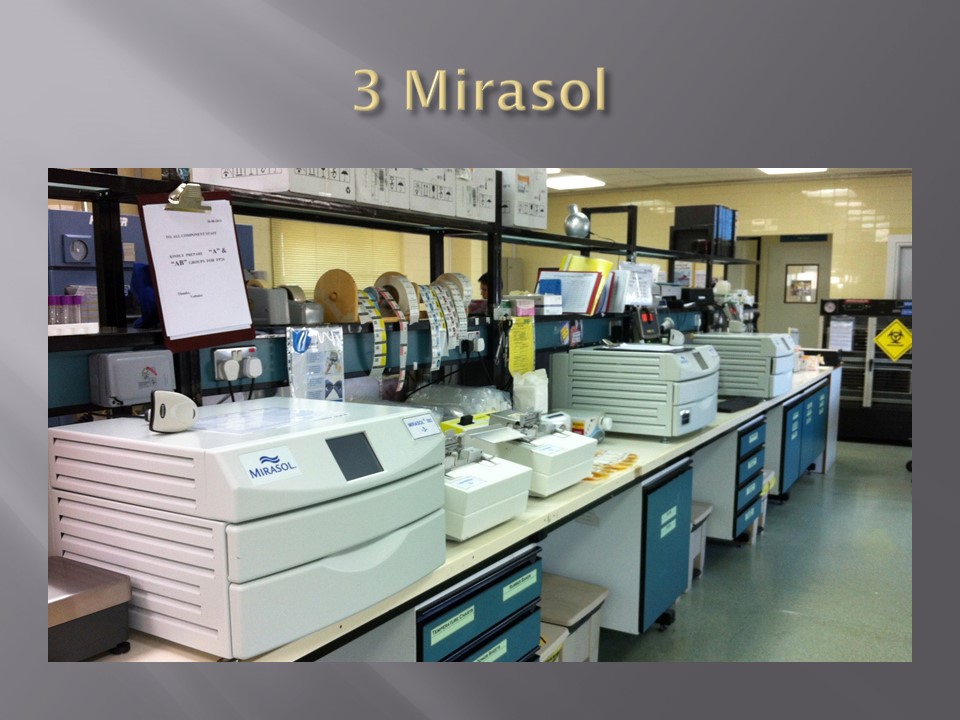
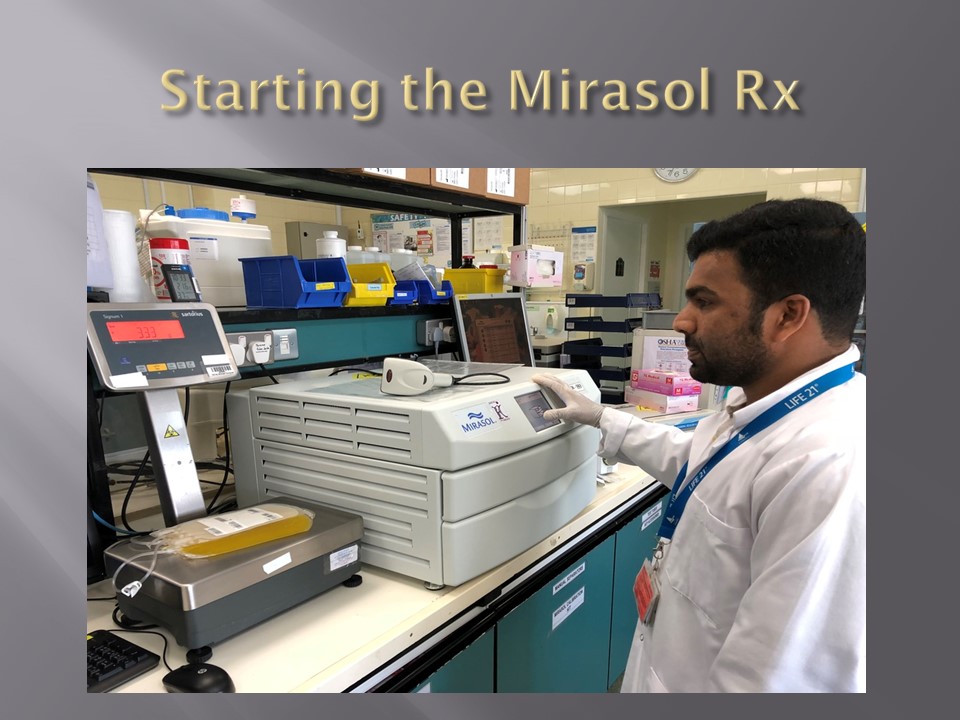
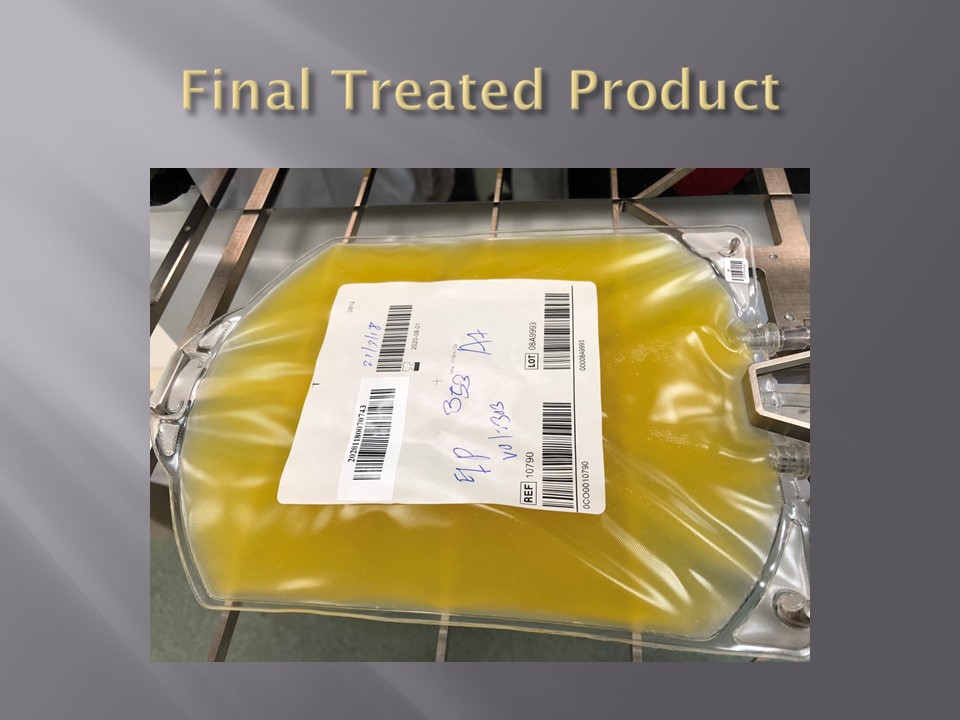
Automated Component Processing:  Reveos and Mirasol Pathogen-Inactivation

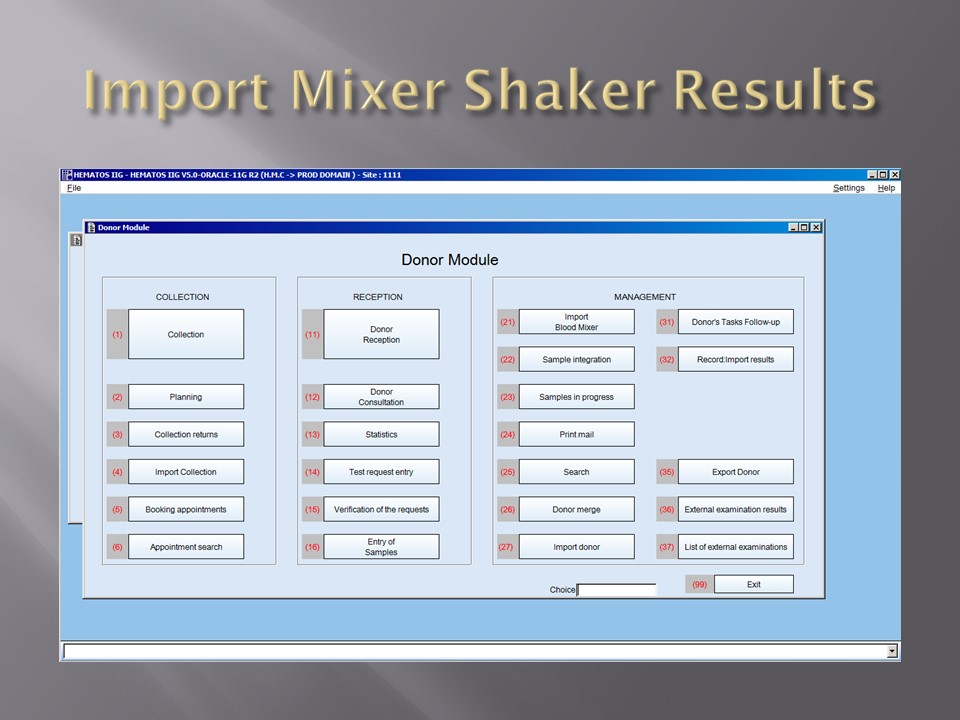
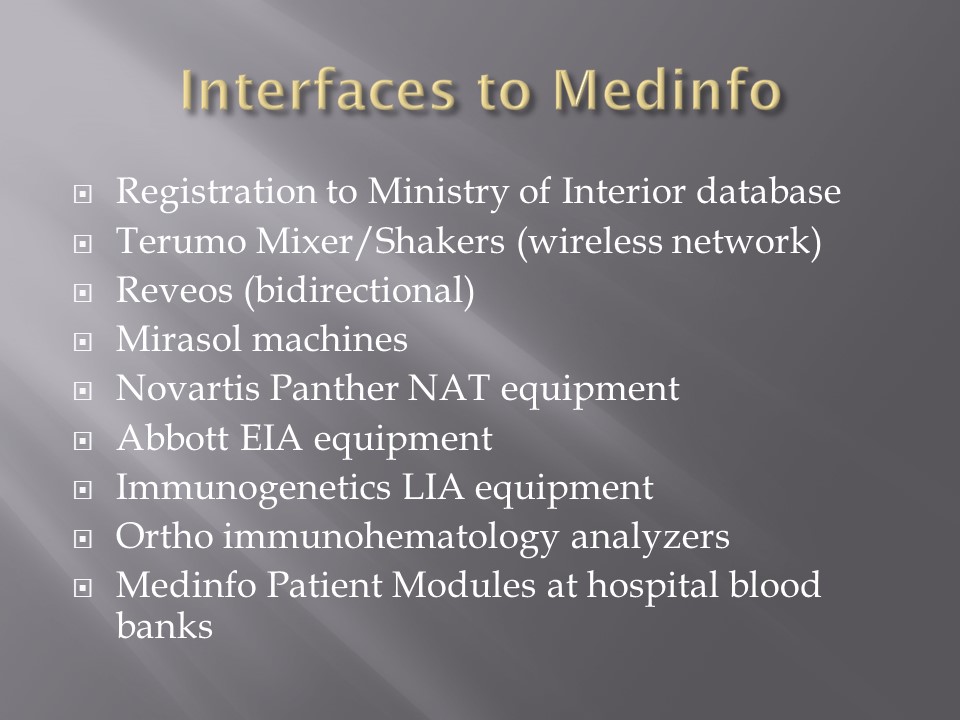
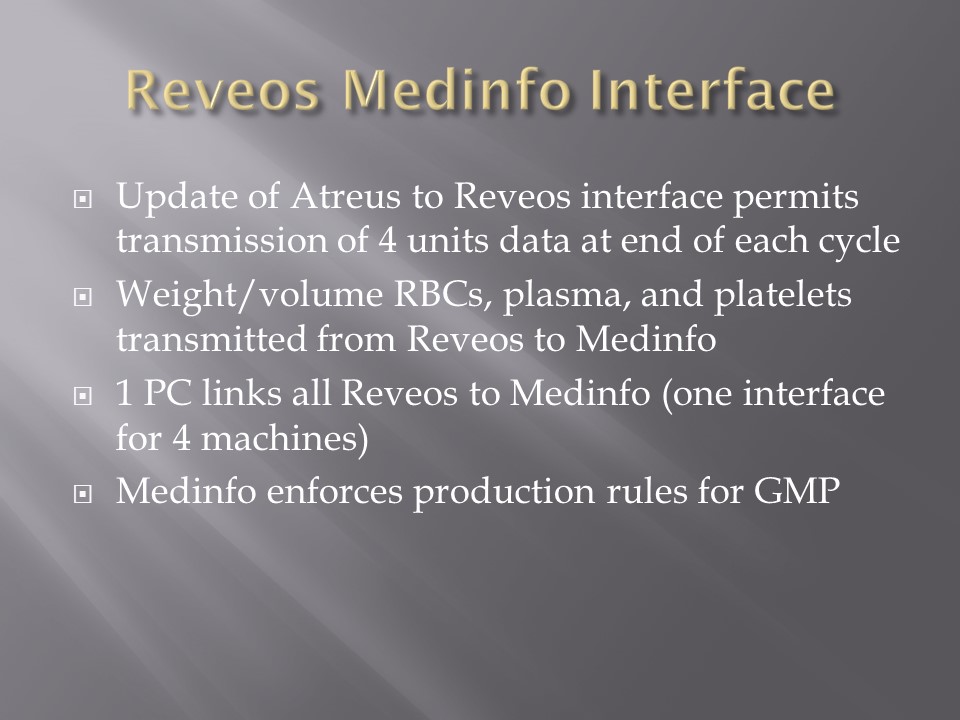
The production instruments have more complicated interfaces than the testing equipment discussed in the previous post:

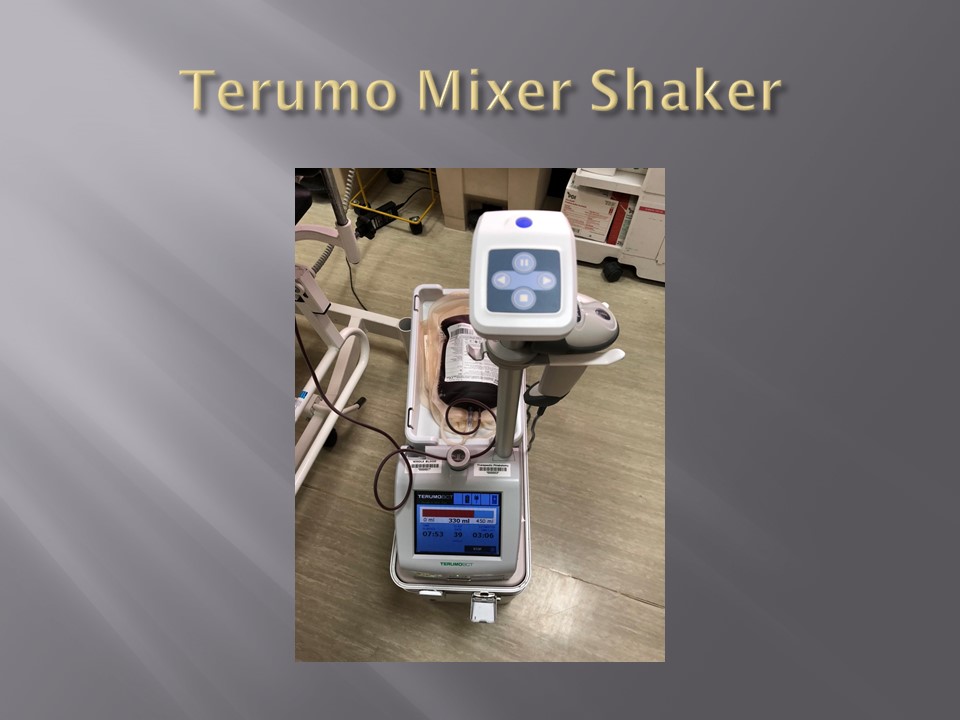
In the collection area (on-site or remote), the cvolume of the whole blood and collection time are recorded in Medinfo and based on the rules, production may only occur within specified volume and collection time.  Otherwise, Medinfo will block further processing.

The ISBT unit number of the whole blood units are read by the Reveos.  Only those units passing the collection criteria will proceed to separation.

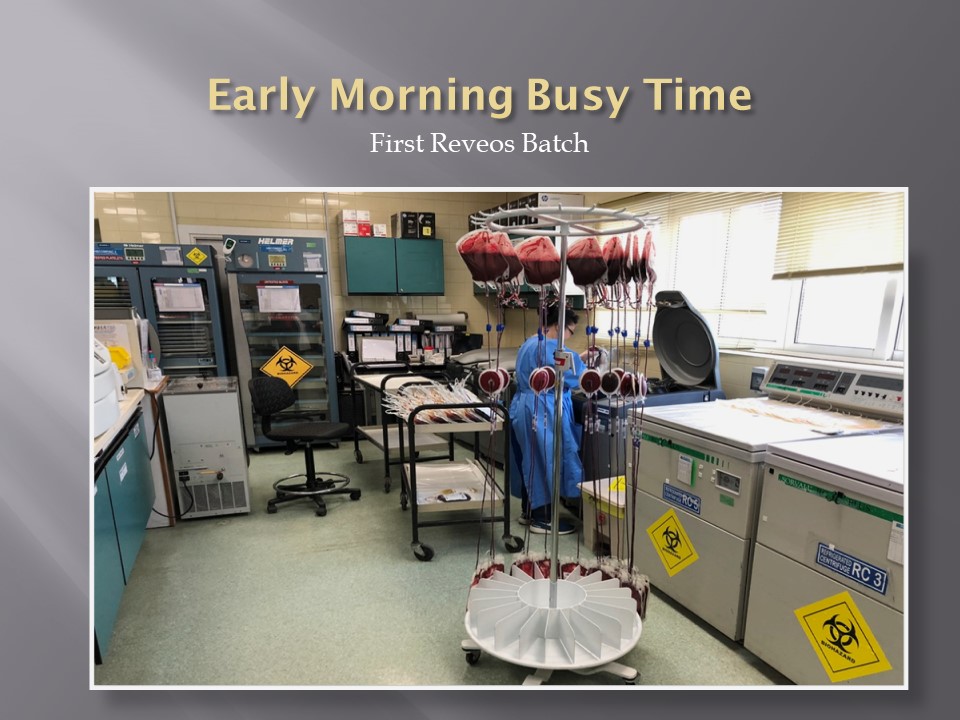
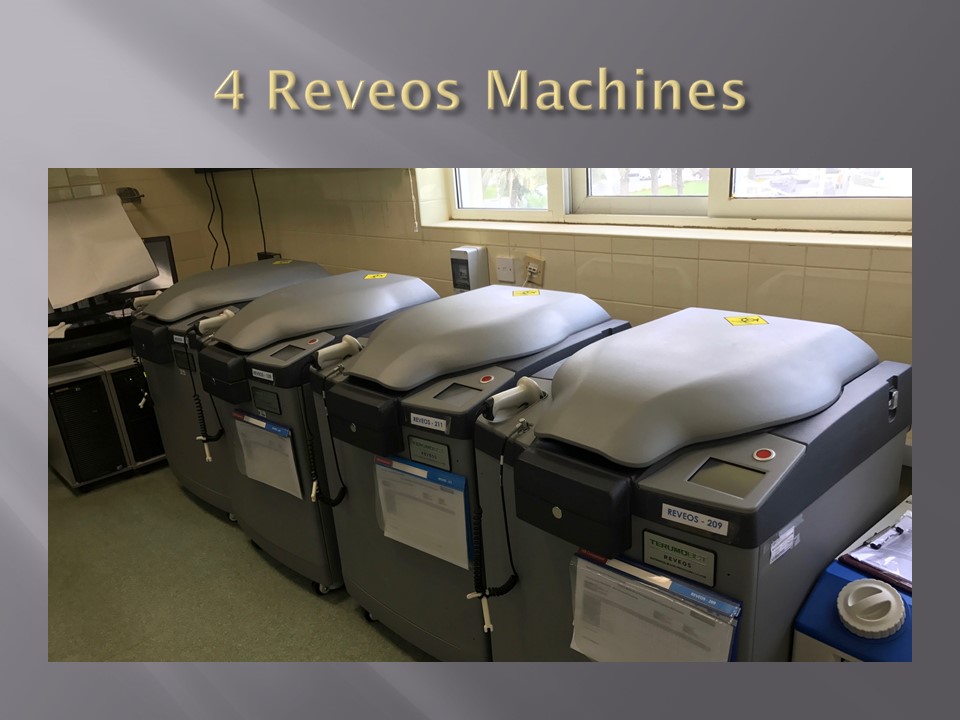
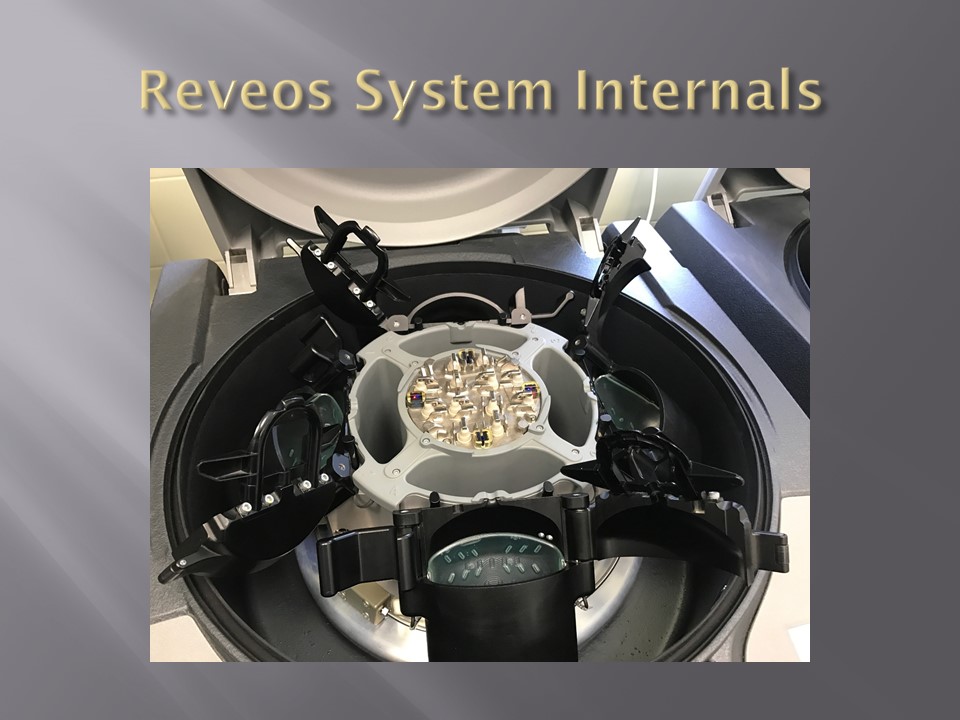
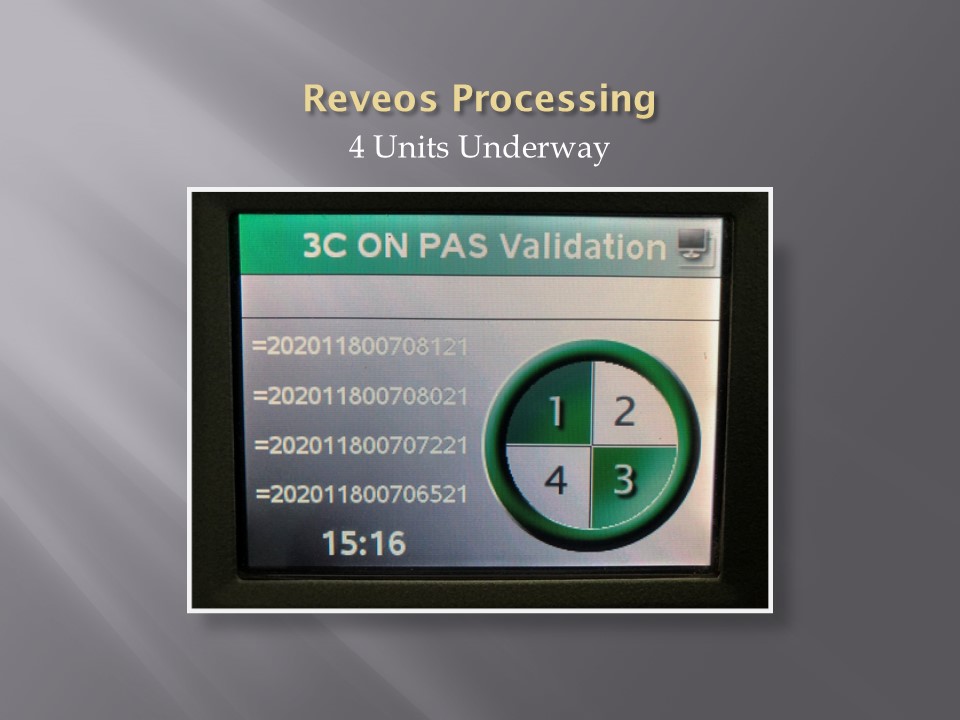
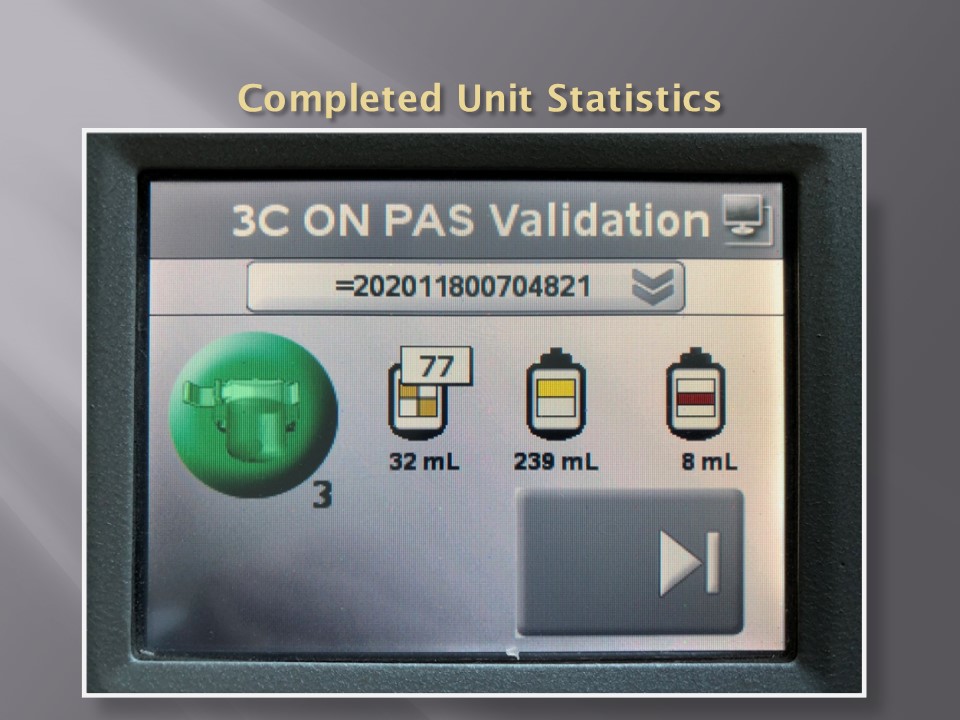
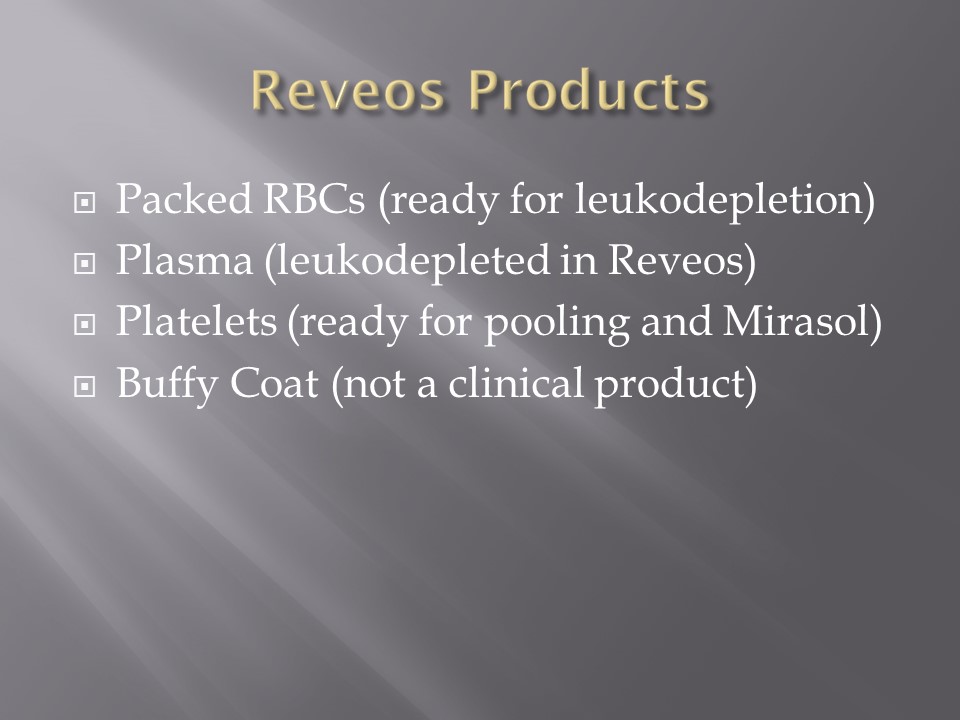
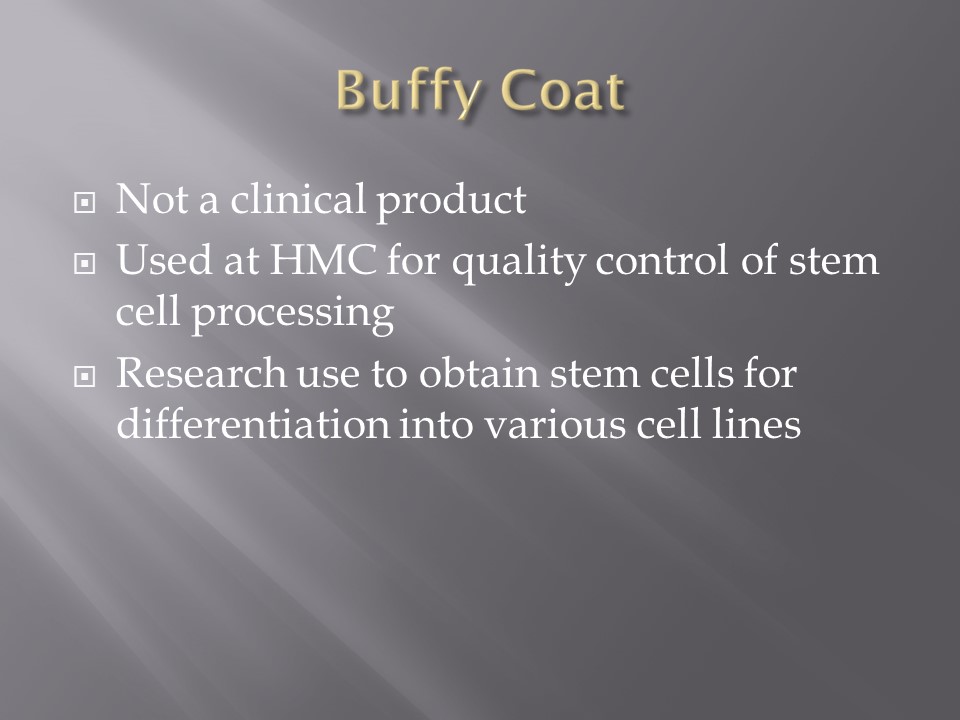
In about 20 minutes, the Reveos machine will simultaneously process four units of whole blood into packed RBCs, leukodepleted plasma, buffy coat platelets, and residual buffy coat.  The volumes of the RBCs, plasma, and platelets are recorded in Reveos.  For the platelets, the platelet yield index is also provided.

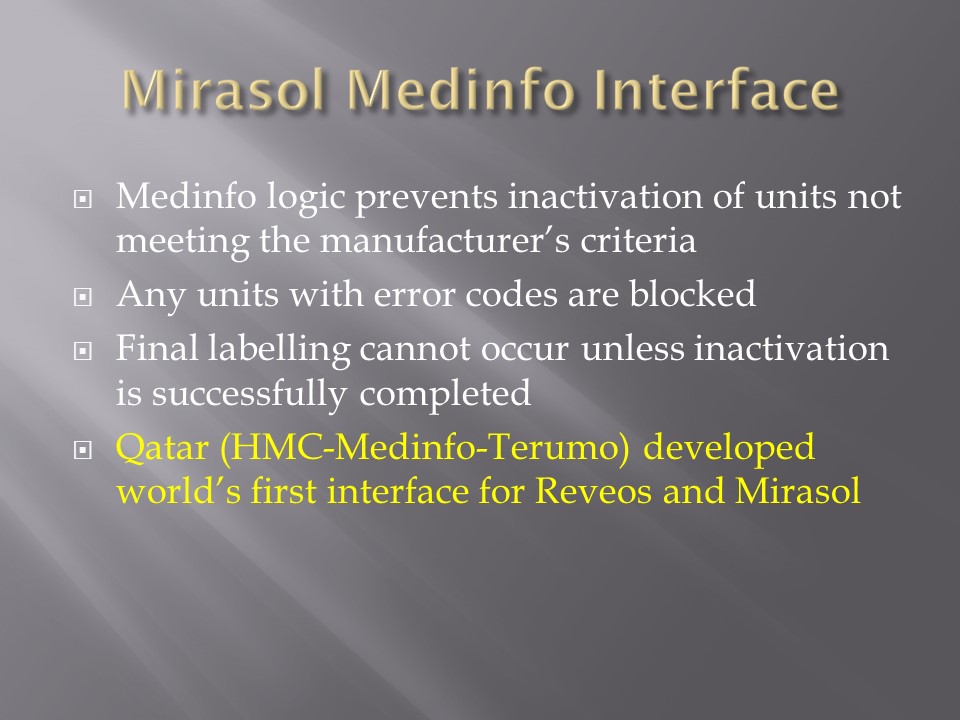
Within Medinfo, these parameters are compared to criteria of acceptability according to the manufacturer.  Volumes for the platelets and plasma must be within certain ranges to permit pooling and pathogen inactivation and additive solution.  Medinfo will not permit these subsequent procedures if the values are out of range and the intermediate components will be discarded.

Here is a sample of Reveos acceptable ranges for component volumes:

E4207 – Whole Blood CPD 450 mL
Volume Consequences

< 400 mL Discard

400 – 500 mL OK

> 500 mL Discard

E5259 – Leukodepleted Packed Red Blood Cells

Volume Consequences

< 230 mL Discard

230 – 330 mL OK

> 330 mL Discard

E2807 – Platelets Concentrate 20-24°C

Volume Consequences

< 20 mL Discard

20 – 55 mL OK

> 55 mL Manual decision

E2555 – FP24:  Plasma Frozen <= 24h

Volume Consequences

< 170 mL Discard

170 – 360 mL OK

> 360 mL Manual decision

All these production parameters are permanently stored in Medinfo as part of the production record of that unit.  The actual location (bucket) of the whole blood unit in the Reveos is also available.

RBCs are manually leukodepleted and the final volumes recorded in Medinfo based on weight.  Based on the platelet yield index, platelets are pooled and the final volume recorded.   Those permissible volumes are next treated with platelet additive solution PAS and then pathogen inactivated.  The acceptable volumes are based on the process used, e.g. platelets in plasma versus platelets in PAS.

How a sophisticated blood bank software like Medinfo enforces good manufacturing process at all stage of production will be a future topic.

To Be Continued:

26/6/20

Processes and Software Building 7: Interfaces 2

Blood Bank instruments may perform tests and release test results in a numerical or alphanumeric format or both.  For example, nucleic acid and enzyme immunoassay may release a qualitative result (e.g. positive, reactive, borderline/grayzone, negative, nonreactive).  Alternatively, the machine may release the signal to cutoff ratio (S/CO) as a numeric result.

Blood bank software may use either kind of result on which to base interpretative rules for acceptability of the donor.  The qualitative result criteria are based on the quantitative SC/O but the equipment automatically interprets this.  The S/CO ratio of 1 is the cut-off point.  Thus a value of 0.99 is negative and the value 1.01 is positive.  But is it really so clear-cut since the difference between the two is so small?  Thus, some people have added the term grayzone for values close to but below the cutoff.  Could a value of 0.95 be an early infection?

I personally prefer to see the actual cutoff but use the manufacturer’s criteria for interpretation.  As a physician, it is good to review the S/CO on serial exams.  If a borderline or grayzone result becomes positive, then perhaps the original result indicated early infection.  The question still remains, what is the grayzone?  0.95 to 0.99, 0.90 to 0.99, etc.  Some accrediting schema have not used grayzone for interpretation.

With Medinfo’s blood bank software, I could chose either option or both—or at least store the S/CO as a nonreported result for subsequent review.  I could even chose, test by test, in a series between reporting either S/CO or the qualitative result.

Semiquantitative results, e.g. in {0, 1+, 2+, 3+, 4+} are qualitative and could also include mixed field (mf) and hemolyzed (h).  I showed examples of this with ABO/D antigen typing in a previous post—see attachment.

On the contrary, the results from blood production equipment may include parameters such as time of preparation, original volume, final volumes for each component, platelet yield index as an indirect measure of platelet count.  When there is pooling, the final total volume is critical to determine if pathogen-inactivation procedures and platelet additive solution can be used.  This is a much more complicated interface.

The blood production equipment interface issues will be considered in a future post.

Attachment:

ABO/D sample typing process in Medinfo

To Be Continued:

24/6/20

Inter-Depot Transfer: Further Thoughts

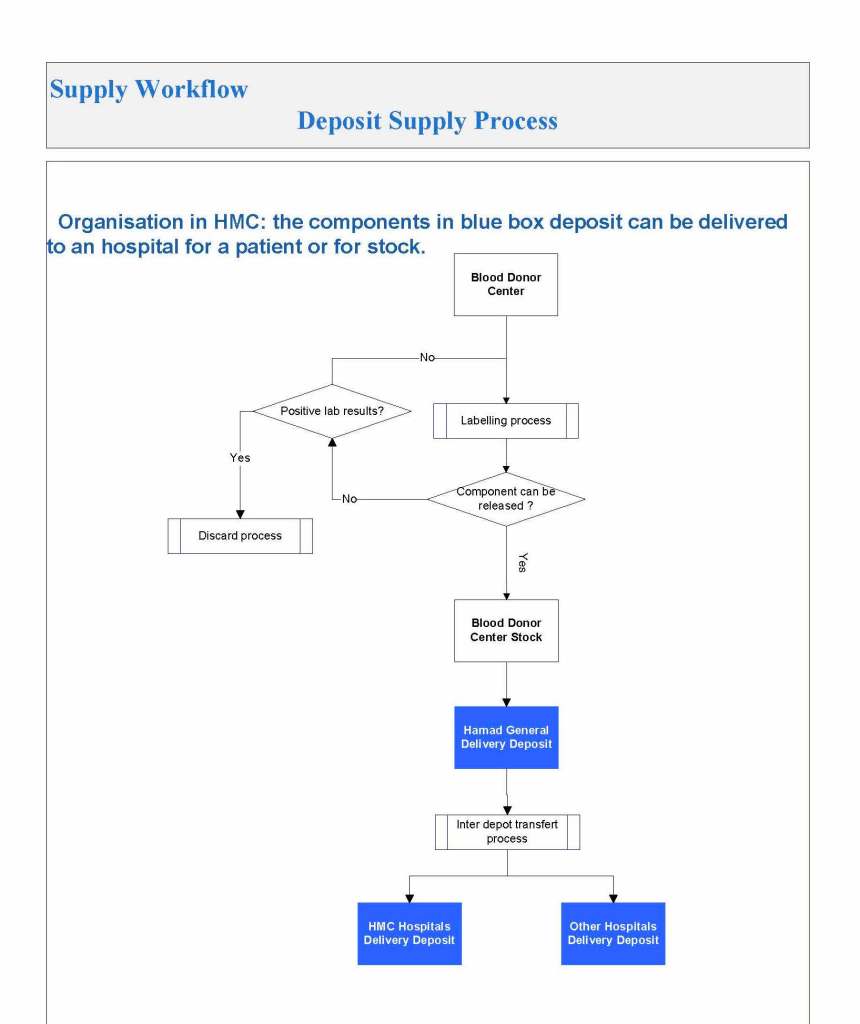
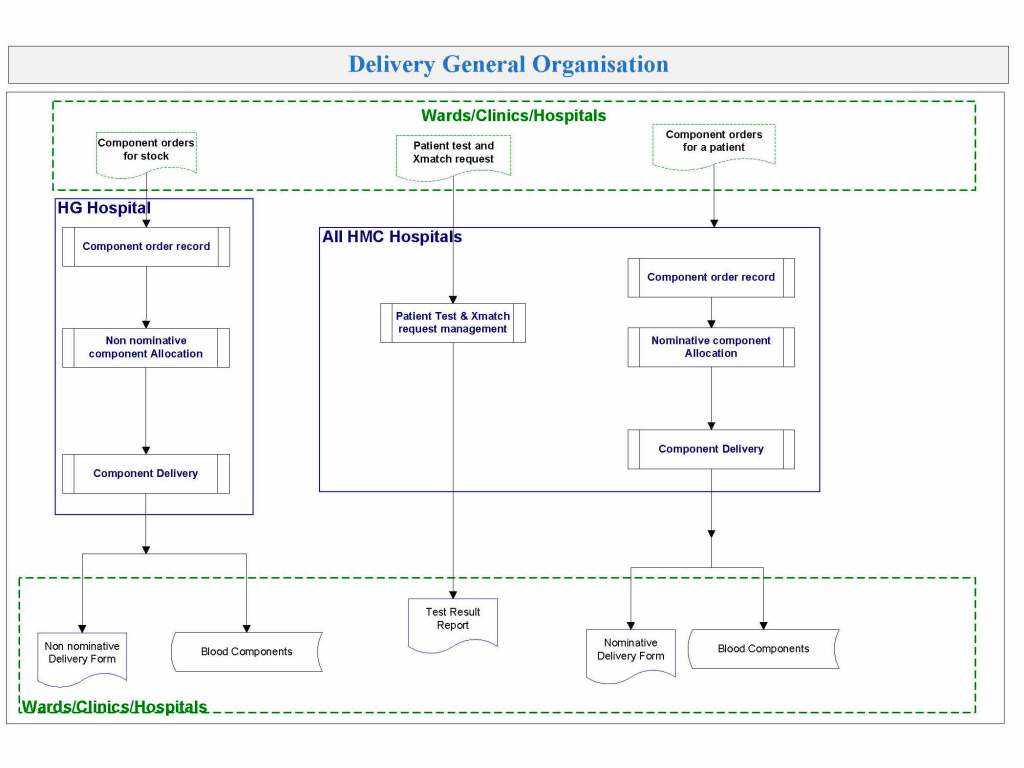
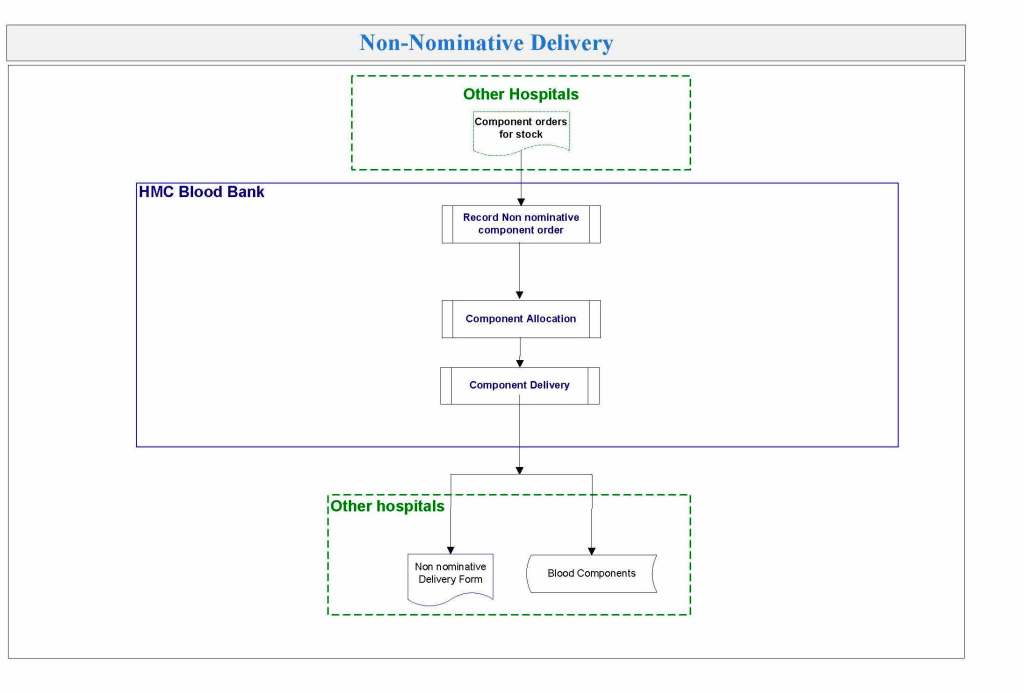
In my recent post, I provided sample flows and parameter mapping for delivery of blood components.  The final components from the component preparation center may be sent to various depots (freestanding location and/or hospital blood banks.  There should be complete traceability for every step (from donor reception, collection, testing, and processing) transport between locations, and finally the exact storage site, which might include which refrigerator/freezer/incubator and even shelf/position number for each component is stored.  The end of that document showed rules for type/antigen matching.

For disaster planning, rapid inventory enumeration by type is very important.  This can be very time-consuming manually.  With our Hematos blood bank system, we could quickly get total inventory across the Qatar or by hospital in less than one minute.  We could also quickly find antigen-matched units across the system and reserve it at any one site for another if necessary.

Smart blood bank dispensing refrigerators, as offered by Haemonetics and Angelatoni, may also serve as depots and take the place of a hospital blood bank for some dispensing.  These solutions can also capture vital information about the storage conditions of the components and prevent release if the storage criteria are not met.  They can also interface with blood bank computer systems and use the main system’s logic for the dispensation rules.

Upon receipt at the hospitals from the blood processing center, the forward ABO and D typing must be confirmed.  We used D reagents which detected partial D so that we would call such donor units as D-positive.  However, if a patient type reagent insensitive to partial D types were used, it is possible for a unit to be typed as D-negative whereas in the donor center it might be D-positive.  Sometimes, nothing types consistently as D-positive:  all you can say is that with a particular reagent and lot number, there is or isn’t reactivity.

The greatest complexity is for RBCs since potentially so many antigens exist.  Criteria for matching/ignoring certain antigens must be made.  Critically significant antibodies such as the Kell, Duffy, Kidd, and certain Rh (D and c) must be antigen matched.  A robust blood bank computer system can enforce these rules.

For other components, antigen/typing may be less important.  In fact, in most situations, any type of platelets can be given to anyone (except neonates).  Despite the potentially incompatible plasma, there is rarely significant hemolysis.  In fact, if pooling platelets without regard to blood types is done, a platelet transfusion is a common cause of a positive direct antiglobulin test DAT—something that is not clinically significant.  No one died of a positive DAT by itself for this reason.

Specific rules for compatible plasma types are important, but nowadays, low-titer group A plasma may be used like universal AB plasma.  The challenge is to be able to perform the ABO titration (specifically anti-B) quickly—titration can be a slow process, even with automated equipment.  A similar situation for low-titer, universal group O whole blood requires both anti-A and anti-B titration (I will return to this topic in a future post).

Overview: Inter-Depot Transfer and Allocation of Blood Components

While I was working in Qatar, this was the overall process for transfer and allocation of blood components. Once they were finally labelled (only possible if all criteria had been meet), they were transferred from the Blood Donor Center BDC to Hamad General Hospital Blood Bank, from which they were distributed to all hospital blood banks in Qatar. Similarly, units could be transferred between the various hospital blood banks.

One could track components as being in:

  1. BDC
  2. Transit BDC to HGHBB
  3. HGHBB inventory
  4. Transit HGHBB to another hospital blood bank
  5. Transit between any two hospital blood banks

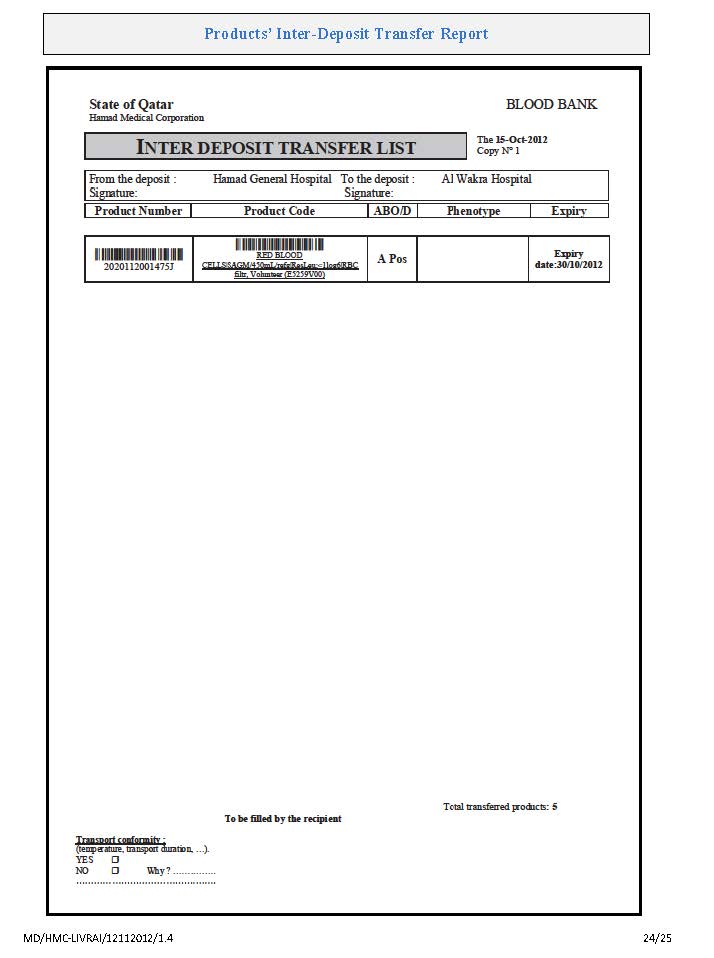
An inventory manifest would be printed to show all transferred units.

For patient use, allocation rules applied which would determine if an electronic or a full antiglobulin-phase crossmatch could be used and whether specific antigen-matched components were required.

There were also separate rules for emergency release if the standard criteria could not be met.

Active Inventory Management: Further Discussion

Yesterday’s post showed my active blood inventory management scheme for my previous position in Qatar.  I thought today I would elaborate on how I adjust the inventory based on critical shortages and planning for disasters and other major events.

I always review the critical shortages to check for atypical usage (e.g. a disaster situation) or production issues (equipment breakdown, shortage of donors during holiday period).

If it is due to increased utilization, I try to adjust the critical and desirable inventories upward to cover the shortfall for future events.  However, it is not always possible if the event is a one-of-a-kind situation unlikely to recur.  Also, I must take into account the available resources (supplies, kits, manpower, equipment) to see if I can cope with the increase.

If it is due to resource issues, I see if I can bolster those by recommending increases or improving utilization of what is available.

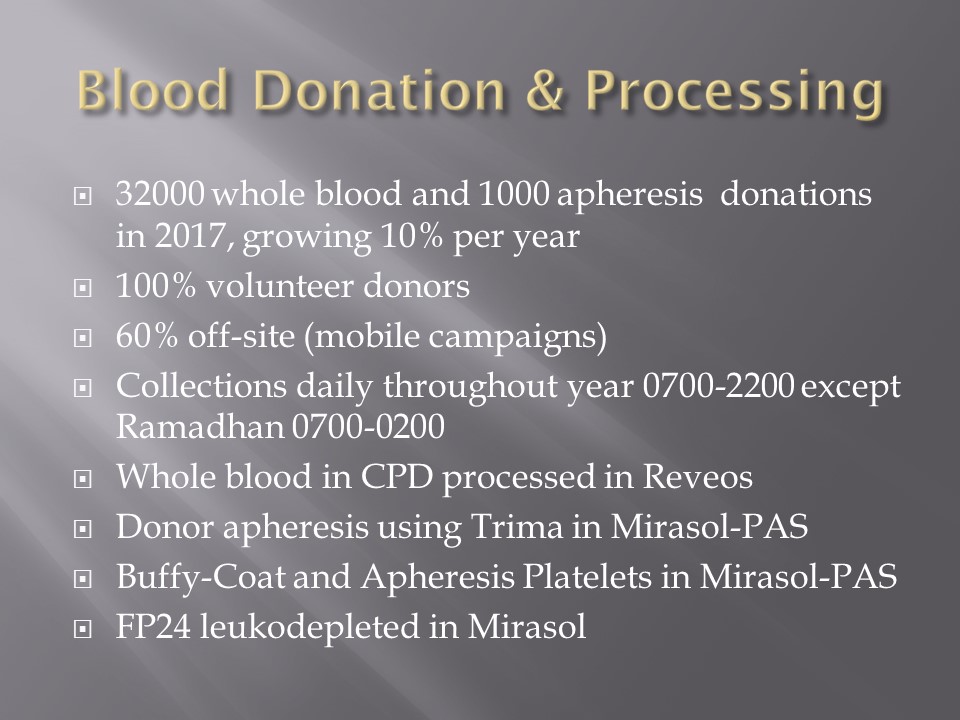
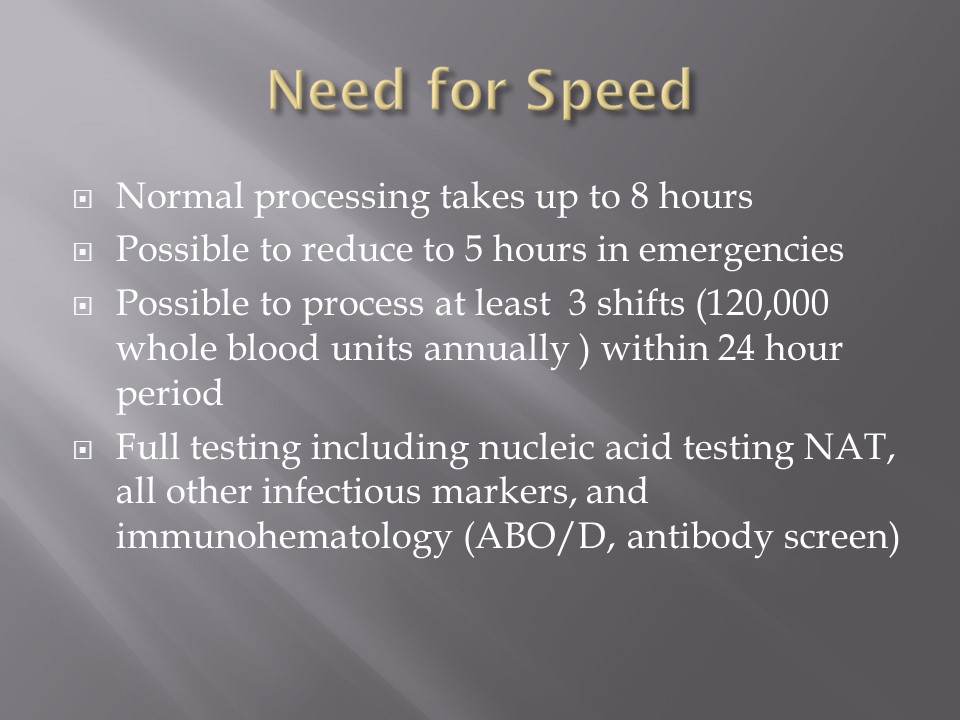
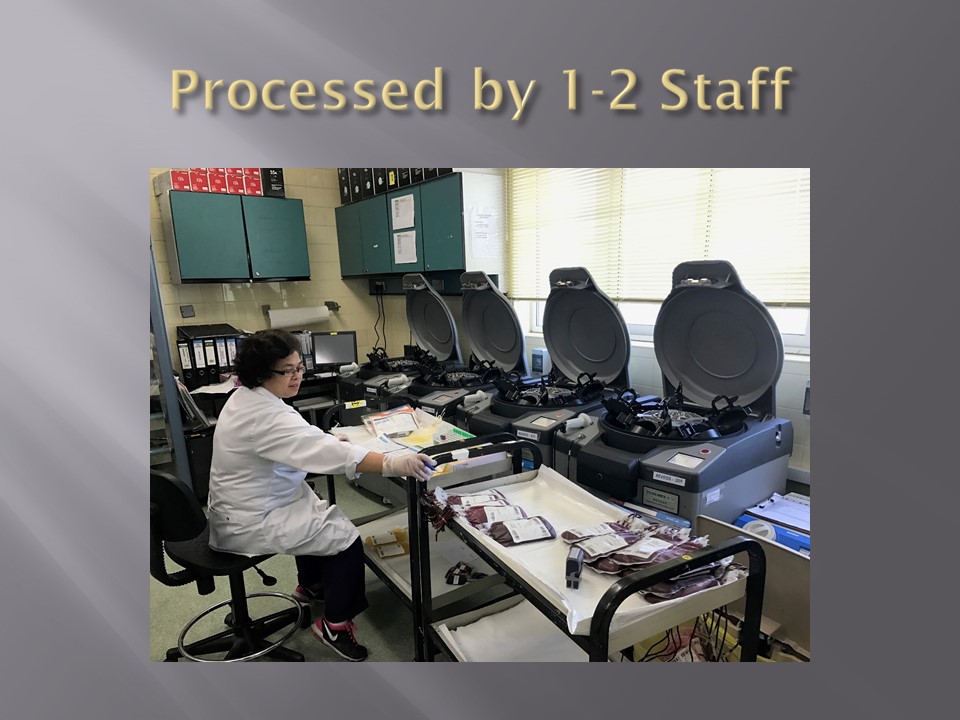
Very important is through-put:  How quickly can I produce components from whole blood or apheresis components?  This was one of the major reasons we shifted away from PCR to other NAT testing with single-well processes since to minimize the need to make additional runs (Grifols Panther System).  Also, automated component processing can greatly speed production (one Reveos can process four whole blood units in about 23 minutes or about 12 units in 75 minutes.)  Those staff can be busy with other tasks while the machines are working.

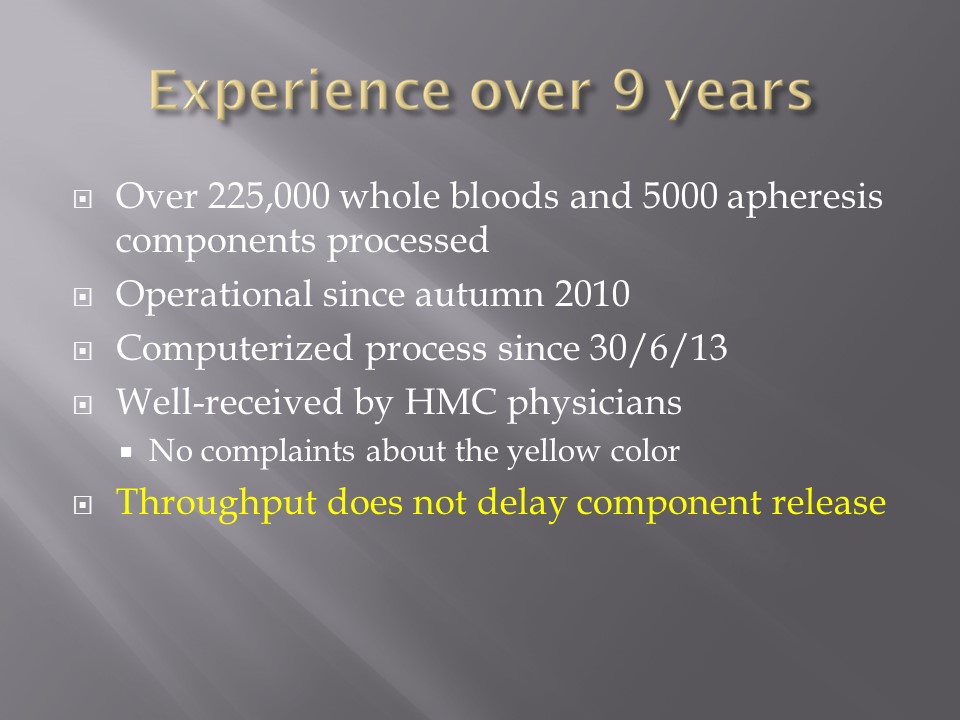
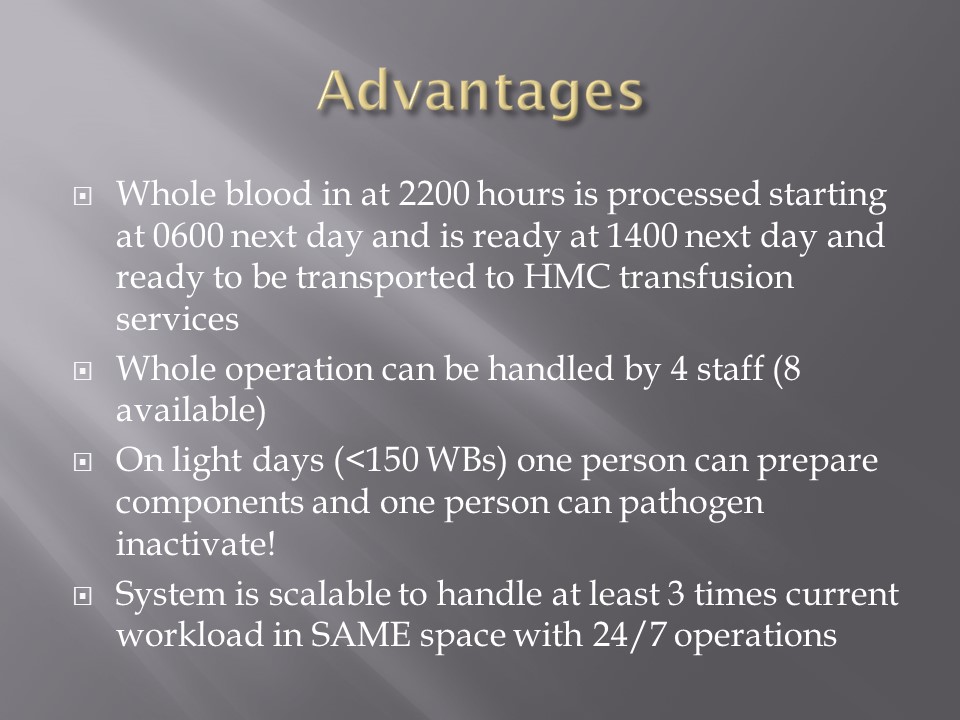
In the system I developed in Qatar, we could complete processing into components (RBCs, buffy coat platelet pools, leukodepleted plasma)–Reveos 3C Program, all marker and immunohematology testing, leukoreduction of the pools and RBCs, Mirasol pathogen inactivation, and platelet additive solution in as little as five hours!!  There is great need for speed in a place that must be 100% self-sufficient in all blood components. We could even further reduce the total processing time if we only made RBCs and plasma, Reveos 2C Program

In rapid turn-around events, it is most helpful to have a robust blood bank computer system that can scale to the challenge.  Also, it must mercilessly enforce all the rules starting with donor qualification, screening, collection through testing and production.  At times of emergency, it is difficult to meet Good Manufacturing Processes manually.

After each major shortage, I recommend a “post-mortem” analysis of the situation with senior donor and quality staff to analyze our processes and see if we can further optimize them for the future.  A report is prepared and reviewed by me as the Division Head/Medical Director of the Blood Bank.  If possible, we implement our recommendations.  If not, I request additional resources from the Administration.

As regards Disaster Planning, I always asked Administration how many victims did they want to save?  When I got the response, I always try to adjust inventory by two extra RBCs and one adult platelet dose (> 2E11) per salvageable victim.  This may come at the expense of increased wastage, especially in a region that cannot export the excess, unused stock.

The exasperating issue is that I didn’t get a clear answer on this last point.  What number should I use?  I made a spreadsheet showing calculations for a variety of endpoints, e.g. 100, 500, 1000 treatable victims and sent this to Administration to consider.

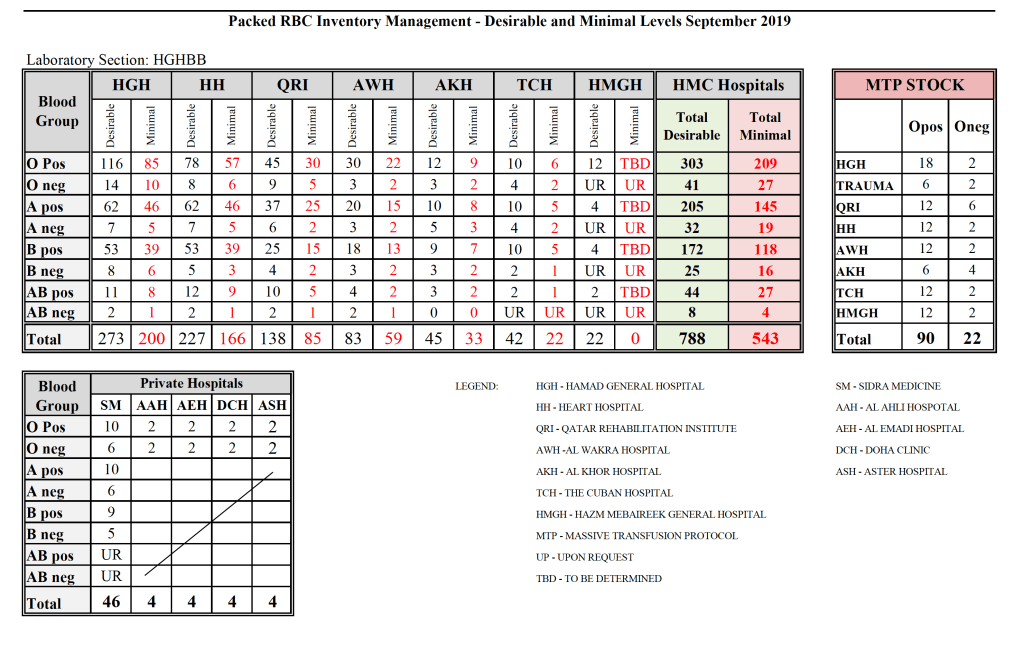
Blood Component Inventory Management

Principle:

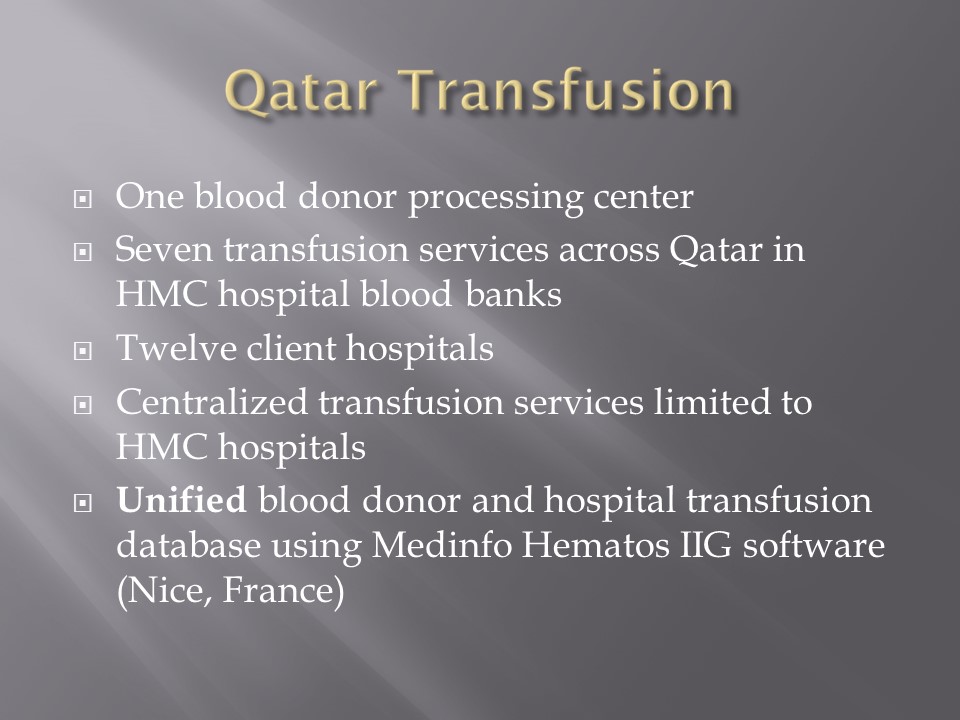
Levels of blood inventory must be maintained to meet usual and unexpected needs and yet still minimize component wastage.  The HMC Blood Donor Center is the only source of blood components in Qatar.  Because Qatar’s demand for blood components is rapidly increasing, we must assess our desirable and critical inventory levels at frequent intervals.

Definitions:

HGHBB:  HGH Transfusion Service/Blood Bank

HIIG:  Hematos IIG dedicated blood bank computer software by Medinfo (Nice, France)

TMP:  Transfusion Medicine Physician

Policy:

  1. Establishing desirable and critical inventory levels:
    1. At least once per year, a review of blood component usage must be made to determine both desirable and minimal (critical) inventory levels for all blood components by group.
    2. Determine the maximal daily usage of each component in this period.
    3. Add 10% as a buffer to the maximal usage to determine the critical inventory level.
    4. Add 50% as a buffer to the maximal usage to determine the desirable inventory level.
    5. After each disaster and after every period of “critical” shortage, reassess the critical and desirable inventory levels.
    6. Minimally, even if there are no disasters or critical shortages, the recalculation of critical and desirable inventory levels must still occur at least once per year.
    7. Contact the HIIG software engineer to change the desirable and critical inventory levels in the computer (cumulative stock entry screen).
  2. Preventing shortages:
    1. Maintain adequate stocks of blood bags, Mirasol, and platelet additive solution,  reagents, functioning equipment with backup site (at least two of EIA and NAT analyzers, two Reveos and two Mirasol machines)
    2. Request additional resources (space and staffing) as far as possible in advance.
    3. Develop an additional testing/processing site for blood components (requested but not effected)
  3. During shortages:
    1. Inventory depot (currently HGHBB) technical staff will contact the Senior Consultant/Division Head, Transfusion Medicine or designate on-call whenever there is a critical shortage of any blood component:
    2. Depending on the severity of the shortage in consultation with the Division Head/Senior Consultant, Transfusion Medicine or TMP on-call will liaise with the key technical, nursing, and recruitment staff.
      1. Donor Recruitment:  Medical Manager, Recruitment/Logistics
      2. Nursing/Apheresis:  Head Nurse, Blood Donor Center
      3. Donor Marker Testing:  Supervisor, Donor Marker Testing
      4. Blood Component Processing:  Supervisor or Senior Technologist, Processing
      5. Hospital Transfusion Services:  Supervisor of Blood Depot (currently at HGHBB) and supervisors of all other hospital transfusion services/blood banks
      6. Medinfo HIIG Software Support/VHT Services:
    3. Depending on the severity of the shortage various actions may be approved by the Senior Consultant/Division Head, Transfusion Medicine:
      1. Transfusion Physician/Medical:
        1. Refer to Medical Director to review all requests for the critically short component(s) and provide initial triage usage
        2. Maintain close contact with clinical team(s) about request, emphasize need to minimize ordering if possible
        3. Refer cases of catastrophic blood use to a multidisciplinary ad-hoc team of physicians as designated by the Corporate Transfusion Committee and Medical Director (appointment of ad-hoc team currently under consideration by Medical Director)

As of this date (23/9/19), the Medical Director has not yet appointed a triage team for severe blood shortages.  The Transfusion Medicine physicians DO NOT serve as gatekeeper at these times.  It must be a committee including clinical medical staff who are the principal end-users of blood components

  • Recruitment:
    1. Mobilize recruitment/registration/aide staff
    2. Generate SMS lists to contact donors of the affected component type
    3. Contact media (radio, TV) and hospital intranet to put out messages to recruit donors
    4. Prepare mobile blood donor vehicles for emergency donor campaigns
    5. Arrange emergency transport of prepared units to affected site
    6. Extend Blood Donor Center hours of operation
    7. Nursing:
      1. Mobilize nursing/phlebotomy staff
      2. Extend staff working hours as needed
      3. Reschedule therapeutic apheresis cases as determined by the TMP
    8. Marker Testing:
      1. Mobilize staff to perform extra infectious marker testing run
    9. Component Processing:
      1. Mobilize staff for component processing (including filtration, pathogen-inactivation, and use of platelet-additive solution)
    10. Inventory Depot/Hospital Transfusion Services/Blood Banks:
      1. Maintain critical inventory level monitoring
      2. Report to Senior Consultant/Division Head, Transfusion Medicine or TMP on acute inventory levels
      3. Cancel non-emergency requests for critically short components
      4. Release components on expedited basis (MTP, emergency release, immediate-spin crossmatch, etc.)
    11. Computer:
      1. Medinfo/VHT software engineers to monitor system, provide support as needed
  • Notifications:
    1. Contact the Chairperson, DPLM, and/or the HMC Medical Director as needed, especially if stocks are in danger of depletion.
    2. Any alterations in the blood orders must be communicated to the patient’s most responsible physician by TM technical staff, TMP, or Senior Consultant/Division Head Transfusion Medicine
  • Post-Event Analysis
    1. Review effectiveness of all actions taken
    2. Modify process based on review
    3. Update Interim Policy
    4. Request additional resources as required

Attachment:

Current inventory calculation (follows)

References:

  1. Standards for Blood Banks and Transfusion Services, Current Edition, AABB, Bethesda, MD, USA
  2. Guidelines to the Preparation, Use, and Quality Assurance of Blood Components, European Committee (Partial Agreement) on Blood Transfusion (CD-P-TS), 17th Edition, 2013

Abnormal Marker Testing Algorithm

At the time this was written, West Nile Virus WNV, Chikungunya, Dengue, and Zika virus were not considered as high-risk and no testing was done on the blood supply for them. There were policies to check donor history and ask questions about each of these agents.

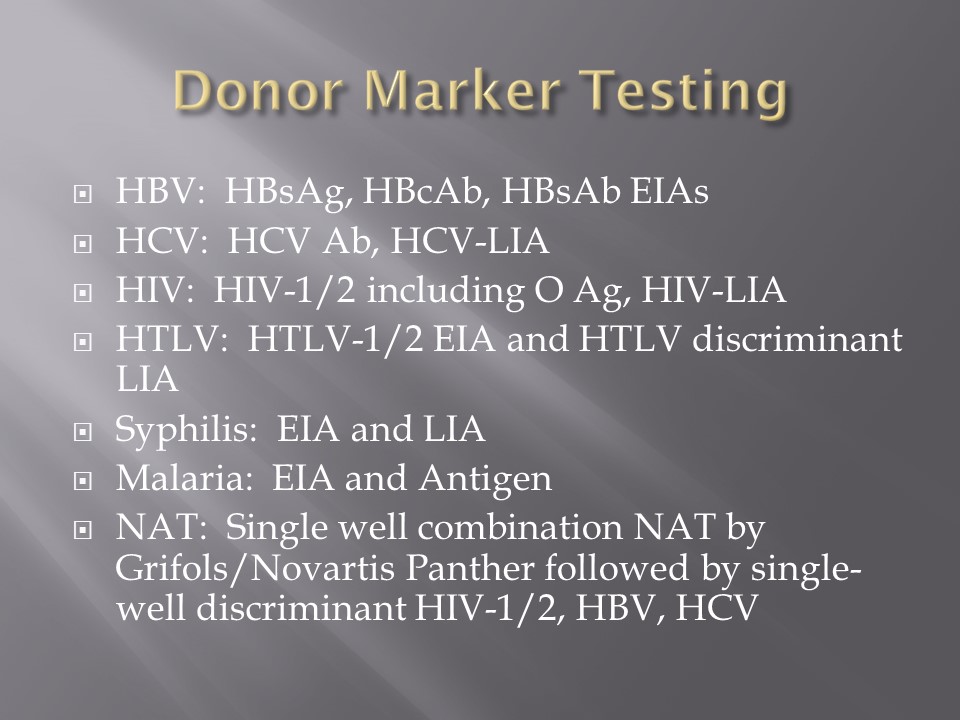
Note that we used a linear immunoblot assay for HIV 1/2, HCV, HTLV 1/2, and syphilis.

Definitions:

Positive result for EIA means S/CO ratio >= 1.0

Positive result for LIA (linear immunoblot assay) means particular pattern of bands as defined by the manufacturer

Indeterminate result for LIA means presence of bands not meeting positive criteria

  • Hepatitis B:
    1. HBsAg non-negative, then:
      1. HBsAg positive with HBsAg confirmatory positive, regardless of other results:  permanent deferral, refer to Infectious Disease clinic
      2. HBsAg positive with HBsAg confirmatory borderline or negative, repeat all HBV testing after 8 weeks
      3. HBsAg borderline:  repeat all HBV testing after 8 weeks
      4. HBV-DNA positive confirmed, regardless of other results:  permanent deferral, refer to Infectious Disease clinic
    2. If HBcAb positive, repeat after 8 weeks
    3. Repeat Hepatitis B Testing After 8 weeks:
      1. HBsAg positive with HBsAg confirmatory positive:  permanent deferral, refer to Infectious Disease clinic
      2. HBsAg positive with HBsAg confirmatory borderline or negative:  permanent deferral, refer to Infectious Disease clinic
      3. HBsAg borderline, permanent deferral, refer to Infectious Disease clinic
      4. HBV-DNA positive confirmed:  permanent deferral, refer to Infectious Disease clinic
      5. HBcAb positive or borderline with negative HBsAg and negative HBV-DNA:  review HBsAb level:
        1. If HBsAb level >= 100 mIU/mL (100 IU/L), donor may be reentered
        2. If HBsAb level < 100, then recommend to donor to receive booster HBV vaccine
          1. After HBV vaccine administration, retest after 30 days:
            1. If HBsAb level >= 100, donor may be reentered
            2. If HBsAb level < 100, donor is indefinitely deferred
      6. HBsAg, HBcAb, HBsAb all negative:  reenter into donor pool
  • Hepatitis C:
    1. HCV-RNA positive confirmed, regardless of other HCV results:  permanent deferral, refer to Infectious Disease clinic
    2. HCV-RNA borderline:  repeat all HCV testing after 6 months
    3. HCV-InnoLIA positive, regardless of other HCV results:  permanent deferral, refer to Infectious Disease clinic
    4. HCV-InnoLIA indeterminate:  repeat all HCV testing after 6 months
    5. HCV-Ab positive, HCV-RNA negative, do HCV-InnoLIA:
      1. If HCV-InnoLIA positive, permanent deferral, refer to Infectious Disease clinic
      2. If HCV-InnoLIA indeterminate or negative, repeat all HCV testing after 6 months
    6. Repeat Hepatitis C Testing After 6 months:
      1. HCV-RNA or HCV-InnoLIA positive:  permanent deferral, refer to Infectious Disease clinic
      2. HCV-RNA or HCV-InnoLIA borderline:  permanent deferral, HCV infection not confirmed
      3. HCV-Ab positive or borderline without positive HCV-RNA or positive HCV-InnoLIA:  permanent deferral, HCV infection not confirmed
      4. HCV-Ab negative, HCV-RNA negative, HCV-InnoLIA negative:  reenter donor into donor pool
  • HIV Testing:
    1. HIV-RNA positive confirmed, regardless of other HIV results:  permanent deferral and do HIV-InnoLIA, refer to Infectious Disease clinic
    2. HIV-RNA borderline:  do HIV-InnoLIA
    3. HIV-InnoLIA positive, regardless of other HIV results:  refer to Infectious Disease clinic
    4. HIV-InnoLIA indeterminate:  repeat all HIV testing after 8 weeks
    5. HIV Ab positive with negative HIV-RNA and/or borderline/negative HIV-InnoLIA:  repeat testing after 8 weeks
    6. Repeat HIV Testing After 8 Weeks:
      1. HIV RNA positive and/or HIV-InnoLIA positive, regardless of other HIV results:  refer to Infectious Disease clinic
      2. HIV-InnoLIA and/or HIV antibodies indeterminate:  permanent deferral, HIV infection not confirmed
      3. HIV Ab negative and HIV-RNA negative and HIV-InnoLIA negative:  reenter into donor pool
  • HTLV 1/2 Testing:
    1. HTLV Antibodies positive, then do HTLV-InnoLIA:
      1. HTLV InnoLIA positive for HTLV-1 and/or HTLV-2:  refer to Infectious Disease clinic
      2. HTLV InnoLIA indeterminate or negative, repeat HTLV Ab and HTLV InnoLIA testing after 6 months
    2. Repeat HTLV Testing After 6 Months:
      1. HTLV 1/2 antibodies positive, permanent deferral and do HTLV InnoLIA
      2. HTLV 1/2 antibodies indeterminate,  permanent deferral and do HTLV InnoLIA
      3. HTLV InnoLIA positive for HTLV-1 or HTLV-2: refer to Infectious Disease clinic
      4. HTLV InnoLIA indeterminate, donor permanently deferred.
        • Issue letter HTLV-Not Confirmed
      5. HTLV 1/2 Ab negative and HTLV InnoLIA negative, reenter donor.
  • Malaria Testing:
    1. Defer donor if he has been in malarial endemic zone within the past 4 months
    2. If travel to malarial zone > 4 months, do malarial antibody testing:
      1. Malaria antibody negative:  no deferral
      2. Malaria antibody positive, perform malarial antigen test:
        1. Malaria antigen test positive, refer to Infectious Disease clinic—defer until 3 years after cessation of treatment
        2. Malaria antigen test negative:
          1. Plasma may be collected
          2. RBCs and platelets must be destroyed.
        3. Repeat malarial antibodies after 3 years:
          1. If malarial antibody test positive, donor must not be used for RBC components but may be used for plasma production
          2. If malarial antibody test negative, reenter donor for all components
    3. Defer donor if he has received malarial treatment (not prophylaxis) for 3 years
      1. Perform both malarial antibody and antigen testing:
        1. Defer based on section 5.2
  • Syphilis Testing:
    1. Syphilis Ab test positive or indeterminate:  do InnoLIA-Syphilis test
      1. InnoLIA-Syphilis test positive:  permanent deferral, refer to Infectious Disease clinic
      2. InnoLIA-Syphilis test borderline or negative:  defer for 1 year, then repeat all syphilis testing.
    2. Repeat Syphilis Testing after 1 Year:
      1. Syphilis antibody testing negative, reenter into donor pool
      2. Syphilis antibody positive or borderline:  do InnoLIA-Syphilis test
        1. InnoLIA-Syphilis test positive:  permanent deferral, refer to Infectious Disease clinic
        2. If InnoLIA-Syphilis borderline or negative:  permanent deferral, syphilis not confirmed, Guidance for Industry, February 2020

References:

  1. Use of Serologic Tests to Reduce the Risk of Transfusion-Transmitted Human T-Cell Lymphotropic Viruses Types I and II, Final Guidance for Industry, February 2020
  2. Draft Guidance for Industry:  Recommendations for Requalification of Blood Donors Deferred Because of Reactive Test Results for Antibodies to Human T-Lymphotropic Virus Types I and II (anti-HTLV-I/II), CBER, September 2018
  3. Guidance for Industry:  Nucleic Acid Testing (NAT) for Human Immunodeficiency Virus Type 1 (HIV-1) and Hepatitis C Virus (HCV): Testing, Product Disposition, and Donor Deferral and Reentry, US Department of Health and Human Services, Center for Biologics Evaluation and Research CBER, May 2010
  4. Guidance for Industry:  Requalification Method for Reentry of Blood Donors Deferred Because of Reactive Test Results for Antibody to Hepatitis B Core Antigen (Anti-HBc), US Department of Health and Human Services, Center for Biologics Evaluation and Research CBER, May 2010
  5. Product inserts, InnoLIA-Syphilis/HCV/HIV/HTLV