Blood Bank Software is Dynamic, NOT Static

I was recently talking with one of the hospital software system administrators from my previous site.  He had originally worked on building the Medinfo system, but was then reassigned to the laboratory modules of the hospital information system.

His alarming comment to me was that the Medinfo build was completed so there was no need to worry about it now—it was finished.  I guess he was looking from the perspective of the general laboratory software.  There is no need to make major changes to the build, just update interfaces and troubleshoot.

I was surprised.  He had no idea of how many times we have to update the structure for new rules and regulations, and changes in blood bank practice—let alone emerging pathogens such as ZIKA, dengue, Chikungunya, and most recently, COVID-19.

My daily morning routine was to survey several blood bank websites with changes to blood donor criteria including US FDA CBER, read the transfusion journals (Transfusion, Vox Sanguis, etc.), AABB, and ASFA.  If there were any changes pertinent to our organization, I had to make interim policies and procedures, and finally prepare specifications for changes in the Medinfo software.

The Medinfo engineers would prepare flow charts of the proposed changes and implement them in a test environment for the Super-Users to test.  I had to prepare validation protocols for the testing, and then review the validation results and finally approve the adoption of the changes.

I cannot remember even a month going by without some revision in the donor protocols.  When COVID-19 came, I had to prepare a parallel, but separate, processing and allocation/release system.

This was a never-ending story that kept the Super Users and the local Medinfo engineers busy.  I always reminded the hospital information system staff that playing with blood bank software was like playing with fire:  there is a good chance you will get burned if you do not set it up properly.

31/10/20

Processes and Software Building 53: Donor Extended Rh and Kell Typing

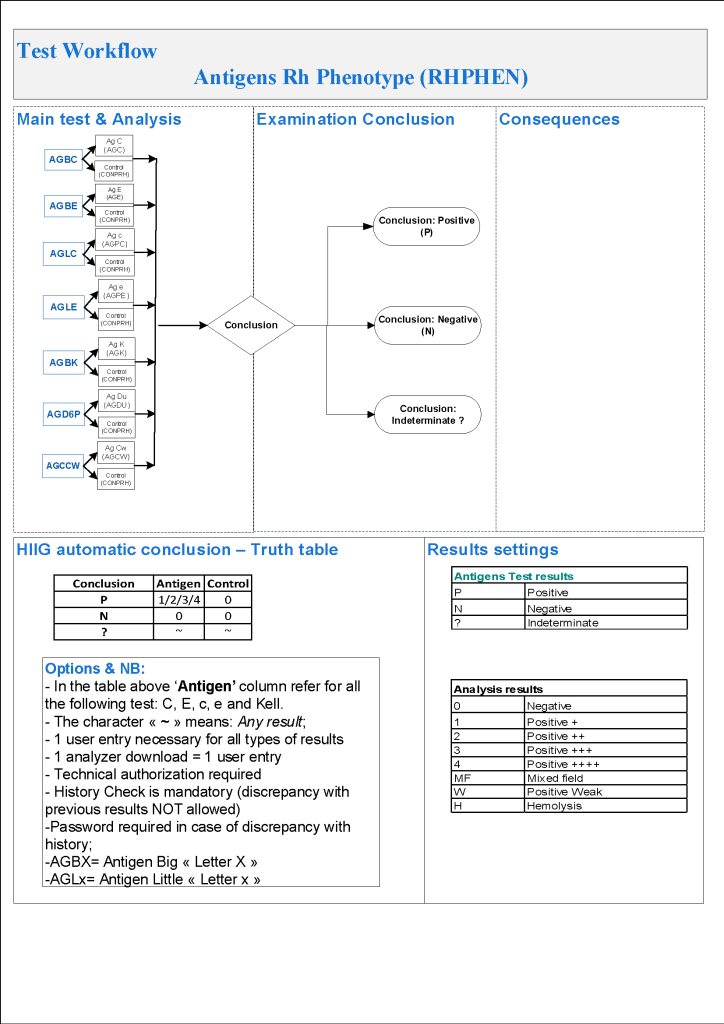
For this typing, I always had both automated and manual methods set up on the blood bank computer system Medinfo Hematos IIG.  The automated method had a bidirectional interface between Medinfo and the instrument.   Medinfo did not need a separate middleware.  A truth table was prepared for acceptable results for automatic interpretation.  Other results had to be manually interpreted by someone with the appropriate security level.

It was standard in my donor processing laboratory that extended Rh typing (EeCc) and Kell were performed.  We were in a region with many sickle cell and thalassemia patients.  Having all RBC units pre-typed in the Blood Donor Center expedited selection and release in the hospital blood bank—especially for matching K-negative units to K-negative patients and extended Rh phenotypes for sickle cell patients.

The manual testing option is structured similarly.  Within Medinfo, it is easy to change the methodology or have more than one methodology if the system is so built.  Thus, if the analyzer for this typing was down, the staff could select the manual methodology.  Likewise, if one testing center went off-line, the work could be completed at another site—no need to repeat testing already completed from the first site.  This flexibility could apply to any test in system.

The manufacturer’s recommendations for the particular reagents in use were strictly followed.  Most importantly, Medinfo can be configured for any set of reagent values.

Please refer to the sample flowchart which also includes Cw and DVI+ typing.  The same process could apply to patient testing, but some reagents would use a DVI- reagent.

18/10/20

Processes and Software Building 52: Donor Antibody Screening

For donor antibody screening, I always had both automated and manual methods set up on the blood bank computer system Medinfo Hematos IIG.  The automated method had a bidirectional interface between Medinfo and the instrument.   Medinfo did not need a separate middleware.  A truth table was prepared for acceptable results for automatic interpretation.  Other results had to be manually interpreted by someone with the appropriate security level.

I did not use pooled cells, but instead 2, 3, or 4 cell screens at various times based on the available reagents.  Personally, I prefer a 3 or 4 cell screen which is more sensitive—I want homozygous Jka and Jkb cells present.  All positive cases had an antibody identification performed.  According to my medical decision, I did not routinely allow any donor to be collected if he/she had a positive antibody screen.  Some standards would permit the use of RBCs from such a case, but this was not my preference.  In cases with rare phenotypes, I would allow production of RBCs (e.g. Bombay donor with anti-H, patient with anti-Tja (PP1Pk)) for patients with those rare types.

The manual testing option is structured similarly.  Within Medinfo, it is easy to change the methodology if the system is so built.  Thus, if the analyzer for antibody screening is down, the staff can select the manual methodology.  Likewise, if one testing center goes off-line, the world can be completed at another site—no need to repeat testing already completed from the first site.  This flexibility can apply to any test in system.

The manufacturer’s recommendations for the particular reagents in use were strictly followed.  Controls were included.  Most importantly, Medinfo can be configured for any set of reagent values.

Also note that Medinfo will check for the donor’s previous testing history and compare results.  If there are discrepancies, this will require manual review.  Normally, a donor with a positive antibody history is indefinitely deferred.  The transfusion medicine physician could remove such a deferral if indicated.

Refer to the following flow diagram for a three-cell  and four-cell screens.

16/10/20

Policy: ISBT Specimen Labelling Audit

Principle:

ISBT specimen labels have a check-digit to reduce the risk of misreading the label.  They are generated by the blood bank computer system Medinfo.  Normally one group of labels is printed for all needs (donor unit, marker testing, donor immunohematology, and donor processing.  Reprinting the same number is restricted to minimize the risk of using the wrong label on a specimen or unit.  These labels are NOT used for patient testing.

ISBT specimen labels are only printed at the time of donor registration.  We must securitize them so that they are not used for other, potentially malicious purposes.  Remember:  a labelling mistake may cause fatality in a patient receiving the wrong blood component.

Policy:

  1. ISBT specimen labels are only for blood donor specimens, initially labelling of donor collections, and intermediate processing of components.
  2. They must be applied to the primary specimens directly at the donor’s bedside.
  3. They must be applied to aliquots from the original ISBT-labelled tubes.
  4. They may NOT be applied to any other specimen (e.g. for routine laboratory testing outside Transfusion Medicine)
    1. If an ISBT label not corresponding to the correct donor is discovered, an OVA or event report must be generated and investigated immediately.
  5. If additional ISBT labels are needed, this must be documented on a specific audit sheet with signature of the person taking the extra labels and a second person to witness their removal.  It will also be noted in the Medinfo system for auditing purposes.
  6. The audit sheet must be kept in a secure place for future reference in Blood Donor Center.

14/10/20

Processes and Software Building 51: Donor D Typing

For donor D typing, I always had both automated and manual methods set up on the blood bank computer system Medinfo Hematos IIG.  The automated method had a bidirectional interface between Medinfo and the instrument.   Medinfo did not need a separate middleware.  A truth table was prepared for acceptable results for automatic interpretation.  Other results had to be manually interpreted by someone with the appropriate security level.

For donors, I wanted reagents sensitive for partial or mosaic D types since any D epitopes are potentially immunogenic.  With some reagents, this meant using a DVI+ reagent and others both DVI+ and DVI- reagents.

The manual testing option is structured similarly.  Within Medinfo, it is easy to change the methodology if the system is so built.  Thus, if the analyzer for D typing is down, the staff can select the manual methodology.  Likewise, if one testing center goes off-line, the world can be completed at another site—no need to repeat testing already completed from the first site.  This flexibility can apply to any test in system.

The manufacturer’s recommendations for the particular reagents in use were strictly followed.  One used the range {0, 1, 2, 3, 4, Mixed Field, Weak} as acceptable.  Another used {0, 2, 3, 4}.  Controls were included.  Most importantly, Medinfo can be configured for any set of reagent values.

The attached flows show two different testing systems as examples of what can be built in the Medinfo system.

9/10/20

Processes and Software Building 50: Donor ABO Confirmatory Typing

For donor ABO confirmatory typing, I always had both automated and manual methods set up on the blood bank computer system Medinfo Hematos IIG.  The automated method had a bidirectional interface between Medinfo and the instrument.   Medinfo did not need a separate middleware.  A truth table was prepared for acceptable results for automatic interpretation.  Other results had to be manually interpreted by someone with the appropriate security level.

The manual testing option is structured similarly.  Within Medinfo, it is easy to change the methodology if the system is so built.  Thus, if the analyzer for ABO typing is down, the staff can select the manual methodology.  Likewise, if one testing center goes off-line, the world can be completed at another site—no need to repeat testing already completed from the first site.  This flexibility can apply to any test in system.

The manufacturer’s recommendations for the particular reagents in use were strictly followed.  One used the range {0, 1, 2, 3, 4} as acceptable.  Another used {0, 2, 3, 4}.  Controls were included.  Most importantly, Medinfo can be configured for any set of reagent values.  Refer to the following flow diagram.

Confirmatory testing also includes D typing.  That will be considered in a future post.

6/10/20

Projective Exercise 8 Solution: D-positive with anti-D

Some Possible Explanations:

Always review the transfusion history of all component types, medication history, and the clinical history!! Start with this first.

  1. Receipt of plasma with anti-D (RhIG, IVIG, etc.)–passive antibodies
  2. Partial D with anti-D:
    1. Partial or mosaic D patient who received D positive RBCs and made anti-D directed against its missing epitopes
  3. Anti-G:
    1. Not all anti-G is anti-C and anti-D:  It is really a separate specificity.  It is possible that anti-G may be made even though the patient is C-positive.
  4. Anti-LW:
    1. However, it is unlikely to show such strong reactions

Can you think of other explanations?

3/10/20

Processes and Software Building 49: Donor Automated ABO Typing

For donor ABO typing, I always had both automated and manual methods set up on the blood bank computer system Medinfo Hematos IIG.  The automated method had a bidirectional interface between Medinfo and the instrument.   Medinfo did not need a separate middleware.  A truth table was prepared for acceptable results for automatic interpretation.  Other results had to be manually interpreted by someone with the appropriate security level.

The manufacturer’s recommendations for the particular reagents in use were strictly followed.  One used the range {0, 1, 2, 3, 4} as acceptable.  Another used {0, 2, 3, 4}.  Controls were included.  Refer to the following flow diagram.

Most importantly, Medinfo could be configured for any set of reagent values.

2/10/20

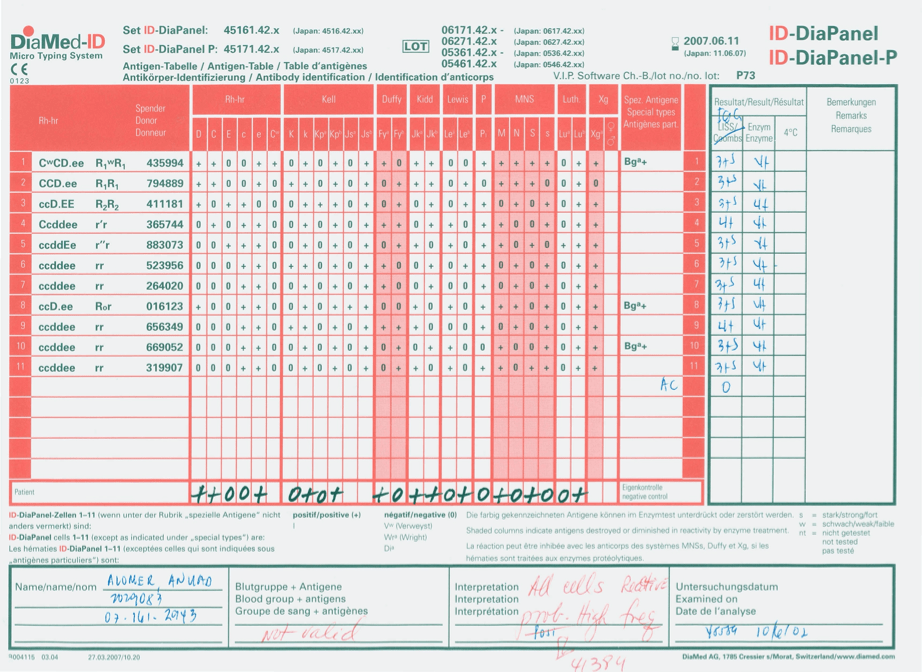
Projective Exercise 8

As a transfusion medicine physician, I must know if I can trust my staff’s interpretation of immunohematology testing.  I may be called at night and they will provide me with results and I must use these to make a medical judgment.  If their interpretation is flawed, I might make a decision that harms the patient.

I really don’t like multiple-choice questions, but nowadays this is often the norm.  For my staff, especially senior staff and those who want to be promoted to senior staff, I have developed a series of projective exercises to help me understand their thought processes.  I emphasize that I do not want a mere regurgitation of isolated facts:  I want integration of the facts into useful information!!

The following is my favorite assessment, offered to advanced staff and candidates for senior technologist, supervisors, and technical manager positions.  Usually, these staff have SBB, ART, FIBLS or equivalent qualifications.

You are reviewing abnormal test results and receive the following case:

Anti-A:           4+

Anti-B:           0

Anti-A,B        4+

A1 cells         0

B cells           3+

Anti-D            3+

D-control      0

Antibody Screen:  3+ in SC1 (R1R1), 4+ in SC2 (R2R2), 0 in SC3 (rr)

Antibody Identification:  Anti-D

Give possible explanation(s) for this situation.  Request any additional information you need.

What blood type will you transfuse?

Solution will follow in a subsequent post.

30/9/20

Direct Antiglobulin Test and Selection of RBC Units for Transfusion

Principle:

In 1984 effective with the 13th Edition AABB Standards, the requirements for performing a direct antiglobulin test and autocontrol for compatibility testing were eliminated.  The DAT is very important to detect delayed hemolytic transfusion reactions, certain autoimmune conditions, and drug-related hemolysis.

Since that time, the immediate-spin crossmatch and now the electronic computer paperless crossmatch may be used for most compatibility testing in place of the classic, antiglobulin-phase (indirect antiglobulin test) crossmatch.

If an antiglobulin phase (IAT) crossmatch is performed, an RBC unit with a positive DAT will cause a false-positive reaction.  Since most crossmatching does not include the IAT, it will not be affected by the DAT status of a donor unit.

Policy:

  1. Donor RBC units will NOT be routinely tested for DAT as part of component processing.
  2. The type of compatibility testing selected for a particular patient should be the technically simplest one (no need to do extra work unless so instructed by the transfusion medicine consultant/designate):
  3. Do a full antiglobulin-phase IAT crossmatch if ANY of the following applies:
    1. There are no two independent ABO/D typings on the patient during the current admission.
    2. The ABO/D type of the current admission does not match the historical information.
    3. The patient has a detectable antibody at 37C
    4. The patient has a history of a clinically significant antibody but no current antibody
    5. Whenever the consultant, transfusion medicine/designate requests it.
    6. Whenever the Medinfo HIIG record so indicates (in comment section)
  4. Do the immediate-spin crossmatch if ALL of the following apply:
    1. Only one determination of the ABO/D type
    2. The historical ABO/D type agrees with the current type.
    3. There are no antibodies reacting at 37C AND there is no history of antibodies at 37C.
  5. Use the computer/electronic crossmatch if ALL of the following apply:
    1. There are two determinations of the ABO/D type and they both agree with each other.
    2. The historical ABO/D type agrees with the current type.
    3. There are no antibodies reacting at 37C AND there is no history of antibodies at 37C.
  6. When to do a DAT on a donor unit:
    1. Patient antibody screen is negative but the full AHG crossmatch is incompatible.
    2. Part of a transfusion reaction workup where the AHG crossmatch of donor cells and patient serum is incompatible.
    3. Whenever the consultant, transfusion medicine/designate requests it.
  7. If a donor unit is found with a positive DAT:
    1. Test with polyspecific and monospecific IgG and C3d antisera
    2. Perform an acid-elution.
    3. Send the results to the transfusion medicine consultant/designate for review.
    4. The reviewer will enter his review in HIIG in the Donor Consultation Section both as global donor comment and a result-specific comment against the antibody screen result.
    5. Use of the DAT-positive donor unit:
      1. Select another RBC unit for the transfusion.
      2. The final decision to use the unit will be made by the Transfusion Medicine consultant/designate.

Important:  Don’t do a classic AHG/IAT phase crossmatch unless you have to do it  (see conditions above.)  A donor unit with a DAT is unlikely to be clinically significant and may be transfused safely to the patient in most situations.  Patients receiving electronic-crossmatch and immediate-spin crossmatch are receiving units with positive DAT without incident.

References:

  1. Standards for Blood Banks and Transfusion Services, Current Edition, AABB, Bethesda, MD, USA
  2. Guidelines to the Preparation, Use, and Quality Assurance of Blood Components, European Committee (Partial Agreement) on Blood Transfusion (CD-P-TS), Current Edition
  3. Technical Manual, Current Edition, AABB, Bethesda, MD, USA