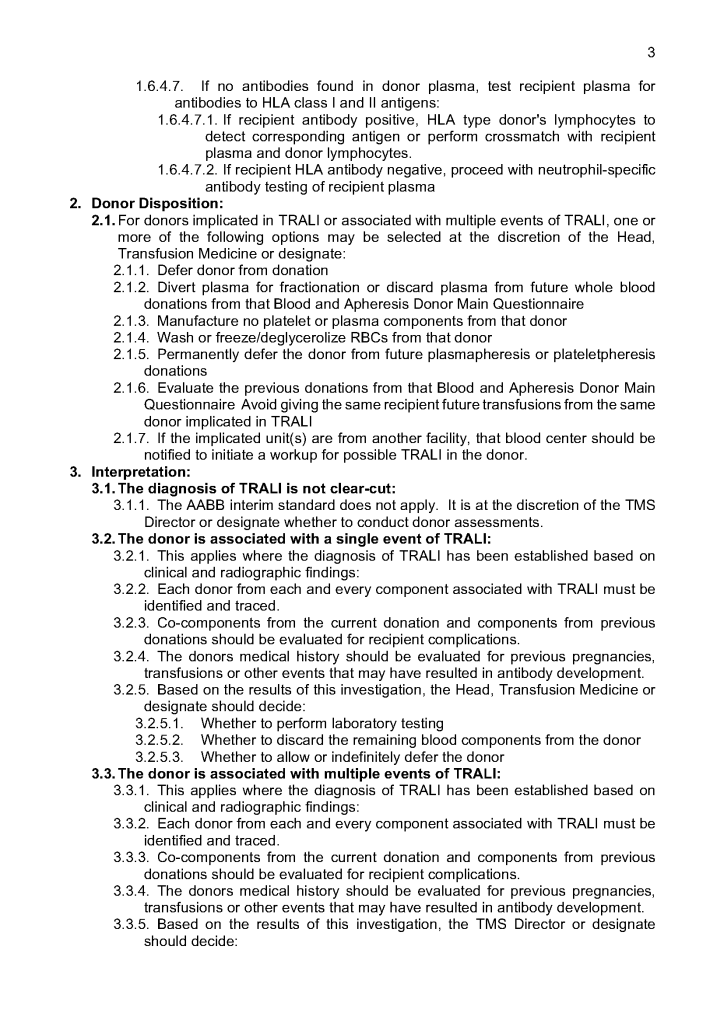
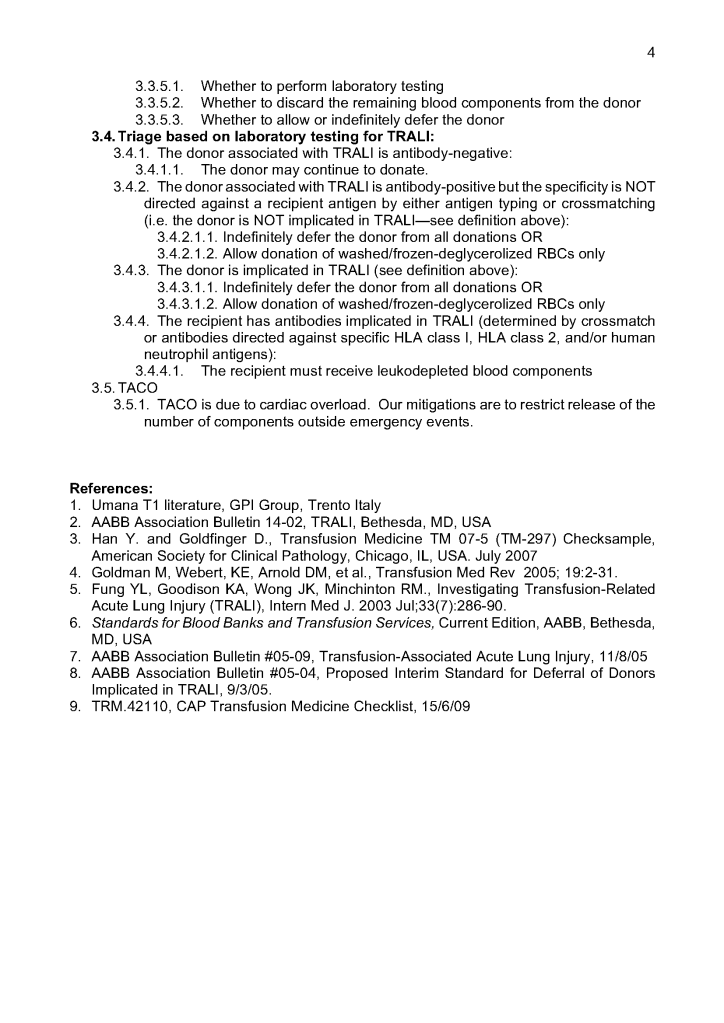
Serologic Controls

In old days of only polyclonal reagents, QC of reagents took significant time.  This has been simplified and easier since the introduction of monoclonal cocktail reagents.

Controls may be explicit (a specific control provided by the manufacturer) or implicit (implied by at least one negative reaction in the well of a gel card).

In order to properly interpret test results:

  • Always follow manufacturer’s recommendations for performance of test AND use of controls.
  • Use only the manufacturer’s specified control for testing.  For example, do not substitute 6% albumin as the D-control if the manufacturer provides a specific control.
  • Use manufacturer’s criteria for control validity.

Make certain test results meet the criteria for interpretation.  Do not accept negative results for IAT typing if DAT is strongly positive (blocking antibody).

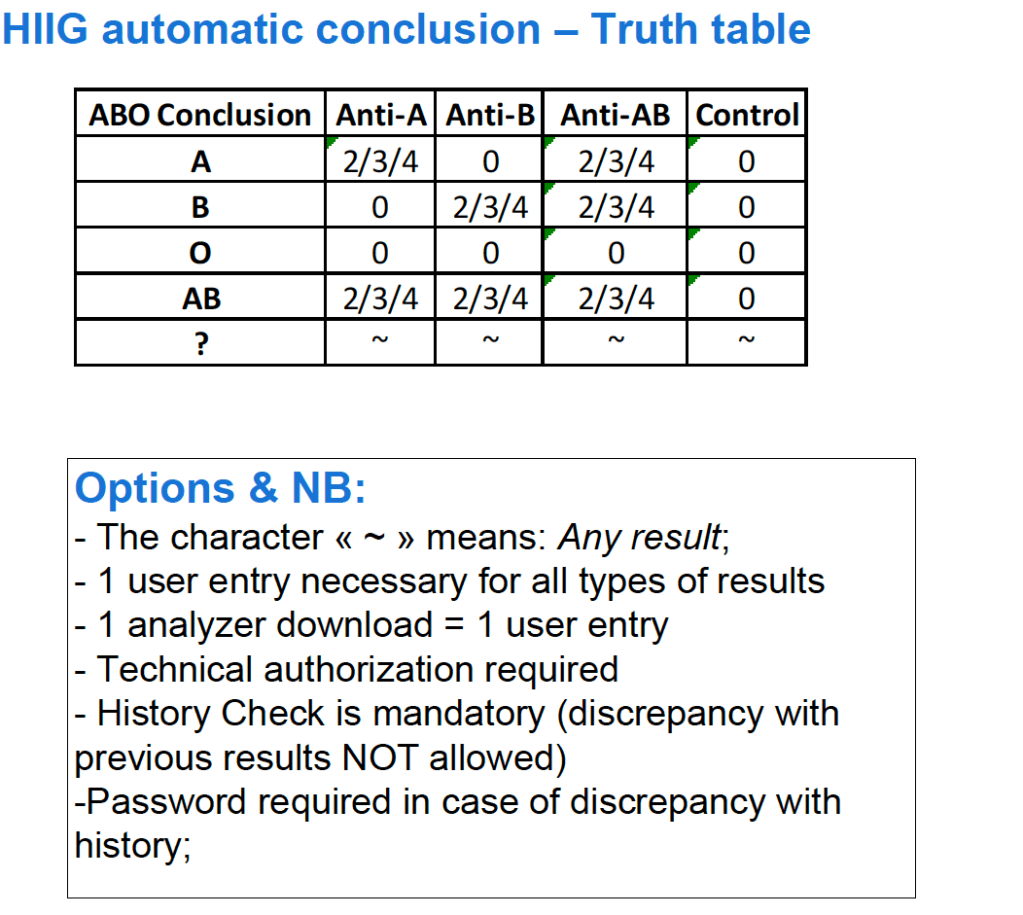
For both manual and automated tests, you can build the control criteria directly into your blood bank computer system’s truth table of results.  This way the system will enforce the criteria and prevent false interpretations:

Example of control for ABO typing:

Physician Comments in Medinfo

Principle:

There are several different types of comments in HIIG:

  • Donor Global
  • Patient Global
  • Analytical Comments
  • Result Comments

Physicians may enter any of these comment types.  Comments may be entered before or after a test is authorized/verified.  If entered after authorization, the test must be modified to accept the comment.  Only result comments are visible in the patient’s medical record.

Policy:

  1. Physicians should use comments in the following situations:
    1. Interpretations of DAT, antibody identification, ABO discrepancies
    2. Instructions for the selection of specific and/or modified blood components
    3. Donor eligibility issues (e.g. donor marker testing abnormalities and disposition)
    4. Donor reactions
    5. Telephone call documentation
    6. Donor counseling documentation
    7. Any special instructions to staff
    8. Any other situation where the transfusion physician determines it is desirable to enter a comment
  2. Copy all result-comments and also enter then as global comments against the patient or donor record as applicable.

Procedure—Patient Result Comments After Results are Authorized/Verified:

Sign into HIIG and select Patient module, Patient Consultation, and enter the patient hospital HC number.

Comments in Medinfo Hematos IIG

This post is the policy for using comments in Medinfo software.  A subsequent post will show the process of entering comments.

Principle:

There are several different types of comments in HIIG:

  • Donor Global
  • Patient Global
  • Analytical Comments
  • Result Comments
  • Contraindication Comments

Global Comments appear on the first main screen of either the donor or patient record.  The presence of comments is indicated by a bar at the bottom of the screen (in yellow or blue saying Presence of Comments.  Double-clicking opens the list of entered comments.

Examination/Results Comments appear only when you open the result to which it is attached.  You must know in advance to which result they are linked to find them.

Contraindication Comments appear when entering a donor deferral code

At HMC, we will enter examination/results comments again as global comments (donor or patient) so it is easy for staff to retrieve them and see them with all other comments.  You can do this by cut and paste.

Physicians may enter any of these comment types.  Comments may be entered before or after a test is authorized/verified.  If entered after authorization, the test must be modified to accept the comment and require a special password (not the user sign-into HIIG).  Only results/examination comments are visible in the patient’s medical record.  Global, analysis, and contraindication comments are visible only in HIIG!  Donor comments are only visible in HIIG.

The presence of comments documents physician review of abnormal results as required by the various accreditation standards.

Policy:

  1. Only designated staff may enter comments.
  2. Comments entered after authorization/verification of results will modify the donor/patient record and require a special, high-level password distinctly different from the normal user password.
  3. Enter comments in the following situations:
    1. Telephone call documentation (e.g. critical values).
    2. Interpretations of donor or patient test results, transfusion reactions, etc.
    3. Instructions for the selection of specific and/or modified blood components
    4. Donor eligibility issues (e.g. donor marker testing abnormalities and disposition)
    5. Donor reactions
    6. Donor counseling documentation (e.g. donor counseled at 0930 on 24/3/14 about his abnormal result).
    7. Any special instructions to staff
    8. Any other situation where the transfusion physician/supervisor or designate determines it is desirable to enter a comment
  4. Copy all results/examination-comments and also enter then as global comments against the patient or donor record as applicable.

References:

  1. Standards for Blood Banks and Transfusion Services, Current Edition, AABB, Bethesda, MD, USA
  2. Workflows 1001-1005, Medinfo Hematos IIG, 2013-2014.

Use of Expired Reagents

This is a sample document for use of expired reagents I wrote for HMC Qatar.

Principle:

Due to logistics issues including the long distance between suppliers in Europe and North America and Qatar and the importation/customs clearance of critical materials, Transfusion Medicine has developed a contingency variance policy to minimize disruption of the essential transfusion medicine testing and component preparation.  Approval for use of outdated reagents in special circumstances is not meant to be an excuse for untimely monitoring and improper ordering of supplies.

Definition:

Rare Reagent:  Any reagent that is either used uncommonly or is in short supply and difficult to obtain in a timely matter.
Policy:

  1. Maintain a minimum six (6) months’ supply of each reagent when feasible.
    1. This cannot be done for short-outdate reagents such as reagent red cells for panels and antibody screens.
  2. If an in-date reagent is not available for use, then an outdated reagent may be considered for use if:
    1. It passes an in-run quality control including negative and positive controls as applicable specific for the test in question.
    1. Supervisor reviews the results and approves their use:
      1. Results using such outdated reagents may only be used if they pass the validation rules in that procedure.
    1. The Division Head, Transfusion Medicine, or designate reviews the supervisor’s recommendations and approves their use.
  3. All such variances must be documented as follows:
    1. Variance document form
    1. In the comments for results within the Medinfo Hematos IIG software.

References:

Sections 1.3.2 and 7.0, Standards for Blood Banks and Transfusion Services, Current Edition, AABB, Bethesda, MD, USA

SARS-CoV-2 Antibody for CCP in Medinfo Hematos IIG

When I started my COVID-19 convalescent plasma CCP collection in early March, 2020, there were few antibody tests available.  However, I anticipated that eventually we would want to include antibody results with the donor record.  Antibody results were not used originally at all in the criteria for CCP acceptability for release.

There are many assays by type of antibody (total, IgG, IgA, IgM) and quantitation by titer and/or signal-cutoff ration S/CO.  Any of these parameters may be used to define rules for acceptability to complete production and/or allocate to patients.  Instrumentation used for titering/quantitation may be interfaced to the blood bank software.

Here is my generic approach to including these results with the donation record.  In Medinfo HIIG, it is possible enter test results retrospectively and these can be used set rules for acceptability.  Please consult with my detailed post on using rules against parameters.

All of this is easily implemented since all test information will be stored as parameters.  From these parameters we can construct rules for:

  • Low titer CCP
  • High titer CCP
  • Acceptability for patient allocation

Also, one can override the rules if the clinician and the transfusion medicine physician agree.  For example, there is a severe shortage of group B CCP so use of low-COVID-antibody titer group B CCP could be allowed.

The key is to build whatever test methodology you use and include the manufacturer’s cutoff for low versus high titer interpretation.  These results can be printed on the ISBT label as well.  One can easily build multiple methodologies and acceptability criteria if different tests are used at different testing sites in your system—just as can be done for other tests (ABO/D, antibody screen, etc.)  If one changes methodologies in the future, Medinfo will still use the same rules that applied for the day of production.

Here are some sample test rules:

Example 1:  Total COVID antibody > 160 is high titer:

  • If antibody >= 160, label as high-titer CCP and use for patient allocation.
  • If antibody < 160, label as low-titer, physician must override for patient allocation

Example 2:  IgG antibody with S/CO ratio > 12 is high-titer:

  • If S/CO >= 12 label as high-titer CCP and use for patient allocation.
  • If S/CO < 12, label as low-titer and discard.

Example 3:  IgG and IgM antibodies must have S/CO > 12:

  • If BOTH IgG and IgM antibody measurements have S/CO >12, use for patient allocation.
  • Otherwise, discard unit.

Another option would be just to record the quantitation for each antibody type and list this on the ISBT label and permit its release regardless of the value.  One could also permit low-anti-B titer group A plasma with whatever rules you set up.

Universal Low-Titer Group O Whole Blood

Principle:

Fresh group O whole blood has viable platelets, plasma, and RBCs.  Fresh whole blood may provide better resuscitation than individual components.  It can replace MTP component therapy of separate RBCs, plasma, and platelets.  We will use low ABO-titer whole blood units (here called O universal OU) in selected trauma cases, based on availability.

Testing for low-titer (both low-titer anti-A and anti-B) units is time-consuming and monopolizes the automated immunohematology analyzers.  This is the rate-limiting step.

Policy:

  1. Stock a limited number of OU whole bloods at the trauma/emergency room sites—based on inventory needs.
  2. Allow up to 2 doses (2 OU units/patient) before reverting to the MTP protocol.
  3. Prepare allocation rules to allow group OU whole blood and group O RBCs to be used for ALL ABO types except Oh, Ah, Bh.
  4. Medinfo Hematos IIG will use the new allocation rules for OU in emergency release situations only.  It will not be allowed for routine use.

References:

  1. Technical Manual, Current Edition, Bethesda, MD, USA
  2. Standards for Blood Banks and Transfusion Services Current Edition, AABB, Bethesda, MD, USA

Setting Up Universal Low-Titer Group O Whole Blood

This post outlines a framework for establishing the use of universal group O whole blood.  Manual titering large number of donor specimens in my organization is not precise.  Using an automated system will also increase the precision of the results.  The rate-limiting step is the ability to do the anti-A and anti-B titers.

Process:

  1. Select cut-offs for anti-A anti-B titer.  This should be determined by the blood bank medical director.
    1. I recommend saline 1:64 for both titers based on recent THOR (Thrombosis Hemostasis Oxygenation Research) meetings
  2. Assess availability of automated immunohematology analyzers for titration.
    1. Titration may take up to 30 minutes per sample, during which time the machine cannot be used for any other purpose.
  3. Perform a survey of the anti-A and anti-B titers in your blood donor population.
    1. At my sites, about 50% had titers less than or equal to 1:64.
    2. Determine how stable the titer is:
      1. Does the titer change between whole blood donations?
  4. Prepare as follows:
    1. Collect whole blood units in CPD.
    2. Filter with a platelet-sparing whole blood leukodepletion filter.
  5. Add a new blood type OU (for group O whole blood universal) for plasma in your blood typing algorithm.
  6. Establish new allocation rules to permit group OU whole blood for all ABO types.
  7. Software:
    1. Set up new truth table in your blood bank computer system.
    2. Validate the modification in your blood bank donor and patient modules.
    3. Update ISBT code for this new product, verify your transfusion service module can read this.
  8. Determine the target inventory level for universal plasma (group AB and low-titer A) based on current/past usage.
    1. I started with a trial of a small inventory of 8 units to cover 4 patients each receiving a maximum of 2 units at one trauma site.
    2. Consider a dose of two as equivalent to an MTP dose in an adult.
    3. If more than 2 units  are needed, revert to the MTP protocol.
Special notes:

  1. At my last location, we had only 3 analyzers capable of doing the titration.  Thus, we could only do 6 titrations per hour at the expense of stopping all other testing.  You will have to coordinate the titration with your other immunohematology testing.  Also, you must verify if all these equipment can interface to your production software.  In my system, any test (including titration) could be performed at any location and its results be used for production purposes.
  2. Donor ABO antibody titers may fluctuate.  I would not use previous results to qualify a donor to be OU.  I would repeat the anti-A and anti-B titer each donor encounter.

References:

  1. Technical Manual, Current Edition, Bethesda, MD, USA
  2. Standards for Blood Banks and Transfusion Services Current Edition, AABB, Bethesda, MD, USA
  3. Medinfo Hematos IIG Donor Production Module

Teaching Document: Validation Process

This is a teaching document for medical technology and transfusion fellows to explain the general structure of a validation.

Principle:

All validations must be planned.  A validation protocol must be prepared with specific criteria for acceptance.  All validations with attached evidence must approved by the Head, Transfusion Medicine.

Policy:

  1. A written validation protocol must be prepared in the advance and at least including the following:
    1. Specific parameters and number of iterations to be performed
    1. Designated staff to perform validation
    1. Documentary evidence of the testing
    1. Specific acceptability criteria
  2. The completed validation protocol must be submitted to the Division Head, Transfusion Medicine, or designee for review.
  3. Once the validation plan has been reviewed, it must be performed by the designated staff.
    1. Software validations will be performed in a specific test environment, not in the live, production system.
  4. The completed validation document, including screenshots of the software functionality if applicable, must be submitted to the Division Head, Transfusion Medicine for review.
  5. The equipment or software may only be used if the acceptability are met AND the validation is approved by the Division Head, Transfusion Medicine or designee.
  6. The completed validation protocol will be stored in the document control system.

Reference:

Standards for Blood Banks and Transfusion Services, Current Edition, Bethesda, MD, USA