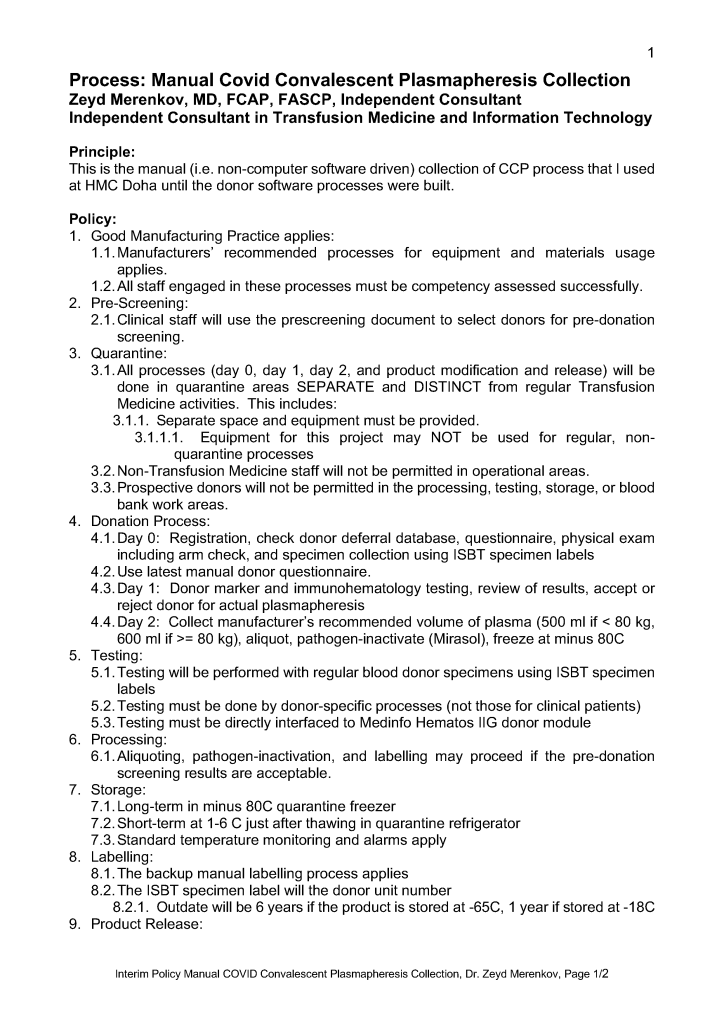
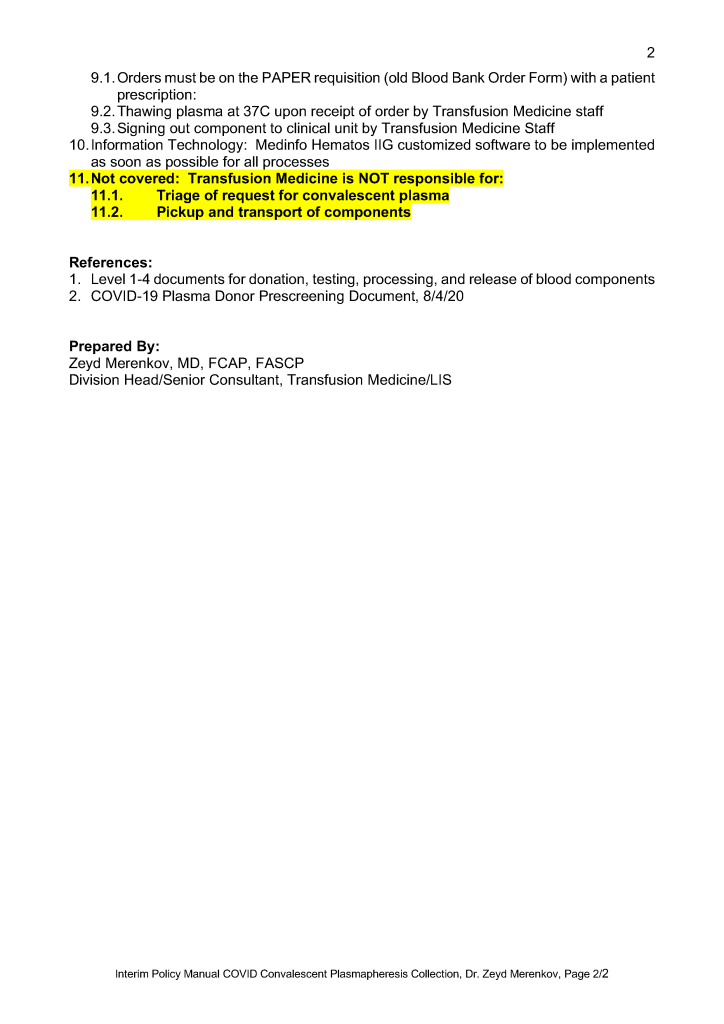
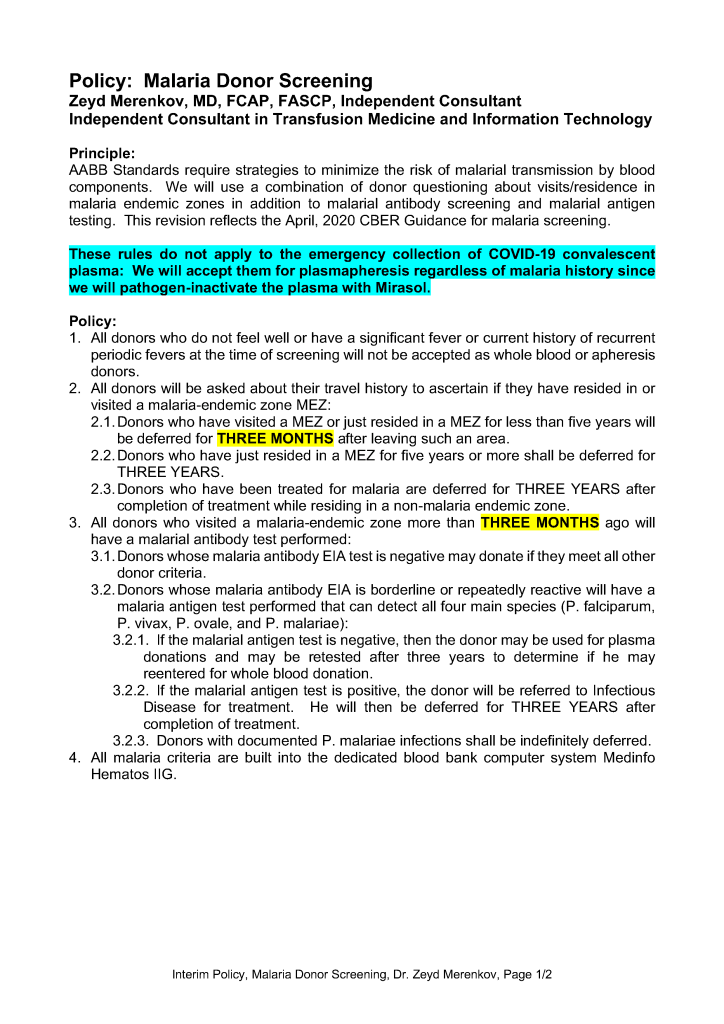
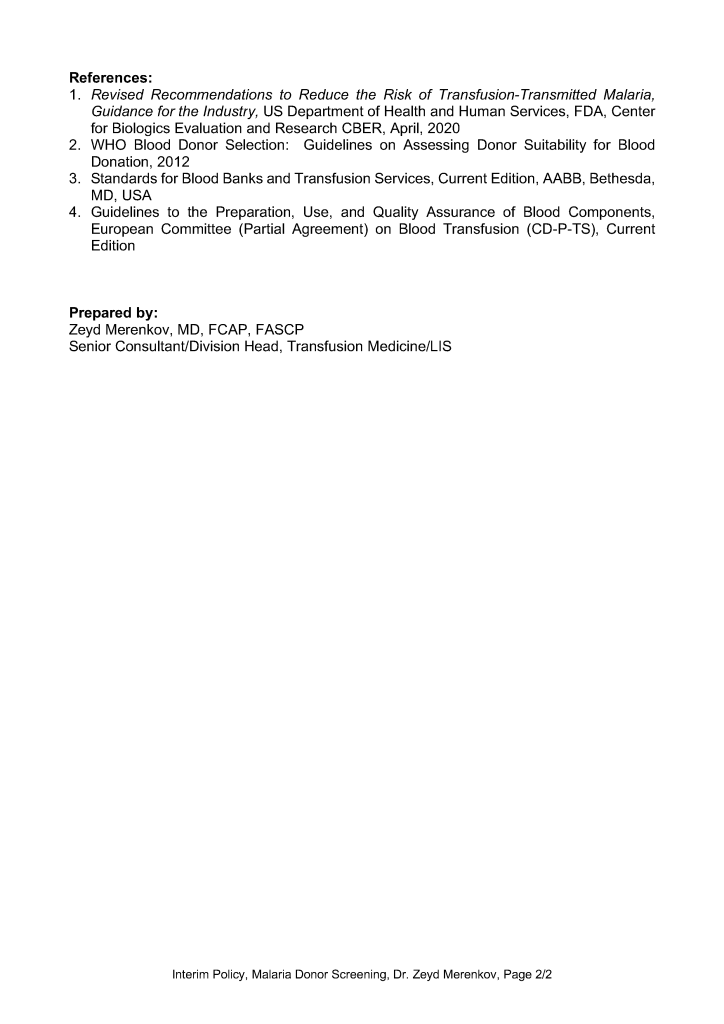
Policy: Investigation of Mislabeled Donor Units

This is an updated version of a previous post.

Principle:

All donor unit mislabeling is potentially life-threatening and must be stringently investigated as soon as possible after the discrepancy is detected.  Most importantly, if there is one error, there may be possibly ADDITIONAL donor unit errors (e.g. switch of donor tubes or units, etc.).  All donor units processed in the same batch must be also quarantined until the discrepancies are resolved.

Policy Details:

The following steps MUST be performed as soon as possible:

  1. The Component Processing Supervisor or Senior Technologist must be IMMEDIATELY notified of any discrepancy.
  2. The Blood Bank Supervisor will inform the Division Head, Transfusion Medicine.  If the Head is not available, notify the Transfusion Medicine on-call.
  3. Quarantine ALL donor units collected and processed in the same batch.
  4. Obtain copies of all testing including photos of the gel/glass bead cards documenting the discrepancy.
  5. Obtain copies of all worksheets used in donor processing for the affected batch.
  6. Perform repeat ABO/D typing of ALL DONOR UNITS in the affected batch.  Any further discrepancies must be investigated and resolved.
  7. All repeat testing must be entered into the Medinfo Hematos IIG computer system.
  8. Identify all staff who were involved in handling the donor unit (phlebotomist, blood bank technicians processing and labelling the unit).  Identify those associated directly with the error.
  9. Submit all documents and photos to the Blood Bank Supervisor or designate.
  10. Prepare an occurrence/variation OVA report documenting all the data, findings, and interpretations.
  11. All investigations must be reviewed by the Supervisor, responsible blood bank physician, and one of the senior consultants.
  12. All such investigations must then be finally reviewed and approved by Head, Transfusion Medicine or his designate.  Only when the issue(s) are completely resolved and investigation is approved may the donor unit be properly relabeled and released into available stock.  Also, only at that time may the other units in the affected batch be released into available stock!!
  13. Photograph the correctly relabeled unit and attach it to the other documentation of the incident.
  14. If the discrepancy cannot be resolved, ALL units in the affected batch must be discarded.
  15.  The implicated staff’s personnel record should be reviewed for previous errors.   Appropriate disciplinary action should be taken and documented in the personnel record.  If a verbal warning is given, it should still be documented in the written record.
  16. If there is a systemic cause for the error, appropriate measures should be taken to minimize reoccurrence.

Reference:

Standards for Blood Banks and Transfusion Services, Current Version, AABB, Bethesda, MD, USA

Policy: Division Head Transfusion Medicine Role in Policy Making

Principle:

The Division Head, Transfusion Medicine and Blood Banks, is responsible for all aspects of transfusion medicine at HMC for the State of Qatar.  The following policy documents some of those roles.

Policy:

  1. The Division Head, Transfusion Medicine HTM, serves as a member of the Corporate Transfusion Committee
  2. The HTM through the CTC establishes criteria for transfusion of blood components and passes these through the HMC corporate process for establishing official guidelines.
  3. The HTM reviews blood component requests, especially in times of shortage to triage in conjunction with the Medical Director and Chairperson, DPLM
  4. The HTM establishes transfusion practices through the interim policies, which are in turn used to prepare processes and procedures through corporate transfusion medicine.
  5. The HTM serves as Project Manager for the Medinfo Hematos IIG computer system and prepares policies, processes, and procedures for Transfusion Laboratory Information Systems.

References:

Standards for Blood Banks and Transfusion Services, Current Edition AABB, Bethesda, MD, USA

Building Donor Center Software Processes: Donor Physical Examination and Adverse Reactions

Donor physical examination, along with the donor questionnaire, are important both for donor and patient safety.  In general:

Is it safe for the donor to donate?

Is it safe for the patient to receive the blood even if it is safe for the donor to donate.

Any donor who does not feel well must not donate.  This may be the single most important step in ensuring a safe blood supply.

The donor physical examination includes the vital signs (blood pressure, pulse, temperature, heart rate, and temperature).  I have attached a sample set of criteria for review.  All are user-definable.  Note how the arm examination is also included (looking for scarring, skin lesions, etc.)

For all types of donations, there may be adverse reactions.  These must be documented in the record along with the disposition of the donation.  Will the donor need an extended deferral if the RBCs in the apheresis run are not returned?  This can be built from the reaction documentation.  Note the following sample table of reactions.

To Be Continued

Building Donor Center Processes: Setting Deferral Intervals between Donation Types

Donation can be whole blood or apheresis-based.  The sex and age for each donation type is specified.  At HMC, we did not accept females for platelet or plasma donations, so the starting age is listed as 99 years.  Otherwise, in accordance with Qatari law, the starting age for donation is 18.  All these parameters are user-definable, and a transfusion medicine physician can override the rules if necessary.

For each and every combination of donations, the deferral interval must be specified.  Examples follow.  The temporary deferral period is in days:

Previous donation whole blood, current donation whole blood:  56

Previous donor platelets, current donation whole blood:  2

Previous donation whole blood, current donation platelets:  56

Also note how for each possible combination there is an entry for male AND female.  Females are restricted to whole blood donation and only RBCs will be made from the collection.

If there is a collection incident and the apheresis procedure is not completed, the interval will be set to 56 days.  This will be covered in the post on donor adverse effect reporting.

To Be Continued: