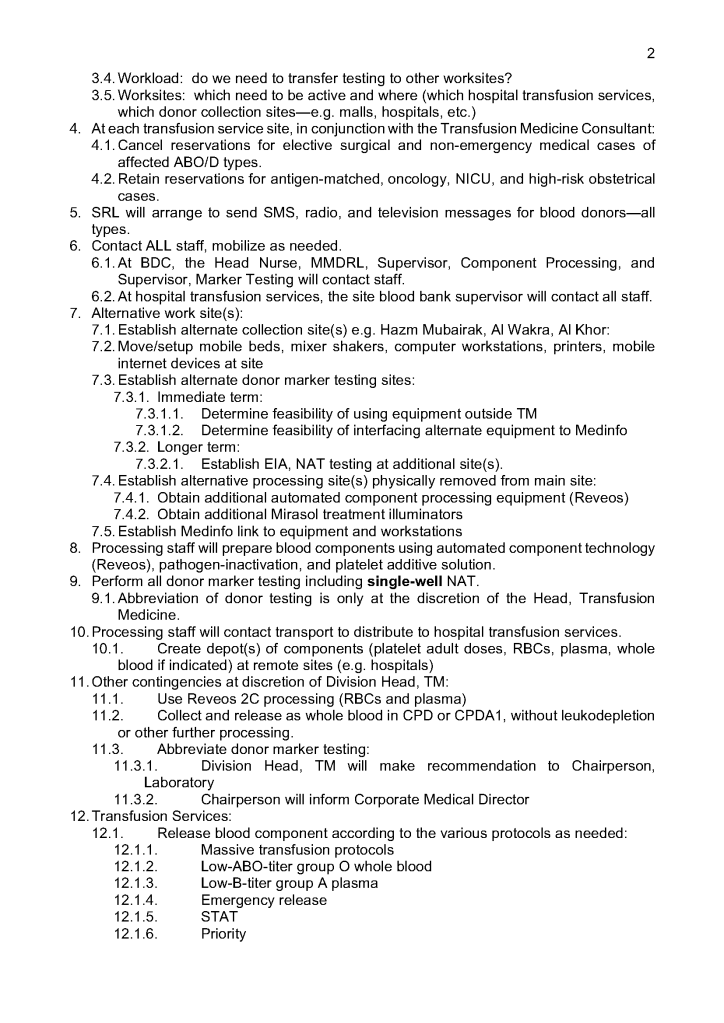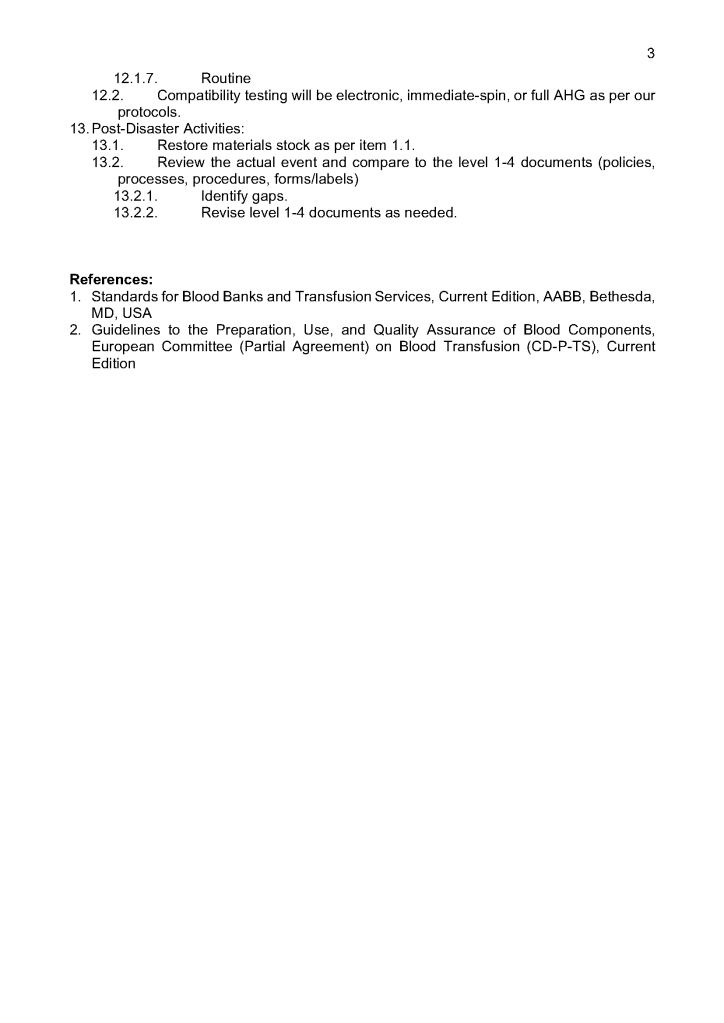
Operational Effects of the COVID Pandemic–My Experience in Qatar

The COVID-19 pandemic imposed new challenges to our system.  In general, these could be divided into:

  1. Decreased donors
  2. COVID vaccine effects
  3. Decreased available staff
  4. Shortages of supplies
  5. More demands on donor apheresis staff—CCP
  6. More demands on donor processing staff—CCP
  7. More demands on hospital transfusion service/blood bank staff—CCP

There were fewer donors in the early phase and the nurses also had to add a large number of donor plasmapheresis collections for COVID convalescent plasma CCP.  Still they had to maintain all donor and therapeutic apheresis services with no increase in staff.  Although elective procedures had been cancelled, there were still obstetrical, oncologic, and trauma services in full action.

Many of our staff were on leave when the borders were closed.  Some had to wait months before they could return to work.  Others had COVID-19 infection and were quarantined for several weeks.  This further reduced staffing.  We could not just hire outside staff since considerable training is involved in these processes.

I dedicated a separate donor collection space for the CCP program away from the regular donors as well as a quarantine processing area.  Similarly, the CCP plasma was kept segregated from the regular plasma supply and a specially designed location was identified for release of this product.  Working for this program diverted resources from blood collection to this special project, again without increasing resources.

With disruptions to shipments of supplies, including the Reveos whole blood kits and Trima donor apheresis sets, we had to rely on our large in-home inventory until the situation stabilized.  We prescreened the CCP donor candidates before we would collect them to avoid wastage of kits.

Fortunately, our throughput was minimally affected because our equipment and processes had always stressed speed.  We used single-well NAT testing to minimize the need of additional runs.  Also, we used Reveos automated component processing to greatly speed production (one Reveos can process four whole blood units in about 23 minutes or about 12 units in 75 minutes.)  One technologist could operate all 4 of our machines simultaneously and perform other tasks while the machines were working.

In the system I developed in Qatar, we could complete processing into components (RBCs, buffy coat platelet pools, leukodepleted plasma), all marker and immunohematology testing, leukoreduction of the pools and RBCs, Mirasol pathogen inactivation, and platelet additive solution in as little as five hours.

In rapid turn-around events, it is most helpful to have a robust blood bank computer system that can scale to the challenge.  Also, it must mercilessly enforce all the rules starting with donor qualification, screening, collection through testing and production.  At times of emergency, it is difficult to meet Good Manufacturing Processes manually.

I had built parallel separate donor collection, donor processing, and transfusion service/hospital blood bank processes specifically for CCP and had to staff them with available personnel, limited our capability to process regular donors.  The blood bank computer software restricted CCP use to designated physicians and transfusing locations.  For those interested, there is a separate series of posts about the CCP project and its implementation in the dedicated blood bank Medinfo HIIG.

COVID-19 vaccinations should have minimal effect in donor qualification since mRNA or antigen-based ones do not cause donor deferral.  Live attenuated COVID vaccines will defer donors for 2 weeks by current rules—the same as other live vaccines.  Donors who had previously received CCP will be deferred for three (3) months after last receiving this product.

In summary, the COVID pandemic reduced staffing and affected donor recruitment.  We had production mitigations to maximize throughput.  The system was stressed by the reduced staffing and special demands to produce CCP.  However, the extent of our automation allowed us to maintain throughput throughout the crisis.

Teaching Document: Validation Process

This is a teaching document for medical technology and transfusion fellows to explain the general structure of a validation.

Principle:

All validations must be planned.  A validation protocol must be prepared with specific criteria for acceptance.  All validations with attached evidence must approved by the Head, Transfusion Medicine.

Policy:

  1. A written validation protocol must be prepared in the advance and at least including the following:
    1. Specific parameters and number of iterations to be performed
    1. Designated staff to perform validation
    1. Documentary evidence of the testing
    1. Specific acceptability criteria
  2. The completed validation protocol must be submitted to the Division Head, Transfusion Medicine, or designee for review.
  3. Once the validation plan has been reviewed, it must be performed by the designated staff.
    1. Software validations will be performed in a specific test environment, not in the live, production system.
  4. The completed validation document, including screenshots of the software functionality if applicable, must be submitted to the Division Head, Transfusion Medicine for review.
  5. The equipment or software may only be used if the acceptability are met AND the validation is approved by the Division Head, Transfusion Medicine or designee.
  6. The completed validation protocol will be stored in the document control system.

Reference:

Standards for Blood Banks and Transfusion Services, Current Edition, Bethesda, MD, USA

COVID-19 Convalescent Plasma CCP Donor Questionnaire and Collection

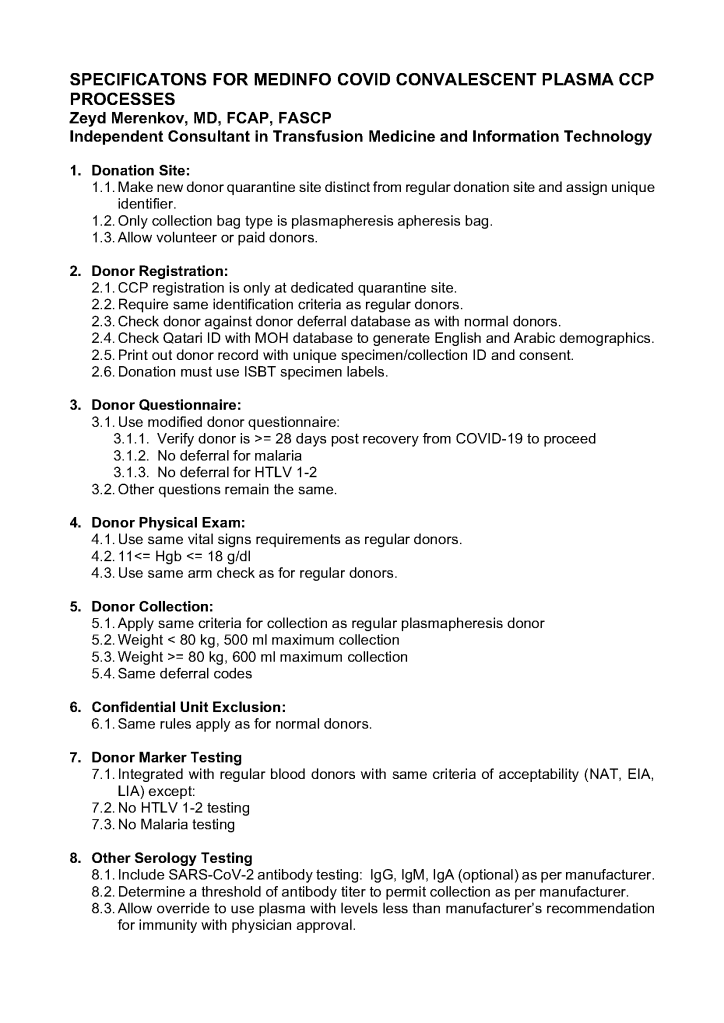
This is a part of a series of posts on the actual Medinfo design of the CCP donation and release processes.  The site and donor registrations were covered in a recent previous post.

Donor Questionnaire and Physical Examination:

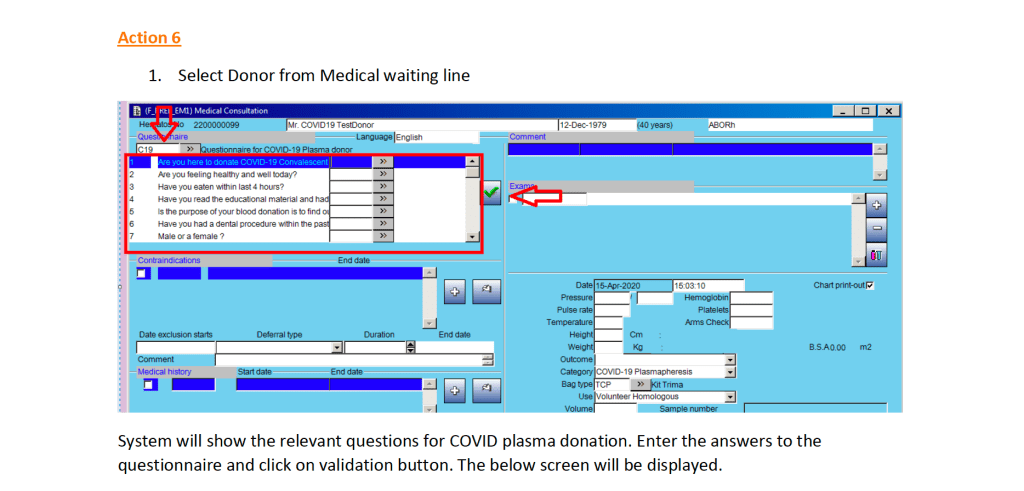
After registration, there is the online CCP donor questionnaire and vital signs entry.

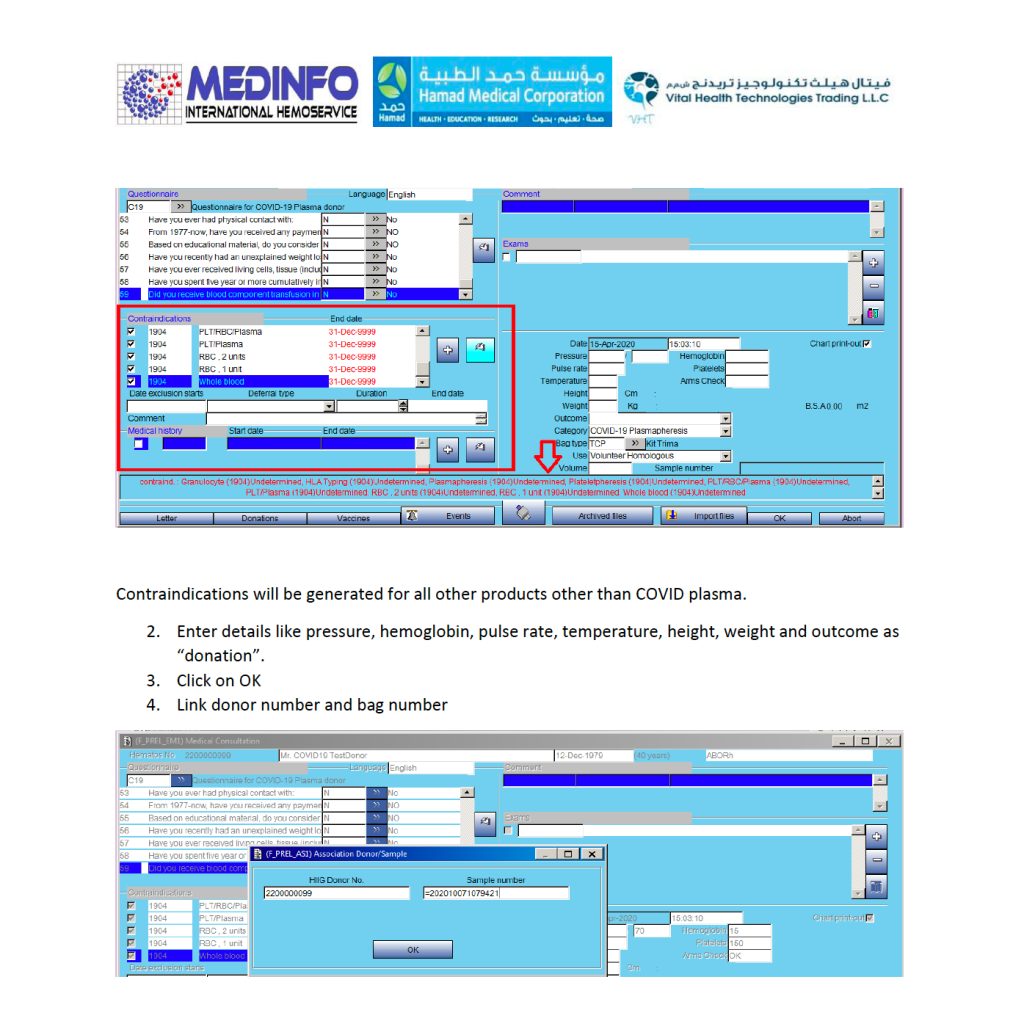
Note that the CCP donor will automatically be excluded from other types of donation.  All other types will appear as contraindications in RED below.

Donor Apheresis Collection:

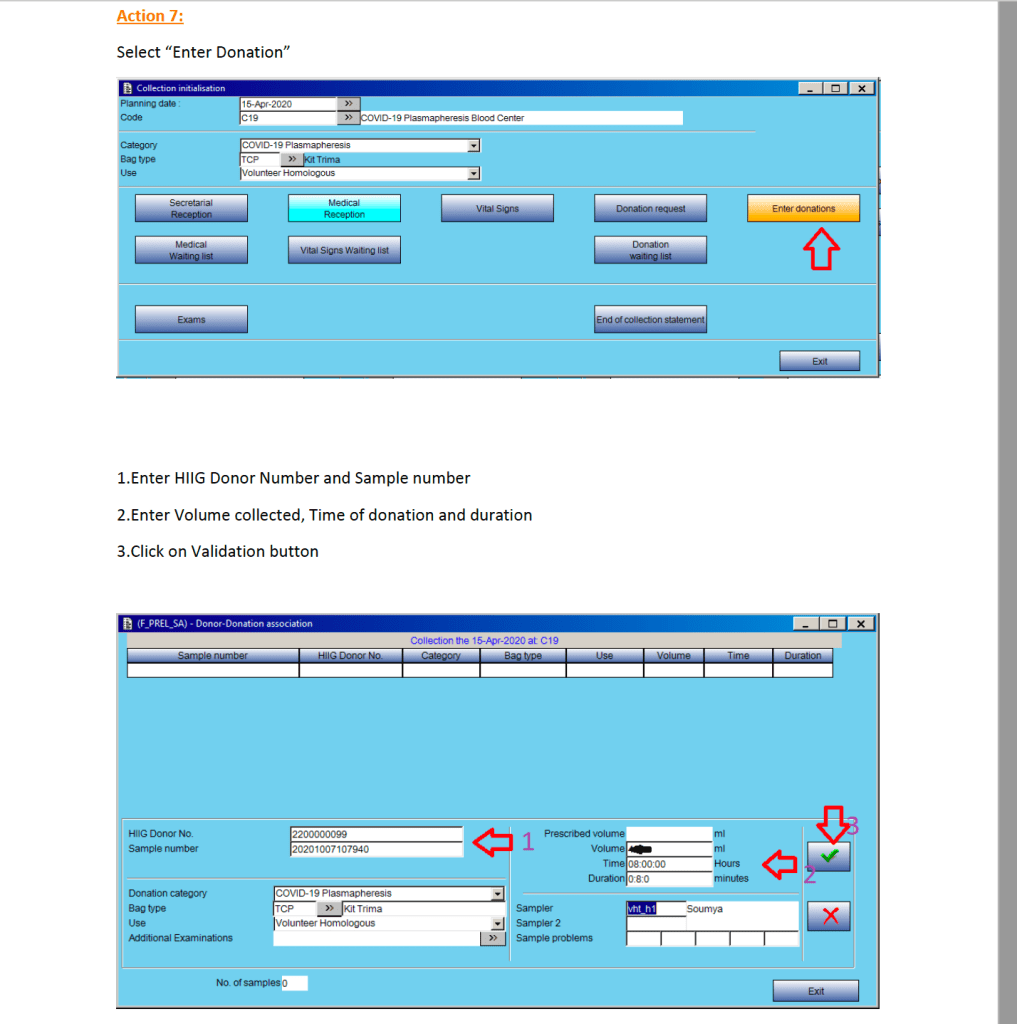
The actual donation process is the same as for plasmapheresis donors:

COVID-19 Convalescent Plasma CCP Donor Registration

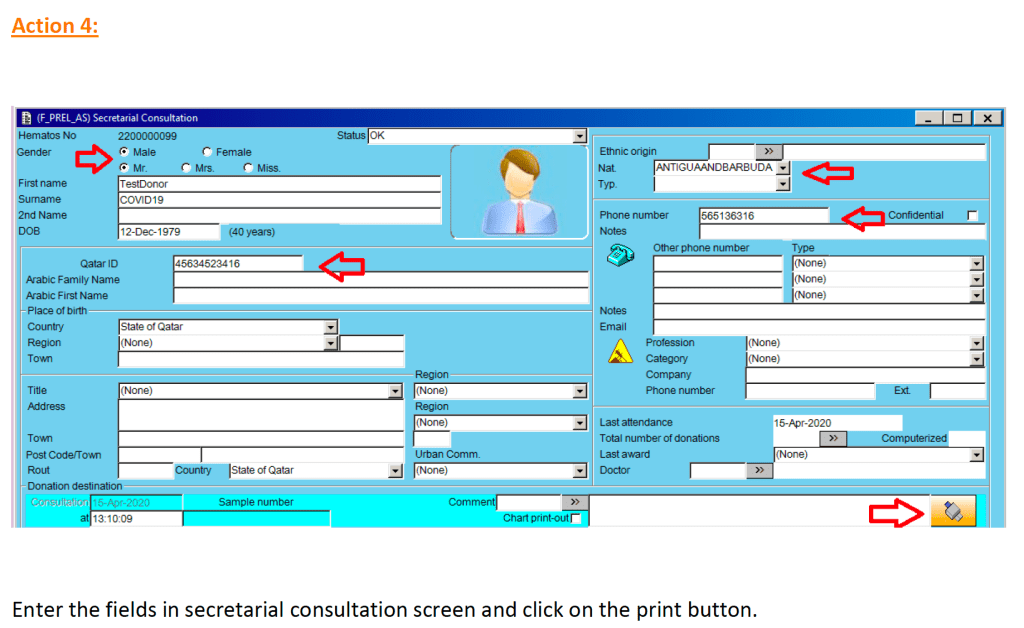
I designed a completely quarantined process for collection, processing, and release of CCP at HMC Doha.  This document shows the Medinfo process for donor registration as a separate donor center code.

Check donor history and donor deferral database.  If there is no previous encounter, generate a new donor file:

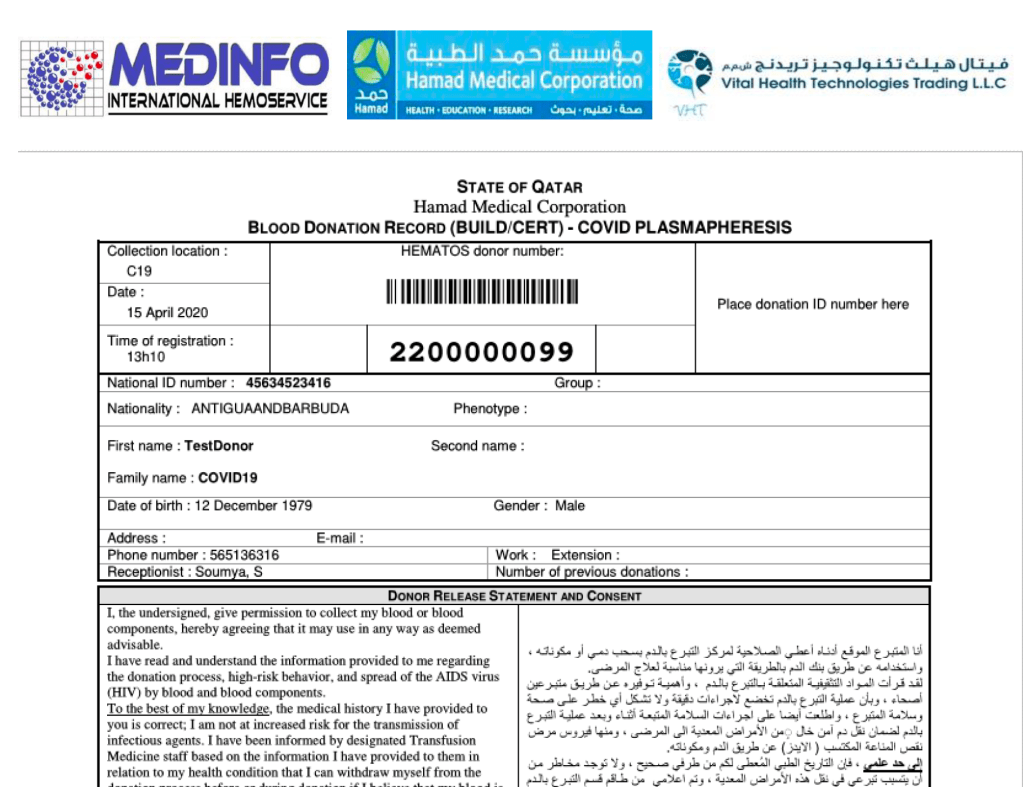
At the completion of this action, the Blood Donation Record with the donor unit number (in this example 2200000099) and consent form in English and Arabic is generated.

CCP could only be collected at this special site and only the apheresis bag could be used for collection.  Regular donation options were not available at this CCP site nor was CCP collection an option at the regular donation sites.

8/1/21

Logistics and Processes for a COVID-19 Convalescent Plasma Program

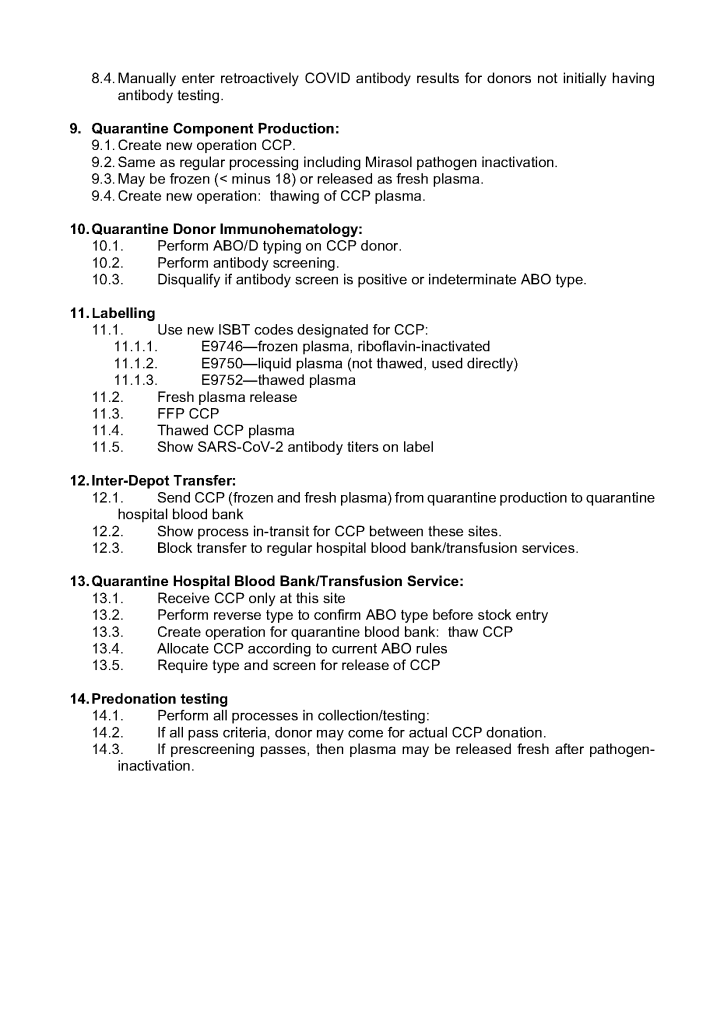
I prepared the following plan for a CCP program for HMC Qatar in March, 2020.  The workflow is divided into four (4) modules:

  1. Registration/Interview/Physical Examination/Apheresis Collection
  2. Donor Marker Testing and Immunohematology Testing
  3. Production/Aliquoting/Pathogen-Inactivation/Storage
  4. Product Thawing/Product Release

Module 1:

  1. Collection/registration/screening must be in a separate area from regular blood and apheresis donations.
  2. Donors must provide consent.
  3. ISBT specimen labels must be used on each tube collected.
  4. We need a minimum of two apheresis nurses, one for the registration/screening/post-donation observation and one for the actual apheresis procedure.
  5. If there will be multiple serial donors, then we need a waiting area (each donor at least 2 meters apart).
  6. Donor screening must be in sound-proof area so that other waiting donors cannot hear the interview/questionnaire process.
  7. Amount that can be collected depends on body weight:  500 ml for <80 kg and 600 ml for >= 80 kg, collection may occur twice per week
  8. Collection time includes 15 minutes for registration/interview/physical examination, 60-75 minutes and 15 minutes for cleanup/disinfection before the next case, approximately 2 hours per donation.
  9. A post-donation observation area (minimum 15 minutes after collection) with apheresis nurse nearby in case of reactions is needed if there will be multiple donors.
  10. Specimens will

Module 2:

  1. Donor testing and donor immunohematology will be done with other donor specimens in our regular location

Module 3:

  1. Apheresis collection must be processed and stored separately from regular blood/apheresis donations.
  2. Processing will occur only after the results are shown to meet all criteria.
  3. Pre-collection testing (test-only donation) would permit processing without waiting for results.
  4. Storage at minus 80C may be for a minimum of six (6) years but this may be extended if needed.
  5. All acceptable components will have a final ISBT label—no products without the ISBT label will be transfused.  The ISBT label indicates that the unit meets all donor criteria for convalescent plasma.

Module 4:

  1. Product modification (thawing) and release (sign out from blood bank) must be in a separate area(s) from the regular hospital blood bank.
  2. Release of convalescent plasma follows the same process as regular component release
  3. Transfusion of convalescent plasma at the patient’s bedside follows same process as regular component transfusion
  4. Nursing and other staff performing the transfusion must pass competency assessment.
  5. Plasma will be transfused as ABO-identical or compatible unless low ABO-titer group A is used.
  6. Plasma must be free of clinically significant antibodies

Workflow Considerations:

  1. Donors must be restricted to the waiting, collection, or post-donation observation areas.
  2. Donors must NOT pass through production, testing, or component release areas (just as they are currently restricted in the Blood Donor Center and HMC hospital blood banks/transfusion services).

Logistics:

  1. Throughput is a maximum of 4 donors (2000 to 2400 ml plasma) per eight-hour shift with one apheresis nurse and one donor apheresis (Trima) machine.
  2. The processes are scalable with additional staff and machines (e.g. with 3 machines and nurses, then 12 donors and 6000 to 7200 ml of plasma collected).
  3. Thawing of 1-2 units of plasma takes up to one hour.  Contact the quarantine blood bank at least one hour before the desired pick-up time.
  4. The four modules above can be in separate areas not adjacent to one another.  Modules 1, 3, and 4 must be quarantine areas where access is limited.  Module 2 can be performed with regular donor specimens using standard precautions.
  5. We can provide training for transfusion of blood components and competency assessment to any location transfusing this product.

Information Technology:

  1. All modules will be connected to the Medinfo Hematos IIG dedicated blood bank computer system.
  2. All records of collection/production/testing/storage/modification/release will be stored therein.
  3. All ordering of convalescent plasma components will be through Medinfo.
  4. External test results (e.g. future antibody titering) can be added to the component information.
  5. Links to the Hospital Information System (Cerner) may be considered after the Medinfo processes are fully functional.