Updated Donor Questions for Ebola Virus Screening

The AABB just updated its Ebola Toolkit and made proposed changes to the Uniform Donor Questionnaire UDQ to reflect this.  Up to five (5) questions should be included in your questionnaire.  What question(s) to use depends on:

  • Are you in an area with NO widespread transmission?—1 question (#1)
  • Are you in an area with widespread transmission?—5 questions (#1-5)
  • Are you in an area post-widespread (> 4 weeks) transmission?—1 question (#1)
 YesNo
Ebola Question 1: Have you ever had Ebola virus disease or infection?qq
Ebola Question 2: In the past 8 weeks, have you lived in, or traveled to, a country with widespread transmission of Ebola virus disease or infection? (Review list of affected areas, as classified by CDC) *qq
Ebola Question 3: In the past 8 weeks, have you had sexual contact with a person who has EVER had Ebola virus disease or infection?qq
Ebola Question 4: In the past 8 weeks, have you had direct exposure to body fluids (blood, urine, stool, saliva, semen, vaginal fluids or vomit) from a person who may have Ebola virus disease or infection, including a person under investigation?qq
Ebola Question 5: In the past 8 weeks, have you been notified by a public health authority that you may have been exposed to a person with Ebola virus disease or infection?qq

If the response to question #1 is YES, then the donor is indefinitely deferred.

For questions 2-5, there is an 8-week deferral.

In areas with no widespread transmission, self-deferral of donors with a history of Ebola infection should be adequate, only question #1 is required.  If there is widespread transmission, questions #2-5 should be added.  Four (4) weeks after widespread transmission stops, revert back to using question #1 only.

These can be easily added to the donor questionnaire in Medinfo blood donor module.

References:

  1. AABB v2.1 DHQ and Flowcharts Modified for Ebola Risk, March 2021, AABB, Bethesda, MD, USA
  2. AABB Ebola Toolkit, Revised May 2020, Bethesda, MD, USA
  3. Recommendations for Assessment of Blood Donor Eligibility, Donor Deferral and Blood Product Management in Response to Ebola Virus, Guidance for Industry,  U.S. Department of Health and Human Services, Food and Drug Administration Center for Biologics Evaluation and Research, January 2017

Extracts from the WHO HTLV-1 Key Facts Document 3-2021

The World Health Organization WHO just released a Key Facts document on HTLV-1 infection (references below) as follow up to their February, 2020 Technical Report.  Here are some highlights for blood bankers:

HTLV-1 is efficiently transmitted by blood transfusion with a rate of 28-63% from a donor with HTLV-1 and up to 87% from a tissue transplant. 

Testing can be made more complicated due to the length of time between contracting the virus andthe seroconversion required for the virus to appear on tests. This period has been reported to be aslong as 65 days.

Mandatory HTLV-1 antibody screening of all blood donations has been implemented in 23 countries.

Because HTLV-1 is almost always cell associated, leukoreduction may be as effective as blood donation screening in preventing transmission.

Following current practices, screening tests for HTLV-1 should be followed by confirmatory tests for the diagnosis of HTLV-1.  Most screening tests use immunoassays, which rely on detecting anti-HTLV-1 antibodies. Commonly used confirmatory tests detect antibody responses to specific HTLV-1antigens.  Test types include the Western Blot, radioimmunoprecipitation assay (RIA) and linear immunoblot assay LIA.  However, the Western Blot test has been found to give unreliable results.  Several  studies have proposed transitioning from using Western Blot for confirmation in routine testing to using line immunoassay or NAT.

In my laboratory in Qatar, we detected approximately 8-10 cases of infection per year on a donor testing base of 36,000 for the year 2019.  These were confirmed cases by LIA.  In addition to the universal leukodepletion of all components to the CE-mandated level of < 1E6, we also pathogen-inactivated platelet components and plasma.

References:

  1. Technical Report Human T-Lymphotrophic Virus Type 1, WHO, February 2020
  2. Key Facts Human T-Lymphotrophic Virus Type 1, WHO, 3/3/21

Physicians and RBC Antibodies

During my career, the role of the transfusion medicine physician in handling RBC antibodies has evolved.  Depending on your location, either a specific transfusion medicine physician or a hematologist covering the specialty handled this.  In the United States, most hematologists nowadays do not do this.

During my US residency training in pathology, most trainees did not have an interest in blood banking and often used the rotation to take vacations.  For their board certification in clinical pathology, they crammed for the examination and afterwards did not engage in it.

When I started my career in the United States, hospitals had a hospital blood bank/transfusion service and handled most of their antibody problems themselves.  In Chicago where I practiced, many blood banks had Specialist in Blood Banks SBB graduates or SBB students working, and of course, they had a dedicated blood bank supervisor.

Currently in the United States, the hospital blood banks may be staffed by generalists and there is no one with specific antibody experience.  SBB graduates are expensive and usually work in blood centers or academic hospitals.

If you have a regional blood center with a reference laboratory, you can send your antibody workups there and let the blood center select appropriately antigen-matched units.  The physician covering the blood bank does not have to get very involved.

In the Middle East in the systems that I have run, there have been no reference laboratories and often no regional blood center.  The hospital system or the free-standing blood bank is an independent entity and must rely on itself.  The physician responsible for the blood bank must review the antibody panels and make his own decision how to select RBC components.

In the Middle East, especially in the larger centers with academic hospitals, there is usually a transfusion medicine physician who reviews the antibody workups and makes the final decision of what RBC types to dispense.  He does not have a reference laboratory to rely on.  He is responsible for the choices and has no one to refer cases on a 24/7 basis.

In the Middle East, the transfusion medicine physician must be proactive.  He must also select antigen-matched, fully or partially, and understand the trade-offs in cases with multiple antibodies.  He must know how to deal with nonspecific antibodies and antibodies to high-incidence antigens, especially if he works in a region where the antibody panels are not optimized to the local population or there are many different ethnic groups in the local area.

Thus, training someone to practice in the Middle East requires spending considerable time in technical matters that might not be necessary if he/she practiced in the West.  He may not only have to serve as a physician but he may be the equivalent of the reference laboratory supervisor.  Until such time that reference laboratories are available, this model is essential for safe practice.  Training programs for the region must reflect this and in particular, teach about specific antibodies common to the region.  He must be technically oriented and he must take ultimate responsibility for the interpretation of the antibody workups and selection of the appropriately matched units.

Building Processes in a Blood Bank Computer System

This is updated version of a previous post.

This post is mainly on building processes for a non-turnkey system such as the Medinfo Hematos IIG software that I have worked with in several countries, but there will be a few words about turnkey systems for general laboratories.

This has been a collaborative effort between the software vendor’s engineers, my Super Users, and myself.  This pluralistic approach has been most productive.

A turnkey system has pretty much already defined most of the basic processes—those have been specifically approved by a regulatory agency such as US FDA.  There is little customization except formatting screen and reports.  Instrument interfaces are also mainly predefined.  This requires much less thought and planning than a custom-built system designed on the sites actual workflows, but it can be an exercise of putting a round peg in a square hole.  You don’t always get what you want or need.

In the locations where I collaborated in setting up the Medinfo Hematos IIG program, we did not follow US FDA but mainly the Council of Europe CE standards since these were much more customizable.  We could modify and add additional criteria specific to our country and region (e.g. rules for donor qualification for local pathogens).  This has always been my preferred approach.  Also, the USA does not use the full ISBT specification for its labels.

Start with a frame of reference (CE) and then try to optimize it for our local needs.  Unfortunately for blood banking, FDA has many fewer approved options than other regions, including in the preparation of blood components, e.g. prohibiting the use of pooled buffy coat platelets, lack of automated blood component production such as Reveos, and use of world-class pathogen-inactivation technologies such as Mirasol.

If you invested the time to make a detailed workflow across all processes and tests, much of this can be readily translated into the software processes, but first you must study the flows and determine where you can optimize them.  This requires that you study the options in the new software to see what you can use best.

I always liked Occam’s Razor, i.e. “ntia non sunt multiplicanda praeter necessitatem,”—the simpler the better as long as it meets your needs.  If the manual processes are working well and can be translated into the new system, do so.  If they need changes for optimization, then do so only if necessary.
Most of my career has been spent overseas with staff from many different countries and backgrounds, most of whom were not native in English.  The wording of the processes is very important.  Think of the additional obstacle of working with a complicated software in your non-mother tongue!  Also consider the differences between American English, British English, and international English.  I always made the Super Users read my proposed specifications and then asked them to repeat what I wrote/said.  There were many surprises!

I think of the Aesop’s fable about the mother who gave birth to an ugly baby looking like a monkey.  Still, to the mother her baby was the most beautiful baby and she entered him into a beauty contest.  In other words, to the mother her child is perfect!

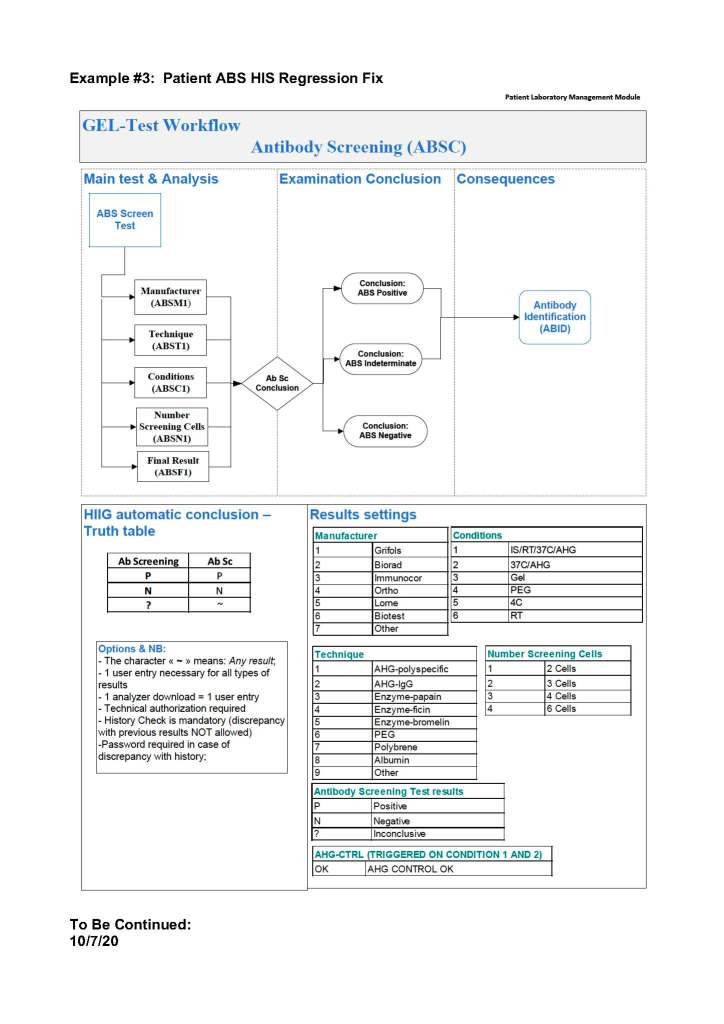
It is most important to use the manufacturer’s recommendations to build tests and for the special automated processing and pathogen-inactivation processes.  For example, we had multiple ABO and D typing tests—they did not necessarily agree on what were acceptable results for automated release of results.  The same is true for many other tests.

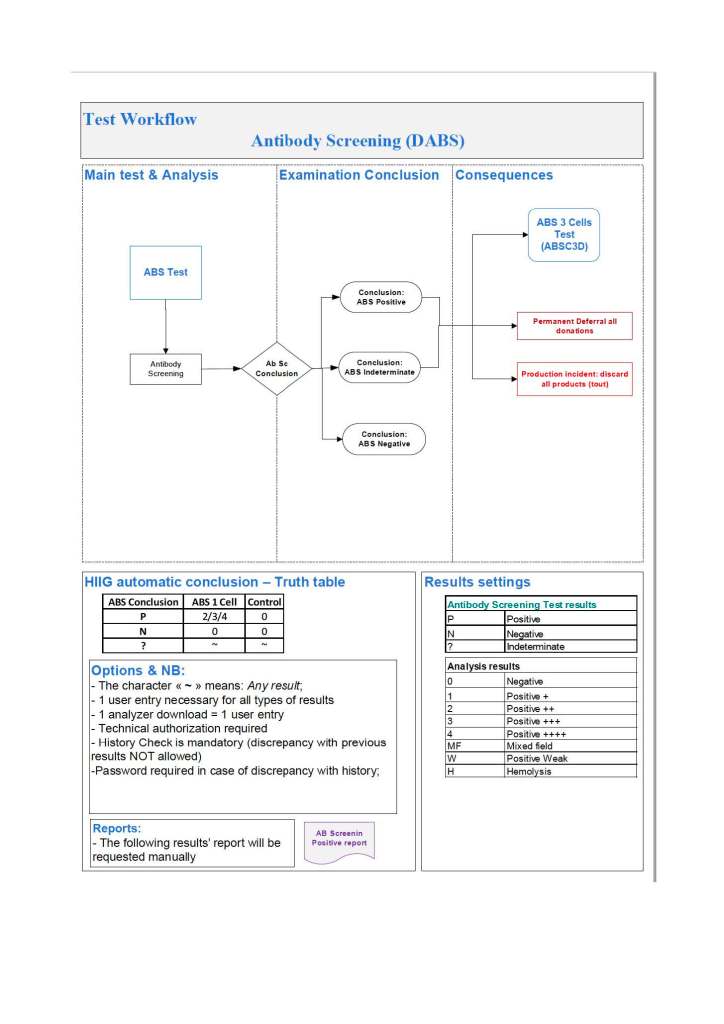
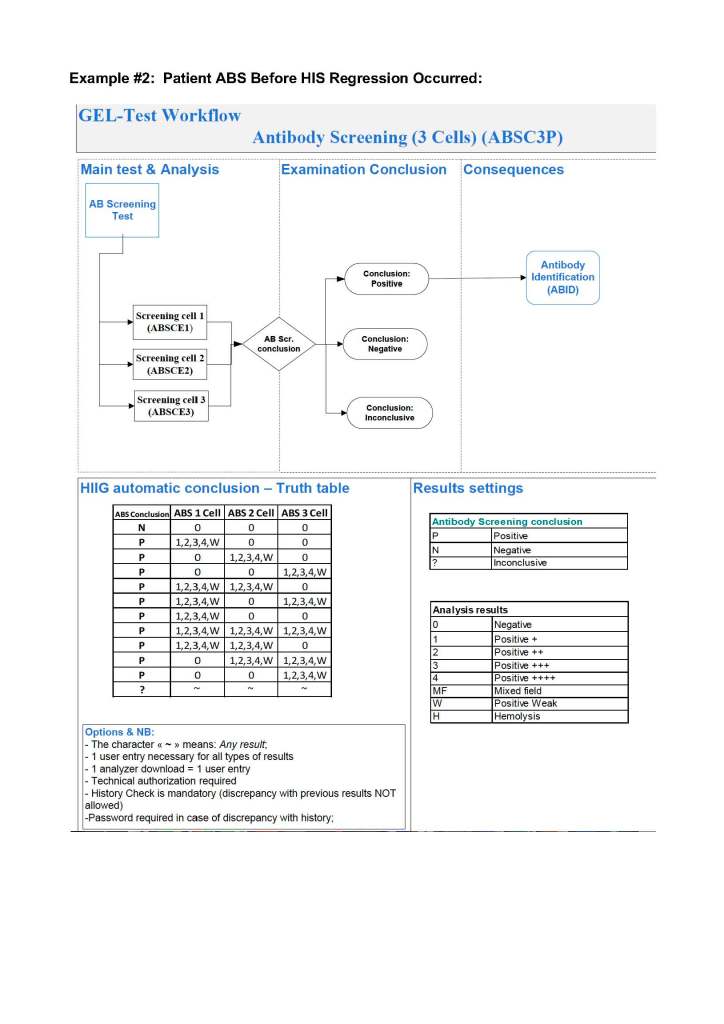
Example:  One method for Rh(D) typing stated that only results in {0, 2+, 3+, 4+} were acceptable—all other results required manual review and/or additional testing.  Another only accepted results in {0,3,4}.  Thus we had to build separate D typing processes for each methodology.

Another consideration is whether to offer all the processes globally or restricted to one site.  I favor allowing access to all methodologies at all sites—in case of a disaster where tests had to performed at another site.   This means that if you send an order over an interface from the hospital system to the blood bank system, then at the receiving (blood bank) end, you would choose which methodology to use, i.e. it is not a one-to-one mapping but rather a one to many mapping.

If we changed equipment at  one site to that used at another site, we didn’t have to modify our software to accommodate this.  Even if you didn’t have the equipment or reagents at one site, you could always build it into the system and not activate the settings until needed.

Finally, the issue of middleware.  Many instruments offer this, but one faces the problem about support and regression errors when you either update the middleware software or the blood bank computer software.  Medinfo itself could serve as the middleware so there was less chance of errors when updating the software.  In fact, I never used any middleware when using Medinfo.