
Inter-Depot Transfer, Blood Delivery, Type and Antigen Matching

This is an update of a previous post.

The final components from the component preparation center may be sent to various depots (freestanding location and/or hospital blood banks.  There should be complete traceability for every step (from donor reception, collection, testing, and processing) transport between locations, and finally the exact storage site, which might include which refrigerator/freezer/incubator and even shelf/position number for each component is stored.  The end of that document showed rules for type/antigen matching.

For disaster planning, rapid inventory enumeration by type is very important.  This can be very time-consuming manually.  With our Medinfo Hematos blood bank system, we could quickly get total inventory across the Qatar or by hospital in less than one minute.  We could also quickly find antigen-matched units across the system and reserve it at any one site for another if necessary.

Smart blood bank dispensing refrigerators, as offered by Haemonetics and Angelatoni, may also serve as depots and take the place of a hospital blood bank for some dispensing.  These solutions can also capture vital information about the storage conditions of the components and prevent release if the storage criteria are not met.  They can also interface with blood bank computer systems and use the main system’s logic for the dispensation rules.

Upon receipt at the hospitals from the blood processing center, the forward ABO and D typing must be confirmed.  We used D reagents which detected partial D so we would call such donor units as D-positive.  However, if a patient type reagent insensitive to partial D types is used, it is possible for a unit to be typed as D-negative whereas in the donor center it might be D-positive.  Sometimes, nothing types consistently as D-positive:  all you can say is that with a particular reagent and lot number, there is or isn’t reactivity.

The greatest complexity is for RBCs since potentially so many antigens exist.  Criteria for matching/ignoring certain antigens must be made.  Critically significant antibodies such as the Kell, Duffy, Kidd, and certain Rh (D and c) must be antigen matched.  A robust blood bank computer system can enforce these rules.

For other components, antigen/typing may be less important.  In fact, in most situations, any type of platelets can be given to anyone (except neonates).  Despite the potentially incompatible plasma, there is rarely significant hemolysis.  In fact, if pooling platelets without regard to blood types is done, a platelet transfusion is a common cause of a positive direct antiglobulin test DAT—something that is not clinically significant.  No one died of a positive DAT by itself for this reason.

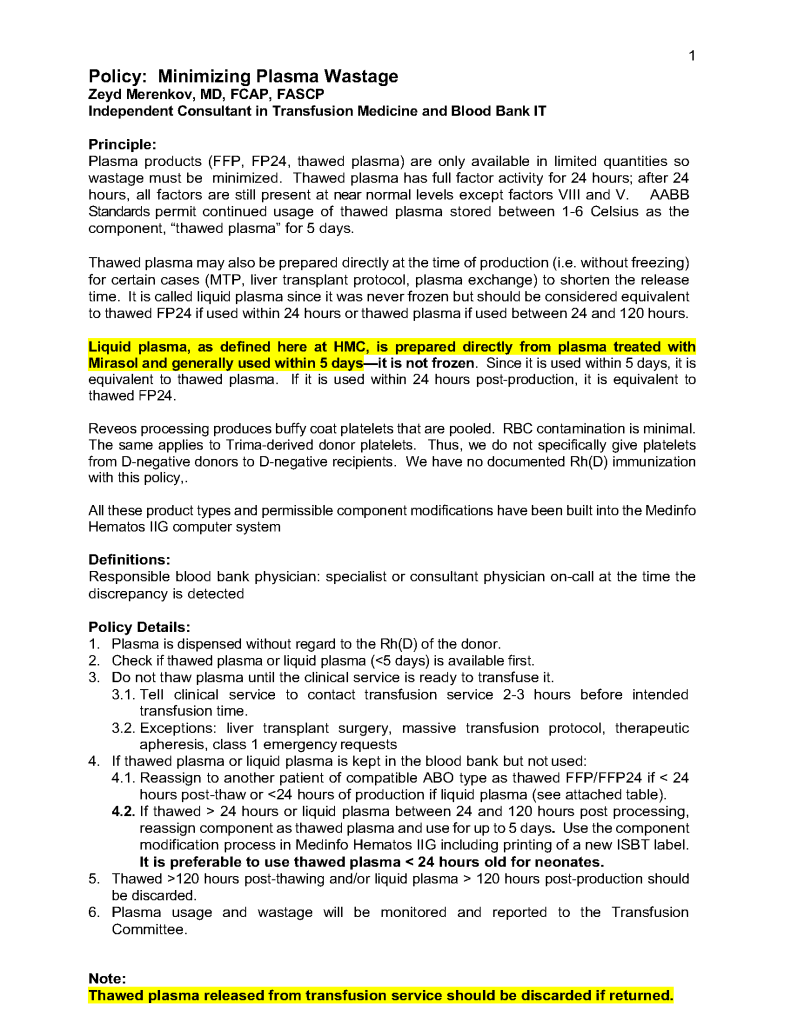
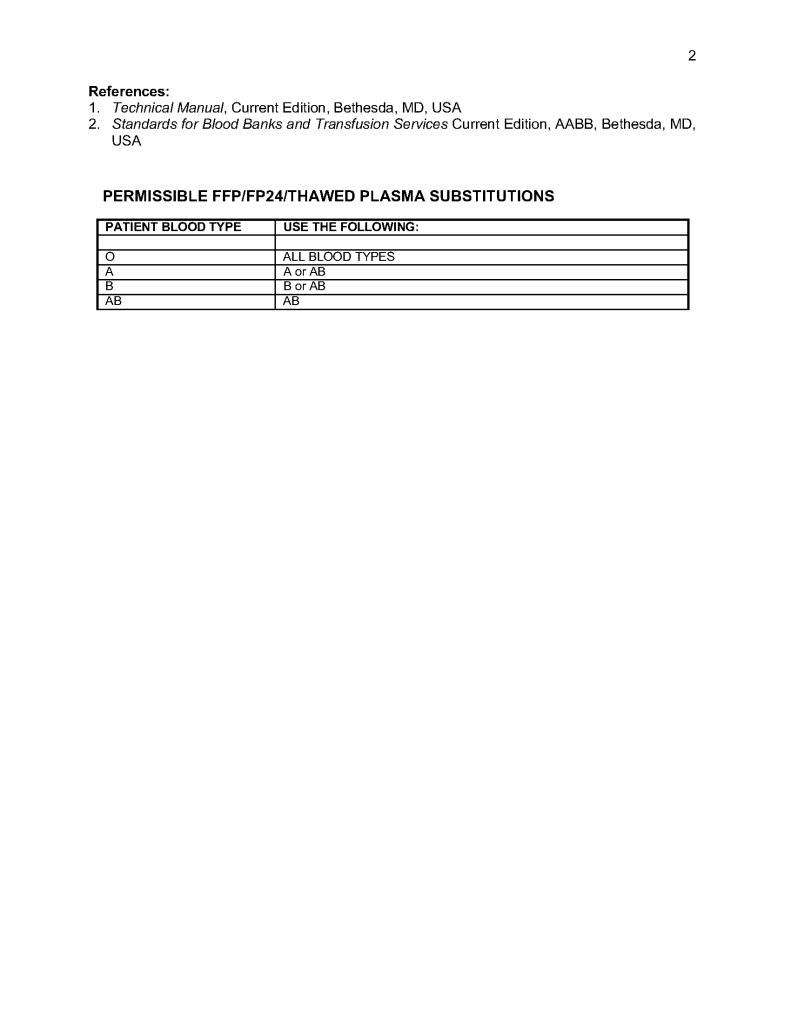
Specific rules for compatible plasma types are important, but nowadays, low-anti-B-titer group A plasma may be used like universal AB plasma.  The challenge is to be able to perform the ABO titration (specifically anti-B) quickly—titration can be a slow process, even with automated equipment.  A similar situation for low-titer, universal group O whole blood requires both anti-A and anti-B titration (I will return to this topic in a future post).

Process: Donor Collection

Process:  Donor Collection

Zeyd Merenkov, MD, FCAP, FASCP

Independent Consultant in Transfusion Medicine

5.4.1 PROCESS DONOR COLLECTION:

Process:

  1. Donors must pass and complete all previous processes in the donor workflow (registration, questionnaire, and physical examination) before the collection process begins.
  2. The donor is positively identified by a designated picture ID and Hematos donor consent form with specimen/encounter number and barcode.
  3. Donor staff checks and prepares a suitable vein
  4. Donor staff collects/labels specimens and the whole blood or apheresis components AT THE DONOR’S BEDSIDE.
  5. Donor reactions are assessed and treated as they occur.
  6. Donors are observed in a post-donation area and given post-donation instructions before discharge.
  7. All processes are documented in Hematos IIG.
  8. Donor units and specimens are sent to component processing and donor marker testing.
  9. The collection workstation and equipment are cleaned before starting a new donor collection.

References:

  1. HMC 1001 Setting Specification, Version 1.5, Hematos IIG, Medinfo
  2. Standards for Blood Banks and Transfusion Services, Current Edition, AABB, Bethesda, Maryland, USA

Policy: Donor Collection

5.4 POLICY: DONOR COLLECTION

Policy:

  1. All donors will be positively identified with a picture ID and by their Hematos identifiers (donor ID and session registration/specimen number).
  2. All previous processes (registration, donor deferral database check, questionnaire, and physical examination) must pass.
  3. The donor’s arm veins will be inspected for a suitable donation site and prepared by a suitable aseptic technique.
  4. Whole Blood:
    1. Only whole blood units collected within the specified time interval may be used for component processing.
  5. Apheresis:
    1. Apheresis units will be collected at frequencies to keep the total RBC loss below 200 in any 8-week period.
    2. Only apheresis units collected within the specified time interval may be used for component processing.
  6. Donors will be treated for adverse reactions as needed.
  7. All specimens and donor units will be labeled at the donor’s bedside before starting a new donor collection.
  8. Donors will be monitored post-donation for a reasonable interval before discharge.
  9. All processes will be documented in the Hematos blood bank computer system.
  10. All equipment and supplies will be used according to manufacturer’s instructions.
  11. The collection workstation and equipment will be cleaned before starting the next donor.
  12. All policies, processes, and procedures must comply with Qatari, HMC, and applicable accreditation standards (i.e. AABB, CAP, and JCI).

References:

  1. HMC 1001 Setting Specification, Version 1.5, Hematos IIG, Medinfo
  2. Standards for Blood Banks and Transfusion Services, Current Edition, AABB, Bethesda, Maryland, USA, October 2013

Product Delivery in Medinfo 1

This is the start of a series of posts on how Medinfo blood bank software was designed for product delivery in the HMC system in Doha.

The overall process was:

  1. Transfer blood components (all types) from the Blood Donor using the Interdepot Transfer process (see that post for details) to the Hamad General Hospital HGH General Delivery Deposit.
  2. Release components to individual HMC system hospitals and client blood banks from the HGH General Delivery Deposit,.

It was also possible to release blood components directly from the Blood Donor Center to HMC hospital blood banks as a contingency.  Client hospitals outside the HMC system still had to obtain their components from HGH General Delivery Deposit.

Interfaces with Quantitative and Qualitative Results

Processes and Software Building Part 7

This is an update of a previous post.

Blood Bank instruments may perform tests and release test results in a numerical or alphanumeric format or both.  For example, nucleic acid and enzyme immunoassay may release a qualitative result (e.g. positive, reactive, borderline/gray-zone, negative, nonreactive).  Alternatively, the machine may release the signal to cutoff ratio (S/CO) as a numeric result.

Blood bank software may use either kind of result on which to base interpretative rules for acceptability of the donor.  The qualitative result criteria are based on the quantitative SC/O but the equipment automatically interprets this.  The S/CO ratio of 1 is the cut-off point.  Thus a value of 0.99 is negative and the value 1.01 is positive.  But is it really so clear-cut since the difference between the two is so small?  Thus, some people have added the term gray-zone for values close to but below the cutoff.  Could a value of 0.95 be an early infection?

I personally prefer to see the actual cutoff but use the manufacturer’s criteria for interpretation.  As a physician, it is good to review the S/CO on serial exams.  If a borderline or gray-zone result becomes positive, then perhaps the original result indicated early infection.  The question still remains, what is the gray-zone?  0.95 to 0.99, 0.90 to 0.99, etc.  Some accrediting schema have not used gray-zone for interpretation.

With Medinfo’s blood bank software, I could choose either option or both—or at least store the S/CO as a nonreported result for subsequent review.  I could even chose, test by test, in a series between reporting either S/CO or the qualitative result.

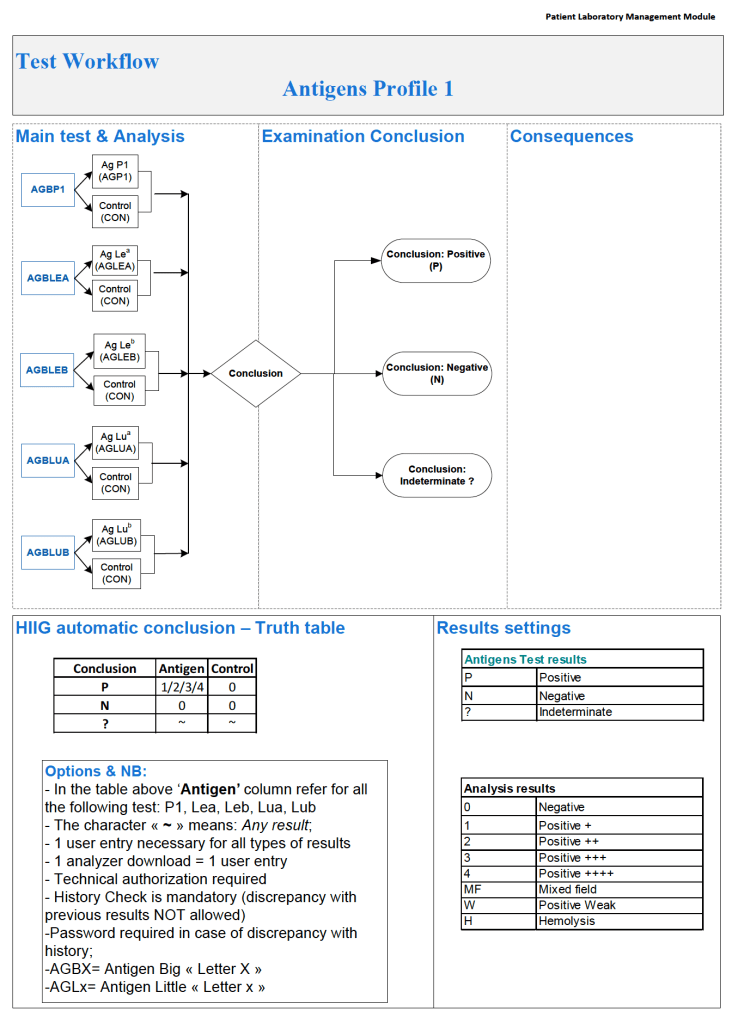
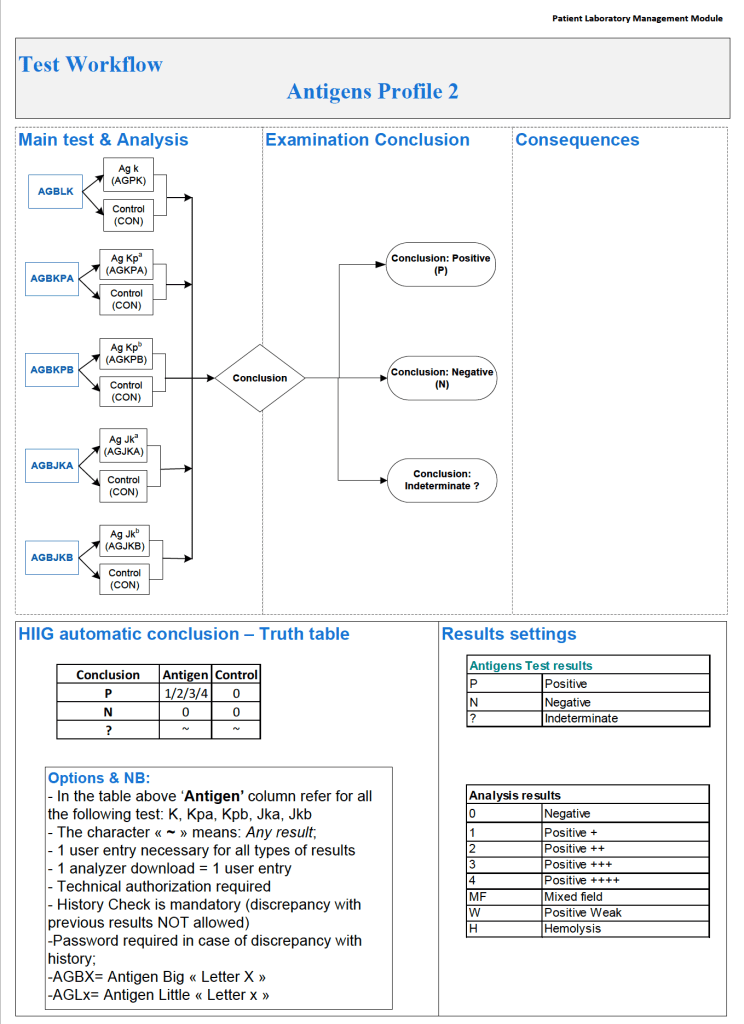
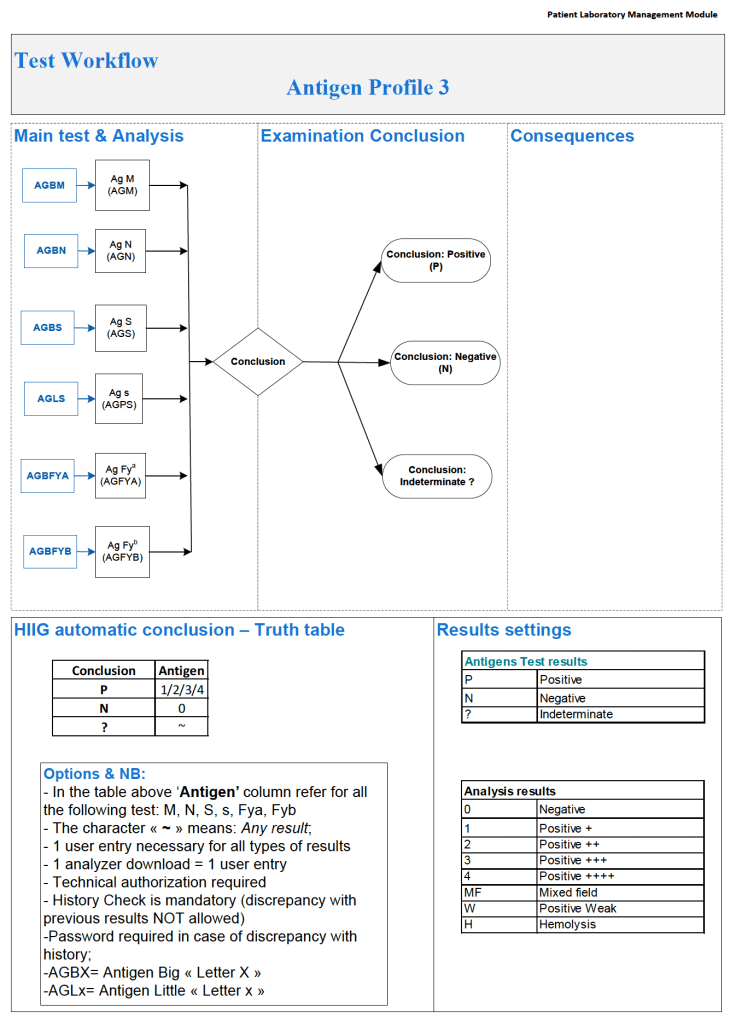
Semiquantitative results, e.g. in {0, 1+, 2+, 3+, 4+} are qualitative and could also include mixed field (mf) and hemolyzed (h).  I showed examples of this with ABO/D antigen typing in a previous post—see attachment.

On the contrary, the results from blood production equipment may include parameters such as time of preparation, original volume, final volumes for each component, platelet yield index as an indirect measure of platelet count.  When there is pooling, the final total volume is critical to determine if pathogen-inactivation procedures and platelet additive solution can be used.  This is a much more complicated interface.

Process: Donor Physical Examination

This is a sample process document for donor physical examination. Compare it to the previous post Policy: Donor Physical Examination.

5.3.1 PROCESS DONOR PHYSICAL EXAMINATION:

Process:

  1. The donor is positively identified by a designated picture ID and Hematos donor consent form with specimen/encounter number and barcode.
  2. Donor staff measures vital signs of donor and enters results into Hematos IIG.
  3. Donor staff inspects donor arms for suitable veins and checks for concurrent skin diseases and/or scarring.
  4. Medinfo Hematos IIG determines donor eligibility to collect components.

References:

  1. HMC 1001 Setting Specification, Version 1.5, Hematos IIG, Medinfo
  2. Standards for Blood Banks and Transfusion Services, Current Edition, AABB, Bethesda, Maryland, USA

Policy: Donor Physical Examination

This is another example of a short concise policy statement. The process example will follow:

5.3 POLICY: DONOR PHYSICAL EXAM

Policy:

  1. All donors will be positively identified with a picture ID and by their Hematos identifiers (donor ID and session registration/specimen number).
  2. The donor’s vital signs (BP, pulse, temperature, respiratory rate) will be measured by designated Donor Center staff.
  3. The donor’s arm veins will be inspected for a suitable donation site and evidence of scarring.
  4. Donor eligibility for actual collection will be determined by the Hematos IIG algorithms based on this data.
  5. All policies, processes, and procedures must comply with Qatari, HMC, and applicable accreditation standards (i.e. AABB, CAP, and JCI).

References:

  1. HMC 1001 Setting Specification, Version 1.5, Hematos IIG, Medinfo
  2. Standards for Blood Banks and Transfusion Services, Current Edition, AABB, Bethesda, Maryland, USA

Processes and Software Building 6: Interfaces

This is an updated version of a previous post.

Interfaces—General Considerations:

When buying equipment while planning/implementing new laboratory software, I originally had a rule not to purchase anything that the vendor did not have a ready interface.  Even that was not so clear since some vendors had interfaces listed as alpha, beta, and completed.

Could you use an alpha or beta interface?  Was it safe for patient care?  What was the development cycle for new interfaces with your vendor—months, years?

Even if the vendor had a completed interface?  How “complete” was it?  Did it accept all data from the machine?  Did the data stream require reformatting?  Who would write the transformational script?

Even if the vendor could support it, could your local IT organization and the local agent’s IT staff do it?  I had plenty of headaches over this.  The best equipment with the best interface that the local agent could not support was worthless to me.

Some finished interfaces took months to install because of connectivity issues.  What version of the operating system OS was used?  Was it secure?  Did our IT department accept that OS version (e.g. Windows 7) and the provided malware protection?  I have seen malware spread across a network from the interface software installed by the vendor, threatening the entire corporate system. 

Did the solution require middleware?  What were the implications of having middleware and its affect on the main software program, especially at the time of its upgrade or the main software?

I have seen vendors using Windows 2000 for their interface software as late as 2017.  It was difficult for some of them to update to current, more secure versions.  Anyway, our corporate IT department gave them all a deadline to update to the current operating system—they all complied or risked losing all connectivity to the network.

Almost every instrument vendor has told me that they can communicate with my laboratory system.  I guess that is true:  one talks in Russian and the other Sanskrit—they do communicate but is it effective?  Talking is not necessarily useful communication!

I remember one open EIA machine that had a TCP/IP port but it was not functional by the standard protocols.  One had to emulate a serial port to get some rudimentary communication.  The port’s light blinked, however.  I never imagined that someone would put a nonfunctional port as a mere decoration.

On the other hand, I have had excellent experience with another software vendor Medinfo.  Even if the vendor did not have the interface developed, they could build it from scratch in a few weeks.  Paradoxically, it was faster to build these new interfaces than some so-called already interfaces.

I must emphasize:  This is a collaborative team effort between the blood bank information system, software vendor, instrument vendor, and your institution’s IT staff.  There must be excellent cooperation between them for a successful result.

When installing the Medinfo Hematos IIG software, many of our most important interfaces (the Terumo mixed shaker, Trima, Reveos and its predecessor Atreus, Mirasol illuminator) had no developed interfaces when we started.  This was a risk, but actually those interfaces were developed in a few weeks and fully functional.  In fact, we were the first site in the world to have those interfaces working—and without any Middleware.

In general, the blood bank software vendor installed the completed interface and did some low-level testing.  Then, my blood bank computer team did the testing.  The final responsibility for testing and acceptance was with the end-user blood bank team and me as Head of the Laboratory Information Systems.

In general,  I wrote the validation protocol and assigned the tasks to the Medinfo Super Users.  To perform this testing, we still had to register donors and collect and then export the specimens to the donor marker testing laboratory before the actual interface testing could begin.  This was all done in a special test domain separate from the production domain.  The interface did not go live until the validation was completed and accepted and then was moved to the production environment.

I made the validation criteria and reviewed all data as Division Head of Laboratory Information Systems.  Representative screen shots were made.  All data was sent to me.  My final acceptance was required before the interface could be activated.

Automated component processing (Reveos) and component modification are more complicated and will be covered in a future post.

Anecdotes: Outside Software Consultants

Sometimes, you may not have adequate resources for a project so you will consider hiring an outside consultant.  During my career, I have used several outside consultants for projects ranging from installing a new general laboratory computer system to assisting in getting international accreditations.

Regrettably, my experience with software consultants has been mixed.  I have used them for general laboratory software installation and settings.  Very few have any experience with dedicated blood bank software or setting up hospital blood bank modules.  They are often former employees of the software vendor you are using.  There is always a potential for conflict of interest.

The software consultant must work for you, NOT for the vendor you are using.  He/she must maintain his independence from the vendor and only represent your interests.  I have had many problems with this.  Here are some of my unpleasant experiences:

Current and Future States:

One set of consultants gave essentially the following current state mapping for almost every test in our menu:

  • Order this.
  • Collect this.
  • Receive this.
  • Perform this.
  • Release this.

They did not know our current state so they were unable to help us build a proper future state.

Mapping Errors:

The consultants were in charge of exporting results from a previous system into the new one, this included mapping the results into the appropriate test fields.  They assumed it would map properly, I insisted on testing a two-week sample of laboratory results and discovered major errors that could adversely affect patient care—it was a major disaster and almost held up implementing a hospital go-live on-time.

Benefits of New Software:

The consultants were obsessed with calculating benefits of the conversion to the new software vendor and making fancy PowerPoint presentations to assure officials that they were gaining benefits.  There were many issues to resolve that were critical to the functionality that I felt the time would have been better spent in fixing the software issues than calculating alleged benefits.

The Need for Speed:

There were some consultants without any experience in blood bank who insisted that this had no bearing in making software settings.  One bragged to me that he could install a blood bank system in a few days.

Default Settings:

Some outside consultants kept pushing using the default settings.  There is no “one size fits all” solution for a large healthcare organization.  There is need for customization.  I wondered why we needed the consultants to set up default settings which is what the vendor wanted us to do anyway.

Process: Donor Medical Questionnaire

This is one of a series of posts comparing policies and processes in the blood bank.

PROCESS:  5.2.1 DONOR QUESTIONNAIRE

Process:

  1. The donor is positively identified by a designated picture ID and Medinfo Hematos donor consent form with specimen/encounter number and barcode.
  2. Donor is taken to a private area for the interview.
  3. Donor is asked ALL questions by Donor Center staff using the Hematos IIG questionnaire.
  4. Hematos IIG determines if any contraindications apply.
  5. Questionnaire will be referred to transfusion medicine physician for any questions requiring physician review.
  6. Donors without contraindication are sent for donor physical examination.

References:

  1. HMC 1001 Setting Specification, Version 1.5, Hematos IIG, Medinfo
  2. Standards for Blood Banks and Transfusion Services, Current Edition, AABB, Bethesda, Maryland, USA