Manual Collection of COVID-19 Convalescent Plasma

This process was originally done in the first phase of CCP collection.  I have updated it to include SARS-CoV-2 antibody testing.

Principle:

Due to the pandemic, we will initially MANUALLY collect an experimental, investigational-use-only plasma product from apheresis donors and treat it with Mirasol.  THIS IS A EMERGENCY INTERIM PROCESS UNTIL THE MEDINFO HEMATOS IIG PROCESSES ARE PREPARED AND VALIDATED.

Policy:

  1. Good Manufacturing Practice applies:
    1. Manufacturers’ recommended processes for equipment and materials usage applies.
    1. All staff engaged in these processes must be competency assessed successfully.
  2. Pre-Screening:
    1. Clinical staff will use the prescreening document to select donors for pre-donation screening.
  3. Quarantine:
    1. All processes (day 0, day 1, day 2, and product modification and release) will be done in quarantine areas SEPARATE and DISTINCT from regular Transfusion Medicine activities.  This includes:
      1. Separate space and equipment must be provided.
        1. Equipment for this project may NOT be used for regular, non-quarantine processes
    2. Non-Transfusion Medicine staff will not be permitted in operational areas.
    3. Prospective donors will not be permitted in the processing, testing, storage, or blood bank work areas.
  4. Donation Process:
    1. Day 0:  Registration, check donor deferral database, questionnaire, physical exam including arm check, and specimen collection using ISBT specimen labels
    2. Use latest manual donor questionnaire.
    3. Day 1:  Donor marker and immunohematology testing, review of results, accept or reject donor for actual plasmapheresis
    4. Day 2:  Collect manufacturer’s recommended volume of plasma (500 ml if < 80 kg, 600 ml if >= 80 kg), aliquot, pathogen-inactivate (Mirasol), freeze at minus 80C
  5. Testing:
    1. Testing will be performed with regular blood donor specimens using ISBT specimen labels
    2. Testing must be done by donor-specific processes (not those for clinical patients)
      1. Exclude malaria and HTLV testing.
    3. Testing must be directly interfaced to Medinfo Hematos IIG donor module
    4. CCP COVID antibody testing:
      1. SARS-CoV-2 antibody testing to be performed to determine cut-off for donor eligibility for CCP collection.
      2. Use of donors with antibody levels below threshold is at the discretion of the treating clinician.
  6. Processing:
    1. Aliquoting, pathogen-inactivation, and labelling may proceed if the pre-donation screening results are acceptable.
  7. Storage:
    1. Long-term in minus 80C quarantine freezer
    2. Short-term at 1-6 C just after thawing in quarantine refrigerator
    3. Standard temperature monitoring and alarms apply
  8. Labelling:
    1. The backup manual labelling process applies
    2. The ISBT specimen label will the donor unit number
      1. Outdate will be 6 years if the product is stored at -65C, 1 year if stored at -18C
  9. Product Release:
    1. Orders must be on the PAPER requisition (old Blood Bank Order Form) with a patient prescription and signed by a physician designated to treat COVID patients.
      1. No orders in Cerner
    2. Thawing plasma at 37C upon receipt of order by Transfusion Medicine staff
    3. Signing out component to clinical unit by Transfusion Medicine Staff to locations treating COVID-19 patients.
  10. Information Technology:  Medinfo Hematos IIG customized software to be implemented as soon as possible for all processes
  11. Not covered:  Transfusion Medicine is NOT responsible for:
    1. Triage of request for convalescent plasma
    2. Pickup and transport of components

References:

  1. Level 1-4 documents for donation, testing, processing, and release of blood components
  2. COVID-19 Plasma Donor Prescreening Document, 8/4/20
Policy: Selection of Components for ABO-Incompatible Renal Transplants

Principle:

Kidneys have strong expression of ABO type and must be matched the same way as RBC components.  In the case of ABO-incompatible renal transplants, we must not give significant amounts of plasma incompatible to the ABO type of the donor kidney.  Plasma must also be compatible with the patient’s ABO type for RBC transfusions.  The amount of residual plasma in PRBCs is limited since we use an additive solution SAGM.  Likewise, platelet components are suspended in platelet additive solution with only minimal residual plasma.  Cryoprecipitate has only minimal plasma and is given without regard to the patient’s ABO type.

All of the following rules can be built into the blood bank computer system Medinfo without hard coding.

Policy:

  1. RBC components:  Use ABO-compatible RBCs in SAGM.  DO NOT USE WHOLE BLOOD!!
  2. Platelet components in platelet additive solution PAS (normally available component):  Any ABO type may be given
  3. Platelet components in plasma:  Only group AB platelets may be used.
  4. Plasma (any type FFP, FP24, solvent-detergent treated, or thawed):  Only group AB plasma may be used
  5. Cryoprecipitate:  Any ABO type including mixed types may be used, mixed types are preferable to neutralize the minimal ABO-incompatible plasma.

References:

  1. Standards for Blood Banks and Transfusion Services, AABB, Current Edition, Bethesda, MD USA
  2. Technical Manual, AABB, Current Edition, Bethesda, MD, USA

My Experience: Blood Bank Considerations for Setting Up ABO-Incompatible Renal Transplantation

Setting up ABO-incompatible renal transplants is a major undertaking and requires close coordination between Transfusion Medicine and the clinical team.  This post addresses my experience in setting up this program in 2019 at HMC in Qatar.

Like any process involving titration, it is best to automate it to minimize inter-technologist variability.  Unfortunately, doing both IgG and IgM titers takes up to 1 hour per machine and totally monopolizes the machine during that interval.  I did not have sufficient staff to even consider doing the titrations manually.  Performing automated titers disrupted my workflow so I encouraged the clinicians to send the specimens for off-peak processing.

Titration:

  1. Obtain the full clinical protocol and especially note the thresholds for transplantation.
  2. Determine the methodologies used at the reference site.  Can you do this at your local site or do you have to use an alternative method?
  3. Do you have equipment to automatically titer?  Doing both IgG and IgM may monopolize an immunohematology analyzer for one hour?  How will this affect your other testing?
  4. Regardless if it is the same method, you must still correlate your titers with the protocol site, both IgG and IgM.
  5. If you are using multiple analyzers for titration, you must do a comparison study between them.  How much does the titer vary?

Columns:

  1. Determine column inventory and order the A, B, and AB columns.  You must order enough to finish the course of treatment.  It may take weeks to get additional columns, depending on your supply chain.  Each column costs thousands of euros.
  2. Where are you going to store the columns?  Ours needed 2-8C storage.  Can you keep them away from quarantined products and patient specimens?
  3. Are your columns single-use? 
  4. If multi-use, who is going to restore them after use?  How do you ensure that it is dedicated for the right patient?

Apheresis Equipment:

  1. How are you going to attach the column to the apheresis equipment?
  2. Will you use your therapeutic apheresis equipment like Terumo Optia directly or will you use a second machine (e.g. Medicap)?
  3. Do you have all the clamps, tubing, and holder for the column?

Staffing:

  1. Do you have sufficient apheresis nurses to perform the procedures?  You may be running the apheresis for up to 8 hours.  How does this impact your other procedures or donor center operations?  Our pool of apheresis nurses was very limited.  They also covered routine blood donation.  How will doing this process impact your regular donation and other apheresis operations—donor and therapeutic?
  2. Do you have sufficient supplies of ACD-A anticoagulant and calcium gluconate?

Specimen Collection:

  1. Perform titrations expeditiously:  Can you finish titration testing before the next scheduled procedure?  In our institution, we collected specimens at 0400 and had them directly brought to the blood bank for testing.  Results were ready at 0600 so the clinicians could decide early if another procedure was needed.

Table of Permissible ABO Types:

  1. Define acceptable blood products by blood type—take into consideration pathogen inactivation and platelet additive solution if used.  At our institution, all RBCs were in additive solution and all platelets were pathogen-inactivated in platelet additive solution PAS so residual ABO antibodies were minimal in the final components.  Since the platelets contain only minimal plasma, we did not concern ourselves with matching their ABO type with the donor kidney.  Otherwise, platelet types with plasma compatible to the donor kidney must be selected.

Software:

  1. Prepare a truth table for acceptable ABO component types based on #16 above.
  2. Include the titer cutoff for IgG and IgM antibodies in the organ transplant module.

Selection of blood component for ABO-incompatible renal transplantation is discussed in a separate post that will follow.

25/12/20

COVID-19 Convalescent Plasma CCP Series Introduction

I will be posting a detailed series about the manual and software-enhanced COVID-19 processes that I set up in Qatar at HMC Doha in March-April 2020.

In this series I will provide you with screen shots of my Medinfo Hematos IIG software design for each step in the process:  collection, processing, testing, inter-depot transfer, and hospital transfusion service/blood bank release.

This GMP-compliant software-enhanced system is based on the manual system I set up in early March 2020 at HMC.

I want to thank Medinfo Hematos IIG for their rapid response to building this parallel system based on my standard processes in so short a time (two weeks) and my special thanks to the software engineering team at Vital Health Technologies, the agent for Medinfo in Qatar.

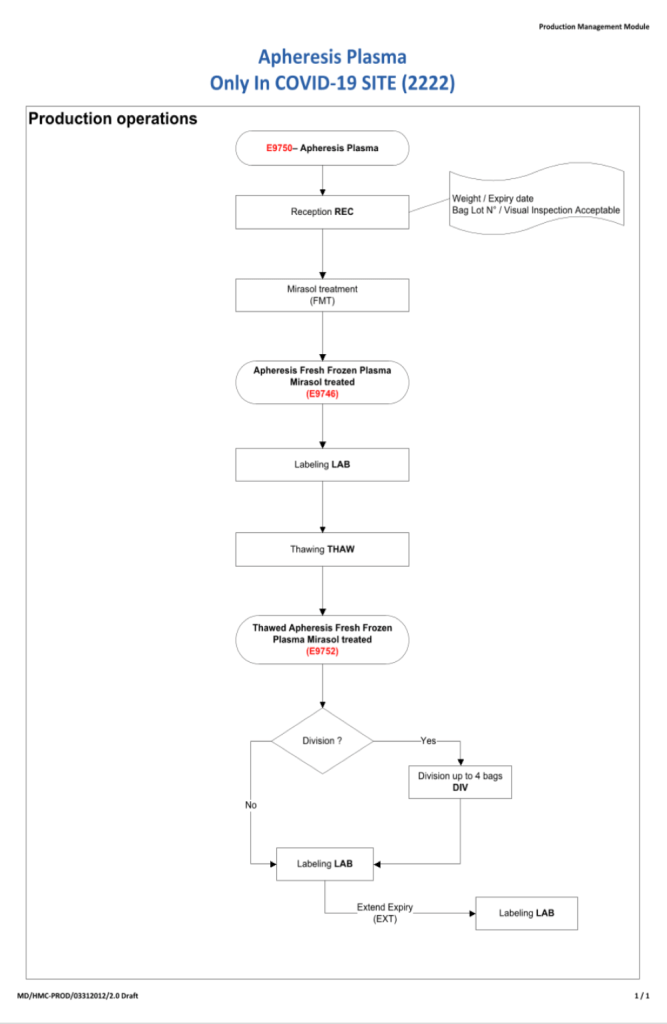
To start the series, I am providing the basic workflow for the system.  As is normal in Medinfo software design, a full mapping of the processes are made.  This workflow shows the new CCP ISBT codes and the quarantine collection and processing steps.  The donor testing (marker and immunohematology) processes are similar to those for regular donor units.

This is basically the same process both manually and in the software.  I always say:

A good software process is based on a good manual process!!

Please note the following workflow for our initial discussion.

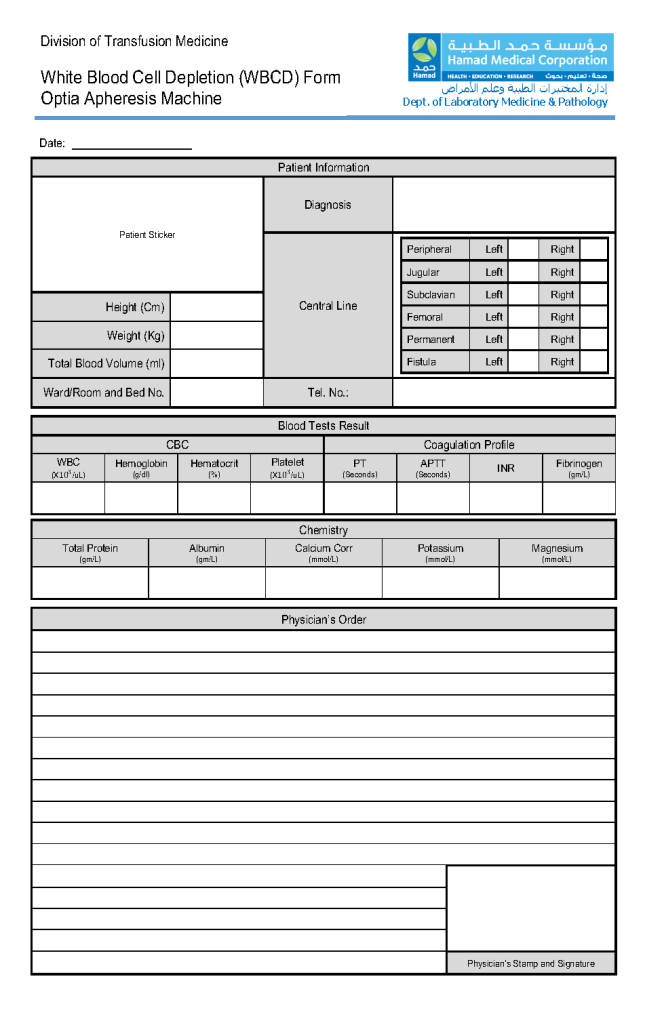
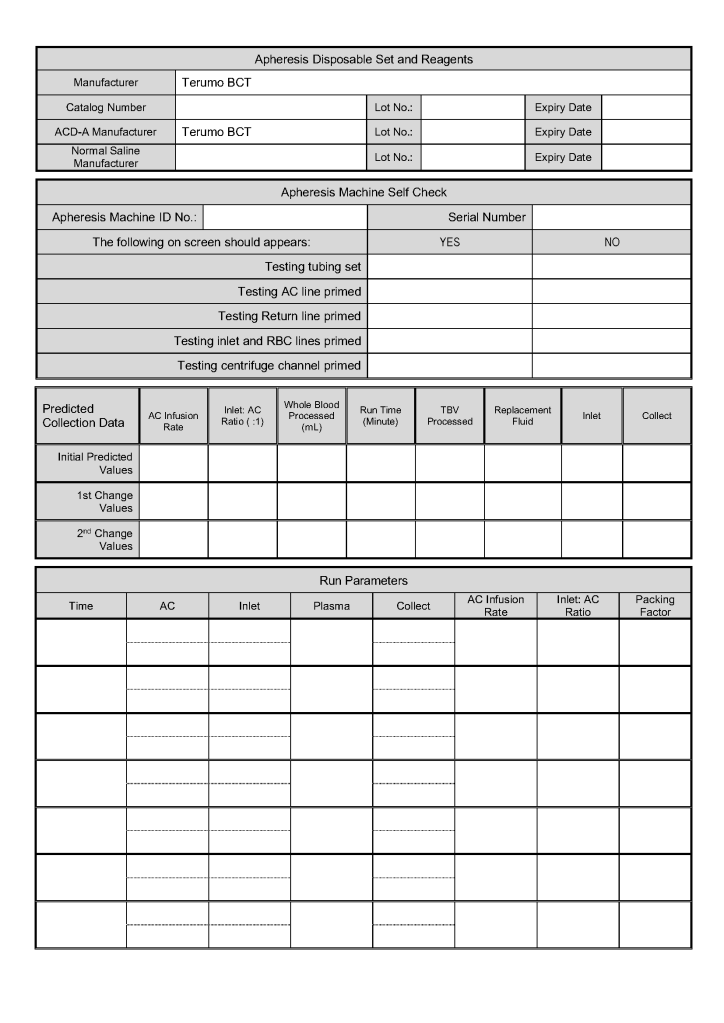
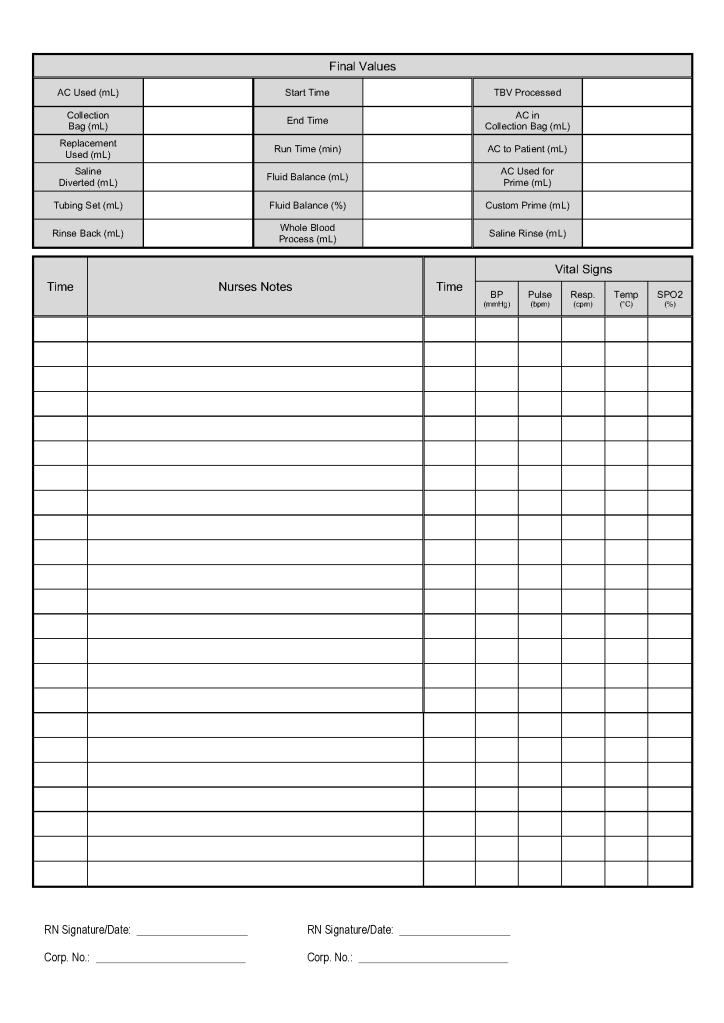
Leukodepletion Apheresis Form

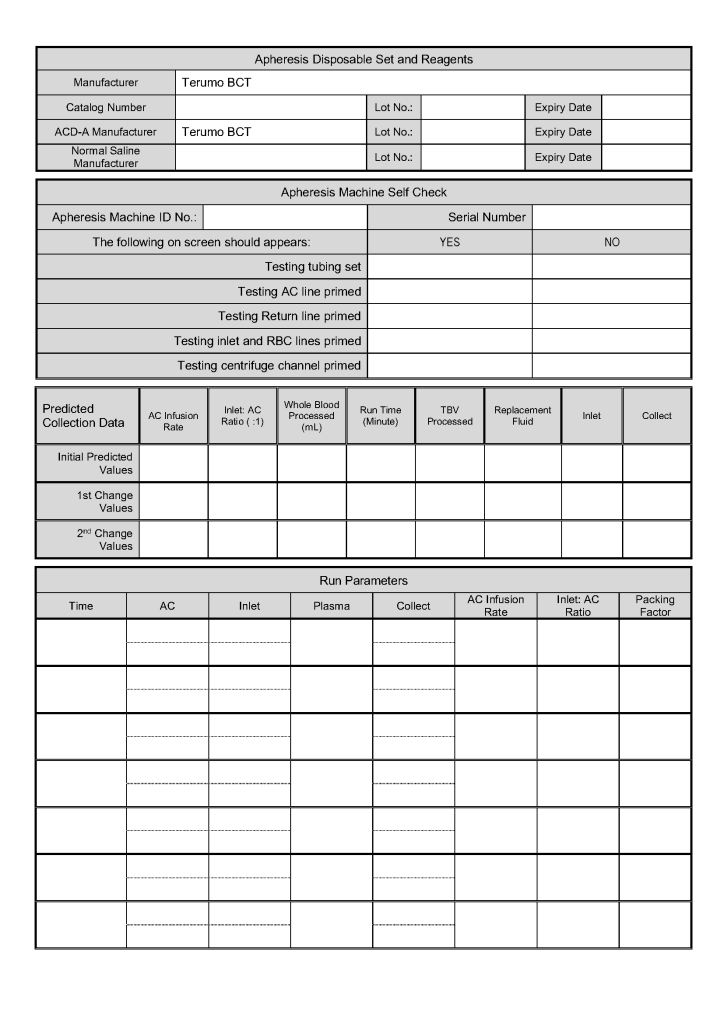
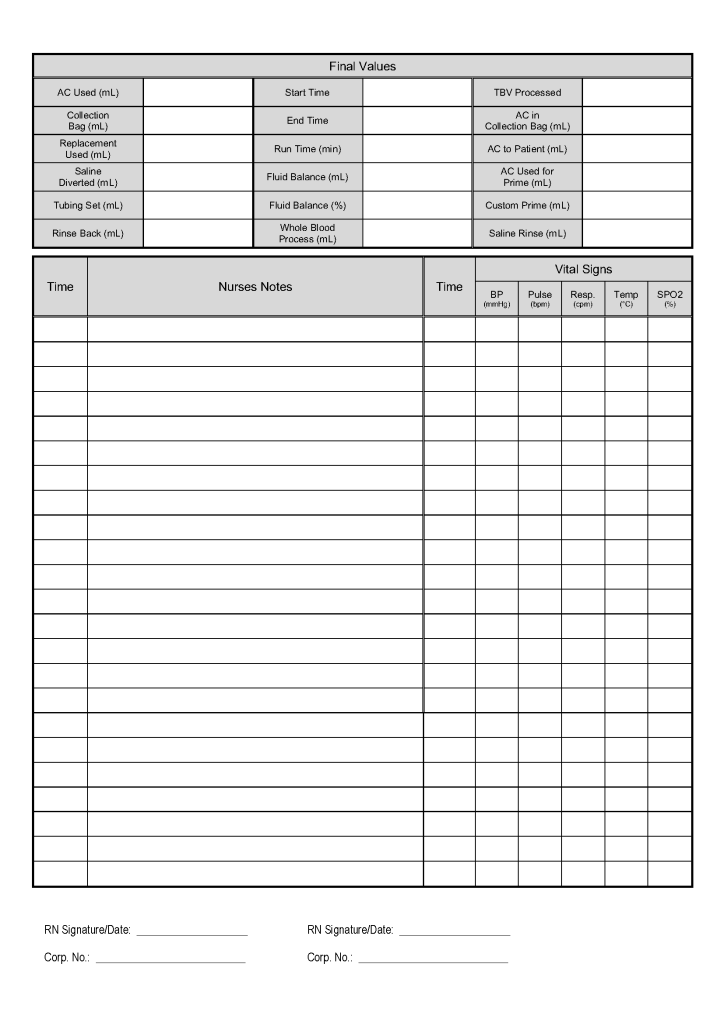
This form is the result of a collaborative effort between my therapeutic apheresis team and me. I want to thank Dr. Saloua Al Hmissi, Consultant, Transfusion Medicine, and Ms. Mini Paul, Head Apheresis Nurse for all their efforts.

This form can be readily converted into a computer data entry form–depending on your software’s capabilities.

Use of Universal Low-Titer Group A Plasma

Principle:

Since group AB plasma is in short supply, use of group A plasma with low anti-B titers may be substituted based on inventory levels.

Policy:

  1. If the AB inventory is low, we will test group A donors at the time of collection for anti-B titers.
    1. The numbers to be tested will depend on the level of the shortage and the availability of equipment to perform titration.
  2. Use the automated analyzer to perform saline anti-B.
    1. If the saline titer is less than or equal to 1:64, the plasma may be used for recipients of any ABO blood group and will be labelled as group AU—A Universal.
  3. Process the unit routinely and perform pathogen-inactivation.
  4. Medinfo Hematos IIG will only label for universal use if the titer is below the cutoff.
    1. The ISBT label must explicitly show group AU plasma and the actual anti-B titer.
  5. Allocation rules for low-titer group A plasma will be identical to group AB except:
    1. For neonates, preferentially use group AB.
    2. For children < 20 kg, use ABO-compatible plasma (non-group AB) before selecting group AB or if not available, low-titer A in that order.
  6. Donors must have a new anti-B titer performed each donor encounter.

References:

  1. Technical Manual, Current Edition, Bethesda, MD, USA
  2. Standards for Blood Banks and Transfusion Services Current Edition, AABB, Bethesda, MD, USA

Framework for Establishing the Use of Universal Low-Titer Group A Plasma

This post outlines a framework for establishing the use of low-titer group A plasma as a universal donor.  Manual titering large number of donor specimens in my organization is not practical.  Using an automated system will also increase the precision of the results.

Process:

  1. Select a cut-off anti-B titer.  This should be determined by the blood bank medical director.
    1. I selected saline 1:64 based on recent THOR (Thrombosis Hemostasis Oxygenation Research) meetings
  2. Perform a survey of the anti-B titers in your blood donor population.
    1. At my sites, about 50% had titers less than or equal to 1:64.
    2. Determine how stable the titer is:
      1. For serial donor plasmapheresis, how long could you accept the donor as low-titer?
      2. Does the titer change between whole blood donations?
  3. Determine the target inventory level for universal plasma (group AB and low-titer A) based on current/past usage.
  4. Assess availability of automated immunohematology analyzers for titration.
    1. Titration may take up to 30 minutes per sample, during which time the machine cannot be used for any other purpose.
  5. Add a new blood type AU (for group A universal) for plasma in your blood typing algorithm.
    1. AU should be used interchangeably with group AB.
  6. Software:
    1. Set up new truth table in your blood bank computer system.
    2. Validate the modification in your blood bank donor and patient modules.
    3. Update ISBT code for this new product, verify your transfusion service module can read this.

Special notes:

  1. At my last location, we had only 3 analyzers capable of doing the titration.  Thus, we could only do 6 titrations per hour at the expense of stopping all other testing.  You will have to coordinate the titration with your other immunohematology testing.  Also, verify if all these equipment interface to your production software.  In my system, any test (including titration) could be performed at any location and its results be used for production purposes.
  2. Donor ABO antibody titers may fluctuate.  I would not use previous results to qualify a donor to be AU.  I would repeat the anti-B titer each donor encounter.  If I collect donor plasmapheresis, I would determine for how long the titer can be used (see 2.2.1 above).

References:

  1. Technical Manual, Current Edition, Bethesda, MD, USA
  2. Standards for Blood Banks and Transfusion Services Current Edition, AABB, Bethesda, MD, USA
  3. Medinfo Hematos IIG Donor Production Module

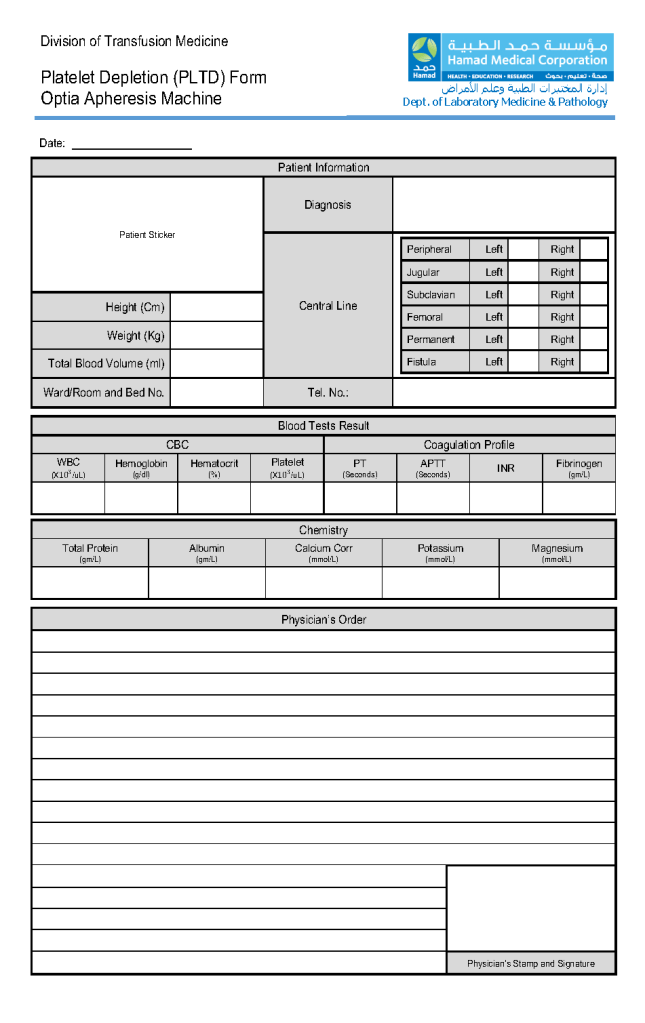
Platelet Depletion Apheresis Form

This is the apheresis form used for reductive thrombapheresis developed by my apheresis team and me. In particular, I want to thank Dr. Saloua Al Hmissi, Consultant Transfusion Medicine, and Ms. Mini Paul, Head Apheresis Nurse, all their hard work.

The attached form can be developed into a computer entry form if one has a suitable hospital information system. It is organized so that the apheresis nurse can quickly enter the data on one screen. Never forget that our goal is treat the patient–not spend all of our time on data entry!!

20/12/20

Data Entry Verification: Updated Version

This is an update from the previous version posted to include low-titer group A FFP/FP24 and low ABO-titer group O whole blood.

Principle:

This policy outlines steps taken to minimize the risk of data entry errors and is based on a dualistic approach:  review of results by a senior technologist and/or supervisor and various computer safeguards built into the Medinfo Hematos IIG blood bank computer HIIG system.  This policy also discusses the verification (here called authorization) and purge processes of HIIG.

Policy:

  1. Review by senior technical, supervisory, or transfusion medical staff:
    1. Designated test procedures require review by a second technologist before authorization.
    2. Complex immunohematology testing and specimens showing aberrant results (e.g. ABO/D discrepancies) are reviewed by the supervisors or designates and ultimately a transfusion medicine physician before authorization.
  2. Computer system HIIG rules:
    1. Privileges:
      1. System restricts which staff can perform specific tests
    2. Patient/donor identity:
      1. System asks end-users to verify patient/donor identity before starting any access to the patient/donor record.
      2. System performs historical database checking and flags any inconsistencies (e.g. historical ABO/D typing differences, etc.)
    3. Testing:
      1. Only selected staff have privileges to authorize or purge.
      2. ABO/D testing algorithms require entry of reactions, not interpretation of results and are compared to a truth table.
        1. Aberrant results require special review before ABO/D typing results can be authorized/purged.
        2. D-controls must be negative to allow D typing results to be authorized for liquid D-typing reagents.
      3. DAT results require appropriate controls to meet truth-table criteria.
      4. Eluates require last wash to be negative before authorization
    4. Blood components:
      1. Selection of RBC or plasma units requires two independent sample determinations within 72 hours of each other.
      2. ABO-incompatible RBC or FFP/FP24 transfusions are not allowed.
      3. Titer-based ABO blood group selection:
        1. Low titer group A FFP may be used as universal plasma like group AB.
        2. Group O whole blood with low anti-A and anti-B titers may be used for all ABO types.
        3. Acceptable titer threshold is specifically defined as parameters in Medinfo.
      4. Donors with any detectable clinically significant antibodies are permanently deferred.
      5. Depending on the patient’s antibody history, release of RBC units may require antigen-matched units.  Examples:
        1. Mandatory matching (only antigen negative matched units allowed—no antigen positive or antigen-untyped units):  Antibodies against H, D, c, K, k, Kpa, Kpb, Jsa, Jsb, Jka, Jkb antigens, anti-PP1Pk
        2. Priority matching (incompatible or untested can be approved by a transfusion medicine physician):  C,E, e, Fya, Fyb, M, S, s
        3. Antigen matching not required:  Lea, Leb, N
      6. Least-incompatible crossmatch require special authorization to release
      7. Protocols to force irradiation or other modified components can be setup in HIIG.
    5. Donors:
      1. Donor tests have same criteria as the same test used in patient testing for controls, etc.
      2. Donor demographics are read directly from the Ministry of Interior database—no manual entry (bar code only used).

References:

  1. Workflows for Hematos IIG (1001 through 1005), 2013-2020
  2. Standards for Blood Banks and Transfusion Services, Current Edition, AABB, Bethesda, MD, USA
  3. Guidelines to the Preparation, Use, and Quality Assurance of Blood Components, European Committee (Partial Agreement) on Blood Transfusion (CD-P-TS), Current Edition

Preventing Graft vs. Host Hemolytic Anemia

Principle:

Donor lymphocytes in an organ transplant may make antibodies and cause a clinically significant hemolytic anemia, i.e. a graft vs. host hemolytic anemia GVHHA.  Optimal handling in these cases should include antibody screening/identification for all potential donors and recipients.  The transfusion medicine physician should review the results for possible issues of antibody/antigen incompatibilities to proactively select matched blood components and avoid GVHHA.

In the Medinfo blood bank computer system, we can make custom rules to ensure release of only antigen-matched units as needed.

Policy:

  1. Perform antibody screen and identification (if indicated) for all prospective organ donors and recipients.
  2. If the organ donor has clinically significant antibodies, check if the recipient has the corresponding antigens.  If so, select RBC units negative for the donor antibody specificities. 

Example:  Donor has anti-Kell (K1) and patient is K1-positive.  Use only K1-negative RBCs post-transplant.

  • Send the case to the transfusion medicine physician to review.  He will contact the clinicians as indicated.
  • Create a rule in Medinfo forcing the antigen matching.

References:

  1. Technical Manual, Current Edition, Bethesda, MD, USA
  2. Standards for Blood Banks and Transfusion Services Current Edition, AABB, Bethesda, MD, USA