
Policy: Ortho Rh1 D Typing Reagents for Patients
Zeyd Merenkov, MD, FCAP, FASCP
Independent Consultant in Transfusion Medicine and Blood Bank IT
Revision Date: 21/3/18
Principle:
We must select D-negative RBC units for transfusion if the patient is truly D-negative or if he/she is a partial D since transfusion of a partial D positive unit may induce antibodies against any part of the D molecule. Thus, for patients, we will consider patients with partial D as D-negative. Note that this is NOT the usual practice in the USA; however, AABB Standards do allow that we do NOT test patients for weak D and give D-negative RBCs instead.
Background:
Ortho Diagnostics Reagents use two different monoclonal antibody cocktails that react variably with the antigen D (Rh1)—these are found on the card: Anti-A/B/A,B/D/D/Ctrl:
Anti-D/Anti-RH1—IgM monoclonal antibody clone D7B8 can detect most examples of weak and partial D including weak D types 1, 2, 3, 4.0, and D categories II, III, IV, V, VII, DBT, and R0Har. It does NOT detect category VI. Retest positive reactions of 2+ or less by an alternate method.
Anti-D/Anti-RH1—IgM monoclonal antibody RUM1 can detect most examples of weak and partial D including weak D types 1, 2, 3, 4.0, and D categories II, III, IV, V, VII, DBT, and R0Har. It does NOT detect category VI. Retest positive reactions of 2+ or less by an alternate method.
Policy:
- Follow the manufacturer’s instruction for storage, handling, and usage of all reagents.
- If the D-control is positive, the reactions are indeterminate, repeat by another method.
- Run both anti-D reagents listed—do not use the donor typing algorithm or reagents.
- Use the following table for interpretation and further actions if needed:
| Pattern # | Anti-D/D7B8 | Anti-D RUM1 | D-Interpretation |
| 1 | Positive | Positive | D-positive |
| 2 | Positive | Negative | Do additional testing |
| 3 | Negative | Positive | Do additional testing |
| 4 | Negative | Negative | D-negative |
If the reaction is 2+ or less with either the Ortho anti-D/D7B8 reagent or anti-D/RUM1 or if the patterns 2 or 3 above, repeat by another manufacturer’s reagents. In the meantime, consider the patient as D-negative.
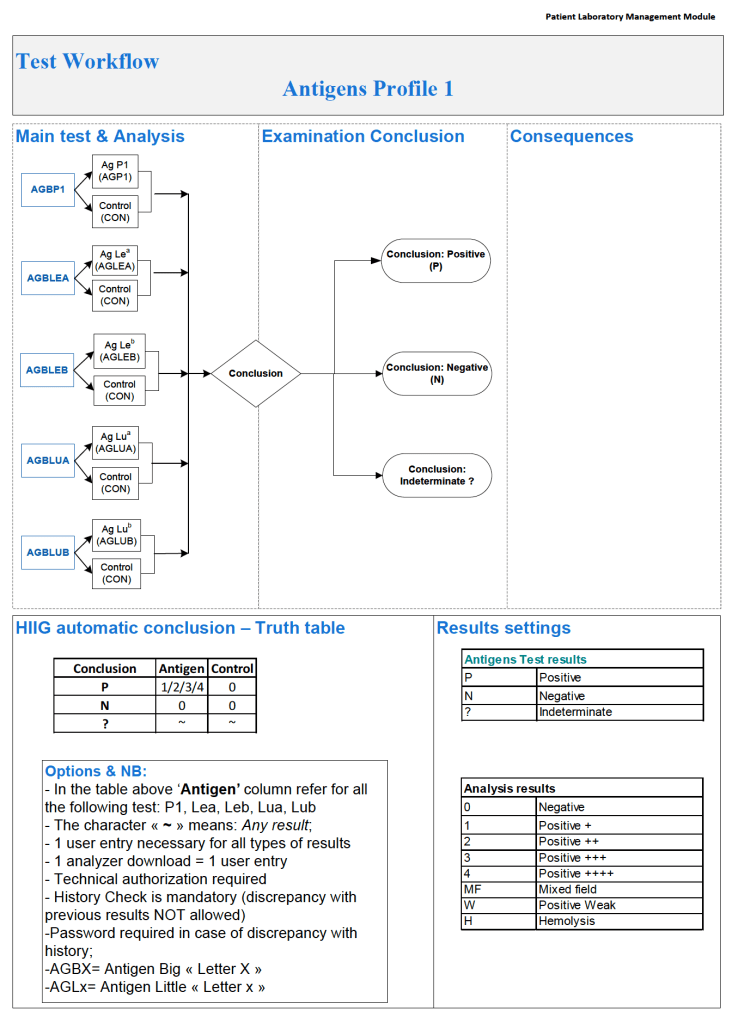
Medinfo-Ortho interface settings for Patient Testing in Hematos Medinfo IIG:
| Anti-D/D7B8 | Anti-D RUM1 | D-Interpretation |
| 3, 4 | 3, 4 | D-positive |
| 3, 4 | 0 | ~ |
| 0 | 3, 4 | ~ |
| 0 | 0 | D-negative |
| ~ | ~ | ~ |
Note all of the following:
- If the result is D-indeterminate, use D-negative RBCs.
- No reagents may be able to detect all D variants.
- ~ means any other value for that reagent (1+, 2+, mf, hemolyzed)
- Note that this new algorithm makes a 2+ reactivity as indeterminate with Anti-D/D7B8 or Anti-D/RUM1.
References:
- Publication e631300291, Product Insert, Anti-A/B/A,B/D/CDE/Control Card, 2010, Ortho Clinical Diagnostics, High Wycombe, Buckinghamshire/UK
- Standards for Blood Banks and Transfusion Services, Current Edition, AABB, Bethesda, MD, USA




 Dr. Zeyd Merenkov